ISS N(Online): 2320-9801 ISS N (Print): 2320-9798
International Journal of Innovative Research in Computer
and Communication Engineering
(An ISO 3297: 2007 Certified Organization)Vol. 3, Issue 4, April 2015
A Secure Cluster Based En-route Filtering
Scheme in Wireless Sensor Networks
P.Pritto Paul
1, Kessamsetti . Thejaswi
2Assistant Professor, Dept. of CSE, Ve la mmal Engineering Co llege, Chennai, Ta milnadu, India 1
PG Student, Dept. of CSE, Vela mma l Engineering Co llege, Chennai, Ta milnadu, India 2
ABSTRACT: Wire less Sensor Networking is one of the most prominent technology that is used in almost all real time applications. WSN is used in the estimat ion of temperature in Cyber Physical Network System(CPNS) where the sensor nodes are deployed in an unsecured environment. In this kind of environment the lifetime of the network , consumption of energy , re-election of cluster head plays an effective role . So, the network lifet ime with limited battery power becomes a problemat ic issue. By selecting the cluster head randomly a mong the nodes may leads to the issue of battery loss , false data injection attacks. In order to prevent this we ma ke use of Fuzzy logic technique. In fuzzy logic based cluster head election the base station is responsible for the cluster head election because the base station is more powerful than the sensor nodes in terms of power of computing , unlimited supply and storage of power , and me mory. So by selecting the most efficient node as the cluster head we can securely forward the data to the base station by using secure algorithms.
KEYWORDS: Cyber physical network system, Fu zzy logic , Re-e lection.
1. INTRODUCTION
Wireless sensor networks are e xpected to interact with the ph ysical world at an unpredictable leve l to enable various new applications. However, a large-scale sensor networks are deployed in a adverse or even in an unsecured environment which leads to the problem such as accidental failure of nodes in a network, Fa lse data injection . As the sensor nodes are relatively small in size and as they are deployed in absence of human environment they are highly sensitive to various risks such as compro mising of nodes. False sensing reports can be inject through compro mised nodes, which can lead to fa lse alarms.
The false data injection in a cyber physical network system can be overcome by the forma t ion of clusters where the neighbor sensor node with nearly similar properties will be organized into the form of c lusters. In the hierarchica l
network structure each cluster has a leader, which is also called the cluster head (CH). The sensor nodes are responsible
for periodica lly transmis sion of data to the cluster head(CH) nodes . CH nodes aggregate the data and transmit the m to the base station (BS) either direct ly or through the intermediate commun ication with other CH nodes. The BS is the central processing unit for the data received from the sensor nodes. The Base Station is fixed at a place in a stationary manner wh ich is far away from the all the sensor nodes .The primary function of cluster head is to collect the data from the nodes present within that cluster and perform aggregation of the data before sending it to the BS.
The advantages of cluster based environment is: 1) supporting network scalability and decreasing energy consumption through data aggregation 2) It can localize the route setup within the cluster and thus reduce the size of the routing table stored at the individual node. The main parameters included in clustering are: Nu mber of clusters, Nodes and CH mobility, Nodes types and roles, Cluster formation, Cluster-head selection.
II.RELAT ED WORK
ISS N(Online): 2320-9801 ISS N (Print): 2320-9798
International Journal of Innovative Research in Computer
and Communication Engineering
(An ISO 3297: 2007 Certified Organization)Vol. 3, Issue 4, April 2015
sensors for false report detection. As a report is forwarded through multip le hops toward the sink, each intermediate node verifies the correctness of the MACs carried in the report and drops the report if an incorrect MAC is detected. The disadvantage of SEF is probability of detecting incorrect MACs increases with the numbe r of hops the report
travels. SEF[1] and IHA[4] have the T-threshold limitations. That is, if the adversary compro mises T nodes from
diffe rent groups, they could inject fa lse data to generate the false report.
B) Location-B ased Resilient Security (LBRS)[2] approach which make use of two techniques: location-binding keys
and location-based k ey assignment. In location based resilient scheme the location of the sensors and sink is stationary by which it can assign fixed key values for the sensor in order to provide security. Based on its location, a node stores
one key for each of its localneighboring cells . LBRS provides a solution to this security problem, but it depends on the
stationary of the sink and the fixed routing model such that it cannot work with mob ile sinks and various routing protocols.
C) Gr ouping-B ased Resilient Statistical En-r oute Filtering (GRSEF)[3] the GRSEF does not depend on sink . It improves the filtering e fficiency by div iding the sensor nodes into certain number of groups and assigns authentications to the groups. GRSEF e mp loyees a multi-a xis division technique to overcome the threshold limitation problem that we have seen in SEF[1] and IHA[4].
III.PRELIMINARY
A) The B asics of En-r oute Filtering:
The en-route filtering technique used in wireless networks with which the inte rmediate nodes checks the correctness of the data that is being travelled along the route fro m source to the sink with the help of intermed iate nodes present in the network. The ma in function of intermediate node is not only checks the correctness of the data but also can filter the false data effectively.
B) Propose d Syste m for En-route Filtering:
The proposed system for en-route filtering is based on cluster environment where the sensor nodes are organized into groups (clusters). The cluster head is elected by the nodes within the cluster in a random fashion by using the protocol like rando m seed distribution transitory with master key (rsdtmk). The random number generator produces a sequence of bits fro m an init ial value with the help of recursive algorith m . As the cluster head is randomly e lected a mong the nodes there occurs a delay in the transmission of data from source to destination when cluster head gets drained. The packet loss ratio is also high in rando m c luster head election.
C) Security Model Of En-r oute Filtering:
ISS N(Online): 2320-9801 ISS N (Print): 2320-9798
International Journal of Innovative Research in Computer
and Communication Engineering
(An ISO 3297: 2007 Certified Organization)Vol. 3, Issue 4, April 2015
D) Syste m Model :
The cluster formation process eventually leads to a two-levels of hierarchy where the CH nodes are the higher level of hierarchy and the cluster-me mber nodes are the lower level hiera rchy. These sensor nodes periodically transmit their data to the corresponding CH nodes. The CH nodes aggregate the data (thus decreasing the total number of relayed packets) and transmit the m to the base station (BS) either directly or through the intermediate communicat ion with other CH nodes.
IV. IMPLEMENTATION MODELS AND ALGORITHMS
A) Cluster He ad Elec tion using Fuzz y logic:
In Fuzzy log ic technique the control will be constructed in the Base Station which has the global view over the whole network. The Base Station is responsible for the cluster head election based on t he following three para meters : Energy, Concentration, Centrality. Energy is available with in each node. Concentration is number of neighbor nodes for the base station. Centrality is the value that is based on how close is the node to the cluster. The input’s of fuzzy inference system are the energy and the distance of a particular node to the base station.
Node Energy = Energy re ma in ing/Initial Energy
B) Design of Fuzzy syste m
Input
Output
a. Fu zzificat ion : The input value is converted into Fuzzy values.
b. Fuzzy Interface Engine : The converted Fuzzy values are applied to the fuzzy rules. The aggregation of all the outputs of all the rules are unified.
Fuzzification
Fuzzy Interface Engine
ISS N(Online): 2320-9801 ISS N (Print): 2320-9798
International Journal of Innovative Research in Computer
and Communication Engineering
(An ISO 3297: 2007 Certified Organization)Vol. 3, Issue 4, April 2015
C) Security Model:
After the election of cluster head the data has to be securely forwarded to the base station. The data can be securely transmitted fro m the cluster head to the base station as the cluster head is trusted party elected by the base station. The data being transmitted must be enclosed with Cluster ID. The fuzzy logic technique ma kes use of Energy balance loss protocol.
D) Key generation:
The key generation is an important step in clus ter format ion as it provides security for the transmission of data between the nodes. In key generation process the steps such as encryption and decryption of data takes place.
V. RES ULTS AND DIS CUSSION
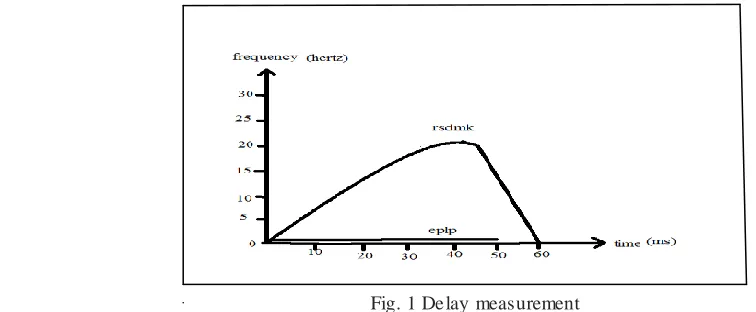
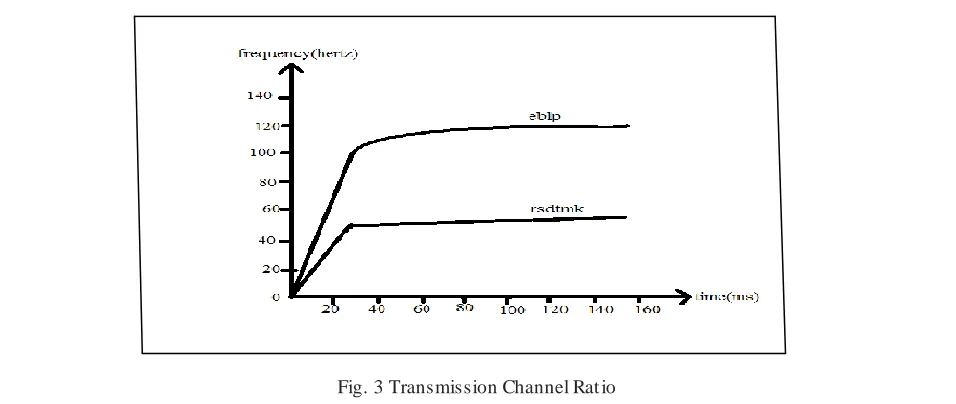
The results are estimated and the graph is generated when the data transmission takes place from c luster to the sink. The ns2 simulator tool is used to compare the two protocols such as random seed distribution with the help of master key(rsdtmk) and energy balance loss protocol(eblp) which is used in the fuzzy logic based cluster head election. And the graphs clearly show that eblp protocol is more efficient than the existing protocol like rsdtmk.
Fig. 1 De lay measurement
The fig.1represents the comparison between the two protocols that represents the measurement of delay while transferring the data fro m the source to destination. The occurrence of delay is reduced by using the energy balance loss protocol which is e mp loyed in fu zzy logic techniq ue.
ISS N(Online): 2320-9801 ISS N (Print): 2320-9798
International Journal of Innovative Research in Computer
and Communication Engineering
(An ISO 3297: 2007 Certified Organization)Vol. 3, Issue 4, April 2015
The fig. 2 represents the comparison graph of packet loss ratio between the rsdtmk and eblp. The packet loss ratio is comparative ly high when we use random c luster head election method. The packet loss ration can be reduced by energy balance loss protocol which e mp loyed in fu zzy logic technique.
Fig. 3 Transmission Channel Rat io
The fig.3 g raph clearly shows the transmission channel established in eblp is higher than the channel established in rsdtmk. So, the data is more securely transferred in the channel established through eblp rather than rsdtmk. As the transmission channel ration is high the data loss ratio can be reduced.
VI. CONCLUS ION
The clustering scheme achieves not only high en -routing filtering probability but also high reliability for filtering the injected false data with multi-reports without depending on static routes and node localization. Due to the simp licity
and effectiveness, the cluster based scheme could be applied toother fast and distributed authentication scenarios in
wireless network.
REFERENCES
1) F. Ye, H. Luo, S. Lu, and L. Zhang, “ Statistical en -route filtering of injection false data in sensor networks,” IEEE Journal on Selected Areasin Communications (JSCA), vol. 23, no. 4, pp. 839–850, 2005.
2) H. Yang, F. Ye, Y. Yuan, S. Lu, and W. Arbaugh, “Toward resilient security in wireless sensor networks,” in Proc. of the 6th ACM international symposium on Mobile ad hoc networking and computing (MobiHoc’05), 2005, pp. 34–45.
3) L. Yu and J. Li, “Grouping-based resilient statistical en-route filtering for sensor networks,” in Proc. of the 28th IEEE International Conference on Computer Communications (INFOCOM’09), 2009, pp. 1782–1790.
4) “Clustering in Wireless Sensor Networks” textbook Basilis Mamalis, Damianos Gavalas, Charalampos Konstantopoulos, and Grammati Pantziou. 5) “Filtering Schemes for Injected False Data in Wsn”IOSR Journal of Computer Engineering (IOSR-JCE) e-ISSN: 0661, p- ISSN: 2278-8727Volume 13, Issue 6 (Jul. - Aug. 2013), PP 29-31.
6) “Fuzzy logic based energy efficient protocol in wireless sensor networks” ICT ACT JOURNAL ON COMMUNICATION TECHNOLOGY, DECEMBER 2012, VOLUME: 03, ISSUE: 04
7) “A New Approach in key generation and Expansion in Rijndael Algorithm” The International Arab Journal of Information T echnology, vol. 3, No.1, January 2006.
8) “An Optimized Low Loss Energy-Aware Routing Protocol for Wireless Sensor Networks” International Journal of Computer Applications (0975 - 8887) Volume 65 - No. 21, March 2013.
9) “A Survey on Algorithms for Cluster Head Selection in WSN” International Journal of Advanced Research in Computer Engineering & Technology (IJARCET) Volume 2, No 5, May 2013.
10) “Algorithms For Wireless Sensor Networks” Sartaj Sahni and Xiaochun Xu
Department of Computer and Information Science and Engineer ing, University of Florida, Gainesville, FL 32611 {sahni,xxu}@cise.ufl.edu September 7, 2004.