INKUMSAH, KOBI K. Improving Structural Testing of Object-Oriented Programs via Inte-grating Evolutionary Testing and Symbolic Execution. (Under the direction of Dr. Tao Xie).
by
Kobi K. Inkumsah
A thesis submitted to the Graduate Faculty of North Carolina State University
in partial fullfillment of the requirements for the Degree of
Master of Science
Computer Science
Raleigh, North Carolina
2008
Approved By:
Dr. Kemafor Anyanwu Dr. Laurie Williams
Dr. Tao Xie
DEDICATION
BIOGRAPHY
ACKNOWLEDGMENTS
TABLE OF CONTENTS
LIST OF TABLES . . . vi
LIST OF FIGURES . . . vii
1 Introduction . . . 1
2 Example . . . 4
3 Framework . . . 7
3.1 Evolutionary Testing . . . 8
3.1.1 Population Initialization . . . 9
3.1.2 Fitness Calculation . . . 10
3.1.3 Re-combination and Mutation . . . 11
3.2 Symbolic Execution . . . 12
3.2.1 Concrete Execution and Constraint Collection . . . 12
3.2.2 Constraint Solving and New Input Generation . . . 12
3.3 Argument Transformation . . . 14
3.4 Chromosome Construction . . . 15
4 Implementation . . . 17
5 Evaluation . . . 19
5.1 Branch Coverage . . . 22
5.1.1 Coverage Improvement . . . 23
5.2 Coverage Subsumption . . . 25
5.3 Branch Ranking . . . 26
6 Threats to validity . . . 28
7 Related Work . . . 29
8 Conclusion . . . 31
LIST OF TABLES
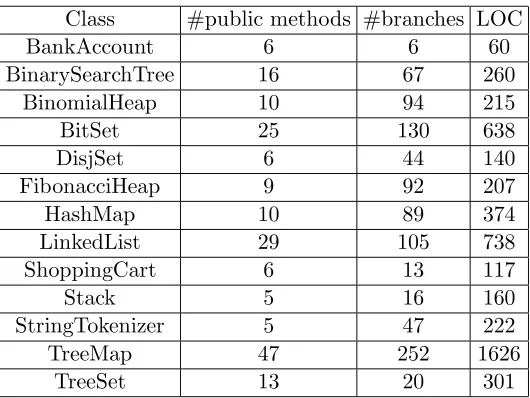
Table 5.1 Experimental subjects . . . 20
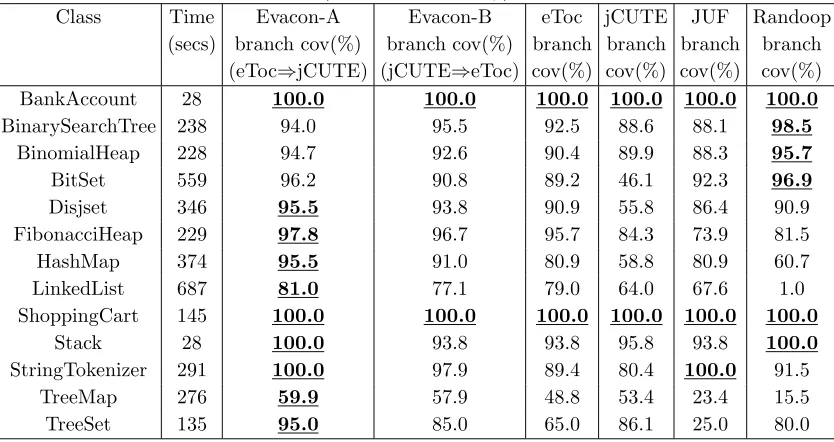
Table 5.2 Branch coverage achieved by the six tools on the experimental subjects . . . 21
Table 5.3 The length of the longest method sequence generated by Evacon-A or Randoop that achieves new branch coverage . . . 23
Table 5.4 Coverage improvement of Evacon-A and Evacon-B . . . 24
LIST OF FIGURES
Figure 2.1 A bank account example. . . 4
Figure 2.2 A test generated by an evolutionary testing tool . . . 5
Figure 2.3 A test generated by integrating evolutionary testing and symbolic execution . . . 5
Figure 2.4 A test generated by integrating symbolic execution and evolutionary testing . . . 5
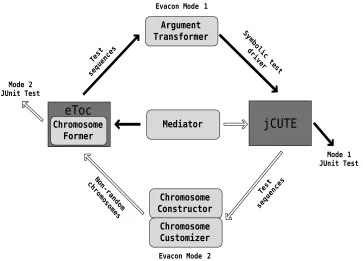
Figure 3.1 Framework overview . . . 7
Figure 3.2 Genetic algorithm for test input generation using branch coverage as the testing goal (adapted from Tonella [23]) . . . 9
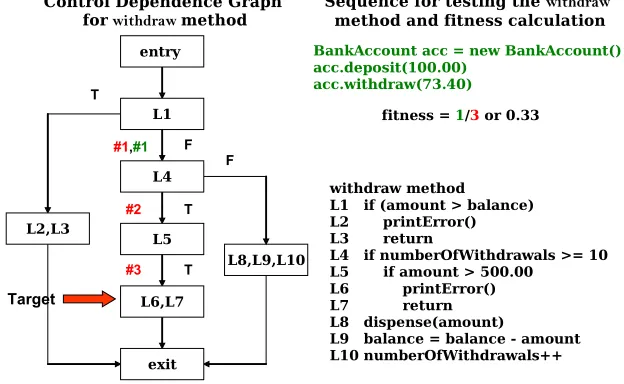
Figure 3.3 Fitness calculation of the method sequence for testing thewithdraw method . . . 10
Figure 3.4 The resulting symbolic test after argument transformation is applied on the test in Figure 2.2. . . 14
Figure 3.5 A symbolic test generated using the symbolic test driver in Figure 3.4 . . . 14
Figure 3.6 The chromosome derived from the method sequence in Figure 2.3 . . . 16
Figure 4.1 Implementation overview . . . 17
Chapter 1
Introduction
Software unit test coverage and adequacy measurements[28] provide a good basis for assessing software unit quality. In unit testing, achieving high structural coverage of the pro-gram unit under test such as a class helps increase confidence in the quality of the unit. Although various unit-test generation tools have been developed to help increase structural coverage such as branch coverage over manual testing, many branches in the program under test are difficult to cover due to two main challenges.
First, some branches involve complex program logics and generating tests to cover them requires deep knowledge of the program structure and semantics. Second, in programs especially object-oriented programs, covering some branches requires special method sequences to lead the receiver object or non-primitive arguments to specific desirable states, and gener-ating such method sequences is often challenging because of the huge search space of method sequences: we need not only the right method sequence skeleton1 but also the right method arguments in the method sequence skeleton.
To address the first main challenge (especially to generate special primitive-type ar-guments to cover branches that are difficult to cover), recently symbolic execution tools such as JPF[24] and CUTE/jCUTE [21] explore paths in the program under test symbolically and col-lect symbolic constraints at all branching points of an explored path. The colcol-lected constraints are solved if feasible, and a solution is used to generate a test input that forces the execution of the program under test along the path. This process is repeated until all feasible paths have been explored or the number of explored feasible paths has reached the user-specified bound. However, these symbolic execution tools do not provide effective support for generating method
sequences that produce desirable receiver-object states or non-primitive-argument states. To address the second main challenge, some bounded-exhaustive testing tools such as JPF[24], Rostra[26], and Symstra[27] generate exhaustive method sequences up to a small bound (with some pruning based on state equivalence[26, 24] or subsumption[27, 24]). However, sometimes covering some branches requires long method sequences whose length is beyond the low bound that can be handled by these tools. Some evolutionary testing tools such as eToc[23] represent initial randomly generated method sequences as a population of individuals and evolve this population by mutating its individuals until a desirable set of method sequences is found. However, because these evolutionary testing tools do not use program structure or semantic knowledge to directly guide test generation, they cannot provide effective support for generating desirable primitive method arguments even if the right method sequence skeleton is generated. In this thesis, we propose a novel framework called Evacon that integrates evolution-ary testing[23] and symbolic execution[21] to address the respective weaknesses of these two techniques and to produce tests that achieve higher branch coverage than the tests generated by each technique alone. In particular, we establish a bridge from evolutionary testing to symbolic execution by generalizing concrete tests generated by evolutionary testing to symbolic tests as test drivers to symbolic excution. Therefore, symbolic execution can help improve the method arguments in method sequences initially generated by evolutionary testing. We also establish a bridge from symbolic execution to evolutionary testing by encoding concrete tests gener-ated by symbolic execution as chromosomes; these chromosomes are population individuals for evolutionary testing to evolve.
This thesis makes the following main contributions:
• a novel integration of two existing techniques to address a significant problem in structural testing of object-oriented programs;
• a comprehensive empirical comparison of our integration with state-of-the-art represen-tative testing tools for various test-generation techniques including search-based test gen-eration using genetic algorithms, symbolic execution, and random testing;
We have implemented our proposed framework and applied it to test 13 classes previ-ously used in evaluating white-box test generation tools. The empirical results show that our framework can achieve higher branch coverage than evolutionary testing, symbolic execution, or random testing.
Chapter 2
Example
public class BankAccount {
private double balance;
private int numberOfWithdrawals;
public void deposit(double amount) {
if (amount > 0.00)
balance = balance + amount;
}
public void withdraw(double amount) {
if (amount > balance) {
printError();
return;
}
if (numberOfWithdrawals >= 10) {
if (amount > 500.00) {
printError();
return;
} }
dispense(amount);
balance = balance - amount;
numberOfWithdrawals++;
} }
We next illustrate how our framework is used in testing object-oriented programs through aBankAccountexample as shown in Figure 2.1. This bank account example, which im-plements a bank account service, has been adapted for illustration purposes from theBankAccount
class used in our experiments. The BankAccountclass declares several public methods. Among them, thedepositmethod allows money to be deposited in the account. Thewithdrawmethod allows money to be withdrawn from the account. The withdraw method begins by checking whether the withdrawal amount is more than the available balance. If so, an error message is printed and the method exits. The method also checks if the number of previous withdrawals
(numberOfWithdrawals)is at least 10 and amount is greater than 500.00. If so, another error message is printed and the method exits; otherwise, the withdrawal amount is dispensed, and both balanceand numberOfWithdrawalsare updated.
public void testGenByEtoc() {
BankAccount acc = new BankAccount();
acc.deposit(1.00);
acc.withdraw(20.00);
}
Figure 2.2: A test generated by an evolutionary testing tool
public void testGenByEtocAugmentedByjCUTE() {
BankAccount acc = new BankAccount();
acc.deposit(1000.00);
acc.withdraw(10.00);
}
Figure 2.3: A test generated by integrating evolutionary testing and symbolic execution
public void testGenByjCUTEAugmentedByeToc() {
BankAccount acc = new BankAccount();
acc.deposit(1000.00);
acc.withdraw(10.00);
...//repeated acc.withdraw(10.00) 8 times
acc.withdraw(501.00);
}
Figure 2.4: A test generated by integrating symbolic execution and evolutionary testing
of the first conditional within the method body. Note that additional method invocations of
withdrawforming a longer method sequence cannot succeed in exercising the false branch unless a withdraw method argument is less than the argument value of the earlier deposit method. However, an evolutionary testing tool such as eToc[23] relies on random testing for generating primitive argument values forwithdraw, and it is not effective in generating desirable argument values.
To address the weakness of evolutionary testing in generating desirable primitive ar-gument values, we integrate evolutionary testing and symbolic execution[21]. In particular, we generalize the concrete primitive values (1.00and 20.00in Figure 2.2) in the sequence to be symbolic. Then given the sequence with symbolic values, the symbolic execution tool can generate concrete primitive values to cover feasible paths in the methods. One of the generated tests is shown in Figure 2.3. This test includes a desirable method argument value (10.00) of
withdrawfor covering its first conditional’s false branch and the value is less than the argument value (1000.00) of the earlierdeposit method.
Given the sequence with symbolic values derived from Figure 2.2, a symbolic execution tool still can never generate method arguments to cover the true branches of the second and thirdifstatements ofwithdraw; its coverage requires at least ten successful withdrawals denoted by ten invocations of withdraw and the last withdraw’s amount of more than 500.00. An existing symbolic execution testing tool such as jCUTE[21] does not provide mechanisms in searching for desirable method sequences. To address the weakness of symbolic execution in generating desirable method sequences, we integrate symbolic execution and evolutionary testing by evolving the method sequences generated by symbolic execution to a desirable one as shown in Figure 2.4 for covering the true branch of the second and third conditionals of
Chapter 3
Framework
Figure 3.1: Framework overview
3.1
Evolutionary Testing
Evolutionary testing techniques [14, 5, 25, 15] implement genetic algorithms mimicking natural evolution. In the area of automated test input generation for structural coverage using evolutionary testing, Pargas et al.[20] proposed a genetic algorithm to automatically generate test data. The approach by Pargas et al. was later extended by Tonella[23] to test object-oriented programs such as Java classes. According to the proposed evolutionary testing scheme, method sequences represent actions that can be encoded as chromosomes of individuals in a population. A population represents a potential solution to a testing goal, and this solution can be optimized through genetic re-combination and mutation.
Furthermore, optimizing potential solutions requires the use of a formula of fitness
to filter out less suitable individuals with regards to the testing goal while preserving more suitable ones. Re-combining and mutating themore suitable individuals then become the basis for generating a new population, which is hoped to be at least as fit as the predecessors[20].
We have integrated into our framework the technique for evolutionary testing proposed by Tonella[23], which uses branch coverage as the testing goal. The technique encodes a method sequence as a chromosome (an individual of a population). For the program under test, each chromosome encodes object creation, a sequence of method calls to prepare the receiver object, and finally a call to the method under test. Below is an example of a method sequence and the resulting chromosome, which encodes the method sequence.
BankAccount acc = new BankAccount() acc.deposit(1.00)
acc.withdraw(20.00)
$y0=BankAccount():$y0.deposit(double):$y0.withdraw(double)@1.00,20.00
The receiver object of the sequence is identified using a unique alphanumeric string prefixed by the$symbol such as $y0. A chromosome has two parts separated by the@symbol such as [email protected]. The first part encodes the actions of the method sequence using method argument types rather than the method arguments themselves, while the second part supplies the actual method arguments.
to 5), followed by Fitness Calculation and Chromosome Selection (Line 14), and finally Re-combination and Mutation (Line 15). Evolution begins with instrumenting the program under test (Line 1) to determine the branch points within the program under test. The branch points are initialized as targets to be covered. To initialize targets, an instrumenting program inserts method-invocation statements at every branch point within the program under test. Executing the instrumented version of the program under test causes the inserted methods to be invoked. When invoked, each inserted method adds a unique integer value identifying the branch point to a predefined set, which represents the execution trace (branch points visited during program execution).
generateTests(programUnderTest:Class, useRandom:True)
1. branchTargets <- instrumentor(programUnderTest) 2. if useRandom then
3. population <- generateRandomPopulation(size) 4. otherwise
5. population <- getCustomPopulation(size) 6. while hasMoreToBeCovered(branchTargets) 7. and time() < maxTime
8. t <- getATarget(branchTargets) 9. while t is not covered
10. executeTestCases(population) 11. update(branchTargets) 12. if t is covered then break 13. otherwise
14. subPopulation <- getFitnessOf(t, population) 15. population <- recombineAndMutate(subPopulation) 16. end while
17. end while
Figure 3.2: Genetic algorithm for test input generation using branch coverage as the testing goal (adapted from Tonella [23])
3.1.1 Population Initialization
point for evolutionary testing instead of a random population. A target is selected (Line 8) and the genetic algorithm searches the population of method sequences for a method sequence that covers the selected target. Specifically, each method sequence in the population is executed (Line 10) to see if it covers the target. If a test case is found to cover the target, it is saved, the algorithm exits the inner loop (Line 12), a new target is selected, and the remaining method sequences are executed on the new target. This process continues until all targets are covered or the evolution of tests is terminated because the maximum time for testing is reached.
Figure 3.3: Fitness calculation of the method sequence for testing thewithdraw method
3.1.2 Fitness Calculation
When a selected target cannot be covered by existing method sequences, the fitness
of each method sequence is calculated (Line 14). The fitness of a method sequence measures the ratio of the control and call dependence edges traversed during the execution of the method sequence over the control and call dependence edges leading to the target. Therefore, method sequences with higher ratios closer to one come closer to covering the target while method sequences with lower ratios closer to zero move farther away from covering the target.
is evaluated to falsesince the amount (73.40) is less than balance (100.00). The control flow takes thefalseedge leading to statement L4. The predicateL4is then evaluated. The control flow takes thefalseedge sincenumberOfWithdrawalshas not reached10, and hence avoiding the second and third edges that lead to the target. Thefitness of the method sequence is therefore
0.33derived by dividing the number of edges (1) encountered during execution by the number of edges (3) that lead to the target.
3.1.3 Re-combination and Mutation
Method sequences with high fitness values are selected for re-combination and mu-tation (Line 15) to produce offspring, which is the new population of method sequences. We have adapted Tonella’s approach for carrying out re-combination and mutation of chromosomes. Re-combination is done on pairs of chromosomes. To re-combine a pair of chromosomes, each chromosome is divided into two parts using a randomly selected midpoint. Parts of the first and second chromosomes are swapped and re-combined to form new chromosomes. The example below shows how two chromosomes are re-combined.
Parent chromosomes
$y0=BankAccount():$y0.deposit(double):|$y0.deposit(double)@50.00,25.12 $y5=BankAccount():$y5.withdraw(double):|$y5.deposit(double)@3.50,100.00
Offspring (new chromosomes)
$y0=BankAccount():$y0.deposit(double):$y5=BankAccount():
$y5.deposit(double)@3.50,100.00
$y5=BankAccount():$y5.withdraw(double):$y0=BankAccount():
$y0.deposit(double)@50.00,25.12
3.2
Symbolic Execution
We have adapted into our framework symbolic execution implemented by Sen and Agha[21], which combines concrete and symbolic execution. Within our knowledge, Larson and Austin[13] first proposed combining concrete and symbolic execution while Godefroid et al.[8] proposed combining concrete and symbolic execution in generating test inputs. In the combination technique proposed by Godefroid et al., during concrete execution, all symbolic constraints along the path of execution are collected and conjuncted together. The constraints are solved, if feasible, to generate new test inputs that force the next execution of the program under test along an alternate path. If the constraints are too complex to be handled by a constraint solver, Godefroid et al. propose substituting symbolic values with concrete values. In particular, for Java programs, Sen and Agha[21] developed jCUTE for combining concrete and symbolic execution. The symbolic execution technique implemented by jCUTE carries out two steps executed inside a loop. The steps involve concrete execution and constraint collection, followed by constraint solving and new input generation.
3.2.1 Concrete Execution and Constraint Collection
For the withdrawmethod in Figure 2.1, jCUTE randomly generates a concrete input for the variable amount (e.g., 3.00), while assigning toamount a symbolic variable (e.g., a0). If we assume that balance is less than amount (e.g., balance is 2.00), when withdraw is invoked using amount of 3.00, the execution takes the true branch of the first if statement. During this execution, jCUTE collects the path constraint (a0 >2.00) from the predicate of the first branch of withdraw. Furthermore, because amount is greater than balance, an error is printed and the method exits. However, since not all feasible paths have been explored, jCUTE does constraint solving and new input generation as described next.
3.2.2 Constraint Solving and New Input Generation
Since the second invocation of the withdraw method by jCUTE is the only successful one so far, numberOfWithdrawals = 1 and the falsebranch of the second if statement is taken. The method exits after invoking the dispense method, updating the balance, and increasing the private field numberOfWithdrawals by one. To force the next execution path along the true
branch of the secondifstatement, jCUTE attempts to solve the last constraint that it collected (numberOfWithdrawals ≥ 10). However, jCUTE cannot cover thetruebranch of the secondif
statement of the withdrawmethod due to two factors.
First, a longer sequence of method invocations involving thewithdrawmethod (9 more successful invocations) is required, causing the private field numberOfWithdrawalsto reach 10. Although jCUTE can be configured to generate longer method sequences with a test driver such as the example below, its symbolic execution can explore method sequences up to only a small bound.
public static void main(String[] args) {
BankAccount acc = new BankAccount();
for (int i = 0; i < 12; i++) {
switch(cute.Cute.input.Integer) {
case 0 : acc.deposit(cute.Cute.input.Double());
break;
case 1 : acc.withdraw(cute.Cute.input.Double());
break;
default : {}
} } }
In the preceding example, a symbolic argument is passed to thedepositandwithdraw
methods that are enclosed within aswitch statement inside aforloop. Theforloop specifies the method sequence length for jCUTE to use. For each iteration of the loop, jCUTE generates a concrete input that is used inside theswitch statement to determine which public method of
BankAccountto invoke.
con-structor, the constraints cannot be satisfied and jCUTE cannot generate a test input to follow the corresponding path.
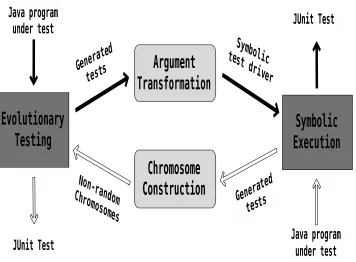
Symbolic execution using jCUTE requires a symbolic test driver, which is generated within our framework for the program under test through the use of argument transformation. Within our framework, symbolic execution serves to construct suitable method argument values whose method sequences are to be improved through evolutionary testing. Consequently, the final tests produced characterize method arguments obtained through symbolic execution and method sequences obtained through evolutionary testing.
3.3
Argument Transformation
The argument-transformation component transforms primitive method arguments of method sequences (produced by evolutionary testing) into symbolic arguments[22]. This trans-formation allows jCUTE’s symbolic execution technique to do concrete and symbolic execution on the primitive arguments. Our argument transformation process involves parsing method sequences generated by evolutionary testing to identify method invocations. For each method invocation requiring a method argument, we replace instances of concrete method arguments with equivalent symbolic arguments used to drive symbolic execution. In general, argument transformation can be used to transform any JUnit[12] method sequence into a symbolic test driver compatible with jCUTE’s symbolic execution technique.
public void testGenByEvTest() {
BankAccount acc = new BankAccount();
acc.deposit(cute.Cute.input.Double());
acc.withdraw(cute.Cute.input.Double());
}
Figure 3.4: The resulting symbolic test after argument transformation is applied on the test in Figure 2.2
public void symbolicTest() {
i = 0;
input = new Object[2];
input[i++] = new Double(1000.00);
input[i++] = new Double(10.00);
cute.Cute.input = this;
new BankAccountTest().testGenByEvTest()
}
After symbolic execution, we derive the final test suite by aggregating the test inputs generated by symbolic execution and method sequences generated by evolutionary testing. In doing so, we preserve the level of coverage achieved by the method sequences obtained from evo-lutionary testing while augmenting this coverage by generating additional argument values that can achieve new coverage. Figure 3.4 shows the resulting symbolic test driver after argument transformation is applied on the test in Figure 2.2 (generated by evolutionary testing). A double value is transformed to a symbolic double input represented ascute.Cute.input.Double().
The argument transformation component is used when test generation starts with evolutionary testing followed by symbolic execution. Given the symbolic test driver in Figure 3.4, jCUTE’s symbolic execution technique can help generate desirable method arguments for achieving new branch coverage; one test generated with jCUTE’s symbolic execution technique is shown in Figure 3.5. jCUTE’s symbolic execution technique produces a JUnit test that has two parts. The first part initializes an array with objects that hold concrete values that have been generated from symbolic execution. These concrete values are used to replace symbolic arguments specified in the symbolic test driver. The second part then calls the symbolic test driver directly. Without further processing, the symbolic test format is incompatible with evolutionary testing, which represents test cases as chromosomes. The chromosome construction component described in the next section addresses this issue.
3.4
Chromosome Construction
The chromosome-construction component constructs chromosomes out of method quences generated using symbolic execution. By using chromosome construction, method se-quences from symbolic execution are made available to evolutionary testing through chromo-some encoding. Chromochromo-some construction involves two steps.
example below shows a method sequence derived from the symbolic test in Figure 3.5.
1.execution(void BankAccountTest.symbolicTest()) args:
2.execution(void BankAccountTest.testGenByEvTest()) args:
3.call(BankAccount()) args:
4.execution(void BankAccount.deposit(double)) args:1000.00
5.execution(void BankAccount.withdraw(double)) args:10.00
The sequence begins with the invocation of the symbolic test and the symbolic test driver (Lines 1 and 2). The extracted method sequence used to form chromosomes involves the constructor call and the invocations on the methodsdepositand withdraw(Lines 3 to 5).
In the second step, we transform each method call into a chromosome format. The final outcome of the second step is a list of non-random chromosomes to be used in evolutionary testing. The chromosome-construction component is used when test generation starts with symbolic execution followed by evolutionary testing. Figure 3.6 shows the resulting chromosome derived from chromosome construction on the preceding method sequence. A strand in the chromosome has four parts except for constructor invocations, which have three parts. The first part identifies the chromosome. The second part is the name of the class to which the method being invoked belongs (this part is omitted for constructor calls). The third part is the name of the method being invoked. Finally, the fourth part lists the method arguments’ data types and corresponding values. Evolutionary testing tries to find suitable combinations of method sequences, starting from the method sequences and method arguments generated by symbolic execution. For example, given the chromosome in Figure 3.6, evolutionary testing can help generate desirable method sequences for achieving new branch coverage; one test generated with evolutionary testing is shown in Figure 2.4.
$x71,BankAccount,[]:
$x71,BankAccount,deposit,[double]:1000.00
$x71,BankAccount,withdraw,[double]:10.00
Chapter 4
Implementation
Figure 4.1: Implementation overview
Chapter 3.3) and provides the bridge from evolutionary testing to symbolic execution.
TheChromosome constructorperforms chromosome construction (described in Chap-ter 3.4) and provides the bridge from symbolic execution to evolutionary testing. We have also used eToc developed by Tonella[23] and jCUTE developed by Sen and Agha[21] to perform evolutionary testing (described in Chapter 3.1) and symbolic execution (described in Chapter 3.2), respectively. The Chromosome former within eToc is responsible for randomly generating and building a population to be used in evolutionary testing. We have developed theChromosome customizercomponent as a subclass to the Chromosome formerto reuse the existing evolution-ary testing capabilities and also to make it possible to use a non-random population of tests in evolutionary testing. Specifically, the user of our tool can specify (with a command line option) whether or not a random population should be used in evolutionary testing.
When our tool is used to test a program using the first mode, theMediatorcomponent, which manages the modes of Evacon, performs three macro steps. First, eToc is invoked to construct method sequences using a random population. To generate method sequences, eToc uses OpenJava[16] to instrument the program under test to collect branch targets. The use of eToc also requires the user to provide information on how to construct objects for the types used in the program under test. The information on constructing objects is usually provided in the form of constructor signatures. Using branch information and constructor signatures, eToc constructs method sequences using the evolutionary technique. In the second step, theArgument transformeris invoked to transform method arguments within the produced method sequences to symbolic arguments (Figure 3.4 shows the exact form of symbolic method arguments). The
Argument transfomeruses pattern matching to find method arguments. Each method argument is replaced with a symbolic argument available through jCUTE’s concolic test library. In the third step, jCUTE is invoked on the transformed method sequences. The final JUnit[12] test is produced after aggregating the results of steps two and three.
The second mode of Evacon also involves three macro steps carried out by theMediator
component. First, jCUTE is invoked automatically and the program under test undergoes symbolic execution. Symbolic execution produces method sequences with desirable method arguments. The method sequences are converted into a population of chromosomes by the
Chapter 5
Evaluation
coverage tool to measure branch coverage in our tool comparison.
Table 5.1: Experimental subjects
Class #public methods #branches LOC
BankAccount 6 6 60
BinarySearchTree 16 67 260
BinomialHeap 10 94 215
BitSet 25 130 638
DisjSet 6 44 140
FibonacciHeap 9 92 207
HashMap 10 89 374
LinkedList 29 105 738
ShoppingCart 6 13 117
Stack 5 16 160
StringTokenizer 5 47 222
TreeMap 47 252 1626
TreeSet 13 20 301
We conducted the experiments on a Pentium PC with a 1.86GHz processor and 1Gb memory. We have adapted Hansel[1] to record branch coverage for generated tests. Table 5.1 shows the 13 classes used in the experiments. The 13 classes are experimental subjects that have been previously used in evaluating white-box test generation tools [23, 24, 26, 27]. TheBankAccountprogram, which implements a bank account service, is similar to our running example. TheShoppingCartprogram is an implementation of an online shopping cart service. The classes BitSet, HashMap, LinkedList,Stack, StringTokenizer,TreeMap, and TreeSet have been taken from the Java Standard library. The remaining classes are popular data structures. The classes range in size between 60 lines of code (LOC) and 1626 LOC. The number of public methods vary between 6 and 47. The number of branches within the classes vary between 6 and 252.
On the experimental subjects, we applied two types of Evacon integrations: bridging eToc to jCUTE with the argument transformation component (denoted as Evacon-A) and bridging jCUTE to eToc with the chromosome construction component (denoted as Evacon-B).
Table 5.2: Branch coverage achieved by the six tools on the experimental subjects
(JUF: JUnit Factory)
Class Time Evacon-A Evacon-B eToc jCUTE JUF Randoop (secs) branch cov(%) branch cov(%) branch branch branch branch
(eToc⇒jCUTE) (jCUTE⇒eToc) cov(%) cov(%) cov(%) cov(%) BankAccount 28 100.0 100.0 100.0 100.0 100.0 100.0
BinarySearchTree 238 94.0 95.5 92.5 88.6 88.1 98.5
BinomialHeap 228 94.7 92.6 90.4 89.9 88.3 95.7
BitSet 559 96.2 90.8 89.2 46.1 92.3 96.9
Disjset 346 95.5 93.8 90.9 55.8 86.4 90.9 FibonacciHeap 229 97.8 96.7 95.7 84.3 73.9 81.5 HashMap 374 95.5 91.0 80.9 58.8 80.9 60.7 LinkedList 687 81.0 77.1 79.0 64.0 67.6 1.0 ShoppingCart 145 100.0 100.0 100.0 100.0 100.0 100.0
Stack 28 100.0 93.8 93.8 95.8 93.8 100.0
StringTokenizer 291 100.0 97.9 89.4 80.4 100.0 91.5 TreeMap 276 59.9 57.9 48.8 53.4 23.4 15.5 TreeSet 135 95.0 85.0 65.0 86.1 25.0 80.0
program under test to a test server, which tests the program and makes the results available for download. The test server, which carries out testing of the program under test, cannot be stopped when the time limit for testing is reached. For the remaining tools, we use Evacon-A’s runtime as the common runtime, being eToc’s default runtime (60 seconds) plus jCUTE’s runtime during Evacon-A’s integration process.
5.1
Branch Coverage
Table 5.2 shows the first experimental results. Column 2 shows the common runtime measured in seconds. Columns 3-8 show the branch coverage achieved by the six tools: Evacon-A, Evacon-B, eToc, and jCUTE, JUnit Factory, and Randoop, respectively.
We highlight in bold font and underline the table entries where the highest branch coverage is achieved among the six tools. We observe that Evacon-A achieves the high-est branch coverage in 10 of the 13 classes (BankAccount, DisjDet, FibonacciHeap, HashMap,
LinkedList,ShoppingCart,Stack, StringTokenizer,TreeMap, and TreeSet) but for 3 of the 13 classes (BinarySearchTree,BinomialHeap, and BitSet), Randoop achieves the highest branch coverage. We suspect that this result is due to Randoop’s ability to use execution feedback to avoid generating exception-throwing tests. We observed that while the other tools generated tests that caused the program under test to throw exceptions, preventing branch coverage of some key parts of the program under test, Randoop generated tests that tried to avoid these previously encountered exceptions.
In contrast, we also observed that for the LinkedList program, Randoop’s branch coverage was the least among all the tools. In particular, we observed that although Randoop generated a large number of tests for LinkedList class, only a small fraction of the generated tests involved public methods of the LinkedList class. A large number of the tests involved setup and helper classes of public methods of LinkedList. Randoop also tied with Evacon-A in achieveing full branch coverage for Stack. Both Evacon-A and JUnit Factory achieved full branch coverage for the StringTokenizerclass. All tools achieved full branch coverage for the
ShoppingCart and BankAccount classes. The tools eToc, jCUTE, and JUnit Factory did not perform better in terms of branch coverage compared with Evacon-A.
Furthermore, we observed that although Evacon-A and Evacon-B obtained the same level of coverage for the classesBankAccountandShoppingCart, Evacon-A performed better than Evacon-B in terms of branch coverage for all other classes except for BinarySearchTree. We suspect that this result is because evolutionary testing in Evacon-B is not able to achieve new coverage using the method arguments obtained from symbolic execution even after evolving the method sequences. In contrast, in Evacon-A, a new set of method arguments are derived using symbolic execution.
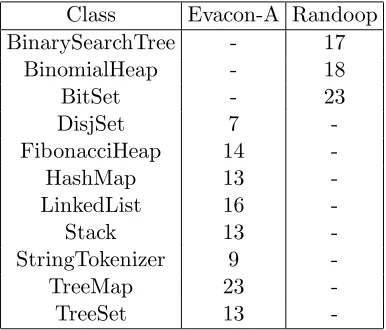
Table 5.3: The length of the longest method sequence generated by Evacon-A or Randoop that achieves new branch coverage
Class Evacon-A Randoop
BinarySearchTree - 17
BinomialHeap - 18
BitSet - 23
DisjSet 7
-FibonacciHeap 14
-HashMap 13
-LinkedList 16
-Stack 13
-StringTokenizer 9
-TreeMap 23
-TreeSet 13
-remaining tools. We have used the"-"symbol for the table enteries under Evacon-A in which Randoop achieves higher branch coverage or table enteries under Randoop in which Evacon-A achieves higher branch coverage. For all the classes under test except for DisjSet and
StringTokenizer, method sequences of length at least 13 were required to achieve new branch coverage. In other words, existing tools [24, 26, 27, 21] with bounded exhaustive method sequences may need to be able to handle a relatively large bound in order to achieve new branch coverage for many of the experimental subjects.
5.1.1 Coverage Improvement
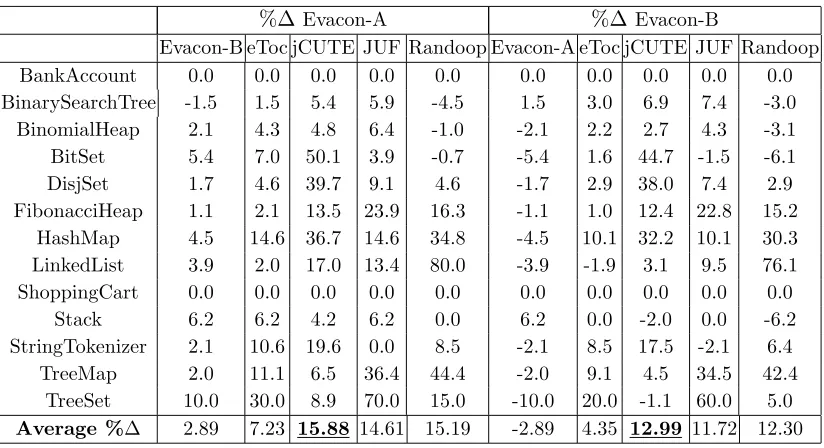
We compare the details of the coverage improvement among the tools to identify which tools consistently do better compared to the other tools in terms of branch coverage. To compare the coverage improvement among the tools, we measure the percentage change in branch coverage of one tool over the other tools for each program under test. Table 5.4 shows the coverage improvement of Evacon-A and Evacon-B compared with the other tools. For each program under test, we calculate the coverage improvement for Evacon-A and Evacon-B by subtracting the branch coverage achieved by each tool (listed in Columns 5 to 8 of Table 5.2) from the branch coverage achieved by Evacon-A and from the branch coverage achieved by Evacon-B.
Table 5.4: Coverage improvement of Evacon-A and Evacon-B %∆ Evacon-A %∆ Evacon-B
Evacon-B eToc jCUTE JUF Randoop Evacon-A eToc jCUTE JUF Randoop BankAccount 0.0 0.0 0.0 0.0 0.0 0.0 0.0 0.0 0.0 0.0 BinarySearchTree -1.5 1.5 5.4 5.9 -4.5 1.5 3.0 6.9 7.4 -3.0
BinomialHeap 2.1 4.3 4.8 6.4 -1.0 -2.1 2.2 2.7 4.3 -3.1 BitSet 5.4 7.0 50.1 3.9 -0.7 -5.4 1.6 44.7 -1.5 -6.1 DisjSet 1.7 4.6 39.7 9.1 4.6 -1.7 2.9 38.0 7.4 2.9 FibonacciHeap 1.1 2.1 13.5 23.9 16.3 -1.1 1.0 12.4 22.8 15.2
HashMap 4.5 14.6 36.7 14.6 34.8 -4.5 10.1 32.2 10.1 30.3 LinkedList 3.9 2.0 17.0 13.4 80.0 -3.9 -1.9 3.1 9.5 76.1 ShoppingCart 0.0 0.0 0.0 0.0 0.0 0.0 0.0 0.0 0.0 0.0
Stack 6.2 6.2 4.2 6.2 0.0 6.2 0.0 -2.0 0.0 -6.2 StringTokenizer 2.1 10.6 19.6 0.0 8.5 -2.1 8.5 17.5 -2.1 6.4
TreeMap 2.0 11.1 6.5 36.4 44.4 -2.0 9.1 4.5 34.5 42.4 TreeSet 10.0 30.0 8.9 70.0 15.0 -10.0 20.0 -1.1 60.0 5.0
Average %∆ 2.89 7.23 15.88 14.61 15.19 -2.89 4.35 12.99 11.72 12.30
tools. A deficit in coverage improvement, denoted by a negative coverage improvement value, shows that the tool listed in the column performed better than either Evacon-A or Evacon-B for a particular program under test. To be fair, we calculate the coverage improvement for each tool (eToc, jCUTE, JUnit Factory, and Randoop) as we have done for Evacon-A and Evacon-B but for simplicity we show only the results for Evacon-A and Evacon-B. Evacon-A achieved an improvement deficit in 4 of the 65 total comparisons (13 comparisons with each of the five remaining tools), which is6.0% of the total comparisons.
Furthermore, Evacon-A did not achieve any coverage improvement (denoted by 0.0% coverage improvement) over the other tools in 12 of 65 comparisons, accounting for18.5% of the total comparisons. For Evacon-B, 19 comparisons out of 65 (29.2% of the total comparisons) were coverage improvement deficits. In addition, there were no coverage improvements in 12 out of 65 comparisons (18.5% of total comparisons) for Evacon-B. Overall, Evacon-A achieved cov-erage improvement in 49 out of 65 comparisons, accounting for75.4% of the comparisons while Evacon-B achieved coverage improvement in 34 out of 65 comparisons representing (52.3%). Both Evacon-A and Evacon-B achieved the highest and second highest coverage improvement in the comparisons of the tools for the programs under test.
-40 -30 -20 -10 0 10 20 30 40 50 60 1
Test generation tools
% S u m o f a v e ra g e i m p ro v e m e n ts p e r to o l Evacon-A Evacon-B eToc jCUTE Junit Factory Randoop
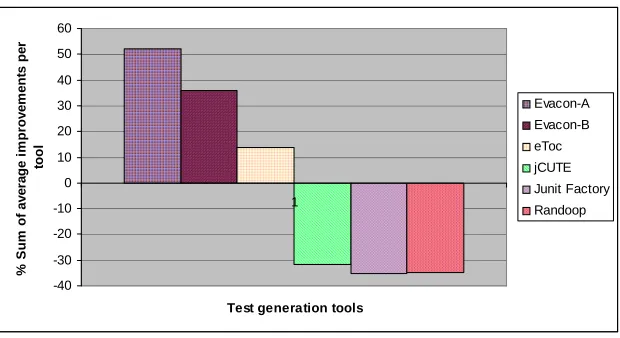
Figure 5.1: Average Percent Improvement among tools
column by 13 (the number of programs under test). Evacon-A achieved an average coverage improvement of at least2.89%and at most15.88%. Although Evacon-B produced more coverage improvement deficits than Evacon-A, 4.0% more on the average, Evacon-B still achieved an average coverage improvement of at least 4.35%(not counting average coverage improvement deficits) and at most 12.99%average coverage improvement.
To evaluate all the tools using the average coverage improvement, we calculate the average coverage improvement for all the tools just as we have done for A and Evacon-B. The graph in Figure 5.1 plots the sum of all the average coverage improvement values for each tool (for Evacon-A, the sum of Columns 2 to 6 on the last row in Table 5.4). Evacon-A has the highest average coverage improvement of 55.79%. We also observed that although Evacon-B did not achieve the highest branch coverage exclusively in any of the 13 classes, its average coverage improvement of 38.48%is more than three times the average coverage improvement of eToc, which achieved12.40%and came in third. The tools JUnit Factory, Randoop, and jCUTE produced average coverage improvement deficits of-31.86%,-35.32%, and-39.45%, respectively.
5.2
Coverage Subsumption
We also observed from our experiments that the branch coverage achieved by some tools subsumed1 the branch coverage achieved by other tools for some of the programs under
1Branch coverage A subsumes branch coverage B if all branches covered in B are also covered in A, but there
test. Although the branch coverage of no tool subsumed the branch coverage of all other tools in all the programs under test, the branch coverage of Evacon-A subsumed the branch coverage of Evacon-B (in 12 of the 13 programs under test), eToc (in 7 of the 13 programs), jCUTE (in 3 of the 13 programs), JUnit Factory (in 1 of the 13 programs), and Randoop (in 4 of the 13 programs). The branch coverage of Randoop subsumed the branch coverage of Evacon-A (in 1 of the 13 programs). Randoop was the only tool whose branch coverage subsumed Evacon-A’s branch coverage. We suspect that this result is due to the large number of tests (over 1800 tests on the average) generated by Randoop.
To identify the pairwise combination of the tools that achieve an optimal coverage of the programs under test, we investigated the pairwise combinations of the tools that led to the highest subsumption. We observed that Evacon-A and JUnit Factory achieved the highest pairwise subsumption. The branch coverage achieved by both tools together subsumed all the other tools in 5 of the 13 programs under test. This result shows that for 8 of the 13 programs under test, more than a pairwise combination of the tools is required to achieve an optimal branch coverage.
5.3
Branch Ranking
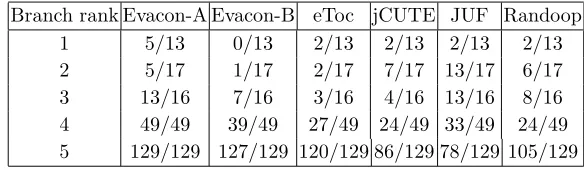
We also rank all the branches within the 13 classes under test based on the number of tools that can cover them. Table 5.5 shows the branch coverage achieved by the six tools using our branch ranking metric. Column 1 shows the different ranks. A rank-1 branch is covered by only one of the six tools while a rank-2 branch is covered by only two of the six tools. Similarly, rank-3, rank-4, and rank-5 branches are covered by only three, four, and five of the six tools, respectively. We use branch ranking to help gain insights on which tools can be good at covering those difficult-to-cover branches and which tools can be integrated to achieve better coverage. Covering a majority of the top-ranked (rank 1 and 2) branches demonstrates a tool’s effectiveness in covering difficult-to-cover branches, which cannot be covered by other tools. To be concise, we have omitted rank-0 branches (branches covered by none of the six tools) and rank-6 branches (branches covered by all six tools) from our comparisons in Table 5.5.
Table 5.5: Branch coverage achieved by different tools using branch ranking
Branch rank Evacon-A Evacon-B eToc jCUTE JUF Randoop 1 5/13 0/13 2/13 2/13 2/13 2/13 2 5/17 1/17 2/17 7/17 13/17 6/17 3 13/16 7/16 3/16 4/16 13/16 8/16 4 49/49 39/49 27/49 24/49 33/49 24/49 5 129/129 127/129 120/129 86/129 78/129 105/129
Among the remaining 224 branches, Evacon-A covered 5 of 13 rank-1 branches, more than twice the number of rank-1 branches covered by any of the other tools. Evacon-A also covered 5 of 17 rank-2 branches second to JUnit Factory, which covered 13 of 17 rank-2 branches. Among the top-ranked (rank 1 and 2) branches, JUnit Factory covered 15 of 30 branches, five more than Evacon-A, which covered 10 of 30 top-ranked branches. Overall, Evacon-A covered more branches than all the other tools except for rank-2 branches in which JUnit Factory covered more.
Chapter 6
Threats to validity
Chapter 7
Related Work
There is a large body of work in the area of automatic test generation for Java programs but none of the existing techniques leverage evolutionary testing and symbolic execution to generate tests that include both suitable method arguments and suitable method sequences as we have proposed. Among the existing test generation tools, JCrasher[6] tests the behavior of public methods using random data and reports method sequences that throw undeclared runtime exceptions. Eclat[18] uses a set of dynamically-inferred properties derived from an existing model such as an existing test suite to guide generation of tests that violate inferred properties of the program under test.
In general, random testing uses randomized processes to cheaply generate test inputs from a test domain. Random testing is not effective in generating tests to cover different pro-gram elements. DART[8], Randoop[19], and Jartege[17] use different techniques to compensate for this limitation. DART uses dynamic analysis of the program behavior during random test-ing and generates new test inputs to direct program execution to exercise different program elements. Randoop[19] uses user-specified properties in conjunction with execution feedback to produce both error revealing and regression test cases. Jartege[17] uses specifications to reduce the amount of irrelevant test cases produced by its random process. By leveraging both symbolic execution and evolutionary testing, our technique both generates test inputs to exer-cise different branches within the program under test and also ensures optimal combination of method sequences for test cases.
our proposed technique is that our technique produces appropriate method sequences, which are lacking in these other structural coverage techniques. Search-based test generation [23, 25, 15] use genetic algorithms to find both method arguments and method sequences for the program under test. This testing process is usually referred to in the literature as evolutionary testing. Traditional evolutionary techniques suffer from the path problem (a phenomenon in which a search process is led away from its target) as described by McMinn et al.[14]. McMinn et al. propose factoring out paths to the search target and searching for test data for each individual path using dedicated genetic algorithms all operating in parallel. As a result, feasible paths contribute more toward the search landscape promoting test data discovery. While this species per path approach use program parallelism, our technique does not involve multiple genetic algorithms but still addresses thepath problem by means of leveraging symbolic execution and constrain solving.
Chapter 8
Conclusion
To achieve high structural coverage such as branch coverage of object-oriented pro-grams, we have developed a novel unit-test generation framework called Evacon for integrat-ing evolutionary testintegrat-ing and symbolic execution. The former searches for desirable method sequences with a genetic algorithm and the latter generates desirable method arguments by exploring alternate paths within the methods under test. In particular, our Evacon framework provides a bridge from evolutionary testing to symbolic execution by generalizing concrete tests (generated by evolutionary testing) to symbolic tests as test drivers to symbolic execution. Our Evacon framework also establishes a bridge from symbolic execution to evolutionary testing by encoding concrete tests generated by symbolic execution as chromosomes, inputs to evolution-ary testing.
We have implemented our framework and applied it to test 13 classes previously used in evaluating white-box test generation tools. The experimental results show that the tests generated using our framework can achieve higher branch coverage than tests generated by evolutionary testing, symbolic execution, or random testing within the same amount of time.
Bibliography
[1] Hansel 2.0. 2006. http://hansel.sourceforge.net/. [2] AgitarLabs. Junit factory. http://www.junitfactory.com/ [3] AspectJ. http://www.eclipse.org/aspectj/.
[4] AspectJ Compiler. http://www.parc.com/research/projects/aspectj/default.html
[5] A. Baresel, D. Binkley, M. Harman, and B. Korel. Evolutionary testing in the presence of loop-assigned flags: A testability transformation approach. InSIGSOFT Software Engineering Notes, 29(4):108–118, 2004.
[6] C. Csallner and Y. Smaragdakis. JCrasher: An automatic robustness tester for Java. In Software—Practice & Experience, 34(11):1025–1050, 2004.
[7] R. Ferguson and B. Korel. The chaining approach for software test data generation. InACM Transaction Software Engineering Methodology, 5(1):63–86, 1996.
[8] P. Godefroid, N. Klarlund, and K. Sen. DART: Directed automated random testing. InProc. ACM SIGPLAN 2005 Conference on Programming Language Design and Implementation, pages 213–223, 2005.
[9] N. Gupta, A. P. Mathur, and M. L. Soffa. Automated test data generation using an iterative relaxation method. In
Proc. ACM SIGSOFT International Symposium on Foundations of Software Engineering, pages 231–244, 1998. [10] N. Gupta, A. P. Mathur, and M. L. Soffa. Generating test data for branch coverage. InProc. IEEE International
Conference on Automated Software Engineering, pages 219–228, 2000.
[11] K. Inkumsah and T. Xie. Evacon: A framework for integrating evolutionary and concolic testing for object-oriented programs. InProc. IEEE/ACM International Conference on Automated Software Engineering, pages 425–428, 2007. [12] JUnit. http://www.junit.org/.
[13] E. Larson and T. Austin. High coverage detection of input-related security faults. InProc. Usenix Security Sympo-sium, pages 9–24, Aug 2003.
[14] P. McMinn, M. Harman, D. Binkley, and P. Tonella. The species per path approach to search-based test data generation. InProc. International Symposium on Software Testing and Analysis, pages 13–24, 2006.
[16] OpenJava. http://www.csg.is.titech.ac.jp/openjava/.
[17] C. Oriat. Jartege: A tool for random generation of unit tests for java classes. InQoSA/SOQUA, pages 242–256, 2005.
[18] C. Pacheco and M. D. Ernst. Eclat: Automatic generation and classification of test inputs. InProc. European Conference Object-Oriented Programming, pages 504–527, 2005.
[19] C. Pacheco and M. D. Ernst. Randoop: Feedback-directed random testing for Java. InCompanion to ACM SIGPLAN Conference on Object Oriented Programming Systems and Applications, pages 815–816, 2007.
[20] R. P. Pargas, M. J. Harrold, and R. Peck. Test-data generation using genetic algorithms. In Software Testing, Verification & Reliability, 9(4):263–282, 1999.
[21] K. Sen and G. Agha. CUTE and jCUTE: Concolic unit testing and explicit path model-checking tools. InProc. International Conference on Computer Aided Verification, pages 419–423, 2006.
[22] N. Tillmann and W. Schulte. Unit tests reloaded: Parameterized unit testing with symbolic execution. InIEEE Software, 23(4):38–47, 2006.
[23] P. Tonella. Evolutionary testing of classes. InProc. ACM SIGSOFT International Symposium on Software Testing and Analysis, pages 119–128, 2004.
[24] W. Visser, C. S. Pˇasˇareanu, and R. Pel´anek. Test input generation for Java containers using state matching. In
Proc. ACM SIGSOFT International Symposium on Software Testing and Analysis, pages 37–48, 2006.
[25] S. Wappler and F. Lammermann. Using evolutionary algorithms for the unit testing of object-oriented software. In
Proc. Conference on Genetic and Evolutionary Computation, pages 1053–1060, 2005.
[26] T. Xie, D. Marinov, and D. Notkin. Rostra: A framework for detecting redundant object-oriented unit tests. In
Proc. IEEE International Conference on Automated Software Engineering, pages 196–205, 2004.
[27] T. Xie, D. Marinov, W. Schulte, and D. Notkin. Symstra: A framework for generating object-oriented unit tests using symbolic execution. InProc. International Conference on Tools and Algorithms for the Construction and Analysis of Systems, pages 365–381, 2005.
![Figure 3.2: Genetic algorithm for test input generation using branch coverage as the testinggoal (adapted from Tonella [23])](https://thumb-us.123doks.com/thumbv2/123dok_us/1507400.1184579/17.612.196.433.302.534/figure-genetic-algorithm-generation-coverage-testinggoal-adapted-tonella.webp)