Longitudinal and Spatial Analyses Applied to Corn Yield Data from a
Long-Term Rotation Trial
- Institute of Statistics Mimeo Series #2559
Cavell BROWNIE, Larry D. KING, and Tina J. DUBE.
The statistical analysis of yield data from a long term rotation trial presents a number of
challenges, as illustrated by a 10 year study on the effects of reduced chemical inputs and different cropping sequences, most of which involved corn (Zea mays L.) (King and Buchanan, 1993). Important features of the yield data from this trial include considerable
unbalance, possible correlations across time and space, possible heterogeneity in the error variances across years, and the availability of pretreatment measurements of soil
properties. We investigated a number of analyses of the rotation trial corn yields, restricting attention to models that could be implemented using standard software, specifically Proc Mixed in SAS (SAS Institute, 1999). These analyses included several
types of split plot, repeated measures and spatial analyses, each with and without soil covariates. Diagnostic graphs and AIC values indicated that the model should allow for
heterogeneity across years in the error variance. The precision of contrasts in years with high (respectively, low) error variance was underestimated (respectively, overestimated) in analyses that assumed constant variance. Allowing spatial correlations resulted in a
small reduction in estimates of precision, and including soil covariates was important in two of nine years. The best models were a repeated measures with banded covariance, as
Cavell Brownie is Professor and Tina J. Dube a graduate of the Department of Statistics, North Carolina State University, and Larry D. King is Professor Emeritus, Department of Soil Science, North Carolina State University, Raleigh NC 27695, USA.
1.
INTRODUCTION
The sustainability of agricultural cropping systems is an increasingly important topic. The
only way to compare the cumulative effects of different cropping systems over a number of years is to conduct long-term trials where the treatments involve different crop
sequences as well as management practices (e.g., Mueller et al., 2002). Classical rotation
trials have long been used to assess sustainability of yield for different crop sequences. A design feature of these classical rotation trials is that each possible ‘start’ is included for
each crop rotation to ensure that every phase of each rotation is present every year (e.g., Singh and Jones, 2002; Patterson, 1964). The desire to study a number of management factors as well as different cropping sequences can, however, make it infeasible to
include all of the different starts for every rotation (e.g., King and Buchanan, 1993).
Management systems with reduced chemical inputs are of particular interest in assessing sustainability. King and Buchanan (1993) describe a study that was initiated in 1985 to compare two management systems (conventional and reduced chemical inputs) in four
cropping sequences (continuous grain sorghum, continuous corn, a 2-year corn rotation and a 4-year, later changed to 3-year, corn rotation). Due to the large number of different
first seven years of this trial. Analyses of the data, combined across years, have not yet been reported.
Singh and Jones (2002) examined several analyses of yields for two trials that involved
2-year barley rotations in a classical design. Focusing on the repeated measures nature of the data, these authors compared five models for the within-plot error covariance
structure, namely PS, the split plot model with constant error variance and constant covariance over years; AR, a first order autoregressive structure; PSH and ARH, generalizations of PS and AR, respectively, to allow for heterogeneity of the error
variance across years; and C, a control model with iid errors. The models that allowed heterogeneity across years were preferred based on the Akaike Information Criterion
(AIC).
To select an appropriate analysis for the corn yield data from the long-term, reduced inputs, rotation trial, we consider several features of the data. As noted by Singh and
Jones (2002), the repeated measures nature of the yields is important. Also, separate analyses by year suggested that, as in the barley rotation trials, the error variance differed across years. In addition, precision may be increased by using an analysis that accounts
for spatial variation by modeling the correlation between plot errors as a function of the distance between plots (e.g., Brownie, Bowman and Burton, 1993; Cullis and Gleeson,
1991). Precision may also be increased by treating measurements of soil texture and plot elevation, obtained at the start of the trial, as potential covariates. Finally, because not all starts were included for each crop sequence/management combination, the degree of
There are several ways to account for correlations between errors over time and space, leading to a number of possible models for analyzing the corn yields. In addition to the PS, AR, PSH and ARH models in Singh and Jones (2002), possible covariance structures
include banded models for correlations over time, isotropic and anisotropic exponential or power covariance models for correlations over space, and a 3-dimensional space-time
covariance structure, all with and without covariates. Determining the best analysis a priori is not possible, so our goal is to compare and evaluate a number of plausible models, restricting attention to those that can be implemented using readily available
software, specifically Proc Mixed in SAS (SAS Institute, 1999; Littell et al., 1996). More information about the rotation trial is given in Section 2, and the different analyses are
outlined in Section 3. Results and discussion follow in Section 4.
2. THE ROTATION STUDY
The rotation trial was initiated in 1985 in an area of about 6 ha, the experimental layout being a randomized block design with 4 blocks. Visual assessments of soil texture and
topography were used to determine blocks. As indicated in Figure 1, resulting blocks were irregular in shape and plots in the same block were not always contiguous. Plot
dimensions were 8 x 30 m, and coordinates (in m) along east-west and north-south axes were determined for plot centers. After plots had been established, values for clay, gravel, sand and silt content were obtained for each plot, as well as the elevation at each corner
1 and 2. Some of the gaps in Figure 1 occur because only plots containing corn rotations are shown. Other gaps are grassed waterways.
Rotations in the long-term study involved four crop sequences: continuous grain
sorghum, continuous corn, a 2-year rotation of corn and double-cropped winter wheat and soybean, and a 4-year corn, winter wheat/soybean, corn, red clover hay rotation (changed
in 1989 to a 3-year corn, red clover hay, winter wheat/soybean rotation). Crop sequences were studied under two management systems (current management practices, or CMP, and reduced chemical inputs, or RCI). In addition, the CMP rotations involved a third
factor, nitrogen (N) fertilizer, at 4 rates. In the RCI systems, N was supplied by a clover green manure crop, or by red clover in the rotation. Two entry points or starts were
included for the 2-year corn sequences (though only at the high rate of N in the CMP system). Three starts were included for the 4-year/3-year RCI rotations. By including ‘dummy’ treatments, provision was made at the beginning of the study to allow for
introduction of new treatments as the study progressed. A detailed description of the study can be found in King and Buchanan (1993).
Cropping sequence/management/start combinations are referred to as rotations for
convenience. Some rotations were modified during the course of the experiment but after 1989 there were 27 different rotations that involved corn. Corn yields are available for
3. STATISTICAL ANALYSES
3.1 MODELS AND COVARIANCE STRUCTURES.
To describe the different analyses, we first ignore the soil covariates, and then briefly indicate how to include the covariate information. Ignoring covariates, a linear model for the corn yields is
ijk ij jk i
ijk RY
Y =µ +β +( ) +δ +ε (1)
where Yijk is the yield in year k for rotation j in block i, k = 1,…,6,8,9,10,
j = 1,…,27, i = 1,…,4,
i
β is a random effect for the ith block or rep,
jk RY)
( is a fixed effect for rotation j in year k, with
∑
( ) =0 jk jkRY ,
ij
δ is a random effect for the ijth plot (the plot in block i containing rotation j), and
ijk
ε is a random error associated with the ijth plot in year k.
The corn yield data are highly unbalanced because of the different crop sequences, with
corn planted in 155 of the possible 9x27 = 243 rotation-year combinations. (There are also several missing yields.) Thus instead of including main and interaction effects for rotation and year, we fit an effect for each observed rotation-year combination,
represented as ( in the linear model (1). Also, the different rotations represent
combinations of levels of three factors: crop sequence (with possibly multiple starts), management and fertilization, but only a subset of the possible combinations is used. It is
jk
therefore easier to treat rotations asa single factor and use contrasts for tests relating to
the treatment structure.
The models used in analyzing the data are defined by different assumptions about the
random effects in the linear model (1). These models, and the commonly used descriptions of the corresponding analyses, are outlined below. Where appropriate, a generalization that allows heterogeneity of the error variance across years is included.
Note that SPL, AR and ARH are analogous, respectively, to PS, AR and ARH in Singh and Jones (2002), though SPLH is not the same parameterization as PSH. The SAS code to carry out each analysis is presented in the Appendix.
Unless otherwise noted, block effects βi are assumed to be iid with mean 0 and variance
, and to be independent of all other random effects.
2 β
σ
Split plot.
SPL corresponds to a split plot analysis with year as a subplot factor. In the SPL model,
the random effects δij and εijkare assumed to be mutually independent, each with mean
0, and with variances σδ2 and σε2, respectively.
SPLH is a modification of the split plot model to allow year specific error variances; δij
and εijkare as for PS, except that Var(εijk) = 2 , k = 1,…,6,8,9,10. k
ε
σ
Repeated measures with autoregressive errors.
Analysis of repeated measures data using the split plot approach can lead to invalid tests because the split plot model implies that all pairs of measurements on the same plot are equicorrelated, whereas the correlation between two measurements taken over time on
this latter correlation structure, within-plot errors are modeled as a first order
autoregressive, or AR(1), process (see also Singh and Jones, 2002).
AR represents a repeated measures analysis with an AR(1) structure for errors in the
same plot across time. Plot effects δij are as for SPL, and Cov(εijk,εijl)= σε2 ρ|k−l| ;
) , ( ijk ijl
Cov ε ε ′′ = 0 if i′j′≠ij.
ARH is a modification of AR that allows year-specific error variances, with
) , ( ijk ijl
Cov ε ε = σεkσεl ρ|k−l|.
Repeated measures with unstructured error covariance.
UN corresponds to another type of ‘repeated measures’ analysis in which the within-plot error covariance is ‘unstructured’ or as general as possible (e.g., Gumpertz and Brownie, 1993). Thus UN allows heterogeneity of the error variance across years but the required
number of covariance parameters is large. Plot effects are subsumed in the error
covariance, thus δij ≡0, and Cov(εijk,εijl) = σεkl.
Repeated measures with banded error covariance.
UNm, m = 2, 3, 4, …,8, is a reduced parameter modification of UN in which the error
covariance is assumed to be 0 for measurements in the same plot that are separated by at
least m years. Cov(εijk,εijl) = σεkl if |k−l| < m, Cov(εijk,εijl) = 0 otherwise.
Spatial analysis – isotropic covariance.
The effects on yield of small-scale variation in soil can be modeled by assuming that the correlation between effects for two plots is a decreasing function of the distance between
model holds, whereas an anisotropic model is needed if the correlation is not the same in
all directions.
SPI assumes an isotropic exponential covariance model for the plot effects δij. The
errorsεijk are iid representing a nugget effect with constant variance across years. Thus
) ( lm
Cov δij,δ = , where d is the distance between plots ij and lm. An
equivalent parameterization that is implemented in SAS with the TYPE = SP(POW)
option (see the Appendix) is obtained by defining .
2 δ
σ e−dθ
θ
ρ =e−
SPIH is a modification of SPI that allows the variance of the errorsεijkto differ across
years, similar to allowing a nugget effect of different magnitude in each year.
Spatial analysis – anisotropic covariance.
SPA assumes that plot effects have the anisotropic covariance structure given in equation
(3.11) of Zimmerman and Harville (1991); that is, Cov(δij,δlm) = , where
d
2 δ
σ 1 2
2 1d ρd ρ
1 and d2 are the distances between plots ij and lm in the east-west and north-south
directions, respectively. As noted in the Appendix, this is implemented using the TYPE = SP(POWA) option.
SPAH is a modification of SPA that allows the variance of the errorsεijkto differ across
years.
Spatio-temporal error covariance.
SP3D models the correlations across space and across time using a 3-dimensional anisotropic covariance structure for the errors. This covariance is related to the
errors which allows for 2-dimensional spatial variation with time as the third dimension.
Thus, δij ≡0, and Cov(εijk,εi′j′k′) = σε2 1 2 3 , where d 3
2 1d ρd ρd
ρ 1 and d2 are the
distances between plots ij and i j′′
|
k
k− ′
in the east-west and north-south directions,
respectively, and d3 = | , the number of years between the observations.
3.2 INCLUDING SOIL COVARIATES.
Each of the above analyses can be modified by including one or more of the baseline soil measurements or plot elevation as covariates. These soil properties are true covariates in that they were measured at the start of the study and represent properties (e.g., clay
content) that are not likely to be modified over time by effects of the rotations.
Depending on the amount of rainfall, however, the relationship between yield and, e.g., clay content, can differ across years. This was explored by obtaining residuals after
fitting rotation by year effects and graphing residuals against each soil property
separately for each year. Such graphs, and other preliminary analyses, suggested a model
with clay content and gravel content as covariates, with different slope parameters each year. One way to represent this model is:
ijk ij ij k ij k jk i
ijk RY C G
Y =µ +β +( ) +γ1 +γ2 +δ +ε (3)
where Cijand Gij represent clay and gravel content, respectively, measured at baseline, for
plot ij, and γ1kand γ2krepresent the slopes in the regression of yield in year k on clay
and gravel content, respectively. Assumptions concerning the random effects do not
change.
3.3 TESTS FOR ROTATION EFFECTS.
After selecting an appropriate analysis, within- and between-year comparisons among
limited number of interesting comparisons. King and Buchanan (1993) note that in the RCI management system, the first year when the Rotation effect becomes significant is 1992. We therefore compared the mean of the 2- and 4-/3-year rotations under RCI
management (R2 and R4) with the RCI continuous corn (R1) in each of the years, and averaged over years. We also tested for a linear trend across years in this contrast. Other contrasts tested were R2, R4 compared to the CMP continuous corn at the 0 and 70 kg
ha−1 rates of N (C1 and C2), both within years and averaged over years.
Within-year comparisons can, of course, be tested in separate analyses by year, but across-year comparisons, must be tested in a combined analysis. A model that assumes
constant error variance may produce inappropriate standard errors (SEs), especially for within-year contrasts, if the homogeneity assumption fails.
4. RESULTS AND DISCUSSION
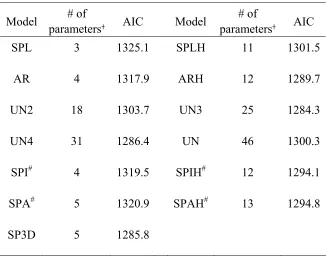
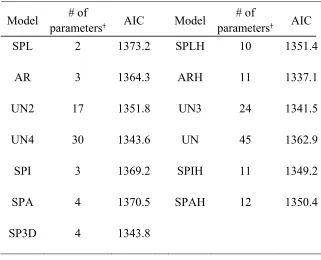
AIC values are presented for models without soil covariates in Table 1, and for models
with covariates included in Table 2. As the fixed effects are different for these two sets of models, the AIC values are used to compare models within a table but not between tables. Not surprisingly, given the way that blocks were determined, including clay and gravel as
covariates with year-specific slopes resulted in an estimate of 0 for for all models.
Thus each model in Table 2 was fitted with assumed to be 0, and had one fewer
covariance parameter than the corresponding model in Table 1.
2 β
σ
2 β
Estimates of the error variance obtained with the UN model (ignoring covariates)
varied from 0.33 in 1987 to 1.02 and 1.12 in 1995 and 1989, respectively, while was
estimated to be 0.60 with SPL (Figure 2). Including covariates reduced the error variance
under SPL to 0.53, and resulted in little change under UN for for 1987-1991.
Reductions under UN were more substantial in the later years, particularly 1995, where
including covariates reduced from 1.02 to 0.53. Whether or not covariates were
included, the pattern of variation across years in under ARH, the banded models,
SPIH and SPAH, was similar to that for UN.
2 k ε σ 2 k ε 2 ε σ 2 ˆ k ε σ ˆ σ 2 ˆ k ε σ
AIC values for SPLH, ARH, SPIH, and SPAH in Tables 1 and 2, support the visual impression in Figure 2 that there is heterogeneity in the error variance across years. Each
of these models is preferred to (has a lower AIC value than) the more restrictive counterpart that assumes a constant error variance across years. The banded UNm
models, which allow heterogeneity across years but ignore spatial correlations, have low
AIC values for m = 3, 4, 5. (Though not in the tables, the AIC values for UN5 are 1286.6 and 1346.9.) Compared to UN3, UN4 and UN5, the UN model appears to be
overparameterized, and UN2 is underparameterized.
The correlation structure (ignoring block effects) for yields in the same plot across years is compared in Figure 3 for the SPL, AR and UN models, fitted without covariates.
Results are similar if covariates are included. Estimated correlations are graphed against the lag, or the number of years between yields. The correlation under SPL does not
AR correlation depends on the lag d and is obtained as
(
σˆδ2 +σˆε2ρˆd) (
/σˆδ2 +σˆε2)
, where0.066 ,
= 2
ˆδ
σ ρˆ = 0.297 and 0.642. Correlations under the UN model (which
places no restrictions on the structure) appear to decrease in absolute magnitude as the lag increases but are highly variable at small lags. The pattern of the estimated correlations
under UN is consistent with the low AIC values for the banded models UN3, UN4, UN5, which force a correlation of 0 at high lags and allow a general structure at low lags. These banded models are preferred to SPL, AR and UN2 (each of which has a smaller number
of parameters than UN3), and are also preferred for reasons of parsimony to the UN model.
= 2
ˆε σ
To assess the correlations across space, empirical variograms were computed on
estimated plot effects and separately for each year on residuals obtained after fitting rotation effects. These variograms were generally similar in shape with an effective range
equal to 2 or 3 plot lengths. The sill appeared to depend on year, however, agreeing with the lower AIC values for SPIH and SPAH in comparison to the SPI and SPA models. The AIC values for these four models also support use of the isotropic, rather than
anisotropic, spatial structure. Harder to explain are the low AIC values for the 3-dimensional space-time model, SP3D, which does not allow heterogeneity of the error variance across years.
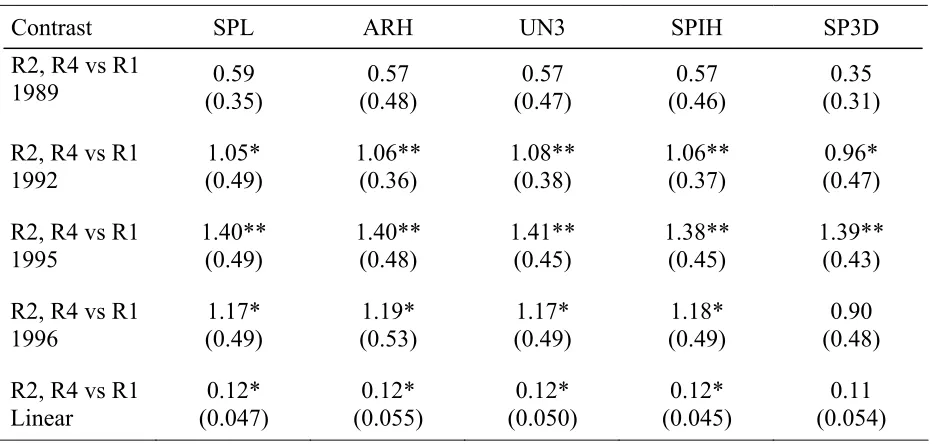
Results for treatment contrasts are given in Table 3 for ARH, UN3, SPIH, SP3D (four of the top five models in terms of AIC), and also for SPL. For brevity, estimates and SEs are reported only for the R2, R4 vs R1 contrast in selected years, and for the linear trend
agree more closely with results for SPL than with the models that allow variance heterogeneity (ARH, UN3 and SPIH). Thus, under SPL and SP3D, SEs appear to be underestimated for 1989, and overestimated for 1992, years with, respectively, high and
low values of The same pattern holds for the within-year contrasts R2, R4 vs C1
and R2, R4 vs C2. . ˆ2
k
ε
σ
Results are more similar across analyses for effects averaged over years than for
within-year effects (though SP3D consistently produces the smallest SEs). For the linear trend across years in the R2, R4 vs R1 contrast, SEs differ across analyses and SPIH has the smallest SE. Differences in the fitted covariance structure across time and space may
have a greater impact for the linear effect, compared to the average effect, because early years (including 1989) and late years are weighted more heavily than middle years. Fitting covariates noticeably reduces error for contrasts in 1992 and 1995 for ARH, UN3
and SPIH but not for SP3D and SPL. The effect of fitting covariates is smaller for SEs of effects averaged over years. Compared to the split plot and repeated measures analyses, p-values for the covariates clay and gravel are larger (though significant at .05) under the
spatial analyses, indicating some overlap between the two methods (use of covariates versus spatial correlations) of accounting for within-block variation.
For the UN3 model with covariates included, averaging over years, yields for the RCI 2-
and 4-/3-year rotations (R2, R4) were higher than for RCI continuous corn (by 0.8 ± 0.23
kg ha–1), higher than for CMP continuous corn with 0 N (by 1.9 ± 0.26 kg ha–1), but
lower than for CMP continuous corn with 70 kg ha–1 N (by 0.9 ± 0.26 kg ha–1). In the
RCI system, the additional yield with the 2- and 4-/3-year rotations, compared to
period. Similar conclusions are reached with each of the analyses, though the linear effect is not significant under SP3D.
The agreement between SEs for SPL and SP3D suggests that even though the AIC value
is low for SP3D, given the evidence of heterogeneity, this model is not appropriate. Assuming heterogeneity is present, another reason that p-values for within-year contrasts will be inaccurate under SP3D, is that error degrees of freedom (using the
Kenward-Roger method, Kenward and Kenward-Roger, 1997), are too large, because the effect of estimating an error variance for each year is not taken into account.
The models investigated are by no means the only plausible error covariance structures
for this data set. For example, an alternate spatial model assumes that plot effects are iid
and the errors εijkare spatially correlated within each year. With this parameterization,
including heterogeneity in the spatial covariance across years gave AIC values larger than for SPIH and SPAH. Because our goal was to focus on analyses that could be implemented using standard software, more complex spatial models (e.g., the semiparametric models of Durban, Hacket, McNichol et al., 2003) or space-time models were not considered. Such models would have to take into account the unbalance, strong year effects, and
heterogeneous error variance.
Our results reinforce the findings of Singh and Jones (2002) that accounting for heterogeneous errors across years is important for long-term trials. Of the covariance
APPENDIX
PROC MIXED CODE.
The code needed to implement the analyses in SAS Proc Mixed is outlined. Fixed effects
are listed in the Model statement and random effects in the Random and Repeated
statements. Plot effects, δij,are indexed by all combinations of Block and Rotation (i.e.,
by BLOCK*ROTATION). The structure for the δij is specified in the Random
statement, while that for the errors εijk is in the Repeated statement. If no specific
structure is given via the TYPE or GROUP options, levels of a random effect are treated
as iid.
PROC SORT; BY BLOCK ROTATION YEAR;
********** SPL or split plot ***************************************************; PROC MIXED; CLASS BLOCK ROTATN YEAR;
MODEL YIELD = ROTATN*YEAR / DDFM = KENWARD; RANDOM BLOCK BLOCK*ROTATION;
LSMEANS ROTATION*YEAR;
******** SPLH, split plot with year-specific error variances ***************************; ******** obtained via the GROUP option in Repeated *******************************;. PROC MIXED; CLASS BLOCK ROTATN YEAR;
MODEL YIELD = ROTATN*YEAR/ DDFM = KENWARD; RANDOM BLOCK BLOCK*ROTATION;
REPEATED BLOCK*ROTATN*YEAR / GROUP = YEAR SUBJECT = BLOCK*ROTATN;
************** AR or AR(1) errors **********************************************; PROC MIXED; CLASS BLOCK ROTATN YEAR;
MODEL YIELD = ROTATN*YEAR / DDFM = KENWARD; RANDOM BLOCK BLOCK*ROTATION;
********** ARH or AR with heterogeneous error variance ***************************;
*** Replace TYPE = AR(1) with TYPE = ARH(1) in Repeated statement for AR ****;
********** UN or unstructured error covariance ***********************************; PROC MIXED; CLASS BLOCK ROTATN YEAR;
MODEL YIELD = ROTATN*YEAR / DDFM = KENWARD;
RANDOM BLOCK;
REPEATED YEAR / TYPE = UN SUBJECT = BLOCK*ROTATION;
********** UN2 or banded error covariance *************************************; **** Replace TYPE = UN with TYPE = UN(2) in the Repeated statement for UN ********; ********** Similarly for UN3, UN4, etc. ****************************************;
********** SPI or isotropic spatial covariance ***********************************; **** WEST and SOUTH represent the plot coordinates measured in the east-west
**** and north-south directions, respectively. *************************************; PROC MIXED; CLASS BLOCK ROTATN YEAR;
MODEL YIELD = ROTATN*YEAR / DDFM = KENWARD;
RANDOM BLOCK;
RANDOM BLOCK*ROTATION / TYPE = SP(POW) (WEST SOUTH) SUBJECT = INTERCEPT;
**** For SPA, change POW to POWA in the second Random statement for SPI ***;
********** SPIH - isotropic spatial with heterogeneous nugget *********************; PROC MIXED; CLASS BLOCK ROTATN YEAR;
MODEL YIELD = ROTATN*YEAR / DDFM = KENWARD;
RANDOM BLOCK;
RANDOM BLOCK*ROTATION / TYPE = SP(POW) (WEST SOUTH) SUBJECT = INTERCEPT; REPEATED BLOCK*ROTATION*YEAR / GROUP = YEAR ;
***For SPAH, change POW to POWA in the second Random statement for SPIH***;
********** SP3D – anisotropic space-time **************************************; PROC MIXED; CLASS BLOCK ROTATN YEAR;
MODEL YIELD = ROTATN*YEAR / DDFM = KENWARD;
REPEATED / TYPE = SP(POWA) (WEST SOUTH YEAR) SUBJECT = INTERCEPT; RUN;
Notes:
(i) To include soil covariates, the Model statement is modified. For example, to allow for regression on CLAY = clay content and GRAV = gravel content, with year-specific coefficients, the Model statement is:
MODEL YIELD = ROTATN*YEAR CLAY CLAY*YEAR GRAV GRAV*YEAR
/ DDFM = KENWARD;
(ii) When covariates were included, was estimated to be 0 for all models, so the
covariance analyses were run with the Model statement in (i) above and with BLOCK deleted from the Random statement.
2 β
σ
(iii) The TYPE = AR(1) and ARH(1) options in Proc Mixed assume equally spaced measurement times. This presents a problem with the corn yields because there is a 2-year gap in the data between 1992 and 1994. Including 1993 yields as missing values in
the data set produces the correct estimates with AR(1). Results with ARH(1) also seem correct though the output contains a meaningless estimate of the error variance for 1993.
(iv) To obtain estimates of mean yields for Rotations in different years for a given analysis, an Lsmeans statement is added as shown in the code for SPL. Estimate or Contrast statements can be used to test for within- and across-year contrasts on the
Rotations. There are 155 Rotation*Year combinations, listed first by rotation and then by year, so care must be taken to specify the coefficients correctly.
REFERENCES
Brownie, C., Bowman, D.T., and Burton, J. (1993), “Estimating Spatial Variation in Analysis of Data from Yield Trials: A comparison of methods,” Agronomy Journal 85, 1244-1253.
Brownie, C. and Gumpertz, M. (1997), “Validity of Spatial Analyses for Large Field Trials,” Journal of Agricultural Biological and Environmental Statistics 2:1-23. Cullis, B. R. and Gleeson, A. C. (1991), “Spatial Analysis of Field Experiments – an
Extension to Two Dimensions,” Biometrics 47, 1449-1460.
Ersboll, A. K. (1997), “A Comparison of Two Spatio-temporal Semivariograms with Use in Agriculture,” in Modelling Longitudinal and Spatially Correlated Data:
Methods, Applications and Future Directions, T. G. Gregoire et al. eds. Pp299-308.
Durban, M. Hackett, C. A., McNicol, J. W., Newton, A. C., Thomas, W. T. B., and Currie, I. A. (2003), “The Practical use of semiparametric models in Field Trials,”
Journal of Agricultural, Biological and Environmental Statistics 8, 48-66. Kenward, M. G. , and Roger, J. H. (1997), “Small Sample Inference for Fixed Effects
from Restricted Maximum Likelihood,” Biometrics 53, 983-997.
King, L. D., and Buchanan, M. (1993), “Reduced Chemical Input Cropping Systems in the Southeastern United States. I. Effect of Rotations, Green Manure Crops and Nitrogen Fertilizer on Crop Yields,” American Journal of Alternative Agriculture, 8, 58-77.
Littell, R. C., Milliken, G. A., Stroup, W. W., and Wolfinger, R. D. (1996), SAS System for Mixed Models, New York: SAS Institute, Inc.
Mueller, J.P., Barbercheck, M.E., Bell, M. Brownie, C., Creamer, N.G., et al. (2002), “Development and Implementation of Long-term Agricultural Systems Studies: Challenges and Opportunities,” Horttechnology 12:362-368.
Singh, M. and Jones, M. J. (2002), "Modeling Yield sustainability for Different
Rotations in Long-Term Barley Trials,” Journal of Agricultural, Biological and Environmental Statistics 7, 525-536.
Zimmerman, D. L. and Harville, D. A. (1991), "A Random Field Approach to the Analysis of Field-Plot Experiments and Other Spatial Experiments,” Biometrics
Table 1. AIC values for models with split plot, repeated measures and spatial covariance structures, and without fitting covariates.
Model # of
parameters† AIC Model
# of
parameters† AIC
SPL 3 1325.1 SPLH 11 1301.5
AR 4 1317.9 ARH 12 1289.7
UN2 18 1303.7 UN3 25 1284.3
UN4 31 1286.4 UN 46 1300.3
SPI# 4 1319.5 SPIH# 12 1294.1
SPA# 5 1320.9 SPAH# 13 1294.8
SP3D 5 1285.8
† the number of covariance parameters in the fitted model, including , even in cases
where this parameter is estimated to be 0 .
2 β
σ
# 2
β
Table 2. AIC values for models with split plot, repeated measures and spatial covariance structures, with clay and gravel content as covariates.
Model # of
parameters† AIC Model
# of
parameters† AIC
SPL 2 1373.2 SPLH 10 1351.4
AR 3 1364.3 ARH 11 1337.1
UN2 17 1351.8 UN3 24 1341.5
UN4 30 1343.6 UN 45 1362.9
SPI 3 1369.2 SPIH 11 1349.2
SPA 4 1370.5 SPAH 12 1350.4
SP3D 4 1343.8
† 2
β
σ
2 β
σ
was estimated to be 0 for all analyses. Therefore all models were refitted assuming = 0, and the number of covariance parameters is one less than that for the
Table 3. Estimates (and SEs) of RCI rotation effects on mean yield (kg ha–1) under five methods of analysis. The difference between the RCI 2- and 4-/3-year rotations (R2 and
R4) and RCI continuous corn (R1) is reported for selected years, as well as the average increase per year in this comparison.
Without Covariates
Contrast SPL ARH UN3 SPIH SP3D R2, R4 vs R1
1989 0.58 (0.36) 0.58 (0.47) 0.58 (0.46) 0.53 (0.45) 0.43 (0.31) R2, R4 vs R1
1992 (0.51) 0.80 (0.40) 0.80 (0.44) 0.80 (0.40) 0.84* (0.48) 0.75 R2, R4 vs R1
1995 1.57** (0.51) 1.57* (0.64) 1.57* (0.60) 1.55* (0.61) 1.42** (0.44) R2, R4 vs R1
1996 (0.51) 1.19* (0.53) 1.19* (0.50) 1.19* (0.51) 1.24* (0.49) 0.85 R2, R4 vs R1
Linear 0.12* (0.050) 0.12 (0.060) 0.11* (0.053) 0.12* (0.049) 0.09 (0.055) With Covariates
Contrast SPL ARH UN3 SPIH SP3D
R2, R4 vs R1
1989 (0.35) 0.59 (0.48) 0.57 (0.47) 0.57 (0.46) 0.57 (0.31) 0.35
R2, R4 vs R1
1992 (0.49) 1.05* 1.06** (0.36) 1.08** (0.38) 1.06** (0.37) (0.47) 0.96* R2, R4 vs R1
1995 1.40** (0.49) 1.40** (0.48) 1.41** (0.45) 1.38** (0.45) 1.39** (0.43) R2, R4 vs R1
1996 (0.49) 1.17* (0.53) 1.19* (0.49) 1.17* (0.49) 1.18* (0.48) 0.90 R2, R4 vs R1
Linear 0.12* (0.047) 0.12* (0.055) 0.12* (0.050) 0.12* (0.045) 0.11 (0.054)
FIGURE CAPTIONS
Figure 1. Field layout for the reduced chemical inputs rotation trial showing the four blocks, with plots indicated by block number, and by percent clay content of the soil.
Only plots with corn rotations are shown.
Figure 2. Estimated error variance for each year with the UN model, ignoring covariates
(о) and with covariates fitted (+). For comparison, the estimated (constant) error
variance using the SPL model, ignoring covariates (∆) and with covariates fitted (◊), is
also shown.
Figure 3. Correlations between errors across time in the same plot in relation to the Lag, or number of years between measurements, estimated by fitting an unstructured error
covariance (о), by fitting an AR(1) covariance (●), and the (constant) correlation with