Abstract—To design and improve the working of wireless network, a new technique is proposed in cross-layer by merging the concept of multiple sink and high power header transmission. Information is interchanged between two or more layers of protocol stack to evaluate the effect on lifetime is main thought of the cross-layer design and by splitting the information between different layers we get better performance results. In this proposed work, the three layers of the protocol stack are used, which are: physical, MAC and network layer. The proposed work is the combination of multiple sink with high power header transmission in cross layer is used to save power, reduce collision, deceasing time delay is done by using the high power header. The purpose of using high power header (RTS/CTS/ACK) transmission is that the other neighbor nodes go on sleep mode that are in range of sender node and receiver node goes in active mode . By this collision is avoided, retransmission is reduced and power is saved. In this proposed work, the entire area is divided into the grid
form and then the nodes are deployed in that area. Multiple sinks are placed, where the density of the nodes is high. Multiple sink is used rather than single sink in ring shape structure. The distance factor is reduced by using multiple sink. The nodes transmit there data to nearest sink. So, less power is used by the sender nodes to transmit data and less power is consumed by the receiver nodes and network lifetime is increased. Due to minimum distance from source to destination the delay factor is also reduced.
Keywords—Cross layer, power consumption, sink, high
power header, wireless sensor network (WSN).
I. INTRODUCTION
When the small size sensors in large amount are deployed in regions needing observation and monitoring that network is called Wireless Sensor Networks (WSN) [1]. Cost of the sensor nodes much lower than the traditional wired network. For accurate measurements a large amount of nodes will deployed. A node contains sensing elements (motion, temperature, pressure, etc.), microprocessor, mobility
Available Online atwww.ijcsmc.com
International Journal of Computer Science and Mobile Computing
A Monthly Journal of Computer Science and Information Technology
ISSN 2320–088X
IJCSMC, Vol. 4, Issue. 6, June 2015, pg.721 – 725
RESEARCH ARTICLE
A CROSS-LAYER MULTIPLE SINK MAC
PROTOCOL WITH HIGH POWER
HEADER TRANSMISSION
Satveer Kaur
1, Khushal Thakur
21
Research Scholar, ECE Department, Chandigarh University Gharuan, India
2
Assistant Professor, ECE Department, Chandigarh University Gharuan, India
1
(optional), limited memory, a position finding system and a battery. The network topology is unknown and nodes have restricted energy and unattended in nature are main facet of the network. Due to limited resources and deployment of nodes in hostile environments sensor network arise many design issues. For human being, where it is impossible and infeasible to interact or monitor the environments conditions, sensor nodes are placed in area. Many military and social applications affect the efficiency of theses unattended sensor nodes i.e. battlefield surveillances, target field imaging, Military situation awareness, Sensing intruders on bases, distributed computing and inventory control. Small size of sensors is a pre-requisite for some applications; additionally the transmission range of sensor nodes is small, which reduce the chances of detection by some attacker. The speed of CPU, battery lifetime, memory and bandwidth are also constraints due to the size issue of nodes. For rising the lifetime and superiority of information gathering some efficient techniques are necessary and reducing the communication latency in wireless network is also required. In WSN, nodes are mainly to be fixed for the whole lifetime rather than not fixed in mobile ad hoc network. Even though the position of sensor nodes are fixed but their topology and routing path of the network can change. When the data is not being transmitted, sensor nodes may go to sleep mode to save energy in wireless network. New nodes may be added in the network when some nodes are dying and run out of battery. In the network initially all the sensor nodes have same amount of energy, and result of region may experience higher activity in which nodes are located. The behavior of sensor application is data-centric and intermittent communication paradigm is followed. A main factor of WSN is need of the sensor nodes to constantly broadcast the information (data) to destination/receiver or the sender/transmitter within the fixed time interval that is given by the controller/user application to reply to the information in affixed time. Out of date information may lead to disastrous results and there is no use of that information in network. To change the node density; network topology; network size, scalability are another main feature. The density of the sensor nodes in WSN is more than the mobile ad hoc and wired network. The fact arises because the communication range is larger than the sensing range, so to get satisfactory sensing power large amount of nodes are needed. Resistance against attacks and failure is requirement of sensor nodes.
CROSS-LAYER DESIGN
The protocol stack of WSNs is the arrangement of different layers in a sequence manner. The main function of every layer is provided some services to the upper layer present in the stack and lower layers also provides method how they implements services to upper layer so that the level of transparency is increased. When the network is divided into small modules with some different functions and every function contract with much manageability, then its complexity can be reduced; and it also helps to purpose new protocol standard to different layer protocol stack. To offer simple standardization, peer-to-peer association and interoperability between layers in network design theses approaches are used in many equipment and networks structure [2, 3].
The wireless channels oppose various complex challenges due to its dynamic nature in WSNs. As different protocol layers connect in a strict mode, it is not feasible to design the conventional protocol stack. The layers of the protocol stack are designed to opposed the adaption of conditions change in the network, due to this use of the frequency and energy sources is ineffective. To hold up the future application in wireless network QoS is needed at certain level. Due to dynamic nature the problem arises is that how offers and preserve Qos at certain level. This problem is solved by cross-layer design [4].
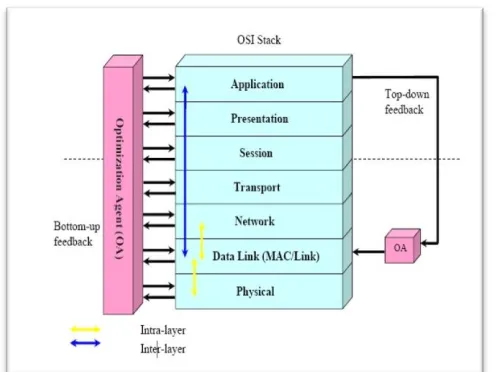
CONCEPT OF CROSS-LAYERING
Figure 1: Cross-layering concept in OSI Stack II. RELATEDWORK
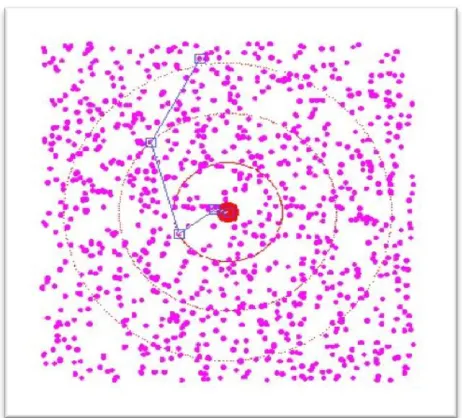
The new MAC protocol name is CROSS-LAYER INTERGRATED-MAC protocol which is advance version of the ADAPTIVE S-MAC (A S-MAC). In A-S-MAC protocol the adaptive listening is used to make the protocol more efficient. On the other hand in case of CI-MAC protocol to remove the problem of power consumption due to idle listening and overhearing the cross-layer data is used. The CI-MAC protocol design a network in which one sink is present at the middle and the nodes are deployed in a ring form, the ring is from1, 2…8.the simple geographical information is used in this network and ring identification (RI) number is used. When the data sends from source to sink the ring identification number is connected with the header frame. Every sensor node puts its RI number on header before sending the data to next-hop [7].
In case of A-S-MAC protocol, the starting of the information interchange is done using RTS and all the other neighbor nodes are silence rather than next receiver nodeand in case of S-MAC protocol adaptive listening take place due to large number of next hops candidates to nodes. So, due to adaptive listening the power consumption is take place. In CI-MAC protocol the author generate new function in which when the sender node sends the data it will choose the next-hop which is present in the next inner ring means with smaller RI and which is close to the sink and which is in the range of the sender node. Using this function, the next hop coordinators are limited and power consumed due to idle listening and overhearing is reduced. Another function proposed by the author is RTR. The request to receive (RTR) frame is used in place of RTS/CTS. By using this function the adaptive listening is reduced and the sender sends RTR to receiver to receive the information. When the node sends RTR it will select a random back-off to reduce the collision with other sensor nodes which are consider our self next hop node. This process decrease power reduction due to overhead.
Other new MAC-protocol name is cross layer power alternative –MAC (CLPA-MAC) which is advance version of the S-MAC and PCS-MAC protocol. In case of S-MAC protocol we study the RTS/CTS/DATA/ACK, all the data is send on same power level. So, the power consumption is high.
On the other hand in case of PCS-MAC protocol the data is send at different power level. In case of CLPA-MAC protocol the author generate a new the format of data frame in which RTS/CTS/DATA/ACK are present to adjust the different situation power and cross-layer method. The frame is dividing into two parts, HEAD and BODY.
TABLE 1: FORMAT OF DATA FRAME
In the above table, the format of data frame is shown, header is consists of frame control/ time interval/SA/DA/SC and on the other hand DATA and FCS are present in body of the frame. The head of frame is send at high power level so the neighbors of transmitter known that he is busy, but the body of the frame is transmitted at low energy level. When the sender has information to send, it can transmit the header of the frame at different level of energy so that the collision and power consumption is controlled. The CLPA-MAC protocol is table based protocol. In this protocol the table driven routing is used to locate the parent node and children nodes, when a sensor nodes wish to link communication. By use of the routing table in the network it is not necessary to take power level for all neighbor nodes.The simulation result is show that the power consumption is less in case of CLPA-MAC protocol and due to less collision the end-to-end delay is reduced [8].
III. PERFORMANCE EVALUATION
The MATLAB software is used for simulation in this proposed work. The simulation is conduct to evaluate the working of our proposed multiple sink with high power MAC protocol with single sink with high power header MAC protocol and single sink MAC protocol. Conclusion of this proposed work shows that multiple sink increase the lifetime, minimize end-to-end delay and increase the energy efficiency.
IV. RESULTANALYSIS
The simulation parameters used for our experiments are discussed in this section A. The simulation results are discussed in B.
A. SIMULATION PARAMETERS
Table 2: Simulation parameters Parameters Values
Network size 420m X 420m
Transmission power 36mW
Reception power 15mW
Sleep power 15/1000mW
Idle power 14mW
Number of nodes 1000
Packet size 1 bit
Figure 2: Single Sink in ring form structure
Figure 3: Simulation of single sink without high power header
Figure 4: Simulation of single sink with high power header
B. SIMULATION RESULTS
MATLAB tool is used to get the simulation results. We evaluate the energy consumption and end-to-end delay results with a linear four-hop network topology in single sink and multiple sink. Simulations of single sink with or without high power header and multiple sink with high power header executed to examine the average power consumption and average end-to-end delay.
1) END–TO-END DELAY:
Figure 6 shows the average end-to-end delay of single sink, single sink with high power header and multiple sinks with high power header. As shown in fig. single sink and single sink with high power header both overlap each other, there end-to-end delay is same. On the other hand in multiple sinks, the end-to-end delay is less as compare to others. In this starting node is same but routing path is different because nodes sends there data to closest sink.
Figure 6: Average End-To-End Delays
2) POWER CONSUMPTION COMPARISON:
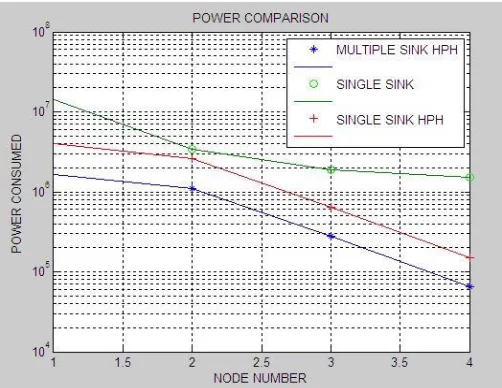
Figure 7 shows the average power consumption of single sink, single sink with high power header and multiple sink with high power header. In this fig. the MSH consumed less power as compare to SS and SSH. So the network life time of MSH is more than other two.
Figure 7: Average Power Consumption V. CONCLUSIONS AND FUTURE SCOPE
A.CONCLUSIONS
The main aim of this thesis is to reduce energy consumption in WSN by making the nodes in sleep mode using high power header and also using the multiple sinks instead of single sink. Reducing the transmission power based on the distance to the receiver is one of the main schemes proposed in this proposed work. When the neighbor nodes are very close to the source node then the power required for transmitting the data will be very less. This is one of the ways where energy can be saved. Sometimes the transmitting power will be less than the receiving power. The high power header used in this proposed work leads the neighbor nodes which are in the range of the transmitter and receiver nodes goes to sleep mode rather than idle mode and as a result the energy consumption will decrease in both transmission and reception. In case of using multiple sink the nodes transmit their data to closest sink, the distance factor get reduced.
B. FUTURE SCOPE
Future work can be concentrated on increasing the lifetime of network by efficient deployment of multiple sink in the network. The effect of varying the range of the rings might prove beneficial to lifetime. Optimum physical layer parameters may further improve the lifetime. The effect of different topology, multi-hoping and network size can be verified. Also, the mathematical analysis of the aggregated energy consumption in the whole network can be done.
REFERENCES
1. I.F. Akyildiz, W. Su, Y. Sankarasubramaniam, and E. Cayirci. Wireless Sensor Networks: A Survey. Computer Networks, 38:393–422, 2002.
3. Raymond Knopp, Navid Nikaein, Christian Bonnet, Herve Aiache, Vania Conan, Sandrine Masson, Gregoire Guibe, and Christophe Le Martret, “Overview of the WIDENS Architecture: A Wireless Ad Hoc Network for Public Safety,” IEEE SECON 2004, Oct 2004.
4. Sanjay Shakkottai, Peter C. Karlsson, and Theodore S. Rappaport, “Cross-Layer Design for Wireless Networks,” IEEE Vol. 41, Issue 10, pp. 74-80, Oct 2003.
5. Vikas Kawadia and P. R. Kumar, “A cautionary perspective on cross-layer design,” IEEE Wireless Communications, Vol. 12, Issue 1, pp. 3-11, Feb 2005.
6. Jamal N. Al-Karaki and Ahmed E. Kamal, “Routing techniques in wireless sensor networks: A survey;” IEEE Wireless Communications, Vol. 11, Issue 6, pp. 6-28, Dec 2004.
7. Niafar Samira and Shahhoseini Hadi Shahriar, et al, “Design a Cross-Layer Integrated MAC and Routing Protocol for Surveillance Systems Using WSNs,” 9781-4244-3941-6/09/$25.00 ©2009 IEEE