e-ISSN: 2278-487X, p-ISSN: 2319-7668. Volume 20, Issue 4. Ver. V (April. 2018), PP 31-41
www.iosrjournals.org
Internal Control Systems and Financial Performance of Public
Institutions of Higher Learining in Vihiga County, Kenya
Andrew Govedi Kisanyanya
*MBA student, Kenyatta University, Kenya-Job Omagwa, PhD
*School of Business, Department of Accounting & Finance, Kenyatta University, Kenya Corresponding Author: Andrew Govedi Kisanyanya
Abstract
: Most public institutions of higher learning across the world have reported suboptimal financial performance compared to private institutions of higher learning. The poor financial performance can be attributed to financial management practice. The sound financial management practices require the institutions of robust internal control systems. However, there are limited empirical research findings regarding the relationship between the internal control system and financial performance. The specific objectives of the study were: to determine the effect of control activities, risk assessment, control environment, information and communication and monitoring on financial performance of institutions of higher learning in Vihiga County, Kenya. The study was anchored on agency theory, stewardship theory, positive accounting theory and attribution theory. The study used a descriptive research design. The target population of respondents was 140 employees in the four institutions studied whereas the sample size was 96 employees. Primary data was collected from sample population using semi-structured questionnaires. Descriptive and multiple regression analysis were used to analyze data. The study found that the institutions had adequate and effective control activities which included regular internal audit reports, adequate segregation of duties in the finance and accounts departments and physical controls to prevent excess allocated funds. Control activities were found to have a positive significant effect on the financial performance of the institutions under study. The study found that the institutions under study had proper risk assessment tools and risk assessment management system because they carried out continuous financial assessment of their organizations coupled with regular, timely and profound audits. Risk assessment was found to have a positive significant effect on the financial performance of the institutions under study. The study established that the institutions had effective control environment. The number of staff in finance and audit departments was adequate and well trained on accounting and financial management system. Control environment was found to have a positive andsignificant effect on the financial performance of the institutions under study. The study found that the institutions had effective flow of information and communication channels. In addition, the study found that effective flow of information and communication enhanced financial accountability and financial performance of the institutions. The expenditure of the institutions was properly monitored and audit departments were independent. Financial monitoring was found to have a positive andsignificant effect on the financial performance of the institutions under study. To the management of the public institutions of higher learning, the study recommends regular and timely financial audit to help them identify any loop holes in their financial systems as well as financial performance.Key Words:
Financial Performance, Internal Control Systems and Public Institutions.--- --- Date of Submission: 09-04-2018 Date of acceptance: 23-04-2018 ---
---I.
Introduction And Background
Financial performance is the ability of an organization to run its operations efficiently to be able to create profits (Sebbowa, 2009). This study used Ray and Kurt’s definition of systems of internal control. Internal control Systems comprises of different elements hence this study only considered five aspects of internal control. These variables included; control activities, Control environment, Risk assessment, Information and communication as well as Monitoring. The dependent variable of the study was financial performance and it was measured in terms of financial reporting, surplus as well as financial accountability. Donald and Delno (2009) indicate that over the past two decades, institutions have capitalized on internal control systems to improve organizational productivity.
preparations, asset protection, resource optimization, error detection and prevention of fraud (Alvin et al., 1993). A reliability of financial reporting is depended on the efficiency of internal controls that provide efficiency transactions, effective book keeping and adequate system authorization. In addition, it is imperious that institutions have good disclosure of the summarized accounting information (Sebbowa, 2009). Generally, internal control systems greatly influence the nature, type and quality of financial reporting. Dixon et al., (1990) stated that when an organization has effective measures of performance, it is able to concentrate on achieving its goals and objectives. Mawanda (2008) poised that it is believed that proper internal controls led to better financial performance, efficient reporting process, more reliable reports and increased financial accountability. One of the administrative responsibilities of the organization is preparation of trustworthy, accurate and timely financial information that enhance effective management of the organization.
An institution of higher learning offers education and research and grants academic awards at levels of Postgraduate, Degree, Diploma, and Certificate in a variety of subjects as guided by the institutions’ statutes. In Kenya, public institutions of higher learning are created under the Act of Parliament to conduct research in different fields with the help of their qualified staff (Onsongo, 2007). The success of an institution is measured by its ability to conduct outreach programs, extension services and research. In 1990s, Kenyan economy was liberalized and parastatals were privatized creating massive changes in the nature of service delivery and development of performance goals as well as strategies (Slack, 2007). Public institutions of higher learning, like other government institutions and parastatals, operate within such an environment and are therefore environment dependent. Public institutions of higher learning have been changing to survive and compete effectively due to economic instability, liberation, and new government policies. Vihiga County is one of the 47 counties in the Republic of Kenya. Vihiga County is home to Kaimosi Teachers Training College, Kaimosi Friends University College, Eregi Teachers Training College and Kaimosi Friends College of science and technology. Hence, the study sought to establish the effect of Internal Control Systems on Financial Performance of public institutions in Vihiga County, Kenya.
II.
Research Problem
The internal control is an essential tool for corporate governance to enhance effective and reliability of financial reporting (Skaife et al., 2007). Such controls further provide total assurance that the targets set by the organization will be achieved (Gerrit & Abdolmohammadi 2010). Normally, internal control systems are set up by organization to aid them in meeting their objectives, ensure generation of reliable financial reports, increase organizational compliance to financial regulations as well as prevent loss of organizational resources (Emasu, 2010). Active involvement and proper financial management of public Institutions of Higher Learning by their management has fostered growth and prosperity of these institutions. Despite the documented benefits of adopting such systems, it remains unclear if such systems significantly affect financial performance of public institutions of higher learning in Kenya. And this formed a good basis for further empirical investigation.
However, related empirical literature such as Ndiwa (2014) and Ndifon (2014) found that organizational internal controls and financial performance is an understudied area, (Gerrit & Abdolmohammadi, 2010). Some of the challenges experienced concerning internal controls include; low liquidity ratios, untimely financial reporting, low accountability, frauds and mismanagement of funds. Mohammed, (2003) researched on the effect of the internal controls of Ethiopian Airlines in Nairobi, Esmailjee, (1993) carried out a case study of internal controls of Nyayo Bus Service Corporations in Nairobi and Chira, (2009) found out that various internal control systems do exist in the banking and transport industries although more weight had been given to operational controls compared to other types of controls. Simiyu (2011) found that middle institutions of learning in Kenya had a number of internal control challenges. They included liquidity problems, poor financial accountability, and untimely generations of financial reports, frauds, and misuse of institutional funds. However, the study did not focus on the study variables of this study as well as none of them were conducted in Vihiga County. This study was motivated by the fact that there are many unaddressed areas about internal control in relation to financial performance of tertiary institutions and the fact that there are no earlier related empirical studies on internal control systems and financial performance in institutions of higher learning in Vihiga County, Kenya.
III.
Objectives of the Study
The study sought to achieve the following specific objectives:
(i) To determine the effect of control activities on financial performance of public institutions of higher learning in Vihiga County, Kenya.
(ii) To establish the effect of risk assessment on financial performance of public institutions of higher learning in Vihiga County, Kenya.
(iv)To establish the effect of information and communication on financial performance of public institutions of higher learning in Vihiga County, Kenya.
(v) To establish the effect of monitoring on financial performance of public institutions of higher learning in Vihiga County, Kenya.
*Null hypotheses were formulated (in view of each respective specific objective) and tested at a significance level of 0.05.
IV.
Significance of the Study
The recommendations of the study are of interest to the management of public institutions of higher learning who would be interested to come up with various ways in which to improve their efficiency and effectiveness through the use of proper internal control system in all their operations. Furthermore the study helps to inculcate scientific and inductive thinking and promotes the development of logical habits and thinking by all staff in the organization. The government and policy makers will gain insight on the critical role of internal controls in the financial performance of public institutions of higher learning. The policy makers will be informed on the type of internal controls to incorporate in public institutions of higher learning. Other institutions will benefit through the understanding of the important role that the internal control systems play in enhancing accountability and effect on financial performance. Academicians and future researchers who will be undertaking other researches related to this. This is because it increases their knowledge on internal control and provides the necessary information to be incorporated into their work. The study also helps them come up with better proposals on internal control and their effects on financial performance of public institutions of higher learning in Vihiga County, Kenya.
V.
Review of Literature
Relevant key theories were reviewed to support the theoretical anchorage of the study besides conducting an empirical review of related studies.
1. Theoretical Review
The study considered the three theories which are agency, stewardship, positive accounting and attribution theories. Agency theory focuses on the behavioral relationship between the owners (principals) and those others (agents) who are contracted by the owners to execute duties on behalf of the principal where the agent is given some decision making power. It is also used to define the relationship between managers and investors by defining the duties and responsibilities ran by the manger on behalf of the investor and the reward that the manager receives from the investor (Jensen & Mckling, 1976). The theory further poised that managers are more informative than investors making it hard for investors to effectively determine whether their interests are well taken care of. Therefore, the theory stated that there is need to have proper and adequate contracts in an organization to minimize opportunistic behaviors by the managers (Mwangi, 2012). To address the interest of both the manager and investor, the contract should draft in a manner that captures the two interests. A good agent-principal relationship is whereby the investor has systems that enable them to effectively monitor the work of their managers (Jussi & Petri, 2004). The theory also stated that incomplete contract information on the expectation of the investors as well as the managers could have adverse effects on the general performance of the organization. This is because the managers will have inadequate knowledge on what is expected of them by the agents leading to under-performance. Therefore, this theory assumes the nature of the relationship between managers and agent is based on wealth maximization (Jensen & Meckling, 1976). This theory is relevant to the study since internal control mechanisms are established in organizations to minimize agency cost and improve general organizational performance (Payne, 2003; Abdel-Khalik, 1993). This study borrows from this perspective and makes assumptions that the owners of the institutions of higher learning have given mandate to the management of these institutions to effectively manage their resources and ensure smooth running of the institution on a daily basis through delegation of duty. Effective internal control systems ensure that investors’ interests are well taken care of. In addition, this theory supports existence of control activities, control environment and risk management.
is necessary for managers to be good overseers while Shleifer, Andlei and Vishny (1997) claimed that the financial return given to the investors by the managers creates good reputation and it also encourages the investors to re-invest with them. In Agency theory, Meckling and Jensen (1994) stated that agency cost is usually lower when the investors form part of the management of the organization for monitoring purposes. However, stewardship theory is complete opposite of the agency theory since it does not advocate for investors monitoring of the organizational performance through internal audit. Nonetheless, Donaldson and Davis (1991) further noted that better financial returns are experienced when these theories are jointly exercised in an organization. Based on this theory, this study works on the view that managers of institutions of higher learning act as caretakers of suppliers, shareholders, consumers, creditors and employees of these institutions.
According to positive accounting theory, accounting research can either be positive or normative research. Positive accounting researches forecast and explain certain accounting elements. Theories aligned to positive accounting research are normally called positive theories. They are based on observations that can be tested and improved over time; normative theories are anchored on beliefs and they describe how certain accounting practices should be executed (Deegan & Unerman, 2006). Watts and Zimmerman (1986) developed positive accounting theory and it states which accounting method a firm is supposed to use and which one it is not supposed to use. This theory assumes that people are opportunistic and they are driven by self-interest in wealth creation and maximization (Deegan & Unerman, 2006). Based this, organizations embrace internal control systems that will cater for the needs of the managers and investors to monitor operational costs of the organization. This theory explains the existence of monitoring, risk assessment, control activities as well as control environment in the public institutions of higher learning.
Attribution theory explains how behavior and events are interpreted as well as their causes (Schroth & Shah, 2000). Reffett (2007) asserted that assessors attribute difference in handling similar situations to difference in personality while the difference is attributed to situational behavior. Similar sentiments were shared by Wilks and Zimbelman (2004) and Schroth and Shah (2000). Similarly, assessors often deduce internal control failure on auditors’ negligence as well as generation of revenue. Bonner et al. (1998) said that when fraud that could affect the financial performance of an organization is not pointed out by the auditor, he/or she is likely to be sued. Reffett’s (2007) further stated that auditors’ inability to detect fraud risk can be very detrimental for an organization. Attribution theory stated that auditing determiners the efficiency of internal control systems of the organization. Therefore, they need to have an adequate understanding of the organizational internal control for proper revenue generation. This theory is relevant to the study since it proposes that control activities like internal audits are key elements of control systems that they help to prevent fraud.
2. Empirical Review
The study reviewed various studies drawn from different industries and different countries as captured hereunder. Ndiwa (2014) studied how financial performance of African Institute of Research and Development Studies was influenced by internal control systems. The study was conducted in African Institute of Research and Development Studies campuses only. The study established that these institutions had adequate resources but weak financial performance leading to closure of some of them. The study pointed out the existence of internal control strategies and audit department. However, the audit department did not have adequate staff. The study established the existence of a positive relationship between financial performance and internal control. In addition, the staff of the audit department had a significant effect on the general finance performance of the institution.
Ndifon (2014) studied the role of internal control activities on the financial performance in tertiary institutions in Nigeria. The study was carried out at Cross River State College of Education, Akamkpa. The findings of the study indicated that all the control activities in the institution were spearheaded by the management. In addition, there was separation of duties among the employees in the finance department and there was consistent supervision of work by the superiors. In addition, the school conducted annually external audit of financial statements. However, there existed no statistical significant relationship between financial performance and internal control activities. The study showed lack of effective transactional checks and balance and security to reduce theft and fraud. In addition, the college failed to conduct regular staff training.
Kamau, (2014) explored how financial performance of manufacturing firms in Kenya were affected by internal controls. The study found out that most of the companies had proper control environment which positively influenced their financial performance, the staffs of the companies under study were well trained on financial management systems and the organizations had security systems to protect their assets and prevent fraud. Regression analysis indicated the existence of a significant positive financial performance and internal control. Palfi and Muresan (2009) studied the significance of proper internal control system in the baking industry. The study findings showed teamwork between the management and internal audit department through regular meetings. Abu Musa (2010) found out that many banks in Saudi had embraced information technology and communication and they also had proper and effective security controls. In addition, the management and staff of the bank were well trained in computerized accounting information systems (Simiyu, 2011).
VI.
Methodology
This study adopted a cross-sectional descriptive survey design since it provides a clear outcome and the characteristics associated with it at a specific point in time. The descriptive design was relevant for this study since it focuses at one point in time and does not require several rounds of monitoring. The descriptive survey attempted to document current conditions to describe what exists at the moment (Mouser & Katton, 1989). The target population for this study consisted of 140 employees of four public institutions of higher learning in Vihiga County, Kenya. A purposive sampling approach was used in this study to allow the research to pick concerned staff especially from the accounts/finance, administration, and operations department within the four public institutions of higher learning in Vihiga. To ensure that the sample size was representative of the population, the sample size was 96 staff drawn from all departments of the institutions. Primary data was collected using a semi-structured questionnaire. The questionnaire was the best data collection tool because the study participants are literate. In addition, the use of questionnaire ensured that the researcher upholds respondents’ anonymity and confidentiality while allowing the researcher to collect data faster from a wide population (Kothari, 2007). Data analysis is the process of data cleaning, coding and editing as well as error checking. Data was analyzed using descriptive analysis (mean and standard deviation).The collected Data was fed into computer programs (using particularly the Statistical Package for Social Scientist-SPSS) for easy analysis and explanation of results. Data was presented in charts and tables. Multiple regression analysis was used to show the statistical relationship of the variables as captured below:
Y= α + β1X1 + β2X2 + β3X3 + β4X4 + β5X5 + ɛ Where:
Y = Financial Performance X1 = Control environment X2 = Risk assessment X3 = Control Activities
X4= Information and Communication X5 = Monitoring
α = Constant ɛ = Error term
VII.
Results And Findings
A. Descriptive Analysis
Firstly, respondents were asked to state whether control activities affected financial performance of public institutions of higher learning in Vihiga County, Kenya. The findings of the study indicated that majority of the respondents agreed that control activities affected financial performance by ensuring proper planning and proper utilization of resources. The mean of this statement was 1.23 and the standard deviation was 0.43. Moreover, the study found that majority of the respondents agreed that there were regular internal audit reports generated in their institutions, there was adequate segregation of duties in the finance and accounts departments, there were physical controls to prevent excess allocated funds and there was proper checks of every employee’s work by the others as well as adequate corrective action was taken to address weaknesses in audit reports. Secondly, the respondents were asked whether risk assessment affected financial performance of their institutions.
Table 1: Risk Assessment and Financial Performance
Item Response Percentage Mean Standard
Deviation Does risk assessment affect financial performance
of the institution?
Yes 71.4 1.29 0.46
No 28.6
The findings of the study indicated that majority of the respondents agreed that risk assessment affected financial performance of their institutions by safeguarding the institutions’ assets and enhancing financial performance. These findings have been supported by the mean of 1.29 and a standard deviation of 0.46. Table 1 above illustrates the findings of the study.
Thirdly, the study sought to establish whether their institutions had proper control environment.
Table 2: Control Environment
Item Response Percentage Mean Standard
Deviation Does the institution have conducive control
environment?
Yes 62.9 1.37 0.49
No 37.1
Source: Research data, 2017
The findings of the study revealed that majority of the respondents agreed that their institutions had effective control environment and adequately staffed finance and audit departments. The results also indicated that the staff was well trained on accounting and financial management system, senior staff authorized access to valuable information and their institution accounting and financial management system safeguarded the institutions’ assets. These findings have been supported by the mean of 1.37 and a standard deviation of 0.49. Table 2 above illustrates the findings of the study.
The respondents were further asked whether control environment affected financial performance of their institutions.
Table 3: Control Environment and Financial Performance
Item Response Percentage Mean Standard
Deviation Does control environment affect financial
performance of the institution?
Yes 71.4 1.29 0.46
No 28.6
Source: Research data, 2017
The findings of the study indicated that majority of the respondents agreed that control environment affected financial performance of their institutions. These findings have been supported by the mean of 1.29 and a standard deviation of 0.46. Table 3 above illustrates the findings of the study.
The study sought to evaluate the effect of control environment on the financial performance of public institutions of higher learning in Vihiga County, Kenya.
Fourthly, the study sought to establish whether their institutions had effective flow of information and communication.
Table 4: Information and Communication
Item Response Percentage Mean Standard
Deviation Does the institution have effective information and
communication?
Yes 72.9 1.27 0.45
No 27.1
Source: Research data, 2017
The findings of the study indicated that majority of the respondents 72.9 percent agreed agreed that their institutions had effective flow of information and communication with a mean of 1.27 and a standard deviation of 0.45. Table 4 above illustrates the findings of the study.
The respondents were further asked whether information and communication affected financial performance of their institutions. The results of this analysis are as provided below in table 5 below.
Table 5: Information and Communication and Financial Performance
Item Response Percentage Mean Standard
Deviation Does information and communication affect
financial performance of the institution?
Yes 77.1 1.23 0.42
No 22.9
The findings of the study indicated that majority of the respondents agreed that information and communication affected financial performance of their institutions with a mean of 1.23 and a standard deviation of 0.42. The study established that effective information and communication prevent wastages of resources and duplication of duties. The results of this analysis are as provided in table 5 above.
Fifthly, the respondents were asked whether financial monitoring affected financial performance of their institutions.
Table 6: Monitoring and Financial Performance
Item Response Percentage Mean Standard
Deviation Does financial monitoring affect financial
performance of the institution?
Yes 80.0 1.20 0.40
No 20.0
Source: Research data, 2017
The findings of the study indicated that majority of the respondents agreed that financial monitoring affected financial performance of their institutions with the mean of 1.2 and a standard deviation of 0.40. The study established that financial monitoring prevent wastages of resources and enhanced financial accountability. Table 6 illustrates the findings of the study.
The respondents were further asked whether internal control systems affected financial performance of the institution. The results of this analysis are as provided in table 7 below.
Table 7: Financial Controls and Financial Performance
Item Response Percentage Mean Standard
Deviation Do internal control systems affect financial
performance of the institution?
Yes 80.0 1.20 0.40
No 20.0
Source: Research data, 2017
The findings of the study indicated that majority of the respondents 80 percent agreed to statement with a mean of 1.20 and a standard deviation of 0.40. Table 7 illustrates the findings of the study.
In addition, the study sought to establish whether the institutions under study had a stable financial performance over the last five years. The results of this analysis are as provided in the table 8
Table 8: Stable Financial Performance
Item Response Percentage Mean Standard
Deviation Do you consider the financial performance of your
institution to have been fairly stable over the last five years?
Yes 74.3 1.26 0.44
No 25.7
Source: Research data, 2017
The findings of the study indicated that majority of the respondents 74.3 percent agreed to statement with a mean of 1.26 and a standard deviation of 0.44. These results were attributed to proper use of resources and expansion of the institutions. However, some of the respondents had dissenting opinion due to embezzlement of funds. Table 8 above illustrates the findings of the study.
B. Regression Analysis
Table 9: Model Summary
Model R R Square Adjusted R Square Std. Error of the
Estimate
1 .533a .284 .228 5.7314
Source: Research data, 2017
In view of table 9, above, the coefficient of correlation (R) of 0.533. This is an indication of a fairly average positive correlation between internal control systems and financial performance of institutions of higher learning in Vihiga County, Kenya. The coefficient of determination indicates that internal control systems explain 28.4% of financial performance of institutions of higher learning in Vihiga County. The adjusted R2 however, indicates that internal control systems explain 22.8% of financial performances of institutions of higher learning in Vihiga County whereas 77.2% to be influenced by other factors that were not captured in this study.
The findings of the study differ with the study of Ndiwa (2014) which established the existence of a positive relationship between financial performance and internal control. In addition, the staff of the audit department had a significant effect on the general finance performance of the institution. Ndifon (2014) showed that there existed no statistical significant relationship between financial performance and internal control activities.
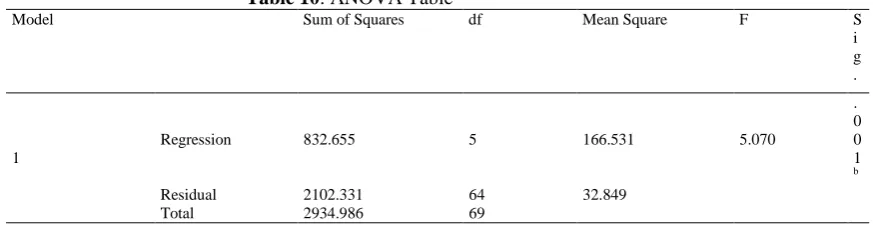
The table below shows the ANOVA result for the effect of internal control systems on financial performance of public institutions of higher learning in Vihiga County, Kenya.
Table 10: ANOVA Table
Model Sum of Squares df Mean Square F S
i g .
1
Regression 832.655 5 166.531 5.070
. 0 0 1 b
Residual 2102.331 64 32.849
Total 2934.986 69
Source: Research data, 2017
Table 10 above shows the Analysis of Variance (ANOVA). The f-value of the ANOVA was found to be 5.070 while p-value was 0.001 which is < 0.05. These results indicated that the model is statistically significant hence, internal control systems collectively have a significant effect on financial performance of institutions of higher learning in Vihiga County. Hence, internal control systems are good predictors of financial performance.
To establish the effect of internal control systems on financial performance, regression analysis was done to determine the relationship between internal control systems and financial performance of public institutions of higher learning in Vihiga County, Kenya. The results of this analysis are as provided below in table 11
Table 11: Coefficientsa
Model Unstandardized
Coefficients
Standardized Coefficients
t Sig.
B Std.
Error
Beta
1
(Constant) 22.671 5.107 4.440 .000
Control Activities .142 .178 .090 .800 .027
Risk Assessment .013 .227 .007 .059 .013
Control Environment .264 .194 .181 1.363 .018
Information and Communication .002 .162 .002 .010 .049
Monitoring .668 .212 .417 3.147 .003
From the Coefficients Table 11 above, the regression model can be derived from the un-standardized coefficients as follows:
Y = 22.671 + 0.142X1 + 0.013X2 + 0.264X3 + 0.002X4 + 0.668X5
The results in Table 11 indicated that control activities, risk assessment, control environment, information and communication and monitoring have a significant positive effect on financial performance of institutions of higher learning in Vihiga County because their p-values were less than 0.05. The most influential variable was monitoring with a regression coefficient of 0.668 (p-value = 0.003), then control environment with a coefficient of 0.264 (p-value = 0.018), then control activities with a coefficient of 0.142 (p-value = 0.027), then risk assessment with a coefficient of 0.013 (p-value = 0.043), and lastly information and communication with a coefficient of 0.002 (p-value = 0.049). According to this model when all the independent variables values are zero, financial performance of will have a score of 22.671.Since all the p-values were less than 0.05, then it means that all independent variables had a significant effect on financial performance of all the public institutions of higher learning under study.
These results imply that a unit increase in control activities could result to increase in financial performance by 0.142 all else held constant; a unit increase in risk assessment could result to increase in financial performance by 0.013 all else held constant; a unit increase in control environment could result to increase in financial performance by 0.264 all else held constant; a unit increase in information and communication could result to increase in financial performance by 0.002 all else held constant; and a unit increase in financial monitoring could result to increase in financial performance by 0.668.
VIII.
Key Findings and Discussions
The study documents several findings in view of the results. Firstly, the study findings revealed that the institutions under study had adequate and effective control activities which included regular internal audit reports, adequate segregation of duties in the finance and accounts departments and physical controls to prevent excess allocated funds. The findings of the study are in line with the findings of Ndifon (2014), which showed that all the control activities in the institution were spearheaded by the management. In addition, there was separation of duties among the employees in the finance department and there was consistent supervision of work by the superiors. In addition, the school conducted annually external audit of financial statements.
In addition, the institutions had proper checks of every employee’s work as well as adequate corrective action was taken to address weaknesses in audit reports. From regression analysis, a unit increase in control activities could result to increase in financial performance by 0.142. The findings of the study are in line with the findings of Kamau, (2014) which found that proper control environment positively had a significant positive effect on their financial performance, the staffs of the companies under study were well trained on financial management systems and the organizations had security systems to protect their assets and prevent fraud. Regression analysis indicated the existence of a significant positive financial performance and internal control activities.
The study sought to establish the effect of risk assessment on the financial performance of public institutions of higher learning in Vihiga County, Kenya. The study found out that the institutions under study had proper risk assessment tools and risk assessment management system because they carried out continuous financial assessment of their organizations coupled with regular, timely and profound audits. The findings of the study were concurrent with the findings of Ndiwa (2014) that pointed out the existence of internal control strategies and audit department are risk management techniques employed by institutions. Palfi and Muresan (2009) showed teamwork between the management and internal audit department through regular meetings. The results also indicated that all employees were well trained on risk assessment and risk assessment affected the institution’s revenue for the last five years. From regression analysis, a unit increase in risk assessment could result to increase in financial performance by 0.013. The findings of the study have been concurrent by the findings of Amudo and Inanga (2009) that stated that risk management had a positive significant effect on the financial performance of institutions.
Exchange companies. These findings were seconded by the findings of Mawanda (2008) that stated that effective implementation of proper control systems may improve the financial performance of an organization.
The study sought to evaluate the effect of information and communication on the financial performance of public institutions of higher learning in Vihiga County, Kenya. The study found out that the institutions under study had effective flow of information and communication channels. The institutions had modern and efficient information and communication technologies to enhance adequate transfer of information, excellent record of transactions and proper accountability for assets. The findings of the study is in agreement with the findings of Amudo and Inanga (2009) which shows that information and communication is a key ingredient in internal control system because it influences the nature of working relations across the different organizational levels. In addition, the study found that effective flow of information and communication enhanced financial accountability and financial performance of the institutions. From the regression analysis, a unit increase in information and communication could result to increase in financial performance by 0.002. The findings of the study have been concurrent by the findings of Abu Musa (2010) which found out information technology and communication had a positive influence on financial performance of banks.
The study sought to evaluate the effect of monitoring on the financial performance of public institutions of higher learning in Vihiga County, Kenya. The study sought to evaluate the effect of financial monitoring on the financial performance of public institutions of higher learning in Vihiga County, Kenya. The study established that the institutions had effective monitoring and evaluation activities. The expenditure of the institutions was properly monitored and audit departments were independent. The findings of the study have been concurrent by the findings of Theofanis et al., (2011) that stated that effective internal control system requires regular monitoring to ensure effective and efficient system performance over time. Monitoring of internal control systems ensures quality reviews and audits. In addition, the institutions had proper supervisory activities to enhance accountability and transparency and they held regular management meetings to assess the financial status of the institutions. From regression analysis, a unit increase in financial monitoring could result to increase in financial performance by 0.668. The findings of the study have been concurrent by the findings of Amudo and Inanga (2009) that stated that monitoring of organizational operations increases efficiency of the internal control system. Therefore, monitoring help the management of an organization to assess whether organizational policies drafted are effectively and efficiently implemented by the staff of the organization.
IX.
Conclusions and Recommendations
In view of the study findings, we concluded that public institutions of higher learning in Vihiga County, Kenya have effective internal control systems as supported by the study findings of clear separation of roles, supervision and commitment of management, proper communication channels, efficient internal audit management systems and clear policies and procedures. It is evident from the findings that the dimensions of internal control systems thus control activities, control environment, risk assessment, information and communication and monitoring have a significance effect on the financial performance of Public Institutions of Higher Learning in Vihiga County, Kenya. In particular, the study concludes that there is a significant positive relationship between internal control systems with financial performance of the public institutions of higher learning in Vihiga County, Kenya.
X.
Contribution to Knowledge
This study contributes to the body of knowledge both in methodology, theory and practice. The results of the study help in identifying the gaps within the internal control systems in public institutions of higher learning in Kenya. It is also of invaluable benefits to management and those charged with governance and training in the institutions under study on how to streamline the systems of internal controls thus ensuring improved financial performance and ultimately ensures attainment of the institutional objectives. The development partners who are usually interested at helping the Public Institutions of Higher Learning to modernize the training facilities will have an understanding of a wide variety of factors that hinder the growth of public institutions of higher learning hence financial sustainability. Finally, scholars and other researchers who would like to carry out more studies on internal Control systems and financial performance of Public Institutions of Higher Learning will find the study beneficial.
References
[1]. Amudo, A. and Inanga, E.L. (2009). Evaluation of internal control systems: A case study from Uganda. Int. Res. J. Finance and Economics. 3: 124 –144.
[2]. Cooper, D. R and Schindler, P.S. (2003). Business Research Methods. New York: Me Review, 28(3),371- 82.
[3]. Donald K. K & Delno L. A. T (2009) Proposal and Thesis Writing, An introduction. Pauline Publications Africa. Nairobi, Kenya. [4]. Donaldson, L., & Davis, J. H. (1991). Stewardship theory or agency theory: CEO governance and shareholder returns. Australian
Journal of management, 16(1), 49-64.
[5]. Dixon, J.R., Nanni, A.J. and Vollmann, T.E. (1990). The New Performance Challenge – Measuring Operations for World-Class Competition, Dow Jones-Irwin, Homewood, IL.
[6]. Emasu, S. (2007). Public Financial Management – Concepts and Practices. IMF.
[7]. Fama, E. F. (1980). Agency problems and the theory of the firm. The Journal of Political Economy, 88(2), 288-307.
[8]. Gerrit S and Mohammad J. A (2010), Monitoring effects of the internal Audit Function: Agency Theory versus other explanatory variables. International Journal of Auditing. Blackwell Publishing Ltd.
[9]. Jensen, M. C., & Meckling, W. H. (1976). Theory of the firm: Managerial behavior, agency costs and ownership structure. Journal of financial economics, 3(4), 305-360.
[10]. Kamau, C.N. (2013). Effect of internal controls on financial performance of manufacturing firms in Kenya. [11]. Unpublished MBA Management Research Paper, Nairobi: University of Nairobi.
[12]. Mawanda, S. P. (2008). Effects of internal control systems on financial performance in an institution of higher Learning in Uganda: A case of Uganda Martyrs University. Unpublished thesis, Uganda Matyrs University.
[13]. Mugenda, O.M. and Mugenda, A.G. (1999). Research methods: Quantitative and qualitative approaches. MA: Nairobi Acts Press. [14]. Palfi, C. and Muresan, M. (2009) Survey on weaknesses of banks internal control systems, Journal of International Finance and
Economics, 9.
[15]. Sebbowa B, (2009), The role of internal audit function in Organizations. Simiyu O J. (2011). 'Effectiveness of internal control system in Higher Institutions of Learning' Unpublished MBA Project, University of Nairobi.
[16]. Theofanis, K., Drogalas, G. and Giovanis, N. (2011). Evaluation of the effectiveness of internal audit in Greek Hotel Business. International Journal of Economic Sciences and Applied Research, 4(1). 19-34.
[17]. Watts, H. (1999). A Conceptual Framework to Financial Reports and Internal Audits. 20: 753-778.
[18]. Wilks, T., & Zimbelman, M. (2004). Decomposition of fraud-risk assessments and auditors’ sensitivity to fraud cues. Contemporary Accounting Research, 21(3), 719–745.