ISSN 2286-4822 www.euacademic.org
Impact Factor: 3.1 (UIF) DRJI Value: 5.9 (B+)
An Analysis of Angular Velocity at Various Joints
for inside Instep Soccer Kick by Different Level
Players
MOHAMMAD AHSAN KATARINA TOGA RURU Department of Sports and Physical Education School of Humanities and Education
Fiji National University Fiji
Abstract:
instep kick to cause variation in the ball velocity of all level players. But none of the joint’s angular velocity significantly differed to contribute to cause variation in ball velocity.
Key words: Soccer, Kinematics, Angular Velocity, Inside instep kick
Introduction
Soccer is a fall field sports that is extremely popular in many countries. Young children love to play all version of soccer since it is a fast moving, running, and vigorous game. Soccer players work very hard to keep in shape, and to improve their kick. The uniqueness of using the feet to stop and propel the ball the majority of the time makes the skills difficult to learn as well as interesting, for this reason a great deal of practice is necessary to gain control and accuracy in the use of soccer kick. Most of the players don't know that there is a scientifically correct way of going about doing this. Most researches by means of sports biomechanics on soccer have found some very interesting facts that all soccer players would do well to learn. Science and technology boost all researchers develop around the world in field of sports. The scholars have a number of studies relating performance and advancement of soccer players at every mode of game with used biomechanical analysis skills which it to boost sports excellence. The instep soccer kick is the most widely studied (Lees and Nolan 1998; Nunome et al. 2006; Apriantono et al. 2006). A comprehension of the biomechanics of soccer kicking can support the coaching procedure. Coaching experience, combined with knowledge of a mechanical model of the desired performance, is regarded as essential for a coach to standard performance (Elliott 2001; Lees 2002).
areas. Successful kick depends on different factors like angular distance, displacement, speed and velocity of the kick that is well illustrate using biomechanical analysis. Earlier reviews have revealed that biomechanics of soccer movements in-detail (Lees 1996; Lees and Nolan 1998). The (2D) kinematics of the lower limb segments during instep soccer kicks have been previously assessed (Lees 1996; Lees and Nolan 1998). This include analysis of angular distance and angular velocity curves during the kick with the linear kinematics of the different joints. Before the impact of the foot, the speed was higher, the duration of foot-ball contact was shorter and the ball speed was highest. For this, the ball-to-foot speed ratio has been considered as a successful kick (Asami and Nolte 1983; Kellis et al. 2004; Lees and Nolan 1998; Nunome et al. 2006).
Material & Methods
Participants
The ninety nine soccer players from high, medium and low level (Thirty from each group) were selected for this study. All participants were in good health and do not have any injury in the lower extremity. Each participant wore his normal soccer kit and boots.
Experimental Protocol
The anthropometric data of the subject
Table 1
Data collection and analysis
The study was conducted on the field setting. The film recordings were conducted on sunny and clear weather on the soccer ground. Each subject was permitted free approach angle and distance run for the kick. Standard ball (weight 450 grams) was used for all subjects and for the kick. Two cameras would be used for this study. One camera was positioned perpendicular to the sagittal plane and parallel to the mediolateral axis (camera optical axes perpendicular on the sigittal plane) as their kicking leg giving approximately a 90° between their respective optical axes. The camera will focus on the lower limb of the subject when the subject in full swing of kicking foot to get a better outlook. Video footage was captured with JVC Hard Disk video cameras. The cameras were set at sports mode and the sampling rate of the video camera was fifty fields per second. The identified trail were played with the help of Hero Video of Hero Super Player 3000 software to make individual clips of each player for individual kicking skills. The separate clips were then opened on to the Motion Analysis Tool (MAT) software. This software provides to identify the angles, displacement, time and number of frames. Kinematics parameter investigated throughout the kicking motion.
VARIABLE LEVELS MEAN
AGE (Years)
HIGH 20.48
MEDIUM 14.09
LOW 14.21
WEIGHT (kg.)
HIGH 63.12
MEDIUM 53.76
LOW 49.24
HEIGHT (cm)
HIGH 171.29
MEDIUM 161.28
Statistical Analysis
SPSS Software used for to calculate Analysis of Variance (ANOVA) with Least Significant Difference (LSD) post hoc test to determine the means significant difference between different level players during inside instep soccer kicks.
Results
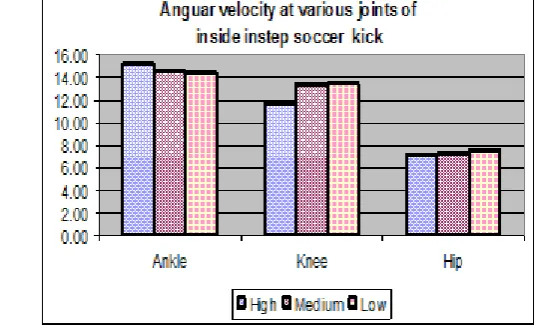
Description of Angular Velocity at Various Joints for Different Level Players of Inside Instep Soccer Kick
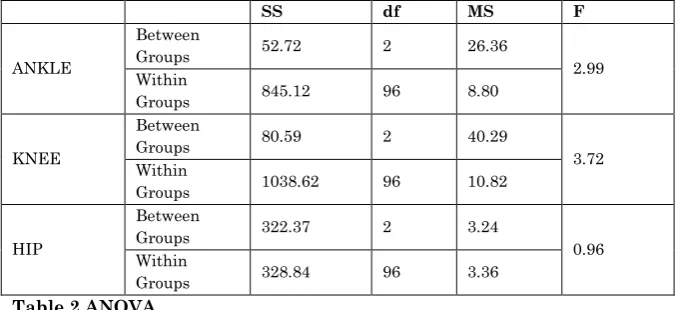
SS df MS F
ANKLE
Between
Groups 52.72 2 26.36
2.99 Within
Groups 845.12 96 8.80
KNEE
Between
Groups 80.59 2 40.29
3.72 Within
Groups 1038.62 96 10.82
HIP
Between
Groups 322.37 2 3.24
0.96 Within
Groups 328.84 96 3.36
Table 2 ANOVA
Dependent
variable Levels (I) Levels (J) Difference (I-J) Sig.
ANKLE
HIGH MEDIUM 1.61* 0.03
MEDIUM LOW 0.14 0.85
LOW HIGH 1.47* 0.05
KNEE
HIGH MEDIUM 1.71* 0.04
MEDIUM LOW 0.35 0.66
LOW HIGH 2.07* 0.01
HIP
HIGH MEDIUM 0.25 0.58
MEDIUM LOW 0.37 0.41
LOW HIGH 0.62 0.17
Table 3 Multiple Comparisons
* The mean difference is significant at the .05 level.
The comparisons of Least Significant Difference (LSD) for mean of angular velocity of joints during inside soccer kick has been computed and presented in Table-3. The table reveals that high and medium levels; high and low levels for ankle joints, high and medium levels; high and low levels player for knee joint showed significant mean difference. Whereas medium and low level players for ankle joint; medium and low level players for knee joint, high and medium level; medium and low level and high and low level players for hip joint showed no significant mean difference for angular velocity during inside instep soccer kick.
Discussion
The result of investigations accomplished by Kellis et al. 2004 and Nunome et al. 2006 showed that the speed of the foot before impact is the higher, foot-ball contact is shorter and speed of the ball is high. For this, the foot to ball speed ratio has been measured as an index of a useful kick. Nunome et al. (2002) show that the angular velocity of the hip increased the side-foot kick rapidly during the leg- acceleration phase, while the instep kick’s angular velocity was small. The angular velocity of hip rotation was significantly greater than the side-foot kick.
Angular velocities also affect the linear velocity of the foot, which in turn affects the velocity of a ball of soccer kick, this is as a result of summation of segmental velocities (Isokawa& Lees, 1998) it also formed that when compared non-dominant kicking leg with the non-dominant kicking leg it is found that the dominant kicking leg produce greater ball distance. The angular velocity of shank improves as the knee extends in the direction of the ball. The angular velocity of shank is the product of the moments exerted by the muscles at knee joint, linear acceleration and angular velocity of the thigh also produce the moment (Putnam 1991). Angular velocity of the knee at ball contact (13640/s) was lesser than 15400/s for the distance kicking group and the 13900/s for the small kicking group (Baker and Ball 1996).
Noland and Feeley (2001) found that the kick patterns were difference between the experience and novice payers’ angular velocity for hip joints. The left foot experienced players kick exhibit a maximum (flexor) velocity of 741 degrees/second and the minimum (extensor) angular velocity was 418 degrees/second while the right foot novice player kick exhibit a maximum (flexor) angular velocity 235 degrees/second and minimum (extensor) only 286 degrees/second.
with the ball (Luhtanen 1988). Velocities of ankle and toe achieved their uttermost height just before contact and from 40-50 m/s after the highest velocity of the knee. Swing leg’s time is the time from the landing of the non kicking foot until the impact with ball. The duration of times for swing phase of the kick has been recorded between .13 and .15 second. This is recommend that there are two kinds of kicking model surrounded by the instep kick: one used a lengthy backswing and had a more kicking time, the another used backswing and moved the lower leg quickly by knee extension which effect a little time of kicking (Isokawa and Lees 1988).
Conclusion
The result of the study indicated for angular velocity at various joints of different level players of inside instep kick that velocity of ankle and knee joints showed significant mean difference. But, angular velocity of hip joint showed insignificant mean differences among different levels. However, high and medium level; and high and low level players for ankle and knee joint showed significant mean difference, whereas medium and low level player showed insignificant mean difference. The angular velocity of ankle and knee joints both contributes significantly in inside instep kick to cause variation in the ball velocity of all level players. But none of the joint’s angular velocity significantly differed to contribute to cause variation in ball velocity.
BIBLIOGRAPHY:
Asami, T. and V. Nolte. 1983. “Analysis of Powerful Ball Kicking.” In Biomechanics VIII-B, edited by H. Matsui and K. Kobayashi. Human Kinetics, Champaign, IL., 695-700.
Baker, J. and Ball, K. 1996. “Biomechanical considerations of the drop punt.” Technical report for the Australian
Institute of Sport AFL football development
squad. Australian Institute of Sport: Canberra.
Elliott, B. 2001. “Biomechanics of Sport.” In Better Coaching: Advanced Coaches Manual, edited by F. Pyke, 171-180. Champaign, Illinois, USA: Human Kinetics.
Isokawa, M. and Lees, A. 1998. “A biomechanical analysis of the instep kick motion in soccer.” In Science and Football, edited by T. Reilly, A. Lees, K. Davids, and W.J. Murphy, 449-455. New York: E & FN Spon.
Kellis, E., A. Katis and I. Gissis. 2004. “Knee biomechanics of the support leg in soccer kicks from three angles of approach.” Journal of Medicine Science and Sports Exercise 36: 1017-1028.
Kellis, E., A. Katis and I.S. Vrabas. 2006. “Effects of an intermittent exercise fatigue protocol on biomechanics of soccer kick performance.” Journal of Medicine Science and Sports Exercises 16: 334-344.
Lees, A. and L. Nolan. 1998. “The biomechanics of soccer: A review.” Journal of Sports Science 16: 211-234.
Lees, A. 1996. “Biomechanics Applied to Soccer Skills.” In Science and Soccer, edited by T. Reilly, 123-134. London: FN Spon.
Luhtanen, P. 1988. Kinematics and kinetics of maximal instep kicking in junior soccer players. In T. Reilly, A. Lees, K. Davids and W. J. Murphy (Eds.), Science and Football, pp. 441-448 London; New York: E. and F. N. Spon. Noland, Shelley and Feeley, Jamie. 2001. “The in-step soccer
Nunome, H., Asai T., Ikegami Y. and Sakurai, S. 2002. “Three-dimensional kinetic analysis of side-foot and instep soccer kicks.” Journal of Medicine Science and Sports Exercises 34(12): 2028-2036.
Nunome, H., M. Lake, A. Georgakis and L.K. Stergioulas. 2006. “Impact phase kinematics of instep kicking in soccer.” Journal of Sports Science 24: 11-22.
Plagenhoef, S. 1971. Patterns of Human Motion. MC Graw-Hill, Englewood Cliffs, NJ.
Putnam, C. A. 1991. “A segment interaction analysis of proximal-to-distal sequential segment motion patterns.” Medicine and Science in Sports and Exercise 23(1): 130-144.