Available online: https://edupediapublications.org/journals/index.php/IJR/ P a g e | 4918
Higher Education: Growth, Financing, Challenges & Recommendations
Dr. Sunil Kumar
Deptt. Of Public Admn.
NET in Education
H.No.-414 Sector- 4 Rtk
“Today more than ever before in human history, the wealth or poverty of a nation depends on the quality of the higher education. Those with a larger repertoire of skills and a greater capacity for learning can look forward to lifetime of unprecedented economic fulfilment. But in the coming decades the poorly educated face little better than the dreary prospects of lives of quiet desperation.”
The World Bank, 2000
Prelude
Available online: https://edupediapublications.org/journals/index.php/IJR/ P a g e | 4919
Higher Education is regarded as the engine of development in the new world economy. Higher Education is a specialized form of human capital and living in a post-industrial era, no doubt, it is a substantial investment in human capital in a nation. Higher Education is the education and training beyond the secondary level provided by universities and affiliated colleges, professional institutes in fields of Humanities, Science, Commerce, Management, Law, Performing Arts and Medicines, Design, Engineering Communication and Technology etc. At the end of a prescribed course of study, a degree, diploma or certificate is awarded. In the globalized world, higher education not only prepares students for the knowledge world, but also plays a vital role in socio-economic and technological developments of a nation. Higher Education is essential for individual progress as well as national development
Growth of Higher Education in India
In its size and diversity, India is the 3rd largest higher education system in the world (after
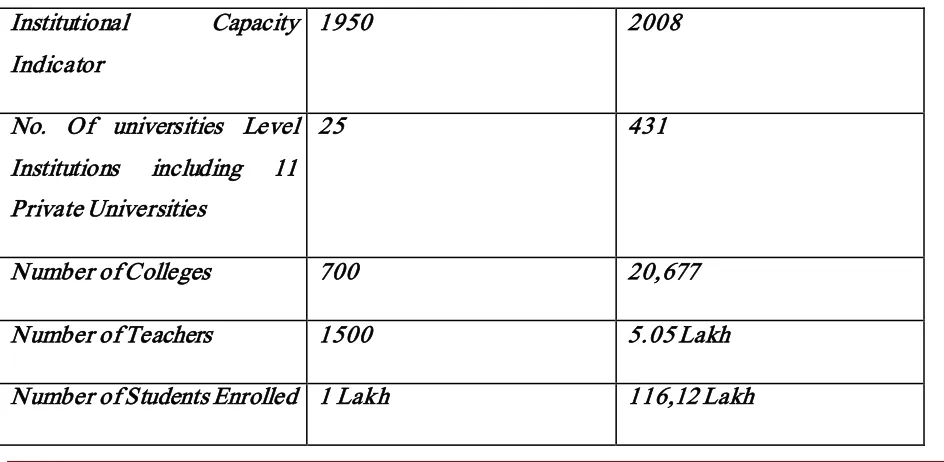
China and USA) in terms of enrolments which was above 1 crore (approx.) in 2005-06. In terms of the number of institutions, India is the largest higher education system in the world (Department of Higher Education, GOI). Here are some indicators of the expansion of higher education system in India.
Table 1: Capacity Expansion in Higher Education
Institutional Capacity Indicator
1950 2008
No. Of universities Level Institutions including 11 Private Universities
25 431
Number of Colleges 700 20,677
Number of Teachers 1500 5.05 Lakh
Available online: https://edupediapublications.org/journals/index.php/IJR/ P a g e | 4920
(Source of Data: University News, p-30, September 14-20, 2009)
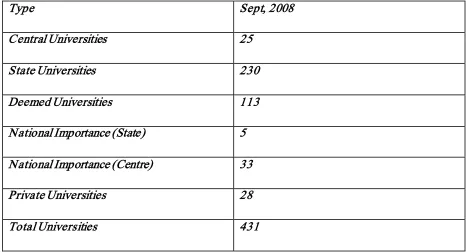
Table 2: Type of Universities
Type Sept, 2008
Central Universities 25
State Universities 230
Deemed Universities 113
National Importance (State) 5
National Importance (Centre) 33
Private Universities 28
Total Universities 431
(Source of Data: University News, p-30, September 14-20, 2009)
Many fold expansion in institutional capacity of Higher Education has enhanced enrolment ration from 0.7% in 1950-51 to 10.5% in 2006-07 is still low compared to world average of 23.2% and an average of 54.6% for developed countries, 36.3% for countries in transitions and 11.3% for developing countries (Source of Data: Internet). Since independence, the system has grown around 17 fold in terms of universities and 31 folds in terms of number of colleges and 15 folds in terms of gross enrolments. Eleventh Five Year Plan mainly focuses on 15% enrolment in Higher Education by 2015 and National Knowledge Commission has projected needs of 1500 universities to attain it.
Financing Higher Education in India
Available online: https://edupediapublications.org/journals/index.php/IJR/ P a g e | 4921
of the world, but it is lagging behind in educational sector. Overall educational index of India is 0.57 with the rank of 141 among the comity of nations (University News, Sept 14-20, 2009). India has the lower public expenditure on higher education and education overall as % of GDP. Real annual growth rate of public expenditure on higher education was 7.5% in the 1950s, while it has been only 13% in the year of 2008-09. Higher Education has received a special attention in the budget session 2009-10 with the allocation of Rupees 15,429 crores and this year’s handout to higher education is 36.1% over the last year’s (Yojana, Aug,2009). We are still lagging behind in national commitment of investing 6% of GDP in education, but it was only 3.8% in 2008. To achieve the target of 5% net increase in GER as per Eleventh Five Year Plan, India needs to invest rupees 2,26,410 crore for strengthening higher education (Reference: India Today, July 13, 2009)
Challenges
Low Budget Allocation to Higher Education
Progress of India’s higher education system is remarkable from 1950 to till now proceedings. Still, we are lagging behind in education sector. Major reason behind this is due to low funding in higher education. It is because government has limited financial resources. In spite of doing many efforts, investment in higher education is just only 3.8% instead of requirement of 6% of GDP
Privatization
Available online: https://edupediapublications.org/journals/index.php/IJR/ P a g e | 4922
standing and seeming difficult to be achieved. The role of the government in higher education is essential. It cannot be executed by the private sector solely. The government has to acknowledge its importance of looking back and looking forward.
Academic and Administrative Reforms
India’s higher education system needs accountability, professionalism, academic and administrative reforms. Efforts have been done time to time. Recently, Chairman of the committee to Advise on Renovation and Rejuvenation of Higher Education, Professor Yashpal submitted his 94-page report to UHRD Minister on June 24, 2009. The Yashpal report argues for autonomy in higher education, both from the state and from private commercial interests. But this report is considered a self-contradictory document and some of its recommendations are not new and prescriptions of this committee are stretch of imagination.
Globalization and Internationalization of Higher Education
Globalization has created a global market place for students and scholars. The globalised world of higher education is highly unequal at national and international levels between developed and developing countries. Making higher education according to globalized and international needs is a very challenging and time consuming task.
Fundamental challenges facing Higher Education
Lack of cooperation and transparency at bodies of Universities at different levels, political interference in academic and administrative reforms, lack of equity in equality, lack of implementation of existing programmes and policies, inadequate utilization of available resources, rural-urban gender disparities, disparities in the quality of education support research, issues related to assessment and accreditation system, inadequate and poor basic physical infrastructure are fundamental shortcomings facing higher education.
Available online: https://edupediapublications.org/journals/index.php/IJR/ P a g e | 4923
Existing higher education system is an outcome of sustained development since independence with more of patchwork done on the potholes, resurfacing the worn out of old crush. It calls from expansion to facilitate inclusive education and to accommodate all who need higher education. There are some suggestions to improve higher education system in India:
- Share best practices on governance and administration over higher education - Indian institution should be encouraged to participate in education fairs globally - Integrate technology and pedagogy to enhance quality and reach of education
- Emerging models in higher education, vocational and skill institutes to prepare the next generation workforces
- Collectively a branding and marketing program of Indian higher education program can be developed.
Conclusion
India’s education system has expanded exponentially over the past five decades and there has been a considerable increase in the spread of educational institutions along with enrolment at every stage. Higher education is the key to India’s future rise as an economic super power but it suffers from several weaknesses. But India is a land of great opportunity. India has the potential to overcome the challenges in a formative manner and has strength to work hard for deriving a sound framework, which will break the national boundaries to reach globally. Swami Vivekananda said,” India will be raised not with the power of flesh bur with the power of spirit; not with the flag of destruction but with the flag of peace and love.”
References
1. GOI (2005). National Sample Survey, 2004-05.
Available online: https://edupediapublications.org/journals/index.php/IJR/ P a g e | 4924
4. Singh, K. P. & Ahmed, S. (2011). Higher Education in India: Major Concerns. University News, Vol. 49 (29), pp. 1-5.
5. Singh, P. (2011). Pitroda commission on quality of higher education: Reasons for concerns and recommendations of concerns. University News, Vol. 49 (34), pp. 9-12