Regulating Group Cognitive Conflicts using
Intelligent Agents in Collaborative M-Learning
Stephen T. Njenga
School of Computing and Information Technology Murang’a University of Technology
Murang’a, Kenya [email protected]
Robert O. Oboko
a& Elijah I. Omwenga
b School of Computing and InformaticsUniversity of Nairobi
Nairobi, Kenya a[email protected]
Elizaphan M. Muuro
School of Engineering and TechnologyKenyatta University Nairobi, Kenya [email protected]
Abstract—Group cognitive conflicts occur when a learner in a collaborative mobile learning environment becomes aware of a discrepancy between his/her existing cognitive framework and new information or experience. The cognitive conflicts stimulate the learning process by making an individual to move from his/her learning sphere and participate with others in the learning process. However, there is a big challenge on how students handle and resolve conflicts during collaborative learning. Intelligent agents have been used in this paper to provide support for group interactions by regulating the group conflicts. An experimental design with one control group and two experimental groups (role playing and guided negotiation) is used to compare levels of group knowledge construction. The findings showed improved levels of knowledge construction where regulated conflicts were used compared to where they were not used.
Keywords—group cognitive conflicts; knowledge construction; intelligent agent; collaborative m-Learning
I. INTRODUCTION
The future of teaching and learning in collaborative environments will be greatly influenced by m-learning [1]. Mobile devices are not just cognitive tools that reorganize how learners think; but are also important for engaging learners in productive learning [2]. The use of mobile phones for collaboration is in line with the tenets of constructivism which involves both teachers and students as active participants in the learning processes [3]. Students take advantage of the mobile devices to facilitate flexible collaboration in and out of classroom settings [4]. The mobile devices allow students to communicate what they have learnt, critically analyzing information, and create new knowledge through their interaction [3].
According to [5], there is not enough research about how group members engage, sustain and productively regulate collaborative processes. For example, not much has been done on how students handle and resolve conflicts on knowledge which arise during collaboration, and how they can be facilitated [6].
Computer Intelligence can provide support for learner collaboration [7], as an essential and necessary aspect of
effective learning. Computer agents have been used to provide control over interaction in group learning [8].
This paper discusses the use of intelligent agents to provide collaborative mobile learning support for regulated group cognitive conflicts. There are two types of agents used: role playing agent and guided negotiation agent. The rest of the paper discusses the objectives of the study, related work, research design, the findings, and the conclusions.
II. OBJECTIVES
The main objective of this study is use an experimental design to investigate the effect of regulating group cognitive conflicts in a collaborative m-learning platform using intelligent agents to improve the level of group knowledge construction.
The specific objectives are:
• To investigate the effect of role playing on the level of group knowledge construction in collaborative m-Learning group interaction processes.
• To investigate the effect of guided negotiation on the level of group knowledge construction in collaborative m-Learning group interaction processes. • To compare the role playing facilitation with guided
negotiation facilitation in terms of the levels of group knowledge construction.
There are three research questions from the three objectives above.
Research Question 1
Which groups of learners (those using role playing or those not using) achieve higher levels of group knowledge construction in collaborative m-learning group interaction processes?
Research Question 2
Research Question 3
Which groups of learners, between those using role playing facilitation or guided negotiation facilitation, achieve higher levels of group knowledge construction in collaborative m-learning group interaction processes?
III. RELATED WORK
A. Group Knowledge Construction
Collaborative learning can be defined as a process where knowledge is jointly created [9] based on ideas and thoughts of others [10]. Knowledge construction itself is an outcome of collaborative learning [11], and evidence that collaboration took place [12]. Knowledge is created through interactions, as a joint undertaking during collaborative learning [13]. This knowledge is constructed socially during the interactions among learners and later internalized as individual knowing [14].
Knowledge construction involves collective inquiry by the participants through dialogue and interactive questioning leading to continuous improvement of ideas [15]. Knowledge construction occurs when a learner disagrees with a partner’s conception or identifies an error in his/her thinking, but by justifying it. A student may also refine another student’s idea by attempting to reconstruct the solution [16]. Thus, knowledge construction can only take place when learners exchange ideas, viewpoints and arguments as they discuss a group problem [17]. Group members need to explain, compare, synthesize, and connect different ideas together [18], through interactions [17].
B. Group Cognitive Conflicts
Interaction among learners in collaborative learning is the key element in group learning [19]. Learning cannot take place in collaborative environment in the absence of social interactions, that is, where group members do not question, analyze, synthesize, evaluate, and make decisions [20]. Learners learn more effectively by externalizing and articulating their unformed, still-developing understanding together [21]. However, effective group interaction is determined by some issues, which if not given due consideration can negatively affect the group learning outcomes. Among them are the group cognitive conflicts.
A cognitive conflict as an imbalance resulting from a contradiction of newly acquired knowledge with existing knowledge [22]. Cognitive conflicts are noted when peers argue amongst themselves, clarify and evaluate each other’s ideas leading to cognitive restructuring [23]. This conflict on knowledge occurs in a social interaction as a divergence between the knowledge and/or the students’ viewpoints compared to others from group members [24]. A cognitive conflict is a vital factor in an individual’s conceptual change during learning [25] since it makes an individual to move from his personal learning cycle to social cycle and participate in group work through interactions [26]. The cognitive conflicts assist the learner in identifying, challenging and reconstructing likely misconceptions. Conflicting ideas and knowledge also motivate the learners to explore, combine and refine each
other’s ideas and understandings [6]. Group cognitive conflicts assist to uncover ideas and assumptions from all group members might otherwise lead to incomplete analysis and improper decisions [27]. The disagreements in terms of knowledge conflicts allow participants to construct explanations, give reasons, and justify their views. Those misunderstandings during collaboration are important since they force group members to provide explanations, give reasons, and justify their positions [28]. Since these cognitive conflicts emanate from the individual students with differing interpretation and understandings, dealing with these conflicts is perceived as a knowledge construction process whereby ideas are processed to achieve a deeper understanding [6].
Group cognitive conflicts have their own share of challenges on group interaction. When encountered with conflicting knowledge, students may raise the issue or desist [6]. Improper level of cognitive conflicts can cause difficulties, problems, and even endanger the learning process. For example, if the conflict is excessive, it could lead to withdrawal, anxiety or frustration. Some researchers claim that it can even break down the learners’ current internal structures [29]. Too little or too much cognitive conflict existing in a group causes learning problems [30]. Too much agreement suppresses relevant and important new ideas which may be introduced and not so relevant ideas being unchallenged [31]. The difficulty in reaching a consensus becomes a major challenge in attaining effective learning [32]. This raises the need to regulate group cognitive conflicts.
Resolving of conflicts on knowledge is important for the constructive and collaborative tasks during learning [6]. The ability to resolve conflicts during collaborative learning determines how well group members are able to create a shared understanding of a topic [33]. It is crucial to know how to deal with conflicts on knowledge in a collaborative learning [6]. The way those conflicts are dealt with and the ability to resolve them affects group learning [34]. This paper discusses two approaches for regulating group cognitive conflicts namely Role playing and Guided Negotiation.
Through roles, group members assume responsibilities on themselves or others by positioning themselves or others, or in response to others’ positioning moves [35]. When a group member is limited to a single role, the multiple functions that the member can perform are ignored [36]. Role-playing is known to increase interactions during knowledge construction in collaborative discussions [37]. When participants take new roles differing from what they are, they get encouraged to look at the problem from a different perspective. Assigning of roles is meant to improve students’ engagement with each other towards successful collaborative task [38]. Also some members may feel free to express themselves when they “hide” behind a role [39].
viewpoints which see through the conflict leading to effective learning [42]. However, the efficiency of negotiation is dependent on mutual understanding, effective dialogue and communication between all group members. According to [43], the use of interaction rules may help in regulating a discussion (e.g. each member should come up with three ideas).
C. Intelligent Agents in Collaborative Learning
Computer support for collaborative learning becomes most effective when designed to foster productive social interaction [37]. Intelligent agents have been used in collaborative learning by providing control over interactions during group learning. Due to their features, computer agents are suitable for collaborative learning to provide control over interaction and assessment for group members within short time constraints [8]. Intelligent autonomous agents can be built into teams to solve the problems collaboratively, with functionalities and skills already distributed among the agents [44]. Intelligent agents are good for incorporating learning theories into collaborative interactions and environments [45].
A common type of intelligent agents called Intelligent Pedagogical Agents (IPA) is used in collaborative learning. IPAs assist learners by providing pedagogical guidance, tutorials, finding learning resources, tracking learners’ progress, aiding collaborative and communicating learning functions [46], creating and providing adaptive dialogues, giving guidance, resolving difficulties and motivating learners [47]. There are two subcategories of IPAs: conversational agents and teachable agents. While conversational agents hold and facilitate conversations with learners, teachable agents are taught by the students in order to perform some tasks like solving puzzles [48]. Conversational agents used in collaborative environments range from simple chat interfaces to full virtual talking heads with full expressiveness. Conversational agents are known for providing dynamic support for collaborative learning and consequently improve the learning outcomes [49].
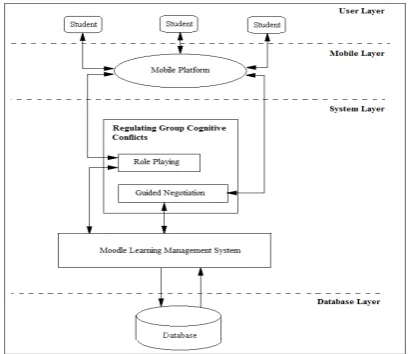
D. Regulation of Cognitive Conflicts with Intelligent Agents We used two intelligent agents to develop architecture for regulating group cognitive conflicts shown in Fig 1. The two agents are within the Systems Layer of the architecture.
Fig. 1. Architecture for regulating Group Cognitive Conflicts using
Intelligent Agents
The Role Playing agent regulates the group cognitive conflict by choosing encouraging members to choose a role to play during the group discussions. The agent also displays the current role played by each group member to the others. Each role has a specific set of task associated with it, and this controls the way the discussion is conducted. For example, a member could contribute as a starter by initiating the discussion, and could later contribute as a supporter as the discussion continued.
The Guided Negotiation agent provides the students with sentence openers to assist them to choose the kind of contribution they want to make. The sentence openers are in the form of Propose, Counter-Propose, Agree-Disagree, Question, Answer and Provide Information. The agent also aimed to improve collaboration by encouraging members to elaborate and explain their contributions. The agent did so by providing the members with an option to either elaborate or explain each of their contributions. For example, one could answer a question and accompany the answer with an explanation.
The architecture was implemented as a mobile application and used by students in the experiment described below.
IV. METHODOLOGY
An experiment to investigate the effect of regulated group cognitive conflicts on the level of group knowledge construction was conducted using students from a local university in Kenya. The students undertook a unit called ‘Design and Analysis of Algorithms’ in a 14-week semester. A total of 30 students took part in the experimental study. They were first registered to use the system for accessing their lecture notes and other collaborative learning features. In the 6th week, all participants took part in a series of three online discussions. Each discussion group participated in three discussions by solving three ill-structured problems for each of the three treatment conditions. The posted messages were saved in the system’s server for later analysis. A few of the students were randomly selected for a survey interview after the online discussions were closed. Each participant of the interview took 15 minutes.
A. Research Design
The research design used in this study was post-test only experimental study with control group. The experiment used multiple treatment design. The treatment conditions are explained below:
Treatment 1: The members of this group used role playing as the technique for regulating group cognitive conflicts.
Treatment 2: The members of this group used guided negotiation for regulating the cognitive conflicts.
Treatment 3: This was the control group. The participants in this group used neither role playing nor guided negotiation.
discussion group was given a different treatment condition from the first one. Again, in the third online discussion, each group participated in a different treatment condition from the first and the second discussion. That is, all the discussion groups participated in the three treatment conditions. Duration of one week was observed between each online discussion.
B. Validity of Results
The following measures were taken to ensure the validity of the results for this study:
a) Participants were given prior explanation about the usage of the system, and a brief guide on how to participate in the group discussion
b) Online group discussions were randomly assigned in the first measure, and keen observation made in allocating the subsequent measures
c) Equal time allocated to each discussion group to solve the group task
d) Each of the discussion groups was not able to access or mingle with others during the discussion duration.
e) Duration of one week was given in between the online discussions.
f) The features to regulate group cognitive conflicts were embedded within the collaborative m-learning prototype and students were not made aware of the existence of those facilitations or their absence when solving the group problem.
C. Treatment Materials and Instruments
Three ill-structured group problems of same level of difficultness in the subject area of “Design and Analysis of Algorithms” were used in this study. Each of the ill-structured problems was developed in consultation with an expert in the field of Design and Analysis of Algorithms.
A set of interview questions was used in conducting the survey with randomly selected individuals.
A content analysis coding scheme (tool) adopted from [50] was used in calculating the level of knowledge construction for each group to be used for further analysis.
V. FINDINGS
There were two main sources of data for analysis: (i) posted messages by students in the online discussion, and (ii) the responses to the survey by randomly selected students. A total of 324 messages were posted by 30 participants who participated in all the three treatment conditions. After categorizing the messages into different knowledge level codes by two independent coders using the Content Analysis Tool, an inter-rater agreement of 0.716 was attained. The coding of the messages where the two coders disagreed was done by a third coder. The code where two of the three coders did not agree was subjected to a consensus. The average level of group knowledge construction was calculated for each group.
A. Descriptive Statistics
The mean group level of knowledge construction for the guided negotiation group (2) and role playing group (3) is higher than the one for the control group (1). In Table I, the mean for the control group is 5.0001 being lower than those for both the means for Guided Negotiation (7.5367) and Role Playing (6.7202). N is the number of participants.
TABLE I. DESCRIPTIVE STATISTICS
Mean Std. Deviation N
Control 5.0001 2.64347 10
GuidedNegotiation 7.5367 2.28883 10
RolePlaying 6.7202 1.70702 10
B. Analysis for Posted Messages
A repeated measures ANOVA was conducted on the messages posted during the discussion after they were categorized by the independent coders. Mauchly’s test was done to check the sphericity condition. As shown in Table II, the variances of the between levels of knowledge construction were not significant (significance value is 0.764 which is above 0.05). df is the degrees of freedom.
TABLE II. MAULCHY’S TEST OF SPHERICITY
Within Subjects
Effect
Mauchly's W Approx.
Chi-Square
df Sig. Epsilona
Greenhous
e-Geisser Huynh-Feldt Lower-bound
Facilitation .935 .539 2 .764 .939 1.000 .500
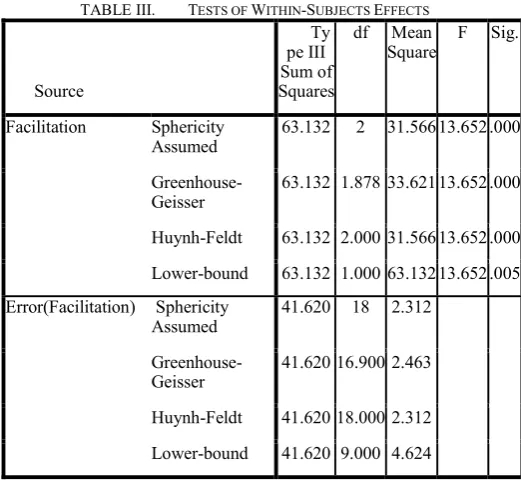
Thus, the assumption of sphericity was not violated. With sphericity not violated, Table III further shows us a significant difference in the level of knowledge construction in the three treatment groups (F = 13.652, p < 0.01).
TABLE III. TESTS OF WITHIN-SUBJECTS EFFECTS
Source
Ty pe III Sum of Squares
df Mean
Square F Sig.
Facilitation Sphericity
Assumed 63.132 2 31.566 13.652 .000
Greenhouse-Geisser 63.132 1.878 33.621 13.652 .000
Huynh-Feldt 63.132 2.000 31.566 13.652 .000
Lower-bound 63.132 1.000 63.132 13.652 .005
Error(Facilitation) Sphericity
Assumed 41.620 18 2.312
Greenhouse-Geisser 41.620 16.900 2.463
Huynh-Feldt 41.620 18.000 2.312
From Table IV, the estimated marginal mean for the control group is 4.587± .476, the one for Guided Negotiation is 7.953 ± .555 and the mean for Role Playing is 7.256 ± .423.
TABLE IV. ESTIMATED MARGINAL MEANS
Facilitation Mean Std. Error 95% Confidence Interval
Lower
Bound Bound Upper 1 4.587 .476 3.510 5.664 2 7.953 .555 6.697 9.209 3 7.256 .423 6.299 8.213
This is a clear indication that the facilitations for regulating cognitive conflicts (Guided Negotiation and Role Playing) improved the level of knowledge construction in the discussion groups.
C. Analysis for Survey Interview
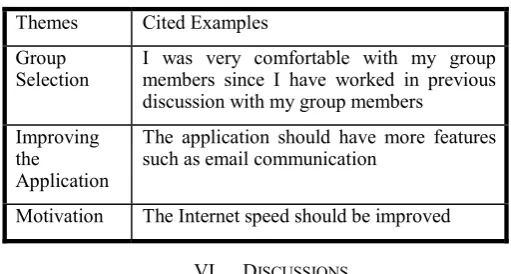
Five (5) students who were randomly selected took part in the survey interview. A summary of their responses is given in Table V.
TABLE V. SAMPLE RESPONSES FROM THE SURVEY
Themes Cited Examples
Group
Selection I was very comfortable with my group members since I have worked in previous discussion with my group members
Improving the
Application
The application should have more features such as email communication
Motivation The Internet speed should be improved
VI. DISCUSSIONS
This discussion section is based on the research questions of this study.
Research Question 1 - Which groups of learners (those using role playing or those not using) achieve higher levels of group knowledge construction in collaborative m-learning group interaction processes? The results indicated a significant difference between the control group and the role playing group. This is because different roles played by participants introduced different views by members at different times during the discussion which contributed to a rise in the level of knowledge construction.
Research Question 2 - Which groups of learners (those using guided negotiation or those not using) achieve higher levels of group knowledge construction in collaborative m-learning group interaction processes? The results show a
significant difference between the control group and the guided negotiation group. This is because the participants in the guided negotiation group were provided with instructions on how to conduct a group discussion and were also guided on the kind of contribution to make during the discussion.
Research Question 3 - Which groups of learners, between those using role playing facilitation or guided negotiation facilitation, achieve higher levels of group knowledge construction in collaborative m-learning group interaction processes? The regulation of group cognitive conflicts using Guided Negotiation achieved a higher level of group knowledge construction than using Role playing.
VII.CONCLUSION
From this study, it can be concluded that the use of both role playing and guided negotiation improves the level of group knowledge construction. The intelligent agents seem to be effective in collection and analysis of group interactions to dynamically regulate the group discussions.
ACKNOWLEDGMENT
We acknowledge the financial support provided by the National Commission for Science and Technology Innovations in Kenya which provided a research grant for this study. We also thank all the students from Murang’a University of Technology and Kenyatta University who participated in this study.
REFERENCES
[1] El-Hussein, M. O. M., & Cronje, J. C. (2010). Defining Mobile Learning
in the Higher Education Landscape. Educational Technology & Society, 13 (3), 12–21.
[2] Laru J. (2012). Scaffolding learning activities with collaborative scripts
and mobile devices (Unpublished Phd dissertation), University of Oulu, Finland.
[3] Dabbagh, N., & Kitsantas, A. (2011). Personal Learning Environments,
social media, and self-regulated learning: A natural formula for connecting formal and informal learning. The Internet and Higher Education, 15(1), 3–8.
[4] Cheong, C., Bruno, V., & Cheong, F. (2012). Designing a
Mobile-app-based Collaborative Learning System. Journal of Information Technology Education: Innovations in Practice, Volume 11, 2012.Järvelä (2014)
[5] Järvelä, S. (2014). Shared regulation in CSCL, Naples Webinar.
[6] Aarnio, M. (2015). Collaborative Knowledge Construction in the
Context of Problem-Based Learning. Exploring learning from conflicting ideas and knowledge (Unpublished PhD Thesis), University of Helsinki, Finland.
[7] Downes, S. (2012). Connectivism and Connective Knowledge (ver 1.0 -
May 19, 2012). Essays on meaning and learning networks.
[8] Looi, C. –K. (2014). How Collaborative Problem Solving might be
assessed internationally at scale?
[9] Arvaja, M., Salovaara, H., Häkkinen, P. & Jarvela, S. (2007).
Combining individual and group-level perspectives for studying collaborative knowledge construction in context. Learning and Instruction 17, 448-459.
[10] Mercer, N. (2010). The analysis of classroom talk: Methods and
methodologies. The British Journal of Educational Psychology, 80, 1– 14.
Computer-Supported Collaborative Learning Discussions Using Sequential Analysis. Educational Technology & Society, 17 (4), 216–228.
[12] Alavi, M. & Dufner, D. (2005). Technology-mediated collaborative
learning: A research perspective, In S. R. Hiltz and R. Goldman (Eds.), Learning together online: Research on asynchronous learning networks (pp. 191–213). Mahwah, NJ: Lawrence Erlbaum.
[13] Zufferey, J.D., Bodemer, D., Buder, J. & Hesse, F.W. (2010). Partner
knowledge awareness in knowledge communication: Learning by adapting to the partner. The Journal of Experimental Education, vol. 79, no. 1, pp. 102-125.
[14] Damúa, C., I. (2013). Knowledge Co-construction and Object-oriented
Collaboration. A Study of Learning through Collaborative Construction of Knowledge Objects in Higher Education. (Unpublished Phd Dissertation).
[15] Ioannou, A., Demetriou, S., Mama, M. (2014). Exploring factors
influencing collaborative knowledge construction in online discussions: Student facilitation and quality of initial postings, American Journal of Distance Education, 28 (3), in press
[16] Prata, D. N., Baker, R. S. J., Costa, E. B., Rosé, C. P., Cui, Y. & de
Carvalho, A. M. J. B. (2009). Detecting and Understanding the Impact of Cognitive and Interpersonal Conflict in Computer Supported Collaborative Learning Environments.
[17] Mthembu, S.Z. & Mtshali, F.G. (2013). Conceptualisation of knowledge
construction in community service-learning programmes in nursing education. Curationis; 36 (1).
[18] Stahl, G., Cress, U., Law, N. & Ludvigsen, S. (2014). Analyzing the
multidimensional construction of knowledge in diverse contexts. Computer-Supported Collaborative Learning. - Confirm Journal and Volume
[19] Näykki, P. (2014). Affective and Effective Collaborative Learning.
Process-Oriented Design Studies in a Teacher Education Context. Unpublished PhD Thesis, University of Oulu, Finland.
[20] DeLoach, S. B. and Greenlaw, S. (2005). Effectively Moderating
Electronic Discussions. Available at SSRN: https://ssrn.com/abstract=752624
[21] Chi, M. T. H. (2009). Active-constructive-interactive: a conceptual
framework for differentiating learning activities. Topics in Cognitive Science, 1(1), 73-105. (Moody, 2010)
[22] Moody, B. (2010). Connecting the points: cognitive conflict and decimal
magnitude. In L. Sparrow, B. Kissane & C. Hurst (Eds.),Shaping the future of mathematics education. Proceedings of the Annual Conference of The Mathematics Education Research Group of Australasia(pp. 422– 429). Fremantle: MERGA.
[23] Snapwiz (2012). Improving Student Engagement by Integrating
Adaptive and Collaborative Learning Technologies.
[24] Dillenbourg, P. (1999). What do you mean by ‘collaborative learning?’
In P. Dillenbourg (Ed.), Collaborative-learning: Cognitive and Computational Approaches (pp.1–19). Oxford: Elsevier.
[25] Bao, L., Kim, Y., Raplinger, A., Han, J., & Koenig, K. (2013). Affective
Factors in STEM Learning and Scientific Inquiry: Assessment of Cognitive Conflict and Anxiety. Special Issue of Research on Education Assessment and Learning.
[26] Said, T., Shawky, D. and Badawi, A. (2015). Identifying
Knowledge-building Phases in Computer-supported Collaborative Learning: A Review. Proceedings of 2015 International Conference on Interactive Collaborative Learning (ICL). Florence, Italy.
[27] Gutbezahl, C.D. (2010). Cognitive Conflict. The Cure for Anger in
Hospitals. Managing Conflict to Help Create Better American Hospitals.
[28] Lai, E. R. (2011). Collaboration: A Literature Review. Pearson Research
Report, 2.
[29] Chow, T. –C. and Treagust, D. (2013). An Intervention Study Using
Cognitive Conflict to Foster Conceptual Change. Journal of Science and Mathematics Education in Southeast Asia. 36 (1): pp. 44-64.
[30] Bearison, D.J., Magzamen, S., & Filardo, E.K. (1986). Socio-conflict
and cognitive growth in young children. Merrill-Palmer Quarterly, 32, 51–72.
[31] McLaren, B. (2014). What Happens When We Learn Together. A
Research-Based Whitepaper on the Power of Collaborative Learning.
[32] Rimor, R., Rosen, Y. and Naser. K. (2010). Complexity of Social
Interactions in Collaborative Learning: The Case of Online Database Environment. Interdisciplinary Journal of E-Learning and Learning Objects. Volume 6, 2010. IJELLO special series of Chais Conference 2010 best papers.
[33] Johnson, D. W. & Johnson, R. T. (2009) An educational psychology
success story: Social interdependence theory and cooperative learning. Educational Researcher 38(5): 365–79.
[34] Hall, P., & Weaver, L. (2001). Interdisciplinary education and
teamwork: a long and winding road. Medical Education, 35(9), 867–875.
[35] Sarmiento, J. W. & Shumar, W. (2010). Boundaries and roles:
Positioning and social location in the Virtual Math Teams (VMT) online community. Computers in Human Behavior, 26(4), 524-532.
[36] Chiu, M.M. (2000). Group Problem-Solving Processes: Social
Interactions and Individual Actions. Journal for the Theory of Social Behaviour 30:1. Pp 27-49.
[37] Deiglmayr, A. & Rummel, N. (2015). The Mediating Role of Interactive
Learning Activities in CSCL: An INPUT-PROCESS-OUTCOME Model.
[38] Hou, H.-T. (2012). Analyzing the Learning Process of an Online
Role-Playing Discussion Activity. Educational Technology & Society, 15 (1), 211–222.
[39] Gustavsson, P. (2002). Mobile Scenarios: Supporting Collaborative
Learning among Nomads.
[40] Stahl, G. (2011). Knowledge Negotiation in in Asynchronous Learning
Networks. - Confirm Journal and Volume
[41] Puntambekar, S., & Young, M. F. (2003). Moving toward a theory of
CSCL. In U. Hoppe, B. Wasson, & S. Ludvigson (Eds.), Computer supported collaborative learning 2003: Designing for change in networked learning (pp. 503–512). Amsterdam: IOS Press.
[42] Chan, C. K. K. & Chan, Y. Y. (2011). Students' views of collaboration
and online participation in Knowledge Forum. Computers & Education, 57(1), 1445-1457.
[43] Hamdan, N. A. & Schaper, H. (2012). Collaboration in Mobile Learning
Seminar: Mobile Learning 2011/2012. Computer-Supported Learning Research Group.
[44] Aydin, M. E. (2012). Coordinating Metaheuritic agents with team
intelligence. Journal of Intelligent Manufacturing 23: 991-999.
[45] Miao, C., Yu, H., Shen, Z. & Tao, X. (2010). Agents for collaborative
learning in Virtual Worlds. (Workshop on Opportunities for intelligent and adaptive behavior in collaborative learning system Supplementary Proceedings of the Tenth International Conference on Intelligent Tutoring Systems Pittsburgh, PA, USA).
[46] Soliman, M. & Guetl, C. (2010). Review and Perspectives on
Intelligent Multi-agent Systems’ Support for Group Learning. World Conference on Educational Multimedia, Hypermedia & Telecommunications ED-MEDIA 2010, June 2010, Toronto, Canada.
[47] Soliman, M. & Guetl, C. (2010b). Intelligent pedagogical agents in
immersive virtual learning environments: A review. In MIPRO, 2010 Proceedings of the 33rd. International Convention. IEEE Computer Society Press, 2010.
[48] Veletsianos, G. & Russell, G.S. (2013). Pedagogical Agents. J.M.
Spector et al. (eds.), Handbook of Research on Educational Communications and Technology.
[49] Kumar, R., & Rosé, C.P. (2010), Conversational Tutors with Rich
Interactive Behaviors that support Collaborative Learning (Workshop on Opportunities for intelligent and adaptive behavior in collaborative learning systems - Supplementary Proceedings of the Tenth International Conference on Intelligent Tutoring Systems Pittsburgh, PA, USA.)
[50] Van der Meijden, H. (2005). Knowledge Construction through CSCL: