© 2014, IJCSMC All Rights Reserved 246
Available Online atwww.ijcsmc.com
International Journal of Computer Science and Mobile Computing
A Monthly Journal of Computer Science and Information Technology
ISSN 2320–088X
IJCSMC, Vol. 3, Issue. 8, August 2014, pg.246 – 256
RESEARCH ARTICLE
SEAD AND ARIANE Routing
Protocol: Comparative Study
Ankita, Vikram Nandal
M.Tech Student, Department of CSE, R.N. College of Engineering & Management
Assistant Professor, Department of CSE, R.N. College of Engineering & Management
[email protected], [email protected]
Abstract: The latest advancement in wireless technology and its applications received a lot of
attention. An ad hoc network is one such recent technology, which gives a new paradigm for
wireless self-organised networks. Ad hoc networks are simple peer-to peer networks, self-
organized and with no fixed infrastructure. Ad-hoc network is a concept in computer
communication which means that user wanting to communicate with each other forms a
temporary network, without use of centralized administration. Each node in the network acts
both as host and router and must therefore willing to forward packet for other node. For this
purpose routing protocol is needed. A Mobile Ad-hoc Network (MANET) is a temporary
wireless network composed of mobile nodes without any permanent infrastructure. Each node
not only operates as an end system, it also acts as a router to forward packets on behalf of
other nodes. Ad hoc networks are basically peer-to-peer, multihop mobile wireless networks in
which information packets are transmitted in a store-and –forward manner from a source to
an arbitrary destination, via intermediate nodes.
Keywords: MANET, Doppler shift, signal attenuation, DOS, SEAD, ARAN
© 2014, IJCSMC All Rights Reserved 247
I.
INTRODUCTION
SEAD
is designed based on the DSDV (Destination Sequenced Distance Vector) protocol. SEAD was proposed by Yih-Chun Hu, David B. Johnson and Adrian Perrig, [3].DSDV: Destination Sequenced Distance Vector[10] routing protocol is one of the first protocol proposed for ad hoc wireless networks. It was developed based on the distributed Bellman Ford algorithm where each node maintains a table that contains the shortest distance and the first node on the shortest path to every other node in the network. It’s a table driven routing protocol. Routes to all destinations are readily available at every node at all times. The tables are exchanged between neighbours at regular intervals to keep an up-to-date view of the network topology. Whenever there is a change in the network topology, the table entries are updated. It provides loop free single path to the destination. DSDV sends two types of packets “full dump” and “incremental”. SEAD was developed based on DSDV working principle [4], [5]. SEAD incorporates One- Way Hash function [4] to authenticate in the routing update mechanism to enhance the routing security. Let us consider a One-Way Hash function ‘H’ and see how the hash property is used in SEAD node authentication. The hash function H generates a one way hash chain of values (h0, h1, h2, h3, h4,..…..hn). The initial has chain value h0 is created using a random initial number x. At any stage ’h(i)’ can be calculated using h( i-1) using the hash function H. i.e. h(i) = H( h(i-1).
Let us consider ‘m’ is the no of nodes in the network, so the upper bound for the hop counts is < m-1. Let the hash chain values calculated using H be (h1,h2...hn), where ‘n’ is divisible by m, then for a routing table entry with sequence number ‘i’, let k = ((n/m)-i). If the metric ‘j’(distance) is used to authenticate the routing update entry, then h(km+j) is used to authenticate the table update entry for that sequence number ‘i’ and distance ‘j’. A malicious node can modify h(km+j) only if it knows the value of h(km+j-1), which is impossible to calculate. So the hashing technique is used to authenticate the nodes participating in the ad hoc network.
Ariadne
is a secure routing protocol developed by Yih-Chun Hu, David B. Johnson and Adrian Perrig [3], based on the Dynamic Source Routing protocol (DSR). [4][5][7].DSR: DSR is an on-demand routing protocol, which finds the route as and when required, dynamically. DSR routing protocol manage the network without any centralized administrator or infrastructure. In route discovery this protocol discovers for the routes from source node to destination. In DSR, data packets stored the routing information of all intermediate nodes in its header to reach at a particular destination. Routing information for every source node can be change at any time in the network and DSR updates it after each change occur [7]. Intermediate routers don´t need to have routing information to route the passing traffic, but they save routing information for their future use. Basic purpose to develop DSR was to reduce the overhead on the network and designing self-organizing and self-configuring protocol to support MANET. The DSR protocol contains two phases in its routing mechanism:
© 2014, IJCSMC All Rights Reserved 248
Fig1: route discovery
b) Route maintenance: Route maintenance is carried whenever there is a broken link observed in the specific route to the destination. When the packets are forwarded through a specific route, each node sends the packet to the next node in the route and the next node acknowledges the packet received. When a broken link is observed in the destination path the broken link will not acknowledge to the packet transmitted by the neighbour node, and the node send a route error message (RERR) to the source node. The source then responds to this RERR and stops sending the next packets and will look in its route cache for alternative routes and follow the next available path.
Secure Routing Protocol (SRP)
Secure Routing Protocol (SRP), was proposed by Papadimitratos and Hass [8]. SRP is implemented over DSR [4], [5], with an underlying Security Association (SA) between the source and destination nodes. The trust relation is maintained with a public key infrastructure and a shared key K(sd), was maintained between the source and destination nodes using the security association. In SRP the route request (RREQ) contains six fields and a MAC value to initiate the discovery process. The RREQ is signed with the shared key K(sd) between the source and destination. The intermediate nodes participating in the route discovery measures the frequency of queries received from their neighbours and maintains a priority ranking inversely proportional to the query rate. So if a malicious node participates in the network with malicious RREQ‘s will be dealt last in the priority list. When the RREQ reaches the destination node, it verifies the integrity and authentication with the MAC value and shared key between the source and destination. Once the integrity and authentication is checked for the received RREQ, the Destination node responds with a Route Reply packet (RREP).
II.
Protocol Evaluation
Case study against identified attack patterns
© 2014, IJCSMC All Rights Reserved 249
then drop or compromise the packets. They can also send false information and lead packets to the wrong node and cause congestion in one area. The attacks can either target at the routing procedure or try to flood the networks.
Most common attack patterns identified in ad hoc network environment
Denial-of-service with modified source route
Tunnelling
Spoofing
Black hole attack
Wormhole attack
Routing table overflow attack
Denial-of-service with modified source route:
A denial of service attack in general could be launched at any layer of an ad hoc network.
On the physical and media access control layers, an adversary could employ jamming to interfere with communication on physical channels. On the network layer, an adversary could disrupt the routing protocol and disconnect the network. On the higher layers, an adversary could break down high-level services. In the routing mechanism a source node sends route request messages to all neighbours to find a route to the destination node. In the denial-of-service case a malicious node in between can successful send an erroneous route message to the source route to disrupt the service.
Tunnelling
:
Ad hoc networks have an implicit assumption that any node can be located adjacent to any other node. A tunneling attack is where two or more nodes may collaborate to encapsulate and exchange messages between them along existing data routes. One vulnerability is that two such nodes may collaborate to falsely represent the length of available paths by encapsulating and tunnelling the routing message between them.
Spoofing
:
A single malicious node in the ad hoc network can spoof the nodes identity in order to forward packets through it. Later the information can be used to create DoS attacks.
Blackhole
:
In Black hole attack a malicious node uses the routing protocol to advertise itself as having the shortest path to the node whose packets it wants to intercept and in this way it can compromise the service.
Warmhole
:
© 2014, IJCSMC All Rights Reserved 250
III.
Mappings between Attacks Pattern and Protocol
SEAD:
SEAD was developed based on DSDV and incorporates One-Way Hash function to authenticate in the routing update mechanism in order to enhance the routing security. Securing a table driven protocol is harder than securing an on demand protocol due to the existence of predefined routes. Distance vector protocols encapsulate the route information into a hop count value and a next hop. An attacker cannot create a valid route with a larger sequence number that it received due to the properties of hash function. As SEAD incorporates neighbour authentication through Hash functions, an attacker cannot compromise any node. SEAD is prone through warmhole attack. Even if authentication is provided using hash functions, a warmhole attack is possible through tunnelling the packets from one location and retransmitting them from other location into the network. All packets in the wormhole attack flow in a circle around instead of reaching the destination.
Ariadne:
Ariadne was developed based on an on demand protocol, Destination Source Routing (DSR). Ariadne uses MAC s and shared keys between nodes to authenticate between nodes and use time stamps for packet lifetime. Warmhole attacks are possible in Aridane through two compromised nodes. Ariadne prevents spoofing attacks with time stamps. The use of source routes prevents loops, since a packet passing through only legitimate nodes will not be forwarded into a loop due to time stamps.
SRP:
Secure routing protocol (SRP) was developed based on Destination Source Routing (DSR). The intermediate nodes participating in the route discovery measure the frequency of queries received from their neighbours and maintain a priority ranking inversely proportional to the query rate. So the malicious compromised nodes participating in the network are given least priority to deal with. The security analysis is similar to Ariadne as it is based on DSR protocol.
ARAN:
Aran uses public key cryptography and a central certification authority server for node authentication and neighbour node authentication in route discovery. Denial-of-service attacks are possible with compromised nodes. Malicious nodes cannot initiate an attack due to the neighbour node authentication through certificates. Participating nodes broadcast unnecessary route requests across the network. An attacker can cause congestion in the network, there by compromising the functionality of the network.
SAODV:
© 2014, IJCSMC All Rights Reserved 251
SAR:
SAR was developed using a trust-based framework. Each node in the network is assigned with a trust level. So the attacks on this framework can be analyzed based on trust level and message integrity. As show below the author [Seung, Prasad, Robin] evaluated the security of SAR in terms of trust level and message integrity.
Trust Level: SAR routing mechanism is based on the behaviour associated with the trust level of a user. It is a binding between the identity of the user and the associated trust level. To follow the trust-based hierarchy, cryptographic techniques like: encryption, public key certificates, shared secrets, etc. are employed.
Message integrity: The compromised nodes can utilize the information flow in between nodes and reading of packets to launch attacks. It results in corruption of information, confidentiality of the information, and in denial of network services.
© 2014, IJCSMC All Rights Reserved 252
IV.
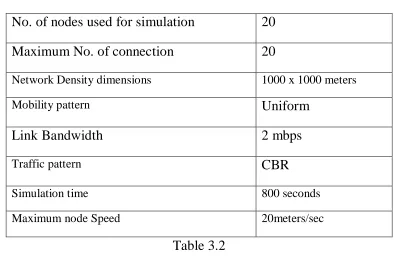
SIMULATION AND EVALUATION
No. of nodes used for simulation
20
Maximum No. of connection
20
Network Density dimensions
1000 x 1000 meters
Mobility pattern
Uniform
Link Bandwidth
2 mbps
Traffic pattern
CBR
Simulation time
800 seconds
Maximum node Speed
20meters/sec
Table 3.2
Metrices used:
Packet Delivery Fraction (PDF):
This is the ratio of total number of packets successfully received by the destination nodes to the
number of packets sent by the source nodes.
This estimate gives us an idea of how successful the protocol is in delivering packets to the
application layer. A high value of PDF indicates that most of the packets are being delivered to
the higher layers and is a good indicator of the protocol performance.
Byte Overhead (BO):
The total number of routing bytes transmitted during the simulation. For packets sent over
© 2014, IJCSMC All Rights Reserved 253
Packets Overhead(PO):
The total number of routing packets transmitted during the simulation. For packets (512 kbps)
sent over multiple hops, each transmission of the packet at each hop counts as one transmission.
Median Latency(ML):
The time taken by the route discovery packet to reach from the source to destination is known
and Median latency. The less time to discover the route to the destination indicates the high
performance of the protocol.
Average end-to-end delay (AED):
This is the average delay between, sending the data packet by the CBR source and its receipt at
the corresponding CBR receiver. This includes all the delays caused during route acquisition,
buffering and processing at intermediate nodes, and retransmission delays at the MAC layer.
© 2014, IJCSMC All Rights Reserved 254
V.
Results
Packet Delivery Fraction (PDF):
Byte Overload:
© 2014, IJCSMC All Rights Reserved 255
VI.
Security and Performance Analysis Security Analysis
The security analysis of SEAD and Ariadne are done in this thesis. SEAD is a table driven protocol, and securing a table driven protocol is harder than securing an on demand protocol due to the existence of predefined routes. From the table 3.1 we can see that all type of security attacks are possible in SEAD routing protocols with a compromised node. If no compromised malicious nodes exist in the network, SEAD is stable to all attack patterns through neighbour authentication. Routing loops can only be possible when there is more than one malicious node in the network. The confidentiality of the network topology with respect to participating nodes is maintained with neighbour authentication.
Ariadne uses MAC s and shared keys to authenticate between nodes and use time stamps for packet lifetime. Warmhole attacks are possible in Aridane through two compromised nodes. Ariadne prevents spoofing attacks with time stamps. The use of source routes prevents loops, since a packet passing through only legitimate nodes will not be forwarded into a loop due to time stamps.
Performance Analysis:
Packet Delivery Fraction (PDF):
Figure 3.1 shows the results of the performance metric, packet delivery fraction. A higher value of PDF indicates that most of the packets are being delivered to the higher layers and is a good indicator of the protocol performance. SEAD consistently outperforms Ariadne in terms of packet delivery fraction at lower pause times in the simulation. This shows that the route discovery is faster in SEAD than in Ariadne and the number of routing advertisements sent by SEAD are more than Ariadne. So at lower pause time SEAD contains more up to date routing information than Ariadne. At higher pause times the PDF graph for Ariadne increases gradually. As Ariadne uses TESLA broadcast authentication with shared keys between nodes, at the lower pause times it takes more time for route discovery and once secure routes are discovered the PDF graph increases gradually because of the secure route.
Byte Overhead (BO):
Figure 3.2 shows the results of the performance metric, byte overhead. SEAD graph shows increased byte overhead than Ariadne, this is due to the increased number of routing advertisements in SEAD than Ariadne. Ariadne graph shows a decrease in byte overhead with increased simulation time. The increased overhead in SEAD causes some congestion in the network. As the simulation time increases Ariadne outperforms SEAD with decreased byte overhead.
VII.
Conclusion and Future Work
Securing ad hoc environments is a challenging task. The main purpose of this thesis work was to acquire in-depth knowledge of ad hoc routing protocols and secures routing protocols. Security evaluation of some of the secure routing protocols are done using case study with the most commonly identified attack patterns in ad hoc networks. Performance evaluation of ad hoc secure routing protocols SEAD and Ariadne was done with most commonly identified performance metrics.
In the secure routing protocols most of the security attacks are possible with a compromised node. From the case study results, it concludes that table driven protocols are more prone to security attacks than on demand driven protocols. Protocols based on DSR and AODV are more stable to security attacks due to the strong cryptographic implementation.
© 2014, IJCSMC All Rights Reserved 256
Ariadne. This is due to the routing mechanism involved in these protocols. SEAD encapsulates routing information in routing tables, so at lower pause time SEAD out performs Ariadne.