Available Online atwww.ijcsmc.com
International Journal of Computer Science and Mobile Computing
A Monthly Journal of Computer Science and Information Technology
ISSN 2320–088X
IJCSMC, Vol. 3, Issue. 8, August 2014, pg.331 – 338
EXPLORING THE DIFFERENT TYPES OF
IMAGE BASED CAPTCHA METHODS
S.THANGAVELU
1; T. PURUSOTHAMAN
2¹R.S - Manonmaniam Sundaranar University, Tirunelveli, India ²Govt. College of Technology, Coimbatore, India
1
Email: [email protected]
Abstract— CAPTCHA is an acronym that stands for ―Completely Automated Public Turing test to tell Computers and Humans Apart‖. The primary purpose of Captcha is to differentiate the remote user in the cyber network is whether human or bot program. It is a challenge response system that acts as a security mechanism for web forms and web applications from being spammed by computer bots. Captcha is also used in all type of online interactions. The Captcha authentication process improves the security of websites and web applications by preventing the unauthorized entry of bots that generate automated content and also prevents the unauthorised entry of hackers to perform malicious activities into the websites.
Keywords — Captcha, bots, text, image, security, spam.
I. INTRODUCTION
Various types of Captcha techniques have been deployed in different websites all over the world with distinctive features. The Captcha methods can be categorized as text, image, audio and video based methods [1].
Text Based Captcha: Text based Captcha methods are the most widely used and commonly accepted form of Captcha. Till now, majority of the websites employs text based Captcha only because of its user friendliness. In a text based Captcha a sequence of characters and numerals are randomly generated and then distorted in noisy background to prevent any bot attacks. Gimpy, EzGimpy, Baffle text, MSN Captcha, Pessimal print Captcha [2] are some of the popular text Captcha used by most of the websites.
The principal advantages of text based methods are,
It is user friendly to all section of users.
It is easy for generation and validation.
The disadvantages are,
More distortion and background noise make it difficult for human users also.
Recent OCR softwares can break most of the text Captcha in any form.
It is also suffered by relay attacks, pixel count and dictionary attacks.
Captcha methods are designed based on the image recognition concept of the user. Humans have the ability to recognize different types of images and capable to identify different patterns also. In the image based Captcha methods the users need to recognize the images and to perform different kind of actions such as solving a quiz or puzzles, matching different symbols or objects, identify human faces etc.
The primary advantages are
,
It is an alternate for the text Captcha
Humans like images than text. Hence it builds interest to solve the Captcha by humans
Become a robust challenge for the OCR software
Audio-Based Captcha: The audio based Captcha [3] methods employs audio clipping as Captcha. The Captcha generation program picks a word or a sequence of numbers at random and turns them into a sound clip using suitable software. In some applications the sound clip is distorted and presented to the user. The human users need to identify and enter the correct word for authentication. But it is a difficult task for the bot programs. This Captcha test is based on the perceptive capacity of human to the language and the accent which is not feasible for the bots. This type of Captcha is particularly useful for the visually disabled users, but difficult for the users with hearing impairments. Also the user needs good knowledge in English.
Video Based Captcha: In the video based Captcha [4] methods a video clipping is randomly selected and presented to the user. The video clipping normally contains three or more key words. Sometimes the videos may be picked from a public domain like YouTube and used it as Captcha. The users need to watch the video, identify the words and submit in the text box for authentication. The disadvantages are,
Large video file size needs extra download time or require high bandwidth.
User needs more concentration to identify the words in the video.
II. APPLICATIONS OF CAPTCHA
Captcha has a variety of applications for keeping the websites and web applications secure. These include,
Online Polls: Captcha can be used in online poll websites to guard them from the bots entry into the polls and fabricate the results. Thus it increases the reliability and accuracy of the online polls.
Blogs and Forums: Captcha can be also be used as a protective method to prevent Spam comments on blogs and forums by the Internet bots
Email account registration: Sometimes Email services such as Gmail, Rediffmail, Yahoomail and other Email service providers are flooded by huge number of free email account request by computer bots. In order to prevent this type of bot attacks, Captcha is introduced in the account signup page.
Preventing forged registrations: Spam bots everywhere on the Internet, searches for any type of signup forms to fill in automatically. Captcha on signup page can distinguish a human and bots. Thus it blocks the unauthorized entry of bots to auto fill the registration forms.
Search engine bots: Search engine bots are nothing but automated programs that systematically browse the web pages and add them to the search engine index. Captcha can be used restrict the web pages that are not to be indexed by the bots in search results.
Dictionary Attacks: Captcha can also be used to prevent dictionary attacks on passwords by iterations.
III.DIFFERENTTYPESOFIMAGEBASEDCAPTCHAMETHODS
The section describes the different types of Image Captcha methods based on image recognition and pattern matching concept which are in use by different web applications. Their perceptions in web applications are also illustrated.
ESP PIX Captcha: ESP known as extrasensory perception or sixth sense is the exclusive property of humans. This can be used to differentiate humans and bots. Hence an ESP game [5] has been deployed as a Captcha method for the web security. Later it was extended as ESP PIX Captcha. The ESP PIX Captcha needs a large database of labeled images. The Captcha generation program picks multiple images of the same object at random, and presents them to the user. The user has to look all the set of pictures and then select the word that best describes all the images. The figure.1. shows the ESP PIX Captcha image.
Figure 1. ESP PIX Captcha
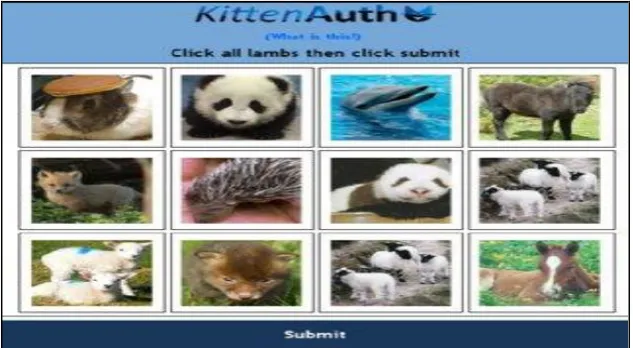
Kittenauth Captcha: Kittenauth is another interesting image based Captcha. It uses the pictures of popular animals, birds and other living things as Captcha image. Identifying animal images are easy for human and it will be very difficult for the bot programs. Figure 2. shows the kittenauth Captcha image.
Figure 2. Kittenauth Captcha image
Figure 3. Assira Captcha image.
Picatcha: Picatcha is slightly different from other image based Captcha methods. This method was developed by a group of research team in University of California, Berkeley. It exhibits a set of different objects which includes a group of closely related object images. The user needs to select and click one or more images of a particular object to prove as human. Figure 4. shows the Picatcha image.
Figure 4. Picatcha image
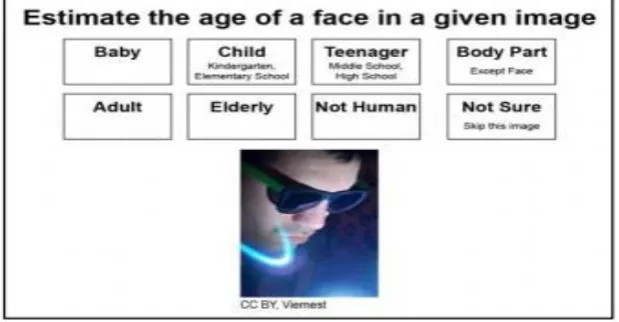
AgeCaptcha: AgeCaptcha [7] is another image based Captcha. In this method age indeterminate faces are sequentially displayed to the user along with predefined response categories. Then, the user is asked to identify the age group of each face by selecting one of the response categories. The human users are capable of differentiating the different age group of the image displayed. Sometimes the image may be other parts of the body also. This will be challenging task for the bots. Figure 5. shows the AgeCaptcha.
Collage Captcha: Collage Captcha [8] is another interesting image based Captcha which challenges the image recognition capacity of the human. Collage is an art of making a picture with different objects. In this method also different objects were presented to the user in different orientation. The users need to concentrate on every object and then select the requested image to get authentication. Figure 6. shows the collage Captcha image.
Figure 6. collage Captcha
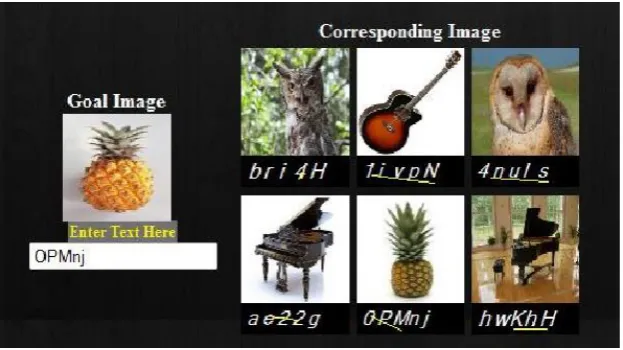
Hybrid Collage Captcha: Hybrid Collage Captcha [9] is another type of collage Captcha with two step authentication. The Captcha displays one goal image and six option images. The user has to identify the target image which is similar to the goal image and then enter the text below the target image for authentication. This becomes a tough challenge for the bots. Humans only can complete the test and get authenticated. The figure 7. shows the hybrid collage Captcha.
Figure 7. Hybrid collage Captcha
Figure 8. Image orientation Captcha
Imagination Captcha: Imagination Captcha [11] also designed with two step authentication. In the first step the user has to find and click on the geometric centre of the image. The image consists of multiple photos selected from a database. In the second step, the user is presented with another photo and asked to pick a suitable caption for it from a list of choices given in the drag down box. Figure 9. shows the Imagination Captcha.
Figure 9. Imagination Captcha
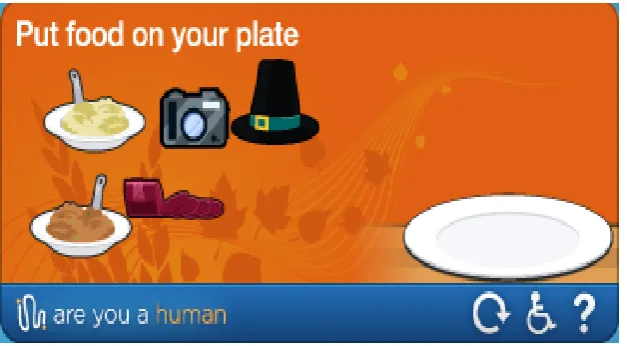
PlayThru Captcha: PlayThru is another image based Captcha security method. It is an alternative to the traditional text based Captcha method in which the user has to play a mini game with physical activities, such as dragging and dropping. Playing game or physical activities are possible only for humans whereas it is a challenging task for the bots. Figure 10. shows the PlayThru Captcha. In this Captcha the user have to click and drag the object to the destination to prove him as human.
Confident Captcha: Confident Captcha [12] is another image based Captcha method to prevent malicious bots entry into the web applications. It is based on click operations in multiple steps. To get authentication the user need to click the specific images correctly to prove, they are human. The figure 11. shows the confident Captcha image. The confident Captcha needs a large database of different images for its operation.
Figure 11. Confident Captcha image
IV.CONCLUSION
The primary purpose of implementing Captcha in all the websites is to prevent the unauthorized entry and access of bots into the web services. The bots perform malicious activities in the web applications which need to be prevented. Traditional text based Captcha methods have been deployed for a very long period. The enormous growth of OCR software becomes a remarkable threat to the of text Captcha security. Hence novel image based Captcha methods with different concepts and methods have been employed to increase the security of the web applications. The image Captcha methods also has some disadvantages.
Image Captcha methods are difficult for the blind users, low vision and color blindness users.
It is suffered by machine learning and edge detection attacks.
Image Captcha also experiences pixel count and random guess attacks.
Moreover the image based Captcha methods makes fun and interesting for humans. It is easy for humans to solve and so they will stay with the web applications. Hence the Captcha usability also increased.
R
EFERENCES
[1] Riswan Ur Rahman, 2012, ‘Survey on Captcha Systems’, Journal of Global Research in Computer Science, vol.3, no: 6.
[2] Coates, A.L, S. Bired & J. Fateman, 2003, ‘Pessimal Print: A Reverse Turing Test’, International Journal on Document Analysis and Recognition, vol.5, no.2, pp 158-163.
[3] Gao et al, 2010, ‘An audio CAPTCHA to distinguish humans from computers’, in: 3rd International Symposium on Electronic Commerce and Security, pp 265–269.
[4] Kluever, 2009, ‘Balancing Usability and Security in a Video Captcha’, in: Proceedings of the 5th Symposium on Usable Privacy and Security, pp 1–14.
[5] Luis von Ahn, 2004, ‘Labeling Images with a Computer Game’, in: Proceedings of the SIGCHI Conference on Human Factors in Computing Systems.
[6] Elson, 2007, ‘Asirra: a Captcha that exploits interest-aligned manual image categorization’, in: Proceedings of the 2007 ACM, pp 366–374.
[7] Jonghak Kim et al, 2014, ‘AgeCAPTCHA: an Image-based Captcha that Annotates Images of Human Faces with their Age Groups’ , Transactions on Internet and Information Systems Vol. 8, No. 3.
[8] M. Shirali-Shahreza & S. Shirali-Shahreza, 2007, ‘Collage CAPTCHA’, in: 9th International Symposium on Signal Processing and Its Applications, Sharjah. pp. 1-4.
[10] Rich Gossweiler et al., 2009, ‘What’s Up CAPTCHA? A CAPTCHA Based On Image Orientation’, in: International World Wide Web Conference Committee, April 20–24, Madrid, Spain.
[11] Ritendra Datta, 2005, ‘IMAGINATION: A robust image-based CAPTCHA generation system’, in: Proceedings of the 13th ACM International Conference on Multimedia, Singapore.