Available Online atwww.ijcsmc.com
International Journal of Computer Science and Mobile Computing
A Monthly Journal of Computer Science and Information Technology
ISSN 2320–088X
IJCSMC, Vol. 3, Issue. 11, November 2014, pg.116 – 121
RESEARCH ARTICLE
AN ANALYSIS AND SURVEY OF
MOBILE LEARNING SYSTEMS
M. Shobanarani
PG Scholar, Department of Computer Science and Engineering, Gnanamani College of Technology, Nammakal, India
A. Ushanandhini
Programmer, Sona College of Technology, Salem, India
R. Umamaheswari
Associate Professor, Department of Computer Science and Engineering, Gnanamani College of Technology, Nammakal, India
Abstract- In growth of data communication and information technologies is changing the people use in their usual everyday life. Recent research in learning systems points out different methods and various approaches to enhance students learning in all situations. This study is to address how mobile technology can be designed to support and understand different representation for mobile in classroom use and in learning process. This type of learning system offers present-day learning process through tablet computers, handheld devices, smart phones and to support variegated platform. This study paper analyses and describes characteristics of this type of learning system.
Index Terms- E-learning; D-learning; M-learning; Learning Management System
I.
INTRODUCTION
fixed time in a fixed place. In distance education to retain the probity of the education process it uses technology to disparate the learner from the teacher and the learner from the learning category.
A delivery of education, learning and training are achieved electronically through electronic learning (e-learning). The next generation of learning move from distance learning (d-learning) and electronic learning (e-learning) to mobile learning (m-learning). Table 1 shows the some variation in electronic learning and mobile learning process. In these increasing criteria, basically we are not able to imagine any professional of any working environment without a mobile phones or PDS (Personal Digital Assistant). Nowadays, the use of the mobile devices started to be used for the learning environments, for this reason it appeared a new kind of learning called ―Mobile learning‖ and that is mediated via mobile phone technologies such as Smartphone, wearable devices or tablets. Learning activity with each isolated learner‘s mood include demand, attributes and absorption are order to boost a learning content which are direct with mobile learning systems. The personal pocket devices such as PDAs, Smartphone and tablets will acquire or extend educational particulars of mobile learning [1]. Essentially, usage of technologies such as Internet, mobile phones technologies, etc. is related with adapt in tools and devices are using in everyday life [3], [4]. Learners or students can accumulate process and access information outside the classroom through mobile devices. These devices can bring people together, it can motivate review, co-operation and conversation and also current learning environments reinforce strengths-based teaching.
It can also extend to provide students and teachers extensibility, exposure, and access to resources. A replica of learner is prompt to include all the data that the system knows about a learner or it is generally compute either with default values or by querying the learner. We propose a new aspect of mobile learning in which technological integrate in mobile devices in everyday classroom and outside of the classroom. The design of learning system also includes following characteristics like it needs to support face-to-face activities and to provide scaffolding of the students and the teacher is able to utilize the technological. In such place teachers and students need novel type of learning environments, which may entirely satisfy their needs and allow them to use learning tools and services of their choice to support their lifelong learning, and in which they are fully responsible for their learning process. The primary consideration like screen size, scroll and zoom operations are evaluated while using a mobile device in learning process and another major issue is the user using varying operating system such as android, blackberry and iOS, so it will be run in all operating system.
II. SKETCH ON LEARNING MANAGEMENT SYSTEM
Much was accomplished and the group made numerous recommendations to learning environment which included the formation of two study groups one to look at Learning Management and other to look at the use of Mobile Devices in the classroom. Let we see some basics things behind in Learning Management Systems (LMS). Learning Management System (LMS) is included some of the following vital parts.
Self-educate utility
Persistent course content transmission
Course executive and administration structure
Course task function management
Facilitate insight restate
Learning Management System is project based, it needs to suite of easy to use collaboration tools such as Google Docs integrations, etc. that can be used to create more reliable learning experiences. Individual student learning profiles access information in manner of personalized instruction and assessment based on student learning styles. Learning Management System included some of priorities it will be,
Purpose of the system from the end users perspective
Leaning systems competence to consolidate with the Student Information Systems and Google Docs
Implementation aspect should be manage to support on-going training process
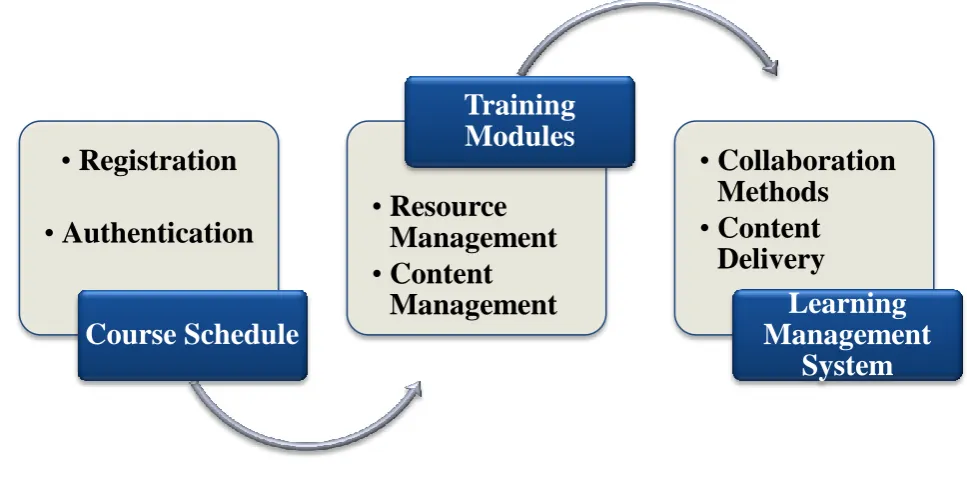
Fig. 1 has been shown systematic learning management system with different modules include course schedule, training modules and with our operational parts.
Figure 1. Systematic learning management system
III. SIGNIFICANCE, UTILITY AND PROVOCATION OF MOBILE LEARNING
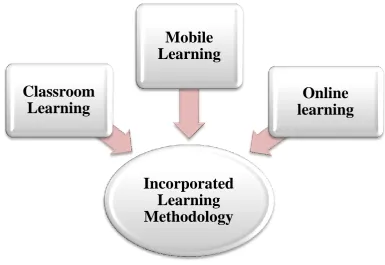
M-learning also consider the following disclosure for effective mobile technology aspects, Fig. 2 shows the incorporated learning methodology and it‘s include different types of learning they may be classroom learning, mobile learning and on-line learning. In the m-learning environment it prospect a physical or social environment with a mobile device that can furnish related information about the environment and stimulate learners in activities such as information gathering, information discussion and information sharing.
This type of learning environment enable learning to take place which can make greater use of learners instantaneous context and circumambient. By this way, mobile learning technologies can expedite learning in both context and learning across contexts. Mobile learning also consider some of the following significance terms for useful process.
A. Start compact, think widely
It takes time to expand and establish functional mobile content.
B. Content portable
Retain the short videos, rapid updates, etc.
C. Turn on
The study shows that organizations are deploying even previously their approach is entirely developed. Start planning an approach now, even if it is just a small segment of the overall learning environment which are used in the M-Learning programs, they can include new technology into the classroom and devices used in these technology were lightweight than books and PCs. Formally, mobile learning supports the learning process rather than being integral process and it can be a useful add-on tool for students with their special needs.
Normally, mobile learning behold the different aspect of prosperity include formation options to delivery of multimedia content which will be available in mobile devices are significantly less cost than PCs and other devices. This type of learning environment supports continuous and pliable learning, it also anxious mainly in diminishing training cost. Improving the levels of learning and participation in education and using the communication aspect of a mobile phone as playing a major role in learning activity.
•
Registration
•
Authentication
Course Schedule
•
Resource
Management
•
Content
Management
Training
Modules
•
Collaboration
Methods
•
Content
Delivery
Learning
Management
Figure 2. Incorporated learning methodology
In mobile learning process it needs to validate and justify the development of specification and other types of resources was justified to optimum understand the challenges and aspect of education, training or learning community and whenever mobile-learning environment has been accomplished its needs to incorporate many and more technical challenges that have a broad range of screen space, key size and connectivity aspect.
The concern meets bandwidth for fast streaming to support for specified device. Mobile-learning environment include many recent features include multiple standards, multiple screen sizes and multiple operating systems. In addition to these challenges, there are some other challenges are also included like equipment, maintenance, connectivity, support from technical aspect and teacher-student training.
.
Subject E-learning M-learning
Content Access classroom access or internet Laboratory Access of learning from anywhere, anytime
Communication Electronic-mail-to-Electronic-mail Immediate messaging
Location scenario Private location No geographic boundaries
Content Delivery To reach internet site it will take some travel time Wireless internet connectivity so no travel time need
TABLE 1. VARIATION IN ELECTRONIC LEARNING AND MOBILE LEARNING PROCESS
Incorporated
Learning
Methodology
Classroom
Learning
Mobile
Learning
IV. ESSENTIALITY FOR MOBILE TECHNOLOGIES
In order to initiate mobile learning technologies, we need some baseline learner‘s necessitated specification and it should be:
A. High convenient
The initiated technologies should be available at anywhere and anytime with user needs.
B. Clear benefits
The technology is suited to everyday demands for reference, communication and learning.
C. Easy-going
The features should be adapted to the context for learner‘s ability and knowledge and the learning environment.
D. Use to use
The technology is easily penetrated and navigated by learners with no antecedent sophistication using it.
E. Intent-on
The learner can use the learning environment technology to manage learning throughout a lifetime, so that the learner‗s personal collection of resources and knowledge will be promptly accessible despite refashion in technology.
V. BACKGROUND
An encouraged vision of mobile learning that values the binate utility of distance learning and continual connectivity [5], the value of mobile devices as tackle of learning is establish in the storage ability that enable learners to connect to beforehand downloaded document at any moment, and presently enables learners to bring the classroom into the field simply by audio/video recordings [6].
Personalized learning [7], an academic teaching process is achieved by the learner‘s receiver of knowledge as demonstrate in traditional classrooms and it‘s specification. In this process the assent of learners and trainers should proponent limited instruction between them and another side its have ability to organize variation, management and contribution for learning environment.
VI. CONCLUSION
Blooming growth in technology will make it time exhaustive to include electronic tools and make it increasingly minimum cost. The importance of the mobile learning application represents an enhanced aspect in learning process because of learners have to gather, share and understand the information‘s. The overall view on the existing approaches in learning system and mobile-learning domain shows that it most probably applies leading to processes, where particular knowledge should be used. A distinctive factor of this technique evolution, compared to other approaches in the background approaches and development of an upgraded methodology to meet well-established requirement in mobile-learning process.
REFERENCES
[1] Birkbeck. University of London. Glosary of Terms. http://www.bbk.ac.uk/ccs/elearn/glossary.htm.
2006.
[2] J. Foreman, ―Game-Based Learning: How to Delight and Instruct in the 21st Century,‖ Educause, vol.
39, no. 5, pp. 50-66, 2004.
[3] F. J. García-Peñalvo, ―Estado actual de los sistemas e-learning,‖ Teoría Edu. Edu. Cultura Soc. Inf., vol. 6, no.2,2005.[Online].Available:http://campus.usal.es/~teoriaeducacion/rev_numero_06_2/ n6_02_art_garcia_penalvo.htm, accessed Aug. 8, 2014.
[4] F. J. García-Peñalvo, Advances in E-Learning: Experiences and Methodologies.Hershey, PA, USA:
Information Science Reference, 2008.
[5] P. Harris, ―Goin‘ mobile,‖ Learn. Circuits, Jul. 2001 [Online]. Available:
http://www.learningcircuits.org/2001/jul2001/harris.html
[6] P. Hayes, D. Joyce, and P. Pathak, ―Ubiquitous learning—An application of mobile technology in
education,‖ in Proc. ED-MEDIA, Lugano,Switzerland, 2004, pp. 1811–1816.
[7] Rudd, T. (2008). Learning spaces and personalisation workshop outcomes. Bristol, UK: NESTA