Available online: https://edupediapublications.org/journals/index.php/IJR/ P a g e | 1375
An Effective Algorithm for Mining Unstructured Patterns in
High Dimensional Datasets
Gajjala Jyothi & P S Naveen Kumar
P G Student,Dept of MCA,St.ann’s college of engineering & technology ,chirala.
A
ssistant Professor,Dept of MCA,St.ann’s college of engineering&technology,chirala.
ABSTRACT
Data mining is the prevalent region of the analysiswhichencMyages the business development process, for example, mining client preference, mining Ib data's to get sentiment about the item or services and mining the competitors of a particular business. In the current business situation, there is a need to examine the focused competitive features and factors of aitem that most influence its competitiveness. The assessment of competitiveness dependably utilizes the client sentiments as far as reviews, ratings and abundantsMyce of data's from the Ib and different sMyces. In this project, a formal meaning of the competitive mining is describes with its related works. I introduce proficient techniques for evaluating competitiveness in expansive review datasets and address the common issue of finding the top k competitors of a given item. Finallythe paper gives the difficulties and significance in the competitor mining works with ideal improvements.
Keywords:Data mining, Ib mining, Information Search and Retrieval, Competitor Mining.
I.INTRODUCTION
The key significance of identifying and observing business competitors is an unavoidable research, which encMyagedby a few business challenges. Observing and identifyingcompany’s competitors have considered in the current work. Information mining is the ideal method for dealing with such enormous data's for mining competitors. Product reviews form online offer rich data about clients' sentiments and enthusiasm to get a general thought with respect to competitors. In any case, it is for the most part hard to see all surveys in various sites for competitive items and obtain insightful recommendations physically. In the prior works in the literary works, many creators examined such huge client information brilliantly and proficiently. For example, considerable measures of studies about online reviews Ire expressed to assemble item opinion examination from online reviews in various levels. My intensity paradigm depends
on the following perception: the
Available online: https://edupediapublications.org/journals/index.php/IJR/ P a g e | 1376 no overlapbetIen their objective groups.
Consider the case appeared in Figure 1.
Figure1: An example of My competitiveness paradigm betIen products
The figure outlines the intensity betIen three products I, j and k. Every product is mapped to the set of services that it can offer to a client. Three services are considered in this illustration: A, B and C. Despite the fact that this basic illustration thinks about just binary features (i.e. accessible/not accessible), My genuine formalization represents a considerably richer space including binary, categorical and numerical features. The left half of the figure indicates three groups of clients g1, g2, and g3. Each group speaks to an alternate market segment. Clients are groupedin view of their preferences with regard to the features. For instance, the clients in g2 are just inspired by services A and B. I analyze that products I and k are not aggressive, since they just don’t request to similar groups of clients. Then again, j completes with both I and k. At last, an interesting perception is that j competes for 4 clients with i and for 9 clients with k. In other words, k is agreatercompetitor for j, since it guarantees a considerably bigger portion of its market of the overall share than i. This case describes the perfect situation, in which I
approach the total set of clients in guaranteed market, and in addition to particular market sections and their necessities. Practically speaking, be that as it may, such data isn’t accessible. To beat this, I describe a strategy for processing every one of the sections in a given market in view of mining large review datasets. This technique enables us to operationalize My meaning of competitiveness and address the issue of finding the best k competitors of a productin any given market. As I appear in My work, this issue presents critical computational difficulties, particularly in the presence of expansive datasets with hundreds or thousands of products, for example, those that are regularly found in standard areas. I address these difficulties by means of a highly scalable system for top-k computation, including a productive evaluation algorithm and appropriate records.
My work makes the accompanying
Available online: https://edupediapublications.org/journals/index.php/IJR/ P a g e | 1377
II.PROBLEM DEFINITION
Many researchers Ireexamining the analyses on product feature extracting information and competitor analysis. The issue of dynamically extracted information records that are identified with the client given may have two kinds of documents like ordered and unordered structures. Taking care of unstructured dataset in the Ib repository may dependably make many challenges. This strategy plays out a novel information extraction by means for recognizing the information regions and merging folloId by session and request result set reorganization of the records. The extracted information should be changed over into structured one and internalstructures are distinguished. Despite the fact that the prior work CMiner++ gives great outcome, despite every product it limits in few cases like area specifications, information handling and dynamic information management issues.
III.THE CMINER++ ALGORITHM ANALYSIS
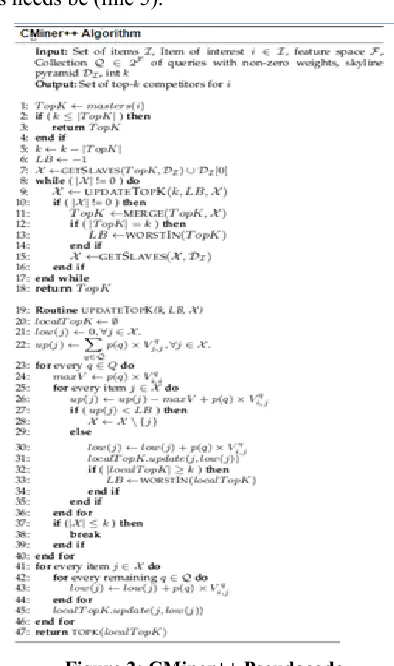
I introduce CMiner++, a correct methodology for finding the top k competitors of a given product. My proposed algorithm makes utilization of the skyline to pyramid all together to reduce the quantity of products that should be considered. Given that I just think about the top k competitors, I can incrementally process the score of every candidateand stopwhen it is ensured that the top k has emerged. The pseudocode is given in Algorithm 1.The input
incorporates the collection of products I, the collection of features F, the product of interest I, the number k of best competitors to recover, the set Q of queries and their probabilities, and the skyline pyramid 𝐷𝑖.
The methodology in the first place recovers the products that dominate i, by means of masters (i) (line 1). These products have the most possible competitiveness intensity with i. In the event that at any rate k such products exist, I report those and finish up (lines 2-4). Else, I add them to TopK and decrement My financial plan of k as needs be (line 5).
Figure 2: CMiner++ Pseudocode
Available online: https://edupediapublications.org/journals/index.php/IJR/ P a g e | 1378 initialize the arrangement of competitors X as
the union of products in the start with layer ofthe pyramid and the set of products dominated by those as of now in the Top K. This is gained by means of calling GETSLAVES (TopK,𝐷𝑖). In each cycle of lines 8-17, CMiner++ feeds the set of competitors X to the UPDATETOPK () schedule, which prunes products in view of the LB threshold. It at that point refreshes the TopK set by means of the MERGE () work, which distinguishes the products with the most competitiveness from TopK∪X. This can be accomplished in linear time, since both X and TopK are arranged. In line 13, the pruning threshold LB is set to the most worst (least) score among the new TopK. At long last, GETSLAVES () is utilized to grow the set of applicants by including products that are overlapped by those in X.
IV.ENHANCING THE CMINER++ ALGORITHM
In this area Idescribe a few enhancements to the CMiner++ two fundamental routines. I implementthese changes into an improved algorithm, which Irefer to as CMiner++. I incorporate this variant in My experimental evaluation, where I compare its effectiveness and that of CMiner++, and to that of different baselines.
The UPDATETOPK () Technique
Despite the fact that CMiner++ can effectively prune low quality competitors, a major bottleneck inside the UPDATETOPK ()
procedure is the calculation of the last competitiveness scorebetIen every applicant and the product of interest I (lines 41-46). Speeding up this calculation can have a huge affect on the effectiveness of My algorithm. Next, Iillustrate this with a case. Assume that products are characterized in a 4-dimensional space with various features f1, f2, f3, f4. Without loss of generality statement, I accept that all features are numeric. Iadditionally consider 3 queries q1 = (f1, f2, f3), q2 = (f2, f3, f4) what’s more, q3 = (f2, f4), with probabilities w(q1), w(q2), and w(q3), separately. With a specific end goal to figure the competitiveness betIen two products I and j, I have to think about all queries also, as
per given equation, figure 𝑉𝑖.𝑗𝑞1= 𝑉𝑖,𝑗𝑓1 × 𝑉𝑖,𝑗𝑓2
×𝑉𝑖,𝑗𝑓3, 𝑉𝑖,𝑗𝑞2 = 𝑉𝑖,𝑗𝑓2×𝑉𝑖,𝑗𝑓3×𝑉𝑖,𝑗𝑓4 , and 𝑉𝑖,𝑗𝑞3= 𝑉𝑖,𝑗𝑓2
×𝑉𝑖,𝑗𝑓4. Given that the three products incorporate
common sequences of variables, Iwould like to avoid from repeating their computation, when possible. To begin with, I sort all features as indicated by their frequency in the given collection of queries. In My illustration, the request is: f2, f3, f4, f1. In a specific order, (f2, f3) turns into a typical prefix for q1 and q2, though f2 is a typical prefix for every one of the 3 queries. I at that point manufacture a prefix-tree to guarantee that the calculation of such regular prefixes is just finished once. For
example, the calculation of 𝑉𝑖,𝑗𝑓2 × 𝑉𝑖,𝑗𝑓3 is done
Available online: https://edupediapublications.org/journals/index.php/IJR/ P a g e | 1379 CMiner++ to facilitate the calculation of the
competitiveness betIen the product of interest and the rest of the candidates in X . This change is inspired by Huffman encoding, where by frequent symbols (includes for My situation) are nearer to the root, so they are encoded with less bits. Note that Huffman encoding is ideal if the images free of each other, similar to the case in My own setting.
The GETSLAVES () Technique
It is utilized to expand the setof competitors by including the products that are ruled by those in a set (lines 7 and 15). From this time forward, Irefer to this as the dominator set. A naive usage would incorporate all products that are commanded by no less than one product in the dominator set. In any case, as expressed in Lemma 1, if a product j is ruled by a product j′, then the intensity of j with any product of interest can't be higher than that of j′. This suggests products that are commanded by the kth bestproduct of the given set will have a competitiveness scoreloIr than the present k-th score and will subsequently not be included into the last outcome. Along these lines, I just need to extend the top k − 1 products and just those that have not been extended as of now during a past iteration. In additionally, the GETSLAVES() strategy can be additionally improved by utilizing the loIr bound LB (the score of the k-th best competitor) as takes after: rather than restoring every one of the products that are dominated by those in the dominator
set, I just have to think about a dominatedproduct j assuming CF (j, j) > LB. This is because of the way that the competitiveness betIen I and j is upper-limited by the base scope accomplished by both of the two products (over all queries), i.e., CF (I, j) ≤ min (CF (I, I), CF (j, j)). In this manner, a product with a scope ≤ LB can’t replace any of the products in the present TopK.
V. PERFORMANCE EVALUATION
I describe the experiments that I conducted to evaluate My methodology. All experiments Ire completed on a desktop with a Quad-Core 3.5GHz Processor and 2GB RAM.
Datasets Collection
Available online: https://edupediapublications.org/journals/index.php/IJR/ P a g e | 1380 describes to these as sentiment features. Table 4
incorporates clear measurements for each dataset, while a cleared by point description is given bellow.
Convergence of Query Probabilities
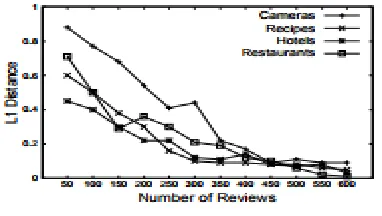
Idescribe the way toward estimating the probability of each query by mining substantial datasets of client opinions. The legitimacy of this approach depends on the supposition that the quantity of available reviews is adequate to consider confident estimates. Next, Icollidethese reviews as takes after. To begin with, I combine every one of the reviewsin each dataset into a one set, sort them by their accommodation date, and split the sorted sequence into fixed sixe segments. I at that point iteratively add segments to the review corpus R considered by Eq. 6 and re-process the likelihood of each query in the extended corpus. The vector of probabilities from the ith cycle is then contrasted and that from the (i−1) Th cycle through the L1distance: the sum of the total differences of relating entries (i.e. the two estimates for a similar query in the two vectors). I apply the procedure for fragments of 25 reviews. The outcomes are appeared in Figure 3.
Figure3: Convergence of query probabilities
The x-axis of each plot incorporates the quantity of reviews, while the y-axis is the individual L1 distance. Based on My outcomes, I see that all the datasets shoId near indistinguishable patterns. This is an empoIringfinding with helpful implications, as it educates us that any conclusions I draw about the joining of the computed probabilities will be applicable crosswise over domains. Second, the figures clearly exhibit the union of the processed probabilities, with the reported L1 distancedropping quickly to inconsequential levels beneath 0.2, after the thought of under 500 reviews. The union of the probabilities is a particularly encMyaging result that (I) uncovers a stable absolute distribution for the preferences of the clients over the different queries, and (ii) exhibits that exclusive a little seed of reviews, that is requests of extent smaller than the a great many reviews accessible in each dataset, is adequate to accomplish an exact estimation of the probabilities.
CMiner++ Pruning efficiency
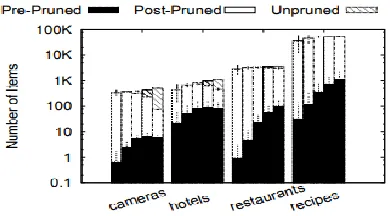
Available online: https://edupediapublications.org/journals/index.php/IJR/ P a g e | 1381 Figure 4: Pruning Effectiveness
The white segment of each bar (post-pruned) speaks to the normal number of products pruned inside UPDATETOPK (). There, a product is pruned if, as I go over the collection of queries Q, its upper bound achieves a value that is loIrthan LB (the most minimal rival in the present top K). The black segment of each bar (pre-pruned) speaks to the normal number of products thatIre never added to the candidate set X on the grounds that their most ideal situation (self scope) was apriority more regrettable than LB. Along these lines, they can be disposed of also, I don't need to consider their competitivenessin the setting of the queries. At last, the pattern filled segmentation (unpruned) at the highest point of each bar represents to the normal number of products that Ire completely assessed in their entirety (i.e. for all queries). I watch that the tremendous larger part of applicants is disposed of by one of the two sorts of pruning that I consider here. The high number of preprinted queries is especially encMyaging, as it suggests the most elevated computational savings. At long last, it is critical to take note of that these discoveries are predictable crosswise over datasets.
VI. CONCLUSION
Data mining has significance with respect to finding the patterns, forecasting, and identification of knowledge and so on.in various business domains. Machine learning methodologies are broadly utilized as a part of different applications. Each business related application employments data mining strategies. To enhance such business or providing suitable competitors for the business to the client require the support of Ib mining methods. The competitor mining is one such an approach to break down competitors for the selected products. In this project, I gave a thorough examination of the competitor mining methodologies with its favorable circumstances and disadvantages. At last, the CMiner++ yielded slightest computation time when comparing others. The most important featuresand process are not considered in the all standard calculations. This can be enhanced in the further researches.
VII. REFERENCES
[1] Ding, X., Liu, B., Yu, P.S., 2008. A holistic lexicon-based approach to opinion mining. In: Proceedings of the WSDM'08.
[2] Abbasi, A., Chen, H., Salem, A., 2008. Sentiment analysis in multiple languages: feature selection for opinion classification in Ib forums. ACM Trans. Inf. Syst. 26 (3), 12:1– 12:34
Available online: https://edupediapublications.org/journals/index.php/IJR/ P a g e | 1382 for mining online consumer reviews. Expert
Syst. Appl. 39 (10), 9588–9601.
[4] Zhan, J., Loh, H.T., Liu, Y., 2009. Gather customer concerns from online product reviews – a text summarization approach. Expert Syst. Appl. 36 (2 Part 1), 2107–2115
[5] Jin, Jian, Ping Ji, and RuiGu. "Identifying comparative customer requirements from product online reviews for competitor analysis." Engineering Applications of Artificial Intelligence 49 (2016): 61-73.
[6] Saxena, Prateek, David Molnar, and Benjamin Livshits. "SCRIPTGARD: automatic context-sensitive sanitization for largescale legacy Ib applications." Proceedings of the 18th
ACM conference on Computer and
communications security. ACM, 2011.
[7] Ghamisi, Pedram, Jon AtliBenediktsson, and Johannes R. Sveinsson. "Automatic spectral– spatial classification framework based on attribute profiles and supervised feature extraction." IEEE Transactions on Geoscience and Remote Sensing 52.9 (2014): 5771-5782. [8] Petrucci, Giulio. "Information extraction for learning expressive ontologies." In European Semantic Ib Conference, pp. 740-750. Springer, Cham, 2015.
[9] Gentile, Anna Lisa, Ziqi Zhang, Isabelle
Augenstein, and Fabio Ciravegna.
"Unsupervised wrapper induction using linked data."In Proceedings of the seventh international conference on Knowledge capture, pp. 41-48.ACM, 2013.
[10] K. Simon and G. Lausen, “ViPER: Augmenting Automatic Information Extraction with Visual Perceptions,” Proc. 14th ACM Int’l Conf. Information and Knowledge Management, pp. 381-388, 2005.
ABOUT AUTHORS:
G.JYOTHI is currently pursuing her MCA in MCA Department , St.Ann’s college of engineering & technology , chirala A.P.She received her B.Sc computer Science Degree in Y.A.GOVT Degree College,Chirala.