Philips Medical Systems Nederland BV
REPORT
DICOM Image Retrieval
Author
Gerald van Veldhuijsen
Date
28 August 2006
Table of Contents
PART I ... 4
1 Introduction ... 4
1.1 Philips Medical Systems... 4
1.2 Assignment... 4
1.3 Document Organization... 5
2 DICOM Standard ... 5
3 Requirements ... 7
4 Related Work ... 9
PART II ... 11
5 Data retrieval vs. Information retrieval... 11
6 DICOM & XML ... 12
7 Terrier ... 15
7.1 Index Mechanism ... 15
7.2 Retrieval Mechanism... 17
7.3 Conclusion... 19
8 Related Work ... 19
9 Global approach description... 21
PART III ... 23
10 Terrier Modifications and Extensions... 23
10.1 Index ... 23
10.1.1 Index Structure... 24
10.1.2 Tag Indexing ... 26
10.1.3 Lexical Ordering ... 26
10.2 Retrieval... 27
10.3 Performance Optimization ... 29
11 System Implementation ... 30
11.1 Document Parsing ... 30
11.2 User Interface ... 32
11.2.1 Input Side ... 32
11.2.2 Output Side ... 34
PART IV... 37
12 Experiments ... 37
12.1 Test Setting... 37
12.2 Test setup ... 38
12.2.1 Basic functionality ... 38
12.2.2 Retrieval performance... 38
12.2.3 Flexibility... 39
12.2.4 Performance... 39
PART V... 41
13 Discussion and Conclusion... 41
13.1 Results Discussion ... 41
13.2 Project Evaluation... 42
13.3 Outlook... 42
References ... 43
PART I
1 Introduction
1.1
Philips Medical Systems
Philips Medical Systems (PMS) in Best is part of PMS global. PMS produces medical equipment. The business activities of PMS are divided in three categories: Imaging systems, customer services and clinical solutions.
Imaging systems consist of medical equipment, used to create images of various parts of the human body in varied detail for radiologists and cardiologists. Examples of this equipment are X-ray machines and CT-scanners.
Customer services include consultancy, which consists of analysis and advice, and the financing, maintenance and repair of medical equipment.
Clinical solutions include healthcare IT systems as well as patient monitoring and cardiac devices. Examples of healthcare IT systems are archiving systems for medical images, viewing stations and medical printers. Examples of the second category are the automated external defibrillators.
The IT department of PMS is responsible for the software of the medical equipment. Our project has taken place in the Interoperability department of PMS. The Interoperability department is a testing department of the IT department. A great deal of the software of the medical equipment must operate according to the DICOM (Digital Imaging and Communication in Medicine) standard. The
Interoperability department tests whether the software characteristics are conform the standard. These tests consist of two types. The first type of test checks whether a system on its own operates conform the standard. The second type of test has the purpose to check whether the system is able to
communicate with other medical devices conform the standard.
Of course the level of testing is very high, because the subject of testing is medical equipment. The correct functioning must be guaranteed before a system can be approved and taken into production. Medical (DICOM) images play a very prominent role in these tests.
1.2 Assignment
This section contains the original assignment description that served as the starting point for our project.
With the DICOM standard an enormous set of medical images can be exchanged. A DICOM image contains the actual image data together with several descriptive information blocks. Within the Interoperability department there are many CD’s available containing different medical images. An important part of the process of approving a product is the validation of the DICOM interface. For this validation, these medical images are used.
Depending on the system to be tested a selection has to be made from the large amount of images available. All available images have to be searched through to see whether the image data and descriptive blocks conform the conditions of the system to be tested. As the number of available images is increasing enormously (the number of CD’s is already in the order of hundred’s) it is almost impossible to do this job by hand. As an extra difficulty, the CD’s are not all stored in a central place, but are distributed over the department.
1.3 Document
Organization
This document will describe our project that has dealt with the above-described assignment. The whole document is split up in 5 large parts, i.e. Problem Definition, Method, Implementation, Testing and Conclusion.
The rest of this document is organized as follows. After this introduction Part I continues with a section (2) on the DICOM standard. As the DICOM standard is the backbone of the images that we are dealing with, it is an important part of our project. In this section we introduce the standard, we describe the relevant basics of the standard and we will try to depict the complexity of the DICOM standard. Next we deal with the requirements specification of our system in section 3. Then we continue with section 4 that discusses the related work in the domain of our problem.
In Part II we start with section 5 on data retrieval versus information retrieval. Here we will explain the differences and resemblances between the two concepts as well as what aspects we need of both. We continue with DICOM XML in section 6. The first step in our approach to solve the problem was to use XML as the document format for our data collection. Here we explain why we chose this approach and what the characteristics of this approach are. After this, in section 7 we deal with the Terrier platform that we have used as the basis for our system. We describe the important characteristics of Terrier here. Then in section 9 we describe the global approach of our total system. Here we introduce the division between the implementation that is a modification of the Terrier platform and the other implemented parts.
In the next two sections in Part III we then continue to go into the implementation in more detail. In section 10 we deal with the extensions and modifications of the Terrier platform. In subsection 10.1 we describe the new index process along with the different index structures. In subsection 10.2 we deal with the weighting mechanism of our system and in 10.3 we discuss the performance optimizations we had to make to the Terrier platform. In section 11 then we describe the implementation that is not related to the Terrier platform. In this section we deal with the input side of our system, i.e. how the data enters the system and how it is processed, as well as with the output side. In the description of the output side we deal with the way queries are used and with the presentation of the results. After we have dealt with the implementation of the system, in Part IV, i.e. section 12, we describe the experiments we did to verify the functionality of the system. We conclude our report in section 13, which is the content of Part V, with a discussion of the results and an outlook to future work.
2 DICOM
Standard
The Digital Imaging and Communications in Medicine (DICOM) standard was originally published as the ACR-NEMA standard. This was the result of the founding of a joint committee between the American College for Radiology and the National Electrical Manufacturers Association that had the purpose to develop interfaces and standards relating to imaging equipment and other medical electronic equipment. [1]
After that the DICOM standard evolved to its current version, DICOM 3.0. It is now maintained by a special DICOM Standards Committee and is published by the NEMA [2]. The current version is called 3.0 to show that it was based on the ACR-NEMA standard version 1.0 and 2.0. Although the name and version remains DICOM 3.0 an updated edition of the standard is published each year. In practice this means that the standard grows with each update. Nowadays the standard has been adopted by virtual all suppliers of imaging products.
The DICOM standard can be seen as a set of engineering information that describes the information structures and procedures that control the input and output of data from medical imaging systems [3]. The standard describes how medical images and its associated information should be formatted and how to exchange them. Note that the term ‘image’ can be misleading here, because DICOM objects do not necessarily need to contain an image at all. An example of this is a structured report (SR). Like the name suggests this is a structured report about a medical investigation of a patient. It can link to images, but does not contain an image itself. We will use the terms DICOM image and DICOM objects interchangeable throughout the rest of this document.
communicate with each other. For this the DICOM standard contains extensive descriptions of protocols, services and information objects that make this communication possible.
The DICOM standard changes continuously over years. Every now and then new medical imaging data fields and higher-level information objects are introduced to support new techniques (like 3D-imaging recently). On the other hand, some parts are phased out because the corresponding techniques are not used anymore.
The two fundamental components of DICOM are the information object and the service class.
Information objects define the core contents of medical imaging, and service classes define what to do with those contents [3]. A distinction is made between service class users (SCU) and service class providers (SCP). For example DICOM printing is a service class. The actual DICOM printer is the SCP and a workstation that is capable of sending the appropriate messages in order to let it print would be considered a DICOM print SCU.
At the implementation level, DICOM specifies a file format for storing data. The part of the file format that contains the descriptive information is called the DICOM header. This is for us the most
interesting part of the standard, because our problem deals with a collection of stored DICOM data and not with the communication between different DICOM devices. We must note here however that this header is not very different for stored objects and objects that are the subject of communication. The most important feature that distinguishes the DICOM header from the many other image
standards is that it is not restricted to image data alone. Also image related information is stored and like we mentioned the image data even is not necessarily always present.
The specification of the DICOM header is described almost entirely in parts 3, 5 and 6 of the standard. The basic building blocks are the DICOM attributes. Such an attribute consists of a tag, a value representation (VR) and a value field.
Part 6 contains all tags that can exist in DICOM data. A tag consists of two 16-bit numbers. Because they are derived from the old ACR-NEMA standard is the first part known as ‘Group’ and the second as ‘Element’ [4] . Together they form the attribute tag and they are usually shown in parentheses. For example the attribute tag of a patient name is (0010,0010) and the study description has (0008,1030) as tag. The number of different tags defined in the standard lies in the order of thousands. The attribute tag is a unique identifier. This means that although the standard can change, this identifier will always belong to the same attribute.
Part 5 describes the different value representations and their value ranges. For example attributes that have Patient Name (PN) as the VR have a maximum length of 64 characters. This is all specified in part 5.
Part 3 lists the different information objects recognized by the DICOM standard. It describes what is contained in an information object; it specifies which attributes must be present and which are optional. As an example “Digital intra-oral x-ray image” is an information object, where the attributes “Patient’s Name” and “Pixel Data” are two of the mandatory attributes.
The DICOM standard not only specifies the DICOM header itself, but it also specifies how this data should be stored on removable media such as diskettes, optical disks, CD’s and DVD’s. DICOM specifies the DICOM header and a file directory. This file directory is called DICOMDIR. Through this DICOMDIR the other DICOM images stored on the medium can easily accessed.
The DICOM standard is not always very straightforward to use and understand. This is not only due to its extensive size. First of all can information objects can be used recursively, possibly resulting in complex nested structures. Further, besides the classes and attributes defined in the standard, users are free to use self-defined attributes, so called private attributes. Finally, the standard is ambiguous and (partly as a consequence) it gives the possibility to create redundant information. It is ambiguous because the same data can be represented in multiple ways and redundant because the same data can be stored in different locations. Different locations can be the different information objects within a DICOM object, but also different DICOM objects itself.
One cause of this seeming complexity is the way the standard is built up. As we mentioned previously, a special DICOM Standards Committee maintains the standard. Actually the current standard is the result of the joined effort of all big vendors of medical equipment and all these vendors have members in the committee. A lot of parts of the standard are based on compromises between different vendors. A proposal that in itself would be an improvement, for example in the field of ambiguity, but also would be in favor of only one (a few) of the vendors, will probably not pass the counsel.
statements that accurately describe their DICOM implementation. Due to the complexity of the standard no products currently implement it totally. A conformance statement is a document that clearly describes what parts of the DICOM standard are supported by a particular piece of equipment. The main purpose of a conformance statement is to easily give a verdict on whether system A is capable of correctly communicating with system B. The Interoperability department completely tests the functionality of a system and can therefore check or generate a conformance statement.
[5] [2] [3] [1] [4]
3 Requirements
This section describes the functional requirements of the system. In Appendix A the complete functional requirements document can be read. The testers of the Interoperability department are the main group of potential users. The images in the Interoperability department are not used for testing purposes only. They are also used for promotion and demonstration purposes. Therefore the application is not restricted to the group of testers only. Other users that should be able to use the system could be people working at the marketing department who also often search for suitable images for this reasons. The other way is also true, i.e. that images that were used for demonstrations in the first phase are also be used for testing purposes afterwards.
The activities of a tester in the Interoperability department related to the search for images are the following. Based on the characteristics of the system to test (=Conformance Statement) the images that cover the required functionality of the system under testing must be selected. The DICOM retrieval system that we have developed should help the user in finding the most suitable images. Sometimes it is possible to use an artificial image. There are tools that can construct an artificial image. They take an image and some descriptive data and put this together into DICOM format. Besides the fact that this takes more time then using existing images, it is most of the time preferred to take images from the real world. The preference to use real world examples is a common
phenomenon in the test domain.
The support for the user to easy search for images puts requirements on the search and retrieval capabilities of the system as well as on the presentation of the results. We discuss these two types of functional requirements separately. Before that we shortly deal with the requirements of the storage of images into the system and after it we discuss the requirements for the system that are implied by the explicit functional requirements.
The basis of the system is a collection of data to search in, a collection of DICOM images. To create such a collection users must be able to load this data into the system. The system must be able to accept all DICOM objects that are available. The images can be offered to the system as single images or as sets of images. In the latter case this set of images is provided with a DICOMDIR as is described in previous section.
During the process of loading images into the system, the user must be able to add his own
description to the data he is providing. In the rest of this document we will refer to this a user-defined meta-data or just meta-data. In the case of a single image this meta-data belongs to that image only, but in case a set of images is uploaded the meta-data is applicable for the whole set. The minimum content of the meta-data is the CD-description of which the
images originate from. In the original situation the description on the CD-case was the main identifier in the search process. This information must be maintained. The user-defined meta-data can vary from only this CD-description to a short
description of the test for which it was used. There is no limit to the length of this data.
Clinical vs. Non-Clinical Clinical data contains DICOM objects that originate from medical systems in hospitals. This means that these objects contain real body parts. Non-clinical data is generated purely for testing purposes and can contain everything, for example a stapler. Clinical data that is used is (should be) anonymized, so that the privacy of patients is guaranteed.
One type of information that is part of this user-defined meta-data must be defined explicitly. This information tells whether the specific image(s) are clinical or non-clinical. As we mentioned previously, there is a preference to use real world examples for testing purposes and this information plays an important role in this selection.
idea results from the fact that the users of our system vary in their expertise level with respect to the DICOM standard. Further like we indicated in the previous section is the DICOM standard simply too extensive and too variable to have complete knowledge of.
Based on this idea we can distinguish the different types of querying that must be supported. First of all it must be possible to query on content only. With content only we mean queries that consist of simple keywords; this is comparable with the way current information retrieval systems are used, like Google.
The matching of the keywords in the queries with the images in collection should be based on fuzzy matching. Here again we can make the analogy with Google that will also return results that contain terms that almost but not exactly match the keywords from the query.
Further we need to support queries where content and structure are combined. These are so-called containment queries where is searched for keywords that must occur in the context of specific structural parts of the DICOM standard. The lowest level of this structure is the level of the DICOM attributes. So for example it must be possible to query for keywords in a specific attribute.
Finally we have another two types of queries that must be supported: range queries and exact matching queries. These types of queries are very useful when the boundaries of a system are tested because this way the images can be retrieved with characteristics that are on those specific
boundaries. The structural part plays an important role in this type of queries. The queries consist of a structural part and value together with one of the operators ‘=’ or ‘<’.
Another retrieval requirement is that the meta-data that was added during the storage process must be taken into account in the retrieval process. This means that when information contained in the user-defined meta-data somehow matches a query, the images that belong to this meta-description must be put into the result set. We are not interested in retrieving the meta-information itself, but it should cause its related images to be returned as result.
Finally, all information contained in the DICOM objects must be available for querying. This is to be prepared for changes in information needs of the users. At this moment some information of the DICOM objects may be very relevant to base the selection of images on, but due to various reasons other information can become relevant in the future as well or instead. When simply all information is available for querying this process will not lead to problems.
For the presentation of the results the most important requirement is that not necessarily all available results for a query have to be returned, but when there are result available at least some must be returned. Further the returned results should be ordered according to relevance. In this ordering it is not necessary that the best result will be listed first but at least the worst result should not be listed first. Next we have to answer the question what is determinative for DICOM object to make it more relevant then others. The answer to this question can be divided into two parts.
Documents can be ranked with respect to the relevance of the keywords
Documents can be ranked with respect to the relevance of the structural information
There are some aspects that play a role in the relevance of a document with respect to the keywords of the query. First of all a document that contains for example the word ‘mr’ does not necessarily has to be a DICOM image that originates from a mr (Magnetic Resonance) system. Most probably this is however the type of image the user is looking for in that case. So the application must use other techniques than simply return the documents that contain the requested keyword.
Further when multiple keywords are used in a query, all this keywords can contribute to the returned result set of images. Some keywords however will lead to more relevant result than others. For example the keyword ‘image’ occurs in nearly every DICOM image. This keyword is then less likely to contribute to relevant results compared to keywords that occur less frequently. Also with this
phenomenon the application has to deal with when retrieving images.
Some parts of the document structure are regarded to contain more relevant information than others. Currently, these are typically the fields that are used in the current available systems for querying. When information that is searched for occurs in any of these parts, it should be possible to rank these documents higher. In other words, it should be possible to assign a higher weight to some structural parts and it this must be flexible because it can change over time.
Finally we discuss the requirements that don’t fit into any of the previous categories and/or are
implications of the previous discussed requirements. In the discussion on the storage requirements we mentioned that it must be able to load all available DICOM objects into the system. In the previous section on the DICOM standard we mentioned that the DICOM standard is subject to change. The application must be flexible enough to deal with these changes in the future. This means no
implementation work needs to be done to make sure that new DICOM images can be loaded into the system.
Last of all, the system needs to meet some performance criteria. The response time of the system has to be within certain limits, where the size of our data collection will be large. The exact size of our collection of images is not representative, because it consists of both image data and descriptive data. When retrieving we will only search through the descriptive data. The experiments must show the size of this descriptive data.
However we think of a response time in the order of seconds, where a response of more than ten seconds is undesirable. We take into account that we are introducing a new system to the users. Real reference material is not available, but it is at least important to make new users enthusiastic and a long response time does not contribute to that.
Summarizing all the discussed requirements we can say that we need flexibility for both input of DICOM object as for the information that can be queried. We need to be able to query both content as structure and in the retrieval process we take user-defined meta-data into account. Finally we need to order the returned results according to relevance.
4 Related
Work
Our project is not the first attempt to solve the previous described DICOM retrieval problem. Within PMS there have been previous attempts to come to a solution. These projects are however not properly documented. The solutions vary from database-based solutions to solutions based only on Excel sheets that contain an inventory of all available images. Some of them were more successful than others but none of them led to constructive satisfying solution. The reasons for these other attempts to fail were basically the same for all these projects and can be divided into two causes:
• Changes in the structure of the information to be stored
• Changes in the information needs of the users
Like we described in the section 2 the DICOM standard can change and therefore the way the information is structured in the DICOM images changes and new types of DICOM objects can be introduced. Most of the previous systems were based on a certain (fixed) data model and therefore these new structures could not be added. To change the model and system mostly took too much effort and then still there is no guarantee for the future.
The second cause is related to the previous. The information that users of the systems are interested in changes over time. The problem with the previous systems was that they provided a predefined set of searchable information that was a subset of the total information available. Information that was outside the scope of these sets was not searchable. The greater importance this new information gained, the less useful the search systems became.
Picture Archiving and Communication Systems (PACS) are systems that are developed both outside PMS as well as inside as a business activity of PMS. They are mainly used in hospitals and these systems are capable of storing an enormous amount of images that of course also can be retrieved. These systems also always implement a DICOM interface and therefore it is possible for medical imaging equipment to directly send their images to a PACS. These PACSs are developed for the use in hospitals. The set of searchable information is rather small and is specifically chosen so that medical specialists can retrieve the necessary images, based on for example only the patient name. This lack of query possibilities already makes them unsuitable to solve our problem.
being a mature and stable storing device for medical images. Also does this not really make a difference to our proof of concept for our system, because our actual system would be a retrieval engine on top of a PACS.
In future work we can look at what the possible advantages of using a PACS are and how to integrate it into our system.
Outside PMS not much attempts can be found that tried to solve the problem. On of the few is the plug-in for the desktop variant of the Google search engine [7]. This plug-in simply processes the descriptive blocks of the DICOM images as flat files and indexes these. So this plug-in contains the intelligence of how it must decode the information in a DICOM object in order to process it. This project will not suffer from the two problems that we described that were problematic for the projects within PMS. It does not use a fixed model for the DICOM objects, so changes in the standard are not a problem, only if the way the information must be decoded changes. Further it does not use a subset of the information, but it offers all information that it encounters.
However it is not possible to use all the types of queries we defined in the requirements. The reason for this is that the structure of the DICOM images is ignored. Further it is not possible to use the user-defined meta-data we described and it is not possible to show a preview of the images in the results. Finally it is not an open source project so it is not possible to make changes based on the
requirements of our project.
Finally there are some projects that provide more retrieval possibilities then current DICOM
PART II
5
Data retrieval vs. Information retrieval
This section is meant to describe the relationship between data retrieval and information retrieval. The reason for this discussion is that in the description of the requirements in section 3 aspects of both concepts come to the fore. So here we first introduce both concepts, then we deal with the differences between the two. Then we look at which aspects of both concepts apply to our project and finally we look at the consequences.
The standard work that is currently referenced to when dealing with the concept of information retrieval is [10]. In this book the following definition of information retrieval is given:
Information retrieval (IR) is a part of computer science that studies the retrieval of information (not data) from a collection of written documents. The retrieved documents aim at satisfying a user information need usually expressed in natural language [10]. Today’s IR-systems allow the user to enter keywords that identify the subject of which the user wants to find information. Such an IR-system then returns a list of results that are ordered according to the relevance of the documents. This
ordering is based on a certain model and it is of course system specific.
In [10] also a definition of data retrieval is given: data retrieval (DR) is the retrieval of items (tuples, objects, Web pages, documents) whose contents satisfy the conditions specified in a (regular
expression like) user query. The most well-known systems that support DR are SQL-based database systems. Both the data as the queries for these systems are well-structured.
The differences between IR and DR are clearly depicted by [11]. An overview of the differences is given in figure 1.
Figure 1. Information Retrieval vs Data Retrieval [12]
Further in the requirements we discussed that we wanted the results to be presented in a ordered way, i.e. ranked according to relevance. As we can see in figure 1 the ranking of results according to relevance is part of IR.
Finally we discussed the requirements that we needed flexibility with respect to both the document structure at the input side as the information availability at the output side. This is not a specific characteristic of IR in general, but a large part of current IR systems has this characteristic. We already saw in section 4 on the related work that the DICOM plug-in for the Google desktop meets the requirement that it does not put requirements on the structure of the documents and also that it has all information that is contained in a DICOM object available to search through.
In figure 1 we see that for the query types and retrieval for DR holds that the queries are well structured and results are only delivered in case of exact matching. This corresponds to our
requirements that we must support the query types exact matching and range matching. The queries in these cases are structured, because they always consist of a field in combination with a value(s). Retrieval is based on exact matching because documents either satisfy the condition posed in the query or not. This corresponds with the definition of DR.
The main challenge for our DICOM retrieval system was to combine these two types of retrieval into one fully functional system. That means that we want to exploit the use of structure from data retrieval while still maintaining the flexibility of the information retrieval concept.
6
DICOM & XML
This section describes the first step that we took in our approach to solve the problem. Instead of directly using the images in DICOM format we have used XML representations of the descriptive data of the DICOM images. First we discuss why we have chosen to work with XML as an intermediate format and after that we describe how the XML format is used and what the effects of this approach are.
Original DICOM data is in binary format. In principle this binary DICOM stream can be used to transfer data inside and between programs (and it is of course). However this would require each program (component) to be aware of the fine nuances of how to decode and encode the binary DICOM stream. Therefore an XML representation of the DICOM data is a useful alternative [13]. The author of [13] as well as other experts suggest that an XML representation should be become part of the DICOM standard but up till now no real results in that direction have been achieved. Most of the current research focuses on the structured reports (SR) instead of the DICOM standard as a whole. A DICOM image is like an XML document hierarchically structured. Therefore using XML as the representation of DICOM images is a logical choice. There are a number of advantages of using XML compared to DICOM. XML is far more widely used than DICOM and XML’s popularity is still increasing in various fields. Therefore a lot of tools and parsers are available for processing and manipulating the data. Furthermore a lot of research is done in the field of XML retrieval. By using XML to represent the DICOM data the main subject of our project, the retrieval of DICOM data, internally transforms to the subject of XML retrieval. Finally, as stated, the DICOM standard can be (and is) changed and extended. XML itself and XML tools are in principle very suitable for dealing with this phenomenon. For creating XML representations of the DICOM images we make use of a validation tool for DICOM images, DVT [14]. This is an open source project, which is maintained by the Interoperability
department of PMS.
Simply put, this toolkit validates the communication between medical equipment as well as the
. . .
<Attribute Group="0018" Element="1151" Type="2C" VR="IS" Length="4" Present="+" Name="X-Ray Tube Current">
<Values>
<Value>603</Value> </Values>
</Attribute>
. . .
<Attribute Group="0028" Element="0004" Type="1" VR="CS" Length="12" Present = "+" Name="Photometric Interpretation"> <Values>
<Value>MONOCHROME2 </Value> </Values>
</Attribute>
. . .
<Attribute Group="0008" Element="2111" Type="3" VR="ST" Length="60" Present = "+" Name="Derivation Description">
<Values>
<Value>Compress BN JPEG Lossless, Decompress Pegasus JPEG Lossless
</Value> </Values> </Attribute>
. . .
<Attribute Group="0040" Element="A160" Type="1C" VR="UT" Length="478" Present="+" Name="Text Value"> <Values>
<Value>Examination shows all the dorsal vertebral bodies are of normal stature and contour with normal signal intensity. There is decreased signal in the disc at levels suggesting desiccation of the disc. The remaining dorsal discs show normal signal intensity. The dorsal spinal canal shows normal size and configuration with normal signal intensity. The dorsal spinal cord is not enlarged and shows normal signal intensity. Paraspinal soft tissue shows normal signal intensity.
</Value> </Values> </Attribute>
. . .
<ValidationCounters>
<NrOfValidationErrors>0</NrOfValidationErrors> <NrOfValidationWarnings>0</NrOfValidationWarnings>
<NrOfGeneralErrors>0</NrOfGeneralErrors> <NrOfGeneralWarnings>0</NrOfGeneralWarnings>
<NrOfUserErrors>0</NrOfUserErrors> <NrOfUserWarnings>0</NrOfUserWarnings>
<ValidationTest>PASSED</ValidationTest> </ValidationCounters>
. . .
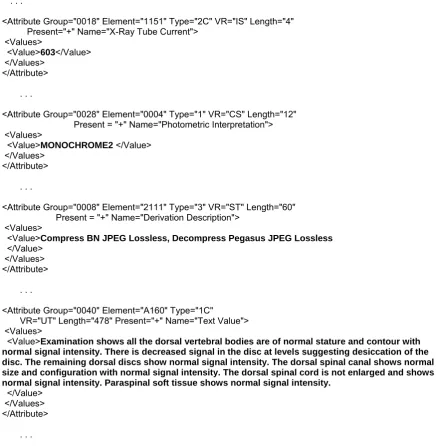
Figure 2: Example of (part of an) XML representation of DICOM object
In figure 2 an example of a part of how such an XML representation of a DICOM object could look like is given, generated by DVT. It shows both information that originates from the original DICOM object as well as added validation information.
The next characteristic is also a direct consequence of the DICOM format. The same information can be placed in several attributes. The effect is that it is not (always) clear in which attribute the useful information can be found.
The last characteristic is a result of the used XML generation tool, DVT. Besides the summary of validation results also validation information is shown at the location that it applies to. This means that throughout the document structures of error messages and warnings can occur.
This approach of using an external tool, DVT, to generate our XML representation has some
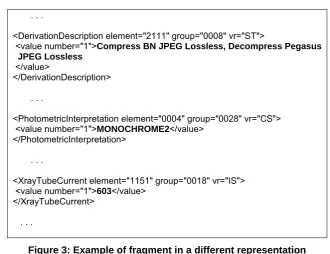
consequences for the requirements of our system. In the requirements we stated that the structure of the DICOM objects is variable. Therefore also the structure of the XML documents can change. Besides this, not only will lead changes in the DICOM standard to changes in the XML document, but also changes in DVT will lead to changes in the XML structure. Because there is no standard that prescribes how an XML representation of a DICOM image looks like, we cannot put restrictions from our side either on the XML documents. Our goal was that our system is flexible enough with respect to the generated XML representation that it also accepts XML representations generated by other tools. In figure 3 an example of a XML representation generated by a tool other than DVT is given.
. . .
<DerivationDescription element="2111" group="0008" vr="ST">
<value number="1">Compress BN JPEG Lossless, Decompress Pegasus JPEG Lossless
</value>
</DerivationDescription>
. . .
<PhotometricInterpretation element="0004" group="0028" vr="CS"> <value number="1">MONOCHROME2</value>
</PhotometricInterpretation>
. . .
<XrayTubeCurrent element="1151" group="0018" vr="IS"> <value number="1">603</value>
</XrayTubeCurrent>
. . .
Figure 3: Example of fragment in a different representation
Further, in the requirements we have specified that users are not obliged to have complete knowledge of the underlying DICOM format in order to be able to work with the system. Now because we are actually dealing with XML retrieval this has slightly changed into the requirement that users are not obliged to have complete knowledge of the underlying XML structure.
Finally, we discussed the requirement that all information should be available for querying. Now when we use the XML documents as representation for the DICOM images we maintain this requirement. This means that the information that is added by the XML generator tool will also be available for querying. This will add useful functionality to the system, because for example the validation information can also be queried, which can be valuable information for testers.
This section can raise the question what basic knowledge a user must have in order to use the application. To basically query the collection the user must have knowledge of the domain specific terminology that can occur in the DICOM objects. This requirement is not different than for other retrieval systems. Further to use the structure in the queries the user must be aware of the names of the different structural parts. Most XML generator tools leave the name intact that was defined by the DICOM standard. To be able to query on features that are unique for a specific XML representation, then the user must have knowledge on how that specific XML structure is build up.
User-defined Meta-information
In the requirements we described that the user must be able to add so-called user-defined meta-information at the time of storage. This meta-information is also stored in an XML document. The advantage of using XML for this data is that we can treat both types of information the same way. For each dataset of images or single image such a meta XML document is created. In case of a dataset the information contained in this file applies to all images in the dataset. Besides the types of meta-information that we described in section 3, all other meta-information that users want to add will be placed in that file.
Because the meta-information must be taken into account at retrieval time, our approach makes sure that somehow their will be a link between the XML documents that are representations of the DICOM images and the XML documents that contain the user-defined meta-information. This mechanism will be described in section 10, where the retrieval mechanism is discussed.
XML generation tools
We use DVT as the tool to generate our DICOM XML representations for the images. Besides DVT there are several tools that are capable of generating XML representations. DCMTk [15] is an open source DICOM toolkit that implements large parts of the DICOM standard. Like DVT also DCMTk has the possibility of validating DICOM objects against the standard. However the module that provides the validation functionality is not free to use. Further, Dcm4che [16] is a open source DICOM
implementation in Java, and one of its features is that it can translate DICOM objects to XML. Finally Pixelmed [17] is a DICOM implementation also in Java. Besides generating XML for DICOM images, it provides viewing functionality as well limited validation functionality. However this implementation is not as stable as the previous three.
7 Terrier
This section will introduce and discuss the Terrier information retrieval platform [18]. This is the system that we used as our base information retrieval system. Here we will discuss the global process of the platform.
Terrier is an open source project and it is meant to provide a platform for the rapid development of Web, intranet and desktop search engines. More generally, it is a modular platform for the rapid development of large-scale Information Retrieval applications, providing indexing and retrieval functionalities [19].
The decision for using Terrier as our base information retrieval system is based on a number of reasons. First of all the Terrier platform is an open source project so it is free to use, which was one of the requirements. Secondly, the Terrier platform is set up in a modular way, making it easier for us to implement our modifications and extensions to this platform. The system achieved good results on TREC 2004 and 2005 [18], so it can be regarded as a mature system. Finally, the Terrier platform was designed to work with an enormous amount of data, which is also the case for our project (The name Terrier stands for TERabyte RetIEveR, which indicates the purpose of the Terrier project).
We will continue by introducing the Terrier platform in general, where the aspects that are important for our application are covered in some more detail. For a more in depth description of Terrier we refer to the documentation of [19].
We can divide the functionality of Terrier into two parts, although they are directly related to each other: Indexing and retrieval. We deal with both parts separately in the next two subsections.
7.1 Index
Mechanism
When the correct parser for each document type is defined, the documents in the collection can be parsed. The parser divides a document into blocks of single terms. Before these single terms are passed on to the indexing process, the terms first go through a so-called term pipeline. This pipeline is a modular mechanism that provides the possibility of defining several operations on the terms. These defined operations are then successively applied to each term. The standard operations in the pipeline are stopword-removal and stemming. Operations can be added and removed from the pipeline
according to the needs of the application that is developed.
With the terms available from the parser the different index structures can be created. This is done in a two-phase process. The first phase of indexing creates the structures:
Document Index
Lexicon (=vocabulary)
Direct Index
After all the documents in the collection are parsed and indexed and all the above structures are created, the last structure is created in the second phase:
Inverted Index
These structures are well-known parts of an information retrieval system. We look at how each of these structures is build up in Terrier in a slightly simplified form. The aspect of ‘field’ information is dealt with afterwards. The different index files are either compressed or fixed-length entry files. Terrier uses advanced compression methods to reduce the size of the indexes. The direct index and inverted index are compressed files, the others are fixed-length entry files.
Document Index This is a fixed-length entry file, where the following information about documents is stored:
integer document identifier
document length, i.e. number of indexed tokens for a document string document identifier
ending offset of the document's entry in the direct index
Lexicon This is a fixed-length entry file, where information about the vocabulary of the indexed collection is stored:
term as a string integer term identifier
document frequency of the term in the collection frequency of the term in the collection
ending offset of the term's entry in the inverted index
Direct Index This is a compressed file, where the terms contained in each document are stored. The direct index is used for automatic query expansion in the Terrier framework. For each document in the collection, the following information is saved:
term identifier gap (gamma encoding).
term frequency in document (unary encoding).
set of flags that indicate whether the corresponding term appears in a specified field
Once the direct index, the document index and the lexicon have been created, the inverted index is created by inverting the direct index. While creating the inverted index also the lexicon is updated with information on the inverted index, i.e. the offsets of the terms in the inverted index. The inverted index has the following structure:
Inverted index This a compressed file, where for each term in the vocabulary postings are stored. For each term in the vocabulary, we save the following information:
document identifier gap (gamma encoding). term frequency in document (unary encoding).
With the field information it is possible to store information on which fields a term occurred in, in a document. Before indexing starts, the user needs to specify which fields will be recognized during indexing. This can be for example ‘Title’, ‘Section’ and ‘Footnote’. Then during the indexing process to each term a bit string is added. The length of this bit string is the maximum number of fields that will be recognized. When a term occurs in a specific field then the bit at the according position in the bit string is set to 1. In this way it is possible to store for each term a set of fields in which the term occurs. This information can be used in the retrieval process to add restrictions to queries with respect to the fields in which a keyword must occur.
Finally, Terrier is a terabyte retriever. In order to deal with these large amounts of data it makes use of advanced memory management, especially needed for indexing. It provides a mechanism for the user to alter several parameters to control the amount of information that is kept in memory at a specific moment in time, this with a trade-off between the amount of memory used and the total index time. Although also we needed to use these techniques we don’t explain them in further detail, because they didn’t affect the decisions taken in this project.
7.2 Retrieval
Mechanism
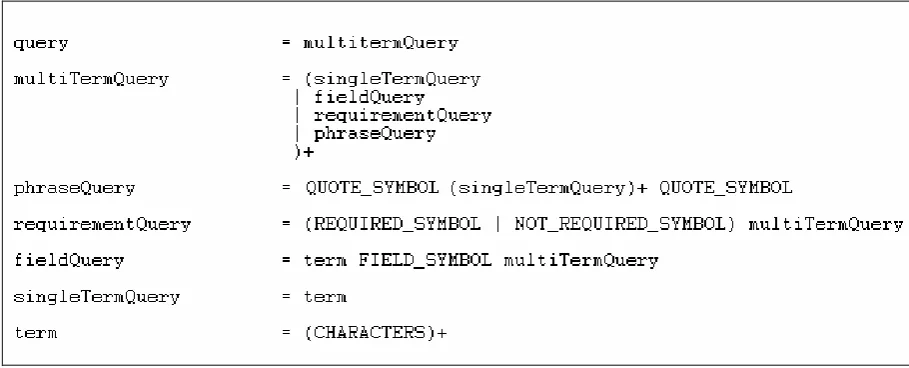
The starting point for retrieval is the query that the user enters into the application. This query is first parsed according to the query grammar of figure 4. This results in a query syntax tree, that then hierarchically represents the query, where the single terms are on the leafs of this tree.
Figure 4: Grammar of the Terrier query syntax
The terms first go through the term pipeline. This is the same pipeline as was used for indexing. This is of course necessary to avoid inconsistent matching. When the terms are out of the pipeline they can be matched against the index. The strategy to transform a query into a ranked set of document is basically as follows:
• Match each term with the index:
Lexicon lookup
Inverted index lookup
• Assign scores to documents
• Rank the documents
We will describe the matching process and especially the process of assigning the different scores to the documents by using figure 5. Initially we ignore the steps of modified scores, these are the steps where TSMS and DSMS are involved, in order to describe the basic scoring process first.
consist of term frequencies and document frequencies. More on these weighting models will follow later.
This process is repeated for all terms in the query and after that for a certain document x the first step of assigning scores of figure 5 is finished. The total score of a document is then the sum of the scores for the different terms.
After all terms of a query have been processed, a number of the documents from the collection has been assigned a score. Based on these scores we can rank these documents so that we get our ranked result set. Now we have described the basic concept of assigning calculating a document score.
Figure 5: Process of assigning document scores
Term and Document score modifiers
the query contains a term with the restriction that this term must occur within a specific field. After the documents have been assigned a score for that term, the term score modifier modifies (i.e. resets) the scores for documents where the term does not occur in that specific field.
The document score modifier operates on the complete result set of documents after all the terms of a query have been processed. A document score modifier modifies the total scores of documents and the effect of a document score modifier is that it decreases the size of the result set of documents and/or changes the order of ranking. An example of a document score modifier that is used by default in the Terrier framework is the ‘boolean fallback modifier’. The principle of this modifier is that when there is at least one document in the result set that contains all the terms specified in the query, then the score of all documents that contain only some of the terms is reset. In other words: the standard boolean constraint for a query is ‘AND’, when this is not feasible then the constraint is relaxed to ‘OR’. For both the term score modifier as the document score modifier holds that it is easy to implement your own modifier and then use it in the framework. In our project we made use of modifiers that were provided by the Terrier framework, like for example the ‘boolean fallback modifier’. Also did we implement are own term score modifiers and the document score modifiers to support our different types of queries that we specified. It will be discussed in the implementation part.
Weighting models
A concept that is characteristic for Terrier is that it uses the Divergence From Randomness (DFR) framework. Several weighting models are implemented in the Terrier framework. Two of them are classic IR models, the others are parameter-free probabilistic models according to the DFR
framework. The DFR approach is based on the simple idea: ”The more the divergence of the within-document term frequency from its frequency within the collection, the more the information carried by the word t in the document d”. This means that the term weighting models are obtained by comparing the actual term distribution with the distribution of a random process. More about these models can be found in [20].
All the implemented models have their own characteristics and for our project the experiments needed to determine which model performs best, if there are differences at all.
7.3 Conclusion
The Terrier framework is flexible starting point for our DICOM retrieval system. Its modular design allows us to easily modify the framework. These modifications were mainly needed to make the system able to support our specified types of queries. It has led to changes in the index structure that are used as well in the retrieval and weighting process.
8 Related
Work
We have chosen to use the Terrier platform as our base system to deal with the retrieval of the DICOM XML documents. A lot of research in the field of XML retrieval in general has been done, which was also mentioned as one of the advantages of using XML. We can divide the approaches in this field roughly into three classes: RDMS systems, native XML databases (NXD) and information retrieval systems. The Terrier platform obviously is placed in the third category.
RDBMS
Several attempts have been done to use RDBMSs as (the basis for) an XML retrieval system. The big advantage for our problem would be that these systems are extremely suitable to support data
retrieval queries. There are however some difficulties when storing XML documents in a RDBMS. XML documents can be stored in RDBMSs in two ways, either as documents as a whole or decomposed [21]. Storing documents as whole is not an option, because during retrieval these documents have to be sequentially searched through which will lead to performance problems. So the XML documents have to be mapped on the relational model. In most of the cases it is possible to map the XML structure on the relational model [22]. However, to correctly make this mapping is laborious in our case because there is no schema of the XML documents available and the document structure can change. Further when the XML data has a regular structure, but that structure varies a lot like in our XML data, mapping it to a relational database results in either a large number of columns with null values (which wastes space) or a large number of tables (which is inefficient) [23].
The definition of a native XML database is according to [24] a system:
- that is specialized in storing XML data and stores all components of the XML model intact.
- where documents go in and documents come out - that contains a full implementation of XPath or XQuery
The advantage of these systems is that they are designed for querying structure in combination with content. Further, some of these systems like exist [25] support storage of schema-less XML
documents. However, these systems usually don’t provide data retrieval queries and ranking mechanisms because these two aspects are not part of the specification of XPath or XQuery. There are exceptions, for example XIRQL [26], which is an extension to XPath based on information retrieval concepts and is implemented in HyReX [27]. It supports ranking of the results and the use of predicates like ‘<’ and ‘>’ on the data types that are used. However, this language requires XML documents to conform to a predefined DTD. This is also described as a drawback in [28].
Finally, we don’t require the full capabilities that XPath or XQuery offer. One could imagine that using such an implementation would introduce unnecessary extra (index) overhead.
IR systems
Besides Terrier there are not many open source IR systems that are freely available. Further most of them, including Terrier, are designed for natural language and simply ignore numeric data. Therefore data retrieval queries are not possible. Besides Terrier, Lucene [29] is a mature IR system that can make use of structural information in querying 1.
Besides the systems in these different categories, there are systems that overlap the categories. In this context [30] states that, considering the wide variety of semi-structured data available in structured XML documents, a need exists for a system that can provide database-like precision when searching typed content within an XML document. A system that supports this type of searching should also still be able to provide the functionality for the user to search the full content of documents and provide a list of matching documents to the query ranked by relevance. Now, regardless whether this is true in general, it is indeed true for our project.
Therefore in [30] a hybrid approach for structured document retrieval is described. The motivation for this approach is to integrate:
- approximate matching - exact matching - range matching
In [30] is further described that current projects that focus on IR from structured document are still in their infancy and do not consider the problem of creating a system that supports exact and range matching of document content.
The hybrid approach in this report means that it makes use of both an RDBMS as an IR system. In the report a plan for such a hybrid system is proposed, however no implementation has been done so no test results of this plan can be described. Interesting would be what the impact is of the overhead that the combination of the two different systems brings about. This compared to solutions that use only one type of system.
In [31] one of the few attempts is made to support range queries in combination with IR from XML documents. In order to accomplish this, extensions are made to the standard index structure of the information retrieval system to support queries that specify numeric ranges. The given reason for this extension is that in information retrieval systems normally treat numbers as keywords; a user
searching for "1999" can find the exact value "1999", but it is not possible to search for "between 1000 and 2200".
To enable numeric queries, when the implementation of this application encounters a number it stores it as several pseudo-keywords representing different numeric ranges which contain the target number. For example, "1999" might be indexed under the pseudo-keywords "1000-2000", "1900-2000", and "1990-2000", as well as the actual value "1999". The problem with this solution is of course that you need to determine the correct pseudo-keywords in advance. When choosing the ranges too large, users are returned too much irrelevant results (precision decreases). When choosing the range too
small, users are returned less result (recall decreases). To choose the right set of pseudo keywords is for our problem impossible.
9 Global
approach
description
Based on the previous sections, in this section we will introduce our approach by giving a global overview of the total system. Also we introduce the most important concepts that are used by the system. The next sections then will go into the approach in more detail.
The decisions that we discussed up till now are that we use a combination of DR and IR, that we use XML documents to represent the DICOM images and that we use Terrier as our base IR system. Based on these decisions and on the other requirements of section 3 we have made a design for our system.
figure 6 schematically shows the architecture of our system. The central point of our system is a modified and extended version of the Terrier retrieval platform. This part will deal with the actual indexing and retrieval of the DICOM XML documents.
Figure 6: Schematic overview of the DICOM retrieval system
Besides this modified version of Terrier we have added a part at the input side of the system and a part that will deal with the presentation of the information to the user. The input part is responsible for the storage of the DICOM images and the automatic generation of the XML documents. Further contains this part our parser that deals with the parsing of the DICOM XML documents.
The presentation part of the system provides a user interface to the system. It deals with the way the queries can be entered into the system and the way that the returned results are shown to the user. The results that are returned by the retrieval engine are a set of DICOM XML documents, because these are the documents that are indexed by the modified Terrier platform. The user however is interested in retrieving images. The presentation part makes sure that the returned XML documents are linked to the corresponding images. Further contains this part the functionality of showing previews of the DICOM images.
The next two sections deal with the details of the implementation of the system. First the modifications and extensions to the Terrier platform are discussed in section 10 and in the next section the other system implementations are described.
We continue this section with the discussion of two important concepts of our system that are used in the description of the implementation. These concepts are the distinction between comparable and non-comparable term and the use of semantic tag names.
Comparable vs. Non-comparable
Simply put, a comparable term is a term that occurs as the only term within a tag. Non-comparable terms are the opposite. These are terms that occur in tags that contain multiple terms as in sentences or text.
It is the responsibility of the parser to mark terms comparable or non-comparable and this information is maintained in the index.
The reason to make this distinction is twofold. First, the decision is related to the relevance of the results to a data retrieval query. A lot of the DICOM data is of the form tag-value. The data retrieval part of a query is of the form tag-operator-value. These query parts can look for example like
match the value part of the query. We believe that the same queries applied to tags that consist of multiple terms (=sentences) would have practically no informative value with respect to the operators we use.
The other reason is that this distinction can lead to more efficient retrieval from the index. We are dealing with an enormous amount of data; data that can be queried with data retrieval queries. We want to keep the subset of data to search through as small as possible. By making already the distinction between comparable and non-comparable data at indexing time, we keep this set as small as possible.
Semantic Tag Names
In the requirements we described that the structure of a DICOM image, and therefore a DICOM XML document, can be used for querying. Because we use a tool to generate this XML, it is machine generated data, although it is mostly human readable.
As a consequence of being machine-generated, a lot of the XML element names don’t have an intuitive meaning. However the requirements described that no need for extensive knowledge of the underlying structure was required for the user. So we cannot by default use the element names as they occur in XML files for indexing. To illustrate this in figure 7 we return to a simplified fragment of a DICOM XML document:
<Attribute Group="0018" Element="1151" Name="X-Ray Tube Current"> 603
</Attribute> . . .
<Attribute Group="0028" Element="0004" Name="Photometric Interpretation"> MONOCHROME2
</Attribute> . . .
<Attribute Group="0008" Element="2111" Name="Derivation Description"> Compress BN JPEG Lossless, Decompress Pegasus JPEG Lossless </Attribute>
Figure 7: DICOM XML fragment
Here we see another problem. Not only are the XML elements semantic-meaningless, also can a lot of different parts all share the same element, which makes it useless for using in queries.
The problem of semantic meaningless tag names is not unique for our domain, but it occurs in many other fields where XML is used to represent the data. For example in [32] the problem is described as well as the need for properly indexing the tags in order to avoid false negatives during retrieval. What we want is that in the example above, when we use structure in our queries, that we are able to use names like ‘Photometric Interpretation’ and ‘00280004’ to indicate the structural parts we want to query.
PART III
10 Terrier Modifications and Extensions
This section describes the modifications and extensions that were made to the original Terrier framework. In analogy to section 7 where the Terrier framework was discussed we have divided this section into a part on indexing and a part on retrieval. Besides these two parts we also have a part where the necessary modifications to improve the performance of our system are discussed.
10.1 Index
In this section we describe the index process of our DICOM retrieval system. The structure of this section is the following. We first deal with the requirements that our index structure needed to satisfy. Then we compare these requirements with the index structure of the original Terrier framework and we define what we had to add and modify. Next we deal with the details of the implementation of our index solution and finally look at the effects of our approach.
Index requirements
The requirements for the index structure are based on the requirements that are described in section 3. Also these index requirements can we divide into two parts. We have requirements for the lookup functionality that the index must provide. This is the lookup functionality that is needed to support the several types of queries have defined. On the other hand we have requirements on the way the index is created.
The requirements that our index had to satisfy are the following: Lookup functionality
• Lookup of a term.
Given a term it must be possible to enumerate all documents in which the term occurs.
• Lookup of a term in a specific structural context.
Given a term in combination with a tag it must be possible to enumerate all documents in which the term occurs within the specified tag
• Lookup of a term in combination with a predicate and a tag
Given a term in combination with a predicate and a tag it must be possible to
enumerate all documents where terms satisfy this condition and occur in the specified tag
Index creation functionality
• Index tag context along with the term
The relation between terms and tags must be maintained
• Index unseen tags on the fly
New unseen structures must be indexed dynamically
So we have three lookup requirements to support our different types of queries. We need to be able to query on terms only and on terms that should occur in a specific context, i.e. the containment queries. Finally we have the data retrieval queries. These queries contain a condition that consists of a
keyword, a tag and a predicate. These predicates can be ‘<’, ‘>’ or ‘=’.
Next we compare our requirements with what is already available in the original Terrier framework. When we look at this framework we see that already available is the lookup of terms and the lookup of terms in a specific context. Further is it possible to store structural information along with the terms. So the two aspects that need to be added are the lookup support for the data retrieval queries and the functionality to index new unseen tags on the fly. Besides this, the index needs to deal with the difference between comparable terms and non-comparable terms that we discussed in the previous section. These two are related to each other; to support the data retrieval functionality the index must be extended with the lookup for exact matching and range matching and the concept of comparable terms.
The next parts describe how this functionality is added. First we discuss the organization of the index. We look at the different structures that the index consists of and what they look like. Then we look at the aspects of tag indexing and finally we look into details of the ordering of the lexicon. This ordering plays an important role in the lookup of range queries.
10.1.1 Index
Structure
Figure 8: Index change
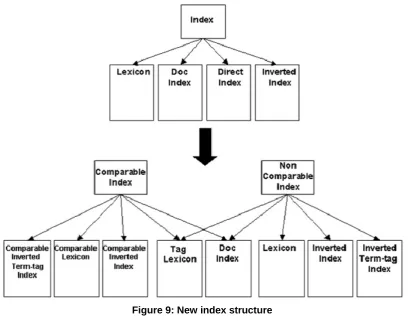
Here we will discuss the organization of the index that we have used. For this we use figure 8 as our guide. This figure represents the change in the index structure from the original Terrier framework into the structure that we have used. The different parts of the original index are discussed in section 7.1.
Index split up
The first aspect that has changed in the new index structure is that the index is split up into two parts: a comparable index and a non-comparable index. This distinction was made to maintain the difference between comparable and non-comparable terms like we discussed in section 9.
comparable and non-comparable terms was to make sure that a smaller subset of data is processed. That is the reason that we decided to split up the index. Instead of post-filtering the results based on a flag, with our solution in case of a conditional query we directly work with a set of only comparable terms.
Next we explain how our index is split up. Splitting up the index means splitting up almost all structures of the original index. The document index does not need to be split up, because it only contains information at document level, and not at term level. The document index can be shared by the comparable index and the non-comparable index.
So initially we get two direct indexes, two lexicons and two inverted indexes. In figure 8 however we see that in the new situation we don’t have a direct index. This is because in the original framework, after the inverted index is created, the direct index is only used for automatic query expansion. Query expansion can be used to improve the retrieval results. This was not necessary in our case so we did not use the automatic query expansion functionality. Therefore in our application the direct index is deleted after the inverted index has been created.
The lookup from this split index structure is as follows. When a term needs to be looked up it is first determined whether we are dealing with a comparable term or not. This depends on the type of query. In case of a data retrieval query, the term is a comparable term and needs it to be looked up from the comparable index.
Of course this introduces a penalty. In case of a ‘normal’ query, i.e. a content only query, both indexes need to be consulted to get the set of result documents. This is because both indexes can contain postings for a particular term. When both indexes contain postings for that term then the statistics for that term – document frequency, term frequency in a document and term frequency in the collection – that are used for weighting need to be merged, i.e. need to be added.
Also will the index grow in size. This is due to the fact that a term can occur in the collection both as comparable term as non-comparable term. The worst-case scenario is that all terms occur as well as comparable term as non-comparable term. Then the total lexicon grows twice as big. The experiments have shown that the total index size for our application is 20% of the total collection size. This is an acceptable size for our project.
In section 7.1 on the Terrier framework we described the aspects of the indexing process of the Terrier framework. Documents are parsed and then the terms are indexed. Before the terms are indexed they first go through a pipeline where, amongst possible other things, stemming and stopword removal are applied.
Now when we are dealing with exact matching, we argued that this is only applicable for comparable terms. However when stemming is applied to these terms while indexing, then it is possible that these terms are changed. For exact matching this term will result in a mismatch, which causes a query to not produce results although there are documents satisfying the condition. Therefore we don’t apply stemming for comparable terms. Also stopword removal is not applied for the same reasons. Now we have made sure that the comparable terms are suitable for exact matching. However this data can also be queried using content only queries, because in that case both indexes are consulted. In a content only query, stemming is applied. This would therefore lead to a false mismatch when terms are looked up from the comparable index. To solve this, when a term is comparable and would need stemming according to the stemming rules, we store the unstemmed term in the comparable index and the stemmed term in the non-comparable index. This way, by maintaining also the stemmed version of the term, although it is a comparable term, we have not reduced the information retrieval capabilities of the application for content only queries. Stemming supports the fuzzy matching of an information retrieval system. This approach is an important aspect for the integration of data retrieval and information retrieval, because it enables both types of matching.
Of course this approach again causes the total index to grow, but this increase is relatively small because the comparable terms tend to be terms where stemming and stopword removal often don’t need to be applied.
![Figure 1. Information Retrieval vs Data Retrieval [12]](https://thumb-us.123doks.com/thumbv2/123dok_us/1166009.1146737/11.595.120.479.405.654/figure-information-retrieval-vs-data-retrieval.webp)