with
For Dummies
Covering the most popular destinations in North America and Europe,
For Dummies travel guides are the ultimate user-friendly trip planners.
Available wherever books are sold or go to www.dummies.com
And book it with
our online partner,
Frommers.com
Book airfare, hotels and packages
Find the hottest deals
Get breaking travel news
Enter to win vacations
Share trip photos and stories
And much more
Available wherever books are sold.
Go to www.dummies.com or call 1-877-762-2974 to order direct.
The fun and easy wa
y
™to travel!
U.S.A.
Also available:
Alaska For Dummies Arizona For Dummies Boston For Dummies California For Dummies Chicago For Dummies Colorado & the Rockies For Dummies
Florida For Dummies Los Angeles & Disneyland For Dummies
Maui For Dummies National Parks of the American West For Dummies
New Orleans For Dummies New York City For Dummies San Francisco For Dummies Seattle & the Olympic Peninsula For Dummies Washington, D.C. For Dummies
RV Vacations For Dummies Walt Disney World & Orlando For Dummies
EUROPE
Also available:
England For Dummies Europe For Dummies Germany For Dummies Ireland For Dummies London For Dummies
Paris For Dummies Scotland For Dummies Spain For Dummies
OTHER DESTINATIONS
Also available:
Bahamas For Dummies Cancun & the Yucatan For Dummies Costa Rica For Dummies Mexico’s Beach Resorts For Dummies
Montreal & Quebec City For Dummies
Vancouver & Victoria For Dummies
by Bruce Murphy and
Alessandra de Rosa
Rome
FOR
DUMmIES
‰2
ND EDITION
Published by Wiley Publishing, Inc. 111 River St.
Hoboken, NJ 07030-5774 www.wiley.com
Copyright © 2008 by Wiley Publishing, Inc., Indianapolis, Indiana
Published simultaneously in Canada
No part of this publication may be reproduced, stored in a retrieval system, or transmitted in any form or by any means, electronic, mechanical, photocopying, recording, scanning, or otherwise, except as permitted under Sections 107 or 108 of the 1976 United States Copyright Act, without either the prior written permission of the Publisher, or authorization through payment of the appropriate per-copy fee to the Copyright Clearance Center, 222 Rosewood Drive, Danvers, MA 01923, 978-750-8400, fax 978-646-8600. Requests to the Publisher for permission should be addressed to the Legal Department, Wiley Publishing, Inc., 10475 Crosspoint Blvd., Indianapolis, IN 46256, 317-572-3447, fax 317-572-4355, or online at http:// www.wiley.com/go/permissions.
Trademarks:Wiley, the Wiley Publishing logo, For Dummies, the Dummies Man logo, A Reference for
the Rest of Us!, The Dummies Way, Dummies Daily, The Fun and Easy Way, Dummies.com and related trade dress are trademarks or registered trademarks of John Wiley & Sons, Inc., and/or its affiliates in the United States and other countries, and may not be used without written permission. Frommer’s is a trademark or registered trademark of Arthur Frommer. Used under license. Walt Disney World is a regis-tered trademark of the Walt Disney Company. All other trademarks are the property of their respective owners. Wiley Publishing, Inc., is not associated with any product or vendor mentioned in this book.
LIMIT OF LIABILITY/DISCLAIMER OF WARRANTY: THE PUBLISHER AND THE AUTHOR MAKE NO REPRESENTATIONS OR WARRANTIES WITH RESPECT TO THE ACCURACY OR COMPLETENESS OF THE CONTENTS OF THIS WORK AND SPECIFICALLY DISCLAIM ALL WARRANTIES, INCLUDING WITH-OUT LIMITATION WARRANTIES OF FITNESS FOR A PARTICULAR PURPOSE. NO WARRANTY MAY BE CREATED OR EXTENDED BY SALES OR PROMOTIONAL MATERIALS. THE ADVICE AND STRATEGIES CONTAINED HEREIN MAY NOT BE SUITABLE FOR EVERY SITUATION. THIS WORK IS SOLD WITH THE UNDERSTANDING THAT THE PUBLISHER IS NOT ENGAGED IN RENDERING LEGAL, ACCOUNTING, OR OTHER PROFESSIONAL SERVICES. IF PROFESSIONAL ASSISTANCE IS REQUIRED, THE SERVICES OF A COMPETENT PROFESSIONAL PERSON SHOULD BE SOUGHT. NEITHER THE PUBLISHER NOR THE AUTHOR SHALL BE LIABLE FOR DAMAGES ARISING HEREFROM. THE FACT THAT AN ORGA-NIZATION OR WEBSITE IS REFERRED TO IN THIS WORK AS A CITATION AND/OR A POTENTIAL SOURCE OF FURTHER INFORMATION DOES NOT MEAN THAT THE AUTHOR OR THE PUBLISHER ENDORSES THE INFORMATION THE ORGANIZATION OR WEB SITE MAY PROVIDE OR RECOMMEN-DATIONS IT MAY MAKE. FURTHER, READERS SHOULD BE AWARE THAT INTERNET WEB SITES LISTED IN THIS WORK MAY HAVE CHANGED OR DISAPPEARED BETWEEN WHEN THIS WORK WAS WRITTEN AND WHEN IT IS READ.
PLEASE BE ADVISED THAT TRAVEL INFORMATION IS SUBJECT TO CHANGE AT ANY TIME AND THIS IS ESPECIALLY TRUE OF PRICES. WE THEREFORE SUGGEST THAT READERS WRITE OR CALL AHEAD FOR CONFIRMATION WHEN MAKING TRAVEL PLANS. THE AUTHOR AND THE PUBLISHER CANNOT BE HELD RESPONSIBLE FOR THE EXPERIENCES OF READERS WHILE TRAVELING.
For general information on our other products and services, please contact our Customer Care Department within the U.S. at 800-762-2974, outside the U.S. at 317-572-3993, or fax 317-572-4002.
For technical support, please visit www.wiley.com/techsupport.
Wiley also publishes its books in a variety of electronic formats. Some content that appears in print may not be available in electronic books.
Library of Congress Control Number: 2008920597
ISBN: 978-0-470-20955-4
Manufactured in the United States of America
About the Authors
Bruce Murphy has lived and worked in New York City, Boston, Chicago, Dublin, Rome, and Sicily. His work has appeared in magazines ranging from Cruising Worldto Critical Inquiry. In addition to guidebooks, he has published fiction, poetry, and criticism, most recently the Encyclopedia
of Murder and Mystery (St. Martin’s Press).
Alessandra de Rosa was born in Rome and has lived and worked in Rome, Paris, and New York City. She did her first cross-Europe trip at age 2, from Rome to London by car. She has continued in that line ever since, exploring three out of five continents so far. Her beloved Italy remains her preferred destination and is where she lives part-time.
Authors’ Acknowledgments
Editorial
Editors: Marie Morris with Alexia Travaglini, Development Editors; Jana M. Stefanciosa, Production Editor
Copy Editor: Cara Buitron Cartographer: Roberta Stockwell Senior Photo Editor: Richard Fox Cover Photos:Front cover:
©Travelpix Ltd/Getty Images, Back cover: © Wilmar
Photography / Alamy Cartoons: Rich Tennant
(www.the5thwave.com)
Composition Services
Project Coordinator: Katherine Key Layout and Graphics: Carl Byers,
Joyce Haughey, Laura Pence Proofreaders: Caitie Kelly,
Sossity R. Smith
Indexer: Slivoskey Indexing Services
Publishing and Editorial for Consumer Dummies
Diane Graves Steele, Vice President and Publisher, Consumer Dummies Joyce Pepple, Acquisitions Director, Consumer Dummies
Kristin A. Cocks, Product Development Director, Consumer Dummies Michael Spring, Vice President and Publisher, Travel
Kelly Regan,Editorial Director, Travel
Publishing for Technology Dummies
Andy Cummings,Vice President and Publisher, Dummies Technology/General User
Composition Services
Gerry Fahey,Vice President of Production Services Debbie Stailey,Director of Composition Services
Publisher’s Acknowledgments
We’re proud of this book; please send us your comments through our Dummies
online registration form located at www.dummies.com/register/.
Contents at a Glance
Introduction ...1
Part I: Introducing Rome...7
Chapter 1: Discovering the Best of Rome ...9
Chapter 2: Digging Deeper into Rome ...14
Chapter 3: Deciding When to Go ...29
Part II: Planning Your Trip to Rome ...37
Chapter 4: Managing Your Money ...39
Chapter 5: Getting to Rome...51
Chapter 6: Catering to Special Travel Needs or Interests ...58
Chapter 7: Taking Care of the Remaining Details ...63
Part III: Settling into Rome ...71
Chapter 8: Arriving and Getting Oriented ...73
Chapter 9: Checking In at Rome’s Best Hotels ...90
Chapter 10: Dining and Snacking in Rome ...112
Part IV: Exploring Rome ...137
Chapter 11: Discovering Rome’s Best Attractions ...139
Chapter 12: Shopping the Local Stores ...193
Chapter 13: Following an Itinerary: Five Great Options ...204
Chapter 14: Going Beyond Rome: Five Day Trips...209
Part V: Living It Up after Dark:
Rome’s Nightlife ...233
Chapter 15: Applauding the Cultural Scene ...235
Chapter 16: Hitting the Clubs and Bars ...241
Part VI: The Part of Tens ...245
Chapter 17: Non Capisco:The Top Ten Expressions You Need to Know ...247
Chapter 18: Ten Great Roman Artists ...250
Chapter 19: From Antique Prints to Cardinal Socks: The Best Roman Souvenirs...254
Appendix A: Quick Concierge...257
Appendix B: Glossary of Italian Words
and Phrases ...269
Maps at a Glance
Rome Orientation ...78
Rome’s Metropolitana (Subway) ...84
Rome’s Most Useful Public Transportation ...86
Rome Accommodations...98
Rome Dining and Snacking ...116
Rome Attractions ...142
Ancient Rome ...148
Palatine Hill ...155
The Roman Forum ...158
The Vatican ...161
The Vatican Museums ...167
Appian Way Archaeological Park ...174
Table of Contents
Introduction ...1
About This Book...1
Conventions Used in This Book ...2
Foolish Assumptions ...3
How This Book Is Organized...4
Part I: Introducing Rome...4
Part II: Planning Your Trip to Rome...4
Part III: Settling into Rome ...4
Part IV: Exploring Rome ...4
Part V: Living It Up after Dark: Rome’s Nightlife ...4
Part VI: The Part of Tens...4
Icons Used in This Book...5
Where to Go from Here...6
Part I: Introducing Rome...7
Chapter 1: Discovering the Best of Rome ...9
The Best Museums...9
The Best Churches...10
The Best Ruins...10
The Best Hotels ...11
The Best Restaurants ...12
The Best Buys in Rome ...12
The Best Daytime and Nighttime Outings...12
Chapter 2: Digging Deeper into Rome ...14
History 101: The Main Events...14
Architecture: From Ruins to Rococo ...20
A Taste of Rome: Eating Locally ...21
Antipasto...22
Primo ...23
Secondo...23
Contorno and salad ...24
Dolci and dessert ...24
Wine...25
Word to the Wise: The Local Language ...25
Background Check: Recommended Books and Movies ...26
True stories ...26
Art history ...26
Works of fiction ...27
Chapter 3: Deciding When to Go ...29
Revealing the Secrets of the Seasons ...29
April through June ...30
July and August...31
September and October...31
November through March ...31
Perusing a Calendar of Events...32
January...32
February...32
March and April ...33
May ...33
June and July ...34
August ...34
September...34
October ...35
November ...35
December...35
Part II: Planning Your Trip to Rome ...37
Chapter 4: Managing Your Money ...39
Planning Your Budget ...39
Transportation ...40
Lodging...41
Dining ...41
Sightseeing...42
Shopping ...43
Nightlife...43
Cutting Costs — but Not the Fun ...44
Handling Money ...45
Making sense of the euro ...46
Using ATMs and carrying cash...47
Charging ahead with credit cards...48
Toting traveler’s checks...49
Dealing with a Lost or Stolen Wallet ...49
Chapter 5: Getting to Rome ...51
Flying to Rome...51
Finding out which airlines fly there...51
Getting the best deal on your airfare ...52
Booking your flight online ...53
Arriving by Other Means...54
Joining an Escorted Tour ...55
Chapter 6: Catering to Special Travel Needs
or Interests ...58
Traveling with the Brood: Advice for Families ...58
Making Age Work for You: Tips for Seniors ...60
Accessing Rome: Advice for Travelers with Disabilities...61
Following the Rainbow: Resources for Gay and Lesbian Travelers ...62
Chapter 7: Taking Care of the Remaining Details...63
Getting a Passport...63
Applying for a U.S. passport...63
Applying for other passports ...64
Renting a Car — Not! ...65
Playing It Safe with Travel and Medical Insurance ...65
Staying Healthy When You Travel...66
Staying Connected by Cellphone or E-Mail...67
Accessing the Internet away from home ...68
Keeping Up with Airline Security ...69
Advance reservations...70
Part III: Settling into Rome ...71
Chapter 8: Arriving and Getting Oriented...73
Navigating Your Way through Passport Control and Customs ...73
Making Your Way to Your Hotel...74
Arriving by plane ...74
Arriving by ship ...76
By train...76
Figuring Out the Neighborhoods ...77
Aventino ...80
Campo de’ Fiori ...80
Colosseo...80
Navona/Pantheon ...80
Piazza del Popolo...81
Piazza di Spagna...81
Prati ...81
Repubblica...81
San Pietro...81
Teatro Marcello ...82
Trastevere...82
Trevi...82
Via Veneto ...82
Getting Around Rome ...83
By subway (metro) ...84
By bus and tram...85
On foot...85
By taxi...88
By motor scooter (motorino)...88
Chapter 9: Checking In at Rome’s Best Hotels ...90
Knowing Your Roman Hotels: What to Expect ...90
Finding the Best Room at the Best Rate...93
Finding the best rate ...93
Surfing the Web for hotel deals...94
Reserving the best room...95
Finding Alternative Accommodations: Apartments and Convents ...95
Arriving without a Reservation ...96
Rome’s Best Hotels ...96
Runner-Up Accommodations ...108
Index of Accommodations by Neighborhood...110
Index of Accommodations by Price...111
Chapter 10: Dining and Snacking in Rome ...112
Getting the Dish on the Local Scene...112
Trimming the Fat from Your Budget ...113
Rome’s Best Restaurants ...114
Dining and Snacking on the Go...128
Bars...128
Wine bars (enoteche)...128
Picnics ...128
Pizza a taglio...129
Pizzerie...129
Really good coffee...130
Snack bars, tavola calda, and rosticcerie ...131
Sweet endings: Gelato ...131
Index of Establishments by Neighborhood ...132
Index of Establishments by Cuisine...133
Index of Establishments by Price...135
Part IV: Exploring Rome ...137
Chapter 11: Discovering Rome’s Best Attractions....139
Rome’s Top Sights...141
Finding More Cool Things to See and Do ...168
For art gallery lovers...168
For museum buffs ...170
For families with kids ...177
For religious-architecture lovers: More great churches...182
For secular-architecture lovers: More delightful Roman piazze and palaces...186
Seeing Rome by Guided Tour ...190
Bus tours...190
Walking tours...191
Boat tours ...191
Air tours ...192
Chapter 12: Shopping the Local Stores ...193
Surveying the Scene ...193
Checking Out the Department Stores...195
Going to Market...196
Discovering the Best Shopping Neighborhoods ...197
Il Centro...197
Navona/Pantheon ...198
Cola di Rienzo...200
Via Nazionale ...201
Trastevere...201
Index of Stores by Merchandise ...202
Chapter 13: Following an Itinerary:
Five Great Options...204
Rome in Three Days...204
Day 1 ...204
Day 2 ...205
Day 3 ...205
Rome in Five Days...206
Day 4 ...206
Day 5 ...206
Rome for Architecture Lovers ...206
Rome for Michelangelo’s Fans...207
Rome for Families ...208
Chapter 14: Going Beyond Rome: Five Day Trips ...209
Ostia Antica: Rome’s Ancient Seaport...209
Getting there...210
Taking a tour...210
Seeing the sights ...210
Dining locally...212
Spending the night...213
Tivoli and Its Trio of Villas ...213
Getting there...213
Seeing the sights ...214
Dining locally...216
Spending the night...217
The Castelli Romani and Their Wines ...217
Getting there...218
Taking a tour...218
Seeing the sights ...219
Dining locally...221
Spending the night...224
Tarquinia ...225
Getting there...225
Taking a tour...225
Seeing the sights ...225
Dining locally...227
Spending the night...228
Viterbo...228
Getting there...229
Taking a tour...229
Seeing the sights ...229
Dining locally...230
Spending the night...231
Part V: Living It Up after Dark:
Rome’s Nightlife ...233
Chapter 15: Applauding the Cultural Scene ...235
Getting the Inside Scoop ...235
Finding Out What’s Playing and Getting Tickets...237
Raising the Curtain on the Performing Arts ...238
Symphony ...238
Opera...239
Dance...239
Theater...239
Chapter 16: Hitting the Clubs and Bars...241
Finding Out What’s on Where...241
All That Jazz...241
Historic Cafes ...242
Wine Bars and Pubs ...243
Dance Clubs ...243
Part VI: The Part of Tens ...245
Chapter 17: Non Capisco: The Top Ten
Expressions You Need to Know ...247
Per Favore ...247
Grazie...247
Permesso...248
Scusi...248
Buongiorno and Buona Sera ...248
Arrivederci ...248
Dov’è ...248
Quanto Costa? ...249
Che Cos’è? ...249
Non Capisco...249
Chapter 18: Ten Great Roman Artists ...250
Pietro Cavallini ...250
Jacopo Torriti ...251
Antoniazzo Romano...251
Giulio Pippi ...251
Cavalier d’Arpino ...251
Artemisia Gentileschi ...252
Plautilla Bricci ...252
Pietro Bracci ...253
Giuseppe Valadier ...253
Duilio Cambellotti ...253
Chapter 19: From Antique Prints to Cardinal Socks:
The Best Roman Souvenirs ...254
Antique Prints...254
Modern Art...255
Fashion ...255
Gold Jewelry ...255
High-Quality Stationery ...255
Lace and Embroideries...255
Traditional Art and Crafts ...256
Plaster Reproductions...256
Vatican Souvenirs...256
Religious Art and Paraphernalia ...256
Appendix A: Quick Concierge...257
Fast Facts ...257
Toll-Free Numbers and Web Sites ...263
Airlines that fly to Rome and around Italy ...263
Major car-rental agencies ...264
Where to Get More Information ...265
Visitor information ...265
Newspapers and magazines ...266
Other sources of information...267
Appendix B: Glossary of Italian Words
and Phrases...269
Basic Vocabulary...269
Numbers ...270
Architectural Terms...271
Common Menu Terms ...273
Introduction
R
ome, the Eternal City, the capital of the ancient Roman Empire and of the modern Italian state, is a city with many faces and myriad charms. Its history is epic — the city vanquished Carthage and was itself sacked by barbarians, saw the birth and development of the Catholic Church, suffered fascism and World War II — and is written in its monu-ments and ruins. Rome is also one of the most beautiful cities in the world, and more tourist friendly than ever. With its noise, traffic, and meandering streets, Rome can be bewildering. But you’ll find Romans warm, welcoming, and ready to help ease you into la dolce vita, particu-larly if you learn a few key words and phrases in Italian (we list some of them throughout this book and especially in Chapter 17 and Appendix B).About This Book
Whether you’re a first-timer or making a repeat visit to see sights you missed the on first go-round, Rome For Dummiesis designed to give you all the information you need to help you make savvy, informed decisions about your trip, while also guiding you to the discovery of known and lesser-known facets of this exciting city.
You’ll be able to use this guide as a reference book to look up exactly what you need at the time you need it. No need to read the entire thing from cover to cover — you can just dive in at any point. No need, either, to remember what you read: There are plenty of easy-to-find flags for quickly locating the bit of info you want.
Some people spend more time planning their trip than they do taking it. We know your time is valuable, so here, we happily do the work to help ease you into a memorable Roman holiday. Unlike some travel guides that read more like phone books, listing everything and anything, this book cuts to the chase. We’ve done the legwork for you, offering our expertise and not-so-humble opinions to help you make the right choices for your trip.
to us, however, so we encourage you to stay alert and be aware of your surroundings. Keep a close eye on cameras, purses, and wallets, all favorite targets of thieves and pickpockets.
Conventions Used in This Book
The structure of this book is nonlinear: You can open it at any point and delve into the subject at hand. We use icons to guide you toward particu-lar kinds of tips and advice (see “Icons Used in This Book,” later in this introduction).
We include lists of hotels, restaurants, and attractions, and for each we give you our frank evaluation. We divide the hotels into two categories: our personal favorites and excellent choices that don’t quite make our preferred list but still get our hearty seal of approval. Don’t be shy about considering these “runner-up” hotels if you’re unable to get a room at one of our favorites, or if your preferences differ from ours.
We use these abbreviations for commonly used credit cards in our hotel and restaurant reviews:
AE: American Express
DC: Diners Club
MC: MasterCard
V: Visa
Note that Discover is not listed. The Discover Card is unknown in Italy, so carrying one or more of the big three — American Express, Visa, and MasterCard — is a good idea.
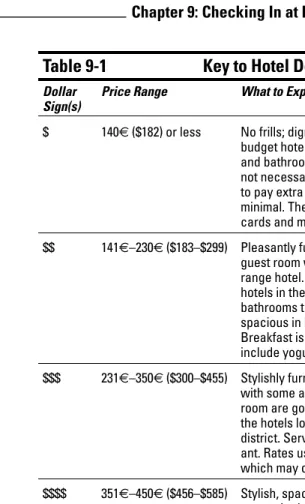
We also include some general pricing information to help you as you decide where to unpack your bags or dine. We use a system of dollar signs to show a range of costs for one night in a hotel (the price refers to a double-occupancy room) or a full meal at a restaurant — including a pasta or appetizer, a secondo(main course or entree), a side dish, and a dessert (but no beverages). Note that within the restaurant listing info, we give you the price range for main courses, or secondi.See Chapter 9 for a detailed chart telling you exactly what to expect in each hotel cate-gory. Here is a table to help you decipher the dollar signs:
Cost Hotel Restaurant
$ 140€($182) or less 35€($46) or less
$$ 141€–230€($183–$299) 36€–50€($47–$65)
$$$ 231€–350€($300–$455) 51€–65€($66–$85)
$$$$ 351€–450€($456–$585) 66€($86) and up
Prices are given in euros, with the U.S. dollar conversion; the exchange rate used is 1€= $1.30. Although we give you definite prices, establish-ments sometimes change prices without notice. Also, in some cases a price goes down but because of exchange fluctuations, the cost goes up. (See the “Follow the bouncing euro” sidebar for more on euro exchange rates.)
Another thing you’ll find accompanying each listing is contact informa-tion. Web sites are listed whenever possible. As for telephone numbers, don’t be surprised if you see
%
06-93021877near%
06-290831.The number of digits in Italian phone numbers is not standardized. Area codes can have two, three, or four digits; the rest of the number may have as few as four or as many as eight digits.For hotels, restaurants, and attractions that are plotted on a map, a page reference appears in the listing information. If an establishment is out-side the city or in an out-of-the-way area, it may not be mapped.
Foolish Assumptions
We’ve made some assumptions about you and what your needs may be as a traveler. Here’s what we assume about you:
You may be an experienced traveler who hasn’t had much time to
explore Rome and wants expert advice when you finally do get a chance to enjoy the Eternal City.
You may be an inexperienced traveler looking for guidance when
determining whether to take a trip to Rome and how to plan for it. You’re not looking for a book that provides all the information
avail-able or that lists every hotel, restaurant, or attraction. Instead, you’re looking for a book that focuses on the places that will give you the best or most memorable experience in Rome.
If you fit any of these criteria, Rome For Dummiesgives you the informa-tion you’re looking for!
Follow the bouncing euro
Only a few years ago, the euro was worth about 90¢. Now it has bounced back
strongly, to around $1.30. That 40¢ swing can make a huge difference. The 100€
How This Book Is Organized
The book has six parts plus two appendixes. Each can be read independ-ently if you want to zero in on a particular area or issue.
Part I: Introducing Rome
This is where you find in-depth information about Rome. It begins with our rundown of the best of Rome in Chapter 1; continues in Chapter 2 with Rome’s history, culture, people, architecture, and cuisine; and ends in Chapter 3 with climate information and a calendar of special events.
Part II: Planning Your Trip to Rome
Here, we guide you through trip planning: budgeting (Chapter 4), decid-ing on escorted and package tours, and choosdecid-ing whether you want to make the travel arrangements yourself or work through an agent (Chapter 5). We include Web sites throughout the section (and, indeed, the entire book), because that’s where you often can find the best deals. We also address the special concerns of travelers with mobility issues, families, seniors, and gays and lesbians (Chapter 6). Finally, we give you tips on all the other necessary details, from getting your passport to thinking about your health (Chapter 7).
Part III: Settling into Rome
Rome may be eternal, but it’s far from dead. Here, we give you all the logistical info on how to get around this bustling city and where to find additional information (Chapter 8), as well as the lowdown on hotels (Chapter 9) and restaurants (Chapter 10).
Part IV: Exploring Rome
This section provides our selection of what, for us, are the best features and attractions of Rome (Chapter 11), its best shops and markets (Chapter 12), and a choice of guided tours and itineraries through its maze of ancient and modern treasures (Chapter 13). We also include side trips to great destinations on the outskirts of Rome (Chapter 14).
Part V: Living It Up after Dark: Rome’s Nightlife
Here is where we give you tips on where to find the entertainment that best suits your mood, from classical concerts and opera (Chapter 15) to bars, pubs, and discos (Chapter 16).Part VI: The Part of Tens
In the back of this book, we’ve included two appendixes. The first — your Quick Concierge — contains lots of handy information you may need when traveling in Rome. It includes phone numbers and addresses of emergency personnel and area hospitals and pharmacies, lists of local newspapers and magazines, protocols for sending mail or finding taxis, and more. Check out this appendix when searching for answers to lots of little questions that may come up as you travel. You can find the Quick Concierge easily because it’s printed on yellow paper.
Appendix B contains a glossary of Italian words that will earn you warm appreciation from the locals.
Icons Used in This Book
We use icons throughout this book as signposts and flags for facts and information of a particular nature or interest. Following are the six types of icons we use:
Keep an eye out for the Bargain Alert icon as you seek out money-saving tips and great deals.
Best of the Best highlights the best Rome has to offer in all categories: hotels, restaurants, attractions, activities, shopping, and nightlife.
Watch for the Heads Up icon to identify annoying or potentially danger-ous situations such as tourist traps, unsafe neighborhoods, rip-offs, and other things to beware.
Look to the Kid Friendly icon for attractions, hotels, restaurants, and activities that are particularly hospitable to children or people traveling with kids. When the icon appears with a restaurant listing, it means that high chairs and mezza porzione(half portions) are available, and we spell out what other special attention the establishment provides. When we use the icon with a hotel listing, it means that the hotel can provide a crib or an extra bed or two (or the hotel has triples and quads). It also means that the hotel might offer babysitting and other amenities suit-able for children, such as a garden, swimming pool, or play area.
The Plan Ahead icon draws your attention to details or plans that you should take care of before you leave home.
Where to Go from Here
Part I
In this part . . .
H
ere’s where we give you a taste of Rome, offering uphighlights without weighing you down with details. (Don’t worry: We fill in all the blanks in the remainder of the book — we promise!)
Chapter 1
Discovering the
Best of Rome
In This Chapter
From picture galleries to ruins
From frescoes to gelato
From smart dining to picnic fare From hotels to nightclubs
P
eople visit Rome for all sorts of reasons. Art lovers flock to its great museums, the faithful make pilgrimages to St. Peter’s Basilica and the Vatican, and others come to soak up Italy’s culture and atmosphere (or just the sun). In Rome For Dummies,we give you our opinions on the best Rome has to offer. In this chapter, we list our very favorites. Throughout the rest of this book, the Best of the Best icon marks the places listed in this chapter.The Best Museums
Rome boasts numerous museums, some vast and famous, others small and catering to specialized audiences. Here is our short list of the not-to-be-missed museums that contain internationally renowned masterpieces and other mind-boggling beauties.
The Vatican Museumstop our list, for the monumental size of their collections and amazing number of masterpieces. They include dozens of rooms dedicated to Renaissance painting and sculpture, as well as a fantastic Egyptian section, an impressive ancient Roman collection, and ethnological art from all over the world. The museums are also home to the Sistine Chapel (mentioned in the next section). See Chapter 11.
The National Roman Museum in Palazzo Massimo alle Termeis a huge museum completely dedicated to ancient Roman art. It con-tains hundreds of artifacts unearthed during the excavation of archaeological sites in Rome and the surrounding areas, including a superb collection of sculptures and some breathtakingly beautiful Roman frescoes. See Chapter 11.
The National Etruscan Museum of Villa Giuliaholds a wonderful collection dedicated to the Etruscans, the mysterious predecessors of the Romans. This is a unique treasure trove of Etruscan artifacts and jewelry. See Chapter 11.
The Best Churches
Among Rome’s hundreds of churches, we considered not only the archi-tecture and the importance of the artwork inside, but also the individual charm and personality of each. Here are our top picks.
St. Peter’s Basilicais the most famous church in a city filled with magnificent churches. Its majestic colonnade and soaring dome are a symbol of Rome as well as of the Catholic Church; treasures inside include Michelangelo’s Pietà.See Chapter 11.
Santa Maria sopra Minerva,the city’s only Gothic church, is filled with artistic delights such as Michelangelo’s sculpture Cristo
Portacroce.See Chapter 11.
The Sistine Chapelcontains the most famous artwork in all of Italy. After the Mona Lisa,the ceiling of the chapel is probably the most famous single piece of art in the world. Decorated with Michelangelo’s frescoes, it is accessible from the Vatican Museums. Don’t forget your binoculars. See Chapter 11.
The little chapel of San Zenone in Santa Prassedewill take your breath away. It is one of the oldest churches in Rome and com-pletely covered with gilded mosaics. See Chapter 11.
The church of Santa Maria in Trastevere is a splendid example of Medieval and Byzantine art, which is rare in Rome after the general baroque overhaul. It is also an excellent excuse to visit Trastevere, a delightful neighborhood. See Chapter 11.
The Best Ruins
The majestic and austere Colosseum, where the Romans watched “sports” (as in fights to the death) and chariot races, is Rome’s most famous ruin and an impressive work of architecture. See Chapter 11.
The Roman Forum and the nearby Palatine Hill,containing the remains of temples, public buildings, villas, and triumphal arches, will take you back in time. They are particularly evocative on romantic Roman nights. See Chapter 11.
The Appian Way, the first road built by the ancient Romans, has been transformed into the Appian Way Archaeological Park, which you can visit on foot or by bicycle. Along the way are the remains of tombs and villas that make the trip well worth the exer-cise. See Chapter 11.
The Caracalla Bathswere among the largest in Rome and are still an impressive sight. They also stage opera performances during the summer. See Chapters 11 and 15.
The Villa Adriananear Tivoli, outside Rome, is more than just a villa. It is a huge complex of buildings, gardens, reflecting pools, and theaters built by the Emperor Hadrian in the second century
A.D. In the mountains above Rome where Hadrian and a few
hun-dred friends could get away from it all, the villa remains an atmos-pheric retreat. See Chapter 14.
The Best Hotels
We picked our favorite luxury hotels as well as our preferred moderately priced and inexpensive accommodations.
Hotel Hasslertops our list as the hotel with the best service among Rome’s many wonderful luxury lodgings. Its location on top of the Spanish Steps also makes it a unique place to stay. See Chapter 9. Presidents and stars stay at the Hotel de Russie, positively one of
the most elegant and classiest hotels in the world. Contemporary design and exquisite good taste are coupled with the classic beauty of its architecture. See Chapter 9.
The Albergo Santa Chiara is one of the oldest hotels in Rome and our favorite in the middle price range. The beauty of the palace and the quality of the service make it a great value. See Chapter 9. The Hotel Arenula is the best of Rome’s budget hotels for service,
The Best Restaurants
Here is a short list of our favorite restaurants in Rome. We love many more than those we describe here, and you’ll find the ones we left behind in Chapter 10.
For fantastic views over the Eternal City, with wonderful food to match, try La Pergola.A meal at this elegant restaurant will be one of your most romantic experiences in Rome. See Chapter 10.
For a truly Roman outing — vetted by Alessandra, a Rome native —
nothing can beat Checchino dal 1887, a historical restaurant in Monte Testaccio. See Chapter 10.
The best enoteca(restaurant winery) in town is Enoteca Capranica. Not only will you love the food, the wine, and the atmosphere, but you’ll also get to enter one of the most charming Roman palaces in the historic center. See Chapter 16.
The Best Buys in Rome
Shopping in Rome is great fun and a perfect excuse to stroll the labyrinthine streets. You can also find some unique treasures, including some great souvenirs.
Select a pair of socks fit for a cardinal— or any other religious item you might think of — from one of the shops in the center of Rome. The vendors showcase a variety of items, from apparel to artwork. See Chapter 12.
Give yourself the pleasure of a handmade piece of gold jewelry.The ancient tradition of goldsmithing is alive and well in Rome, and you’ll find craftspeople working in a variety of styles, from reproductions of ancient classics to contemporary designs. See Chapter 12. An antique print makes a wonderful gift — for yourself or a loved
one. This craft has been a Roman tradition since the Renaissance. See Chapter 12.
Get a picture of the popefrom the huge collection at the Vatican gift shop. See Chapter 11.
Take your pick of fashion accessories— scarves, leather gloves, handbags, wallets, watches, sunglasses — from the many local designers. See Chapter 12.
The Best Daytime and Nighttime Outings
Go for a river cruise along the Tiber.The Compagnia di Navigazione Ponte San Angelo organizes both romantic dinner cruises and day excursions, including a great one to Ostia Antica. See Chapter 11. Take a walk by moonlight near the church of Santa Maria in
Aracoeli and up to the Capitoline Museums on Piazza del Campidoglio for a unique view over the Forum. See Chapter 11. Book tickets for an opera performance at the Caracalla Baths, the
summer location of the Teatro dell’Opera. See Chapter 15.
Enjoy a concert or a dance performance at the Parco della Musica, the city’s recently opened state-of-the-art performing arts center. See Chapter 15.
Chapter 2
Digging Deeper into Rome
In This Chapter
Understanding Rome, past and present
Exploring 2,500 years of great architecture
Discovering the great artists of the Roman Renaissance Savoring Rome’s culture and cuisine
Reading more about Rome
U
nder the Roman Empire, all roads really did lead to Rome, whichwas the cosmopolitan heart of the ancient Roman civilization. In spite of passionate attempts by other Italian cities — Milan, Florence, Venice, Naples — to steal her role, Rome remains the focus of Italian civi-lization and culture. For thousands of years, artists have been coming to Rome to study and work; visitors to see the grandiose monuments; and pilgrims to visit the many Christian and Catholic holy places.
The artists and scholars who were drawn to Rome during the Renaissance left their contribution in churches, buildings, and public squares. The young aristocrats who came from all over Europe and the United States in the 19th century flocked here to absorb the classical world and admire Renaissance art in a rite of passage known as the Grand Tour (the months-long European excursion enjoyed by the rich and satirized by Mark Twain in The Innocents Abroad). Rome was maybe the single most important stop then, and it remains so today.
Here we draw a quick picture of the most striking cultural features of this historically and culturally rich city.
History 101: The Main Events
As legend has it, Rome was founded by Romulus, also known as Romolo, one of two semigod twins (the other was Remus, or Remo) born to Mars and the daughter of a local king, Rea Silvia. After narrowly escaping death — they were saved by a wolf who nursed them — the twins grew up and set about establishing a new town. After a dispute, Romolo took over and marked the borders on the ground. The date was April 21, 753
any good features from other cultures it encountered (or conquered), and creating a set of rules, principles, and laws that are still the bedrock of modern Western values and institutions.
Rome started as a collection of shepherds’ huts, a small town populated by the local Italic tribe. These people were descended from the Villanova tribes, which had settled in the region of Rome around 1,000 B.C. on the
Palatino (Palatine Hill). The town was deeply influenced by the Etruscans, a people famed for their seafaring, gold and metal work, and trading. The Etruscans probably came from Asia Minor, but they established them-selves in Tuscany and then expanded southward. They gave Rome its name, drained the swamps, built sewers, and introduced writing. At that time, Rome had kings, and the chasing out of the last king coincided with the loss of the Etruscans’ influence. Weakened by their struggles with the Greeks, who were colonizing southern Italy, the Etruscans lost their power over Rome near the beginning of the fifth century B.C.
The Roman Republicwas founded in 509 B.C., when the last of Rome’s kings was overthrown. The republic was headed by two consuls and the senate, all controlled by the upper or patrician(aristocratic) class. The
plebeians(the working class) later had their own council and were
rep-resented by tribunes. It took hundreds of years for Rome to gain control over the Italian peninsula; in the meantime, it suffered many reverses, including the destruction of the city by the Gauls in 390 B.C.
Gradually, Rome established military supremacy. The Romans have been called the “Prussians of the ancient world,” for their militarism. They first showed their might in decades of bloody war against the city of Carthage, whose empire spread across North Africa and into Spain. Known as the Punic Wars, these conflicts began in 264 B.C. It took the
Carthagian general Hannibal six months to make his famous march over the Alps to attack the Romans from behind in 218 B.C., marking the start
of the Second Punic War. Hannibal’s army inflicted crushing defeats on the Roman armies, but the Punic Wars eventually ended with the Romans erasing Carthage from the map in 146 B.C. The door was then
open for Rome to spread its influence across the Mediterranean. It ruled its provinces through governors and allowed subject countries to retain local government and customs — though betrayal of Rome was brutally avenged. The republic became fantastically rich, and Hellenic and Eastern art, wealth, and cultural influences flowed into Rome. Recent archaeological finds have shown a Roman presence as far away as the borders of China.
seen, signaling the beginning of the two centuries of peace that allowed the empire to reach its highest point. Not all was well in Rome, though, and a string of mostly debauched and even insane rulers took power: Tiberius, Caligula, Claudius,and Nero. Thanks to Robert Graves’s his-torical novel I, Claudius(and the television miniseries based on the book), Claudius is popularly considered a partial exception even though his third wife, Nero’s mother, was also his niece, and he had 40 senators put to death during his reign — by no means a model of enlightened statesmanship. And then there was Nero,whose very name is a syn-onym for cruelty: He had his own mother put to death in A.D. 59 and was suspected of having ordered the terrible fires that destroyed large parts of the city in A.D. 64.
Order returned in the second century, when Rome enjoyed a string of “good” emperors who brought stable succession and civility — instead of madness and corruption — to the state. They were Nerva, Trajan, Hadrian, Antoninus Pius, and the emperor philosopher Marcus Aurelius. With the ascension of Marcus’s 19-year-old son Commodus(the villain of the hugely popular but fictionalized film Gladiator), the empire was again headed for trouble. The corrupt and arrogant Commodus even had the senate recognize him as divine. With his assassination in A.D. 192, the
empire plunged once more into chaos.
At its height, the empire extended from the Caspian Sea to Scotland. However, a chaotic period of war, plague, barbarian invasions, and infla-tion spelled the beginning of the bitter end for Rome. When Emperor Constantineconverted to Christianity and founded Constantinople in
A.D. 330, Rome’s wealth shifted east. The western empire began to crum-ble under barbarian pressure: The Gothssacked Rome in A.D. 410; the Huns came next under Attila;and the Vandalsof North Africa followed. In A.D. 476, the German chief Odoacer deposed the western Roman emperor, in effect signaling the end of Roman rule over the city. The once-invincible Roman Empire had lost much territory and shrunk to its eastern part, where it continued to rule from Constantinople (until 1453, when it fell to the Ottoman Empire).
Almost 80 years passed before Rome was reconquered by the Byzantines of the Roman Oriental Empire at the end of a long and destructive war against the Goths. The city had suffered terrible destruction, and its population had dwindled from over 2 million at the height of the Roman Empire to about 35,000. After the church’s right to have a political state was recognized and the Vatican state was estab-lished under the aegis of the Franks, Rome reverted to a small provincial
town. The French king Charlemagne had the pope crown him emperor
in A.D. 800, hoping to revive the western Roman Empire. He instead
ended up founding the Holy Roman Empire.
The Roman Empire at a glance
1500 B.C. Bronze Age peoples settle the site of Rome.c. 753 B.C. Rome is officially founded.
c. 509 B.C. The last of the Roman kings is overthrown, and the Republic is born.
264 B.C. The Punic Wars with Carthage begin.
216 B.C. In the worst defeat in Roman history, more than 50,000 Romans fall at the
battle of Cannae against Hannibal’s smaller force.
146 B.C. Carthage is destroyed, and all human habitation of the site is forbidden.
44 B.C. Julius Caesar is assassinated.
31 B.C. Octavian (Augustus) defeats Mark Antony and Cleopatra at the battle of
Actium. He reigns as emperor for the next 40 years.
27 B.C.– Pax Romana (Roman peace) prevails, from the ascension of Augustus to
A.D.180 the death of Marcus Aurelius. There is plenty of war during the pax, but
Rome brings the whole Mediterranean world under its administrative control.
27 B.C. Marcus Agrippa, friend of Augustus, builds the Pantheon.
A.D. 64 Great Fire of Rome, blamed by history on Nero (and by Nero on
Christians), devastates the city.
A.D. 69 A power struggle follows Nero’s death, and Rome has four emperors in
one year.
A.D. 79 Pompeii and Herculaneum are destroyed.
A.D. 80 The Colosseum is completed.
A.D. 98 Ascension of Trajan, the second of the so-called “good” emperors.
A.D. 148 Rome celebrates its 900th anniversary.
A.D. 161 The reign of the humanistic Marcus Aurelius begins.
A.D. 395 Emperor Constantine builds Constantinople. The empire splits into eastern
and western factions.
A.D. 410 The Visigoths sack Rome.
A.D. 441 The Romans fall behind in their payments to Attila the Hun, who begins his
attacks on the empire.
A.D. 455 The Vandals sack Rome.
A.D. 476 Western emperor Julius Nepos is executed, and the German warrior
Odoacer is proclaimed king, effectively ending Roman rule over the west-ern part of the Empire. Roman rule continues over the Eastwest-ern Empire, which resists the attacks.
From the Byzantines to modern Rome
A.D. 552 Narsete, the general of Justinian and emperor in Constantinople, occupies
Rome after the long war against the Goths. The Byzantine domination of Rome begins, together with the slow rise of the temporal power of the church.
A.D. 756 In the famous “donation of Pepin,” the Carolingian ruler Pepin III
(prede-cessor of Charlemagne) recognizes the papacy’s right to its own state and territory, in exchange for being crowned king by the pope. The Vatican State has formally begun.
A.D. 800 Charlemagne is crowned emperor in St. Peter’s Basilica by Pope Leo III.
1084 Robert Guiscard, the Norman, overcomes the resistance of the city after a
three-year siege.
1309 The popes, with Clement V, move to Avignon, France, at the urging of the
French crown. They will not be back until 1377, when Gregory XI returns to Rome.
1526 First reliable census: Rome has 55,000 inhabitants.
1527 The sack of Rome by Holy Roman Emperor Charles V.
1600 The pope and Rome’s most important families start lavishing artwork on the
Eternal City: New churches and palaces and great redecorations of exist-ing buildexist-ings are undertaken.
1798 Rome is occupied by the French, who proclaim a “Jacobite” Roman
republic.
1800 The census calculates the city’s population at 150,000.
1815 Pope Pio VII is restored after the fall of Napoleon.
1849 Mazzini and Garibaldi proclaim a new Roman Republic, but the French help
the pope regain his power over the city.
1870 Rome is occupied by Victor Emanuel II’s troops; it will be proclaimed
capi-tal of the kingdom in 1871.
1881 A new census counts the city’s population at 273,952. Twenty years later, in
1901, the population reaches 422,411 inhabitants.
1922 After the “march on Rome,” Benito Mussolini obtains from the king the right
to form a new government. He will rapidly transform it into a dictatorship.
1929 The Vatican signs the Lateran Pacts, agreeing to relinquish all of Rome
except its churches and the territory of the Vatican.
1943 Rome, occupied by the Germans in spite of the resistance of Italian troops,
Emperor. For the next 1,000 years, the pope became a key element in the struggle for power among the Holy Roman Emperor (who was German), Spain, and France (aspiring to the imperial crown). In spite of the trou-bles that such a system brought to Rome — the city was under siege between 1081 and 1084, before being won by the Normans — the papacy grew stronger and richer, becoming a leading force in Italy. The popes, usually from the leading families in Rome, attracted the best artists from all over Italy and Europe to decorate the city’s ever-increasing number of religious and secular buildings. They gave great influence to the artis-tic side of the Renaissance— the rediscovery of classical learning and culture — as they sought to make their city and its churches more and more splendid, with works of art and architectural masterpieces.
But in many ways, Rome was very backward. Unfortunately, the popes were not very interested in commerce, and they imposed a reactionary and stultifying rule that killed the economy and stopped the city’s devel-opment, making them quite unpopular. This state of affairs lasted for hundreds of years. Rome was also caught up in international politics and war, as well as in the struggle for power in Europe between the Germans and the French. The German troops of the Holy Roman Emperor Charles V sacked the holy city on May 6, 1527, one of Rome’s darkest days. Peace was restored in 1529, and the popes kept control over the city until the 19th century.
When the Risorgimento(resurgence) movement, which envisioned a
unified Italy, started developing, Rome was the designated capital for the united country, and local patriots started working toward that aim. In 1848, when revolution swept Europe, Romans seemed to have a some-what sympathetic ruler in Pius IX, who granted many concessions. However, after a democratic republic was declared the following year, Pius fled. He entreated France, Austria, Spain, and the Kingdom of Naples to help him regain his temporal power. The Romans could not defeat several great empires at once, and papal rule was restored.
In fact, Rome was the last piece of the Italian puzzle to fall to the nation-alist movement, because the pope continued to receive help from the French. In 1870, almost ten years after the unification of the rest of Italy, Rome was finally wrested from papal–French control and made into the capital of the Italian kingdom — the parliamentary monarchy of the Savoy house — thus completing the unification.
1944 The Allies liberate Rome on June 4.
1961 Rome reaches over 2 million inhabitants, returning to ancient levels.
1995 In preparation for the millennium celebrations and the Papal Jubilee, a great
After World War I,discontent and economic depression helped Mussolinirise to power in Rome and in the rest of the country. One of his first actions was to reach an agreement with the Vatican, the issue of whose political role had continued to divide the people of Rome ever since the unification of Italy in 1870. With the Lateran Pacts of 1929, the pope agreed to a much-reduced state, and Rome relinquished the terri-tory of the Vatican while recognizing the pope’s authority on church ground. Mussolini’s imperialist adventures abroad were matched by repression at home, and his alliance with the Nazis was disastrous. Italians turned against him in 1943, and his puppet government was overthrown. Under the king’s rule, Italy continued in World War IIon the Allied side while suffering under German occupation. Rome was bombed repeatedly during the occupation and suffered much destruc-tion. The Allies liberated the city on June 4, 1944, two days before D-day.
After the war, Rome voted against the monarchy and was established as the capital of the new Italian republic. Economic recovery was slow, but Rome emerged from the process as a thriving modern city and seat of the Italian government on the one hand, and an ancient archaeological site badly in need of preservation on the other. This contrast created tension between modernization and preservation of the city’s unique historical endowment that persists to this day. (Rome has been building its subway system for over a century but still has only two lines because of the innumerable archaeological treasures hidden underground.) Traffic — a Roman problem since antiquity — continues to top the list of local priorities, together with the management of the massive influx of illegal immigrants and refugees that has been a factor since the 1990s.
Architecture: From Ruins to Rococo
Rome offers an almost complete compendium of architectural styles — ancient Roman, Romanesque, medieval, Gothic, Renaissance, baroque, rococo, neoclassical, modern, and so on. Roman architecture was deeply influenced by Greek culture, as can be seen in column-capital styles around the city.
The Doricstyle is most easily spotted in the simple rectilinear capi-tals at the tops of columns.
The Ioniccapital resembles a scroll.
The Corinthianis the most ornate capital, decorated with a profu-sion of leaves.
Of the country’s Christian-era churches, the earliest to be found are in the Romanesque style, which, as its name suggests, drew inspiration from Roman architecture and particularly the use of the rounded arch. These churches have thick walls and massive piers that support the superstructure of the building, as well as bell towers with arched open-ings. The Romanesque style has an appealing simplicity (especially in comparison with some gaudy later developments in church architec-ture), which you can admire in many churches in Rome, including Santa Maria in Trastevere.
With the Gothicstyle, lines become longer and arches pointed, giving a feeling of soaring toward the sky. Rome’s only card-carrying Gothic church, Santa Maria sopra Minerva, is a less obvious version of the style, much restored (and, alas, mutilated) over the centuries.
With the Renaissance style, ancient architecture is rediscovered, and proportion and balance are stressed. The classical orders have a come-back, with the Doric in the first story of the building, the Ionic in the middle, and the Corinthian at the top. Michelangelo’s Palazzo Farnese in Rome is a classic example of the Renaissance style.
Eventually, the Renaissance style evolved into the more elaborate baroque.The sweeping colonnade in front of St. Peter’s, designed by Bernini, is considered baroque. Rome went through a huge face-lift during the baroque period, when popes and all the important families in the city poured money into new palaces and churches and lavish decorations. If baroque was an elaboration of the Renaissance style, rococo— the addi-tion of all sorts of baubles and flourishes to the underlying structure — was overkill. Perhaps the best word to describe rococo is busy.With its twisting columns and encrusting of gold, Bernini’s baldacchino (bal-dachin, or canopy) inside St. Peter’s shows the baroque starting to get out of hand.
A Taste of Rome: Eating Locally
As in the rest of Italy, meals (and restaurant menus) are divided among
primi(first courses), secondi (second courses), and contorni(side
dishes). The distinction is mostly a matter of presentation: In the U.S., all the components typically arrive together in one dish, while Italians serve them one at a time. Proportions are also different, with meat or fish representing a smaller part of the meal than in the U.S. Antipasti
(appetizers) are an option to open the meal — and allow time for prepa-ration of the main courses — whiledolci(sweets) or gelato(ice cream) are alternatives to fruit or cheese to end the meal.
you won’t find elsewhere in Italy. The leitmotif of Roman cuisine is simplic-ity, with dishes based on few and fresh ingredients. Traditional Roman cui-sine is based on pasta, fresh seasonal vegetables, seafood, and meat — especially organ meat and smaller animals such as pork, chicken, rabbit, lamb, and goat. Preparations are usually simple and flavorful, and a number of “established” dishes remain great favorites with the locals.
Traditional Roman cuisine is always cooked with olive oil, not butter and cream — although, of course, you’ll find those in dishes from other Italian regions (the north in particular). Parmesan cheese (the best being Parmigiano Reggiano,the original from Reggio, which makes the commercial stuff taste like sawdust) is widely used. You’ll find savory
Pecorino Romanograted on traditional pasta dishes; it is the local sheep
cheese from the Roman countryside and has a sharp, distinctive flavor. Vegetarian dishes are common both as main dishes (pasta dishes and
secondi) and as side dishes and salads.
A little oddity in traditional restaurants and trattorie is that each day of the week is traditionally associated with a few specialties. For example, Thursday is the day for gnocchi, and Friday is the day for seppie coi
piselliand baccalà(see “Secondo,” later in this chapter). The underlying
reason is that many of these dishes require lengthy preparations, and because in the best restaurants everything is strictly homemade, these operations are performed only once a week. Be adventurous, and try the local specialties when you can.
Antipasto
The tradition of antipasto is relatively recent and refers to the “munchies” brought out to while away the time before the real meal is served. We aren’t talking about a bowl of peanuts or potato chips, either. In everyday meals at home, the appetizer is a pasta dish or risotto, but on special occa-sions, a large spread precedes the primo. With current concern about carbs, many will choose to have antipasto instead of a starchy primo.
Traditional Roman antipasti usually include a choice of the best local cured meats — salami, ham, and sausages from the area around Rome — and some of the best specialties from the rest of Italy, such as the incom-parable prosciutto di Parma(air-cured ham) and lardo di Colonnata(a cholesterol-free lard cured in marble vats). Other typical appetizers include insalata di mare(sliced octopus seasoned with olive oil, vinegar, and herbs), olives, and carciofini(pickled artichokes). In pizzeria restau-rants, you may also be offered bruschetta(slices of toasted peasant-style bread dressed with olive oil, garlic, and sometimes tomatoes), supplì
(egg-shaped balls of seasoned rice filled with cheese and deep fried),
olive Ascolane(large green olives filled with meat and cheese, battered
Primo
This is the first course of a traditional meal, but nowadays, many will make a meal out of it, maybe accompanied by a contorno(see descrip-tion later in this secdescrip-tion).
Pasta occupies an important place in Roman cuisine: you’ll find spaghetti, penne, tagliatelle, and innumerable varieties of fresh and stuffed pasta. The most traditional dishes are spaghetticon le vongole
(with clams, no tomato), bucatini or rigatoni all’amatriciana (a spicy tomato sauce with lard and onions served with pecorino cheese), and pasta all’arrabbiata(tomato and lots of hot red pepper). Another deli-cious traditional pasta seasoning is gricia(lard, onions, and pecorino). Among the fresh filled pasta, the best are raviolifilled with ricotta and spinach, agnolotti(filled with meat), and cannelloni(large rolls of fresh pasta filled with meat or fish, and baked with tomato sauce and cheese). Tradition dictates that fresh filled pasta is usually reserved for special days — Sunday and holidays — but it’s always on offer for the visitor. Another kind of fresh pasta is potato gnocchi(dumplings, usually in a tomato-based sauce), a beloved local specialty traditionally served on Thursday.
Although less traditional, at least one kind of risotto,a typical dish of somewhat sticky and very tasty seasoned Italian rice, appears on most menus. In seafood restaurants, you’ll find risotto alla pescatora(with fresh shellfish and a bit of tomato); in other restaurants, you’ll find sea-sonal vegetable-based risotto — with artichokes, asparagus, or radic-chio, among others. Soups include the traditional minestrone(a thick vegetable and bean soup) and pasta e ceci(a thick savory soup of pasta and chickpeas, usually served on Thursday).
Secondo
This is the second course of the meal and consists of meat or fish. Tradition holds that Romans eat fish on Tuesday and Friday, meat on other days. Vegetarian dishes are always acceptable. Although few Romans still observe these traditions at home, they are more than happy that Roman trattorie do, and you’ll find them gaily eating the traditional daily specials — so much so that if you arrive too late, the specials will be gone.
Although most trattorie offer fish every day, Tuesday and Friday bring a greater variety of seafood dishes, especially traditional ones such as
seppie coi piselli(cuttlefish stewed with peas) and baccalà(salted cod
prepared in a stew with potatoes). Among the best traditional meat dishes are the abbacchio arrosto(young lamb roasted with herbs), scottadito (lit-erally “finger burning” — thin grilled lamb cutlets), and saltimbocca alla
romana(literally “jump in your mouth Roman style” — thin slices of veal
Contorno and salad
When you order a secondoin a restaurant, it will come without a side dish; you’ll have to order that separately. That’s convenient for vegetari-ans, who always have a choice of fresh vegetables. Cooked greens are very common; you’ll always find a choice of cicoria(dandelions), spinach, or bieda(Swiss chard), prepared all’agro(seasoned with oil and lemon juice) or ripassati(sautéed with garlic and hot pepper). Other tra-ditional contorniare patate arrosto (roasted potatoes, deliciously pre-pared with fresh herbs), patate fritte(french fries), and fagiolini(green beans — but beware; they are well cooked and seasoned with olive oil and lemon juice). January through March is the season for the unique
carciofi Romani (wonderful artichokes you can eat in their entirety —
no spines, woody leaves, or barbs inside to contend with).
You’ll also always find salad, usually a simple affair of plain lettuce, but sometimes more elaborate, with sliced carrots, fennel, and tomatoes. A special salad that’s very common in the summer (lots of people with their swimsuit size in mind order it as a main course) is the Caprese,
made of fresh mozzarella, tomatoes, and basil; sometimes it incorpo-rates the famous mozzarella di bufala(buffalo mozzarella), imported from nearby Campania. All these salads are served unseasoned, with olive oil and vinegar or lemon on the side.
Last but not least is puntarelle,our favorite local fresh green. It’s a spe-cialty in early spring in Rome. This salad is made from the hearts of the
cicoriaplant, which are sliced and seasoned with garlic, anchovy, and
olive oil.
Dolci and dessert
At lunch, most working people end their meal with a piece of fresh fruit or cheese (usually, local pecorino). Rome is not particularly famous for its sweets, but that doesn’t mean your sweet tooth will go unsatisfied — not by a long shot.
Among the most common desserts are creme carameland the traditional
crostata(tart) in two main versions: crostata alla marmellata (tart with
homemade jam) and crostata della nonna (tart filled with pastry cream and pine nuts). Other desserts include bignè alla crema (puff-pastry balls filled with cream, covered with dark chocolate, and served with whipped cream) andtiramisù(layers of mascarpone cheese and espresso-soaked ladyfingers).
You’ll also always find ice cream (gelato), but it will rarely be homemade in a restaurant, and you’re definitely better off waiting and having your ice cream at a proper ice cream parlor. There, you’ll also find granita
Wine
The best-known Roman wines come from the nearby Castelli Romani (hill towns east of the city; see Chapter 14). Among these, the white varieties — such as Frascati— are especially good, very dry, and treach-erously refreshing. Other excellent wines come from the region of Viterbo, near Tarquinia and the Lago di Vico (see Chapter 14), such as the famous Est, Est, Est!and the dessert muscat wine Aleatico di Gradoli.
Word to the Wise: The Local Language
Italian is Rome’s primary language; if you know it a bit, or if your ear is particularly good, you’ll notice that in Rome people speak differently than in other parts of Italy. Roman is the local dialect, a very colorful lingo that has given life to a rich heritage of poetry — Trilussa is the most famous poet writing in the Roman dialect — and popular sayings, often full of a witty philosophy, that are sometimes quite untranslatable.
The other language you can resort to is sign language. Actually, other Italians make fun of Romans for using their hands so much. In Rome, your hands talk — both to emphasize your words and to convey further mean-ing. If you don’t speak any Italian, many Romans will go out of their way to try to understand you and help you out, and signs will be of great help. See the glossary of Italian words in Appendix B for some key words and phrases. Also see Chapter 17, where we list what we deem are the ten most useful Italian expressions to know before your trip. If you’re more adventurous, devote some time to Italian For Dummies,by Francesca Romana Onofri and Karen Antje Möller (Wiley), and become a pro.
The etiquette of drinking
Background Check: Recommended
Books and Movies
Rome has been the subject or the background of innumerable works, both of fiction and nonfiction. We have excluded guidebooks from the sugges-tions in this section — you’ll find those recommended in Appendix A. Whether you want to bone up on history or be entertained by sights of the Eternal City, here are a few surefire choices.
True stories
The following nonfiction favorites not only will expand your knowledge of Rome, but also will be pure reading pleasure.
Polybiuswas a Greek hostage in Rome for 16 years in the second century B.C., during which he wrote his Histories(reprinted by
Regnery/Gateway as Polybius on Roman Imperialismand by Penguin as The Rise of the Roman Empire) to explain “by what means and under what kind of constitution, almost the whole inhabited world was conquered and brought under the dominion of the single city of Rome, and that, too, within a period of not quite fifty-three years” (219–167 B.C.).
The Roman historian Tacitus is one of our primary sources of infor-mation — and lurid stories — about the early emperors, including Augustus, Tiberius, Caligula, and Nero. His Annalshave been pub-lished in the Penguin Classics series as The Annals of Imperial Romeand reprinted many times since.
If you read 25 pages a day, it’ll take you only about four months to get through Edward Gibbon’sHistory of the Decline and Fall of the
Roman Empire(begun in 1776), a monument of English prose in
several volumes. (You can find a less monumental Penguin abridged version in paperback.)
Johann Wolfgang von Goethewas the first great modern literary visitor to Italy, and his wonderful Italian Journey(1816) contains a few great pages on Rome as it was at the time of his visit.
Shortly following Goethe, Stendhal— the author of The Red and
the Blackand The Charterhouse of Parma— visited Rome and fell
deeply in love with the city. You can read his impressions in Three
Italian Chronicles(1826–1829).
Art history
Italian Giorgio Vasariwas a painter, architect, and (literally) Renaissance man. His Lives of the Most Eminent Painters and
Sculptors(1550; expanded in 1568) has been criticized for
inaccu-racy but is full of interesting information about the great painters of the Renaissance. The Oxford edition (1998) is one of the many abridgements in translation of this huge work.
Benvenuto Cellini’sfamous Autobiography(1728) presents a vivid picture of Cellini’s time in Renaissance Florence and Rome. Karl Ludwig Gallwitz’s Handbook of Italian Renaissance Painters
(1999) gives you an at-a-glance guide to 1,200 Italian painters; it also has some nice reproductions, brief essays on the major schools of painting, and some weird charts that show who influ-enced whom. You may want to peruse it before you go, if you’re really into art — it’s softcover and not very thick, so you may even want to bring it along.
Works of fiction
A good novel is often one of the best ways to acquaint yourself with a place, allowing you to immerse yourself in its culture. Our choices include excellent books on both modern and ancient Rome.
Alberto Moravia, one of the great I