Faculty of Behavioral Sciences,
Master of Science program
‘Technology Application in Education and Training’
Final Thesis:
Development of Templates for Learning Objects within
the Learning Content Management System learn eXact
for the Digitale Universiteit
Master student: Tatiana Telnova
Members of the Supervisory Committee:
University of Twente
Faculty of Behavioral Sciences: Dr. Allard Strijker, Mentor Prof. dr. Betty Collis, Chair
Table of contents
LIST OF TABLES ... 4
LIST OF FIGURES ... 4
SUMMARY ... 6
1. INTRODUCTION ... 9
1.1. INTRODUCTION INTO THE RESEARCH PROBLEM... 9
1.2. CONTEXT OF THE PROJECT...10
1.3. GOALS AND OBJECTIVES OF THE PROJECT...12
2. CONCEPTUAL ISSUES RELATED TO THE CONTENT DEVELOPMENT ...14
2.1. E-LEARNING CONTENT: STRUCTURE AND CHARACTERISTICS...14
2.1.1. Definition of e-learning content ...14
2.1.2. Structure of e-learning content and its characteristics ...15
2.1.2.1 Definition of Learning Object and its characteristics ... 15
2.1.2.2 Reusability of Learning Objects ... 17
2.1.2.3 Granularity of Learning Objects... 18
2.1.2.4 E-learning content organization... 19
2.2. TEMPLATES FOR E-LEARNING CONTENT...21
2.2.1. Role and purpose of templates ...21
2.2.2. Meaning of template in literature and in the given research project ...21
2.2.3. Structure of the template ...22
2.2.3.1 CISCO Reusable Learning Object Strategy... 23
2.2.3.2 Templates for Information Objects... 24
2.3. PEDAGOGICAL APPROACHES...25
2.3.1. Pedagogies in the e-learning context ...25
2.3.2. Overview of pedagogical approaches ...27
2.3.2.1 Problem-based learning... 27
2.3.2.2 Project-based learning ... 29
2.3.2.3 Task-oriented learning... 30
2.3.2.4 Experiential learning ... 32
2.3.2.5 Collaborative learning ... 32
2.3.2.6 Skills-based learning ... 33
2.4. INVENTORY OF PEDAGOGICAL APPROACHES AND TECHNOLOGIES...34
2.4.1. Research strategy and design...34
2.4.2. Population and sample...35
2.4.3. Analysis of responses ...35
2.4.3.1 General information about intended course... 35
2.4.3.2 Pedagogical approach and learning scenario in the course... 36
2.4.3.3 Technologies supporting course delivery ... 37
2.4.3.4 Goal of using templates ... 38
2.4.3.5 Desired architecture and interface of templates and intended course ... 39
2.4.4. Conclusion ...39
2.5. LCMS:METHODS,TOOLS,TECHNOLOGIES FOR CONTENT DEVELOPMENT...41
2.5.1. General description of LCMS...41
2.5.2. Characteristics of LCMS Learn eXact ...41
2.5.3. Learn eXact’s definition of template ...43
2.6. CONCLUSION OF LITERATURE FINDINGS AND THEIR IMPLICATIONS TO THE TEMPLATE DESIGN...44
3. DESIGN OF TEMPLATES...45
3.4. FRAMEWORK FOR TEMPLATE DESIGN...45
3.5. DESIGN OF TASK-BASED LEARNING TEMPLATE...46
3.5.1. Analysis of goals of template...46
3.5.2. Conceptual model of Task-based Learning template ...48
3.5.3. Abstract structure of template ...50
3.5.4. Informational model of template ...53
3.5.5. Interaction design of template...54
4. DEVELOPMENT AND IMPLEMENTATION OF TEMPLATES ...56
4.1. DESCRIPTION OF THE TBL APPROACH TEMPLATE...56
4.2. STRUCTURE OF THE TBL APPROACH TEMPLATE...58
4.2.1. Homepage element ...58
4.2.2. Information about the module element...59
4.2.2.1 Instructors... 60
4.2.2.2 Objectives of the module... 60
4.2.2.3 Prerequisites ... 61
4.2.2.4 Competences to be achieved... 61
4.2.2.5 Content of the module ... 62
4.2.2.6 Assessment principles ... 62
4.2.2.7 Organization of the module ... 63
4.2.3. TBL model element...63
4.2.3.1 Step 1. Task description ... 64
4.2.3.2 Step2. Task definition and example... 65
4.2.3.3 Step 3. Task implementation activities ... 65
4.2.3.4 Step 4. Report requirements ... 66
4.2.3.5 Step 5. Submission conditions... 67
4.2.3.6 Step 6. Presentation conditions... 68
4.2.3.7 Step 7. Feedback... 69
4.2.3.8 Step 8. Analysis... 69
4.2.3.9 Step 9. Practice... 70
4.2.3.10 Step 10. Test... 70
4.2.4. Summary of the module ...71
4.2.5. Examination element ...72
4.3. CONCLUSION ABOUT DEVELOPMENT AND IMPLEMENTATION OF TBL APPROACH TEMPLATE...72
5. EVALUATION OF THE TBL APPROACH TEMPLATE ...73
5.1. EVALUATION FRAMEWORK...73
5.2. RESULTS OF THE EVALUATIONS...75
5.2.1. First formative evaluation...75
5.2.2. Second formative evaluation ...77
5.3. DISCUSSION OF THE OVERALL RESULTS OF EVALUATION...79
6. CONCLUSIONS AND RECOMMENDATIONS...81
6.1. CONCLUSIONS...81
6.2. RECOMMENDATIONS...83
7. REFERENCES ...84
8. APPENDICES ...90
APPENDIX 1...90
APPENDIX 2...95
APPENDIX 3...103
APPENDIX 4...106
APPENDIX 5...110
List of Tables
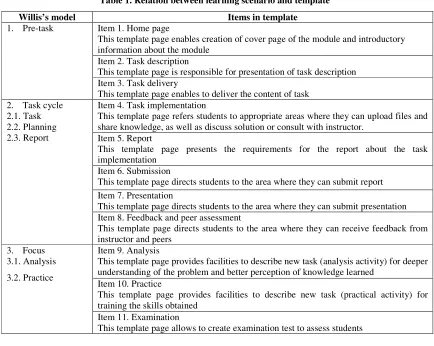
Table 1. Relation between learning scenario and template ... 50
Table 2. Description of elements of the structure of template... 50
Table 3. Formats of input and output ... 53
List of Figures
Figure 1. The organization of the Digitale Universiteit (Fisser & Geloven, 2003)... 11Figure 2. Learnativity Aggregation Model (Wagner, 2002) ... 18
Figure 3. IMS Content Packaging scope (IMS, 2002) ... 20
Figure 4. CISCO’s Reusable Learning Object Structure (Barrit, 2001)... 20
Figure 5. CISCO’s templates for types of RIOs... 24
Figure 6. Pedagogical framework (Cullen, et. al., (2002) ... 26
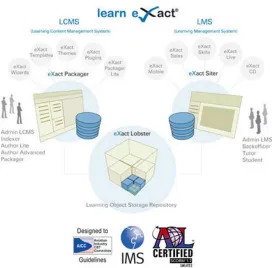
Figure 7. Architecture of LCMS learn eXact (Guinti, 2004) ... 42
Figure 8. Examples of learn eXact themes... 43
Figure 9. Example of learn eXact Model (Virtual Patient) ... 44
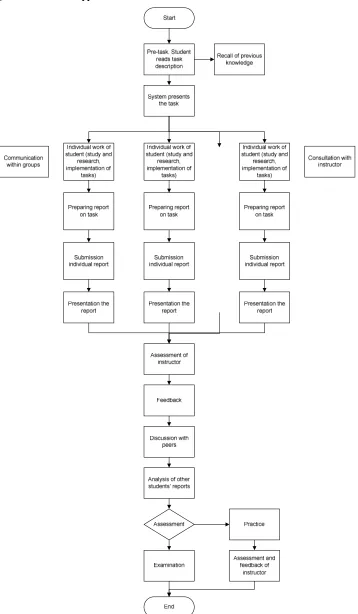
Figure 10. Learning scenario in TBL approach... 49
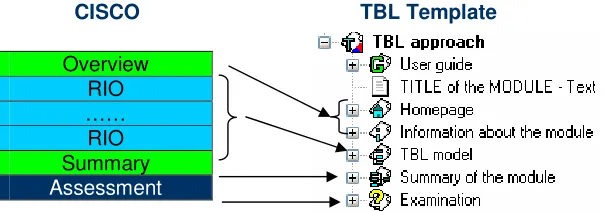
Figure 11. Mapping of CISCO’s RLO-RIO model on the TBL approach template ... 51
Figure 12. Interface of the template’s page ... 55
Figure 13. Structure of TBL approach element... 56
Figure 14. Subelements of TBL approach element ... 57
Figure 15. Structure of Homepage element... 58
Figure 16. Structure of Module information element... 59
Figure 17. Structure of Instructors element... 60
Figure 18. Structure of Objectives of the module element... 60
Figure 19. Structure of Prerequisites element ... 61
Figure 20. Structure of Competences to be achieved element ... 61
Figure 21. Structure of Content of the module element ... 62
Figure 22. Structure of Assessment principles element ... 62
Figure 23. Structure of Organization of the module element... 63
Figure 24. Structure of TBL model element ... 64
Figure 25. Structure of Step 1 element... 64
Figure 26. Structure of Step 2 element... 65
Figure 27. Subelements of Task definition element... 65
Figure 28. Structure of Step 3 element... 66
Figure 29. Structure of Step 4 element... 67
Figure 31. Structure of Step 6 element... 68
Figure 32. Structure of Step 7 element... 69
Figure 33. Structure of Step 8 element... 70
Figure 34. Structure of Step 9 element... 70
Figure 35. Structure of Step 10 element... 71
Figure 36. Structure of Summary of the module element ... 71
Figure 37. Structure of Examination element... 72
Figure 38. Types of questions ... 72
Summary
This research project aims to facilitate the work of content developers by providing templates for creation of e-learning content in the form of Learning Objects. The project was initiated within the scope of the project conducted by the Digitale Universiteit consortium and was intended to solve problems which DU’s content developers meet during their work on collaborative creation of e-learning materials.
The content developers faced some problems which they wanted to solve by using templates:
• Reusability problem. The template should provide universal LO model which can be reused in different contexts for creation of different kinds of LOs with different purposes, granularity and complexity.
• Instructional design problem. The template should provide guideline for instructional design because not all content developers are specialists in instructional design and are able to create didactical structures.
• Layout and interface problem. The template should enable creation of attractive and effective pieces of learning material (LOs) with nice layout of interactive content.
Therefore the templates are intended to provide two main elements: an abstraction of didactic structure and its rendering.
In order to define what exactly templates are needed and what templates can be done a number of research activities were carried out: literature review and inventory of DU’s content developers’ views on pedagogical approaches and technologies.
Literature review provided theoretical basis for the creation of templates. Several questions were investigated. First, the problem of e-learning content and its organization in the form of Learning Objects was considered. Here the issues of reusability, granularity, metadata description, technology standards, LO’s structure and packaging were discussed. The conclusion was made that CISCO’s Reusable Learning Objects Strategy (Barritt, 2001) could be adopted as a framework for LO’s organization. This literature review enabled to provide understanding of the possible e-learning content organization which leads to understanding what structure of LOs should be reflected in the templates. This allowed building the structure of templates based on desired structure of LOs.
Second, issues related to templates were considered, such as the definition of templates, their roles, their possible functionality, and examples of existing templates. During this review the reference was made to the research of Boot and Merrienboer (2005) who rated working with didactical meaningful objects higher than with multimedia objects and argued for using templates based on meaningful didactical structure. Therefore the conclusion could be made to use pedagogical approached as a core of templates’ didactical structure.
Consequently, the third question involved the used pedagogical approaches. Literature review of pedagogical approaches supplied a short overview of six pedagogies, including Problem-based learning, Project-based learning, Task-oriented learning, Experiential learning, Collaborative learning and Skills-based learning, and allowed elaborating of LO models for some of them based on their learning scenarios.
Fourth, technical issues related to technologies and tools for e-learning content development were considered. This implied describing Learning Content Management Systems in general and learn eXact in particular. This software application was chosen by default as far as it was an application used by the Digitale Universiteit. The literature review related to the technical issues explained how templates were realized within concrete software application and what kind of limitation the learn eXact imposed on the templates.
design templates according to intended user’s preferences in pedagogical approaches and supporting technologies, template goals and functionality, interfaces of templates and content developed by means of templates. The results of analysis demonstrated that the most popular and desirable pedagogical approach was Task-based learning (TBL). Therefore this pedagogical approach was chosen as a basis for intended template. This was further reflected in design and development of the template. As a result of the given research project a template called TBL approach template was designed and developed. The goal of creation of this template was to support content developers and facilitate the process of creation of modules (courses) that include tasks as one of the main components, and allow detailed description of the task according to TBL pedagogical approach.
The product was designed according to the method of user-centered design (ISO 13407, 1999) based on the inventory of target group’s preferences and requirements (DU’s participants) in respect to pedagogical approaches and technologies. Moreover the design of template was grounded on the strong theoretical basis of didactics (various pedagogical approaches were considered, as well as cognitive theories), instructional design (Systematic Design of Instruction (Dick & Carey, 1990), Reusable Learning Objects Strategy (Barritt, 2001), learning technology standards (IMS, SCORM, IEEE), and some other theories related to templates and content development process.
During the design of the template’s prototype a first formative evaluation was carried out. This formative evaluation was implemented in four steps:
• Step 1. Analysis of DU pageSet template and its functionality
• Step 2. Analysis of the design of the structure of the desired TBL approach template based on the DU pageSet template, in consultation with an expert
• Step 3. Appraisal during the development of the first prototype of the TBL approach template, in consultation with an expert
• Step 4. Analysis during the development of the pre-final version of TBL approach template, in consultation with an expert.
The goal of the first formative evaluation was to specify the weaknesses of the current version of template for further redesign and improvement. The first step of this evaluation was carried out solely by researcher, while others were implemented in the form of a series of heuristic walkthroughs with a technical specialist and advanced user of learn eXact software.
At the third step of the first formative evaluation a first prototype of the template was developed and evaluated. The results of formative evaluation were analysed and a pre-final version of template was produced and further evaluated at step four. The template was developed with the use of the Extensible Markup Language (XML) that was required for Learn eXact to develop templates for LOs. The XML allows to separate the structure and description of contents from their rendering, hence the abstraction of the structure and the contents organized inside the actual structure of an LO are described using XML elements and attributes and the LO rendering is handled separately using the XSLT technology in Learn eXact.
the next revision of the course, while others called the template logical, reasonable and probably useful in the real situation of content development.
However two instructors demonstrated skeptic attitude to the TBL approach template although they understood particular value of it. One of them denied any idea of instructional design therefore the template itself looked useless and not efficient. Another participant criticized CBT model of presenting content by arguing for development of more interactive content which motivates and stimulates students’ activities.
As a result of evaluation the following recommendations for the future development of TBL approach template were made. The first recommendation was to carry out performance evaluation in order to test parameters such as time and effort expenditures, effectiveness, reusability etc. among specific target group (DU’s participants). They can be asked to create real pieces of learning materials from their content developer’s practice and evaluate their performance. This will enable to make a final conclusion about the ability of the TBL approach template to support content developers in their activities.
1. Introduction
In this chapter the context and problem, main research questions, purpose, scope, objectives and target audience of the research project are described.
1.1. Introduction into the Research Problem
In the present day society the matter of education is critical and therefore the popularization of e-learning takes place. The reason of rapid and wide distribution and expansion of this type of education is that society requires effective, convenient, flexible, and assured way of education and e-learning is able to provide this. Persistent development of information and communication technologies leads to continuous refinement of e-learning technologies and ensures future growth of this domain. Existing facilities of e-learning enable to apply different pedagogical approaches, provide great flexibility in learning and in different ways improve traditional forms of education.
There are several factors that affect success of e-learning, such as appropriate environment ready for implementation of learning including infrastructure and human factor, as well as quality of e-learning technologies, their complexity and efficiency. However the quality of e-learning depends not only on the form of how the education process is carried out but also on what content is taught and how this content is presented. Consequently one of the most crucial factors that influence quality of education is e-learning content.
The content itself, its fullness and actuality is left for an author. Only the author can specify which content fits the context of the course. Therefore the quality of the content depends on how competent the subject matter expert is. But the way of organizing and sequencing the content, its delivery and presentation can be pre-defined in a standard way. For example, there can be a model depicting relations between desired pedagogies in the course, content, and technologies which support content delivery for different pedagogical approaches.
Such organizational structures can be defined in the form of templates which allow content developers to sequence content within their courses in an optimal way. In order to develop and manage e-learning materials developers use special technologies, particularly Learning Content Management Systems (LCMS). These systems are multi-developer environments where developers can create, store, reuse, manage, and deliver learning content from a central object repository.
One of the LCMSs used in Dutch higher education is the learn eXact LCMS, which enables the use of templates for content development besides all standard functionality. Within the Digitale Universiteit consortium various projects are initiated which are involved in the collaborative development of learning materials using LCMS learn eXact.
This research project is initiated within the scope of the project conducted by the Digitale Universiteit (DU) consortium. The reason of initiating of current research was dissatisfaction of DU’s participants by products created with the LCMS. In most cases the participants face two problems: either content developers don’t have deep insight in functionality of this system and facilities it provides to build attractive and well structured courses or they don’t have sufficient instructional design background to create e-content based on pedagogical approaches supported by computer technologies. As a result, developers create inefficient learning materials which don’t meet the initial goals. In order to solve these problems different supportive technologies and guidance should be provided. This will facilitate the work of content developers and reduce time and effort invested into content creation.
The aim of this research project is to investigate how content developers wish to be supported in their work, if using of templates is a solution to the problems and how templates should be organized to meet the requirements of developers.
This leads to the following research question: How can content developers be supported with templates during the development of learning objects in LCMSs
Universiteit. For the survey a questionnaire will be distributed among content developers. The results of this questionnaire will be analysed and based on the conclusion the templates will be build.
The outcomes of the project will be templates that can be used in LCMS learn eXact. These templates will facilitate the content development process and will help to develop a uniform style for learning materials.
The outcome product is intended for several groups of people related to content development such as: project managers, instructional designers, and super users. However the primary focus is on the instructional designer’s goals to develop content, and therefore templates will also provide solutions for instructional design of courses.
The final stage of the project will contain an evaluation of template. The evaluation will be carried out by the staff of the faculty of Behavioral Science and Technology of the University of Twente (5 TAET instructors). The evaluation will be implemented in the form of two formative evaluations. The results of evaluation will demonstrate whether the use of developed template is effective and efficient and if there is need to continue development and application of such kind of templates.
1.2. Context of the Project
The research project is initiated and conducted within the Digitale Universiteit. The Digitale Universiteit is a consortium of ten universities in the Netherlands: Universiteit van Amsterdam, Universiteit Twente, Vrije Universiteit, Open Universiteit, Fontys Hogescholen, Hogeschool INHOLLAND, Hogeschool Rotterdam, Hogeschool van Amsterdam, Hogeschool van Utrecht, and Saxion Hogescholen. The DU focuses on the development and application of digital educational products and knowledge for higher education (Fisser & Geloven, 2003). Important issues for the DU are the changing demand for education, combining working and learning, permanent education, the role of e-learning and the need for cooperation. On average, the DU fosters 30 projects each year with an annual throughput of 10 M€.
The field in which the DU operates is educational innovation, including current opportunities and problems in higher education where ICT can offer a solution. The consortium aims not only at developing services and products, but also at the mutual sharing of developed knowledge, particularly in the field of educational innovation with ICT: developing new didactic concepts, implementation strategies, change management, cost issues and technical choices, etc. This means that the DU is both a product community and a knowledge community.
Figure 1. The organization of the Digitale Universiteit (Fisser & Geloven, 2003)
As can be seen in Figure 1 there are two major programs in which the projects are carried out, the development program and the virtual learning environment program.
The development program
Most of the projects are carried out within the development program, which consists of the following four program lines:
• Digital testing, assessments and digital portfolio • Digital educational tools: tasks and resources
• Learning and coaching from a distance: dual, virtual and international • Build up and disseminate expertise
The first three program lines of the development program are mainly aimed at developing content and tools that can be used in education. Examples of these are digital learning material for the Law faculties within the consortium, the development of a DU digital portfolio and a complete curriculum for teacher training that can be followed at a distance. The aim of the expertise program is building up and disseminating knowledge and expertise.
Next to these programs that are focused around the development of content, materials and tools there is a more technological program on virtual learning environments, with a focus on standardization and interoperability.
The program Virtual learning environment
In this program, activities are carried out to achieve optimal interoperability between the many different e-learning systems in the ten participating institutions. There are three levels of ambition:
1. exchangeability of digital content 2. the joint use of e-learning tooling 3. full educational interoperability.
The first one is relatively easy to achieve, mainly through the use of standards (like IMS QTI, LOM etc.), although most of the commonly used systems are not fully IMS compliant yet. Where possible and necessary, simple ‘connectors’ are realized in order to be able to carry digital content from one system to another.
Exploitation BV Educational Service
Provider
Development programme 1.Digital testing, assessments
and digital portfolio 2.Digital educational tools:
tasks and resources 3.Learning and coaching
from adistance: dual, virtual and international 4.Build up and disseminate
expertise
Virtual learning environment programme
Contact persons Supervisory Board
Programme Board
Council of participants
The significant role plays the involvement of DU in the use of a Learning Content Management System (LCMS). After a fairly long selection process the DU is now working with learn eXact in about five projects. This process is monitored closely in order to get a clear perspective on the possibilities of an LCMS as such, and of learn eXact specifically.
The given research project is carried out within the scope of one of the projects conducted by the DU related to use of LCMS learn eXact. The purpose of this research project is to provide content developers of the DU with templates and instructions in order to support them in the process of content development.
The products developed as an outcome of the research project are intended mostly for content developers, however the research project itself follows the interests and meets the requirements of several target groups: instructional designers, subject matter experts, project managers, super users, instructors and students.
The main focus is on instructional designers who develop the content (didactics, structure and sequence of content, logical flow of topics and learning activities, etc.) They will make a decision which template is the most appropriate for the purpose of the concrete course and the way this template can be applied. Subject matter experts – people who are responsible for learning content itself (cognition, specifics, fullness, level of difficulty, etc.) Project managers administrate the process of learning content development. Super users are technical staff that creates the content designed by subject matter experts and instructional designers, by means of authoring tools. Instructors utilize the content in their teaching purposes. Students are final users of the learning content developed by other stakeholders.
In order to be effective the content should meet the requirements and preferences of students, reflect instructors’ teaching styles and cover learning objectives therefore templates should provide creation of such kind of content which satisfies all stakeholders especially content developers and instructional designers of the DU.
1.3. Goals and objectives of the Project
One of the trends of DU’s programs is content development. Several organizations are involved into the collaborative creation of learning materials using learn eXact. During the development of content the content developers faced a number of problems in working with this software such as: (1) content developers are not aware of all facilities and functionalities of the system therefore they don’t use it in the full scale, (2) developed materials are quite poor because the content developers use simple tools and structures to form their courses, (3) although the learn eXact provide a few embedded templates, they don’t cover all instructional needs and content developers’ requirements, (4) content developers don’t have enough support in the form of predefined models and built-in instruments for fast and easy creation of attractive and efficient courses.
The goal of the given research project is to support content developers with tools that facilitate the process of learning content development.
The main objective of this project is to design and develop different templates using the learn eXact software. These templates will enable content developers to create good looking, well structured, didactically correct and pedagogically effective courses. The primary focus of these templates will be on following the rules of instructional design in order to build qualitative content.
The templates provide an abstract structure for learning objects. Learning objects are pieces of learning material that can be reused and exchanged between courses. Templates present general models for learning objects’ organization.
The process of template development follows similar steps as instructional design of content, particularly the Instructional system development model (ADDIE) which incorporates five phases: analysis, design, development, implementation and evaluation. Therefore the structure of this document has the flow of ADDIE model: analysis (Chapters 2), design (Chapter 3), development and implementation (Chapter 4), and evaluation (Chapter 5). Consequently there are four main tasks of the research project:
1. Research
2. Design of templates
3. Development and implementation of templates 4. Evaluation of templates
These tasks will be implemented in the following order which will be accordingly reflected in the document.
The research will be presented in the Chapter 2 that has the following structure. First, literature review will be carried out where multiple definitions related to the research problem will be specified, such as e-learning content, learning objects, technological standards, instructional design, templates, pedagogical approaches and technology support. Second, the inventory of pedagogical approaches and technologies used in the Digitale Universiteit will be described. This inventory will reflect needs and requirements of the DU’s content developers in respect to pedagogical approaches and technologies that will be further considered in the design phase. Third, some technical and technological issues will be discussed, such as functionalities of LCMS in general and learn eXact in particular. Forth, the recommendations for the design of templates will be given which implies discussion about data, methods, models and interfaces for the design and development of templates.
The designing phase will be reflected in the Chapter 3. This chapter will specify framework for designing templates and describe design of particular template based on this framework. The design of template will be further implemented in the form of output product of the given research project which will be reflected in the Chapter 4.
The Chapter 4 will describe the processes of development and implementation of the templates designed in the Chapter 3 and resulting product itself. The goal of the development phase is to implement the prototype of templates in order to see how these templates support content developers and further evaluate their efficiency, and redesign and redevelop if needed. An example of the content developed by means of templates in the form of instructional course about using the developed template will be created as well. The goal of the development of this instructional course is to provide the final product with support in using it. The description of the template realisation will be accompanied by the screen dumps from the instructional course. Moreover this course will be used further during evaluation of template and content developed by means of this template which will be reflected in the Chapter 5.
The Chapter 5 will contain description of the evaluation process of the templates. Two types of formative evaluation will be discussed: a series of heuristic walkthroughs with a technical specialist, and usability testing with five instructors from the University of Twente. The framework for two formative evaluations will be described here, including goals of evaluation and methods and tools for data collection. The description of data collection process is followed by analysis of the results obtained during evaluation and discussion about these results along with proposing solution for further template improvement and re-design.
2. Conceptual Issues related to the Content Development
This chapter provides theoretical background for design and development of templates. The chapter presents definitions of basic terms related to the research problem, describes prerequisites for implementing design and development, and gives the explanation of specific and technical aspects of the research project. The conceptual issues related to instructional design and content development are considered here. The section 2.1 E-learning content: structure and characteristics discusses definition of e-learning content, modern trends, principles of its organization and structuring including definition of the term Reusable Learning Objects and their characteristics especially reusability characteristic, as well as international learning standards related to content organization, such as IMS and SCORM, and CISCO’s definition of the Reusable Learning Object Strategy. This section is followed by the description how the structure of the e-learning content can be specified in the form of templates. The section 2.2 Templates for e-learning content explains role and purpose of templates, provides definitions of template in the literature, overview of existing projects related to template development, and justify the proposed model of template based on the pedagogical approaches for the future design and development. This requires overview of pedagogical approaches which are discussed in the section 2.3 Pedagogical approaches. This section explains the meaning of pedagogical approaches in the e-learning context and also provides an overview of the most significant pedagogies. The next section 2.4 Inventory of pedagogical approaches and technologies demonstrates which exactly pedagogical approaches and technologies are used in the Digital University in order to design templates that meet the requirement of the target group. The next section 2.5 LCMS: Methods, Tools, Technologies for Content Development explains technical aspects of the project, particularly methods, tools and technologies for content development, as well as specifics of LCMS learn Exact used as a tool by the Digital University and perspective of this system to the templates. The last section 2.6 Conclusion of literature findings and their implications to the template design outlines the main concepts discussed in this chapter and provides recommendation for the future design of templates.
2.1. E-learning content: structure and characteristics
This chapter considers issue of instructional content, particularly e-learning content, Reusable Learning Objects and their characteristics including reusability, as well as the problem of e-learning content organization, structuring and development. This chapter contains the following sections: 2.1.1 Definition of e-learning content and 2.1.2 Structure of e-learning content and its characteristics.
2.1.1. Definition of e-learning content
At all times the core of any learning process is the content and the way it is delivered to a learner. The better leaning content is build, structured and tailored to learner the more efficient learning process is. No matter what form of education is, the content plays a major role because the content is an item that student learn. However the delivery of the content depends a lot on the form of education in order to fit particular pedagogical approach, such as traditional learning with face-to-face class activities, distance or blended learning, with or without instructor’s involvement, with or without ICT support, etc. The content should be necessary and sufficient to meet learner’s requirements.
The term instructional content has wide meaning. In general it is a group of subjects consisting of educational material to be acquired in a learning process. This assumes anything that could be learned from abstract in the text-book to audio-record or laboratory experiment, etc. An e-learning restricts this definition to the electronic content which presents “information captured digitally and imparted to learners. Formats for e-learning content include text, audio, video, animation, simulation, and more” (Worldwide Training Glossary of Terms, 2002).
of meaningful e-learning, including ones that provide the best and most open, flexible and distributed learning environments for diverse learners. (Collis & Moonen, 2001)
Nowadays we can state that such learning environments have various challenges: suitable services and content for the learners, broadband connectivity, user-friendliness and interoperability. Cardinalli (2005) from the Guinti Interactive Labs, emphasized the problem that “Publishing and Media Industry must improve the quality of the learning content and be able to adapt to new ways and formats for publishing and communication” but publishers are not ready yet.
Cardinalli stresses new tendency in development of e-learning content by arguing that ‘the open model for content and ICTs is a real business alternative for the future’. Moreover, he pointed that “there is urgent need for qualitative leaps in eLearning infrastructures and technologies along with innovative pedagogical models in order to avoid empty learning platforms or the use of electronic content without relevant virtual learning environment.”
Therefore the main focus of the given research project is on the development of a content fitting modern tendencies in Publishing industry and following innovative pedagogical approaches within relevant learning environments. Different aspects of e-learning content development are discussed further. In the following section various issues of characterizing and structuring of e-learning content are considered.
2.1.2. Structure of e-learning content and its characteristics
This section provides definitions of Learning Object, describes its main characteristics and focus on the reusability property of the Learning Object. Besides it explains how e-learning content is organized and structured including standardization issues. This contains the following subsections: 2.1.2.1 Definition of Learning Object and its characteristics, 2.1.2.2 Reusability of Learning Objects, 2.1.2.3 Granularity of Learning Objects and 2.1.2.4 E-learning content organization.
2.1.2.1 Definition of Learning Object and its characteristics
Before the web-based content presented HTML documents which had solid and inflexible structures of big and monolithic blocks of information (Moral & Cernea, 2005). However along with technology improvement a new approach to the learning content building has appeared. The concept of building content from Learning Objects almost completely replaced the old model of learning content. The use of semantic technologies in formation of personalized sequences of learning objects allows obtain a considerable increase of the working efficiency for both students and teachers in comparison with inflexible structures of the traditional network courses.
There have been many attempts to define a term Learning Object (LO). One of the most overall reviews of existing references to learning object is provided by Sosteric and Hesemeier (2002). They defined the term Learning Object by (a) rejecting useless theoretical links invoked to theorize learning objects, and (b) reducing the definition of learning objects to the bare essentials.
In the conclusion of their review Sosteric and Hesemeier (2002) proposed the following definition: “A learning object is a digital file (image, movie, etc.) intended to be used for pedagogical purposes, which includes, either internally or via association, suggestions on the appropriate context within which to utilize the object.” Finally the most significant and cited definitions were extracted, including the following ones.
The Learning Technology Standards Committee (IEEE LTSC, 2002) defines an object as “any entity, digital or non-digital, which can be used, re-used or referenced during technology supported learning.”
Most authors such as Hodgins (2000); Urdan & Weggen (2000); Gibbons, Nelson & Richards (2000) argued that objects are more than mere digital files, they like to attribute several special features to learning objects such as reusability, adaptability, scalability, searchability, etc.
Another important issue is that learning objects have to be linked to the context of use in learning environments. Therefore it is necessary to provide additional information to learning object that allows an instructor or instructional designer to know how to use the object in an educational setting. The IMS (2002) and the IEEE LTSC (2002) have contributed to the specification of necessary infrastructure for contextualized learning objects by developing Learning Object Metadata standards that provide the necessary context for the educational resource.
One of the most counterproductive approaches has been for theorists to draw on the discipline of computing science and, in particular, object-oriented programming, what follows from the definition by Quinn (2000):
“The learning object model is characterized by the belief that we can create independent chunks of educational content that provide an educational experience for some pedagogical purpose. Drawing on the object-oriented programming model, this approach asserts that these chunks are self contained, though they may contain references to other objects; and they may be combined or sequenced to form longer educational interactions. These chunks of educational content may be of any type - interactive, passive - and they may be of any format or media type. A learning object is not necessarily a digital object…”
The issue of modularity was considered by Longmire (2000) who stressed that learning objects must be modular, “free standing, non-sequential, coherent and unitary.” Others describe the same idea using slightly different terms. Roschelle, et. al. (1998) state that the object must be adaptable “without the help of the original developers to meet unforeseen needs.” According to Ip and Mornson (2001), the object must be constructed in such a way that its users “need not worry about the component’s inner complexity.” In other words, the learning object should be a “black box” in the sense described in the theory of object-oriented design.
Barron (2000), cites a project sponsored by Cisco Systems (Barritt, 2001) in which the concept of educational or “reusable information” objects is derived from the learning object thinking of Merrill (1983) and Clark (1989). Accordingly, each object is defined in informational terms “as a concept, fact, process, principle or procedure”. Writing elsewhere, Clark provides examples of such information objects: “text, audio and animation, learning objectives, practice exercises and feedback”. Later in 2002-2003 the National Learning Infrastructure Initiative (NLII - an EDUCAUSE initiative) formed a Learning Objects Working Group. This group has created an Ontology of Learning Objects which seeks to identify the issues surrounding the creation and use of LOs (Metros, et. al., 2002-03). Many other initiatives have been created since that time working on the problem of Learning Objects, for example NMC Learning Object Initiative, DLNET, etc. And many definitions and views on LO have been produced. However the only one remains the standard definition provided by LTSC (2002). The given research project is carried out with the involvement of Guinti’s software application learn eXact. Thus it is very important to understand Guinti’s perspective on LOs. They provided 2 definitions of Learning Object(1) a self-standing learning resource or resource group, which can be used or re-used in learning contexts with an educational purpose,possibly including pre-assessment and assessment activities (Guinti, 2004a); (2) the basic (simple or complex) unit of a learning experience and as a small, atomic, self-contained chunk of learning that can be reused in different contexts (Guinti, 2004b).
Both definitions conclude that content is structured in an aggregation of “atoms” (LOs), which grant a customizable and flexible reuse, where each atom has its own didactic value and owns the properties of “reusability”, “adaptivity” and “scalability”. For bigger aggregation Guinti is using a term Course. Consequently the following characteristics of LO can be specified (Guinti, 2004a):
• Easily Reusablein other Courses
• Self explanatory, and thus Independentfrom other LO
• Accessibleto different categories of users with different needs and access constrains
• Durable in order to enable high Return on Investments in its possible commercial positioning and/or its usage
This concept provides basis for templates by defining LO model in learn eXact software application. Therefore in this research project we will follow the Guinti’s definition with the special focus on reusability characteristic which is discussed in the section 2.1.2.2 Reusability of Learning Objects.
2.1.2.2 Reusability of Learning Objects
Many authors argued that the most important property of LOs is reuse in different learning contexts (Wiley, 2000b; Polsani, 2003). In this respect Strijker (2004) provided the following definition of LOs as “digital entities, available for use or reuse in different learning settings”.
The main accent of Strijker’s definition is on the reusability of Learning Objects. The works of Collis & Strijker (2003) and Strijker (2004) consider the issues related to the reuse of learning objects and the implementation of learning technology standards for reuse of these learning objects in different contexts (university, commercial, and military) and the human and technical aspects involved.
The idea of reusability is very critical for the Digital University. As was mentioned in the section 1.2 Context of the Project, several projects of the DU were initiated involved into collaborative development and sharing of learning materials. Participants of the projects strive to create Learning Objects reusable by all participants of the DU. Therefore reusability property of LOs is the most important characteristic of the content developed within the scope of the DU.
The given research project is conducted under the DU. Thus the focus should be on the assumption that Learning Objects created by means of the templates are reusable in many contexts. This is one of the most important characteristics that form templates discussed in the section 2.2 Templates for e-learning content and design of templates described in the chapter 3 Design of templates.
Although the undoubted role of reusability there are some problems related to the LO reusing. Boot & Merrienboer (2005) stressed five problems related to the reuse of Learning Objects: (1) the metadata specification – “it is difficult and extremely labor-intensive to specify metadata for large sets of LOs”; (2) the arrangement – “combining and sequencing LOs into larger arrangements is not always easy and self-evident”; (3) the exchange – “it may be difficult to exchange LOs between developers and e-learning systems”; (4) the context – “effective LOs cannot be created in isolation without an implicit or explicit instructional setting, target group and other contextual descriptions”, and (5) the pedagogical function – “it is difficult to express the pedagogical intensions for a LO by means of technical properties such as metadata, leading to sub-optimal reuse”.
In their work Boot & Merrienboer (2005) considered three solutions that overcome these problems: (1) templates instead of instantiations; (2) technically automating what can be automated; and (3) using intermediate instead of final product. Later in the section 2.2 Templates for e-learning content we will consider how these problems can be solved by means of templates.
Besides mentioned above problems there is another critical problem that content developers face while creating LOs – how big an LO should be in order to be reusable in many contexts. As the Reusable Learning Project (2005) states “Granularity, or aggregation level, is important in defining and determining reusability”.
Willey (2000a) argued that “from an efficiency point of view, the decision regarding learning object granularity can be viewed as a trade-off between the possible benefits of reuse and the expense of cataloging. From an instructional point of view, alternatively, the decision between how much or how little to include in a learning object can be viewed as a problem of “scope.”
2.1.2.3 Granularity of Learning Objects
In a general sense granularity of e-learning content reflects size, decomposability and the extent to which the content is intended to be used as part of a larger content. In order to describe the functional granularity of an LO the IEEE Learning Object Metadata (IEEE LTSC, 2002) used a term ‘aggregation level’. According to the scale of IEEE LOM there are four aggregation levels:
• Level 1. The smallest level of aggregation, e.g. raw media data or fragments. • Level 2. A collection of level 1 learning objects, e.g. a lesson.
• Level 3. A collection of level 2 learning objects, e.g. a course.
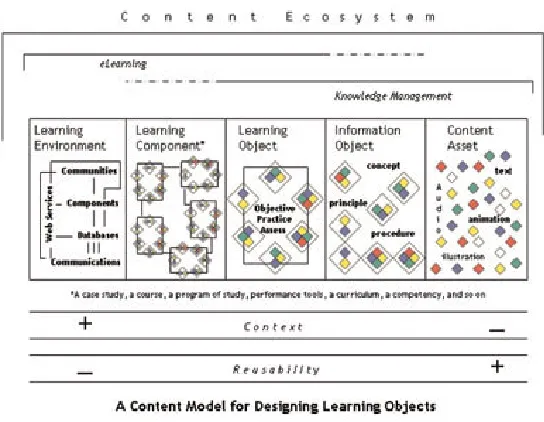
• Level 4. The largest level of granularity, e.g. a set of courses that lead to a certificate. The Learnativity Foundation has developed an Aggregation Model (Wagner, 2002) describing granularity, which can be mapped onto the IEEE LOM aggregation level scale, the following way:
1. Content Asset - raw media: images, text snippets, audio clips, etc. (Level 1 of IEEE LOM) 2. Information Object - a text passage, Web page(s), applet, etc. that focuses on a single piece
of information. It might explain a concept, illustrate a principle, or describe a process. [Single] exercises are often considered to be information objects. (Level 1 of IEEE LOM) 3. Learning Object - a collection of Information Objects that are assembled to teach a single
learning objective. (Level 2 of IEEE LOM)
4. Learning Component - a learning component is a generic term for things like lessons and courses that typically have multiple learning objectives and are composed of multiple learning objects. (Level 3 of IEEE LOM)
5. Learning Environment - a catch-all phase for the combination of content and technology with which a learner interacts. Thus a course written in a course management system is a learning component, but a deployment of the course in a live Course Management System at a particular institution (with a particular enrollment policy, help center, library reserve system, etc.) is a learning environment. (Level 3 or 4 of IEEE LOM)
Graphically Learnativity Content Model is presented in the Figure 2.
Figure 2. Learnativity Aggregation Model (Wagner, 2002)
Another Aggregation Model is specified by Sharable Content Object Reference Model (SCORM), which includes three levels:
2. Sharable content objects (SCOs) - self-contained learning objects or learning components that meet additional technical requirements needed for interoperability with learning delivery platforms
3. Content aggregations - contain assets, SCOs, information on the order in which these should be delivered and metadata about entire aggregation and its individual components. They are equal to learning objects or learning components in the Learnativity Aggregation Model. As we see from the Learnativity Aggregation Model (Figure 2) the bigger level of granularity, the less reusability, and vice versa. Therefore it is necessary to find a balance between reusability and granularity of the content depending on the purpose and requirement to the developing content. Guinti provides the following concept of aggregation levels used in their software applications. They consider Course as a bigger aggregation which is defined as “an organized sequence of learning materials and learning activities (reading, writing and practical work) packaged in a standard, inter-operable format such as Content Packaging” (Guinti, 2004a).
Such Courses may be aggregated into Classes, i.e. Courses of a similar or same context, which can be accessed by a number of users. The Courses can be decomposed into its instructional units (LOs). As far as there is still no formal definition of LO they left some degree of flexibility to the person designing or managing courses in specification the level of granularity of LO. Therefore their product eXact Packager allows maximum flexibility in defining the type of content and allows content developers to decide what a LO should be.
This principle is adopted in the given research project. The content developer decides functional granularity of LO developed by means of template. However template has restrictions to Information Object, Learning Object and Learning Component in Learnativity Aggregation Model. The discussion about template structure is presented in section 2.2 Templates for e-learning content. More detailed description of the granularity and structure of e-learning content, as well as recommendations for content design and development are presented in the section 2.1.2.4 E-learning content organization.
2.1.2.4 E-learning content organization
While describing a Content Model based on LOs it is important to consider two critical issues (Moral & Cernea, 2005):
1. the technical characteristics which enable content’s accessibility, interoperability between various LMSs and reusability in different learning contexts
2. the content structure required to increase content’s effectiveness
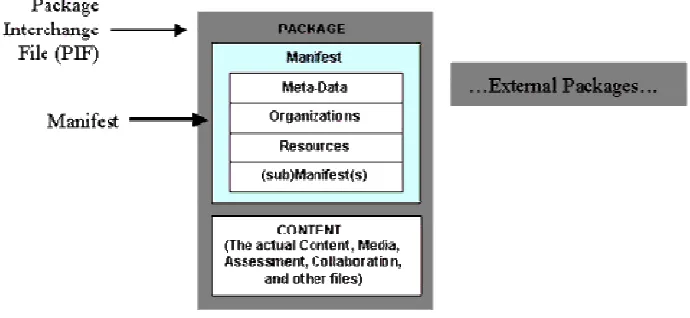
The first issue concerns a common model that could assure the quality of e-Learning contents. In order to standardize a Content Model various initiatives like AICC, IEEE, IMS, Dublin Core and ADL contributed into elaboration of e-Learning standard. As a result Sharable Content Object Reference Model (SCORM) was developed. This is a specification for the development, packaging and delivery of learning material in order to attain the reusability, accessibility through a set of Metadata, interoperability and durability, facing all the technological changes.
The actual standard of the metadata specified by SCORM is the one proposed by IEEE in IEEE LOM which groups specifications from Dublin Core and IMS. The metadata standard body is divided into nine categories based on definitions from the LOM Information Model: General, Lifecycle, Meta-metadata, Technical, Educational, Rights, Relation, Annotation and Classification.
Therefore in the Content Model the LO is organized in a way that regarding the type of learning resources (i.e. narrative texts, tasks, simulations, quiz, graphics, experiments, problems, etc.) all of them are accompanied by the metadata.
Figure 3. IMS Content Packaging scope (IMS, 2002)
The second issue considers structure of content (or LO model) from the didactical point of view. This LO model is derived from exhaustive studies about the learning/teaching processes and the human perception of information, its maintenance in memory and codification.
CISCO (Barrit, 2001) significantly contributed into the LO model evolution by designing Reusable Learning Object Strategy. Cisco Internet Learning Solutions Group (ILSG) proposed modular reusable objects, easy to locate and modify independently on the format, dividing and subdividing the information until the concept level.
According to ILSG’s definition individual Reusable Information Objects (RIOs) form a larger structure called a Reusable Learning Object (RLO). RLO can be any entity of instruction that contains all the essential parts to enhance learning. RLO is a collection of seven, plus or minus two, RIOs that are grouped together to teach a common theme based on a single learning objective. In order to make the collection of RIOs into a complete learning experience, or lesson, an Overview, Summary, and Assessment are added to the package (Figure 4). Consequently an RLO can perform a whole course, a chapter, or a lesson in its minimal expression.
Figure 4. CISCO’s Reusable Learning Object Structure (Barrit, 2001)
Therefore according to the Learnativity Aggregation Model the level of granularity of RLO presents Learning Environment or Learning Component, and RIO – Learning Object.
In the given research project the RLO-RIO structure of content organization will be adopted as a core for LO Model of templates. The design of the templates based on the CISCO’s Reusable Learning Object Strategy will be discussed in the Chapter 3 Design of templates. There will be considered principles of specifying elements of template according to RLO-RIO hierarchy where basic elements reflect RLO components.
2.2. Templates for e-learning content
This chapter defines the term ‘Template’. It explains the role and purposes of templates, as well as necessity of their use. This chapter discusses different approaches to templates, justifies the principles considered in this research as basis for template design, and promotes a model of template based on pedagogical approaches. This chapter contains the following sections: 2.2.1 Role and purpose of templates, 2.2.2 Meaning of template in literature and in the given research project and 2.2.3 Structure of the template.
2.2.1. Role and purpose of templates
Nowadays e-learning is wide used in educational purposes both in university and corporate sector. However it is still innovative and rapid-developing domain and many instructors feel difficulties with transferring their courses from traditional form of education into computer-based. The reason is that instructors often are not aware of electronic learning environments and facilities they provide. This leads to lack of motivation or even resistance of instructors in using e-learning technologies.
The goal of this research project is to support instructors and content developers with templates which present ready-made models of electronic courses. Instructors do not need to know all details of complex instructional design process for e-learning content. The only thing required is that they need to choose appropriate template and fill it with appropriate content. Content developers gain from using templates the following:
• Templates make process of content development simpler and faster • Templates provide structure and guidance during development
• Templates enable to focus on pedagogical issues, and not on technical ones
2.2.2. Meaning of template in literature and in the given research project
This section specifies what definitions of template can be met in the literature and what main features characterize templates.In the literature we can find various definitions of the term ‘Template’. Different authors consider it from different perspectives. For example Microsoft (2001) gives the following definition of template as “a file or files that contain the structure and tools for shaping such elements as the style and page layout of finished files”. Here the focus is on a structure of elements and a tool responsible for shaping layout for elements in the given structure. Microsoft provides the following examples of templates: Microsoft Word templates can shape a single document, Microsoft PowerPoint templates can shape a presentation and Microsoft FrontPage templates can shape an entire Web site.
Wiki (2005) sees template as “some form of device to provide a separation of form or structure from content”. This definition stresses that the main function of template is to provide framework describing the content but not containing the content itself. Wiki gives an example from publishing where “a template may be a predefined layout to give an idea what to write where with boxes and lines; for instance a single-page newsletter template might have a few columns, space for a picture and gaps for the headline and name of the newsletter”.
As following from the Free dictionary’s definition of template “a document or file having a preset format, used as a starting point for a particular application so that the format does not have to be recreated each time it is used” the main goal of template is to provide particular format that can be multiple reused in different contexts.
So from the definitions above we can conclude that the goal of template is to provide reusing of specified format. The main three components of the format can be emphasized:
2. Content – data model that specifies which content should be presented in each element of the structure (for example, in MS PowerPoint a template for text page contains title and text area)
3. Layout – layout, style and form of presentation of actual content on the screen (for example, ‘Clouds’ template in MS PowerPoint assigns background and heading/text/list style, etc.) In the given research project the Template is considered as a framework for building Learning Objects. In order to specify characteristics of Template it is required to understand Guinti’s view on LOs. According to Guinti (2004b), LO is made out of four components:
1. The resources used inside the LO, i.e. texts, images, animations and any kind of media used to convey the information to be learned (the raw assets, completely context-dependent) 2. The abstraction of the didactic structure of the LO, i.e. the way raw assets can be organized
and managed inside the LO (the LO model that, to a certain extent, can be considered context-independent)
3. The actual didactic structure of the LO, i.e. the way raw assets are organized and managed inside the LO
4. The rendering of the LO, i.e. the way the resources and the didactic structure are rendered on a PC or on any other device
The goal of template is to optimize production of LOs that have the same didactic structure but differ in raw assets, as well as production of LOs that have the same raw assets but differ in the didactic structure. In this case template maintains the same abstraction and separates content from actual structure. Therefore the Template (or LO model) can be defined as being made of an abstraction of didactic structure (2) and its rendering (4).
The main purpose of templates is to increase the effectiveness of reuse. In the chapter 2.1.2.2 Reusability of Learning Objects the five problems of reusability were specified. According to Boot & Merrienboer (2005) “templates may help to solve the arrangement, exchange and context problem”. They considered different types of templates, such as for organizing lessons, reaching particular types of instructional objectives or for designing computer screens of the lessons. However for all of them from reusability point of view, “an important implication is that templates should contain as little contextual information as possible so that the developer can precisely specify this context-specific information.”
Boot & Merrienboer (2005) conducted the research about creating and reusing Learning Objects where they explored creating and reusing of didactically meaningful and multimedia learning objects by means of templates. During the research they rated working with didactical meaningful objects higher than with multimedia objects. Thus in the given research project the templates will be based on meaningful didactical structure. The multimedia-based template (DU pageSet template) is considered and criticized in the section 5.2.1. For the purpose of the given research didactical meaningful structure will be built for the templates.
The principles of didactic structure organization provide basis for template design described in the chapter 3 Design of templates. These principles are exhaustively discussed in the next section 2.2.3 Structure of the template.
2.2.3. Structure of the template
2.2.3.1 CISCO Reusable Learning Object Strategy
In the CISCO’s definition of LO model RLO is comprised from small RIOs. Moreover each RLO and RIOs have their own internal structures. This concept can be adopted to combine template didactical structure. More detailed CISCO Reusable Learning Object Strategy is discussed below.
Each RLO contains the following elements: Overview, 5-9 RIOs, Summary and Assessment.
The Overview is used to introduce the RLO and act as an advanced organizer for the learner by providing the objective, outline, and scenario for the module. The RLO Overview has six content items:
1. Introduction (required) - one or two paragraphs that explain the purpose of the RLO 2. Importance (required) - one or two paragraphs that create interest in the RLO for the learner 3. Objectives (required) - can be an “informal” objective but must be based on the same
objective as the “formal ” objective found in the metadata for the RIO
4. Prerequisites (required) - list the knowledge and skills, or other RIOs needed to complete the RLO.
5. Scenario (optional) - relates to a job function. Individual RIOs may use this scenario when listing examples, or explaining processes or procedures.
6. Outline (required) - list the title of each RIO contained in the RLO, as well as the Summary and case study.
The RIOs are self-contained chunks of information built around a single learning objective. Groups of RIOs are combined to form a lesson (RLO). Each RIO is built out of three components (Figure 4): Content items, Practice items and Assessment items.
1. Content items - content related to particular cognitive level.
2. Practice items - any reinforcement activities that give the learner the opportunity to apply skills and knowledge.
3. Assessment items - questions or measurable activities used to determine if the learner has mastered the learning objective for a given RIO.
The Summary is used to conclude the RLO and tie the scenario and objectives covered in each RIO together. It also offers a suggested course of action for learners to broaden their knowledge and skills in this area. Finally, the Summary is a transition between the RIOs and the final Assessment. The RLO Summary has three content items:
1. Review (required) - One or two paragraphs that recap what the learner has just learned in the RLO (touch on all the RIOs in this RLO). It restates objectives and importance of this RLO and concludes the scenario established in the Overview.
2. Next Steps (optional) - suggest other RLOs that are related to this RLO and recommend other areas of study.
3. Additional Resources (optional) - list URLs, PDFs, documents, and other resources that will help the learner learn more about the knowledge and skills covered in this RLO. Resources are accompanied by one sentence describing each resource.
The Assessment is simply a collection of the assessment items that are written to match the objective of each RIO found in this RLO. For each RIO, there are at least two assessment items to form a pool of items. From the point of view of the learner, assessment items appear as a pre- or post-Assessment for the entire RLO. The Assessment serves two functions:
1. Prescribes RIOs that the learner needs to take. Determines gaps in knowledge and skills before the lesson and indicates which RIOs fill those gaps.
2. Ensures that the learner has achieved mastery of all objectives for a given lesson. Determines gaps in knowledge and skills after the lesson and indicates which RIOs that learners should review.
According to this concept RLO presents complex structure which reflect lesson in its minimal expression. CICSO refers RLO as Course or Lesson therefore the template for Course or big piece of learning content can be based on the proposed model of RLO. The way how this is realized in the concrete template is described in the chapter 4 Development and implementation of templates. The design of templates reflecting smaller Informational Objects (RIOs) can be based on several principles which are described in the next section.
2.2.3.2
Templates for Information Objects
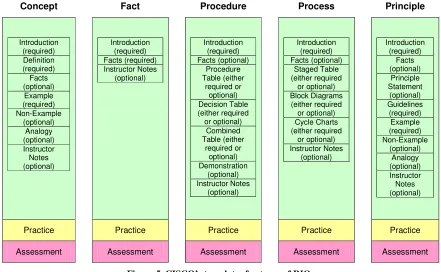
According to CISCO’s definition RIOs are classified into five types based on modified information mapping (Performance Matrix as defined by Clark (1989)) originated from Merrill’s component display theory (Merril (1983)) and Bloom’s Taxonomy of Educational Objectives (Bloom & Krathwohl (1994)): concept, fact, procedure, process, and principle. This classification scheme makes RIOs more reusable.
Besides this classification of RIOs, CISCO also provided templates and guidelines for each type of RIO. Depending on type of RIO, it has different set of components of content, and different type of practice as well. Schematically these five templates are presented in the Figure 5.
Concept Fact Procedure Process Principle
Introduction (required) Definition (required) Facts (optional) Example (required) Non-Example (optional) Analogy (optional) Instructor Notes (optional) Introduction (required) Facts (required) Instructor Notes (optional) Introduction (required) Facts (optional) Procedure Table (either required or optional) Decision Table (either required or optional) Combined Table (either required or optional) Demonstration (optional) Instructor Notes (optional) Introduction (required) Facts (optional) Staged Table (either required or optional) Block Diagrams (either required or optional) Cycle Charts (either required or optional) Instructor Notes (optional) Introduction (required) Facts (optional) Principle Statement (optional) Guidelines (required) Example (required) Non-Example (optional) Analogy (optional) Instructor Notes (optional)
Practice Practice Practice Practice Practice
Assessment Assessment Assessment Assessment Assessment
Figure 5.CISCO’s templates for types of RIOs
2.3. Pedagogical approaches
This chapter describes possible learning scenarios and pedagogical approaches performed in the e-learning content that can be supported by computer technologies. It defines the most valuable approaches and explains the way they are supported by technologies. The chapter discusses the instructional design with respect to pedagogies. The chapter includes the following sections: 2.3.1 Pedagogies in the e-learning context and 2.3.2 Overview of pedagogical approaches.
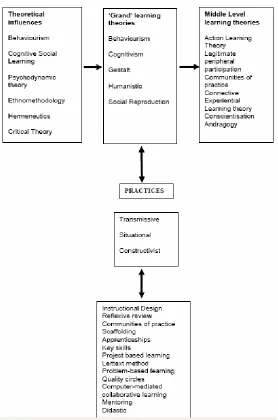
2.3.1. Pedagogies in the e-learning context
There are many pedagogical approaches used in conventional educational practice. According to definition of Center for Research on Education, Diversity & Excellence (CREDE, 2002) “pedagogy means teaching and assisting students through interaction and activity in the ongoing academic and social events of the classroom”. In the traditional classroom there are many ways to teach students. One of the explorations in learning and instruction is the Theory Into Practice Database that contains brief summar