Volume 2009, Article ID 975640,17pages doi:10.1155/2009/975640
Research Article
A Rules-Based Approach for Configuring Chains of Classifiers in
Real-Time Stream Mining Systems
Brian Foo and Mihaela van der Schaar
Department of Electrical Engineering, University of California Los Angeles (UCLA), 66-147E Engineering IV Building, 420 Westwood Plaza, Los Angeles, CA 90095, USA
Correspondence should be addressed to Brian Foo,[email protected] Received 20 November 2008; Revised 8 April 2009; Accepted 9 June 2009
Recommended by Gloria Menegaz
Networks of classifiers can offer improved accuracy and scalability over single classifiers by utilizing distributed processing resources and analytics. However, they also pose a unique combination of challenges. First, classifiers may be located across different sites that are willing to cooperate to provide services, but are unwilling to reveal proprietary information about their analytics, or are unable to exchange their analytics due to the high transmission overheads involved. Furthermore, processing of voluminous stream data across sites often requires load shedding approaches, which can lead to suboptimal classification performance. Finally, real stream mining systems often exhibit dynamic behavior and thus necessitate frequent reconfiguration of classifier elements to ensure acceptable end-to-end performance and delay under resource constraints. Under such informational constraints, resource constraints, and unpredictable dynamics, utilizing a single, fixed algorithm for reconfiguring classifiers can often lead to poor performance. In this paper, we propose a new optimization framework aimed at developingrulesfor choosing algorithms to reconfigure the classifier system under such conditions. We provide an adaptive, Markov model-based solution for learning the optimal rule when stream dynamics are initially unknown. Furthermore, we discuss how rules can be decomposed across multiple sites and propose a method for evolving new rules from a set of existing rules. Simulation results are presented for a speech classification system to highlight the advantages of using the rules-based framework to cope with stream dynamics.
Copyright © 2009 B. Foo and M. van der Schaar. This is an open access article distributed under the Creative Commons Attribution License, which permits unrestricted use, distribution, and reproduction in any medium, provided the original work is properly cited.
1. Introduction
A variety of real-time applications require complex topolo-gies of operators to perform classification, filtering, aggre-gation, and correlation over high-volume, continuous data streams [1–7]. Due to the high computational burden of analyzing such streams, distributed stream mining systems have been recently developed. It has been shown that distributed stream mining systems transcend the scalability, reliability, and performance objectives of large-scale, real-time stream mining systems [5,7–9]. In particular, many mining applications implement topologies of classifiers to jointly accomplish a complex classification task [10, 11]. Such structures enable the application to leverage computa-tional resources and analytics across different sites to provide dynamic filtering and successive identification of stream data.
Nevertheless, several key challenges remain for config-uring networks of classifiers in distributed stream mining systems. First, real-time stream mining applications must cope effectively with system overload due to large data volumes, or limited system resources, while maintain-ing high classification performance (i.e., utility). A novel methodology was introduced recently for configuring the
Proposed framework
Goal:
maximize current
performance
Goal:
maximize expected
performance under
dynamics Input stream Filtered stream
Classifiers
Single algorithm
Re
co
n
fi
g
u
r
ation
Estimation
Prior approaches
Input stream Filtered stream Classifiers
Choosing from multiple algorithms
Adapting and evolvingrules
R
ec
o
nfi
g
u
r
ation
Constructing
system states
Estimatio
n
M
o
delin
g
of
d
ynamics
Decision
makin
g
Stream APPπ, utilityQ
Stream APPπ, utilityQ
Figure1: Comparison of prior approaches and the proposed rules-based framework.
from the previous classifier [11]), joint optimization between autonomous sites can be a very difficult problem, since the analytics used to perform successive classification/filtering may be physically distributed across sites owned by different companies [7,12]. These analytics may have complex rela-tionships and often cannot be unified into a single repository due to legal, proprietary or technical restrictions [13,14]. Second, data streams often have time-varying rates and char-acteristics, and thus, they require frequent reconfiguration to ensure acceptable classification performance. In particular, many existing algorithms optimally configure classifiers underfixedstream characteristics [13,15]. However, some algorithms can perform poorly when stream characteristics are highly time-varying. Hence, it becomes important to designrulesor guidelines to determine for each classifier the best algorithm to use for reconfiguration at any given time, based on its short-term as well as long-term effects on future performance.
In this paper, we introduce a novelrules-basedframework for configuring networks of classifiers in informationally distributed and dynamic environments. A rule acts as an instruction that determines for different stream characteris-tics, the proper algorithm to use, for classifier reconfigura-tion. We focus on a chain of binary classifiers as our main application [4], since chains of classifiers are easier to analyze, while offering flexibility in terms of configurations that can affect both the overall quality of classification as well as the end-to-end processing delay.Figure 1depicts the proposed framework compared to prior approaches for reconfiguring chains of classifiers. The main features are highlighted as follows.
(i) Estimation. Important local information, such as the estimated a priori probabilities (APP) of positive data from the input stream at each classifier and processing resource constraints, is gathered to determine the utility of the stream processing system. In our prior work, we introduced a method for distributed information gathering, where each classifier summarizes its local observations using several scalar values [13]. The values can be exchanged between nodes in order to obtain an accurate estimate of the overall stream processing utility, while keeping the communications overhead low and maintaining a high level of information
privacyacross sites.
(ii) Reconfiguration. Classifier reconfiguration can be per-formed by using an algorithm that analytically maximizes the stream processing utility based on the processing rate, accu-racy, and delay. Note that while, in some cases, a centralized scheme can be used to determine the optimal configuration [11], in informationally distributed environments, it is often impossible to determine the performance of an algorithm until sufficient time is given to estimate the accuracy/delay of the processed data [13]. Such environments require the use of randomized or iterative algorithms that converge to the optimal configuration over time. However, when the stream is dynamic, it often does not make sense to use an algorithm that configures for the current time interval, since stream characteristics may have changed during the next time interval. Hence, having multiple algorithms available enables us to choose the optimal algorithm based on the expected stream behavior in future time intervals.
stream dynamics. Stream dynamics affect the APP of positive data arriving at each classifier, which in turn affects each classifier’s local utility function. In our work, we define a
system state to be a quantized value over each classifier’s local utility values as well as the overall stream processing utility. We propose a Markov-based approach to model state transitions over time as a function of the previous state visited and algorithm used. This model enables us to choose the algorithm that leads to the best expected system performance in each system state.
(iv) Rules-Based Decision-Making. We introduce the concept of rules, where a rule determines the proper algorithm to apply for system reconfiguration in each state. We provide an adaptive solution for using rules when stream characteristics are initially unknown. Each rule is played with a different probability, and the probability distribution is adapted to ensure probabilistic convergence to an optimal steady state rule. Furthermore, we provide an efficiency bound on the performance of the convergent rule when a limited number of iterations are used to estimate stream dynamics (i.e., imperfect estimation). As an extension, we also provide an evolutionary approach, where a new rule is generated from a set of old rules based on the best expected utility in the following time interval based on modeled dynamics. Finally, we discuss conditions under which a large set of rules can be decomposed into small sets of local rules across individual classifier sites, which can then make autonomous decisions about their locally utilized algorithms.
While dynamic, resource-constrained, and distributed classification is an application that very well highlights the merits of our approach, we note that the framework developed in this paper can also be applied to any application that meets the following two criteria: (a) the utility can be measured and estimated by the system during any given time interval, but (b) the system cannot directly reconfig-ure and reoptimize due to unknown dynamics in system resource availabilities and application data characteristics. Importantly, in contrast to existing works that develop solutions for specific application domains such as optimizing classifier trees [16] or resource-constrained/delay-sensitive data processing [17], we are proposing a method that encapsulates such existing algorithms and determines rules on when to best apply them based on system and application dynamics.
This paper is organized as follows. In Section 2, we review several related works that address various challenges in distributed, resource-constrained stream mining systems, and decision-making in dynamic environments. InSection 3, we introduce the application of interest, which is optimizing distributed classifier chains, and propose a delay-sensitive utility function. We also discuss a distributed information gathering approach to estimate the utility when each site is unwilling to share proprietary data. InSection 4, we intro-duce the rules-based framework for choosing algorithms to apply under different system conditions. Extensions to the rules-based framework, such as the decomposition of rules across distributed classifier sites and evolving a new rule
from existing rules, are discussed in Section 5. Simulation results from a speech classification application are given in
Section 6, and conclusions inSection 7.
2. Review of Existing Works
2.1. Resource-Constrained Classification. Various works in resource-constrained stream mining deal with both value-independent and value-dependent load shedding schemes. Value independent (or probabilistic) load shedding solutions [17–22] perform well for simple data management jobs such as aggregation, for which the quality depends only on the sample size. However, this approach is suboptimal for applications where the quality is value-dependent, such as the confidence level of data in classification. A value-dependent load shedding approach is given in [11,15] for chains of binary filtering classifiers, where each classifier configures its operating point (e.g., threshold) based on the quality of classification as well as the resource availability across utilized processing nodes. However, in order to analytically optimize the quality of joint classification, strong assumptions about the relations between classifiers are often required (e.g., exclusivity [11], where each chained classifier filters out a subset of data from the previous classifier). Such assumptions about classifier relationships may not be valid when each classifier is independently trained and placed on different sites owned by different companies.
A recent work that considers stream dynamics involves intelligent load shedding for a classifier [23], where the load shedder attempts to maximize certain Quality of Decision (QoD) measures based on the predicted distribution of feature values in future time units. However, this work focuses mainly on load shedding for asingle classifierrather than a distributed network of classifiers. Without a joint consideration of resource constraints and effects on feature values at downstream classifiers, the quality of classification can suffer, and the end-to-end processing delay can become intolerable for real-time applications [24,25].
Finally, in our prior work [13], we proposed a model-free experimentation solution to maximize the performance of a delay-sensitive stream mining application using a chain of resource-constrained classifiers. (We provide a brief tutorial on delay-sensitive stream mining with a chain of classifiers in Section 3.) We proved that this solution converged to the optimal configuration for static streams, even when the relationships between individual classifier analytics are unknown. However, the experimentation solu-tion could not provide any performance guarantees for dynamic streams. Importantly, in the above works, dynamics and information-decentralization have been addressed in
isolationfor resource-constrained classification, but there has not been an integrated framework to address these challenges
jointly.
of dynamic systems is the Markov decision process (MDP) [26], where a Markov model is used for state transitions as a function of the previous state and action (e.g., configuration) taken. In an MDP framework, there exists an optimal policy (i.e., a function mapping states to actions) that maximizes an expectedvalue function, which is often given as the sum of discounted future rewards (e.g., expected utilities at future time intervals). When state transition probabilities are unknown, reinforcement learning techniques can be applied to determine the optimal policy, which involves a delicate balance betweenexploitation
(playing the action that gives the highest estimated value) and exploration (playing an action of suboptimal value) [27].
While our rules-based framework is derived from the MDP framework (e.g., rules map states to algorithms while policies map states to actions), there is a key difference between traditional MDP-based approaches and our pro-posed rules-based approach. Unlike the MDP framework, where actions must be specified by quantized (discrete) configurations, algorithms are explicitly designed to perform iterative optimization over previous configurations [28]. Hence, their outputs are not limited to a discrete set of configurations/actions, but rather converge to a locally or globally optimal configuration over the real (continuous) space of configurations. Furthermore, algorithms avoid the complication involving how the configurations (actions) should be quantized in dynamic environments, for example, when stream characteristics change over time.
Finally, there have been recent advances in collaborative multiagent learning between distributed sites related to our proposed work. For instance, the idea of using a playbook to select different rules or strategies and reinforcing these rules/strategies with different weights based on their perfor-mances, is proposed in [29]. However, while the playbook proposed in [29] is problem specific, we envision a broader set of rules capable of selecting optimization algorithms with inherent analytical properties leading to utility maximization of not only stream processing but also distributed systems in general. Furthermore, our aim is to construct a purely automated framework for both information gathering and distributed decision making, without requiring supervision, as supervision may not be possible across autonomous sites or can lead to high operational costs.
3. Background on Binary Classifier Chains
3.1. Characterizing Binary Classifiers and Classifier Chains. A binary classifier partitions input data objects into two classes, a “yes” class H and a “no” class H. A binary classifier chain is a special case of a binary classifier tree, where multiple binary classifiers are used to detect the intersection of multiple classes of interest. In particular, the outputs stream data objects (SDOs); the “yes” class of a classifier, are fed as inputs to the successive classifier in the chain [11], such that the entire chain acts as a serial concatenation of data filters. For simplicity of notation, we index each binary classifier in the chain byvi,i=1,. . .,I, in the order that it processes an input
stream, as shown inFigure 2. Data objects that are classified as “no” are dropped from the stream.
Given the ground truthXifor an input SDO to classifier
vi, denote the classification decision on the SDO byXi. The proportion of correctly forwarded samples is captured by theprobability of detectionPD
i = Pr{Xi ∈ Hi | Xi ∈ Hi}, and the proportion of incorrectly forwarded samples is captured by the probability of false alarm PF
i = Pr{Xi ∈ Hi | Xi∈/Hi}. Each classifiervi can be characterized by a detection-error-tradeoff(DET) curve or a curve that maps the false alarm configurationPF
i to a probability of detection
PD
i [30,31]. For instance, a DET curve can be mapped out by different thresholds on the output scores of a support vector machine [32]. A typical DET curve is shown in Figure 3. Due to the functional mapping from false alarm to detection probabilities and also to maintain a representation that can be generalized over many types of classifiers, we denote the
configurationof each classifier by its false alarm probability
PiF. The vector of false alarm configurations for the entire chain is denotedPF.
3.2. A Utility Function for a Chain of Classifiers. The goal of a stream processing application is to maximize not only the amount of processed data (the throughput), but also the amount of data that is correctly processed by each classifier (thegoodput). However, increasing the throughput also leads to an increased load on the system, which increases the end-to-end delay for the stream. We can determine the performance and delay based on the following metrics. Suppose that the input stream to classifier vi has a priori
probability (APP) πi of being in the positive class. The probability of labeling an SDO as positive can be given by
i=πiPiD+ (1−πi)PFi. (1)
The probability ofcorrectly labeling an SDO as positive can be given by
℘i=πiPDi . (2)
For a chain of classifiers as shown inFigure 2, the end-to-end cost can be given by
C=(π−℘) +θ(−℘)
=π−
n
i=1 ℘i+θ
⎛ ⎝n
i=1 i−
n
i=1 ℘i
⎞ ⎠,
(3)
whereπindicates the true APP of input data that belongs to the intersection of all positive classes of the classifiers, andθ
specifies the cost of false positives relative to true positives. Sinceπ depends only on the stream characteristics, we can regard it as constant and remove it from the cost function, invert it, and produce a utility function: F = n
i=1℘i −
θ(ni=1i−
n
i=1℘i) [13,15]. Note that
n
i=1iis simply the total fraction of stream data forwarded across the entire chain.ni=1℘i=
n
Table1: Summary of parameter types and a few examples.
Type of parameter forvi Description Examples
Static parameters Fixed parameters, exchanged during initialization π
Observed parameters Can be measured by the last classifiervn D
Exchanged parameters Traded with other classifiers ℘i,i
Configurable parameters Configured by classifiervi PiF
Forwarded Forwarded Forwarded
Dropped Dropped Dropped Source
stream
Processed stream
v1 π1PD1
(1−π1)P1F
v2 π2P2D
(1−π2)P2F
vn
πnPDn
(1−πn)PnF
Figure2: Classifier chain with probabilities labeled on each edge.
of detection by each classifier, times the conditional APP of positive data at the input of each classifiervi.
To factor in the delay, we consider an end-to-end processing delay penaltyG(D)=e−ϕD, whereϕreflects the application’s delay sensitivity [24,25], with largeϕindicating that the application is highly delay sensitive, and small ϕ
indicating that the delay on processed data is unimportant. Note that this function not only has an important meaning as a discount factor in game theoretic literature [26] but also can also be analytically derived by modeling each classifier as anM/M/1 queuing facility often used for networks and distributed stream processing systems [33,34]. Denote the total SDO input rate and the processing rate for each classifiervi, byλiandμi, respectively. Note furthermore from (1) that each classifier acts as a filter that drops each SDO with i.i.d. probability 1−i, and forwards the SDO with i.i.d. probabilityito the next-hop classifier, based on its operating point on the DET curve. The resulting output to each next-hop classifier is also given by a Poisson process [35], where the arrival rate of input data to classifier vi is given by
λi = λ0 i−1
j=1j. Because the output of an M/M/1 system has i.i.d. interarrival times, the delays for each classifier in a classifier system, given the arrival and service rates, are also independent [36]. Hence, the expected delay penalty
G(D) for the entire chain can be calculated from the moment generating function [37]:
E[G(D)]=ΦD −ϕ
=
n
i=1
μi−λi
μi−λi+ϕ
. (4)
In order to combine the two different objectives (accuracy and delay), we construct a single objective function F · G(D), based on the concept of fairness implemented by the Nash product [38]. (The generalized Nash product provides a tradeoff between misclassification cost [15, 39] and delay depending on the exponent attached to each term
Fα and H(D)(1−α)
, respectively. In practice, we observed through simulations that, for the considered applications, an equal weight α = 0.5 provided the best tradeoff between
classification accuracy and delay.) The overall utility of real-time stream processing is therefore
max
PF∀vi∈VQ
PF=max PF G(D)
⎛ ⎝n
i=1 ℘i−θ
⎛ ⎝n
i=1 i−
n
i=1 ℘i
⎞ ⎠ ⎞ ⎠
s.t. 0≤PF≤1.
(5)
3.3. Information-Distributed Estimation of Stream Processing Utility. Note that while classifiers may be willing to provide information about PF
i andPDi , the conditional APP πi at every classifier vi is, in general, a complicated function of the false alarm probabilities of all previous classifiers, that is,
πi=πi(PFj)j<i. This is because setting different thresholds for the false alarm probabilities at previous classifiers will affect the incoming source distribution to classifiervi. One way to visualize this effect is to consider a Gaussian mixture model operated on by a chain of 2 linear classifiers, where changing the threshold of the first classifier will affect the positive and negative data distribution of the second classifier. However, because analytics trained across different sites may not obey simple relationships (e.g., subsets), constructing a joint classification model is very difficult if sites do not share their analytics. Due to legal and proprietary restrictions, it can be assumed that, in practice, the joint model cannot be constructed, and hence the objective function Q(PF) is unknown.
0 0.2 0.4 0.6 0.8 1
Pd
0 0.2 0.4 0.6 0.8 1
Pf
DET curve for a basketball image classifier
Figure 3: The DET curve for an image classifier used to detect basketball images [40].
APP. The APP can be estimated from the input stream using maximum a priori (MAP) schemes. Consequently,
every parameter in (5) can be easily estimated based on some locally observable data. By exchanging these locally obtained parameters and configurations across all classifiers, each classifier can then estimate the overall stream processing utility.Table 1summarizes the various parameter types, their descriptions, and examples in our problem.
4. A Rules-Based Framework for
Choosing Algorithms
4.1. States, Algorithms, and Rules. Now that we have dis-cussed the estimation portion of our framework (Figure 1), we move to discuss the proposed decision-making process in dynamic environments. We introduce the rules-based framework for choosing algorithms as follows.
(i) A set of statesS = {S1,. . .,SM} that capture infor-mation about the environment (e.g., APPs of input streams to each classifier) or the stream processing utility (local or global) and can be represented by quantized bins over these parameters.
(ii) The expectedutilityderived in each stateSm,Q(Sm). (iii) A set ofalgorithmsA= {A1,. . .,AK}that can be used
to reconfigure the system, where an algorithm deter-mines the configuration at timet,PFt, based on prior configurations, for example,PFt =Ak(PtF−1,. . .,PFt−τ). Note that an algorithm differs from an action in the MDP framework [26] in that an action simply corresponds to a (discrete) fixed configuration. In fact, algorithms are generalizations of actions, since an action can be interpreted as an algorithm that always returns the same configuration regardless of the prior configurations, that is,Ak(PFt−1,. . .,PFt−τ)=
ck, whereckis some constant configuration.
(iv) A set of pure rulesR = {R1,. . .,RH}. Each rule
Rh : S → A is a deterministic mapping from a state to an algorithm, where the expressionRh(S) =
A ∈ Aindicates that algorithmA should be used if the current system state is S. Additionally, we introduce the concept of a mixed ruleR, which is a random rule with a probability distribution over the set of pure rules R, given by a probability vector r = [p(R1),. . .,p(RH)]T. For convenience, we denote a mixed rule by the dot product between the probability vector and the (ordered) set of pure
rules, r · R = H
h=1rhRh, where rh is the hth element ofr. As will be shown later, mixed rules are powerful for both proving convergence results and for designing solutions to find the optimal rule for algorithm selection when stream characteristics are initially unknown.
4.2. State Spaces and Markov Modeling for Algorithms.
Markov processes have been used extensively to model the behavior of dynamic streams (such as multimedia) due to their ability to capture temporal correlations of varying orders [23,41]. In this section, we extend Markov modeling to the space of algorithms and rules. (Though a Markov model may not be entirely accurate for relating stream dynamics to algorithms, we provide evidence in our simula-tions that, for temporally-correlated stream data, the Markov model approximates the real process closely.) Importantly, based on Markov assumptions about algorithms and states, we can apply results from the MDP framework to show that the optimal rule for selecting algorithms in steady state is always pure. While this result is a simple consequence of the MDP framework, we provide a short proof below to guide us (in the following section) on how to construct a solution for learning the optimal pure rule under unknown stream dynamics. Moreover, the details in the proof will also enable us to prove efficiency bounds when stream parameters cannot be perfectly estimated.
Definition 1. Define afirst-order algorithmic Markov process
(or algorithmic Markov system) for a set of algorithms A
and discrete state space quantizationSas follows: the state and algorithm used at time t, (st,at) ∈ S × A, is a sufficient statistic for st+1. Hence, st+1 can be described by a probability transition function p(st+1 | st,at) =
p(st+1 | st,at(PFt−1,. . .,PFt−τ)) for any past configurations (PFt−1,. . .,PFt−τ).
Note that Definition 1 implies that in the algorithmic Markov system model, the state transitions are not depen-dent on the precise configurations used in previous time intervals, but only on the algorithm and state visited during the last time interval.
Exchanged Exchanged
℘j,lj,j < i
Observed
λi,πi
Configurable
PF i
Static
πi
vi · · · vN
℘j,lj,j > i
Figure4: The various parameters in relation tovi.
P(r·R) with entries: [P(r·R)]i j =
H
h=1rhp(st+1 = Si |
st = Sj,at = Rh(st)), where the subscript hindicates the
hth component of r. Consequently, the transition matrix for a mixed rule can also be written as P(r · R) = H
h=1rhP(Rh).
Definition 3. Thesteady state distributionfor being in each state Sm, given a rule Rh, is given by p(s∞ = Sm |
Rh) = limt→ ∞[Pt(Rh)·e]m, where e = [1, 0,. . ., 0]T. (Note that the steady state distribution can be efficiently calculated by finding the eigenvector corresponding to the largest eigenvalue (e.g., 1) of transition matrixP(Rh).) This can be conveniently expressed as a steady state distribution vectorpss(Rh)=limt→ ∞Pt(Rh)·e.
Likewise, denote the utility vector for each state by q(S)=[Q(S1),. . .,Q(SM)]T. Thesteady-state average utility is given by
Q pss(Rh)·S
pss(Rh)Tq(S). (6)
Lemma 1. The steady state distribution for a mixed rule can be given as a linear function of the steady state distribution of pure rules, pss(r · R) =
H
h=1rhpss(Rh). Likewise, the
steady state average utility for a mixed rule can be given by
Q(pss(r·R)·S)=
H
h=1rhpss(Rh)Tq(S).
Proof. The steady state distribution vector for being in each state can be derived by the following sequence of equations:
pss(r·R)= lim t→ ∞P
t(r·R)·e
= lim t→ ∞
H
h=1
rhPt(Rh)·e
=
H
h=1 rhlim
t→ ∞
Pt(R h)·e
=
H
h=1
rhpss(Rh).
(7)
Likewise, thesteady state average utility for a mixed rulecan be given by
Q pss(r·R)·S=
M
m=1 ⎡ ⎣H
h=1
rhpss(s|Rh)
⎤ ⎦Q(Sm)
=
H
h=1 rh
M
m=1
pss(Sm|Rh)Q(Sm)
=
H
h=1
rhpss(Rh)Tq(S).
(8)
Proposition 1. Given an algorithmic Markov system, a set of pure rules R and the option to play any mixed rule r·R, the optimal rule in steady state is always pure. (Note that this proposition is proven in [26] for MDPs.)
Proof. The optimal mixed ruler·Rin steady state maximizes the expected utility, which is obtained by solving the following problem:
max
r Q pss(r·R)·S
s.t.
H
h=1
rh=1, r≥0.
(9)
FromLemma 1,Q(pss(r·R)·S) = H
h=1rhpss(Rh)Tq(S), which is a linear transformation on the pure rule steady state distributions. Hence, the problem in (9) can be reduced to the following linear programming problem:
max
r H
h=1
rhpss(Rh)Tq(S)
H
h=1
rh=1, r≥0.
(10)
4.3. An Adaptive Solution for Finding the Optimal Pure Rule.
We have shown in the previous section that an optimal rule is always pure under the Markov assumption. However, a mixed rule is often useful for estimating stream dynamics when the distribution of stream data values is initially unknown. For example, when a new application is run on a distributed stream mining system, there may not be any prior transmitted information about its stream statistics (e.g., average data rate, APPs for each classifier). In this section, we propose a solution calledSimultaneous Parameter Estimation and Rule Optimization(SPERO). SPERO attempts to accomplish two important objectives. First, SPERO accurately estimates the state utilities and state transition probabilities, such that it can determine the optimal steady state pure rule from (10). Secondly, SPERO utilizes a mixed rule that not only approaches the optimal rule in the limit but also provides high performance during any finite time interval.
The description of the SPERO algorithm is as follows (highlighted in Figure 5). First each rule is initialized to be played with equal probability (this is the initial state of the top right box in Figure 5). After a rule is selected, the rule is used to choose an algorithm in the current system state, and the algorithm is applied to reconfigure the system. The result can be measured during the next time interval, and the system can then determine its next state as well as the resulting state utility. This information is updated in the Markov state space modeling box inFigure 5. After the state transition probabilities and state utilities are updated, expected utility in steady state is updated for each rule, and the optimal rule is chosen andreinforced. Reinforcementis simply increasing the probability of playing a rule that is expected to lead to the highest steady state utility, given the current estimation of state utilities and transition probabilities.
Algorithm 1uses a slow reinforcement rate (increasing the probability that the optimal rule is played by the mth root of the number of times it has been chosen as optimal), in order to guarantee steady state convergence to the optimal rule (Proof is given in the appendix). For visualization, in
Figure 6we plotted the mixed rules distribution chosen by SPERO for a set of 8 rules used in our simulations (see
Section 6, Approach B for more details).
4.4. Tradeoff between Accuracy and Convergence Rate. In this section, we discuss the tradeoffbetween the estimation accuracy and the convergence rate of SPERO. In particular, SPERO uses a slow reinforcement rate to guarantee perfect estimation of parameters as t → ∞. In practice however, it is often important to discover a good rule within a finite number of iterations, without continuing to sample rules that lead to states with poor performances. However, choos-ing a rule under finite observations can prevent the system from obtaining a perfect estimation of state utilities and transition probabilities, thereby converging to a suboptimal pure rule. In this section, we provide a probabilistic bound on the inefficiency of the convergent pure rule with respect to imperfect estimation caused by limited observations of each system state.
Consider when the real expected utility in a state is given by Q(Sm), and the estimation based on time averaging of observations is given byQ(Sm). Depending on the variance of utility observations in that state σ2
m, we can provide a probabilistic bound on achieving an estimation error of
σ with probability at least 1− σ2
m/σ2 using Chebyshev’s inequality, that is, Pr{|Q(Sm)−Q(Sm)| ≥ σ} ≤ σm2/σ2. Likewise, a similar probability estimation bound exists for the state transition probabilities, that is, Pr{|Pi j(Rh) −
Pi j(Rh)| ≥ δ} ≤ η. Both of these bounds enable us to estimate the number of visits required in each state to discover an efficient rule within high probability. We provide the following proposition and corollary to determine an upper bound on the expected number of iterations required by SPERO to discover a near optimal rule.
Proposition 2. Suppose that |Q(Sm)− Q(Sm)| ≤ σ and
|Pi j(Rh)−Pi j(Rh)| ≤ δ. Then the steady state utility of the
convergent rule deviates from the utility of the optimal rule by no more than approximately2Mδ(UQ+2Mσ), whereUQis the
average system utility of the highest utility state.
Proof. From [42], it is shown that if the entry wise error of the probability transition matrices isδ, then the steady state probabilities for the estimated and real transition probabilities obey the following relation:
pss(Sm|Rh)−pss(Sm|Rh) pss(Sm|Rh) ≤
1 +δ
1−δ M
−1
=2Mδ+O δ2.
(11)
Furthermore, since pss(Sm | Rh) ≤ 1, a looser bound for the element wise estimation error of pss(Sm | Rh) can be given by|pss(Sm|Rh)−pss(Sm|Rh)| ≤((1 +δ)/(1−δ))M− 1 ≈ 2Mδ, where the O(δ2) term can be dropped for smallδ. Maximizing Hh=1rhpss(Rh)Tq(S) in (10) based on estimation leads to a pure rule Rh (byProposition 1) with estimated steady state utility that differs from the real steady state utility by no more than
pss(Rh)Tq(S)−pss (Rh)Tq(S)
≤
M
h=1
pss(Sm|Rh)Q(Sm)−pss(Sm|Rh)Q(Sm)
≤
M
h=1
pss(Sm|Rh)−pss(Sm|Rh)max
Q(Sm),Q(Sm)
+pss(Sm|Rh)Q(Sm)−Q(Sm)
≤MUQδ+ 2M2δσ
=Mδ UQ+ 2Mσ
.
(12)
(1)Initialize state transition count, mixed rule count, and utilities for each state. For all states and actionss,s,a,
If there existsRh∈Rsuch thatRh(s)=a,
Set state transition countC(s,s,a)=1.
Else
Set state transition countC(s,s,a)=0. Set rule countch:=1for allRh∈R.
For all statess∈S,set state utilitiesQ(0)(s) :=0. Set state visit counts(v1,. . .,vm)=(0,. . ., 0).
Set initial iterationt:=0. Determine initial states0. (2)Choose a rule.
Select mixed ruleR(t)=r·R,wherer=[M√c
1,. . .,M√cH]T/Hh=1 M√ch.
Calculateat=R(t)(s)for current states.
(3)Update state transition probability and utility based on observed new state. Process stream for given interval, and update timet:=t+ 1. For new statest=Sh,measure utilityQ.
Set: Q(t)(S
h) :=vhQ(t−1)(Sh)/(vh+ 1) +Q/ (vh+ 1).
Set:vh=vh+ 1.
Update:C(st,st−1,R(t−1)(st−1)) :=C(st,st−1,R(t−1)(st−1)) + 1. For alls,s∈S, set:p(s|s,a)=C(s,s,a)/s∈SC(s,s,a).
(4)Calculate utilities that would be achieved by each rule, and choose best pure rule. Calculate steady-state state probabilitiespss(Rh)for pure rules.
Seth∗:=arg maxh|Rh∈Rq
Tp
ss(Rh),whereq=[Q(t)(S1),. . .,Q(t)(SM)] T
. Updatech∗:=ch∗+ 1.
(5)Return to step2.
Algorithm1: (SPERO)
Markov state space modeling
Find optimal steady state
pure rule R
Update state transition prob.
Update state utility vector
q Perprfoocessinrm streamg Determine
new state
st
h
Update mixed
rule distribution r
t := t +1
p(st|st−1,at−1)
Stream utilityQ
Select algorithm
at=R(t)(st)
Figure5: Flow diagram for updating parameters inAlgorithm 1.
estimatedruleR∗will have at least the sameestimatedaverage utility of the true optimal rule and a true average utility withinMδ(UQ+ 2Mσ) of that value. Hence, combining the two maximum errors, we have the bound 2Mδ(UQ+ 2Mσ) for differences between the performances of the convergent rule and the optimal rule.
Corollary 1. In the worst case, the expected number of iterations required for SPERO to determine a pure rule that has average utility within Mδ(UQ + 2Mσ) of the
optimal pure rule with probability at least(1−ε)(1−η)is
O(maxm=1,...,M(1/(4nδ2),vm2/(εσ2))).
Proof. maxm=1,...,M(1/(4nδ2),vm2/(εσ2)) is the greater value between the number of visits to each state required for Pr{|Q(Sm)−Q(Sm)| ≥ σ} ≤ ε, and the number of state transition occurrences required for Pr{|Pi j(Rh)−Pi j(Rh)| ≥
δ} ≤ η. The number of iterations required to visit each state once is bounded below by the sojourn time of each state, which is, for recurrent states, a positive number τ. Multiplyingτby the number of state visits required to meet the two Chebyshev bounds gives us the expected number of iterations required by SPERO.
Note that we use big-O notation, since the sojourn time
τ for each recurrent state is finite, but this can also vary depending on the system dynamics and the convergent rule.
5. Extensions of the Rules-Based Framework
1
0.5
0
1
0.5
0 1 2 3 4 5 6 7 8
t=0
1 2 3 4 5 6 7 8
t=1
1
0.5
0
1 2 3 4 5 6 7 8
t=2
1
0.5
0
1 2 3 4 5 6 7 8
t=10000 · · ·
Figure6: Rule distribution update in SPERO for 8 pure rules (seeSection 6).
Forwarded
Forwarded Dropped
Dropped
Dropped Source
stream Processed
stream
Car Mountain
Forwarded Sports
π1PD1
(1−π1)P1F
π2PD2
(1−π2)P2F
π3PD3
(1−π3)P3F
Figure7: Chain of classifiers for car images that do not include mountains, nor are related to sports.
0 0.05 0.1 0.15 0.2 0.25 0.3 0.35 0.4 0.45 0.5
U
tilit
y
0 100 200 300 400 500 600 700 800 900 1000 Iterations
Safe experimentation with local search
Figure8: Convergence of safe experimentation.
to unknown stream dynamics. In this subsection, we propose a solution that evolves a new rule out of a set of existing rules. Consider for each stateSm a set of preferred algorithms
ASm, given by the algorithms that can be played in the
state by the set of existing rulesR. Instead of changing the probability density of mixed ruler·Rthrough reinforcing each existing rule, we propose a solution called Evolution From Existing Rules(EFER), which reinforces the probability of playing each preferred algorithm in each state based on its expected performance (utility) in the next time interval. Since EFER determines an algorithm for each state that may be prescribed by several different rules, the resulting scheme is not simply a mixed rule over the original set of pure rules
R, but rather anevolved ruleover a larger set of pure rules
R.
Next, we present an interpretation on the evolved rule space. The rule spaceRcan be interpreted by labeling each
mixed rule Rover the original rule spaceR as anM×K
matrixR, with entriesR(m,k) = p(Ak | Sm) =
H h=1rh· I(Rh(Sm)=Ak), and I() is the indicator function. Note that for pure rulesRh, exactly 1 entry in each rowmis 1, and all other entries are 0, and any mixed ruler·Rlies in the convex hull of all pure rule matricesR1,R2,. . .,RH (SeeFigure 12 for a simple graphical representation.). Anevolved ruleR, on the other hand, is a mixed rule over a larger setR ⊃ R, which has the following necessary and sufficient condition: eachrowof ruleRis in the convex hull of eachrowof pure rule matricesR1,R2,. . .,RH.
An important feature to note about EFER is that the evolved rule is not designed to maximize the steady state expected utility. SPERO can determine the steady state utility for each rule based on its estimated transition matrix. However, no such transition matrix exists for EFER, since, in the evolution of a new rule, there is no predefined rule to map each state to an algorithm, that is, no transition matrix for an evolving rule (until it converges). Hence, EFER focuses instead on finding the algorithm that gives the best expected utility during thenext time interval (similar to best response play [43]). In the simulations section, we will discuss the performance tradeoffs between SPERO and EFER, where steady state optimization and best response optimization lead to different performance guarantees for stream processing.
5.2. A Decomposition Approach for Complex Sets of Rules.
(1)Initialize state transition count, prescribed algorithm probabilities, and utilities for each state. For all states and actionss,s,a,set state transition countC(s,s,a)=1.
Initialize algorithm probability count
c(Sm,Ak) :=
H
h=1I(Rh(Sm)=A)foreachSmandAk.
For all statess∈S,set state utilitiesQ(0)(s) :=0. Set state visit counts(v1,. . .,vm)=(0,. . ., 0).
Set initial iterationt:=0. Determine initial states0. (2)Choose an algorithm.
Select algorithmAk with probabilityp(Ak)=c(st,Ak)/Kκ=1c(st,Aκ).
(3)Update state transition probability and utility based on observed new state. Process stream for given interval, and update timet:=t+ 1. For new statest=Sm,measure utilityQ.
Set:Q(t)(S
h) :=vhQ(t−1)(Sh)/(vh+ 1) +Q/ (vh+ 1).
Set:vh=vh+ 1.
Update:C(st,st−1,R(t−1)(st−1)):=C(st,st−1,R(t−1)(st−1)) + 1. For alls,s∈S,set: p(s|s,a)=C(s,s,a)/s∈SC(s,s,a).
(4)Calculate the expected utility in the next time interval, and increment frequency of the best algorithm in the last state. IfQ(t)(S
m)=max{Q(t)(Sη)|η=1,. . .,H},
Setk∗:=arg max
k|Ak∈R K
k=1
s∈Sp(s|s,Ak)Q(s),where:
q=[Q(S1),. . .,Q(SM)]T.
Incrementch∗:=ch∗+ 1.
(5)Return to step 2 and repeat.
Algorithm2: (EFER)
perform more poorly than a smaller state space (as we will show in our simulations).
To overcome the complexity issue, we propose a decom-position method that omits a subset of rules in order to reduce a large rule space into a collection of simple rules that can be decided autonomously by each classifier site. We define the decomposition methods below.
Definition 4. Consider a centralized state space modelSfor a system ofndifferent sites.Sis said to bedecomposableifS= S1×S2× · · · ×Sn, whereSiis alocal state space modelat site
i. Likewise,Sispartially decomposableifS=S1×S2× · · · × Sn×S, whereSis ashared state space modelthat is contained in all local models. In other words, all local state space models are of the formSi×S. Similarly, an algorithm space model is said to be decomposable ifA=A1×A2× · · · ×An, where the algorithm spaceAiis the set of algorithms that can be used to reconfigure system parameters at sitei.
Definition 5. Adecomposable rule space modelR=R1×R2× · · · ×Rnis given over adecomposablealgorithm space model
A=A1×A2× · · · ×Anand apartially decomposablestate space modelS=S1×S2× · · · ×Sn×S, where each local rule inRimaps a local state inSi×Sto a local algorithm in
Ai.
Note that, in a decomposed rule space model, each site has its own set of local rules and algorithms that it plays independently based on partial information (or a state space model using partial information) about the
entire system. The notion of partial information has several strong implications. For example, a centralized rule space is not always decomposable, even when it is played over a decomposable algorithm and state space (SeeExample 1.). Hence, there always exist centralized rules that cannot be simulated by a decomposed approach. Furthermore, when the local state space models are not identical between each classifier, the classifiers converge to a Nash equilibrium [43] when running SPERO locally and independently, even when their payoffs are identical. While proof of convergence is a straightforward extension of Proposition 3, it is difficult
to prove conditions under which the convergence point is optimal or suboptimal, since multiple Nash equilibria may exist [43]. In general, the convergent rule depends highly on the initial rules used in SPERO (seeExample 2). However, as we demonstrate inExample 2, the probability of converging to a suboptimal rule is also correlated with its efficiency, such that poor equilibria are reached with low probability.
whereR(1):S
1 →A1, andR(2):S2 →A2. A decomposable rule is for each classifier to use experimentation in state
S1,i and local search in stateS2,i. A nondecomposable rule is for each classifier to use experimentation in all states, unless both classifiers are in stateS2,i. As can be seen, to use nondecomposable rules, each classifier needs information about the states of both classifiers.
Example 2 (convergence to a suboptimal equilibrium). Consider a simple scenario involving two classifiers i =
1, 2, and two algorithms for each classifier, A1,i and A2,i. The centralized model contains four states given by the combinations of algorithms used in the previous time interval. Suppose that when both classifiers perform action
A1,i, the utility of the system in the following time interval is 2. When both classifiers perform action A2,i, the utility of the system is 1. Otherwise, the utility is 0. In the local model, each classifier measures only two states, where each state is given by the algorithm that it performed during the last interval, that is, S1,i = A1,i, S2,i = A2,i. Suppose that during the first 100 iterations, the following actions happen to be played: (A1,1,A1,2) with probability 1/100, (A2,1,A1,2) with probability 9/100, (A1,1,A2,2) with probability 9/100, and (A2,1,A2,2) with probability 81/100. (Note that these classifiers are probabilistically choosing algorithms independently.) Then for each classifier, the estimated utility of using algorithmA1,iis 1/10∗2 = 1/5, while the utility of using algorithmA2,iis 9/10. Each classifier will thus continue to reinforce its own algorithmA2,i, leading to a convergent suboptimal rule of using (A2,1,A2,2) with probability 1 (unless the state/action (A1,1,A1,2) is played a significant fraction of time to update the local utilities). Note that (A2,1,A2,2) is a Nash equilibrium as well as the optimal (A1,1,A1,2).
Note that while, inExample 2, suboptimal convergence is possible, the likelihood of suboptimal convergence to (A2,1,A2,2) is dependent on the utilities achieved in the two Nash equilibria. The greater the difference between the utili-ties of the Nash equilibria, the more unlikely the distributed approach is to converge to a suboptimal rule. For example, suppose thatQ(A1,1,A1,2)= α > 1, andQ(A2,1,A2,2) = 1, and the utility is zero otherwise. Then algorithmA2,imust be played with probability of at least 1−1/(α+ 1) in order for both classifiers to reinforce the suboptimal combination of algorithms (A2,1,A2,2). Hence, for large α, suboptimal convergence is unlikely to occur unless initial conditions are heavily weighted towards (A2,1,A2,2).
6. Simulation Results
6.1. Application: Classification of TV Video Data. Our posed algorithm is tested using classifiers and videos pro-vided by IBM’s TRECVID 2007 project [44]. By extracting features such as color histogram, color correlogram, and co-occurrence texture, the classifiers are trained to detect high-level features, such as whether the video shot takes place outdoors, or in an office building, or whether there
is an animal or a car in the video. The classifiers are SVM-based and can therefore dynamically set detection thresholds for the output scores for each image without changing the underlying implementation. We chose this dataset due to the wide range of high-level features detected, which best models classifiers trained across different sites. We chose to construct a chain out of classifiers to detect images that contained cars but did not include mountains and were not sports related, as this includes a sizable fraction of images from the total set (113 images from a total of 18000) and also requires heavy filtering of images at each classifier. The arrangement of classifiers is shown inFigure 7. The resource available across each classifier constitutes approximately 1/10 of the resource required by the classifiers to process the true fraction of positive data. The application delay sensitivity is set to a DPFϕ=50.
6.2. Motivation for Using Rules: an Experimentation Algo-rithm. To motivate the need for rules, consider first the safe experimentation algorithm introduced in our prior work [13]. We applied the algorithm to the existing dataset and discovered that the algorithm converged to the optimal performance (i.e., optimal fusion of decision thresholds for the classifier chain) when excess processing resources were available and delay sensitivity was low (See Table 2). Furthermore, compared to the optimal fusion of classifier scores without considering resource constraints, our algo-rithm boosted the detection rate by an order of magnitude while reducing the processing delay when resource con-straints were scarce (only about 10% of the stream could be processed from end-to-end!), and delay sensitivity was high. This was achieved by jointly choosing the operating points based on both the load at downstream classifiers as well as the overall classification performance/cost, thus leading to intelligent load shedding of low-confidence data. However, note from Figure 8 that convergence of the experimentation algorithm is slow and requires several hundred iterations before reaching the optimal configu-ration. Consequently, if the stream characteristics (e.g., a priori probability) change significantly within a hundred iterations, the performance of this algorithm will not be able to adapt quickly enough to optimize the system. In fact, as we will show later, the performance can be significantly improved by using a decomposed rule space, where each classifier individually chooses from a small set of algorithms.
6.3. State Space, Algorithms, and Rules Used in Simulations.
In our experiments, we use the following state space quantizations and algorithms listed hereinafter.
(i) State Space. In our experiments, we associate four states
Table2: Detection and false alarm tradeofffor the entire chain after global convergence of algorithms
Safe Exp Safe Exp with local search Optimal classifier configuration with “random load shedding” High resources (pd, pf) 0.8053, 0.3376 0.8053, 0.3291 0.8053, 0.3291
Low resources (pd, pf) 0.1062, 0.0024 0.1062, 0.0024 0.0060, 0.0025 Low resources (delay [secs], Pr{D >5}) 3.98, 0.2847 3.98, 0.2847 6.06, 0.4382
state. Furthermore, the state space can be divided into local states for each classifier that capture different ranges of local utilities. We used a low state 0 and a high state 0.1 for the local utilities of each classifier.
(ii) Algorithms. The algorithm space consists of 4 algorithms modified from the solution proposed in [13]. AlgorithmA1 randomly chooses a new configuration for the classifier.A2 samples a random configuration near its current best (or
baseline) configuration, and if the utility increases with the new configuration, set the new baseline configuration to the new configuration. Additionally, we use two algorithms
A3,A4to perform random experimentation in lowPF(below the equal error rate configuration) and high PF (above the equal error rate configuration) regions of each classifier.
We will compare 3 different types of rules-based approaches.
(i) The first approach (Experimentation) involves a sin-gle fixed (but fairly efficient) rule, which performs algorithm A1 when the system utility is below a threshold (0.2), and algorithm A2 otherwise. This approach is very similar to the algorithm proposed in [13]. This approach has the lowest complexity of all the approaches.
(ii) The second approach (Small Rule Space) uses a state space consisting of the 4 different levels of minimum utility and a centralized algorithm that allocates identically to each and every classifier, one of the 4 algorithms. To map each state to an algorithm, 8 heuristic rules are used. SPERO is used to determine the optimal steady state rule.
(iii) The third approach (Distributed/Large Rule Space) uses a large state space with 4 levels of utility as well as 2 levels of local utilities for each classifier, totaling 32 states. Due to the high complexity and long convergence time of the centralized approach, we use decomposition by configuring each classifier independently using the 4 algorithms, leading to a total of 43 = 64 possible algorithms. Finally, we consider 512 decomposable pure rules, where the rule space is a cross product between 8 local rules at each classifier. Note that the actual rule space at each classifier is similar to the second approach (8 states, 4 algorithms, 8 rules), although the combined centralized rule space is huge. SPERO is used at each classifier independently to learn the optimal local rule.
6.4. Comparison of Algorithms under Different Levels of Dynamics. In Figure 9, we display the average utilities achieved over the first 10 000 time intervals of SPERO under different rates of change (given inSection 6.1). We discovered that the average performance of the first approach (experi-mentation) decreases as the rate of change increases, since changing stream characteristics requires the experimentation approach to randomly sample different points frequently when the utility level drops below the fixed threshold. In a highly dynamic case (e.g., rate of change equal to 12), the experimentation approach obtains an average utility that outperformed the small rule space by approximately 20%. The poor performance can be attributed to the poor choice of rules, where, out of the 8 rules, the rule that corresponds to the first approach actually outperforms all other rules. However, because SPERO performs random selection out of all 8 rules and requires many iterations to converge, the average performance is poorer during the first 10 000 iterations. Finally, we discovered that in the third approach (large rules-space), which we implemented in a distributed fashion across classifiers due to its high complexity, the rule space contained a convergent rule that significantly outperformed the optimal rule in the first two approaches. The average utility for the first 10 000 iterations was about 27% higher than the experimentation approach. This is because the decomposed rule enables each classifier to model better the dynamics in its own local environment, which has a greater effect on its individual performance and delay.
On the other hand, for static or near static environments, we discovered that approaches 2 and 3 usually performed worse than experimentation. This is because, in slowly time-varying environments, the optimal rule in both the small and large rule spaces is in fact the experimentation rule. However, because of their slower learning rates, approaches 2 and 3 tend to perform more poorly during the first 10 000 iterations while trying to discover (and reinforce) the experimentation rule.
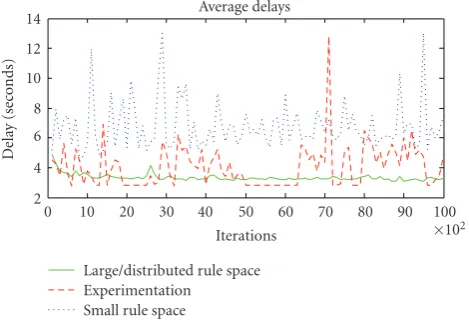
ensure that correctly classified data is received with low delay. FromTable 3, it can be seen that the experimentation approach performs very poorly, since whenever it obtains a configuration with high utility, the stream dynamics change within the next few time intervals, forcing the solution to perform random experimentation again. On the other hand, the small rule space had a better confusion matrix, but the utility suffered from the long end-to-end processing delay and high-delay variance. This is due to periodically choosing suboptimal rules that operate at high false alarm regions even when the APP is high. Hence, the experimentation approach achieved a higher delay-sensitive utility than the small rule space. Finally, the large/distributed rule space provided the best performance as well as the lowest average delay and delay variance. As indicated by Table 4, each classifier converges toward a different local rule that is highly dependent on its accuracy and resource constraints. (In Table 4, rule 2 corresponds to approach 1, while other rules are mixtures of local search and random configurations in low and high false alarm regions.) Importantly, Table 4 shows that by decomposing 512 rules into 8 local rules at each classifier, SPERO converges quickly to a rule that performs well under the given dynamics.
6.5. Evaluation of the Markov Assumption for Algorithms.
An important consideration is whether system dynamics are accurately modeled by the algorithmic Markov process given inDefinition 1. To determine the sufficiency of infor-mation captured by the last state, we calculated the state transition probabilities for each algorithm conditioned on only the last state, versus the state transition probabilities conditioned on the last 2 states. The similarity between distributions obtained based on the last state, and the last two states, was evaluated for each algorithm using the average absolute difference between the estimated state transition probabilities. In other words, we evaluated a distance metric (1/M)st∈S|Pr{st | st−1,at−1} −Pr{st |st−1,at−1,st−2}|for
each at−1 andst−2. We discovered that, for the centralized state space partitioned into 4 bins based on utilities, the (first-order) Markov model and the second-order Markov model had transition probabilities that differed element wise by no more than 0.04. This shows that the first-order Markov model is sufficient in capturing most of the information about the past two states, which provides higher confidence in the accuracy of Markov modeling for algorithms for the distributed classification system.
6.6. Evolution of a New Rule. In this section, we used EFER to evolve a new rule from the large/distributed rule space. We compared the performance of our evolved rule with the convergent distributed rule in the previous section and discovered that the average performance of the evolved rule was about 10% worse than that of the best prescribed rule in the large/distributed rule space. However, as shown in
Figure 11for a highly dynamic environment, EFER provides smaller utility fluctuations and guarantees a better minimum utility with high probability.
5 10 15 20 25 30
U
tilit
y
0 2 4 6 8 10 12
Rate of change in stream APP Experimentation
Small rule space
Large/distributed rule space
Figure9: Comparison of utilities (×0.01) achieved by different rule spaces under different levels of dynamics.
2 4 6 8 10 12 14
Dela
y
(sec
o
nds)
0 10 20 30 40 50 60 70 80 90 100
×102 Iterations
Experimentation Small rule space
Large/distributed rule space Average delays
Figure10: Comparison of delays for the 3 approaches. Each point is an average delay over 100 intervals.
This phenomenon can be explained by how SPERO and EFER updates rules. Recall that, in SPERO, the mixed rule was updated by reinforcing the pure rule with the highest
steady stateperformance. Such a rule may perform well in certain states, but poorly in other states, since transients are ignored in this approach for the sake of maximizing theaverageperformance. However, the evolved rule, which chooses an algorithm based on the expected performance in thenext time interval, is more likely to discover a rule that performs well in each state, although not necessarily the rule that provides the optimal steady state performance.
![Figure 3: The DET curve for an image classifier used to detectbasketball images [40].](https://thumb-us.123doks.com/thumbv2/123dok_us/1161645.1146216/6.600.58.288.71.269/figure-det-curve-image-classier-used-detectbasketball-images.webp)