Volume 2009, Article ID 394065,13pages doi:10.1155/2009/394065
Research Article
Rate Distortion Analysis and Bit Allocation Scheme for
Wavelet Lifting-Based Multiview Image Coding
Pongsak Lasang
1and Wuttipong Kumwilaisak
21Media Processing Group, Panasonic Singapore Laboratories (PSL), Block 1022 Tai Seng Avenue 06-3530, Singapore 534415 2Communication and Multimedia Laboratory, Department of Electronics and Telecommunication, Faculty of Engineering,
King Mongkut’s University of Technology, Thonburi 126 Prachauthis Road, Bangmod, Tungkru, Bangkok 10140, Thailand
Correspondence should be addressed to Wuttipong Kumwilaisak,[email protected]
Received 10 January 2009; Revised 17 May 2009; Accepted 13 August 2009
Recommended by Lisimachos P. Kondi
This paper studies the distortion and the model-based bit allocation scheme of wavelet lifting-based multiview image coding. Redundancies among image views are removed by disparity-compensated wavelet lifting (DCWL). The distortion prediction of the low-pass and high-pass subbands of each image view from the DCWL process is analyzed. The derived distortion is used with different rate distortion models in the bit allocation of multiview images. Rate distortion models including power model, exponential model, and the proposed combining the power and exponential models are studied. The proposed rate distortion model exploits the accuracy of both power and exponential models in a wide range of target bit rates. Then, low-pass and high-pass subbands are compressed by SPIHT (Set Partitioning in Hierarchical Trees) with a bit allocation solution. We verify the derived distortion and the bit allocation with several sets of multiview images. The results show that the bit allocation solution based on the derived distortion and our bit allocation scheme provide closer results to those of the exhaustive search method in both allocated bits and peak-signal-to-noise ratio (PSNR). It also outperforms the uniform bit allocation and uniform bit allocation with normalized energy in the order of 1.7–2 and 0.3–1.4 dB, respectively.
Copyright © 2009 P. Lasang and W. Kumwilaisak. This is an open access article distributed under the Creative Commons Attribution License, which permits unrestricted use, distribution, and reproduction in any medium, provided the original work is properly cited.
1. Introduction
In recent years, multiview image coding has become an interesting research area due to its various multimedia applications such as 3-dimensional television, free-viewpoint television, and video surveillance. A set of multiview images is taken by several cameras from different angles. These cameras aim at the same objects to capture the depth of the objects and other useful information. This generates a huge data volume, which makes efficient compression of multiview images necessary.
Most multiview image compression algorithms in liter-ature try to reduce intraview and interview redundancies among image views. In [1], Tong and Gray studied the inter-view redundancy and the disparity compensated predictive coding for multiview images. Magnor et al.[2] proposed the multiview image coding technique based on the texture map and model-aided prediction. In video coding, the efficient
motion compensation schemes using a lifting technique [3– 5] have been proposed to reduce redundancies between video frames, when the wavelet transform is used. It was shown that this guarantees the invertibility at the synthesis side. In addition, using a wavelet compression framework, the scalable property and high-energy compaction can be achieved [3]. The wavelet lifting techniques used for coding multiview images were first proposed in [6,7]. The disparity compensation is incorporated into the lifting structure called
disparity-compensated lifting to transform the light fields
is selected among Haar, 5/3, or a new proposed wavelet lifting scheme. The criterion in the selection is based on the Minimum Mean Square Error (MMSE) and some selected image features. In their work, the SPIHT codec is also used for coding wavelet coefficients.
To optimally code multiview images with a lifting technique, the bit rate should be allocated to different subbands with the objective to maximize the reconstructed multiview image quality. Without a model, we may need to exhaustively search for the optimal bit allocation solution. This makes the multiview image coding very complex. The first bit allocation algorithm was proposed by Shoham and Gersho [11]. The algorithm provides the optimal solution to the problem for an arbitrary set of quantizers. Since this algorithm needs to compute the rate-distortion (R-D) characteristics for all available quantizers, it has a high com-putational complexity. The complexity of such algorithm can be significantly reduced, if the R-D characteristics can be accurately approximated. Lin and Ortega [12] used a polynomial-spline function to fit the R-D curve for the optimal bit allocation. In [13], the analytical model is used to approximate the empirical R-D curve. However, the scope of these algorithms is limited to a wide range of bit rate. In [14], Rajpoot investigated the combination of different R-D models to represent the accurate R-D characteristics for a wide range of bit rate. Even though many previous works examine various multiview image coding techniques and the R-D models for encoding image and video contents, there are not many works examin-ing the development of distortion analysis and an R-D model to use in the bit allocation and to code multiview images.
In this paper, we derive the distortion and present the model-based bit allocation scheme for wavelet lifting-based multiview image coding. The derived framework can reduce the complexity in searching for the suitable solution of bit allocation in image subbands. The redundancies among image views are first removed by DCWL. The redundancy removal is performed on the macroblock level with the block size of 16×16 pixels. The distortion prediction of the low-pass and high-pass subbands of each image view obtained from the DCWL process is analyzed. Together with the derived distortion, a rate distortion model is used in the model-based bit allocation to obtain the bit allocation solution. We study and analyze the accuracy and performance of the model-based bit allocation schemes, when different rate distortion models including exponential model [15], power model [16], and the proposed rate distortion combining both exponential and power models are used. The proposed rate distortion model exploits the accuracy of both models in a wide range of target bit rates. The bit allocation framework allocates bits to all subbands of image views with the goal to minimize distortion of the reconstructed multiview images. Low-pass and high-pass subband components are compressed by SPIHT with the bit allocation solution derived from the model-based bit allocation scheme.
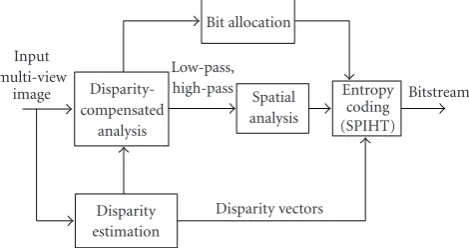
Figure 1shows the overall framework of the proposed multiview image coding. First the system inputs a set of
Input multi-view
image Disparity-compensated
analysis
Low-pass, high-pass Spatial
analysis
Entropy coding (SPIHT)
Disparity estimation
Bit allocation
Disparity vectors
Bitstream
Figure 1: The overview framework of the proposed multiview image coding.
multiview images that will be used to encode. Then, block-based disparity estimation is performed to estimate the disparity vectors. At disparity-compensated (DC) analysis, the estimated disparity vectors are used to compensate the disparity between image views. Then, the wavelet lifting is performed. The wavelet coefficients from DCWL are compressed using SPIHT codec [8]. The bit rate used in SPIHT codec for encoding each subband is computed from the rate distortion model, in which finally the compressed bitstream will be produced.
The remainder of this paper is organized as follows. InSection 2, we present the disparity-compensated wavelet lifting. In Section 3, we analyze and derive the distortion prediction of multiview image, when disparity compensation with the wavelet lifting scheme is used. In Section 4, we describe the model-based bit allocation to different subbands of multiview images based on the derived distortion and different rate-distortion models. The experimental results are shown inSection 5. The conclusion remarks and future works are given inSection 6.
2. Disparity-Compensated Wavelet Lifting
The lifting scheme is used to construct the discrete wavelet transform (DWT) as investigated in [17]. In general, high-pass (H) and low-pass (L) subband decompositions can be achieved with a sequence of predict (P) and update (U) steps from the lifting structure. There are more than one possible wavelet lifting structures used to code multiview images such as Haar or 5/3 wavelet lifting.
The analysis side of the lifting scheme decomposes multiview images to H andL subbands. Suppose that we haveNimage views. We divide this group of image views into even views,X2i, and odd views,X2i+1, wherei=0,. . .,N/2,
which are similar and highly correlated in general. In the context of multiview image coding, the disparity estimation and compensation can be effectively integrated into theP
andUsteps. The synthesis side reconstructs the multiview images from H and L subbands by inverting U and P
X2i
X2i+1
P
+
U +
−a2i,2i+1
b2i+1,2i
Li
Hi
Analysis side
(a)
X2i
X2i+1
P
+ U
+
a2i,2i+1
−b2i+1,2i
Li
Hi
Synthesis side
(b) Figure2: The first level decomposition of DCWL Haar type.
Analysis side
X0 + L0
b1,0
U −a0,1
Predict P X1
+
+ H0
b1,2
U
−a2,1 Update
P
X2
P
L1
b3,2
U −a2,3
X3 +
P
H1
b3,4
U −a4,3
X4 +
. . .
. . .
. . .
L2
(a)
Synthesis side
X0
+ L0
−b1,0 P
a0,1
U
X1
+ H0
−b1,2 P
a2,1
U
. . .
. . .
. . . X2 +
X3
+ L1
−b3,2 P
a2,3
U
+
X4 H1
−b3,4 P
a4,3
U
L2
(b)
Figure3: The first level decomposition of disparity compensated 5/3 wavelet lifting.
In the DCWL Haar type, the disparity compensation is performed by using only a single adjacent view as a reference view, whereas 5/3 type uses two adjacent views. Specifically, DCWL Haar type uses image viewi−1 or image viewi+ 1 to reduce the redundancy in image viewi, while DCWL 5/3 type uses both of them. It is possible to use more than two reference image views in DCWL. For example, to predict image viewi, we may use image viewsi−1,i+1,i−3,i+3,i−5,
i+ 5,. . .. In other words, an even view is predicted from odd views, and an odd view is predicted from even views. In this way, it is guaranteed that all image views can be recovered at the synthesis side of wavelet lifting.
For DCWL Haar type, theith low-pass (Li) and high-pass
(Hi) components can be written as
Hi=X2i+1−a2i,2i+1P
X2i,d2i+1→2i
,
Li=X2i+b2i−1,2iU
Hi−1,−d2i−1→2i
.
(1)
The ith low-pass (Li) and high-pass (Hi) components
for DCWL 5/3, which uses two reference frames to perform disparity compensation, can be written as
Hi=X2i+1−a2i,2i+1×P
X2i,d2i+1→2i
−a2i+2,2i+1×P
X2i+2,d2i+1→2i+2
,
Li=X2i+b2i−1,2i×U
Hi−1,−d2i−1→2i
+b2i+1,2i×U
Hi,−d2i+1→2i
,
(2)
wheredn→mdenotes the set of disparity vectors from image
view n to image view m. P(Xm,dn→m) is the prediction
step, which is the disparity compensation of imageXmusing
dn→m.U(Hk,−dl→j) is the update step usingHkand inverse
Table1: Scaling factors in theP andU steps in different lifting types.
Lifting modes am,n bm,n
Haar mode 1 1
2
5/3 mode 1
2
1 4
used in the P andU steps, respectively. All the subscripts, denoting view indices, are restricted between 0 andN−1, whereNis the number of image views.
We adopt the weighting scheme in [18]. Specifically,am,n
is set to the inverse of the number of reference views andbm,n
is set toam,n/2.Table 1summarizes the scaling factors in the
lifting modes.Figure 4illustrates the reference image views used in disparity compensation with DCWL Haar and 5/3 types.
At the synthesis side, the inverseU andP steps recover viewsX2i andX2i+1 from the subbands. The reconstructed images for DCWL Haar can be written as
X2i=Li−b2i−1,2i×U
Hi−1,−d2i−1→2i
,
X2i+1=Hi+a2i,2i+1×P
X2i,d2i+1→2i
.
(3)
The reconstructed multiview images for DCWL 5/3 can be expressed as
X2i=Li−b2i−1,2i×U
Hi−1,−d2i−1→2i
−b2i+1,2i×U
Hi,−d2i+1→2i
,
X2i+1=Hi+a2i,2i+1×P
X2i,d2i+1→2i
+a2i+2,2i+1×P
X2i+2,d2i+1→2i+2
,
(4)
whereX2iandX2i+1are the reconstructed versions of image viewsX2iandX2i+1.LiandHiare the reconstructed versions
of low-pass and high-pass subbandiofLiandHi. Note that
at the synthesis side the reconstructed image views may not be equal to those in the analysis side due to the lossy coding by the quantization process or the truncation of wavelet coefficients in each subband.
3. Distortion Analysis of Wavelet Lifting-Based
Multiview Image Coding
In this section, we analyze the distortion of wavelet lifting-based multiview image coding. In multiview image coding context, to reduce redundancies among image views, the similar pixels from adjacent views are estimated (i.e., dispar-ity prediction inPstep). Pixels are classified as “connected pixels,” if good matches can be found in the overlapped regions between image views. Otherwise, pixels are classified as “unconnected pixels” as pixels in the nonoverlapped regions in either forward or backward directions. The connected pixels with more than one disparity vectors are
known as “multiconnected pixels.” These kinds of pixels influence the distortion computation of the reconstructed images. Therefore, their effects are taken into account during the distortion prediction. The example of connected pixels and unconnected pixels between image views 0 and 1 is shown inFigure 5, when parallel views are being captured.
The distortion of reconstructed connected pixels has the influence from multiple reference image views in both forward and reverse disparity prediction, whereas the distor-tions of reconstructed unconnected pixels have the influences from only reference image views in forward or reverse direction. Let f and r be the ratios of connected pixels in forward and reverse directions of the reference images, where 0≤ f ≤1, 0≤r ≤1, and f +r ≤1. Consider the use of the 5/3 wavelet lifting in disparity compensation. First, consider the connected pixel area. Based onTable 1, letam,n =aand
bm,n=bfor allmandn. The distortion corresponding to the
connected pixels of viewsX2iandX2i+1can be expressed as
DC,X2i=DLi−b×
DHi+DHi−1
,
DC,X2i+1=DHi+a×
DX2i+DX2i+2
=DHi+a×DLi−a×b×
DHi+DHi−1
+a×DLi+1−a×b×
DHi+DHi+1
=(1−2×a×b)×DHi+a×DLi−a×b×DHi−1 +a×DLi+1−a×b×DHi+1,
(5) whereDC,X2iandDC,X2i+1 are the distortions in the connected pixel area of image viewsX2iandX2i+1, which are caused by forward and backward prediction, respectively. The scaling factora(predict operator) and the scaling factorb(update operator) are set to 1/2 and 1/4, respectively (for 5/3 wavelet lifting [18]). In this paper, the multiconnected pixels are treated as the regular connected pixels. Therefore, its distortion computation is the same as (5). We also use the same scaling factors (a = 1/2, b = 1/4) for the multiconnected pixels. Note that the update operator can be computed based on the number of multiconnected pixels; see [19].
Next, let us consider the distortion in the unconnected pixel area. When only the image views used for forward prediction are used, the distortion of viewsX2iandX2i+1can be written as
DUf,X2i=DLi−bf ×DHi,
DUf,X2i+1=af×DLi+
1−af ×bf
×DHi,
(6)
whereDUf,X2i andDUf,X2i+1 are the distortions in the uncon-nected pixel area of image viewsX2i andX2i+1, which are caused by the forward prediction.
When only the image views used for backward prediction are used, the distortion of viewsX2iandX2i+1can be written as
DUr,X2i =DLi−br×DHi,
DUr,X2i+1 =ar×DLi+ (1−ar×br)×DHi,
V0
V1
V2
V3
V4
(a) Haar mode
V0
V1
V2
V3
V4
(b) 5/3 mode
Figure4: Illustration of the reference image views in DCWL Haar and 5/3 types.
Unconnected pixels (reverse) Connected pixels
Unconnected pixels (forward)
View 0 View 1
Figure 5: The example shown the unconnected, connected, and occluded pixels, when we consider image view 0 and 1 (reference view).
whereDUr,X2i andDUr,X2i+1 are the distortions in the uncon-nected pixel area of image views X2i andX2i+1, which are
caused by the backward prediction. The scaling factorsbf,
af, br and ar can be computed based on Table 1. More
specifically, we setaf =ar=1 andbf =br=1/2.
We can compute the total distortion of multiviewX2iand
X2i+1from all areas as
DX2i =
1−f −r×DC,X2i+f ×DUf,X2i+r×DUr,X2i,
DX2i+1 =
1−f −r×DC,X2i+1+f ×DUf,X2i+1+r×DUr,X2i+1. (8) Assume that every pixel in viewX2i+1 can be possibly predicted from two adjacent reference views (viewX2i and
X2i+2). Based on our observation from several multiview
test images, most contents of different image views are close to one another, when cameras are not shifted significantly among image views. Therefore, the disparity compensation can remove redundancy significantly. Based on the fact discussed above, if the distortions of image views are equally distributed, we can write the distortion ofLandHsubbands as
DHk∼=DHk−1∼=DHk+1,
DLk∼=DLk−1∼=DLk+1.
(9)
Table2: The average offandrratio of different test images.
Test images Average offratio Average ofrratio
Tsukuba 0.02343750 0.01931250
Teddy 0.02734375 0.02539062
Venus 0.01171875 0.02148437
Race1 0.0625000 0.05468750
The experimental results inSection 5(seeFigure 6) support the above assumption.
From (5), we will obtain
DC,X2i=DLi−2×b×DHi,
DC,X2i+1 =2×a×DLi+ (1−4×a×b)×DHi.
(10)
If we setaf =ar=aandbf =br=b, from (8), the total
distortion of multiviewX2iandX2i+ican be written as
DX2i =DLi−
2−f −r×b×DHi,
DX2i+1 =
2−f −r×a×DLi
+1−4−3×f −3×r×a×b×DHi.
(11)
When all blocks can find good matches (i.e.,image views are fully overlapped and f,r =0), based onTable 1(a=1/2,
b =1/4) (11), we can write the total distortions ofX2iand
X2i+1as
DX2i =DLi−
1 2×DHi,
DX2i+1 =DLi+
1 2×DHi.
(12)
For the multiview test images used in this paper, the average ratios of f andrare shown inTable 2.
Note that the ratios inTable 2will be used to analyze the distortion and bit allocation of multiview test images in the experimental result.
4. Rate-Distortion Model and Bit Allocation
0 0.1 0.2 0.3 0.4 0.5 0.6 0.7 0.8 0.9 1 Rate (bpp)
0 5 10 15 20 25 30 35
D
ist
or
ti
on
Tsukuba:Hsubbands
ActualL0
ActualL1
ActualL2
Proposed Exponential model Power model 0.1 0.3 0.5 0.7 0.9 1.1 1.3 1.5 1.7
Rate (bpp) 0
100 200 300 400 500 600 700
D
ist
or
ti
on
Tsukuba:Lsubbands
ActualH0
ActualH1
Proposed
Exponential model Power model
(a)
0 0.2 0.4 0.6 0.8 1 1.2 Rate (bpp)
0 5 10 15 20 25 30 35
D
ist
or
ti
on
Teddy:Hsubbands
ActualL0
ActualL1
Proposed
Exponential model Power model 0.1 0.3 0.5 0.7 0.9 1.1 1.3 1.5 1.7 1.9
Rate (bpp) 0
100 200 300 400 500 600 700 800
D
ist
or
ti
on
Teddy:Lsubbands
ActualH0
ActualH1
Proposed
Exponential model Power model
(b)
0 0.1 0.2 0.3 0.4 0.5 0.6 0.7 0.8 0.9 1 Rate (bpp)
0 5 10 15 20 25 30 35
D
ist
or
ti
on
Venus:Hsubbands
ActualL0
ActualL1
ActualL2
Proposed Exponential model Power model 0.1 0.3 0.5 0.7 0.9 1.1 1.3 1.5 1.7
Rate (bpp) 0
100 200 300 400 500 600 700 800 900
D
ist
or
ti
on
Venus:Lsubbands
ActualH0
ActualH1
Proposed
Exponential model Power model
(c)
4.1. Rate-Distortion Model. An accurate rate distortion model plays an important role in multimedia compression and transmission due to its efficiency in computation and low complexity. At high bit rate, the exponential model matches well with rate distortion characteristic [16]. If we model the distribution of wavelet coefficients as a Laplacian distribution and define distortion as De,l(Xr,Xo) = |Xr −
Xo|, whereXr andXo are the reconstructed image and the
original image, respectively, the rate distortion function can be written as [15]
RDe,l
=ln σ
De,l
; 0< De,l< σ, (13)
whereσis the standard deviation of wavelet coefficients.De,l
is the distortion from the exponential model, when we model the distribution of wavelet coefficients as a Laplacian source andRis a coding bit rate.
When we model the distribution of wavelet coefficients as a Gaussian distribution and define distortion as
RDe,g
=1
2log
σ2
De,g
; 0< De,g < σ2, (14)
where σ2 is the source variance. Laplacian and Gaussian source models are widely used for source modeling because of their mathematical tractability [20]. We can write a general form of the exponential model of both Laplacian and Gaussian sources as [15]
De(R)=α×e−β×R, (15)
whereDe(R) is a general form of the exponential model and
αandβare the constants depended on the source type. At a low bit rate region, the power model is highly accurate to represent rate-distortion function [16]. This model can be used for both Gaussian and Laplacian sources. A general form of the power model can be written as
Dp(R)=η×R−γ, (16)
whereηandγare constants depended on the source type. However, the exponential model or the power model may not accurately represent the rate-distortion function over a wide range of bit rate. We experimentally compare the accuracy of the exponential and the power models with the actual data using different test images inSection 5(see Figure 6). We found that both models are not able to fit the actual data in a whole range of bit rate. Therefore, we propose a combined rate-distortion model. It exploits the advantages of both exponential and power models by trying to capture rate distortion function precisely in a whole range of bit rate.
The proposed rate distortion model can be written as
Dt(R)=ω1×De(R) +ω2×Dp(R)
=ω1×α×e−β×R+ω2×η×R−γ,
(17)
whereDe(R) is the exponential distortion component,Dp(R)
is the power distortion component, andω1andω2are the weights of the exponential and the power components, where
0 ≤ ω1 ≤ 1, 0 ≤ ω2 ≤ 1, and ω1 + ω2 = 1. α, β,
η, and γ are the parameters characterizing the proposed distortion model. We compute the parametersα,β,η, and
γusing the least square method, in which we use 7 actual R-D points. We observed that the actual R-R-D points are lined in between the R-D points of the exponential and power models (seeFigure 6inSection 5). Therefore, we empirically setω1 =ω2 =0.5 in this paper as an example for a specific test sequence used in this paper, which give minimum MSE of overall R-D points between the combined model and the actual R-D points. Note that the above choice may not give minimum MSE for other test sequences. Therefore,ω1 andω2 may be adaptively tuned for low and high bit rate differently depending on the image test sequences.
4.2. Model-Based Subband Bit Allocation. The bit allocation
can be formulated as an optimization problem, which aims to minimize the total distortion in a presence of a rate constraint [11]. The total distortion can be expressed as a weighted sum of the distortion ofLandHsubbands. This is because the distortions from (11) can be written in terms of
DLkandDHk. The total distortion of all frames can be written
as
∀i
DX2i+
∀i
DX2i+1=
∀j
ρLj×DLj+
∀j
ρHj×DHj, (18)
whereρLkandρHkare the constants, which are used to weight
the distortion betweenLandHsubbands, respectively. With the assumption that the distortion is equally distributed [21], the total distortion can be simplified as
∀i
DX2i+
∀i
DX2i+1=DL×
∀j
ρLj+DH×
∀j
ρHj. (19)
Using (17) as the representation ofDLandDH, we obtain
DL=ω1,L×αL×e−βL×RL+ω2,L×ηL×R−LγL,
DH=ω1,H×αH×e−βH×RH+ω2,H×ηH×R− γH
H ,
(20)
whereDLandRLare the distortion and the rate ofLsubband.
DH andRH are the distortion and the rate ofH subband.
Let Rtotal be the total rate used to code multiview images,
letRhd,DVbe a number of bits used for coding the disparity
vectors and header information, and letRtexturebe a number of bits used to code the texture information. We know that
Rtexture=Rtotal−Rhd,DV. (21)
With the definition of distortion and rate described above, the problem in allocating bits toLandH subbands can be formulated as follows.
Problem 1. Given a bit rate constraintsRtexturefor coding the
multiview images, find the optimal bit allocation ofLandH
subbands such that
min ⎧ ⎨ ⎩DL×
∀k
ρLk+DH×
∀k
ρHk
⎫ ⎬
under the constraint
RL×
∀k
bLk+RH×
∀k
bHk≤Rtexture, (23)
wherebLkandbHkare the ratios of number of bits inLkand
Hksubbands.
To facilitate the equations, we define
f(RL,RH)=DL×
∀k
ρLk+DH×
∀k
ρHk,
g(RL,RH)=RL×
∀k
bLk+RH×
∀k
bHk−Rtexture.
(24)
We reformulate the problem as minf(RL,RH)
subject to
g(RL,RH)≤0.
(25)
We use a nonlinear programming method [22,23] to obtain the optimal solution. Therefore (25) can be written as
min ⎧ ⎨
⎩f(RL,RH)−μ× m
i=1 lns(i)
⎫ ⎬ ⎭
subject to
g(RL,RH) +s=0,
(26)
whereμ >0 is the barrier parameter and the vector of slack variables=(s(1),. . .,s(m))T
is assumed to be positive.
To compute the optimal bit rate allocation ofLandH
subbands, we set up a cost function based on the Lagrangian cost function as
J(RL,RH,s,λ)
= f(RL,RH)−
⎛ ⎝μ×m
i=1 lns(i)
⎞
⎠+λT×g(R
L,RH) +s
,
(27)
whereλ∈Rmare the Lagrange multipliers.
To obtain the optimal solution (RL,RH,s) of (27), we take
partial derivative of (27) respective toRLandRHand we will
obtain
∇RL,RHJ(RL,RH,s,λ)= ∇f(RL,RH) +G(RL,RH)×λ=0,
∇SJ(RL,RH,s,λ)= −μ×S−1×e+λ=0,
(28) where
G(RL,RH)=
∇g(1)(RL,RH),. . .,∇g(m)(RL,RH)
(29)
is the matrix of constraint gradients, in which superscripts indicating components of a vector,e=[1,. . ., 1]T, andS= diag(s(1),. . .,s(m)).∇is a derivative operator.
Step 1:
Initialize parameterμ >0 and select the parameterεμ>0,θ∈(0, 1) and the final stop
toleranceεSTOP. Choose the starting pointRL,RH
ands >0, and evaluate the objective function, constraints, and their derivatives atRL,RH.
Step 2:
RepeatuntilE(RL,RH,s; 0)≤εSTOP:
(1) Apply sequential quadratic programming method [24] with trust regions, starting from (RL,RH,s), to find an approximate
solution (R+
L,R+H,s+) of (28) satisfying E(R+
L,R+H,s+;μ)≤εμ.
(2) Setμ←θμ, εμ←θεμ,
(RL,RH)←(RL+,R+H),s←s+.
End
Algorithm1
The approximate solution (RL,RH,s) satisfyingE(RL,RH,
s;μ) ≤ εμ, whereE measures the closeness to the optimal
solution, is defined by [23]
ERL,RH,s;μ
=max∇f(RL,RH) +G(RL,RH)∞,
Sλ−μe∞,g(RL,RH) +s∞
, (30)
where∞ isL∞-norm. The toleranceεμ is decreased from
one iteration to the next and must converge to zero. The parameters μand εμ will be reduced by a constant factor
θ∈(0, 1).
Now, the optimal solution ofRLandRHcan be derived.
The algorithm [23] is described inAlgorithm 1.
5. Experimental Results
In this section, we present a sequence of experimental results to analyze distortion and bit allocation of multiview images. We use several test multiview images [25] including Tsukuba, Teddy, Venus, and Race1 [26]. Each set of multiview images is composed of 5 image views. The disparity compensation is done in the macroblock level with the size of 16 × 16 pixels. The residue error after the disparity compensation is encoded by SPIHT codec [8]. We utilize the 5/3 wavelet lift-ing for disparity compensation to demonstrate the developed distortion model and the bit rate allocation.
5.1. Model Accuracy. First, we verify the accuracy of the
Table3: The average of the mean square error (MSE) between the actual distortion and the computed distortion of different rate distortion models.
Images Subbands Average MSE (Mean Square Error)
Exponential model Power model Proposed model
Tsukuba L 2725.079 4009.917 79.747
H 16.963 6.844 2.393
Teddy L 2702.424 5378.732 161.205
H 4.404 4.517 0.7153
Venus L 2758.407 8469.384 435.03
H 7.2376 4.4242 1.8295
Table4: Comparison of subband bit allocation at target bit rate 0.95 bpp.
Test images Uniform allocation Exponential model Power model Proposed Exhaustive search
Tsukuba
RLk(bpp) 0.95 1.462503 1.436343 1.377565 1.35
RHk(bpp) 0.95 0.181246 0.220485 0.308653 0.350
PSNR (dB) 36.907 38.6491 38.8251 39.040 39.1678
Teddy
RLk(bpp) 0.95 1.515464 1.316667 1.414911 1.3967
RHk(bpp) 0.95 0.101804 0.4 0.252633 0.280
PSNR (dB) 34.383 36.21824 36.20671 36.43267 36.4482
Venus
RLk(bpp) 0.95 1.5072 1.30173 1.6333 1.392667
RHk(bpp) 0.95 0.1142 0.4224 0.33 0.286
PSNR (dB) 34.7772 36.75062 36.59987 36.82036 36.8684
Race1
RLk(bpp) 0.95 1.460413 1.183333 1.388267 1.360667
RHk(bpp) 0.95 0.18438 0.6 0.2926 0.334
PSNR (dB) 41.4842 41.8316 42.1802 42.3751 42.4426
model, exponential model, and power model with the actual rate distortion curves of H subband andLsubband, when Tsukuba, Teddy, and Venus are used as test images. We can see that the proposed model outperforms the exponential and power models in fitting the rate-distortion curve. Notice that the actual rate-distortion curves of H0 andH1as well as the actual distortion curves ofL0andL1are close to each other, which verifies the assumption of equally distributed of distortion inSection 3, when the cameras capturing different image views are not shifted significantly from one another. Table 3shows the average of the mean square error (MSE) between the actual distortion and the computed distortion of different models (range from 0.05 bpp∼1.2 bpp for
H subband and 0.1 bpp∼2.0 bpp for L subband). The proposed model gives the minimum MSE comparing to the exponential and power models.
5.2. Bit Allocation Performance. Next, we examine the use
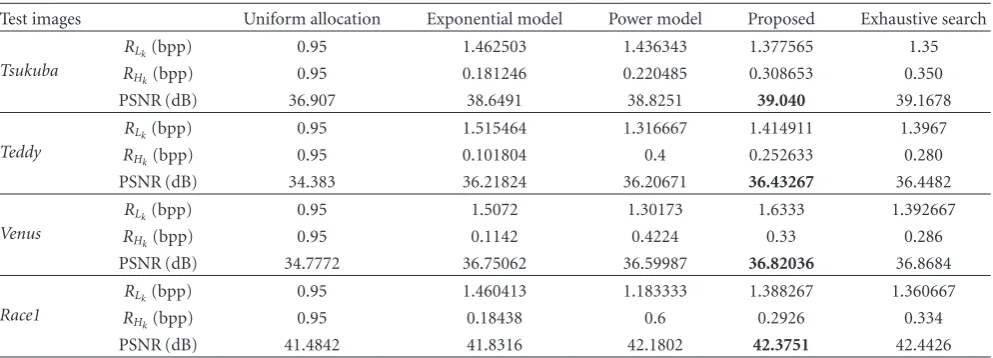
of the proposed algorithm in a rate allocation problem. The solution of this rate allocation problem will be used to encode the H and L subbands of multiview images using SPIHT codec.Table 4shows the comparison on the rate allocation performance comparing the proposed rate distortion model, the exponential model, the power model, the uniform rate allocation, and the exhaustive search rate allocation. The exhaustive search is considered as the best solution. For the exhaustive search, we start with 0.002 bit per pixel and the
increment step size is 0.002 bit per pixel. The target bit rate is set to be 0.95 bit per pixel (bpp). As we can see from Table 4, rate allocation using our proposed rate distortion model gives a very close result to the exhaustive search in various test images. Moreover, it outperforms the uniform rate allocation and also uniform rate allocation based on the normalized energy (i.e., proportionally allocate bits to subbands based on their energies) ofLandH subbands in terms of average PSNR in the range of 1 ∼2 dB and 0.2 ∼ 0.6 dB comparing with the exponential and power models. Figures7and8show the average Peak-Signal-to-Noise Ratio (PSNR) of the reconstructed multiview images ofTsukuba
andTeddyimages over a wide range of target bit per pixel.
0 0.1 0.2 0.3 0.4 0.5 0.6 0.7 0.8 0.9 1 1.1 1.2 Rate (bpp)
24 26 28 30 32 34 36 38 40 42
PSNR
(dB)
Uniform allocation Uniform (normalised energy) Exponential model
Power model Proposed Exhaustive search Comparison of average PSNR of Tsukuba test image
0.8 0.85 0.9 0.95 1 1.05 1.1 37
37.6 38.2 38.8 39.4 40
Figure 7: PSNR comparison of Tsukuba test image when using different bit allocation methods.
0 0.1 0.2 0.3 0.4 0.5 0.6 0.7 0.8 0.9 1 1.2 Rate (bpp)
24 26 28 30 32 34 36 38 40
PSNR
(dB)
Uniform allocation Uniform (normalised energy) Exponential model
Power model Proposed Exhaustive search Comparison of average PSNR of Teddy test image
0.8 0.85 0.9 0.95 1 1.05 1.1 34.6
35.2 35.8 36.4 37 37.6
Figure 8: PSNR comparison of Teddy test image when using different bit allocation methods.
5.3. Complexity. We measure the complexity of 5 different bit
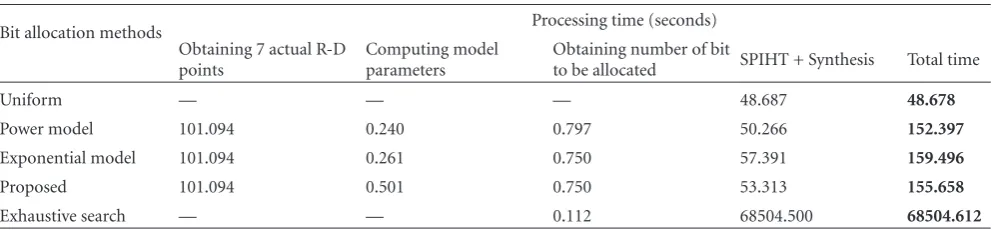
allocation methods using the processing time. The program was run on the PC with Intel 1.86 GHz CPU and 512 MB of RAM. For each method, we measure the processing time in each submodule. The processing time from different methods is shown inTable 5. The target bit rate is 0.95 bpp. Note that the processing time of the common modules, such as disparity estimation and compensation, is not included in the table since all methods are same. Although, fromTable 5, the model-based methods require additional processing time for computing 7 actual R-D points and
43 44 45 46 47 48 49
10×log (number of bit-per-view) 24
26 28 30 32 34 36 38 40 42
PSNR
(dB)
Uniform allocation Uniform (normalised energy) Exponential model
Power model Proposed Exhaustive search Comparison of average PSNR of Tsukuba test image
47 47.5 48 48.5 37
37.6 38.2 38.8 39.4 40
Figure9: PSNR comparison of Tsukuba test image as inFigure 7
using method in [28].
43 44 45 46 47 48 49
10×log (number of bit-per-view) 24
26 28 30 32 34 36 38 40
PSNR
(dB)
Uniform allocation Uniform (normalised energy) Exponential model
Power model Proposed Exhaustive search Comparison of average PSNR of Teddy test image
47 47.5 48 48.5 34.6
35.2 35.8 36.4 37 37.6
Figure10: PSNR comparison of Teddy test image as inFigure 8
using method in [28].
model parameters, SPIHT encoding/decoding process and synthesis are performed only once. Comparing the proposed model with other two models, the total processing time is almost the same even though the proposed model requires extra time for computing model parameters but it is just a fraction of second.
(a) (b)
Figure11: The reconstructed signal ofH(a) andL(b) subbands.HandLsubbands are encoded with bit rate 0.14 bpp and 0.74 bpp, respectively.
Table5: The processing time of different bit allocation methods. The target bit rate is 0.95 bpp.
Bit allocation methods Processing time (seconds) Obtaining 7 actual R-D
points
Computing model parameters
Obtaining number of bit
to be allocated SPIHT + Synthesis Total time
Uniform — — — 48.687 48.678
Power model 101.094 0.240 0.797 50.266 152.397
Exponential model 101.094 0.261 0.750 57.391 159.496
Proposed 101.094 0.501 0.750 53.313 155.658
Exhaustive search — — 0.112 68504.500 68504.612
encoding/decoding and synthesis to be processed. From Table 5, the exhaustive search requires processing time 430 times more than the model-based approach to perform bit rate allocation to multiview images.
In addition to the processing time, we also analyze the growth rate of complexity in terms of Big O notation. We divide the algorithm into two parts: solving optimization problem and SPIHT encoding. The power and exponential models use the same optimization algorithm to allocate bits forLandHsubbands and the complexity of the first part of both models isO(nlog(n/ε)), wherenis the iteration step andεis the tolerance. Thus, the complexity of the combined model isO(2nlog(n/ε)). For the second part, the complexity of the SPIHT [29] isO(α0m2), where the input image is with the size ofm×m, andα0is the constant specifying per pixel complexity of DWT for a wavelet filter of a specific length. Therefore, the total complexity of the proposed combined model isO(2nlog(n/ε) +α0m2). For the exhaustive search, the total complexity including SPIHT isO((n!)(α0m2)).
6. Conclusion and Future Works
This paper presented the distortion analysis and the bit allocation framework for multiview image coding with
disparity-compensated wavelet lifting technique. The distor-tion predicdistor-tion of multiview image coding is analyzed. The new rate distortion model combining the exponential and power models was proposed. Using the derived distortion and the proposed rate-distortion model, the bit alloca-tion method among subbands was described. Experimental results showed that the proposed rate-distortion model can approximate the actual rate-distortion characteristics of image very well in a wide range of target bit rate. Moreover, using the proposed rate-distortion model in the rate allocation problem for coding multiview images provides close results of the optimal bit allocation and PSNR to the multiview image coding using the exhaustive search for the optimal bit rate allocation.
distortion analysis and bit allocation of multiview image and video coding using multireference frames (i.e., more than two frames as used in 5/3 disparity wavelet lifting) are interesting issues because using multireference frames can improve the compression ratio of multiview image and video compression. Finally, the distortion analysis and bit allocation framework of multiview image and video can be further investigated in another transform domain such as DCT domain and in industrial image and video compression standards such as JPEG-2000 or H.264.
Acknowledgments
This paper is partly supported by Panasonic Singapore Labo-ratories (SPL) and Faculty of Engineering, King Mongkut’s University of Technology, Thonburi via National Research University Research Fund of Thai Government.
References
[1] X. Tong and R. M. Gray, “Coding of multi-view images for immersive viewing,” inProceedings of the IEEE International Conference on Acoustics, Speech and Signal Processing (ICASSP ’00), vol. 4, pp. 1879–1882, Istanbul, Turkey, June 2000. [2] M. Magnor, P. Ramanathan, and B. Girod, “Multi-view coding
for image-based rendering using 3-D scene geometry,”IEEE Transactions on Circuits and Systems for Video Technology, vol. 13, no. 11, pp. 1092–1106, 2003.
[3] A. Secker and D. Taubman, “Motion-compensated highly scalable video compression using an adaptive 3D wavelet transform based on lifting,” in Proceedings of the IEEE International Conference on Image Processing (ICIP ’01), vol. 2, pp. 1029–1032, October 2001.
[4] L. Luo, J. Li, S. Li, Z. Zhuang, and Y. Q. Zhang, “Motion compensated lifting wavelet and its application in video coding,” inProceedings of the IEEE International Conference on Multimedia and Expo (ICME ’01), vol. 2, pp. 365–368, August 2001.
[5] B. Pesquet-Popescu and V. Bottreau, “Three-dimensional lift-ing schemes for motion compensated video compression,” in
Proceedings of the IEEE International Conference on Acoustics, Speech and Signal Processing (ICASSP ’01), vol. 3, pp. 1793– 1796, May 2001.
[6] C.-L. Chang, X. Zhu, P. Ramanathan, and B. Girod, “Inter-view wavelet compression of light fields with disparity-compensated lifting,” inVisual Communications and Image Processing, vol. 5150 of Proceedings of SPIE, pp. 694–706, Lugano, Switzerland, July 2003.
[7] B. Girod, C.-L. Chang, P. Ramanathan, and X. Zhu, “Light field compression using disparity-compensated lifting,” in
Proceedings of the IEEE International Conference on Acoustics, Speech and Signal Processing (ICASSP ’03), vol. 4, pp. 760–763, April 2003.
[8] A. Said and W. A. Pearlman, “A new, fast, and efficient image codec based on set partitioning in hierarchical trees,”IEEE Transactions on Circuits and Systems for Video Technology, vol. 6, no. 3, pp. 243–250, 1996.
[9] N. Anantrasirichai, C. N. Canagarajah, and D. R. Bull, “Multi-view image coding with wavelet lifting and in-band dispar-ity compensation,” in Proceedings of the IEEE International Conference on Image Processing (ICIP ’05), vol. 3, pp. 33–36, September 2005.
[10] P. Lasang, W. Kumwilaisak, and A. Kaewpunya, “Multi-view image coding via image feature matching and adaptive disparity-compensated wavelet lifting technique,” in Proceed-ings of the 25th Picture Coding Symposium (PCS ’06), Beijing, China, April 2006.
[11] Y. Shoham and A. Gersho, “Efficient bit allocation for an arbitrary set of quantizers,” IEEE Transactions on Acoustics, Speech, and Signal Processing, vol. 36, no. 9, pp. 1445–1453, 1988.
[12] L.-J. Lin and A. Ortega, “Bit rate control using piecewise approximated rate-distortion characteristics,”IEEE Transac-tions on Circuits and Systems for Video Technology, vol. 8, no. 4, pp. 446–459, 1998.
[13] J. Li, P.-Y. Cheng, and C.-C. J. Kuo, “Embedded wavelet packet image coder with fast rate-distortion optimized decomposi-tion,” in Visual Communications and Image Processing, vol. 3024 ofProceedings of SPIE, pp. 1077–1088, San Jose, Calif, USA, February 1997.
[14] N. M. Rajpoot, “Model based optimal bit allocation,” in
Proceedings of the Data Compression Conference (DCC ’04), p. 558, March 2004.
[15] T. G. Cover and J. A. Thomas,Elements of Information Theory, John Wiley & Sons, New York, NY, USA, 1991.
[16] S. Mallat and F. Falzon, “Analysis of low bit rate image transform coding,”IEEE Transactions on Signal Processing, vol. 46, no. 4, pp. 1027–1042, 1998.
[17] W. Sweldens, “The lifting scheme: a construction of second generation wavelets,”SIAM Journal on Mathematical Analysis, vol. 29, no. 2, pp. 511–546, 1998.
[18] N. Mehrseresht and D. Taubman, “Adaptively weighted update steps in motion compensated lifting based scalable video com-pression,” inProceedings of the IEEE International Conference on Image Processing (ICIP ’03), vol. 3, pp. 771–774, September 2003.
[19] B. Girod and S. Han, “Optimum update for motion-compensated lifting,”IEEE Signal Processing Letters, vol. 12, no. 2, pp. 150–153, 2005.
[20] H.-M. Hang and J.-J. Chen, “Source model for transform video coder and its application—part I: fundamental theory,”
IEEE Transactions on Circuits and Systems for Video Technology, vol. 7, no. 2, pp. 287–298, 1997.
[21] T. Rusert, K. Hanke, and J.-R. Ohm, “Transition filtering and optimized quantization in interframe wavelet video coding,” inVisual Communications and Image Processing, vol. 5150 of
Proceedings of SPIE, pp. 682–693, Lugano, Switzerland, July 2003.
[22] R. H. Byrd, M. E. Hribar, and J. Nocedal, “An interior point algorithm for large-scale nonlinear programming,” SIAM Journal on Optimization, vol. 9, no. 4, pp. 877–900, 1999. [23] R. H. Byrd, J. C. Gilbert, and J. Nocedal, “A trust region
method based on interior point techniques for nonlinear programming,” Mathematical Programming A, vol. 89, pp. 149–185, 2000.
[24] R. H. Byrd, J. C. Gilbert, and R. A. Tapia, “A trust region method based on interior point techniques for nonlinear programming,” Report OTC 96/02, Optimization Technology Center, Northwestern University, Evanston, Ill, USA, 1996. [25] http://cat.middlebury.edu/stereo/data.html.
[26] ftp://ftp.ne.jp/KDDI/multiview.
[28] G. Bjontegaard, “Calculation of average PSNR differences between RD-curves,” ITU SG16 VCEG-M33, April 2001. [29] N. Splrjan, S. Grgic, and M. Grgic, “Modified SPIHT