Volume 2009, Article ID 896284,8pages doi:10.1155/2009/896284
Research Article
2-D DOA Estimation via Matrix Partition and Stacking Technique
Nan-Jun Li, Jian-Feng Gu, and Ping Wei
Department of Electronic Engineering, University of Electronic Science and Technology of China, Chengdu, Sichuan 610054, China
Correspondence should be addressed to Jian-Feng Gu,[email protected] Ping Wei,[email protected]
Received 26 February 2009; Revised 14 June 2009; Accepted 31 August 2009
Recommended by M. Greco
A novel approach is proposed for the efficient estimation of the two-dimensional (2-D) direction-of-arrival (DOA) of signals impinging on two orthogonal uniform linear arrays (ULAs). By partitioning the cross-correlation matrix (CCM) between two ULAs data into a great deal of submatrices and making use of the submatrices and the symmetric subarrays, an extended correlation matrix is constructed, and then uses the modified ESPRIT approach to extract out the so-called Kronecker Steering Vectors (KSVs)of which each is the Kronecker product of the elevation and azimuth angle with a one-to-one relationship. Upon that the proposed method yields the estimate of the 2-D DOA efficiently without requiring the additionally computational burden to remove the pair-matching problem. Furthermore, the main idea of the matrix partition and stacking is to much-enhanced subspace estimate. So based on the use of the concept, the proposed method’s performance is better than the existing similar approaches. Meanwhile, unlike the traditional subspace methods, it is shown that the proposed can resolve the same uncorrelated sources as the number of subarray sensor through a delicate partition-and-stacking process. Simulation results demonstrate that the proposed method is superior to the existing techniques in both DOA estimation and the detection capability of sources.
Copyright © 2009 Nan-Jun Li et al. This is an open access article distributed under the Creative Commons Attribution License, which permits unrestricted use, distribution, and reproduction in any medium, provided the original work is properly cited.
1. Introduction
The problem of two-dimensional (2-D) DOA (i.e., azimuth and elevation angles) has recently received increasing atten-tion. 2-D DOA problem may be closer to some practical environment than 1-D, for instance, using an airborne or a spaceborne array to observe ground-based sources. Additionally, in the last three decades a number of the high-resolution direction finding methods [1] have been studied in the context of 1-D estimation (e.g., the azimuth angle) of multiple plane waves. Among them, MUSIC (Multiple Signal Classification) [2] and ESPRIT [3] are considered the two most popular algorithms. Many 2-D DOA methods are based on the two algorithms. Specially, the latter method has two main advantages over the former. First, the ESPRIT algorithm requires less computational burden and storage space due to that it does not require to search over the whole parameter space. Second, independent of the array response, the ESPRIT algorithm is more robust to array calibration errors. Therefore, the ESPRIT algorithm and its variations [4,5], which are widely devoted to the problem of 2-D DOA estimation with planar arrays, have received
considerable attention in the array-processing literature [6–
13]. Majority of the planar arrays required to implement() these techniques can be divided into three types: the two-orthogonal uniform linear array (the L-shaped array) [6–9], the triangular array [10,11], and the rectangular array [12,
13]. Although the L-shaped array has a simpler configuration compared to the rectangular and triangular ones, it enjoys higher accuracy among these configurations [6]. Thus the L-shaped array has received increased attention in dealing with 2-D DOA estimation problems recently.
of the CCM and its conjugate transpose including the relation between the corresponding combinations of the elevation and azimuth angles. Unfortunately, the Kikuchi’s approach still causes the pair-matching problem when the difference of the corresponding combinations of the 2-D angles {cosθk−cosφk}Kk=1 is small and the signal-to-noise
ratio (SNR) is low [8]. Furthermore, it only employs the CCM to deal with the pair-matching problem such as the pairing algorithm suggested in [9], but does not exploit its characteristics to improve the estimation performance. Recently, Gu and Wei [8] described a technique which utilized joint singular value decomposition (JSVD) for two submatrices selected from CCM unaffected by the additive noise on the condition because of the reasonable assumption for noise and signal to achieve automatic pairing and estimate 2-D DOA. In this way, the JSVD technique in [8] takes at least two advantages over the technique suggested in [15]. First, it has been shown that the JSVD technique does not need additional steps to deal with the pair matching problem. Second, the JSVD is superior in estimating the 2-D 2-DOA, especially at low SNR and with a small number of snapshots.
Therefore, the objective of this paper is to develop another technique for 2-D DOA estimation of multiple sources from two orthogonal ULAs (L-shape array) by partition and stacking the CCM between two ULAs, showing new aspects associated to it. It is unlike the algorithm proposed in [8]. The authors divided the CCM into two submatrices. Herein we will partition the CCM into more submatrices and stack them to form an extended correlation matrix. The extended matrix is formed by taking full advantage of the structure in the underlying data models to apply the modified ESPRIT approach to efficiently obtain the KSVs containing the one-to-one information of the azimuth and elevation angles. The 2-D DOAs automatically paired are then found one-by-one by decomposing the KSVs. Actually, not only ESPRIT but also MUSIC or other methods can be modified to process the extended matrix. However, according to the ESPRIT advantages mentioned above, we modify ESPRIT to process here. Finally, through extensive simulations, it can be demonstrated that the proposed technique overcomes the problems encountered in the Kikuchi method and offers improved estimation performance as well.
The organization of this paper is as follows: We formulate the problem in Section 2. In Section 3, the 2-D DOA estimator is proposed. Experimental results are provided in
Section 4to demonstrate the performance of the proposed technique. Finally, some conclusions are given inSection 5.
2. Problem Formulation
The algorithm presented in this paper applies to sensor arrays with two orthogonally ULAs. For simplicity of presentation, we focus our derivation on an L-shape array of sensors. Consider two ULAs with inter-element spacing d, making up of the L-shape array configuration in thex−zplane as shown in Figure 1. Each linear array consists of M sensor
φk
θk
sk(t) Z
M . . . 2
Y
X M
. .. 1
1
Figure1: Array elements configuration for the joint elevation and azimuth DOA estimation [8].
elements and the element placed at the origin belongs to the z-axis. Suppose that there are K narrowband sources with wavelength λ impinging on the array from different directions, where the number of sourcesKis known or pre-estimated using some detection techniques (e.g., [16,17] and references therein). Thekth source has an elevation angleθk and an azimuth angleφk. These sources are assumed to be in the far-field with respect to the sensor location. The observed signals at the ULA along thex-axis and the ULA along thez -axis are given, respectively, by
x(t)=Axs(t) +nx(t),
z(t)=Azs(t) +nz(t).
(1)
The matrices and vectors in (1) have the follow-ing definitions. Both of the observed signals z(t) =
[z1(t),z2(t),. . .,zM(t)]Tandx(t)=[x1(t),x2(t),. . .,xM(t)]T
are M ×1 vectors and functions of the snapshot t. The superscriptTdenotes the transpose. The source vectors(t)=
[s1(t),s2(t),. . .,sK(t)]T is aK×1 vector. It is also assumed
that theseKsources are uncorrelated with each other and the additive noises{nz(t),nx(t)}are independent of the signal samples [8,15,18]. The elements of{nz(t),nx(t)}are white Guassian random processes with zero-mean and varianceσ2:
Az=[a(θ1),a(θ2),. . .,a(θK)],
Ax=
aφ1
,aφ2
,. . .,aφK
, (2)
are theM×Karray response matrices in thexsubarray and zsubarray, respectively. The response vectors in the elevation and azimuth directions are expressed as
a(θk)=
1,e−jαk,. . .,e−j(M−1)αk
T ,
aφk
=1,e−jβk,. . .,e−j(M−1)βk
T ,
(3)
whereαk=2πdcosθk/λandβk=2πdcosφk/λ.
correlation of the noise due to the fact that our method makes use of the CCM between the the different ULA, where the additive noise can be eliminated. Additionally, it is necessary for the Kikuchi’s method to assume the same number of sensors in the different ULA, while our method has not the limitation if only both of them are greater than or equal to the number of incident signals due to the fact that our method makes use of the many submatrices selected from the CCM. Therefore, compared to the Kikuchi’s method our method is more flexible to design the array configuration.
3. Proposed Method
Under the assumptions of data model, we easily get a cross-correlation matrix Rxz between the signal vectors x(t) and
z(t) described in [8]:
Rxz=E
x(t)zH(t)
=AxE
s(t)sH(t) AHz +E
nx(t)nHz (t)
=AxΛAHz,
(4)
where Λ = diag{ρ1,. . .,ρK} and ρk is the power of the kth source, andE{•}denotes the statistical expectation. The superscriptTdenotes the conjugate transpose. It is easy to see that the cross-correlation matrix Rxz is not affected by the additive noise because of the assumptions mentioned above. Now we introduce our proposed method.
3.1. Partition and Stacking Processing. Let us define a selec-tion matrix of dimensionp×Mas follows:
Pi=
0p×(i−1)Ip0p×(M−p−i+1)
, i=1,. . .,M−p+ 1, (5)
where0a×bis a zero matrix of sizea×bandIp an identity matrix of dimensionp. It is well known that theM×Mmatrix
Rxzcan be divided into (M−p+ 1)2overlapping submatrices of dimension p×p. The corresponding submatrixRi,j are, hence, defined as follows:
Ri,jPi{Rxz}PTj =PiAxΛ
PjAz
H
AxiΛAHz j, i,j=1,. . .,M−p+ 1,
(6)
whereAabis thebth row to the (b+p−1)th row ofAa(a= x,z). According to the ULA assumption, we can get the relationshipAab =Aa1Ωai−1, where the matrixΩia−1denotes the (i−1)th power of aK×K diagonal matrix along the a-axisΩa=diag(γa,1,. . .,γa,K) and
γa,k=
⎧ ⎨ ⎩
exp−jαk
a=z,
exp−jβk
a=x, k=1,. . .,K. (7)
Therefore, (6) can be written as
Ri,j=Ax1Ωix−1ΛΩ
1−j z AHz1
=Ax1Ω1z−jΛΩix−1AHz1.
(8)
Next, we can obtain a stacking matrixRof sizep(M−p+ 1)×p(M−p+ 1):
R=R1,. . .,RM−p+1
, (9)
where
Ri=
RTi,1,. . .,RTi,M−p+1
T = ⎡ ⎢ ⎢ ⎢ ⎢ ⎢ ⎢ ⎢ ⎣
Ax1
Ax1Ω−z1 .. .
Ax1Ω−z(M−p)
⎤ ⎥ ⎥ ⎥ ⎥ ⎥ ⎥ ⎥ ⎦
ΛΩi−1
x AHz1, i=1,. . .,M−p+ 1.
(10)
Remark B. In order to avoid the effect of additive noise, the auto-correlation matrices of the submatrices are not used in the computation of the stacking matrix in (10), which contains all information of the elevation and azimuth angles. The methods in [7,9,15] exploit only the auto-correlation matrices to estimate the elevation and azimuth angle in each ULA along the z and x axis, respectively, and the CCM between different ULA is only employed to obtain the pair-matching information described in [7,9].
Then, rewrite (9) in explicit form by take full advantage of array structural information:
R= ⎡ ⎢ ⎢ ⎢ ⎢ ⎢ ⎢ ⎢ ⎣
Ax1
Ax1Ω−z1 .. .
Ax1Ω−z(M−p)
⎤ ⎥ ⎥ ⎥ ⎥ ⎥ ⎥ ⎥ ⎦
ΛAHz1,Ω−x1AHz1,. . .,Ω−x(M−p)AHz1
= ⎡ ⎢ ⎢ ⎢ ⎢ ⎢ ⎢ ⎢ ⎣
Ax1
Ax1Ω−z1 .. .
Ax1Ω−z(M−p)
⎤ ⎥ ⎥ ⎥ ⎥ ⎥ ⎥ ⎥ ⎦ Λ ⎡ ⎢ ⎢ ⎢ ⎢ ⎢ ⎢ ⎢ ⎣
Az1
Az1Ω−x1 .. .
Az1Ω−x(M−p)
⎤ ⎥ ⎥ ⎥ ⎥ ⎥ ⎥ ⎥ ⎦ H
=Bcz◦Ax1
ΛBcx◦Az1 H
,
(11)
where the superscriptcdenotes the complex conjugate and◦
is the Khatri-Rao matrix product defined byB◦A[b1⊗
a1,b2⊗a2,. . .,bK ⊗aK] where⊗is the Kronecker Product
[19], and
Bx=Axwith the last prows deleted,
Bz =Az with the lastprows deleted.
Then, we can write the stacking matrixRas
R
=bc(θ
1)⊗a1
φ1
,bc(θ
2)⊗a1
φ2
,. . .,bc(θ
K)⊗a1
φK
Λ
·bcφ
1
⊗a1(θ1),bc
φ2
⊗a1(θ2),. . .,bc
φK
⊗a1(θK)
H
d1
θ1,φ1
,d1
θ2,φ2
,. . .,d1
θK,φK
Λ
·d2(θ1,φ1),d2(θ2,φ2),. . .,d2(θK,φK)
H
D1
θ,φΛDH
2
θ,φ,
(13)
where b(θk) and b(φk) are the first (M − p) elements of
a(θk) and a(φk), respectively. di(θk,φk) (i = 1, 2, k =
1,. . .,K) is defined as the kth Kronecker Steering Vector
(KSV) containing thekth one-to-one elevation and azimuth angle information of theith combination. It can be verified [18] that D1(θ,φ) and D2(θ,φ) are full column rank if
min{p(M−p+ 1),M+ 1}> K. It is worth noting that our method can detectMsignals whenp(M−p+ 1) ≥M+ 1. Hence,Ris of rankK.
As the array geometry mentioned earlier,AxandAzhave the following relationship:
Ax=JMAcxΩMx, Az=JMAczΩMz , (14) where JM is the “reversal identity matrix” obtained by reversing the order of the rows ofIM.
Now, recall (4) and use (14) to obtain
JRxzJRcxzJT =JAcxΛATzJ=AxΩ−xMΛΩMz AzHAxΠAHz . (15)
It is easy to find thatΠ=Ω−M
x ΛΩMz is also a diagonal matrix. Hence, we can construct another stacking matrix following the same steps as (6)–(13)
JR=D1
θ,φΠDH2
θ,φ. (16)
Due to the similarity betweenR andJR, it can be similarly shown that rank ofJRisKifM+ 1> K.
3.2. Estimating 2-D DOA. From (13) and (16), we can see that R and JR are constructed from the same KSVs and the different diagonal matrices (i.e., Λ and Π). The authors of [8] proposed a new scheme to extract the signal subspace by the joint singular value decomposition of the two concatenated matrices with the same left or right singular vectors. Inspired by the idea mentioned above, herein we also exploit the JSVD-based to obtain the KSVs. In the Appendix, we show how the KSVs are estimated from (13) and (16) using the ESPRIT-like algorithm. Note that unlike the standard ESPRIT extracting the signal subspace from the eigendecomposition of the covariance matrix of the concatenated measurements from the main array and its copy, here the KSVs are obtained by the JSVD of (13) and (16). In this way, we can detect the same number of signals
as sensors, while the standard ESPRIT will not work in this case.
Having obtained the estimated KSVsD, we can estimate the 2-D DOA of each signal. Obviously, we can implement it by the 2-D “beamforming-like” technique, but searching over 2-D parameter space is a hard work. Therefore, we will suggest the following simple arithmetic to obtain the elevation and azimuth angles, and thekth elevation angle can be got
θk=cos−1
⎡ ⎢ ⎢ ⎣
arg
Dp+ 1 :pM−p+ 1,kHA
2πd/λ
⎤ ⎥ ⎥ ⎦
(17)
whereAdenotesD(1 :p(M−p),k) andD(a:b,k) denotes theath to bth elements of the kth column of D. In order to obtain the corresponding azimuth angle, herein defines a permutation matrix by
Γ=IM−p⊗e1,IM−p⊗e2,. . .,IM−p⊗ep
, (18)
whereeiis theith column ofIp, we then have
D
=ΓD =a1
φ1
⊗bc(θ1),a1
φ2
⊗bc(θ2),. . .,a1
φK
⊗bc(θK)
Q
(19)
φk=cos−1
⎡ ⎣arg
D1 :p−1M−p+ 1,kHB 2πd/λ
⎤ ⎦
(20)
whereBdenotesD(M−p+ 2 :p(M−p+ 1),k).
Remark C. The pairing procedure of [15] is implemented by making good use of the diagonal elements of the cross-correlation matrix between different ULA embodying the corresponding pairs information of the elevation and azimuth angles. However, we find that the parameters with the pair-matching information areωk =cosθk−cosφkk =
1,. . .,K. Therefore, it is easily verify when the difference
among the parameters is very small or there is the same elevation (azimuth) angles and the azimuth (elevation) angle are very close, the Toeplitz matrix formed by the diagonal elements of the cross-correlation matrix may be a rank-deficient matrix so as not to obtain the correct pairing information for the elevation and azimuth angles [9]..Like the method in [8], our proposed can also remove these problems completely by the process of estimating every DOAs independently.
25 20 15 10 5
0
−5
SNR (dB) p=2
p=3 p=4 10−2
10−1
100
101
RMSE
(deg)
(a)
25 20 15 10 5
0
−5
SNR (dB) p=2
p=3 p=4 10−2
10−1
100
101
RMSE
(deg)
(b)
Figure2: RMSE of 2-D DOA estimation from (55◦, 100◦) for (a) elevation and (b) azimuth angle.
(1) Calculate the estimated CCM and its reversal version between the received signal data x(t) and z(t)t =
1,. . .,N:
Rxz= 1 N
N
t=1
x(t)zH(t)
JRxzJRcxzJT
(21)
(2) Form an 2p(M−p+1)×p(M−p+1) extended matrix
REby stacking the estimated CCM asRE
R
JR
.
(3) Perform SVD ofRE. Keep the first 2p(M−p+ 1)×K
submatrix of the left singular vectors ofRE. Let this
submatrix beU1 divided into two matricesU11 and
U12of dimensionp(M−p+ 1)×Kas in (A.3).
(4) Estimate the KSV matricesD in (A.6) andD in (19), which obtain theK KSVs with one-to-one elevation and azimuth angles information.
(5) Estimate thekth 2-D angle{θk,φk}by implementing thekth KSV from (17) and (20). Note that 2-D angles are paired up automatically without extra association needed herein.
4. Simulation Results
In this section, we compare the estimation performance of the proposed method in estimating the 2-D DOAs and the detection probability of successful pair matching. We consider each ULA with elements spaced λ/2 apart and M = 5 sensors. Monte Carlo simulations based on 1000
independent realizations of the received data were carried out.
In the first test, we examine the DOA performance of two uncorrelated sources with equal power. Submatrices of size p=2, 3, 4 are chosen. The incident directions of sources are [θ1,φ1]=[45◦, 110◦] and [θ2,φ2]=[55◦, 100◦], the number
of snapshots is 200, and SNR varies from –5 to 25 dB. The objective performance measure is the root mean square error (RMSE) defined as
RMSE=
1
T T
t=1
∧
a(t)−a
2!
, a=θ,φ, (22)
whereT is the number of the independent trials. Figure 2
shows the RMSE of one of DOA [θ2,φ2] = [55◦, 100◦]
estimation versus SNR for different subarray sizes by the proposed method. It can be seen fromFigure 2that RMSE of the elevation (azimuth) angle increases (decreases) with the increasing size of the submatrices. This is mainly due to the fact that the larger the number of dimensions to construct the KSV matrix, the better the alleviation of the noise by SVD to obtain the KSV matrix. Therefore, we will use the proposed method with the submatrix size of 3 in the subsequent experiments because of the largest dimensions.
Performance evaluation of the proposed method, the
CCM method based on ESPRIT (CCM-ESPRIT) [15],
MUSIC [2] and the joint SVD (JSVD) in [8] is conducted along with the Cramer-Rao bound (CRB) [20]. The signals considered herein are the same as those in the first experi-ment.
25 20
15 10
5 0
SNR (dB) CCM-ESPRIT
JSVD in [8] Proposed
MUSIC CRB 0
0.5 1 1.5 2 2.5 3 3.5 4 4.5 5
RMSE
(deg)
(a)
25 20
15 10
5 0
SNR (dB) CCM-ESPRIT
JSVD in [8] Proposed
MUSIC CRB 0
0.5 1 1.5 2 2.5 3 3.5 4 4.5 5
RMSE
(deg)
(b)
Figure3: JRMSE of joint elevation and azimuth angle estimation versus SNR for two uncorrelated sources with equal power at the DOA: (a) (45◦, 110◦) and (b) (55◦, 100◦).
103
102
101
Snapshot (N) CCM-ESPRIT
JSVD in [8] Proposed
MUSIC CRB 0
0.5 1 1.5 2 2.5 3 3.5 4
RMSE
(deg)
(a)
103
102
101
Snapshot (N) CCM-ESPRIT
JSVD in [8] Proposed
MUSIC CRB 0
0.5 1 1.5 2 2.5 3 3.5 4
RMSE
(deg)
(b)
Figure4: JRMSE of joint elevation and azimuth angle estimation versus the number of snapshots for two uncorrelated sources with equal power at the DOA: (a) (45◦, 110◦) and (b) (55◦, 100◦).
of root mean square error (JRMSE) defined as
JRMSE=
1
T T
t=1 ⎡
⎣∧θ(t)−θ2+ "
∧
φ(t)−φ
#2⎤ ⎦ (23)
JRMSEs of the estimated elevation and azimuth angles versus SNR and the number of snapshots are plotted in Figures
8 6 4 2 0
−2
−4
−6
−8
−10
SNR (dB) Proposed
JSVD in [8] CCM-ESPRIT 0
0.2 0.4 0.6 0.8 1
Det
ection
p
ro
babilit
y
Figure5: Detection probability verses SNR for two uncorrelated sources with equal power.
number of snapshots. This may be due to the fact that the CCM-ESPRIT method only uses the CCM to overcome the pair-matching problems, but not for the DOA estimation, and though the JSVD method exploited the CCM to improve the estimation performance significantly, our technique makes good use of the structure of the CCM to make up the extended matrix with higher dimension for eliminating the effect of additive noise further. Performance of these methods at SNR higher than 10 dB is about the same and close to the CRB.
We also assess the estimation performance in terms of the detection probability of successful pair matching, as shown in Figure 5. The results indicate that the proposed method exhibits the similar detection rates to JSVD and higher detection rates than CCM-ESPRIT. It is worth noting that the CCM-ESPRIT method exhibits very low detection rate at low SNR. This phenomenon may be due to the fact that the Toeplitz matrix used in CCM-ESPRIT [15] to get pair-matching while the proposed and JSVD in [8] are paired automatically.
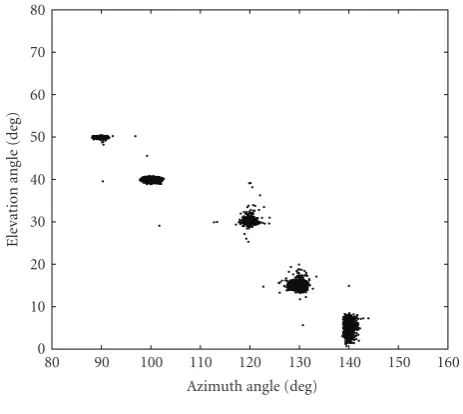
Figure 6shows the scatter plots of the elevation angle versus the azimuth angle for 2-D DOA estimation of five equal power uncorrelated signals from the direc-tion [(5◦140◦), (15◦130◦), (30◦120◦), (40◦100◦), (50◦90◦)]. It is observed that the proposed method is able to deal with more sources than CCM-ESPRIT and JSVD which can estimate four signals at best, that is, the estimates of five signals approach to their respective true values as shown in
Figure 6.
5. Conclusions
In this paper, we have presented a new automatic pairing method for 2-D DOA Algorithm using two orthogonal
160 150 140 130 120 110 100 90 80
Azimuth angle (deg) Proposed method for five signals 0
10 20 30 40 50 60 70 80
Ele
vation
ang
le
(deg)
Figure 6: Scatter plot of the elevation angle versus the azimuth angle for 2-D DOA estimation of five equal power signals at [(5◦, 140◦),(15◦, 130◦),(30◦, 120◦),(40◦, 100◦),(50◦, 90◦)] with 30 dB and 500 snapshots.
ULAs. The proposed method obtains an extended matrix by partition and stacking the CCM, and then estimates the KSVs with pair-matching information to get the one-to-one elevation and azimuth angles. In addition, because of the matrix structural rearrangement, more array structural information are utilized to improve the performance of the DOA estimation. Simulation results have demonstrated that the proposed scheme not only provides more accurate estimates than the CCM-ESPRIT and JSVD, especially at low SNR, but also works well when sources equal to sensors of ULA.
Appendix
Obtaining the Kronecker Steering Vectors
Define an extended matrix of size 2p(M−p+1)×p(M−p+1) by concatenatingR,JRas
RE
⎡ ⎣R
JR
⎤ ⎦=
⎡ ⎣D1
θ,φΛ
D1
θ,φΠ
⎤ ⎦DH
2
θ,φ. (A.1)
The singular value decomposition of the matrixREyields
RE=[U1U2] ⎡ ⎣Σ 0
0 0
⎤
⎦VH, (A.2)
where Σ = diag(σ1,. . .,σK) and U1 = [u1,. . .,uK]U2 =
[uzK+1,. . .,uz2p(M−p+1)]. Combining (13) and (16) with
(A.1)-(A.2), it can be easily proven [8] that there exists a nonsingularK×KmatrixTsuch that
U1 ⎡ ⎣U11
U12 ⎤ ⎦=
⎡ ⎣ D1
θ,φ
D1
θ,φΩxz
⎤
whereU11andU12denote the first and lastp(M−p+1) rows
of U1, andΩxzΩ−xMΩMz has been used. It then follows that
U†11U12=T−1ΩxzT, (A.4)
where the “†” denote the pseudo-inverse. By eigendecompos-ing, we obtain
U†11U12=EΛxzE−1, (A.5)
where E andΛxz are the eigenvector matrix and the asso-ciated eigenvalue matrix ofU†11U12. A comparison of (A.5)
and (A.4) follows thatE=T−1Q, whereQis a “generalized”
permutation matrix, and Ωxz = QΛxzQ−1. Note that the detailed definition of the “generalized” permutation matrix can be found in [21]. Here we will quote it to prevent repetition of work directly. Therefore, recall (A.3), an improved estimate ofD1(θ,φ) can be obtained by
D=D1
θ,φQ= 1
2(U11E+U12EΛxz). (A.6)
Acknowledgments
The authors would like to thank the anonymous reviewers for their useful comments and suggestions. This work is partially supported by the Program for New Century Excel-lent TaExcel-lents in University (NCET), Ministry of Education, China. J. F. Gu is supported by China Postdoctoral Science Foundation (20080441199).
References
[1] H. Krim and M. Viberg, “Two decades of array signal processing research: the parametric approach,” IEEE Signal Processing Magazine, vol. 13, no. 4, pp. 67–94, 1996.
[2] R. O. Schmidt, “Multiple emitter location and signal param-eter estimation,”IEEE Transactions on Antennas and Propaga-tion, vol. 34, no. 3, pp. 276–280, 1986.
[3] R. Roy and T. Kailath, “ESPRIT—estimation of signal param-eters via rotational invariance techniques,”IEEE Transactions on Acoustics, Speech, and Signal Processing, vol. 37, pp. 984– 995, 1989.
[4] Y. Hua and T. K. Sarkar, “On SVD for estimating generalized eigenvalues of singular matrix pencil in noise,”IEEE Transac-tions on Signal Processing, vol. 39, no. 4, pp. 892–900, 1991. [5] M. D. Zoltowski and D. Stavrinides, “Sensor array signal
processing via a procrustes rotations based eigenanalysis of the ESPRIT data pencil,”IEEE Transactions on Acoustics, Speech, and Signal Processing, vol. 37, no. 6, pp. 832–861, 1989. [6] Y. Hua, T. K. Sarkar, and D. D. Weiner, “An L-shaped array for
estimating 2-D directions of wave arrival,”IEEE Transactions on Antennas and Propagation, vol. 39, no. 2, pp. 143–146, 1991. [7] N. Tayem and H. M. Kwon, “L-shape 2-dimensional arrival angle estimation with propagator method,”IEEE Transactions on Antennas and Propagation, vol. 53, no. 5, pp. 1622–1630, 2005.
[8] J. F. Gu and P. Wei, “Joint SVD of two cross-correlation matrices to achieve automatic pairing in 2-D angle estimation problems,” IEEE Antennas and Wireless Propagation Letters, vol. 6, pp. 553–556, 2007.
[9] L. Bai, C.-Y. Peng, and S. Biswas, “Association of DOA estima-tion from two ULAs,”IEEE Transactions on Instrumentation and Measurement, vol. 57, no. 6, pp. 1094–1101, 2008. [10] A. J. van der Veen, P. B. Ober, and E. F. Deprettere,
“Azimuth and elevation computation in high resolution DOA estimation,”IEEE Transactions on Signal Processing, vol. 40, no. 7, pp. 1828–1832, 1992.
[11] V. S. Kedia and B. Chandna, “A new algorithm for 2-D DOA estimation,” Signal Processing, vol. 60, no. 3, pp. 325–332, 1997.
[12] A. L. Swindlehurst and T. Kailath, “Azimuth/elevation direc-tion finding using regular array geometries,”IEEE Transactions on Aerospace and Electronic Systems, vol. 29, no. 1, pp. 145–156, 1993.
[13] P. Strobach, “Two-dimensional equirotational stack subspace fitting with an application to uniform rectangular arrays and ESPRIT,”IEEE Transactions on Signal Processing, vol. 48, no. 7, pp. 1902–1914, 2000.
[14] T. Shu, X. Liu, and J. Lu, “Comments on “L-shape 2-dimensional arrival angle estimation with propagator method”,”IEEE Transactions on Antennas and Propagation, vol. 56, no. 5, pp. 1502–1503, 2008.
[15] S. Kikuchi, H. Tsuji, and A. Sano, “Pair-matching method for estimating 2-D angle of arrival with a cross-correlation matrix,”IEEE Antennas and Wireless Propagation Letters, vol. 5, no. 1, pp. 35–40, 2006.
[16] J. Xin, N. Zheng, and A. Sano, “Simple and efficient nonpara-metric method for estimating the number of signals without eigendecomposition,”IEEE Transactions on Signal Processing, vol. 55, no. 4, pp. 1405–1420, 2007.
[17] P. Stoica and Y. Sel´en, “A review of information criterion rules,”IEEE Signal Processing Magazine, vol. 21, no. 4, pp. 36– 47, 2004.
[18] M. Jansson, B. G¨oransson, and B. Ottersten, “A subspace method for direction of arrival estimation of uncorrelated emitter signals,”IEEE Transactions on Signal Processing, vol. 47, no. 4, pp. 945–956, 1999.
[19] J. W. Brewer, “Kronecker products and matrix calculus in system theory,”IEEE Transactions on Circuits and Systems, vol. 25, no. 9, pp. 772–781, 1978.
[20] P. Stoica and A. Nehorai, “Music, maximum likelihood, and Cramer-Rao bound,”IEEE Transactions on Acoustics, Speech, and Signal Processing, vol. 37, no. 5, pp. 720–741, 1989. [21] Y. Hua and K. Abed-Meraim, “Techniques of eigenvalues