HYPERSONIC BOUNDARY LAYER FLOW AROUND A SHARP CORNER
T h e s i s by A n d r e a s Puhl
In P a r t i a l Fulfillment of t h e R e q u i r e m e n t s F o r the D e g r e e of
Aeronautical Engineer
California Institute of Technology Pasadena, California
ACKNOWLEDGMENTS
The a u t h o r f e e l s a d e e p s e n s e of g r a t i t u d e t o P r o f e s s o r
Toshi Kubota who suggested and s u p e r v i s e d the p r e s e n t e x p e r i m e n t
and, t h r o u g h h i s broad understanding, contributed significantly t o
the completion of t h i s r e s e a r c h . F o r scientific guidance, p e r s o n a l
encouragement and m a n y stimulating d i s c u s s i o n s a r o u s i n g and
cultivating t h e a u t h o r ' s i n t e r e s t , s i n c e r e thanks a r e e s p e c i a l l y
due t o P r o f e s s o r L e s t e r L e e s . The a u t h o r a l s o w i s h e s t o e x p r e s s
his gratitude to: M r s . T r u u s van H a r r e v e l d f o r h e r invaluable
contribution i n reducing the d a t a m o s t c a r e f u l l y a n d conscientiously,
M r s . Virginia Conner f o r h e r a b l e and efficient typing and p r e p a r i n g
of the m a n u s c r i p t , the staff of t h e GALCIT hyper sonic wind tunnels
under M r . P. Baloga and e s p e c i a l l y M e s s r s . S. Roman, J. Van Dijk, G. Van Halewyn and H. Mazurowski f o r t h e i r a s s i s t a n c e i n conduct-
ing the wind tunnel t e s t s , and the staff of the Aeronautic s Machine
Shop under G. Carlson, e s p e c i a l l y M e s s r s. H. McDonald and
6. Baetz for t h e i r skill in constructing the t e s t equipment.
T h i s investigation w a s c a r r i e d out under the s p o n s o r s h i p and
with the financial support of t h e U. S . A r m y R e s e a r c h Office and the
Advanced Re s e a r c h P r o j e c t s Agency, C o n t r a c t No. DA-3 1- 124-
iii
ABSTRACT
An e x p e r i m e n t a l investigation w a s conducted i n t h e GALCIT
Mach 8 h y p e r s o n i c wind tunnel, i n o r d e r t o study t h e behavior of a n axisynzmetric h y p e r sonic l a m i n a r boundary l a y e r flow undergoing a
rapid expansion a t the j u n c t u r e of a cone-cylinder body of revolution
a t z e r o angle of yaw. M a j o r e m p h a s i s w a s placed on the acquisition
of detailed d a t a n e a r the c o r n e r w h e r e e x t r e m e c h a n g e s i n the flow
p r o p e r t i e s w e r e expected. All t e s t s w e r e c a r r i e d out f o r two dif-
f e r e n t r e s e r v o i r p r e s s u r e s but e q u a l t o t a l t e m p e r a t u r e . The b a s i c
m e a s u r e m e n t s c o n s i s t of t h e m o d e l s u r f a c e p r e s s u r e and the pitot
p r e s s u r e covering the e n t i r e flow field of i n t e r e s t . T h e s e i n f o r m a -
t i o n s with c e r t a i n a s s u m p t i o n s w e r e sufficient t o c o n s t r u c t the flow
field.
T h e s u r f a c e p r e s s u r e d i s t r i b u t i o n i s i n t o t a l d i s a g r e e m e n t
with the potential t h e o r y f r o m t h r e e boundary l a y e r thickne s se s
u p s t r e a m of t h e c o r n e r t o about fifteen boundary l a y e r t h i c k n e s s e s
downstream. T h e expansion i s not c o n c e n t r a t e d n e a r t h e c o r n e r
but extended o v e r t h e above-mentioned r e g i o n which i s about one
and a half c y l i n d e r r a d i i long. The p r e s s u r e i m m e d i a t e l y down-
s t r e a m of t h e c o r n e r is about s e v e n - t e n t h s of t h e p r e s s u r e on t h e -
cone, i n c o n s t r a s t t o the two-tenths as p r e d i c t e d by t h e potential
TABLE O F CONTENTS
PART T I T L E
Acknowledgments A b s t r a c t
T a b l e of Contents L i s t of F i g u r e s L i s t of Symbols
I. INTRODUCTION
II.
EXPERIMENTAL APPARATUS AND PROCEDURESPAGE i i i i i i v v
vii
1
4
11. 1. F a c i l i t i e s II. 2. Model
11.3. P r e s s u r e M e a s u r e m e n t s 11.4. Flow Visualization
III. DATA REDUCTION
111. 1. P i t o t P r e s s u r e
111.2. Boundary L a y e r Edge
111. 3. M a c h Number and VeLocit y III. 4. Inviscid Flow
IV. RESULTS
IV. 1. Surface P r e s s u r e IV. 2. Inviscid Flow F i e l d IV. 3. Velocity P r o f i l e s
IV. 4. F l o w F i e l d in Boundary L a y e r
V. CONCLUSION
LIST O F FIGURES
NUMBER PAGE
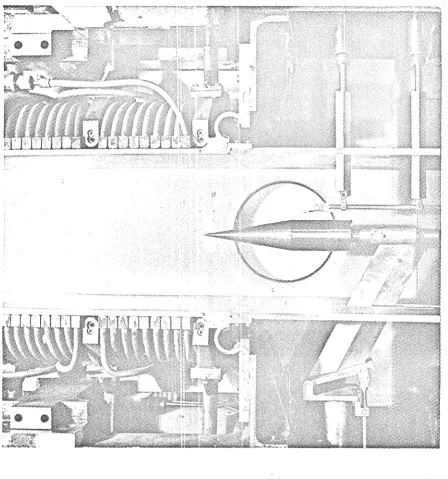
1 Model Installation i n Leg 2
-
GALCIT H y p e r s o n i cWind Tunnel 30
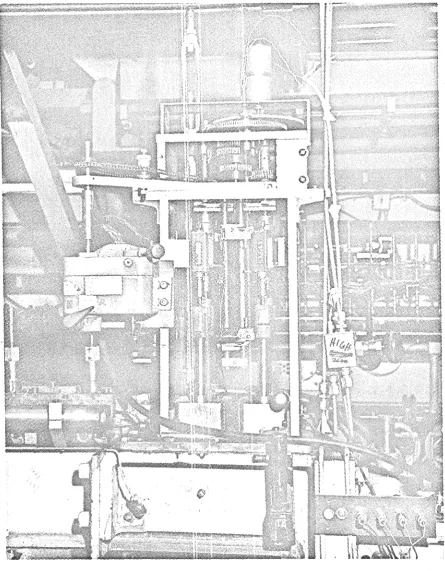
2 D r i v e Mechanism f o r Pitot P r o b e 3 1
3 Cone- Cylinder Model 32
4 Schematic D i a g r a m of the T e s t Setup 33
5 S u r f a c e P r e s s u r e Distributions 34-36
6 Irnpace P r e s s u r e P r o f i l e s 37-46
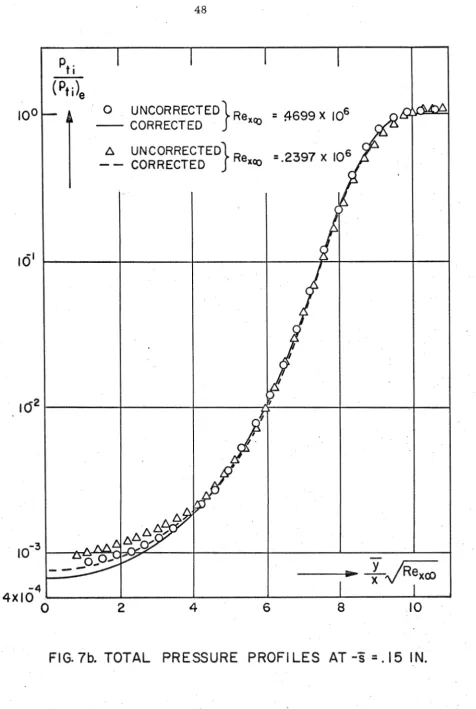
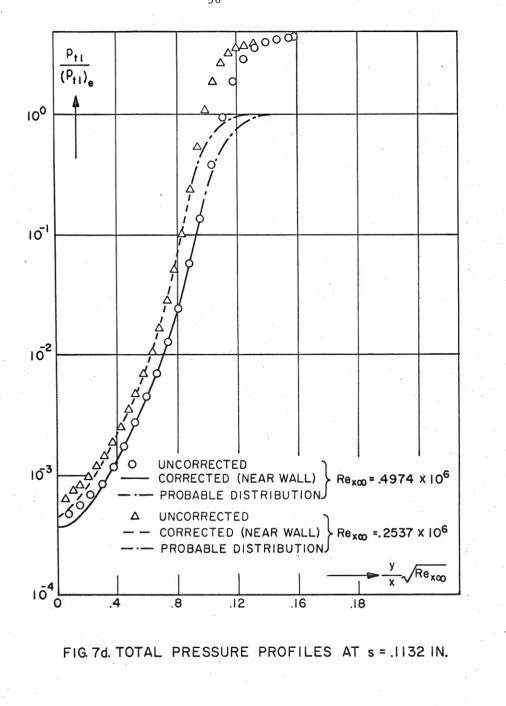
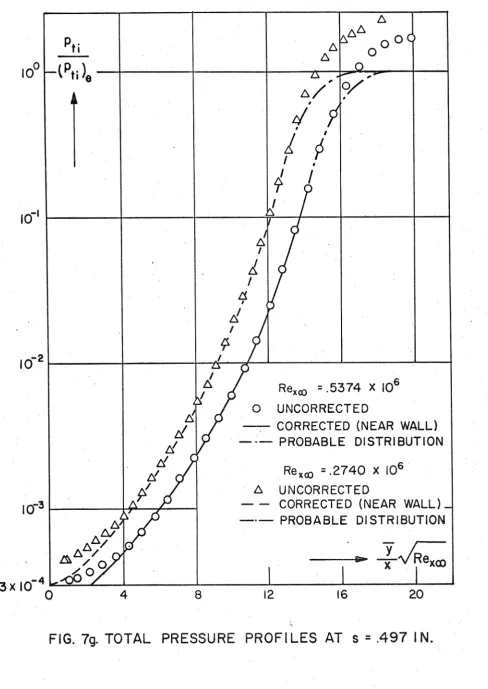
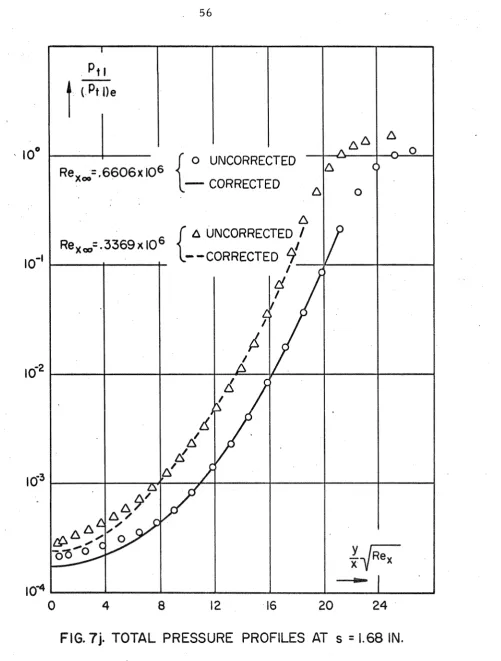
7 T o t a l P r e s s u r e P r o f i l e s
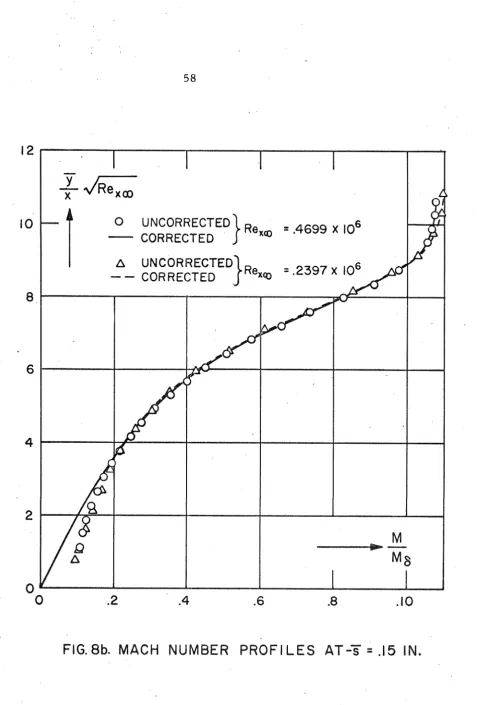
8 Mach Number P r o f i l e s
9
Velocity P r o f i l e s 67-7610 Static P r e s s u r e P r o f i l e s 77-84
11 Static P r e s s u r e V a r i a t i o n Due t o P r o b e - Body
I n t e r f e r e n c e 85
12 Boundary L a y e r Velocity P r o f i l e s N e a r S h a r p
C o r n e r 86-87
13 (Dimensional) Boundary L a y e r Velocity P r o f i l e s
D o w n s t r e a m of S h a r p C o r n e r 88-89
14 Boundary L a y e r Velocity P r o f i l e s D o w n s t r e a m
of S h a r p C o r n e r 90-91
15 Boundary L a y e r Velocity P r o f i l e s " F a r f ' Down-
s t r e a m of S h a r p C o r n e r 92-93
16 T o t a l Head P r o f i l e s U p s t r e a m and D o w n s t r e a m
of S h a r p C o r n e r 94
17 Flow F i e l d Downstream of S h a r p Cone-Cylinder
Junc t u r e 95-96
18 Boundary L a y e r Flow F i e l d Downstream of
LIST O F FIGURES (Cont'd)
NUMBER PAGE
19 Flow F i e l d Near a S h a r p Cone- Cylinder
J u n c t u r e
.
99-
1 0 02 0 T o t a l P r e s s u r e V a r i a t i o n Along S t r e a m L i n e s
in Viscous L a y e r Near Cone- Cylinder J u n c t u r e 1 0 1
-
1 0 2 2 1 S c h l i e r e n P h o t o g r a p h of Flow N e a r S h a r p Cone-LIST O F SYMBOLS
sound speed,
,/zYRT'
(ft. / s e c . )c r i t i c a l sound speed (ft. /sec. )
specific heat a t constant p r e s s u r e and c o n s t a n t volume, r e s p e c t i v e l y
Chapman- Rube s i n f a c t o r , @ d " m
77%-
functions of K
hyper sonic s i m i l a r i t y p a r a m e t e r , M
8
00 coefficient of t h e r m a l conductivity of g a s
t o t a l wetted length of cone
Mach n u m b e r ,
v
/a
p r e s s u r e
pitot p r e s s u r e
P r a n d t l n u m b e r of gas, Cplr/k
G a s constant p e r unit m a s s
r a d i u s of c y l i n d e r (in. ) .
Reynolds n u m b e r p e r unit length (in. - I )
d i s t a n c e along cylinder f r o m c o r n e r d o w n s t r e a m (in. )
d i s t a n c e along cone f r o m c o r n e r u p s t r e a m (in. )
t e m p e r a t u r e (OF r e l a t i v e o r O R a b s o l u t e )
velocity (ft. / s e c . )
wetted d i s t a n c e along body f r o m a p e x (in. )
coordinate n o r m a l t o body s u r f a c e
r a t i o of specific heats,
boundary l a y e r t h i c k n e s s (in. ), a s defined i n P a r t IV. 4
v i i i
LIST O F SYMBOLS (Cont'd)
cone s e m i - v e r t e x angle
o r d i n a r y coefficient of v i s c o s i t y
k i n e m a t i c v i s c o s i t y
m a s s d e n s i t y
h p e r s o n i c boundary l a y e r i n t e r a c t i o n p a r a m e t e r ,
/mx
h13S u b s c r i p t s
inviscid quantity a t cone s u r f a c e
quantity a t the boundary l a y e r edge
quantity a t the s u r f a c e
quantity at r e s e r v o i r conditions r e f e r r e d to wetted length f r o m a p e x
quantity a t s u r f a c e with p r o b e position
quantity a t the boundary l a y e r edge, a s defined in P a r t IV. 4
quantity ahead of n o r m a l shock of p r o b e
I.
INTRODUCTIONF o r smooth bodies i n slightly v i s c o u s flows the t h e o r y of
boundary l a y e r is well e s t a b l i s h e d . The b a s i c a s s u m p t i o n i n t h e
theory i s that the s t r e a m w i s e v a r i a t i o n s i n the flow a r e small c o m p a r e d
to the t r a n s v e r s e g r a d i e n t s i n t h e boundary l a y e r . This assumption
b r e a k s down n e a r a s h a r p leading edge, the t r a i l i n g edge of a thin
plate and a s h a r p c o r n e r . Many p r a c t i c a l s h a p e s have a s h a r p c o r n e r s u c h a s the junction of a cone-cylinder, the r i d g e on a
double-wedge a i r f o i l , and t h e c o r n e r a t t h e bluff b a s e of a finite
cone o r wedge.
It h a s been o b s e r v e d a t subsonic and low s u p e r s o n i c s p e e d s
that the p r e s e s c e of a s h a r p c o r n e r is felt a few boundary 'Layer t h i c k n e s s e s u p s t r e a m in t h e l a y e r and often t h e flow s e p a r a t e s and
r e a t t a c h e s d o w n s t r e a m of t h e c o r n e r . Not m a n y e x t e n s i ve inves-
tigations have been c a r r i e d out on t h i s p r o b l e m e i t h e r e x p e r i m e n t a l l y
o r t h e o r e t i c a l l y because of the difficulties involved and p a r t l y because
of a limited extent of the c o r n e r influence i n t h o s e speed r a n g e s . At
hypersonic speeds, however, the boundary l a y e r s a r e m u c h t h i c k e r
c o m p a r e d t o t h o s e a t low speeds. Also the effects of t h e boundary
l a y e r on t h e e x t e r n a l flow a r e m o r e pronounced, and often t h e s e
m u s t be t a k e n into account i n d e t e r m i n i n g the flow i n the boundary
l a y e r itself. T h u s t h e c o r n e r p r o b l e m c a n no longer be ignored,
and the p r e s e n t investigation i s a i m e d toward obtaining e x p e r i m e n t a l
d a t a on t h e i n t e r a c t i o n of hypersonic l a m i n a r boundary l a y e r with a n
expansion c a u s e d by a s u r f a c e slope discontinuity.
2
Only a l i m i t e d n u m b e r of e x p e r i m e n t s has been c a r r i e d out
on t h i s p r o b l e m i n t h e past. Murthy and ~ a r n m i t ' ' ) investigated
e x p e r i m e n t a l l y t h e i n t e r a c t i o n of a turbulent boundary l a y e r with
P r a n d t l - M e y e r expansion a t M
=
1.88. They found t h a t t h e p r e s -s u r e d o w n s t r e a m of the c o r n e r w a s initially a p p r e c i a b l y higher than
t h e s i m p l e wave t h e o r y predicted but g r a d u a l l y a p p r o a c h e d the
P r a n d t l - M e y e r value about five boundary l a y e r t h i c k n e s s e s down-
s t r e a m . They c a r r i e d out a c h a r a c t e r i s t i c calculation f o r a r o t a -
tional flow, neglecting the subsonic portion of t h e i n i t i a l profile i n
t h e boundary l a y e r , which a g r e e d qualitatively with t h e p r e s s u r e
m e a s u r e m e n t s . S t e r n b e r g ( 2 ) a t B R L and l a t e r Zakkay, Tani, Toba and Mus (3' 4, a t PIBAL studied t h e flow around a s h a r p convex c o r n e r using a cone- cylinder a t s u p e r sonic speeds. They w e r e i n t e r e s t ed
mainly i n the s u r f a c e t e m p e r a t u r e s and heat t r a n s f e r s , and only a
v e r y l i m i t e d amount of fluid d y n a m i c a l d a t a w a s obtained. Apparently
i n t h e s e e x p e r i m e n t s the boundary l a y e r s w e r e s o thin t h a t the s u r -
f a c e p r e s s u r e s d o w n s t r e a m of the c o r n e r w e r e i n f a i r l y c l o s e a g s e e -
m e n t w i t h t h e potential t h e o r y predictions.
~ a k k a ~ ' ~ ' proposed a flow m o d e l a t t r i b u t e d t o Antonio F e r r i ,
i n which the flow o v e r t h e c o r n e r within a d i s t a n c e on the o r d e r of
t h e boundary-layer t h i c k n e s s i s divided into t h r e e p a r t s ; a n inviscid
s u p e r s o n i c l a y e r , a n inviscid sublayer and a v i s c o u s s u b l a y e r a d j a -
cent t o t h e wall. The flow i n t h e s u p e r s o n i c l a y e r m a y be analyzed
by the c h a r a c t e r i s t i c method, and the i n v i s c i d sublayer i s t r e a t e d
constant a c r o s s t h e l a y e r . The v i s c o u s s u b l a y e r i s analyzed by
u s u a l boundary l a y e r techniques, which i s c a r r i e d out in Ref. 3
( 6 )
using a s e r i e s expansion technique suggested by Goldstein andG'iirtler.
*
Zakkay e t a1 did not c a r r y out the inviscid a n a l y s e s . Ina r e c e n t paper by ~ e i n b a u m ' ~ ' the inviscid r o t a t i o n a l s u p e r sonic
flow w a s analyzed, and i t w a s pointed out t h a t t h e boundary l a y e r
i n a region of l a r g e w a l l c u r v a t u r e c a n c a u s e l a r g e d e p a r t u r e f r o m
the P r a n d t l - M e y e r t h e o r y a t hypersonic M a c h n u m b e r s .
In o r d e r to f i l l t h e void of e x p e r i m e n t a l d a t a , t h e p r e s e n t
investigation w a s undertaken t o m e a s u r e t h e s u r f a c e p r e s s u r e d i s -
tributions and t h e pitot p r e s s u r e d i s t r i b u t i o n s i n the boundary l a y e r
on a cone-cylinder at Mach number 8. F r o m t h e s e m e a s u r e m e n t s the flow field n e a r t h e c o r n e r w a s c o n s t r u c t e d t o provide a b a s i s
Tor f u r t h e r t h e o r e t i c a l r e s e a r c h on t h i s subject and t o augment t h e
understanding of t h e phenomena which have eluded t h e ~ r e t i ~ a l de-
scription.
11. EXPERIMENTAL APPARATUS AND PROCEDURES
11. 1. Wind Tunnel
The e x p e r i m e n t w a s conducted i n t h e GALCIT 7s'' X 72"
Hyper sonic Wind Tunnel, Leg No. 2, a t a nominal M a c h n u m b e r of
8. T h e tunnel is of a continuously operating c l o s e d - c i r c u i t type, with a i r a s t h e working medium. It i s i n s t a l l e d with a s y m m e t r i c a l , flexible-plate nozzle which w a s contoured t o yield uniform flow con- ditions i n the t e s t section. In o r d e r t o avoid liquefaction, the a i r w a s heated t o 900°F by m e a n s of a n i c h r o m e - w i r e h e a t e r enclosed i n the supply section u p s t r e a m of t h e nozzle.
The r e s e r v o i r p r e s s u r e w a s m e a s u r e d with a T a t e - E n e r g y nitrogen- balanced gage and could be controlled within f 0. 05 psi. The r e s e r v o i r t e m p e r a t u r e w a s m e a s u r e d by m e a n s of a t h e r m o - couple located between h e a t e r and nozzle and r e c o r d e d with a n a c c u r a c y of 0.3$.
The f r e e - s t r e a m i m p a c t p r e s s u r e w a s r e c o r d e d with a n un- c e r t a i n t y of fO. 03 psi, s o t h a t a n a c c u r a c y of the Mach n u m b e r of f0. 01 r e s u l t e d .
All t e s t s w e r e c a r r i e d out under steady- s t a t e conditions. Since t h e tunnel w a s of the c l o s e d - c i r c u i t continuously operating type, sufficient t i m e w a s available t o e s t a b l i s h t h e r m a l and dynam- i c a l equilibrium. No heating o r cooling of t h e m o d e l w a s considered,
The m o d e l w a s kept a t z e r o angle of incidence. T e s t s w e r e
conducted under t h e following two flow conditions:
A * , M
=
7.8700
ptoo
=
264. 3 p. s. i.a.
Ttco=
90O0F.re^=
. 4 9x
106
- - -
B., M
=
7 . 8 100
Ptco
=
132.3 p. s.i.a.Ttoo
=
900°F.R e ~ o o
=
.257x
The t e s t section flow w a s c o n s i d e r e d uniform over a length
of t h e 'longitudinal body dimension.
11.
2. ModelThe m o d e l i s a 10' s e m i - a n g l e c i r c u l a r cone with a c y l i n d r i c a l
afterbody, providing a 10' turning angle a r o u n d t h e shoulder. The
d i m e n s i o n s of t h e s t a i n l e s s s t e e l m o d e l u s e d i n t h e p r e s e n t t e s t s a r e
given i n F i g u r e 3 . T h e f r o n t a l a r e a of t h e cone-cylinder configuration
w a s l i m i t e d t o a s i z e that would allow the tunnel flow t o s t a r t .
An optical c o m p a r a t o r examination of t h e cone showed that t h e
d e s i r e d angle of 10' w a s within the t o l e r a n c e s shown. T h e d i a m e t e r
of the a p e x w a s m e a s u r e d and found t o be sufficiently s m a l l ( R e
=
ood 100 and 50, r e s p e c t i v e l y ) not t o invalidate the t h e o r e t i c a l a s s u m p t i o n
On the model 1 7 p r e s s u r e o r i f i c e s with a d i a m e t e r of 0.0 1 in. w e r e located a s shown i n F i g u r e 3 . F o r the purpose of aligning the
model t o the f r e e s t r e a m flow, four additional o r i f i c e s with a d i a m e t e r
of 0. 02 in. w e r e installed a t 90' i n t e r v a l s around the circumference.
The positions of the s u r f a c e p r e s s u r e o r i f i c e s with r e s p e c t to the
c o r n e r were checked both microscopically and mechanically and found
to be a c c u r a t e within f O . 00 1 in. T o eliminate mutual i n t e r f e r e n c e and
a l s o for e a s e of construction, the o r i f i c e s i n the shoulder region had
to be distributed in a s p i r a l f o r m around the body.
11.3. P r e s s u r e M e a s u r e m e n t s
-
In o r d e r t o a s s u r e a c c u r a t e positioning of the probe with r e -
spect to the model, a f t e r the proper r e s e r v o i r t e m p e r a t u r e and r e s e r -
voir p r e s s u r e of the tunnel w a s reached, sufficient t i m e w a s allowed
(ca. 10 m i n u t e s ) to p e r m i t the i n s t r u m e n t s in the t e s t section to come
to t h e r m a l equilibrium.
The four static p r e s s u r e o r i f i c e s drilled s y m m e t r i c a l l y a t a
r a d i a l c r o s s section of the cone (X/L
=
0.68) a r e provided for thealignment purpose. To account for s m a l l flow angle changes mainly
due t o a slight dependence of the t e s t section flow on t h e tunnel stag-
nation conditions, the model supports w e r e adjusted until the p r e s s u r e s
a t the d i a m e t r i c a l locations w e r e equalized.
The m o d e l s u r f a c e p r e s s u r e s w e r e m e a s u r e d by m e a n s of a
bank of Silicone-oil U-tube manometer s, with the r e f e r e n c e p r e s s u r e
p r e s s u r e reading s w a s checked by using a Silicone- oil m i c r o m a n o -
m e t e r .
The pitot p r e s s u r e m e a s u r e m e n t s w e r e obtained by using a
flattened pitot probe. The outer dimensions of i t s f o r w a r d face w e r e
0. 04 by 0. 004 inches, thus having an aspect r a t i o of 10. The frontal
height corresponded t o about 4$ of the a v e r a g e boundary l a y e r thick-
n e s s . The probe orifice dimensions w e r e 0.0286 by 0.002 inches,
which limited the t r a v e r s e speed t o 1/6 inch p e r hour i n the boundary
layer. To provide stiffness the probe w a s reinforced with a thin
plate with a s h a r p leading edge and attached t o a holder of
$
in. outerd i a m e t e r . ( T h e d r i v e m e c h a n i s m of the pitot probe i s presented in
F i g u r e 2. )
By m e a n s of a d r i v e mechanism mounted a t the t o p of the
tunnel, the pitot probe w a s t r a v e r s e d through the flow field perpen-
dicular t o the s u r f a c e of t h e body. Downstream of the shoulder the
attitude of the total head probe with r e s p e c t t o the local s t r e a m l i n e
direction h a s been maintained a t a n e s t i m a t e d m e a n value of the
local s t r e a m l i n e tangents, t o minimize the e r r o r caused by the
misalignment of the probe and the flow. The probe position w a s
a c c u r a t e t o f O . 002 in.
The pitot p r e s s u r e w a s converted into an e l e c t r i c signal by
m e a n s of a p r e s s u r e transducer, amplified and plotted against the
probe position on a n XY - r e c o r d e r . F i g u r e 4 shows schematically the recording set-up. The p r e s s u r e t r a n s d u c e r w a s a Statham
T h e d i r e c t c u r r e n t used t o e x c i t e t h e p r e s s u r e t r a n s d u c e r w a s p r o -
vided by a Video I n s t r u m e n t s , Model SR 200 E, D.
C.
power supply, and i t s output w a s adjusted t o 5 v o l t s f 1 millivolt, m e a s u r e d by m e a n sof a digital v o l t m e t e r , Kintel 501B. The excitation voltage w a s m e a -
s u r e d before, during and a f t e r e v e r y run, and i t w a s found t h a t a f t e r
t h e power supply had r e a c h e d constant o p e r a t i o n a l t e m p e r a t u r e t h e
voltage w a s m a i n t a i n e d constant during t h e run.
The s t a t i c c a l i b r a t i o n of t h e t r a n s d u c e r a g a i n s t a liquid U-tube
m a n o m e t e r yielded a c a l i b r a t i o n f a c t o r of 323. 2 m i c r o v o l t s per volt
p e r c m Hg a t r o o m t e m p e r a t u r e d a t a given by f a c t o r y : 328.
9
m i c r o - volts [open c i r c u i t ] p e r volt p e r c m Hg. P r e v i o u s t e s t s o n the lin-e a r i t y , resolution, and r e p e a t a b i l i t y of t h e s a m e t r a n s d u c e r indicated
a s a t i s f a c t o r y behaviour o v e r t h e whole p r e s s u r e r a n g e involved i n t h i s e x p e r i m e n t . T h e deviation of the output did not e x c e e d f O . 15% of
t h e m a x i m u m pitot p r e s s u r e m e a s u r e d f o r t h e highest supply p r e s s u r e
used i n t h i s e x p e r i m e n t . T h e r e a f t e r the significance of t h e data w a s
limited by the a c c u r a c y of the d a t a plotter.
A Sandborn 1500-860s DC a m p l i f i e r w a s used t o amplify the t r a n s d u c e r s i g n a l s by the f a c t o r of 100 and 50 f o r r e s e r v o i r p r e s s u r e s
of 118 and 250 p. s.i.g.
,
respectively. A M o s e l e y Model 2 S AutografXY-Recorder w a s used t o r e c o r d t h e amplified p r e s s u r e signal a s a
function of n o r m a l d i s t a n c e f r o m body s u r f a c e .
11.4. Flow Visualization
In o r d e r t o supplement t h e p r e s s u r e m e a s u r e m e n t s , Schlieren
B e c a u s e of t h e a x i - s y m m e t r i c c h a r a c t e r of t h e flow, t h e Schlieren
effect i n the field between t h e shock and the body w a s understandably
weak. A s a r e s u l t of t h e i n c r e a s e d d e n s i t y v a r i a t i o n a t higher supply p r e s s u r e s the photographs t a k e n at p
=
250 p.s.i.g. and Ttm= 9 0 0 ' ~tco
gave best r e s o l u t i o n of t h e shock wave, t h e boundary l a y e r edge and
the expansion fan. A S c h l i e r e n photograph t a k e n under t h i s condition
111. DATA REDUCTION
111. 1. Pitot P r e s s u r e
Near t h e wall i n the boundary l a y e r the p r e s s u r e m e a s u r e d
by the probe i s not equal t o t h e t o t a l p r e s s u r e of the s t r e a m l i n e aligned
with the probe centerline. The difference c o m e s f r o m t h r e e principal
causes. The f i r s t i s that the boundary l a y e r flow i s d i s t o r t e d by the
disturbance of the probe. T h i s i s minimized by the u s e of a s m a l l
probe, though, t o the a u t h o r ' s knowledge, no quantitative d a t a a r e
available for this. The second c a u s e i s the fact that, when a probe
i s placed i n a s h e a r flow, the stagnation s t r e a m l i n e i s not aligned
with the probe a x i s because of the unsyrnmetry, and the effective
c e n t e r of t h e t o t a l p r e s s u r e i s displaced toward the region of higher
velocity. The c o r r e c t i o n given by Young and M a a s ( 8 ) f o r a n in-
c o m p r e s s i b l e subsonic fluid i s
w h e r e 6 i s the displacement, d l and d t h e i n t e r n a l a n d e x t e r n a l dia- m e t e r s of the probe. T h i s c o r r e c t i o n w a s obtained with a c i r c u l a r
probe in tl e wake of a n airfoil. On the o t h e r hand, the e x p e r i m e n t s
of Davie s
'
9'
i n l a m i n a r boundary l a y e r s a t s u p e r sonic s p e e d sshowed the displacement in the opposite s e n s e when the probe d i a m e t e r
i s one-half of t h e boundary l a y e r t h i c k n e s s o r l a r g e r . However, in
the a u t h o r ' s opinion, t h i s w a s probably due t o the d i s t o r t i o n of the
flow caused by the p r e s e n c e of a l a r g e probe. In s u p e r s o n i c flow,
Johanne son and M a i r ( showed the displacement effect practically
twice a s l a r g e a s the wake half-width. The t h i r d c a u s e i s t h e low
Reynolds number effect. (11, 12913) When the probe Reynolds number
based on the l o c a l flow p r o p e r t i e s i s lower than 200 o r so, the t o t a l
p r e s s u r e m e a s u r e d by the probe i s l a r g e r than t h e t o t a l p r e s s u r e
computed by the inviscid flow relation, since the effects of viscosity
a r e no longer negligible.
I n the p r e s e n t e x p e r i m e n t s the displacement effect i s ex-
pected t o be s m a l l (the o r d e r of
.
O O P inch), iudging f r o m t h e data ofr e f e r e n c e s ( 8) and ( 10 ) - An attempt was m a d e in the p r e s e n t ex- p e r i m e n t s t o c o r r e c t f o r the effects of the flow d i s t o r t i o n and the
viscosity by comparing the velocity profile computed f r o m t h e pitot
p r e s s u r e d a t a and t h e t h e o r e t i c a l profile on the cone s u r f a c e away
f r o m the shoulder. The c o m p a r i s o n was c a r r i e d out for t h e two
Reynolds number s of t h e experiment, and the t o t a l p r e s s u r e c o r r e c t i o n
c u r v e was devised a s a function of the distance f r o m t h e s u r f a c e n o r -
malized by the boundary l a y e r thickne s s and t h e Reynolds number,
which w a s used a t a l l o t h e r stations. The c o r r e c t i o n w a s found t o be
negligible in t h e s u p e r s o n i c portion of t h e boundary l a y e r .
111.2, Boundary L a y e r Edge
-
The boundary l a y e r edge m a y be d e t e r m i n e d f r o m t h e pitot
p r e s s u r e p r o f i l e s taken on the conical p a r t of the model, since the
pitot p r e s s u r e i s n e a r l y constant outside the boundary l a y e r . Simi-
larly, the edge could be defined f r o m the pitot p r e s s u r e c u r v e s f o r
downstream of t h e shoulder. But around the shoulder t h e pitot p r e s -
since t h e pitot p r o b e t r a v e r s e s a s t r o n g inviscid expansion r e g i o n
a f t e r i t h a s e m e r g e d f r o m t h e v i s c o u s l a y e r . ( T h e t h r e e f a m i l i e s
of t o t a l head t r a c e s a r e shown i n F i g u r e
16.
) A different method of finding the boundary l a y e r edge i s t h e r e f o r e n e c e s s a r y , a n d t h e fol-lowing p r o c e d u r e w a s used t o define the boundary l a y e r edge c o n s i s t -
ently along t h e whole r a n g e of i n t e r e s t . Assuming c o n s t a n t s t a t i c
p r e s s u r e a c r o s s t h e boundary l a y e r , the l o c a l t o t a l p r e s s u r e w a s
computed (Fig. 7). In r e g i o n s w h e r e t h e boundary l a y e r edge could be defined f r o m t h e pitot p r e s s u r e profiles, t h e t o t a l p r e s s u r e a t the
edge of t h e v i s c o u s l a y e r w a s found t o be constant within t h e e x p e r i -
m e n t a l a c c u r a c y . Hence, i n the r e g i o n around the shoulder t h e
boundary l a y e r edge w a s defined a s the point a t which the compated
t o t a l p r e s s u r e w a s equal t o t h e t o t a l p r e s s u r e a t the edge a s d e t e r -
mined above. T h e r e s u l t s w e r e shown i n F i g u r e s 1 7 t h r o u g h
19.
111. 3 , Velocitv and M a c h Number P r o f i l e s
On the a s s u m p t i o n of constant s t a t i c p r e s s u r e and t o t a l
t e m p e r a t u r e a c r o s s the boundary l a y e r , the Mach n u m b e r and the
velocity w e r e computed f r o m pitot p r e s s u r e m e a s u r e m e n t s and the
s u r f a c e p r e s s u r e readings.
The a s s u m p t i o n of constant s t a t i c p r e s s u r e cannot be valid
i n t h e i m m e d i a t e neighborhood of t h e c o r n e r because of not negligible
s t r e a m l i n e c u r v a t u r e a n d accompanying p r e s s u r e g r a d i e n t s perpen-
d i c u l a r t o the s t r e a m l i n e s of t h e o r d e r of p
v2/r,
w h e r e r i s ther a d i u s of c u r v a t u r e . T h e p r e s s u r e g r a d i e n t s m a y be d e t e r m i n e d by
the p r e s e n t work, i n view of the i n a c c u r a c y i n e x p e r i m e n t a l l y d e t e r -
m i n e d s t r e a m l i n e shapes.
T h e f i r s t station d o w n s t r e a m of t h e shoulder f o r which the
above a s s u m p t i o n h a s been m a d e w a s about one-half boundary l a y e r
t h i c k n e s s e s away f r o m t h e c o r n e r . Judging f r o m t h e calculation of
t h e s t a t i c p r e s s u r e i n t h e inviscid flow a s d e s c r i b e d i n P a r t 111. 4. the t r a n s v e r s e p r e s s u r e g r a d i e n t s m a y not be negligible n e a r the boundary
l a y e r edge, but i t is expected t h a t t h e p r e s s u r e g r a d i e n t s d e c a y rapidly
i n the boundary l a y e r b e c a u s e of t h e f a s t d e c r e a s e of velocity and den-
s i t y i n the boundary l a y e r . It i s t h u s concluded t h a t t h e velocity and
Mach number p r o f i l e s of the f i r s t two to t h r e e s t a t i o n s j u s t d o w n s t r e a m
of the c o r n e r a r e i n e r r o r only n e a r the boundary l a y e r edge. At f u r -
t h e r d o w n s t r e a m s t a t i o n s with d e c r e a s i n g s t r e a m l i n e c u r v a t u r e ,
P r a n d t l ' s a s s u m p t i o n of constant p r e s s u r e a c r o s s t h e boundary l a y e r
is believed t o be v e r y r e a s o n a b l e .
The velocity p r o f i l e s w e r e calculated w i t h the a s s m p t i o n of
c o n s t a n t stagnation t e m p e r a t u r e i n the e n t i r e flow field. Since g r e a t
difficulties a r e anticipated i n c a r r y i n g out hot w i r e m e a s u r e m e n t s
under the p r e s e n t t e s t conditions, no e x p e r i m e n t a l d e t e r m i n a t i o n of
t h e t e m p e r a t u r e d i s t r i b u t i o n i n the boundary l a y e r w a s attempted.
111.4. Invi s c i d F l o w
The t o t a l head s u r v e y s f o r e a c h station w e r e extended beyond
t h e boundary l a y e r edge a c r o s s the inviscid r e g i o n t h r o u g h t h e shock
wave into t h e f r e e s t r e a m .
In p o r t i o n s of t h e inviscid region, w h e r e t h e flow is unaffected
profiles show a g r a d u a l d e c r e a s e i n p with distance f r o m the model. t
T h i s total p r e s s u r e gradient i n the t r a n s v e r s a l d i r e c t i o n i s attributed
t o the increasing Mach number in t h i s region a s s o c i a t e d with the non-
uniform nature of the potential flow over a cone.
The static p r e s s u r e in the inviscid region of the expansion
f a n was computed using the pitot p r e s s u r e profiles and a n estimated
total p r e s s u r e , which w a s a s s u m e d constant throughout.
The l a t t e r approximation r e q u i r e s c l o s e r s c r u t i n y with r e g a r d
t o the changes in total p r e s s u r e caused by a slight c u r v a t u r e of the
shock resulting f r o m the boundary l a y e r interaction. But, judging by
the s t r a i g h t n e s s of the shock in the region where m e a s u r e m e n t s w e r e
c a r r i e d out, no significant entropy gradient a a e r o s s the inviscid region n e a r the shoulder a r e expected. The total p r e s s u r e w a s obtained f r o m
the pitot p r e s s u r e a t t h e boundary l a y e r edge f a r downstream and up-
s t r e a m of the c o r n e r and f r o m the corresponding s u r f a c e p r e s s u r e s
IV. RESULTS
I V . 1. S u r f a c e P r e s s u r e
N e a r t h e cone c y l i n d e r j u n c t u r e the spacing of the o r i f i c e
d i s t r i b u t i o n i n a x i a l d i r e c t i o n w a s kept sufficiently s m a l l i n o r d e r t o
r e s o l v e the p r e s s u r e d i s t r i b u t i o n a s a c c u r a t e l y a s possible. B e c a u s e
of v e r y high g r a d i e n t s a t the c o r n e r t h e m e a s u r e d p r e s s u r e s w e r e
subject t o the e r r o r due t o t h e finite d i a m e t e r of t h e o r i f i c e s . T h e
d i a m e t e r w a s 0. 01 in.
,
o v e r which d i s t a n c e a p r e s s u r e m a y change a s m u c h as 0. 2 of p a t the s t a t i o n with the m a x i m u m p r e s s u r e g r a -00
dient. The s c a t t e r a t t h i s station w a s l a r g e s t but did not exceed 3. 5$. T h e d e g r e e of r e s o l u t i o n f o r the r e s t of t h e s t a t i o n s w a s c o n s i d e r e d
s a t i s f a c t o r y . Since i t w a s p r a c t i c a l l y i m p 0 s s i b l e to r e a d the p r e s s u r e
a t the c o r n e r itself, t h e f a i r i n g of the p r e s s u r e c u r v e o v e r t h e region
f 0 . 0 2 i n c h e s f r o m the c o r n e r i s somewhat ambiguous. No p r e s s u r e
m e a s u r e m e n t s w e r e conducted n e a r the v e r t e x of the cone since the
p r e s e n t w o r k w a s m a i n l y c o n c e r n e d with t h e investigation of t h e flow
i n the region of the cone c y l i n d e r juncture.
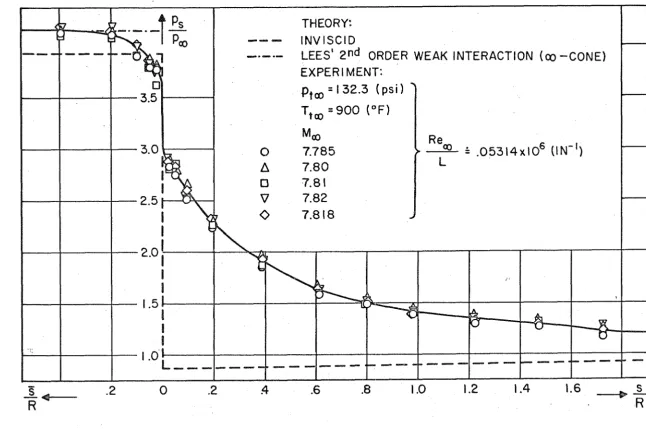
T h e e x p e r i m e n t a l l y found d i s t r i b u t i o n s of s t a t i c p r e s s u r e
along t h e m o d e l s u r f a c e a r e shown i n F i g u r e s 5a through 5 y . F o r
c o m p a r i s o n t h e p r e s s u r e d i s t r i b u t i o n s for inviscid flow and the weak
i n t e r a c t i o n a r e included.
T h e inviscid-flow p r e s s u r e f o r the conical p a r t of the m o d e l
w a s obtained by interpolation of the Kopal t a b l e s a s p r e s e n t e d in
R e f e r e n c e 14. Since the axially- s y m m e t r i c flow a r o u n d t h e shoulder of the p r e s e n t body of revolution i s l o c a l l y a two-dimensional P r a n d t l -
juncture could be obtained f r o m c h a r t s f o r two-dimensional flow. The
s u r f a c e p r e s s u r e f u r t h e r d o w n s t r e a m of t h e shoulder could be obtained
by the method of c h a r a c t e r i s t i c s in axially- s y m m e t r i c flow a s given
i n P r o c e d u r e LA of R e f e r e n c e 15(Isenberg) and w e r e smoothly f a i r e d t o the p r e s s u r e g r a d i e n t which w a s calculated f o r t h e conditions just
d o w n s t r e a m of the cone-cylinder j u n c t u r e using a n a p p r o x i m a t e p r o -
c e d u r e outlined i n R e f e r e n c e
16
(Hakkinen).T h e boundary-layer induced p r e s s u r e on t h e cone w a s c o m -
puted on the b a s i s of L e e s ' weak i n t e r a c t i o n theory, applicable f o r
l a m i n a r hyper sonic flow on a n infinite cone, excluding t h e s t r o n g i n t e r -
a c t i o n r e g i o n ' n e a r ' t h e tip. With t h e introduction of t h e h y p e r sonic
v i s c o u s i n t e r a c t i o n p a r a m e t e r
w h e r e
the induced p r e s s u r e i s given by t h e following a l g e b r a i c r e l a t i o n
The functions F
1
(K)
and 2(K) w e r e taken f r o m Ref. 18. In t h e p r e s e n t c a s e the hyper sonic s i m i l a r i t y p a r a m e t e r w a s K=
1.37. T h e Chapman- Rubesin f a c t o r , C, w a s calculated using S u t h e r l a n d ' s f o r m u l a and the t e m p e r a t u r e f o r a n insulated body. F o r the p r e s e n t c a s e ,C
=
0. 75.00
The s u r f a c e p r e s s u r e s w e r e plotted i n two ways: fir st, t h e
m e a s u r e d p r e s s u r e o v e r f r e e - s t r e a m s t a t i c p r e s s u r e a s a function of the d i s t a n c e s u p s t r e a m and d o w n s t r e a m of t h e shoulder w h e r e the
and, second, t h e s a m e p r e s s u r e r a t i o v e r s u s ( s / L )
,/-
down- s t r e a m and (-;/L)d T o O
u p s t r e a m of the shoulder, respectively. L i s the total wetted length of the cone.According to potential theory the s t a t i c p r e s s u r e along the
cone r e m a i n s constant until the flow expands around the c o r n e r r e -
sulting in a sudden p r e s s u r e d r o p t o s o m e m i n i m u m value just behind
the shoulder. F u r t h e r downstream it a p p r o a c h e s the f r e e - s t r e a m
s t a t i c p r e s s u r e asymptotically. A qualitative c o m p a r i s o n of the m e a -
s u r e d p r e s s u r e distribution with t h e inviscid one yields t h e following
significant r e sult s:
a. The expansion a t the cone-cylinder juncture d o e s have a n
u p s t r e a m effect resulting i n significant p r e s s u r e changes
within t h e influence region of 3 t o 4 t i m e s the l o c a l boundary l a y e r thickness. The p r e s s u r e disturbance propagates
u p s t r e a m i n t h e subsonic p a r t of t h e boundary l a y e r .
b. The p r e s s u r e distribution is not discontinuous at the c o r n e r f r o m t h e potential theory and shows a n obvious smoothing
influence of the viscous l a y e r t o the flow around a s h a r p
c o r n e r .
c. Downstream of t h e c o r n e r t h e s u r f a c e p r e s s u r e is m u c h
higher than the potential t h e o r y prediction. T h e p r e s s u r e
d r o p a t the c o r n e r i s only one-third of the p r e s s u r e d r o p
predicted by the P r a n d t l - M e y e r expansion f o r the inviscid
Mach number a t the cone s u r f a c e and the expansion angle
a t t h e c o r n e r . The p r e s s u r e , then, a p p r o a c h e s gradually
the f r e e s t r e a m value over a distance of s o m e twenty boundary
T h e following tentative flow m o d e l i s proposed t o explain the
above o b s e r v a t i o n s . The boundary l a y e r flow u n d e r g o e s a rapid ex- pansion n e a r t h e c o r n e r . In the m a i n p a r t of the l a y e r the change is
s o rapid i n t h e s t r e a m w i s e d i r e c t i o n t h a t the expansion i s i s e n t r o p i c .
The viscous effects, however, cannot be neglected e v e r y w h e r e , and
n e a r the s u r f a c e we m u s t a s s u m e a v i s c o u s s u b l a y e r w h e r e no s l i p condition i s applied a t t h e wall.
In the inviscid l a y e r , w h e r e i n t h e v i s c o u s e f f e c t s m a y be
neglected, the t r a n s v e r s e p r e s s u r e g r a d i e n t m a y not be neglected.
Then, i n t h e r e g i o n n e a r the c o r n e r , t h e m a j o r p a r t of the p r e s s u r e
v a r i a t i o n i s obtained f r o m t h e expansion of inviscid, non-uniform,
rotational, flow. The solution of t h i s p r o b l e m is not a n e a s y t a s k ,
because the flow is subsonic i n s o m e p a r t s and s u p e r s o n i c i n other.
Some indication of the plausibility of t h i s m o d e l i s provided f r o m t h e
o b s e r v a t i o n t h a t the s u r f a c e p r e s s u r e i n t h e r e g i o n n e a r t h e c o r n e r
a g r e e s f a i r l y w e l l with t h e c h a r a c t e r i s t i c solution f o r r o t a t i o n a l flow
i n the s u p e r s o n i c region.
*
F u r t h e r d o w n s t r e a m t h e computed p r e s -s u r e f a l l s below the m e a s u r e d p r e s s u r e , indicating t h a t t h e v i s c o u s
effect m u s t be taken into account not only i n the v i s c o u s s u b l a y e r but
a l s o i n the o u t e r l a y e r away f r o m t h e c o r n e r .
Plotting the s u r f a c e p r e s s u r e d i s t r i b u t i o n a g a i n s t the d i s t a n c e
n o r m a l i z e d by
d-%
(Fig. 5 y ) shows t h a t i t s c a l e s with the boundaryl a y e r thickness.
*
The n u m e r i c a l solution based on t h e c h a r a c t e r i s t i c method for rotational flow w a s kindly f u r n i s h e d by Dr. J. T. L e e at the TRW Space Technology L a b o r a t o r y . The body contour u s e d i n t h e calcula- tion w a s t h e e x p e r i m e n t a l l y d e t e r m i n e d s t r e a m l i n e with slightly s u p e r-
IV.
2 . Inviscid Flow F i e l dIt is a w e l l known f a c t t h a t t h e s u p e r s o n i c flow p a s t a conical body will have c o n s t a n t physical p r o p e r t i e s along s t r a i g h t l i n e s e m i -
nating f r o m t h e v e r t e x of the cone. In hypersonic flow, however, not
the e n t i r e field f r o m t h e body s u r f a c e t o the shock c a n be t r e a t e d a s a
conical flow, s i n c e t h e s t r o n g boundary l a y e r d i s p l a c e m e n t effect
f o r m s a new "effective" body s h a p e giving r i s e t o c o n s i d e r a b l e c h a n g e s of the inviscid region. B e c a u s e of t h e s t r o n g i n t e r a c t i o n t h e shock
n e a r the t i p is c o n s i d e r a b l y c u r v e d and t h u s the flow c e a s e s t o be
conical.
It is, n e v e r t h e l e s s , believed t h a t m o s t of t h e s t r e a m l i n e s c r o s s i n g t h e m a i n portion of the c u r v e d p a r t of t h e shock a r e contained
i n t h e v i s c o u s l a y e r by the t i m e they r e a c h the c o r n e r .
F i g u r e s 1 7 ' s show the i s o b a r s i n t h e inviscid flow region c o m -
puted f r o m the pitot p r e s s u r e s . The m e a s u r e d pitot p r e s s u r e d i s t r i -
butions w e r e found t o define quite distinctly t h e u p s t r e a m boundary of
t h e expansion fan. It i s s t r a i g h t a s f a r a s c a n be d e t e r m i n e d e x p e r i -
m e n t a l l y and s e e n t o i n t e r s e c t t h e boundary l a y e r edge d i r e c t l y above
the c o r n e r (Fig. 19). In the boundary l a y e r a h e a d of t h e c o r n e r , if we
t a k e the beginning of the expansion a t the point w h e r e t h e s u r f a c e p r e s -
s u r e s t a r t s d e c r e a s i n g (about two boundary-layer t h i c k n e s s e s ahead of
the c o r n e r ) and t r a c e t h e Mach w a v e s f r o m t h i s point i n t h e super sonic
portion, i t a l s o i n t e r s e c t s t h e boundary l a y e r edge d i r e c t l y above the
c o r n e r , giving s o m e support t o t h e flow m o d e l p r o p o s e d i n t h e p r e v i o u s
In F i g u r e 10 s t a t i c p r e s s u r e p r o f i l e s a r e shdwn f o r different
s t a t i o n s d o w n s t r e a m of the c o r n e r . The p r e s s u r e v a r i a t i o n i n t h e
inviscid r e g i o n i s r e p r e s e n t e d a s a d a s h e d line. T h e p a r t which i s continued i n t o the v i s c o u s l a y e r h a s obviously no validity due to the
r a p i d t o t a l p r e s s u r e change t h e r e . On the o t h e r hand, the constant
p r e s s u r e a p p r o x i m a t i o n i n the v i s c o u s l a y e r is not q u i t e c o r r e c t
e v e r y w h e r e i n t h e l a y e r . Near the o u t e r edge t h e r e w i l l be a n a p p r e -
c i a b l e gradient, and t h e a c t u a l p r e s s u r e d i s t r i b u t i o n m a y look like
t h e c u r v e labelled "probable distribution. " In fact, f r o m t h e t r a n s -
v e r s e m o m e n t u m equation i n the boundary l a y e r w e should expect a n
a p p r e c i a b l e p r e s s u r e g r a d i e n t n e a r the o u t e r edge. F r o m t h e mornen-
turn equation
a p
a va y
=
- P U x-
P V a y a V+
( v i s c o u s t e r m s )Introducing t h e following d i m e n s i o n l e s s v a r i a b l e s
-
-
x
=
X/L, y=
y/6-
-
u
=
u/ue, v=
v/(6 ue/L)-
-
P
=
P/P,, P=
P/P,.
w e obtain
a?
t - L ( v i s c o u s t e r m s )b2 ~e
1.
Hence, u n l e s s M ~ S / L
-
0,aF/ay
will not vanish. However, dynami- c a l l y the p r e s s u r e g r a d i e n t i s s t i l l negligible when b/L + 0, since t h ep r o p e r n o r m a l i z a t i o n quantity i s t h e dynamic p r e s s u r e, not the s t a t i c
' p r e s s u r e , when the dynamic effect i s considered. T h e above r e l a t i o n
shows a l s o t h a t t h e p r e s s u r e g r a d i e n t d e c r e a s e s r a p i d l y t o w a r d the
s u r f a c e because
7
a p p r o a c h e s z e r o and t h e o r d e r of magnitude of'i;
IV.
3 . Velocity P r o f i l e sIn F i g u r e s 9a through 9j velocity profiles f o r s e v e r a l stations
a r e shown both i n c o r r e c t e d and uncorrected form. The technique to
c o r r e c t the original d a t a i s d e s c r i b e d in P a r t 111. 1. The velocity w a s non-dimensionalized by dividing the value a t the boundary l a y e r edge
defined i n P a r t 111. 2.
The fact that s e l f - s i m i l a r profiles could be expected up-
s t r e a m of the shoulder unaffected by the expansion prompted the
normalized plot using the squar e - r o o t of t h e f r e e - s t r e a m Reynolds
number based on the wetted distance of the p a r t i c u l a r location f r o m
the apex of the cone. F i g u r e s 9a and 9b, r e p r e s e n t i n g stations on the
cone, of which the l a t t e r one l i e s just u p s t r e a m of the expansion fn-
fluence, show the s i m i l a r i t y a s predicted by theory.
Even though downstream of the c o r n e r
J
K
l o s e s i t s sig-nificance a s a s i m i l a r i t y p a r a m e t e r , the s a m e non- dimensionalization
of the velocity profiles a s indicated above h a s been employed for a l l
stations consistently.
The profiles c e a s e to be s i m i l a r a f t e r the flow h a s undergone
the expansion n e a r the c o r n e r . The profiles show no r e s e m b l a n c e t o
the ones in the undisturbed region on the cone.
The strong favorable p r e s s u r e gradient downstream of the
c o r n e r a c c e l e r a t e s the flow n e a r the wall m o r e than the flow away
f r o m the wall; namely, the velocity profile becomes fuller. This be-
havior i s consistently m o r e apparent a t the lower Reynolds number.
No quantitative t h e o r e t i c a l c o m p a r i s o n c a n be m a d e because of lack of solutions t o the boundary l a y e r equations a p p r o p r i a t e t o the p r e s e n t
In F i g u r e s 14a and 14P n o r m a l i z e d velocity p r o f i l e s down-
s t r e a m of the c o r n e r a r e plotted v e r s u s
7/6.
T h i s plot d i s p l a y sc l e a r l y t h e t r e n d of the profile v a r i a t i o n with the d i s t a n c e f r o m the
shoulder. A s t r o n g a c c e l e r a t i o n of the flow in t h e i n n e r r e g i o n of
t h e boundary l a y e r p e r s i s t s up t o about S/R
=
0. 5. About eight l o c a l boundary l a y e r t h i c k n e s s e s d o w n s t r e a m of the c o r n e r t h e p r e s s u r eg r a d i e n t decayed sufficiently, r e s u l t i n g i n a d e c r e a s e d velocity g r a -
dient a t the wall.
In F i g u r e s 15a and 15P t h r e e "far" d o w n s t r e a m s t a t i o n s being
about 1 t o 2 boundary l a y e r t h i c k n e s s e s a p a r t f r o m e a c h o t h e r show v e r y little change i n t h e i r c h a r a c t e r . T h e p r o f i l e s a l m o s t coincide
and m a y t h u s be called q u a s i self- s i m i l a r . The f a c t that t h e flow
t a k e s long d i s t a n c e s i n r e c o v e r i n g t o the i n i t i a l B l a s i u s - like profile
a f t e r it h a s undergone a n i n t e r a c t i o n with a n expansion fan m a y be
a t t r i b u t e d t o t h e slow p r o c e s s of diffusion, s p r e a d i n g into the p a r t
of the boundary l a y e r of higher M a c h number. T h i s tendency of the
flow s e e m s t o a f f i r m the e a r l i e r mentioned flow m o d e l containing a
strongly v i s c o u s s u b l a y e r with i t s origin a t the c o r n e r .
Through the p r e s e n t a t i o n of the velocity p r o f i l e s i n dimen-
sional f o r m ( F i g u r e s 13a and 13p), it i s intended t o d i s p l a y t h e change
of the p r o f i l e s both n e a r the s u r f a c e and c l o s e t o t h e boundary l a y e r
edge f o r subsequent l o c a t i o n s d o w n s t r e a m of t h e cone- cylinde r junc-
t u r e . Strong c h a n g e s i n the c h a r a c t e r of the c u r v e s a r e
-
a s expected-
m o r e pronounced n e a r the shoulder, and become l e s s f u r t h e r down-
s t r e a m , away f r o m the d i s t u r b a n c e region. F o r t h e l a s t t h r e e s t a t i o n s
In F i g u r e s 12a and 12P velocity profiles u p s t r e a m and down-
s t r e a m of the c o r n e r a r e p r e s e n t e d i n o r d e r t o bring t o light the
s e v e r e difference in t h e i r c h a r a c t e r . Even f o r a "far" downstream
station the velocity d o e s not r e c o v e r t o the B l a s i u s f o r m . A m o r e pronounced deviation a t the s a m e s t a t i o n s i s t o be expected f o r lower
r e s e r v o i r p r e s s u r e s since the lfrelaxation" distance a f t e r t h e expan-
sion will c e r t a i n l y be proportional t o s o m e power of the boundary
l a y e r thickness.
Using one of the flow conditions of the p r e s e n t t e s t , the C r o c c o
solution of the c o m p r e s s i b l e boundary l a y e r equations f o r a flat plate
w a s computed f o r t h e purpose of comparing with the e x p e r i m e n t a l
curves. In Fig. 12a i t i s shown that the t h e o r e t i c a l r e s u l t c o m p a r e s favorably with the s i m i l a r profile m e a s u r e d on the cone.
IV.4. F l o w F i e l d i n B o u n d a r y L a y e r
An a t t e m p t w a s made t o c o n s t r u c t f r o m the m e a s u r e m e n t s t h e complete flow field of the boundary l a y e r n e a r the cone-cylinder
juncture, i n o r d e r t o shed s o m e light on t h e o r e t i c a l a n a l y s e s . F i g -
u r e s 19a and 19p show a resulting picture of the longitudinal section
of the boundary l a y e r flow field in the region of about one boundary
l a y e r t h i c k n e s s u p s t r e a m and four boundary l a y e r t h i c k n e s s e s down-
s t r e a m of the c o r n e r . In t h i s representation, the y-coordinate h a s
not been s t r e t c h e d i n o r d e r t o avoid the distortion. The plot contains
seven s t r e a m l i n e s and a n equal number of constant Mach lines. The
boundary l a y e r edge and t h e initial expansion wave have been included
T h e s t r e a m l i n e s w e r e c h o s e n s u c h that a t t h e s t a t i o n
S
-
=
0.1397
t h e y i n t e r s e c t the constant Mach lines. T h i s a r r a n g e - Rm e n t h a s t h e advantage of indicating strikingly t h e s m a l l e st velocity
changes t h e flow e x p e r i e n c e s during the c o r n e r expansion.
Most of t h e a c c e l e r a t i o n p r o c e s s o c c u r s i n a r a n g e of about
one and a half boundary l a y e r t h i c k n e s s e s d o w n s t r e a m of t h e c o r n e r .
T h e r e the s t r e a m l i n e s tend t o t u r n by a higher angle than the turning
angle of t h e solid boundary. T h i s behavior i s m o r e pronounced for
s t r e a m l i n e s n e a r the wall. At t h i s t i m e i t is not c e r t a i n w h e t h e r t h i s
i s the c o r r e c t p i c t u r e of t h e flow o r t h e e r r o r introduced by the in-
a c c u r a c i e s i n t h e m e a s u r e m e n t s and d a t a reduction p r o c e d u r e s .
Following s t s e a l i n e s i t is o b s e r v e d t h a t the velocity k e e p s
i n c r e a s i n g t o about four boundary l a y e r t h i c k n e s s e s i n t h e subsonic
p a r t and t o about s i x boundary l a y e r t h i c k n e s s e s d o w n s t r e a m of t h e
shoulder n e a r t h e edge of the boundary l a y e r . F u r t h e r d o w n s t r e a m
no significant velocity change o c c u r s in the o u t e r r e g i o n indicating
a m i n o r i m p o r t a n c e of the s h e a r f o r c e s i n t h i s part. Below the
M
=
2. 5 line, however, the p a r t i c l e s on s t r e a m l i n e s g r a d u a l l y d e c r e a s e t h e i r velocity while t r a v e l i n g d o w n s t r e a m . T h i s d e c r e a s e i s m o r epronounced i n the r e g i o n n e a r t h e wall. Such a behavior i s c o n s i s t e n t
with the i d e a of v i s c o u s s u b l a y e r n e a r the wall. F i g u r e s 20a and 2Op
exhibit the c h a n g e s of t o t a l p r e s s u r e along the s t r e a m l i n e s n e a r the
c o r n e r . T h e t o t a l p r e s s u r e w a s non-dimensionalized by the t o t a l
p r e s s u r e s c o r r e s p o n d i n g t o the p a r t i c u l a r s t r e a m l i n e s a t t h e station
-
been used t o n o r m a l i z e t h e longitudinal d i s t a n c e along s t r e a m l i n e s.
L a r g e c h a n g e s i n t o t a l p r e s s u r e o c c u r along s t r e a m l i n e s
c l o s e to the body s u r f a c e when passing o v e r the shoulder. T h e
s t r e a m l i n e i n the subsonic portion s u f f e r s a t o t a l p r e s s u r e l o s s of about 50% of t h e r e f e r e n c e t o t a l p r e s s u r e over a d i s t a n c e of five
boundary l a y e r t h i c k n e s s e s . Along the s t r e a m l i n e s i n t h e o u t e r p a r t
of the boundary l a y e r t h e t o t a l - p r e s s u r e g r a d i e n t n e a r the shoulder
is not l a r g e r t h a n i n a n y o t h e r region.
F i g u r e 18 shows the flow field f u r t h e r d o w n s t r e a m and
d e m o n s t r a t e s the r a p i d growth of t h e boundary l a y e r i n the r e g i o n
extending f r o m t h e c o r n e r to t h r e e boundary l a y e r t h i c k n e s s e s down-
s t r e a m .
It s e e m s noteworthy t h a t n e a r the c o r n e r the subsonic l a y e r
a m o u n t s t o 25% a n d 2 0 s of t h e c o r r e s p o n d i n g boundary l a y e r t h i c k n e s s 6 - 1
f o r t h e f r e e - s t r e a m Reynolds n u m b e r s 0. 1042 X 10 i n and 0.05314
-
1x
1 0 ' ~ i n,
r e s p e c t i v e l y , indicating that t h e subsonic portion is by noV. CONCLUSIONS
F r o m t h e r e s u l t s obtained in the p r e s e n t study the following
conclusions m a y be d r a w n r e g a r d i n g the hypersonic boundary l a y e r
around a s h a r p expansion c o r n e r :
1. The s u r f a c e p r e s s u r e distribution b e a r s no r e s e m b l a n c e t o
t h e inviscid p r e s s u r e distribution predicted by simple wave theory.
I t s behavior c a n be partially explained by the m e c h a n i s m of i s e n t r o p i c
expansion of t h e rotational flow i n the boundary l a y e r .
2 . The P r a n d t l - M e y e r expansion fan in the e x t e r n a l flow i s not c e n t e r e d at t h e c o r n e r . At t h e boundary l a y e r edge i t i s s p r e a d over s e v e r a l boundary l a y e r t h i c k n e s s e s .
3. A r a p i d thickening of t h e viscous l a y e r is o b s e r v e d about one
boundary l a y e r thickness downstream of the shoulder.
4. The velocity g r a d i e n t n e a r t h e body s u r f a c e downstream of the c o r n e r becomes l a r g e , indicating a l a y e r of i n c r e a s e d s h e a r n e a r the
surface. R e c o v e r y t o B l a s i u s profiles downstream of t h e shoulder
r e q u i r e s a d i s t a n c e of many boundary l a y e r thicknesses.
In the p r e s e n t investigation a few a s s u m p t i o n s w e r e m a d e in
the data reduction s o m e of which a r e in contradiction with the experi-
m e n t a l observations. In o r d e r to obtain m o r e r e l i a b l e r e s u l t s , the
following r e f i n e m e n t s a r e recommended:
1. A s y s t e m a t i c study be m a d e on the disturbance c a u s e d by the pitot probe and the n e c e s s a r y c o r r e c t i o n s f o r the pitot p r e s s u r e readings
2 7
2. T h e t e m p e r a t u r e d i s t r i b u t i o n s be m e a s u r e d i n t h e boundary
l a y e r .
3. A v a r i a t i o n of t h e s t a t i c p r e s s u r e be included i n t h e d a t a reduction e s p e c i a l l y n e a r the c o r n e r . It i s a n a l m o s t i m p o s s i b l e
t a s k to m e a s u r e d i r e c t l y t h e p r e s s u r e d i s t r i b u t i o n i n t h e l a y e r , and
p e r h a p s a n i t e r a t i v e technique c a n be used f o r e s t i m a t i n g t h e s t a t i c
p r e s s u r e g r a d i e n t s .
T h e p r e s e n t study s u g g e s t s f u r t h e r inyestigations on the
effects of (1) the v a r i a t i o n of t h e c o r n e r expansion angle; ( 2 ) s u r f a c e
cooling; ( 3 ) rounding-off the c o r n e r , and extensions t o t h e two-
R E F E R E N C E S
1. Murthy, K. R. A. : "Investigation of t h e I n t e r a c t i o n of a Turbulent Boundary L a y e r with P r a n d t l - M e y e r Expansion F a n s a t
M = 1 . 8 8 , " P r i n c e t o n Univ., Dept. of Aero. E n g r g . , R e p o r t 403, November 1957.
.
2. S t e r n b e r g , J. : "The T r a n s i t i o n F r o m a Turbulent t o a L a m i n a r Boundary L a y e r , I ' B a l l i s t i c R e s e a r c h L a b o r a t o r i e s , Aberdeen
Proving Ground, R e p o r t No. 906, May 1954.
3. Zakkay, V. and T. Tani: " T h e o r e t i c a l and E x p e r i m e n t a l Inves- tigation of the L a m i n a r Heat T r a n s f e r D o w n s t r e a m of a S h a r p C o r n e r ,
"
Polytechnic Inst. of Brooklyn, Dept. of A e r o s p a c e Engrg. and Appl. Mech., PIBAL Rept. No. 708, ~ c t o b e r1961.
4. Zakkay, V., Toba, K. and Kuo, T. J. : " L a m i n a r , Transitional, and T u r b u l e n t Heat T r a n s f e r a f t e r a S h a r p Convex C o r n e r ,
"
A I A A J o u r . , Vol. 2, No. 8, pp. 1389-1395, Aug. 1964. 5. Zakkay, V. : "Heat T r a n s f e r a t a C o r n e r , " J o u r . of the Aero.Space Sci., Vol. 27, No. 2, pp. 157-158, F e b . 1960.
6.
Goldstein, S. : "Concerning Some Solutions of the BoundaryLaye r Equations i n Hydrodynamic s, I f P r o c e e d i n g s of the
C a m b r i d g e Philosophical Society, Vol. 25, P a r t I, pp. 1-30, 1930.
7. W e i n b a ~ r n , S. : "The Rapid Expansion of a Supersonic Shear Flow, I ' A v c o - E v e r e t t R e s e a r c h R e p o r t 204, Jan. 1965. 8. Young, A. D. and Maas, J. N. : "The Behavior of a Pitot Tube
i n a T r a n s v e r s e Total P r e s s u r e Gradient, " Aeronautical
R e s e a r c h Council, London, Rep. and Mem. No. 1770, 1936. 9. Davies, F. V. : "Some E f f e c t s of Pitot Size on t h e M e a s u r e m e n t
of Boundary L a y e r s in Super sonic Flow,
"
Royal A i r c r a f t E s t a b l i s h m e n t , F a r n b o r o u g h , Tech. Note No. AERO. 2179, Aug. 1952.10. Johannsen, N. H. and M a i r , W. A. : " E x p e r i m e n t s with L a r g e Pitot Tube i n - a N a r r o w Supersonic Wake," J o u r . of Aero- n a u t i c a l Sciences, Vol. 19, No. 11, pp. 785- 787, Nov.
1952.
11. Sherman, F. S. : "New E x p e r i m e n t s on I m p a c t - P r e s s u r e I n t e r - p r e t a t i o n i n Supersonic and Subsonic R a r e f i e d A i r S t r e a m , "
12. Matthews, M. L. : "An E x p e r i m e n t a l Investigation of Viscous E f f e c t s on Static and I m p a c t P r e s s u r e P r o b e s i n Hyper sonic Flow. GALCIT Hypersonic R e s e a r c h P r o j e c t M e m o No. 44, June 1958.
13. P o t t e r , J. L, a n d Bailey, B. : " P r e s s u r e s i n t h e Stagnation Regions of Blunt Bodies i n the V i s c o u s - L a y e r to M e r g e d - L a y e r R e g i m e s of R a r e f i e d Flow, " von K a r m a n G a s dynam-
i c s F a c i l i t y , ARO, Inc., Technical D o c u m e n t a r y Report NO. AEDC-TDR-63-168, Sept. 1963.
14. Sims,
J.
L. : "Tables f o r Super sonic F l o w Around Right C i r c u l a r C o n e s a t Z e r o Angle of Attack, ' I NASA SP- 3004, 1964.15. Isenberg, J. S. : "The Method of C h a r a c t e r i s t i c s i n C o m p r e s s i b l e Flow,
"
P a r t I. Steady Supersonic Flow. A i r M a t e r i a l Com- m a n d T e c h n i c a l R e p o r t No. F - T R - 11 73A-ND, D e c e m b e r 1947. 16. Hakkinen, R. J. : " F u r t h e r Re su1t.s on Supersonic F l o w NearConvex C o r n e r s , " Douglas R e p o r t SM-35992, M a r c h 22,
1960.
17. Hakkinen, R. J. : "Supersonic Flow Two-Dimensional. and Axially- S y m m e t r i c Convex C o r n e r s an'd C u r v a t u r e Discon- t i n u i t i e s , I ' Douglas R e p o r t No. SM- 27747, July 15, 1958.
0 0 0 0
I---
1
TRANSDUCER
HYPERSONIC WIND TUNNEL
0
UNCORRECTED
CORRECTED (NEAR W A L L )
0
4
8
12
16
20
.
0
4
8
12