Volume 2007, Article ID 79248,11pages doi:10.1155/2007/79248
Research Article
A Joint Optimization Criterion for Blind DS-CDMA Detection
Iv ´an Dur ´an-D´ıaz and Sergio A. Cruces-Alvarez
Departamento de Teor´ıa de la Se˜nal y Comunicaciones, Escuela T´ecnica Superior de Ingenieros, Universidad de Sevilla, Camino de los Descubrimientos s/n, 41092 Sevilla, Spain
Received 30 September 2005; Revised 9 May 2006; Accepted 11 June 2006
Recommended by Frank Ehlers
This paper addresses the problem of the blind detection of a desired user in an asynchronous DS-CDMA communications system with multipath propagation channels. Starting from the inverse filter criterion introduced by Tugnait and Li in 2001, we propose to tackle the problem in the context of the blind signal extraction methods for ICA. In order to improve the performance of the detector, we present a criterion based on the joint optimization of several higher-order statistics of the outputs. An algorithm that optimizes the proposed criterion is described, and its improved performance and robustness with respect to the near-far problem are corroborated through simulations. Additionally, a simulation using measurements on a real software-radio platform at 5 GHz has also been performed.
Copyright © 2007 I. Dur´an-D´ıaz and S. A. Cruces-Alvarez. This is an open access article distributed under the Creative Commons Attribution License, which permits unrestricted use, distribution, and reproduction in any medium, provided the original work is properly cited.
1. INTRODUCTION
Direct-sequence code-division multiple access (DS-CDMA) is a common technique in mobile communications that com-plements other preexisting access techniques such as TDMA or FDMA [1–7]. In systems that use CDMA, users share the same band of frequencies and the same time slots. So the sig-nal that arrives at the receiver is a superposition (in time and frequency) of contributions from different users. Since the objective of the receiver is to extract the symbols sequence of the desired user, the system needs some prior information to achieve this aim. This information is the user’s code, also called spreading sequence. Each user transmits with a diff er-ent cyclic code that multiplies its symbols. For different users, codes are quasiorthogonal. In this way, the receiver can sepa-rate the users’ contributions by means of the codes.
When there is multipath propagation, we have to sup-press the channel effects. Supervised algorithms use training sequences that provide the receiver with knowledge about the channels. Blind detection of users can be performed to obtain the symbol sequence of a desired user without knowledge of the propagation channels. The use of blind techniques in-creases the performance of the transmission system, avoiding the overheads associated with the transmission of training sequences, and providing increased robustness for channels with severe fading [1,3,8].
In the literature, there are several blind criteria for the es-timation of a specific user with knowledge only of its spread-ing code. Some authors proposed the use of MMSE cri-teria to exploit the signal subspace defined by the desired user’s code [2, 8]. In [9], a blind detection scheme based on the constant modulus algorithm (CMA) was addressed, where initialization was the key for the detection of the de-sired user. Other authors also consider the existence of mul-tiple antennas [8, 10–12] in order to improve the perfor-mance of the algorithms by exploiting the increased spa-tial diversity of the resulting model. The inverse filter crite-rion (IFC) for blind equalization has also received increas-ing attention because of its capability for suppressincreas-ing the MAI (multiaccess interference) and ISI (intersymbol inter-ference) in DS-CDMA systems [13]. In [1], a gradient im-plementation of the IFC with code constraints was proposed for asynchronous DS-CDMA systems with multipath chan-nels.
ICA-based criteria are able to blind detect the desired transmitted signal. These criteria usually exploit the non-Gaussianity of the sources together with the a priori infor-mation of the spreading code of the desired user, but without the knowledge of the spreading codes of the rest of the users. BSE allows us to blindly obtain the symbols sequence of a user and, in order to ensure that this user is the desired one, we need to constrain the extraction system from the knowl-edge of the user’s code.
In this paper, we pay special attention to the implemen-tations of the inverse filter criterion with code constraint. One of these implementations [1] maximizes the normalized fourth-order cumulant of the output subject to a constraint on the extraction system (similar to the one proposed in [8]). Recently, some joint optimization approaches based on higher-order cumulants have been proposed in the context of ICA [15–17]. This paper, which presents an enhanced ex-tension of the preliminary results given by us in [16], shows how the extension of the criterion to consider the joint opti-mization of fourth- and sixth-order cumulants leads to an improvement in the MSE (mean square error) of the de-tected user of about 10 dB, which is increasingly significant for good signal-to-noise ratio and short data records. More-over, a prewhitening of the observations results in a better conditioning for the algorithms, which also reduces the MSE by about 5 dB.
In order to corroborate the theoretical behavior of the al-gorithms, we built a software radio platform at 5 GHz aimed at the development of radio interfaces for the fourth gen-eration of mobile communication systems. This platform has been widely characterized [18]. Real measurements of a WCDMA-3GPP signal transmitted at 3.84 Mchip/s have been obtained for testing the analyzed blind detection algorithms. The paper is structured as follows. Section 2 presents a model of the observations vector in DS-CDMA systems, while Section 3 shows how the code of the desired user can be used to constrain the extraction vector. Section 4.1
summarizes the criterion and extraction algorithm intro-duced in [1]. In Section 4.2, we present the incorporation of prewhitening and the extension of the criterion to con-sider the joint optimization of several cumulant orders. In
Section 5, we use simulations to corroborate the theoretical behavior of the algorithms that optimize the criteria. An-other simulation, with real measurements from the software radio platform we have built, is presented in Section 6. Fi-nally,Section 7presents the conclusions.
2. SYSTEM MODEL
Our objective is the blind detection of a user in a communi-cations system that uses DS-CDMA. In our case, blind detec-tion consists in the blind extracdetec-tion of the symbols sequence of the desired user. The proposed receiver is a BSE algorithm modified by a constraint which enforces the extraction of the desired user.
In the blind signal extraction problem for linear and in-stantaneous mixtures, one typically considers the existence ofNindependent source signalss(k)= [s1(k),. . .,sN(k)]T.
In the presence of white additive Gaussian noisen(k) of zero mean and varianceσ2
n, these signals are combined by a linear
memoryless system characterized by theM×Nfull column rank matrixAwithM ≥Nbeing the vector ofM observa-tions
x(k)=As(k) +n(k). (1)
The BSE problem consists in recovering a subset ofK ∈ {1,. . .,N} sources from this observations vector without knowledge of the mixture system. The recovery of the desired sources can be split into two steps. The first step prewhitens the observations, and the second extracts the desired source. The prewhitened observations are
z(k)=Wx(k), (2)
whereWis theM×Mmatrix which enforces the prewhiten-ing or spatial decorrelation of the signal component of the observations.
Multiplyingz(k) by a separation or extractionK×M ma-trixU, one can obtain the vector ofKoutput signals or esti-mated sources
y(k)=Uz(k)=Gs(k) +UWn(k), (3)
where theK ×N matrix G := UWAis the global transfer matrix from the sources to the outputs.
Next, we will describe the steps that convert the problem of blind detection of a user in a DS-CDMA system into a linear and memoryless BSE problem. In similarity with pre-vious works (see [1–3,5,8,19,20]), we will rearrange the observed data (the received signal) into a sequence of vectors in order to obtain an instantaneous MIMO model.
We consider a system withNuusers and a process gain
ofNc chips per symbol. The chips’ sequence (or spreading
sequence) of the jth user can therefore be grouped into the vector
cj=
cj(0),. . .,cj
Nc−1
T
. (4)
Since the spreading sequence has exactly one symbol of dura-tion, we are dealing with a short-code DS-CDMA system. In future high-capacity systems, short codes will become more useful than long codes. The reason is that the MAI in one symbol has identical statistics to the MAI in the next symbol, which allows the multiuser receiver to know adaptively the interference structure [3,14].
The symbol sequence transmitted by thejth user is de-noted by{bj(k)}. The symbols of each sequence are complex
(the modulation can have quadrature components), zero-mean, independent and identically distributed (i.i.d.). For different values of j, the{bj(k)}terms are also mutually
in-dependent.
To construct the transmitted signal, we cyclically send the chip sequence multiplied at each period by a symbol. The discrete signal transmitted by the jth user is therefore
xj(k)=
∞
n=−∞
bj(n)cj
k−nNc
In the case of the uplink, each user has his own linear and dispersive propagation channel. The impulse response of this channel sampled at the chip interval Tc isgj(n) for
thejth user. For the uplink,gj(n)’s are different for different j’s, whereas for the downlink, they are identical. The discrete impulse response includes the effects of chip-matched filter-ing at the receiver (see [3]) but not the transmission delay (modulusNc) of the jth user,dj, that we assume to satisfy
0 ≤dj ≤Nc−1. Thus, we are assuming asynchronism
be-tween users.
The transmitted signal will pass through the correspond-ing channel. We can group the effect of the chip sequence and the channel into the effective channel
hj(k) := Nc−1
n=0
cj(n)gj(k−n). (6)
Therefore, we can express the contribution of thejth user at the receiver after being sampled atTcas
xj(k)=
∞
l=−∞
bj(l)hj
k−dj−lNc
. (7)
The total received signalx(k) is the superposition of the contributions of the Nu users in the presence of additive
white Gaussian noise,
x(k)=
Nu
j=1
xj(k) +n(k). (8)
This is a locally cyclostationary process. Since we aim to work with a locally stationary process, we will define a convolutional MIMO model (multiple inputs and multiple outputs) and then convert this model into an instantaneous MIMO model.
To construct the convolutional MIMO model, we group
Nc consecutive samples of x(k) in the vector x(k), so that
x(k) = [x(kNc+Nc−1),. . .,x(kNc)]T. By similarly
defin-inghj(l) = [hj(lNc−dj+Nc−1),. . .,hj(lNc−dj)]T and
n(k) = [n(kNc+Nc−1),. . .,n(kNc)]T, the convolutional
MIMO model is
x(k)= Nu
j=1
Lj
l=0
hj(l)bj(k−l) +n(k). (9)
If we assume that multipath delays have a duration of at most one symbol (gj(l)=0 forl <0 andl > Nc) and recalling
that 0≤dj< Nc, we havehj(l)=0 forl <0 andl≥3. Thus Lj=2 forj=1,. . .,Nu.
By defining the vectors(k)=[b1(k),. . .,bNu(k)]Tand the
matrixH(l)=[h1(l),. . .,hNu(l)] ofNc×Nuorder, we have
x(k)= H(0) H(1) H(2) ⎡ ⎢ ⎣
s(k)
s(k−1)
s(k−2) ⎤ ⎥
⎦. (10)
The following step will convert the convolutional MIMO model into an instantaneous MIMO model. In order to do
this, we define the vectorx(k), the observations vector in the BSE model,
x(k) := x(k)T,. . .,xk−L
e+ 1
TT
. (11)
In the same, way we define noise vectorn(k). By defining the vector of sources
s(k)= s(k)T,. . .,sk−Le−1
TT
, (12)
and the linear and instantaneous mixing matrix
A=
⎡ ⎢ ⎢ ⎢ ⎢ ⎢ ⎣
H(0) H(1) H(2) 0 0 · · · 0
0 H(0) H(1) H(2) 0 · · · 0
..
. . .. ...
0 · · · H(0) H(1) H(2)
⎤ ⎥ ⎥ ⎥ ⎥ ⎥
⎦,
(13)
we have obtained the linear and memoryless BSE model of (1).
Now, the defined vector of sources consists of delayed versions of the symbol sequences of all users. Since these sequences are i.i.d. and mutually independent, we can af-firm that the vector s(k) actually consists of indepen-dent sources. If we define the elements of s(k) as s(k) =
[s1(k),s2(k),. . .,sNu(Le+2)(k)]T, the source sj+Nud(k) is the
symbol sequence of the jth user with a delay d, that is,
bj(k−d), with 0≤d≤Le+ 1.
The vectorx(k) is of dimensionNcLe×1, the matrixA
is of dimension NcLe ×Nu(Le + 2), andsis of dimension Nu(Le+ 2)×1. Following the notation for BSE,M =NcLe
is the number of observations and N = Nu(Le+ 2) is the
number of independent sources. The minimum number of delaysLewe have to introduce into the model is that which
allows us to obtain at least as many observations as sources, that is,Lemust satisfy
Le≥ 2Nu Nc−Nu.
(14)
3. CODE-CONSTRAINED CRITERION
In the previous section, we showed how to transform the DS-CDMA system model into a linear, instantaneous mix-ing model. Once this is done, one can apply an extraction algorithm to the observations vector and extract the symbol sequence of a user. However, in general, this does not ensure that the resulting symbol sequence corresponds to that of the desired user. To achieve this, we need to incorporate an addi-tional constraint into the extraction algorithm.
Let us assume that we want to obtain the symbol se-quence of the userj0with a delayd. In the absence of noise, after prewhitening the observations, the true extraction vec-toru∗is a row vector (a 1×NcLematrix) that satisfies
u∗WA=αeTp, (15)
where ep is the unit-norm coordinate vector whose single
nonzero element is at positionp=j0+Nud, andαis a
com-plex constant. Note that the minimum norm solution foru∗
is
u∗=αeTpAHWH. (16)
From the model, one can observe that
αeTpAH=α
hHj0(d),. . .,h H
j0(0), 0,. . ., 0
. (17)
By defining h(jd):=[hHj(d),. . ., hHj(1)hHj(0)]H, and recalling
thatgj(l) is 0 forl > Ncand forl <0, and 0≤dj < Nc, we
have
h(jd)=C
(d)
j gj, (18)
with
C(jd):= ⎡ ⎢ ⎢ ⎢ ⎢ ⎢ ⎢ ⎢ ⎢ ⎢ ⎢ ⎢ ⎢ ⎢ ⎢ ⎢ ⎢ ⎢ ⎢ ⎢ ⎢ ⎢ ⎢ ⎢ ⎢ ⎢ ⎢ ⎢ ⎢ ⎢ ⎢ ⎢ ⎢ ⎣
0 0 · · · 0
..
. ... . .. ...
cj
Nc−1
0 · · · 0
cj
Nc−2
cj
Nc−1
· · · 0 ..
. ... . .. ...
cj(0) cj(1) · · · 0
0 cj(0) · · · 0
..
. ... . .. ...
0 0 · · · cj
Nc−1
..
. ... . .. ...
0 0 · · · cj(0)
⎤ ⎥ ⎥ ⎥ ⎥ ⎥ ⎥ ⎥ ⎥ ⎥ ⎥ ⎥ ⎥ ⎥ ⎥ ⎥ ⎥ ⎥ ⎥ ⎥ ⎥ ⎥ ⎥ ⎥ ⎥ ⎥ ⎥ ⎥ ⎥ ⎥ ⎥ ⎥ ⎥ ⎦ ,
gj:=gj
2Nc−1−dj
,. . .,gj
−dj+ 1
,gj
−dj
T
.
(19)
The Toeplitz matrix C(jd) of dimensions [(d+ 1)Nc]×
[2Nc] is similar to the one given in [1,5,8].
From (16), (17), and (18), we can state that
u∗=αgHj0C (d)H
j0 W
H, (20)
where
C(d)
j0 =
C(jd0) 0
(21)
is anNcLe×2Ncmatrix.
By definingP:=WC(j0d), one can rewrite (20) as
u∗=αgHj0P
H, (22)
which is the extracting vector at the solution. SincePis an
NcLe×2Nc matrix andLe > 2, the channel vector can be
expressed as
αgH
j0=u∗P
PHP−1. (23) Let the row vectoru(i)be the estimated extraction vec-tor obtained after theith iteration of the BSE algorithm. In contrast with the true extraction vectoru∗, in general, the
estimated vector does not belong to the subspace spanned by the rows ofPH. The least-squares solution to the inequation
u(i)=αgH
j0P
Hgives the estimated channel vector
αgHj0=u(i)PPHP−1, (24) and, in analogy with (22), from this last result one obtains the new composite extracting vector as
u(i)Πc=αgH
j0P
H, (25)
where
Πc=PPHP−1PH (26)
denotes the projection matrix onto the subspace spanned by the columns ofP. Thus, in order to favor the detection of the desired user, one can automatically incorporate the projec-tion into the preprocessing by simply redefining the observa-tions vector as
z(k)=ΠcWx(k). (27)
4. EXTRACTION ALGORITHMS
In this section, we will first present the existing implemen-tation of the inverse filter criterion. Later on, we consider an algorithm that implements the joint optimization of several higher-order cumulants.
4.1. Algorithm derived from the inverse filter criterion
In [1], Tugnait and Li propose to solve the deconvolution problem by passing the observationsx(k) through an inverse filter or equalizer. Letb(i) denote the row inverse filter ofLe
taps, and whose elements have dimension 1×Nc. The output
of this filter is
y(k)=bx(k)= Le−1
i=0
b(i)x(k−i), (28)
whereb=[b(0),b(1),. . .,b(Le−1)] can be considered as an
extraction vector.
The inverse filter maximizes the contrast function pro-posed by Shalvi and Weinstein (see [21]),
J42(b)=
cum4
yk
cum2
Therth-order cumulants involved (r =2, 4) are real, since they have half of the arguments equal and the other half equal to their conjugates, that is, they have the following structure:
cumr(y)≡cum
y∗,. . .,y∗
×r/2
,y,. . .,y
×r/2
. (30)
The computation of these cumulants in terms of moments, for low orders, is detailed in the appendix.
In the absence of noise, the recovery at the output of the desired j0th user is achieved blindly through the maximiza-tion of (29) with respect to the row vectorb, up to a complex constantα=0, and an arbitrary delay 0≤d≤Le−1 +Lj0, that is,
y(k)=αbj0(k−d). (31)
The algorithm proposed in [1] does not consider prewhitening and adapts the equalizer by means of a gradi-ent algorithm, followed by the projection of the extraction vector onto the subspace spanned by the rows of (R−1
xxC
(d)
j0 ) H.
4.2. Algorithm derived from a joint
optimization criterion
We have seen that the inverse filter criterion solves the prob-lem of blind source extraction by using a contrast function which is based on the second- and fourth-order cumulants of the outputy(k). Recently, the importance of combining the information from several higher-order statistics as a means of improving the accuracy of the results has been highlighted in [15–17]. In the same line of work, we propose here an al-gorithm which is able to optimize a contrast function that combines information from several higher-order cumulants of the output. As will be shown in the next section, the pro-posed algorithm yields improved results in the detection of the desired user.
Let us recall that with the prewhitening of the obser-vations, and the projection that favors the detection of the desired user, the preprocessed observationsz(k) can be ob-tained from (27) while the output is computed as y(k) = uz(k), whereuis a unit-norm row vector.
We propose to estimate the desired independent compo-nent by maximizing a weighted square sum of a combination of cumulants of the output with ordersr ∈ Ω. A contrast function that achieves this objective is given by
ψΩ(y)=
r∈Ω
αrcumr
y(k)2 subject to u 2=1,
(32)
where αr are positive weighting terms. Let us define q =
max{r ∈ Ω}, in our case, we choose to optimize the set of cumulant orders Ω = {4, 6}. Our choice is motivated be-cause the low-order cumulants are those which can be esti-mated with greater accuracy, but the second-order cumulant is already used in the prewhitening step and the odd-order cumulants are zero for symmetric distributions, which pre-cludes them from being used by the criterion.
The only problem with this approach is the difficulty of the optimization of (32), which is highly nonlinear with re-spect to u. We can circumvent this difficulty by proposing a similar contrast function to (32) but whose dependence with respect to each of the extracting system candidates is quadratic, and thus, much easier to optimize using algebraic methods.
Consider a set of q candidates for the extracting sys-tem {u[1],. . .,u[q]}each of unit 2-norm. The correspond-ing set of their respective outputs is denoted by y = {y[1](k),. . .,y[q](k)}. We define a multivariate function
ψΩ(y)=
r∈Ω αr
q r
σ∈Γq r
cumy[σ1](k)
∗
,. . .,y[σr/2](k)
∗
,
y[σr/2+1],. . .,y[σr](k) 2
,
(33)
whereαr>0 andΓ q
ris the set of all the possible combinations
(σ1,. . .,σr) of the elements in{1,. . .,q}takenrat a time.
Theorem 1. The functionψΩ(y), which is invariant with re-spect to the permutation of its arguments, is maximized at the extraction of one of the users. At this extreme point, all the out-puts coincide with one of the transmitted signalsy[1](k)ejθ1 =
· · · = y[q](k)ejθq =αb
j0(k−d), up to some constant scaling
and phase termsθ1,. . .,θq.
There is an interpretation of this theorem in terms of a low-rank approximation of a set of cumulant tensors [22]. A sketch for the proof of this theorem is presented in [23].
The invariant property ofψΩ(y) with respect to
permu-tations in its arguments allows us to describe the dependence of the function with respect tou[m]in the following expres-sion:
φΩ
u[m]=
r∈Ω αr
q r
×
ρ∈Γq−1
r−1
cumy[m](k)∗,y[ρ1](k)
∗
,. . .,
y[ρr/2−1](k)
∗
,y[ρr/2],. . .,y[ρr−1](k) 2
,
(34)
where Γrq−−11 is the set of all the possible combinations (ρ1,. . .,ρr−1) of the elements in{1,. . .,m−1,m+ 1,. . .,q} takenr−1 at a time.
Observe that now the dependence of the contrast func-tion with respect to each of the extracting system candidates is quadratic. Thus,ψΩ(y) can be cyclically maximized with
respect to each one of the elementsu[m],m=1,. . .,q, while the others remain fixed. Then, at iterationi, one optimizes
unlikely) convergence to saddle points. In any case, in com-munications, the cumulants of the transmitted signals are known in advance, so one can evaluate a priori the global maximum of the contrast function in order to check, later, after the convergence, whether a valid solution has been ob-tained.
The previous approach works quite well. However, the speed of convergence of the algorithm could be accelerated if, after each iteration, one projects the candidates onto the symmetric subspace that contains the solutions, that is, one enforces y[1](k)= · · · = y[q](k). This projection still guar-antees the monotonous ascent when the contrast function
ψΩ(y) is shown to be a convex function in the convex
do-mainS= {u: u 2≤1}, see [24]. An additional advantage of this projection is that it improves the accuracy in the es-timation of the statistics involved, because, for constellations like QPSK, the symmetry in the arguments of the cumulants usually reduces the variance of their sample estimates.
After this projection step, one no longer needs to main-tain the notation for all the extraction candidates, since they will be equal, and one only has to distinguish between the value of the extraction candidate that one is optimizing at the
ith iterationu(i)and its value at the previous iterationu(i−1). One can observe that the cyclic maximization of the contrast function with respect to u[m] withm = (i modq) + 1, is now equivalent to the sequential maximization through iter-ations, with respect to the extraction vectoru(i), of the func-tion
φΩ
u(i)
=
r∈Ω r qαr
cumy(i)(k)∗,y(i−1)(k)∗,. . .,
y(i−1)(k)∗,y(i−1),. . .,y(i−1)(k) 2
=u(i)∗M(i−1)u(i)T
(35)
which results from the simplification of (34). Note that M(i−1)is a matrix which does not depend on u(i) and that it is given by
M(i−1)= r∈Ω
r qαrc
(i−1)
zy (r)
c(ziy−1)(r)
H
, (36)
wherec(ziy−1)(r) is defined as
c(ziy−1)(r)=cum
z∗(k),y(i−1)(k)∗,. . .,
y(i−1)(k)∗,y(i−1),. . .,y(i−1)(k)
.
(37)
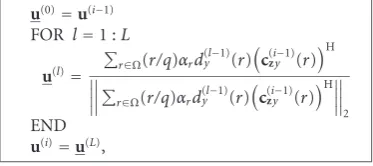
At each iteration, the maximizationφΩ(u(i)) is obtained by
finding the eigenvector associated to the dominant eigen-value of M(i−1). Starting from the previous solution, if one considers using L iterations of the power method to ap-proximate the dominant eigenvector (in practice L = 1 or
u(0)=u(i−1)
FOR l=1 :L
u(l)=
r∈Ω(r/q)αrd(yl−1)(r)
c(ziy−1)(r) H
r∈Ω(r/q)αrd(yl−1)(r)
c(ziy−1)(r) H
2
END u(i)=u(L),
Algorithm1: The extraction algorithm.
2 works well), Algorithm 1 is obtained, whered(yl−1)(r) =
(u(l−1))∗c(i−1)
zy (r).
5. SIMULATIONS
In order to test the performance of the criteria, we performed extensive simulations of the corresponding algorithms in dif-ferent situations. They were compared in terms of the MSE between the output and the symbol sequence of the desired user and in terms of the probability of symbol error.
We considered three users and we performed two diff er-ent simulations: one in which all users were received with the same power, and another in a near-far situation where the power of an interfering user was 10 dB greater than that of the desired user. Each user transmitted 200 symbols with a QPSK modulation. The processing gain or spreading factor was set to 8 chips/symbol where the chips take values in±1. Each of the channels consists of four multipaths with com-plex Gaussian random amplitudes and uniform random de-lays. The observations were arranged as in (11) to obtain an observations vectorx(k) of length 24, that is, we setLe=3.
As it is usual, the algorithms are run in two stages pre-ceded by an initialization. This initialization was chosen sim-ilar to the one detailed in [1]. In the first stage, the maxi-mization of the contrast function is achieved by using the projected and prewhitened observations. This leads to the extraction of the desired user. In the second stage, the ex-traction vector obtained at the end of the first stage is used as the initialization for the unconstrained maximization of the contrast function. In this second stage, we do not impose the projection of the observations. This leads to an improvement of the results, since, in practice, the data-based constraint is not fully accurate due to the small number of samples and the noise.
InFigure 1, we present the MSE versus the SNR which resulted from the simulations. We compared the results of the algorithm of [1] with and without prewhitening, and the algorithm of combined cumulants withΩ= {4, 6}and
α4=α6=0.5. In the figure, one can see that the prewhiten-ing reduces the MSE between the output and the desired user. When we use the proposed algorithm, the reduction in MSE is more evident, and this improvement increases with the SNR. Additionally, by comparing Figures1(a)and1(b), one can observe that the proposed algorithm is more resistant to the near-far problem.
35 30 25 20 15 10 5
MSE
(dB)
0 5 10 15 20 25 30
SNR (dB)
The result of the algorithm (29) without prewhitening The same algorithm with prewhitening
The proposed algorithm (a)
35 30 25 20 15 10 5
MSE
(dB)
0 5 10 15 20 25 30
SNR (dB)
The result of the algorithm (29) without prewhitening The same algorithm with prewhitening
The proposed algorithm (b)
Figure1: The MSE between the output and the desired user over 100 Monte Carlo runs: (a) equal power situation (MAI=0 dB) and (b) near-far situation (MAI=10 dB).
10 4
10 3
10 2
10 1
P
robabilit
y
o
f
sy
m
bol
er
ror
0 5 10 15
SNR (dB) The algorithm presented in [1] The algorithm proposed in this paper
(a)
10 4
10 3
10 2
10 1
P
robabilit
y
o
f
sy
m
bol
er
ror
0 5 10 15
SNR (dB) The algorithm presented in [1] The algorithm proposed in this paper
(b)
1 0.5 0 0.5 1
1 0.5 0 0.5 1
(a)
1 0.5 0 0.5 1
1 0.5 0 0.5 1
(b)
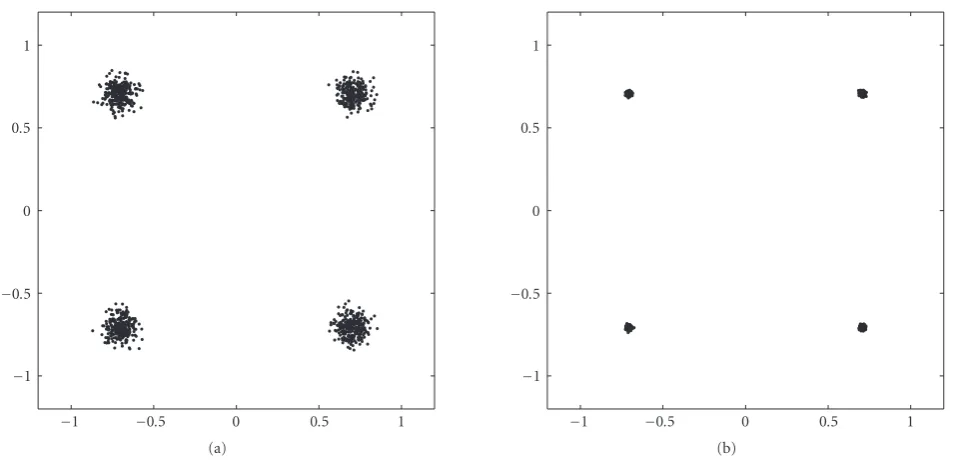
Figure3: Constelations obtained when the extraction algorithms are applied with (b) or without (a) prewhitening for an SNR of 30 dB and an MAI of 0 dB. Thex- andy-axes of the figures refer to the in-phase (real) and quadrature (imaginary) components of the received QPSK constelation.
in [1]. The parameters for this simulation were the same as those used inFigure 1. One can again see better behavior for the proposed algorithm in normal and near-far situations. The robustness against the near-far problem is corroborated from the comparison between Figures2(a)and2(b).
We should note that occasionally, for very low SNR, the algorithms fail to converge. These cases can be detected be-cause they are characterized by an output whose kurtosis is positive or close to zero. When this happens, the algorithm is automatically reinitialized, and the extraction is repeated until a correct solution is found.
Figure 3illustrates the difference between the use or not of the prewhitening preprocessing in a simulation with 1000 samples. In the figure, one can see the improvement due to prewhitening in reduction of the MSE as a smaller radius for the clouds of points centered at the symbols of the constella-tion.
In all these simulations, we used a QPSK constellation. In principle, the proposed criterion and algorithm work with all kinds of signals, real or complex, continuous or discrete. However, the performance of the algorithm will depend on the statistics of the signals considered and on the length of the available data set, since both factors influence the vari-ance of the sample cumulant estimates. For constellations with certain symmetries (like the QPSK), the sample esti-mates of the high-order cumulants and cross-cumulants have a higher precision in absence of noise. Note, however, that the advantage of using QPSK signals quickly disappears for moderate/low signal-to-noise ratios. The QPSK constella-tion is widely used in CDMA, but we also proved the al-gorithm with a 16-QAM constellation and we found good
detection results when increasing the number of symbols to 800 (about four times more than with the QPSK constela-tion).
6. THE SOFTWARE RADIO PLATFORM
OPERATING AT 5 GHZ
In order also to test the algorithms with real signals, we built a software radio platform operating at 5 GHz. The fourth generation of mobile communications systems will take ad-vantage of software radio concepts combining different ac-cess technologies into a common hardware platform. More-over, the trend towards increasing the frequency of opera-tion is arousing great interest in the 5 GHz band, both at the research and commercial levels, which justifies our choice. This section will outline the characteristics of a software ra-dio platform for the transmission of wideband communica-tions signals modulated at 5.25 GHz.
0.05 0 0.05
0.05 0 0.05
(a)
1 0.5 0 0.5 1
1 0.5 0 0.5 1
(b)
Figure4: (a) The received signal for real measurement and (b) the resulting signal after applying the algorithm of blind detection. For the received signal, the continuous signal is represented in grey and the sampling points are represented in black. Received SNR was 8.2 dB. The
x- andy-axes of the figures refer to the in-phase (real) and quadrature (imaginary) components of the received QPSK constelation.
and converts it at IF. This IF signal is sent to the E4407B spec-trum analyzer which demodulates it and gives the recovered IQ signal to the PC. The evaluation of the different modules of both the transmitter and the receiver has been performed from in-fixture measurements, using a universal test fixture.
Measurements were made with the aid of the platform. Because of the limitations in the number of transmitters that we have at this moment (only one) and storage capability, the simulation of the CDMA system was partially real. We had to transmit a user and then superpose the received signal with the one of an interfering user. The resulting sum was transmitted and received once again. Then, the algorithm of blind detection was applied to the received data. The number of symbols was 200, with 4 chips/symbol and 3.84 Mchip/s. The MAI was set to 5 dB. The separation between antennas was 1 m. InFigure 4, we show the results of the simulations with real measurements.
7. CONCLUSIONS
In this paper, we have addressed the problem of the blind detection of a desired user in a DS-CDMA communications system from prior knowledge only of its spreading code. We have shown how to extend the code-constrained inverse fil-ter crifil-terion presented in [1], by considering a more gen-eral criterion based on joint optimization of sevgen-eral higher-order statistics. The combination of different reliable statis-tics of the output led to an improvement in the performance of the detector in terms of mean square error and prob-ability of symbol error. The performance of the algorithm and its robustness with respect to the near-far problem was
corroborated by the results of the simulations, which also revealed that the improvement increases with the signal-to-noise ratio.
APPENDIX
EVALUATION OF CUMULANTS AND CROSS-CUMULANTS
In this appendix, we show how to evaluate the cumulants of the outputs, which is necessary for the implementation of the algorithm. An easy way is to rewrite them in terms of the moments of the outputs by using the following formula (see [25]):
cumy1,y2,. . .,yn
=
p1,...,pm
(−1)m−1(m−1)!
·E
i∈p1
yi
E
i∈p2
yi
· · ·E
i∈pm yi
,
(A.1)
where the sum is extended to all the possible partitions (p1,. . .,pm), m = 1,. . .,n, of the set of natural numbers
(1,. . .,n).
forr∈ {2, 4, 6}, in terms of the moments:
cum2(y)≡cum
y∗,y=E|y|2, cum4(y)≡cum
y∗,y∗,y,y
=E|y|4−2E|y|22
−Ey2E y∗2 ,
cum6(y)≡cum
y∗,y∗,y∗,y,y,y
=E|y|6−9E|y|4E|y|2+ 12E|y|23
−3Ey3y∗E y∗2
−3E yy∗3Ey2
−9Ey2y∗E yy∗2
+ 18Ey2E y∗2
E|y|2.
(A.2)
When taking into account the specific symmetries of the QPSK constellation of the transmitted symbols, one can fur-ther simplify this result. Some of the final terms in the previ-ous expressions vanish, resulting in the simplified formulae
cum2(y)=E
|y|2,
cum4(y)=E
|y|4−2E|y|22,
cum6(y)=E
|y|6−9E|y|4E|y|2+ 12E|y|23, (A.3)
whose complex gradients
∇uHcumr(y)= r
2czy(r) (A.4)
are proportional to the following cross-cumulant vectors:
czy(2)≡cum
z∗,y=Ez∗y,
czy(4)≡cum
z∗,y∗,y,y
=Ez∗y|y|2−2Ez∗yE|y|2,
czy(6)≡cum
z∗,y∗,y∗,y,y,y
=Ez∗y|y|4]−6Ez∗y|y|2E|y|2
−3Ez∗yE|y|4+ 12Ez∗yE|y|22. (A.5)
ACKNOWLEDGMENT
This research was supported by the MCYT Spanish Project TEC2004-06451-C05-03.
REFERENCES
[1] J. K. Tugnait and T. Li, “Blind detection of asynchronous CDMA signals in multipath channels using code-constrained inverse filter criterion,”IEEE Transactions on Signal Processing, vol. 49, no. 7, pp. 1300–1309, 2001.
[2] X. Wang and H. V. Poor, “Blind equalization and multiuser detection in dispersive CDMA channels,”IEEE Transactions on Communications, vol. 46, no. 1, pp. 91–103, 1998.
[3] U. Madhow, “Blind adaptive interference suppression for direct-sequence CDMA,” Proceedings of the IEEE, vol. 86, no. 10, pp. 2049–2069, 1998.
[4] S. Verd ´u,Multiuser Detection, Cambridge University Press, New York, NY, USA, 1st edition, 1998.
[5] M. Honig and M. K. Tsatsanis, “Adaptive techniques for mul-tiuser CDMA receivers,” IEEE Signal Processing Magazine, vol. 17, no. 3, pp. 49–61, 2000.
[6] R. Prasad and T. Ojanper¨a, “An overview of CDMA
evolu-tion toward wideband CDMA,” IEEE Communications
Sur-veys, vol. 1, no. 1, pp. 2–29, 1998.
[7] S. Moshavi, “Multi-user detection for DS-CDMA communi-cations,”IEEE Communications Magazine, vol. 34, no. 10, pp. 124–136, 1996.
[8] D. Gesbert, J. Sorelius, P. Stoica, and A. Paulraj, “Blind mul-tiuser MMSE detector for CDMA signals in ISI channels,”
IEEE Communications Letters, vol. 3, no. 8, pp. 233–235, 1999. [9] P. Schniter and C. R. Johnson, “Minimum-entropy blind ac-quisition/equalization for uplink DS-CDMA,” inAllerton Con-ference on Communication, Control, and Computing, Monti-cello, Ill, USA, September 1998.
[10] J. Castaing and L. De Lathauwer, “An algebraic technique for the blind separation of DS-CDMA signals,” inProceedings of the 12th European Signal Processing Conference (EUSIPCO ’04), pp. 377–380, Vienna, Austria, September 2004.
[11] J. K. Tugnait and J. Ma, “Blind multiuser receiver for space-time coded CDMA signals in frequency-selective channels,”
IEEE Transactions on Wireless Communications, vol. 3, no. 5, pp. 1770–1780, 2004.
[12] M. Sirbu and V. Koivunen, “Multichannel estimation and equalization algorithm for asynchronous uplink DS/CDMA,”
Wireless Personal Communications, vol. 26, no. 1, pp. 33–52, 2003.
[13] C.-Y. Chi and C.-H. Chen, “Cumulant-based inverse filter cri-teria for MIMO blind deconvolution: properties, algorithms, and application to DS/CDMA systems in multipath,” IEEE Transactions on Signal Processing, vol. 49, no. 7, pp. 1282–1299, 2001.
[14] T. Ristaniemi and J. Joutsensalo, “Advanced ICA-based re-ceivers for block fading DS-CDMA channels,”Signal Process-ing, vol. 82, no. 3, pp. 417–431, 2002.
[15] E. Moreau, “A generalization of joint-diagonalization criteria for source separation,”IEEE Transactions on Signal Processing, vol. 49, no. 3, pp. 530–541, 2001.
[16] I. Dur´an-D´ıaz and S. A. Cruces-Alvarez, “An application of ICA to blind DS-CDMA detection: a joint optimization cri-terion,” inProceedings of 7th International Work-Conference on Artificial and Natural Neural Networks (IWANN ’03), vol. 2, pp. 305–312, Menorca, Spain, June 2003.
[17] P. Comon, “Contrasts, independent component analysis, and blind deconvolution,”International Journal of Adaptive Con-trol and Signal Processing, vol. 18, no. 3, pp. 225–243, 2004. [18] J. Reina, I. Dur´an-D´ıaz, and C. Crespo, “Caracterizaci ´on de
circuitos para plataforma de comunicaciones m ´oviles a 5 GHz,” in Actas del XVIII Simposium Nacional de la Uni´on Cient´ıfica Internacional de Radio (URSI ’03). Simposium Na-cional de la Uni´on Cient´ıfica InternaNa-cional de Radio, pp. 108– 109, A Coru˜na, Spain, September 2003.
[19] G. Leus and M. Moonen, “MUI-free receiver for a syn-chronous DS-CDMA system based on block spreading in the presence of frequency-selective fading,”IEEE Transactions on Signal Processing, vol. 48, no. 11, pp. 3175–3188, 2000. [20] C.-Y. Chi, C.-H. Chen, and C.-Y. Chen, “Blind MAI and ISI
filter criteria,”IEEE Transactions on Signal Processing, vol. 50, no. 6, pp. 1368–1381, 2002.
[21] O. Shalvi and E. Weinstein, “New criteria for blind deconvolu-tion of nonminimum phase systems (channels),”IEEE Trans-actions on Information Theory, vol. 36, no. 2, pp. 312–321, 1990.
[22] L. De Lathauwer, P. Comon, B. De Moor, and J. Vandewalle, “Higher-order power method - application in independent component analysis,” inProceedings of the International Sym-posium on Nonlinear Theory and Its Applications (NOLTA ’95), pp. 91–96, Las Vegas, Nev, USA, December 1995.
[23] S. A. Cruces-Alvarez, A. Cichocki, and L. De Lathauwer, “Thin QR and SVD factorizations for simultaneous blind signal extraction,” in Proceedings of 12th European Signal Process-ing Conference (EUSIPCO ’04), pp. 217–220, Vienna, Austria, September 2004.
[24] E. Kofidis and P. A. Regalia, “On the best rank-1 approxima-tion of higher-order supersymmetric tensors,”SIAM Journal on Matrix Analysis and Applications, vol. 23, no. 3, pp. 863– 884, 2002.
[25] C. L. Nikias and A. P. Petropulu,Higher-Order Spectra Anal-ysis. A Nonlinear Signal Processing Framework, Prentice-Hall, Englewood Cliffs, NJ, USA, 1993.
Iv´an Dur´an-D´ıaz was born in Seville, Spain, in 1975. He received the Telecommu-nication Engineer degree from the Univer-sity of Seville in 2001, and is currently work-ing towards the Ph.D. degree at the Uni-versity of Seville. Since 2002, he has been with the Signal Theory and Communica-tions Group of the University of Seville, where he is currently an Assistant Professor. He teaches undergraduate courses on
munications theory, digital transmission systems, and radio com-munications. His current research interests are in the area of statis-tical signal processing, spread spectrum, and wireless communica-tions systems.
Sergio A. Cruces-Alvarezwas born in Vigo, Spain, in 1970. He received the Telecom-munication Engineer degree in 1994 and the Ph.D. degree in 1999, both from the University of Vigo (Spain). From 1994 to 1995, he worked as a Project Engineer for the Department of Signal Theory and Com-munications of this university. In 1995, he joined the Signal Theory and Communi-cations Group of the University of Seville,