Complex interactions between malaria and malnutrition: a systematic literature review
Das D1,2, Grais RF4, Okiro EA7, Stepniewska K1,2, Mansoor R1,2, van der Kam S5, Terlouw DJ6, Tarning J1,2,3, Barnes KI8,9, Guerin PJ1,2
1 WorldWide Antimalarial Resistance Network (WWARN), Oxford, UK
2 Centre for Tropical Medicine and Global Health, Nuffield Department of Clinical Medicine, University of Oxford, Oxford, UK 3 Mahidol Oxford Tropical Medicine Research Unit, Faculty of Tropical Medicine, Mahidol University, Bangkok, Thailand 4 Epicentre, Paris, France
5 Médecins Sans Frontières, Amsterdam, Netherlands 6 Liverpool School of Tropical Medicine, Liverpool, UK 7 Kemri Wellcome Trust Research Programme
8 Division of Clinical Pharmacology, Department of Medicine, University of Cape Town, Cape Town, South Africa
9 WorldWide Antimalarial Resistance Network (WWARN) Pharmacology, University of Cape Town, Cape Town, South Africa
Email addresses:
1
2
3 4 5 6 7 8 9 10 11 12 13
Abstract
Background: Despite substantial improvement in the control of malaria and decreased prevalence of malnutrition over the past two decades, both conditions remain heavy burdens that cause hundreds of thousands of deaths in children in
resource poor countries every year. Better understanding of the complex interactions between malaria and malnutrition is
crucial for optimally targeting interventions where both conditions co-exist. This systematic review aimed to assess the
evidence of the interplay between malaria and malnutrition.
Methods: Database searches were conducted in PubMed, Global Health and Cochrane Libraries and articles published in English, French or Spanish between Jan 1980 and Feb 2018 were accessed and screened. The methodological quality of
the included studies was assessed using the Newcastle-Ottawa Scale and the risk of bias across studies was assessed using
the GRADE approach. The preferred reporting items for systematic reviews and meta-analyses (PRISMA) guideline was
followed.
27
28
29 30 31
32
33 34
Results: Of 2,945 articles screened from databases, a total of 33 articles were identified looking at the association between malnutrition and risk of malaria and/or the impact of malnutrition in antimalarial treatment efficacy. Large
methodological heterogeneity of studies precluded conducting meaningful aggregated data meta-analysis. Divergent
results were reported on the effect of malnutrition on malaria risk. While no consistent association between risk of
malaria and acute malnutrition was found, chronic malnutrition was relatively consistently associated with severity of
malaria such as high-density parasitemia and anaemia. Furthermore, there is little information on the effect of
malnutrition on therapeutic responses to artemisinin combination therapies (ACTs) and their pharmacokinetic properties
in malnourished children in published literature.
Conclusions: The evidence on the effect of malnutrition on malaria risk remains inconclusive. Further analyses using individual patient data could provide an important opportunity to better understand the variability observed in
publications by standardising both malaria and nutritional metrics. Our findings highlight the need to improve our
understanding of the pharmacodynamics and pharmacokinetics of ACTs in malnourished children. Further clarification on
38 39
40 41 42
43 44 45
malaria-malnutrition interactions would also serve as a basis for designing future trials and provide an opportunity to
optimise antimalarial treatment for this large, vulnerable and neglected population.
Trial registration: The review is registered in international prospective register of systematic reviews (PROSPERO Registration No. CRD42017056934).
Keywords: malaria, anthropometry, stunting, wasting, underweight
Background
Malaria and malnutrition in children (refers to all forms of undernutrition) are reported independently to be major causes
of morbidity and mortality in low and middle income countries. About 3.2 billion people remained at risk of malaria with
an estimated 216 million new cases (95% confidence interval: 196 – 263 million) and 445,000 deaths worldwide in 2016;
50 51
52 53
54
55 56 57 58 59
the majority of deaths occur in children under 5 years in sub-Saharan Africa [1]. Approximately 3.1 million deaths in
children under-five are attributed to malnutrition each year, representing 45% of all childhood deaths [2]. The interaction
between malaria and childhood malnutrition has been studied for many years and complex interactions between these
high-burden conditions are now increasingly recognized. Understanding the consequences of malnutrition on malaria and
vice versa is crucial and may help guide the choice of public health interventions and research priorities where significant
co-morbidity exists.
Malnutrition is a complex phenomenon due to its multifactorial aetiology and diverse clinical presentation. Acute
malnutrition manifests with wasting (low weight for height) and chronic malnutrition as stunting (low height for age).
Being underweight (low weight for age) can result from either chronic or acute malnutrition or both. Assessment of
malnourishment can be conducted using anthropometric indicators which compare child’s weight and height to the
standardized age- and sex-specific growth reference derived from the international reference population of children
between 6-59 months of age (World Health Organization (WHO) Child Growth Standards 2006) [3]. The anthropometric
indicators are expressed as a number of standard deviations (SDs) below or above the reference mean or median value,
Z-63 64
65 66 67
68
69 70
71 72 73 74
score. Cutoffs of -3 are used to indicate severe malnutrition and values between -2 and -3 are considered to be moderate
malnutrition. Weight-for-Height Z-score (WHZ) is the indicator used to classify a child with wasting. Mid-Upper Arm
Circumference (MUAC) is another frequently used indicator for wasting. Severe acute malnutrition (SAM) is defined as
MUAC < 115 mm and/or WHZ < -3 and/or bilateral pitting oedema. Stunting is defined by the measure of Height-for-Age Z
score (HAZ) and a child is considered as being underweight based on low Weight-for-Age Z-score (WAZ). These definitions
do not take micronutrient malnutrition into account, which can occur even if the person is getting enough energy and they
are not thin or short.
The exact relationship between childhood malnutrition and malaria remains complex, controversial and poorly
understood. One of the key questions is, to what extent the burden of malaria is attributable to wasting and stunting? In
regards to the impact of malaria on malnutrition, some evidence suggests malaria has adverse effects on nutritional status
of young children [4-9]. On the other hand, whether and how malnutrition influences malaria morbidity and mortality is
debated. Some studies have reported that malnutrition is associated with a higher risk of malaria [10-13], others have
76 77
78 79 80
81 82 83
84 85 86 87
suggested a protective effect [14-17], or no differential risk [18, 19]. Similarly, there is very limited evidence on the
relationship between nutritional status and antimalarial drug efficacy. Clinical efficacy of the current first line malaria
treatment, the artemisinin combination therapies (ACTs) in malnourished children have been rarely explored [20-22].
Understanding the complex relationship of the immune response of individuals infected with malaria and suffering of
malnutrition is crucial to guide specific antimalarial therapeutic approaches in this vulnerable sub-population. There are
key knowledge gaps in defining the complex relationship between malnutrition and malaria, which need to be identified
and addressed. We aimed to conduct a systematic review of the current understanding of interactions between acute or
chronic malnutrition and the risk of developing malarial infection. A further objective was to explore published literature
on the impact of malnutrition on the efficacy of antimalarial treatment.
Methods
We conducted a systematic literature review of manuscripts published between Jan 1, 1980 and Feb 19, 2018. PubMed,
Global Health and Cochrane Libraries were searched using key terms (Additional File 1) and articles published in English,
French or Spanish were accessed. Two reviewers identified relevant articles of interest, as per criteria listed below, by
89 90
91 92 93
94 95 96
97
98
99 100
screening titles and abstracts of publications retrieved. The preferred reporting items for systematic reviews and
meta-analyses (PRISMA) guideline [23] was followed. The PRISMA checklist is provided as Additional File 3 and the review is
registered in international prospective register of systematic reviews (PROSPERO Registration No. CRD42017056934).
Eligibility screening
For the selected articles, full text was obtained and assessed for relevance to any of the following topics of interest: (1)
association between malnutrition and risk of malaria; (2) malnutrition and antimalarial treatment efficacy. We excluded
studies primarily focused on non-malarial conditions such as, TB, HIV, neglected tropical diseases, pneumonia or
diarrhoeal diseases; non-clinical studies (systematic reviews, opinion pieces, editorials, modelling studies, economic
evaluations, guidelines, protocols, book chapters) and in vitro, animal, plant or molecular studies; studies on malaria in
pregnancy and placental malaria; demographic and health surveys, mortality surveys, qualitative studies; case reports or
series; vaccine studies; and studies primarily focused only on malaria or malnutrition or micronutrient deficiencies or
anaemia. For this review, observational and interventional studies in non-pregnant populations with malnutrition assessed
102 103
104
105 106
107 108 109
by anthropometric measurements as exposure and risk of malaria infection (whether asymptomatic parasitemia or
uncomplicated malaria) as outcome were included.
Data extraction
From each of the included studies in this review, the following variables were extracted: authors, year of publication,
country, study design, age (range or median/mean), sex (ratio), sample size, growth standards, malaria transmission
intensity, definition of malaria and the reported risk estimates. The methodological quality of the included studies was
assessed using the Newcastle-Ottawa Scale (NOS) [24] and the risk of bias across studies was assessed using the GRADE
approach [25]. The risk of bias assessment within and across studies is presented as Additional File 4.
Analysis
Aggregated data meta-analysis was not possible due to the heterogeneity of studies in respect to study design, definition
of malnutrition, definition of malaria, study population e.g. age group target, analysis conducted and effect measures
presented. Only summaries of study findings are presented in this review. Association between malnutrition and risk of
114 115
116 117 118
119 120 121
122
123
124 125
malaria was deemed to be statistically significant if either the p value was <0.05 and/or the 95% confidence intervals (CIs)
did not include 1. The risk of malaria was classified as “increased” or “decreased” according to the interpretation of the
effect estimates provided (i.e. incidence risk ratio (IRR), odds ratio (OR), risk ratio (RR) or hazard ratio (HR)) if statistical
significance was achieved as described above.
Results
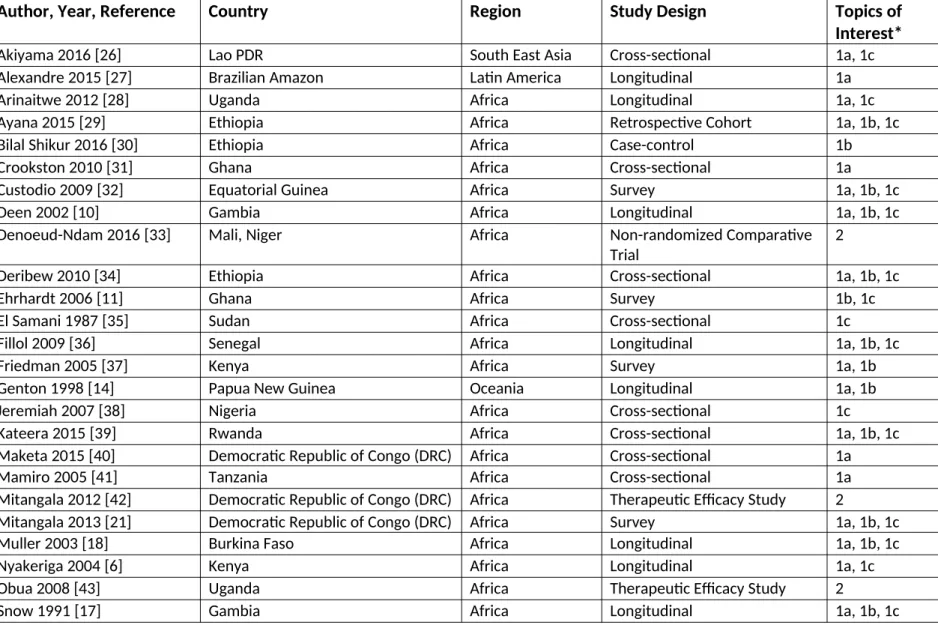
The literature search identified 2,945 articles. A total of 32 articles identified through the search and 1 article obtained
through citation tracking were included, describing cross-sectional surveys (n=16), longitudinal studies (n=12),
interventional studies (n=3), case-control study (n=1) and individual patient data meta-analysis (n=1) (Figure 1). Details of
the 33 studies included in this review are given in Table 1, while the study characteristics are summarised in Additional File
2.
Fig. 1 Flow diagram of study selection
127 128
129 130
131
132 133 134
135 136
Table 1. Details of the studies included (N=33)
Author, Year, Reference Country Region Study Design Topics of
Interest*
Akiyama 2016 [26] Lao PDR South East Asia Cross-sectional 1a, 1c
Alexandre 2015 [27] Brazilian Amazon Latin America Longitudinal 1a
Arinaitwe 2012 [28] Uganda Africa Longitudinal 1a, 1c
Ayana 2015 [29] Ethiopia Africa Retrospective Cohort 1a, 1b, 1c
Bilal Shikur 2016 [30] Ethiopia Africa Case-control 1b
Crookston 2010 [31] Ghana Africa Cross-sectional 1a
Custodio 2009 [32] Equatorial Guinea Africa Survey 1a, 1b, 1c
Deen 2002 [10] Gambia Africa Longitudinal 1a, 1b, 1c
Denoeud-Ndam 2016 [33] Mali, Niger Africa Non-randomized Comparative Trial
2
Deribew 2010 [34] Ethiopia Africa Cross-sectional 1a, 1b, 1c
Ehrhardt 2006 [11] Ghana Africa Survey 1b, 1c
El Samani 1987 [35] Sudan Africa Cross-sectional 1c
Fillol 2009 [36] Senegal Africa Longitudinal 1a, 1b, 1c
Friedman 2005 [37] Kenya Africa Survey 1a, 1b
Genton 1998 [14] Papua New Guinea Oceania Longitudinal 1a, 1b
Jeremiah 2007 [38] Nigeria Africa Cross-sectional 1c
Kateera 2015 [39] Rwanda Africa Cross-sectional 1a, 1b, 1c
Maketa 2015 [40] Democratic Republic of Congo (DRC) Africa Cross-sectional 1a
Mamiro 2005 [41] Tanzania Africa Cross-sectional 1a
Mitangala 2012 [42] Democratic Republic of Congo (DRC) Africa Therapeutic Efficacy Study 2
Mitangala 2013 [21] Democratic Republic of Congo (DRC) Africa Survey 1a, 1b, 1c
Muller 2003 [18] Burkina Faso Africa Longitudinal 1a, 1b, 1c
Nyakeriga 2004 [6] Kenya Africa Longitudinal 1a, 1c
Obua 2008 [43] Uganda Africa Therapeutic Efficacy Study 2
Snow 1991 [17] Gambia Africa Longitudinal 1a, 1b, 1c
Sumbele 2015 [44] Cameroon Africa Cross-sectional 1a, 1b, 1c
Takakura 2001 [45] Lao PDR South East Asia Survey 1b
Tonglet 1999 [46] Democratic Republic of Congo (DRC) Africa Longitudinal 1a, 1c
Uscategui Penuela 2009 [47] Colombia Latin America Cross-sectional 1a, 1b
Verhoef 2002 [13] Kenya Africa Survey 1a, 1b
Verret 2011 [22] Uganda Africa Longitudinal 1a, 1c, 2
William 1997 [48] Vanuatu Oceania Longitudinal 1b, 1c
WWARN Lumefantrine PK/PD Study Group 2015 [49]
Multiple Multiple Individual Patient Data
Meta-Analysis
2
*Topics of Interest: Risk of malaria infection in children with (1a) stunting, (1b) wasting, (1c) underweight; (2) malnutrition and anti-malarial drug efficacy
1. Association between malnutrition and risk of malaria
In total, 29 studies assessed the association between malnutrition and risk of malaria (Tables 2 - 4).
a. Risk of malaria infection in children with stunting (chronic malnutrition)
Twenty-three studies explored the relationship between stunting and risk of malaria infection (Table 2). Overall results
were conflicting, with 15 studies showing that stunting was associated with an increased malaria risk, 11 studies showing
no association and 2 studies showing a protective effect of stunting (Table 2).
140 141 142
143
144
145
Table 2. Relationship between chronic malnutrition (stunting) and risk of malarial infection (N=23)
Author, Year, Reference
HAZ score cutoff
Malaria outcome Risk estimate comparing
children below and above HAZ cutoff
Risk
Akiyama 2016 [26] ≤-2 Asymptomatic malaria confirmed by PCR OR = 3.34 (95% CI = 1.25 - 8.93) Increased Alexandre 2015 [27] <-2 Fever and thick blood smear HR = 0.31 (95% CI = 0.10 - 0.99),
P=0.049
Decreased
Arinaitwe 2012 [28] -1 & -2 Pf malaria, fever and a positive blood smear IRR = 1.24 (95% CI 1.06 -1.46), P=0.008
Increased
<-2 Pf malaria, fever and a positive blood smear IRR = 1.24 (95% CI 1.03 -1.48), P=0.02
Increased
Ayana 2015 [29] <-2 Malaria by RDT HR = 2.50 (95% CI = 1.4 - 5.1) Increased
Crookston 2010 [31] ≥ -2 & <-1 Asymptomatic malaria confirmed by PCR OR = 2.23 (95% CI = 0.99 - 5.02) No impact
≥ -3 & <-2 Asymptomatic malaria confirmed by PCR OR = 0.56 (95% CI = 0.16 - 1.69) No impact
<-3 Asymptomatic malaria confirmed by PCR OR = 1.02 (95% CI = 0.20 - 3.76) No impact
Custodio 2009 [32] <-2 Pf malaria parasitemia prevalence OR = 3.07 (95% CI = 1.40 - 6.73) Increased
Deen 2002 [10] <-2 Malaria episode (fever ≥ 37.5°C or parasitemia >5,000/μL)
RR = 1.35 (95% CI = 1.08 - 1.69), P=0.01
Increased
Deribew 2010 [34] <-2 Pf malaria (any parasitemia) AOR = 0.9 (95% CI = 0.7 - 1.2), P=0.85
No impact
Fillol 2009 [36] <-2 Clinical malaria (fever ≥ 37.5°C plus parasitemia ≥ 3,000/μL)
"Non significant association" reported
No impact
<-2 High density parasitemia (geometric mean ≥ 300/μL)
AOR = 2.42 (95% CI = 1.12 - 5.24), P=0.03
Increased
Friedman 2005 [37] <-2 Concurrent malaria (any parasitemia) AOR = 1.98, P<0.0001 Increased <-2 High density parasitemia (any species, >1,500
– 7,000/μL)
AOR = 1.84, P<0.0001 Increased
<-2 Clinical malaria (fever plus high density AOR = 1.77, P=0.06 Increased
parasitemia)
<-2 Severe anaemia (Haemoglobin <7 gm/dL) AOR = 2.65, P<0.0001* -Genton 1998 [14] <-2 Pf malaria (fever plus any parasitemia) Adj. Rate ratio = 1.13 (95% CI =
0.98 - 1.29), P=0.09
No impact
<-2 Pf malaria (fever plus parasitemia ≥ 5X10^9/L)
Adj. Rate ratio = 1.19 (95% CI = 1.01 - 1.40), P=0.03
Increased
<-2 Pf malaria (fever plus parasitemia ≥ 10X10^9/ L)
Adj. Rate ratio = 1.18 (95% CI = 0.98 - 1.41), P=0.08
No impact
Kateera 2015 [39] <-2 Pf malaria (any parasitemia) "Non significant association" reported
No impact
Maketa 2015 [40] ≤-2 Asymptomatic malaria by blood smear AOR = 1.8, P=0.01 Increased Mamiro 2005 [41] <-2 Malaria by blood smear AOR = 1.9 (95% CI = 1.1 - 3.2),
P=0.02
Increased
Mitangala 2013 [21] <-2 Pf malaria parasitemia (≥ 5,000/μL) AOR = 0.72 (95% CI = 0.37 - 1.40) No impact <-3 Pf malaria parasitemia (≥ 5,000/μL) AOR = 0.48 (95% CI = 0.25 - 0.91) Decreased Muller 2003 [18] ≤-2 Pf malaria (fever plus parasitemia ≥ 1/μL) RR = 1.0 (95% CI = 0.9 - 1.1), P=0.87 No impact ≤-2 Pf malaria (fever plus parasitemia ≥ 5,000/μL) RR = 1.0 (95% CI = 0.9 - 1.2), P=0.59 No impact ≤-2 Pf malaria (fever plus parasitemia ≥
100000/μL)
RR = 0.8 (95% CI = 0.5 - 1.4), P=0.44 No impact
Nyakeriga 2004 [6] <-2 Pf malaria (fever plus any parasitemia) Adj. IRR = 1.89 (95% CI = 1.01 - 3.53), P=0.05
Increased
<-2 Pf malaria (fever plus any para <1 year, > 2,500/μL >1 year)
Adj. IRR = 1.93 (95% CI = 0.9 - 4.16), P=0.09
Increased
Snow 1991 [17] <-2 Clinical malaria (fever plus any parasitemia) "Non significant association" reported
No impact
<-2 Asymptomatic malaria parasitemia "Non significant association" reported
No impact
Sumbele 2015 [44] <-2 Clinical malaria parasitemia Stunted vs. Non stunted: 16.9% vs. 7.5%, P=0.01
Increased
<-2 Asymptomatic malaria parasitemia Stunted vs. Non stunted: 26.0% vs. 26.2%, P=0.91
No impact
<9 m
<-2 Clinical malaria without lab confirmation in ≥ 9 m
AOR = 0.71 (95% CI = 0.28 - 1.14) No impact
Uscategui Penuela 2009 [47]
<-2 Malaria infection OR = 1.94 (95% CI = 1.07 - 3.50), P=0.023
Increased
Verhoef 2002 [13] <-2 Laboratory confirmed malaria OR = 0.87 (95% CI = 0.69 - 1.09), P=0.23
No impact
Verret 2011 [22] ≥ -1 & <0 Pf malaria risk of recurrent parasitemia HR = 2.35 (95% CI = 0.85 - 6.48), P=0.099
No impact
≥ -2 & <-1 Pf malaria risk of recurrent parasitemia HR = 2.89 (95% CI = 1.06 - 7.89), P=0.039
Increased
<-2 Pf malaria risk of recurrent parasitemia HR = 3.18 (95% CI = 1.18 - 8.56), P=0.022
Increased
Pf, Plasmodium falciparum; HAZ, Height-for-age Z-scores; CI, Confidence interval; OR, Odds ratio; HR, Hazard ratio; RR, Risk ratio; IRR, Incidence rate ratio; AOR, Adjusted Odds ratio;
*Limited to anaemia
A prospective cohort study of 487 children under 5 years of age in rural Gambia by Deen et al. reported that being stunted increased the risk of malaria infection significantly (RR = 1.35 (95% CI = 1.08 - 1.69)) [10]. The authors hypothesized that
the observed association between malnutrition and malaria infection might be influenced by confounding factors such as
HIV co-infection or socio-economic factors. Similarly, in a cross-sectional survey in children <3 years in Kenya, Friedman
and colleagues found an increased malaria risk in stunted children, showing a trend towards an increased risk of clinical
149 150 151 152 153 154 155 156
malaria (OR = 1.77, p=0.06), and significantly increased risk of any malaria parasitemia (OR = 1.98, p<0.0001), high density
parasitemia (any species, >1500 - 7000/μL; OR = 1.84, p<0.0001) and severe anaemia (OR = 2.65, p<0.0001) [37]. In
contrast, a longitudinal study from the Gambia by Snow et al. in children aged 1-4 years reported only a minor
(non-significant) impact of stunting on clinical and asymptomatic malaria episodes [17]. Two longitudinal malaria surveillance
reports, one in Senegal with 874 children aged 12 months – 5 years and the other in Burkina Faso with 685 children aged
6-30 months did not show any association between a low HAZ score and subsequent malaria attacks [18, 36]. Similarly,
Verhoef et al. in Kenya did not observe an association between being stunted and the risk of malaria infection; however,
they showed that stunting might determine the severity of malaria-associated anaemia in African children [13]. Verret et al. found that in chronically malnourished children in a high-transmission setting in Uganda, children with mild (HAZ [≥ -2 & <-1]) to moderate (HAZ <-2) stunting not given trimethoprim-sulfamethoxazole prophylaxis were at higher risk for
recurrent parasitemia [22]. Contrary to this, in a cohort survey of 790 children under 5 years in the Kivu province, DRC,
Mitangala and colleagues found that being severely stunted was protective of subsequent malaria parasitemia [21]. This
158 159
160 161 162
163 164 165
finding was supported by Genton et al. in a prospective cohort of 136 children aged 10 – 120 months in Papua New Guinea showing that lower HAZ had a protective effect against falciparum malaria [14].
b. Risk of malaria infection in children with wasting
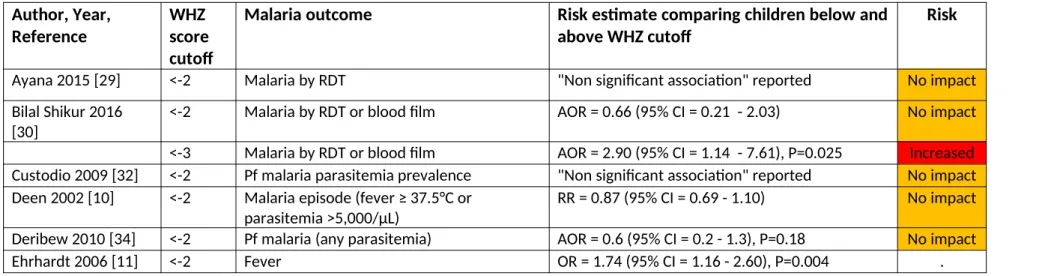
Eighteen studies explored relationship between wasting and risk of malaria infection (Table 3). Overall, results were again
conflicting, with 3 studies showing that wasting was associated with an increased malaria risk, two studies showing a
protective effect and most studies showing no association (Table 3).
Table 3. Relationship between acute malnutrition (wasting) and risk of malarial infection (N=18)
Author, Year, Reference
WHZ score cutoff
Malaria outcome Risk estimate comparing children below and
above WHZ cutoff
Risk
Ayana 2015 [29] <-2 Malaria by RDT "Non significant association" reported No impact
Bilal Shikur 2016 [30]
<-2 Malaria by RDT or blood film AOR = 0.66 (95% CI = 0.21 - 2.03) No impact
<-3 Malaria by RDT or blood film AOR = 2.90 (95% CI = 1.14 - 7.61), P=0.025 Increased Custodio 2009 [32] <-2 Pf malaria parasitemia prevalence "Non significant association" reported No impact Deen 2002 [10] <-2 Malaria episode (fever ≥ 37.5°C or
parasitemia >5,000/μL)
RR = 0.87 (95% CI = 0.69 - 1.10) No impact
Deribew 2010 [34] <-2 Pf malaria (any parasitemia) AOR = 0.6 (95% CI = 0.2 - 1.3), P=0.18 No impact
Ehrhardt 2006 [11] <-2 Fever OR = 1.74 (95% CI = 1.16 - 2.60), P=0.004 .
170 171
172
173 174
175
<-2 Clinical malaria (fever ≥ 37.5°C plus any parasitemia)
OR = 1.86 (95% CI = 1.14 - 3.02), P=0.007 Increased
Fillol 2009 [36] <-2 Clinical malaria (fever ≥ 37.5°C plus parasitemia ≥ 3000/μL)
OR = 0.33 (95% CI = 0.13 - 0.81), P=0.02 Decreased
<-2 High density parasitemia (geometric mean ≥ 300/μL)
AOR = 0.48 (95% CI = 0.04 - 5.34), P=0.55 No impact
Friedman 2005 [37] <-2 Concurrent malaria (any parasitemia) AOR = 0.75, P=0.18 No impact <-2 High density parasitemia (any species,
>1,500 – 7,000/μL)
AOR = 0.96, P=0.88 No impact
<-2 Clinical malaria (fever plus high density parasitemia)
AOR = 1.11, P=0.86 No impact
<-2 Severe anaemia (Haemoglobin <7 gm/dL) AOR = 2.00, P=0.04* . Genton 1998 [14] <-2 Pf malaria (fever plus any parasitemia) Adj. Rate ratio = 0.92 (95% CI = 0.77 - 1.11), P=0.4 No impact
<-2 Pf malaria (fever plus parasitemia ≥ 5X10^9/ L)
Adj. Rate ratio = 0.96 (95% CI = 0.77 - 1.19), P=0.69
No impact
<-2 Pf malaria (fever plus parasitemia ≥ 10X10^9/L)
Adj. Rate ratio = 0.97 (95% CI = 0.75 - 1.24), P=0.78
No impact
Kateera 2015 [39] <-2 Pf malaria (any parasitemia) "Non significant association" reported No impact Mitangala 2013 [21] <-2 Pf malaria parasitemia (≥ 5,000/μL) AOR = 0.34 (95% CI = 0.08 - 1.45), P=0.15 No impact Muller 2003 [18] <-2 Pf malaria (fever plus parasitemia ≥ 1/μL) RR = 1.0 (95% CI = 0.9 - 1.2), P=0.99 No impact
<-2 Pf malaria (fever plus parasitemia ≥ 5000/μL)
RR = 1.0 (95% CI = 0.9 - 1.2), P=0.58 No impact
<-2 Pf malaria (fever plus parasitemia ≥ 100,000/μL)
RR = 1.0 (95% CI = 0.5 - 1.8), P=0.94 No impact
2009 [47]
Verhoef 2002 [13] <-2 Laboratory confirmed malaria OR = 0.78 (95% CI = 0.58 - 1.05), P=0.1 No impact William 1997 [48] <-2 Clinical malaria (fever plus para ≥ 1,000/μL) "Non significant association" reported No impact <-2 P. vivax malaria "Non significant association" reported No impact
Pf, Plasmodium falciparum; WHZ, Weight-for-height Z-scores; CI, Confidence interval; OR, Odds ratio; HR, Hazard ratio; RR, Risk ratio; IRR, Incidence rate ratio; AOR, Adjusted Odds ratio;
*Limited to anaemia
Takakura et al. (2001), Ehrhardt et al. (2006) and Bilal Shikur et al. (2016) found an increased risk of P. falciparum malaria in children with wasting. In a case-control study involving 428 under-five children in Ethiopia, Bilal Shikur and colleagues
(2016) found that severely wasted children were 3 times more likely to have malaria episode that non-wasted children
(adjusted OR = 2.90 (95% CI = 1.14 - 7.61) [30]. In 2006, Ehrhardt et al. reported a survey involving 2,905 children in Ghana aged 6 – 108 months in which wasting was significantly associated with a higher risk of clinical malaria (OR = 1.86, 95% CI =
1.14 – 3.02) [11]. Takakura et al. in a cross sectional study of 309 children and adolescents (aged 2 to 18 years) in the Lao
PDR showed that P. falciparum infection was associated with wasting [45]. However, Fillol and colleagues reported a significant protective association between being wasted (WHZ<-2) at the onset of the rainy season and the risk of a clinical
malaria episode (OR = 0.33, 95%CI = 0.13 – 0.81) in 874 preschool children (between 12 months and 5 years of age) in
177 178 179 180 181
182 183 184
185 186 187
Senegal [36]. Similarly, in a cross-sectional survey of 1,862 very young children (from 0 – 36 months age) in western Kenya,
Friedman (2005) showed that wasting decreased the risk of concurrent malaria (OR = 0.75, p=0.18) and high density
parasitemia (OR = 0.96, p=0.88), although increased the risk of severe malarial anaemia (OR = 2.0, p=0.04) [37]. In
contrast, two other longitudinal studies conducted in the Gambia [17] and in Burkina Faso [18] and a few cross sectional
surveys from Equatorial Guinea [32], Eastern Kenya [13] and Ghana [11] reported no association between being wasted
and the risk of malaria infections.
c. Risk of malaria infection in underweight children
Nineteen studies explored relationship between being underweight-for-age and risk of malaria infection (Table 4). Overall,
results were again conflicting, with five studies showing that underweight children carried a higher malaria risk, and the
remaining studies showing no association (Table 4).
Table 4. Relationship between being underweight and risk of malarial infection (N=19)
Author, Year, Reference
WAZ score cutoff
Malaria outcome Risk estimate comparing children below
and above WAZ cutoff
Risk
190 191
192 193 194
195
196
197
198 199
Akiyama 2016 [26] ≤-2 Asymptomatic malaria confirmed by PCR OR = 1.33 (95% CI = 0.53 - 3.30) No impact Arinaitwe 2012 [28] -1 & -2 Pf malaria, fever and a positive blood
smear
IRR = 1.09 (95% CI 0.95-1.25), P=0.24 No impact
<-2 Pf malaria, fever and a positive blood smear
IRR = 1.12 (95% CI 0.86 -1.46), P=0.39 No impact
Ayana 2015 [29] <-2 Malaria by RDT "Non significant association" reported No impact Custodio 2009 [32] <-2 Pf malaria parasitemia prevalence "Non significant association" reported No impact Deen 2002 [10] <-2 Malaria episode (fever ≥ 37.5°C or
parasitemia >5000/μL)
RR = 1.01 (95% CI = 0.82 - 1.26) No impact
Deribew 2010 [34] <-2 Pf malaria (any parasitemia) AOR = 0.9 (95% CI = 0.7 - 1.2), P=0.90 No impact Ehrhardt 2006 [11] <-2 Fever AOR = 1.59 (95% CI = 1.13 - 2.23), P=0.008 Increased
<-2 Clinical malaria (fever ≥ 37.5°C plus any parasitemia)
AOR = 1.67 (95% CI = 1.10 - 2.50), P=0.009 Increased
<-2 Anaemia (Haemoglobin <11 gm/dL) AOR = 1.68 (95% CI = 1.38 - 2.04), P<0.0001ᵠ . El Samani 1987 [35]
Weight-for-age 75-89% (mild)
History of malaria in past 2 months AOR = 1.20 (95% CI = 0.70 - 2.00) No impact
Weight-for-age <75% (moderat e)
History of malaria in past 2 months AOR = 2.10, (95% CI = 1.10 - 4.00) Increased
Fillol 2009 [36] <-2 Clinical malaria (fever ≥ 37.5°C plus parasitemia ≥ 3,000/μL)
"Non significant association" reported No impact
<-2 High density parasitemia (geometric mean ≥ 300/μL)
AOR = 0.96 (95% CI = 0.35 - 2.66), P=0.94 No impact
≤-2 Pf malaria (fever plus parasitemia ≥ 5000/μL)
RR = 1.0 (95% CI = 0.9 - 1.2), P=0.68 No impact
≤-2 Pf malaria (fever plus parasitemia ≥ 100,000/μL)
RR = 0.8 (95% CI = 0.5 - 1.4), P=0.49 No impact
Nyakeriga 2004 [6] <-2 Pf malaria (fever plus any parasitemia) IRR = 1.33 (95% CI = 0.64 - 2.70), P=0.44 No impact <-2 Pf malaria (fever plus any para <1 year, >
2500/μL >1 year)
IRR = 0.28 (95% CI = 0.51 - 3.17), P=0.60 No impact
Snow 1991 [17] <-2 Clinical malaria (fever plus any parasitemia)
"Non significant association" reported No impact
<-2 Asymptomatic malaria parasitemia "Non significant association" reported No impact Sumbele 2015 [44] <-2 Clinical malaria parasitemia Underweight vs. Non: 21.6% vs. 8.2%, P=0.007 Increased <-2 Asymptomatic malaria parasitemia Underweight vs. Non: 21.6% vs. 27.5%, P=0.44 No impact Tonglet 1999 [46] <-2 Clinical malaria without lab confirmation in
<9 m
AOR = 1.31 (95% CI = 0.68 - 1.94) No impact
<-2 Clinical malaria without lab confirmation in ≥ 9 m
AOR = 0.68 (95% CI = 0.24 - 1.11) No impact
Verret 2011 [22] (≥ -1 and <0 )
Pf malaria risk of recurrent parasitemia HR = 0.65 (95% CI = 0.37 - 1.15), P=0.137 No impact
(≥ -2 and <-1 )
Pf malaria risk of recurrent parasitemia HR = 0.86 (95% CI = 0.45 - 1.62), P=0.636 No impact
<-2 Pf malaria risk of recurrent parasitemia HR = 1.01 (95% CI = 0.54 - 1.89), P=0.969 No impact William 1997 [48] <-2 Clinical malaria (fever plus parasitemia ≥
1000/μL)
IRR = 1.1 (95% CI = 0.57 – 2.1)*, P=0.8 No impact
<-2 Clinical malaria (fever plus parasitemia ≥ 1000/μL)
IRR = 1.3 (95% CI = 0.9 - 1.9)**, P=0.2 No impact
<-2 P. vivax malaria IRR = 2.6 (95% CI = 1.5 – 4.4)*, P< 0.0001; Increased <-2 P. vivax malaria IRR = 1.3 (95% CI = 0.9 - 2.0)**, P=0.2 No impact
Pf, Plasmodium falciparum; WAZ, Weight-for-age Z-scores; CI, Confidence interval; OR, Odds ratio; HR, Hazard ratio; RR, Risk ratio; IRR, Incidence rate ratio; AOR, Adjusted Odds ratio;
ᵠLimited to anaemia;*6 months preceding anthropometric assessment; **6 months following anthropometric assessment
In 2006, Ehrhardt et al. using cross sectional surveys in Ghana found that being underweight was significantly associated with a higher risk of having fever of any cause (OR = 1.59, 95%CI = 1.13 – 2.23), clinical malaria (OR = 1.67, 95%CI = 1.10 –
2.50) and anaemia (OR = 1.68, 95%CI = 1.38 – 2.04) [11]. This was confirmed by Sumbele et al. (2015) who found that
21.6% of underweight children but only 8.2% of adequately nourished children developed clinical malaria (p = 0.007) in
Cameroon. In a series of cross-sectional surveys conducted in the South Pacific island of Vanuatu in 1997, Williams et al.
found a strong association between the incidence of P. vivax malaria and subsequently becoming underweight (IRR = 2.6, 95% CI = 1.5 – 4.4) but no significant effect of P. falciparum malaria (IRR = 1.1, 95% CI = 0.57 – 2.1) [48]. On the other hand,
Tonglet et al. reported a non-significant protective association between being underweight and the risk of clinical malaria in children between 9 months and 2 years of age in the DRC (OR = 0.68, 95% CI = 0.24 – 1.11) [46].
2. Malnutrition and anti-malarial drug efficacy
Limited data exist on the effect of malnutrition on response to antimalarial drugs, in particular ACTs. Only 5 studies were
identified in our literature search, and results were again contradictory.
204 205
206 207 208
209 210 211
212
213
In 2008, Obua et al. explored the impact of nutritional status on the dose, drug concentrations and treatment outcome with co-packaged chloroquine plus sulfadoxine-pyrimethamine in 83 children (6 months – 5 years) with uncomplicated
falciparum malaria [43]. The authors found that stunting (height-for-age Z-score <-2) was associated with higher
bodyweight adjusted (mg/kg) doses of chloroquine and sulfadoxine-pyrimethamine, higher sulfadoxine concentrations on
Day 1 and chloroquine concentrations on Day 3, and better cure rates (p=0.046).
In a longitudinal study of 292 infants (aged 4-12 months) in Uganda, a high malaria transmission intensity setting, ACTs
(artemether-lumefantrine and dihydroartemisinin-piperaquine) were generally efficacious with a good early
parasitological response (99% of study participants cleared parasites by day 3) for treatment of P. falciparum malaria, including in 43% chronically malnourished children [22]. However, in this study, stunted children (height-for-age Z-score
<-2) in the dihydroartemisinin-piperaquine arm who were not taking trimethoprim-sulfamethoxazole prophylaxis (given to
all HIV infected and exposed infants) were at higher risk for recurrent parasitaemia (HR 3.18 (95% CI 1.18-8.56); p=0.022).
Another study carried out in the DRC in 445 children, comparing the efficacy of standard doses of artesunate-amodiaquine
between children with and without severe acute malnutrition (SAM), observed no evidence of reduced efficacy in children
216 217
218 219 220
221 222 223
224 225 226 227
with SAM, which had an adequate clinical and parasitological cure rate, ACPR, of 91.4% [42]. A recent multi-centre (Mali
and Niger), open-label trial compared the efficacy and pharmacokinetics of artemether-lumefantrine in 399 children with
or without SAM. The results of this study showed adequate therapeutic efficacy in both SAM and non-SAM groups (day 42
ACPR 100% vs. 98.3% respectively) with no early treatment failures and no difference in parasite clearance reported.
However, a higher risk of reinfection in children older than 21 months suffering from SAM was evident (AHR 2.10
(1.04-4.22); p=0.038) [33]. Similarly in a large pooled analysis of individual pharmacokinetic-pharmacodynamic (PK-PD) data
from 2,787 patients treated with artemether-lumefantrine for uncomplicated Pf malaria, the WorldWide Antimalarial
Resistance Network (WWARN) demonstrated that among children 1– 4 years of age in high transmission areas, the risk of
reinfection increased with a decrease in WAZ with a HR of 1.63 (95 % CI 1.09 to 2.44) for a child with WAZ of − 3 compared
to an adequately nourished child (WAZ = 0) [49].
Information on the pharmacokinetic properties of ACTs in malnourished children is critically lacking in the published
literature. Our search retrieved a study published in 2016 which assessed the efficacy of AL in relation to drug exposure in
children with SAM vs. non-SAM in Mali and Niger [33]. This study measured lumefantrine concentration and showed that
229 230
231 232 233
234 235 236
237 238
239 240
despite the administration of 92g fat with dosing of SAM children (compared to 15mL milk in non-SAM children), day 7
lumefantrine concentrations were lower in children with SAM compared to non-SAM (median 251 vs. 365 ng/mL,
p=0.049). In the WWARN pooled analysis of individual PK-PD data from patients treated with artemether-lumefantrine for
uncomplicated Pf malaria, underweight-for-age young children (<3years) had 23% (95% CI -1 to 41%) lower day 7 lumefantrine concentrations than adequately nourished children of same age [49].
Discussion
The evidence on the effect of malnutrition on malaria risk remains controversial, and in many instances contradictory. The
current review highlights some key limitations in the way the interaction between malaria and malnutrition has been
assessed and reported. First, differences in methodology, study populations, the variability in measures used to define
malnutrition (e.g. different growth references, different cut off thresholds), and the heterogeneous malaria transmission
intensities with different levels of host immunity within the different studies make the comparison challenging. Second,
there is a paucity of information on the effect of malnutrition on therapeutic responses to ACTs and their pharmacokinetic
properties in malnourished children in published literature. Generally, vulnerable populations with common
co-242 243
244 245 246
247
248 249
250 251 252 253
morbidities such as malnutrition, obesity, HIV or tuberculosis co-infection are excluded from or under-represented in
antimalarial drug efficacy trials [50]. Although weight is documented, height is rarely recorded in ACT efficacy trials (< 20%
of 250 trials currently included in the WWARN repository, personal communication Kasia Stepniewska), restricting the
possibilities for secondary analyses. Another useful metric, mid-upper arm circumference (MUAC) is also rarely
documented in malaria clinical trials despite being relatively easy to measure and low MUAC shown to be associated with
increased malaria risk [51] and decreased lumefantrine bioavailability [52]. Several confounding factors and effect
modifiers have been suggested such as age, co-morbidities (e.g. HIV, tuberculosis co-infection and drug interactions),
immunity, socio-economic status, or refeeding practices. However, these confounding factors are poorly documented and
controlled for in most of the reported studies in this review.
This review has several limitations. First, one third of the studies included in this review recruited individuals of all ages,
and disaggregating observations by the age of individuals (below and above 5 years) was not possible. Methodologically,
the temporal relationship between malnutrition and risk of malaria (and progression from infection to symptomatic
255 256
257 258 259
260 261 262
263 264 265 266
malaria) could not be assessed because of cross-sectional study design (50% included studies). It is also limited by the
extent to which important confounders (such as differential micronutrient deficiencies, ecological and genetic factors) are
measured and reported in the included articles. Finally, the heterogeneity of the selected studies including variations in
measurement of nutritional status, definition of malaria, and statistical approaches adopted in deriving the risk estimates
restricted plausible aggregated data meta-analysis in this review.
Interestingly, while no consistent association between risk of malaria and acute malnutrition was found, chronic
malnutrition was relatively consistently associated with severity of malaria such as high-density parasitemia and anaemia
[10, 36, 37]. The mechanism behind the higher risk of recurrent parasitemia could be explained partially by the impact of chronic malnutrition on the immune system and/or lower antimalarial bioavailability. Likewise, the apparent protection of
wasted children from clinical malaria might be caused by their being administered a higher mg/kg antimalarial dose
and/or a modulation of their immune response and thus an absence of symptoms, e.g. fever usually associated with
malaria as opposed to an absence of malaria infection. Friedman et al. showed high density parasitemia as a predictor for
268 269
270 271 272
273 274 275
276 277 278 279
chronic malnutrition [37]. Nevertheless, the role of malaria in the aetiology of malnutrition remains unclear. The effect of
malaria on nutritional status appeared to be greatest during the first two years of life and age acted as an effect modifier
in the association between malaria episodes and malnutrition [6].
ACTs are now recommended for the treatment of uncomplicated falciparum malaria in almost all malaria endemic
countries and the number of children exposed to these antimalarial agents is increasing. A priority area is to identify gaps
in our current knowledge in regards to the pharmacokinetic properties of artemisinins and partner drugs in malnourished
paediatric populations to optimise dosing in order to ensure efficacy, safety and avoid the selection of parasite resistance
[53]. Exposing pathogens to sub-therapeutic levels of active ingredients is a major driver of resistance. Protein-energy
malnutrition, defined as insufficient calorie and protein intake, may have potential physiological effects on the absorption,
distribution, and metabolism of ACTs, and subsequently affect the efficacy and safety of ACTs. Severe acute malnutrition
can cause pathophysiological changes, including increasing total body water, leading to greater volume of distribution of
drugs, which in turn may cause sub-optimal drug exposure when ACTs are given at standard doses [33, 54]. This could be
further compounded by malnutrition in paediatric patients leading to dosing inaccuracies of ACTs when dose is calculated
281 282
283
284 285
286 287 288
289 290 291 292
by age (over-dosing for actual body weight) or weight (under dosing for age). Malnutrition can also be associated with
intestinal malabsorption and villous atrophy of the jejunal mucosa which may cause impaired drug absorption [55]. The
reduced absorption of lipids and fats has the potential to specifically affect the lipid soluble ACTs [56]. The hepatic
metabolism of the ACTs may be compromised in malnourished children. For instance, in case of quinine, hepatic
metabolism is decreased in protein deficiency and increased in global malnutrition [57]. Thus hepatic metabolised drugs
should be carefully monitored in children with malnutrition. A recent individual patient data (IPD) meta-analysis
conducted by the WWARN to investigate the effect of dosing strategy on efficacy of artemether-lumefantrine showed that
the risk of treatment failure was greatest in malnourished children aged 1 – 3 years in Africa (PCR-adjusted efficacy 94.3%,
95% CI 92.3-96.3) [58]. Another large WWARN IPD meta-analysis of individual PK-PD data from patients treated with
artemether-lumefantrine (AL) for uncomplicated malaria, showed day 7 concentrations adjusted for mg/kg dose were
lowest in very young children (<3 years), among whom underweight-for-age children had 23% (95% CI − 1 to 41%) lower
concentrations than adequately nourished children of the same age and 53% (95% CI 37 to 65%) lower concentrations
than adults [49]. This raises the question of whether an adapted dosing regimen is needed in malnourished young
294 295
296 297 298
299 300 301
302 303 304 305
children. The PK-PD evaluation of artemisinins and longer-acting partner antimalarials for the treatment of malaria in
paediatric populations and the effect of malnutrition on the pharmacological activity of ACTs is a priority area to identify
and address key knowledge gaps.
Conclusions
A summary of the remaining knowledge gaps is presented to serve as the basis for prioritising future research strategies
and highlights the need for standardising measures and reporting of nutritional status. Further analyses using individual
patient data could provide an important opportunity to better understand the variability observed in publications by
standardising both malaria nutritional metrics. In an era of emergence and spread of antimalarial drug resistance, it is
imperative to improve our understanding of the pharmacodynamics and pharmacokinetics of ACTs in malnourished
children to optimise antimalarial treatment of this very large vulnerable population. Pooled analysis, gap analysis and
carefully designed prospective, randomised controlled clinical trials can provide strong evidence on the outstanding
questions raised in this review related to malaria-malnutrition interactions.
307 308
309
310
311
312 313 314
List of abbreviations
ACT: Artemisinin combination therapy; WHZ: Height Z-score; HAZ: Height-for-Age Z-score; WAZ:
Weight-for-Age Z-score; MUAC: Mid-Upper Arm Circumference; OR: Odds ratio; RR: Risk ratio; HR: Hazard ratio; IRR: Incidence risk
ratio; AOR: Adjusted odds ratio; CI: Confidence interval; SD: Standard deviation; Pf: Plasmodium falciparum; SAM: Severe
acute malnutrition; PK-PD: Pharmacokinetic-pharmacodynamic; DRC: Democratic Republic of Congo; WHO: World Health
Organization; WWARN: WorldWide Antimalarial Resistance Network; IPD: Individual patient data; NOS: Newcastle-Ottawa
Scale; GRADE: Grading of Recommendations Assessment, Development, and Evaluation.
Declarations
Ethics approval and consent to participate
Not applicable.
Consent to publish
Not applicable.
Availability of data and materials 319
320
321 322 323
324 325
326
327 328 329 330
All the data used in this review has been presented in the main text either as tables or as supplementary files. Additional
requests for the data can be made through the WorldWide Antimalarial Resistance Network (www.wwarn.org). Please
email: [email protected]
Competing interests
The authors declare that they have no competing interests.
Funding
WorldWide Antimalarial Resistance Network (WWARN) is funded by the Bill and Melinda Gates Foundation. EAO is
supported by the Wellcome as an Intermediary Fellow (# 201866) and also acknowledge the support of the Wellcome to
the Kenya Major Overseas Programme (# 077092 and 203077).
Authors’ contributions
PJG conceived the concept of the review, supervised and coordinated the project. DD and RM reviewed literatures, and
extracted data. KS and RM reviewed methodology and data analysis. DD drafted the manuscript. KIB, RFG, EO, SK, KS and
332 333
334 335 336
337 338 339
340
PJG reviewed and edited drafts of the manuscript. DJT and JT provided intellectual input on the review. All authors read
and approved the final version of the manuscript.
Acknowledgments
The authors gratefully acknowledge the assistance of Eli Harriss with database searches and Per Olav Vandvik for
reviewing the methods of the manuscript. The authors are also very grateful to Prabin Dahal, Makoto Saito, Andrea
Stewart and Alex Gardiner for their valuable comments on the manuscript.
References
1. World Malaria Report 2016. World Health Organization.
2. Black RE, Victora CG, Walker SP, Bhutta ZA, Christian P, de Onis M, Ezzati M, Grantham-McGregor S, Katz J, Martorell R et al: Maternal and child
undernutrition and overweight in low-income and middle-income countries. Lancet 2013, 382(9890):427-451.
3. WHOMGRS: WHO Child Growth Standards based on length/height, weight and age. Acta Paediatr Suppl 2006, 450:76-85.
4. Bradley-Moore AM, Greenwood BM, Bradley AK, Kirkwood BR, Gilles HM: Malaria chemoprophylaxis with chloroquine in young Nigerian children. III. Its effect on nutrition. Ann Trop Med Parasitol 1985, 79(6):575-584.
5. Colbourne MJ: The effect of malaria suppression in a group of Accra school children. Trans R Soc Trop Med Hyg 1955, 49(4):556-569.
6. Nyakeriga AM, Troye-Blomberg M, Chemtai AK, Marsh K, Williams TN: Malaria and nutritional status in children living on the coast of Kenya. Am J Clin Nutr 2004, 80(6):1604-1610.
7. Snow RW, Molyneux CS, Njeru EK, Omumbo J, Nevill CG, Muniu E, Marsh K: The effects of malaria control on nutritional status in infancy. Acta Trop 1997, 65(1):1-10.
344 345
346 347 348
349
350
8. ter Kuile FO, Terlouw DJ, Kariuki SK, Phillips-Howard PA, Mirel LB, Hawley WA, Friedman JF, Shi YP, Kolczak MS, Lal AA et al: Impact of
permethrin-treated bed nets on malaria, anemia, and growth in infants in an area of intense perennial malaria transmission in western Kenya. Am J Trop
Med Hyg 2003, 68(4 Suppl):68-77.
9. ter Kuile FO, Terlouw DJ, Phillips-Howard PA, Hawley WA, Friedman JF, Kolczak MS, Kariuki SK, Shi YP, Kwena AM, Vulule JM et al: Impact of permethrin-treated bed nets on malaria and all-cause morbidity in young children in an area of intense perennial malaria transmission in western Kenya: cross-sectional survey. Am J Trop Med Hyg 2003, 68(4 Suppl):100-107.
10. Deen JL, Walraven GEL, von Seidlein L: Increased risk for malaria in chronically malnourished children under 5 years of age in rural Gambia. Journal of tropical pediatrics 2002, 48(2):78-83.
11. Ehrhardt S, Burchard GD, Mantel C, Cramer JP, Kaiser S, Kubo M, Otchwemah RN, Bienzle U, Mockenhaupt FP: Malaria, anemia, and malnutrition in african children--defining intervention priorities. J Infect Dis 2006, 194(1):108-114.
12. Man WD, Weber M, Palmer A, Schneider G, Wadda R, Jaffar S, Mulholland EK, Greenwood BM: Nutritional status of children admitted to hospital with different diseases and its relationship to outcome in The Gambia, West Africa. Trop Med Int Health 1998, 3(8):678-686.
13. Verhoef H, West CE, Veenemans J, Beguin Y, Kok FJ: Stunting may determine the severity of malaria-associated anemia in African children. Pediatrics 2002, 110(4):e48-e48.
14. Genton B, Al-Yaman F, Ginny M, Taraika J, Alpers MP: Relation of anthropometry to malaria morbidity and immunity in Papua New Guinean children. Am J Clin Nutr 1998, 68(3):734-741.
15. Hendrickse RG, Hasan AH, Olumide LO, Akinkunmi A: Malaria in early childhood. An investigation of five hundred seriously ill children in whom a "clinical" diagnosis of malaria was made on admission to the children's emergency room at University College Hospital, Ibadan. Ann Trop Med Parasitol 1971, 65(1):1-20.
16. Murray MJ, Murray AB, Murray NJ, Murray MB: Diet and cerebral malaria: the effect of famine and refeeding. Am J Clin Nutr 1978, 31(1):57-61. 17. Snow RW, Byass P, Shenton FC, Greenwood BM: The relationship between anthropometric measurements and measurements of iron status and
susceptibility to malaria in Gambian children. Trans R Soc Trop Med Hyg 1991, 85(5):584-589.
18. Muller O, Garenne M, Kouyate B, Becher H: The association between protein-energy malnutrition, malaria morbidity and all-cause mortality in West African children. Trop Med Int Health 2003, 8(6):507-511.
19. Tshikuka JG, Gray-Donald K, Scott M, Olela KN: Relationship of childhood protein-energy malnutrition and parasite infections in an urban African setting. Trop Med Int Health 1997, 2(4):374-382.
20. Hess FI, Nukuro E, Judson L, Rodgers J, Nothdurft HD, Rieckmann KH: Anti-malarial drug resistance, malnutrition and socio-economic status. Trop Med Int Health 1997, 2(8):721-728.
21. Mitangala PN, D'Alessandro U, Donnen P, Hennart P, Porignon D, Bisimwa Balaluka G, Zozo Nyarukweba D, Cobohwa Mbiribindi N, Dramaix Wilmet
M: [Malaria infection and nutritional status: results from a cohort survey of children from 6-59 months old in the Kivu province, Democratic
Republic of the Congo]. Revue d'epidemiologie et de sante publique 2013, 61(2):111-120.
22. Verret WJ, Arinaitwe E, Wanzira H, Bigira V, Kakuru A, Kamya M, Tappero JW, Sandison T, Dorsey G: Effect of nutritional status on response to
treatment with artemisinin-based combination therapy in young Ugandan children with malaria. Antimicrob Agents Chemother 2011, 55
(6):2629-2635.
23. Moher D, Liberati A, Tetzlaff J, Altman DG, Group P: Preferred reporting items for systematic reviews and meta-analyses: the PRISMA statement. BMJ (Clinical research ed) 2009, 339:b2535-b2535.
24. Well GA SB, O'Connell D, Peterson J: The Newcastle-Ottawa Scale (NOS) for assessing the quality of non-randomised studies in meta-analyses.
Ottawa: Ottawa Hospital Research Institute. 2011.
25. Guyatt GH OA, Vist G, Kunz R, Brozek J: GRADE guidelines: 4. Rating the quality of evidence--study limitations (risk of bias). J Clin Epidemiol 2011. 26. Akiyama T, Pongvongsa T, Phrommala S, Taniguchi T, Inamine Y, Takeuchi R, Watanabe T, Nishimoto F, Moji K, Kano S et al: Asymptomatic malaria,
growth status, and anaemia among children in Lao People's Democratic Republic: a cross-sectional study. Malaria journal 2016, 15(1):499-499. 27. Alexandre MAA, Benzecry SG, Siqueira AM, Vitor-Silva S, Melo GC, Monteiro WM, Leite HP, Lacerda MVG, Alecrim MdGC: The association between
nutritional status and malaria in children from a rural community in the Amazonian region: a longitudinal study. PLoS neglected tropical diseases 2015, 9(4):e0003743-e0003743.
28. Arinaitwe E, Gasasira A, Verret W, Homsy J, Wanzira H, Kakuru A, Sandison TG, Young S, Tappero JW, Kamya MR et al: The association between
malnutrition and the incidence of malaria among young HIV-infected and -uninfected Ugandan children: a prospective study. Malaria journal
2012, 11(1):90-90.
29. Ayana TG, Solomon T, Atsbeha H, Shumbulo EL, Amente WD, Lindtjorn B: Malnutrition and malaria infection in children 6-59 months: A cohort study in Adami Tulu District, Ethiopia. Tropical Medicine & International Health 2015, 20(Suppl. 1):294-294.
30. Shikur B, Deressa W, Lindtjørn B: Association between malaria and malnutrition among children aged under-five years in Adami Tulu District, south-central Ethiopia: a case-control study. BMC public health 2016, 16(1):174-174.
31. Crookston BT, Alder SC, Boakye I, Merrill RM, Amuasi JH, Porucznik CA, Stanford JB, Dickerson TT, Dearden KA, Hale DC et al: Exploring the relationship between chronic undernutrition and asymptomatic malaria in Ghanaian children. Malaria journal 2010, 9(1):39-39.
32. Custodio E, Descalzo MA, Villamor E, Molina L, Sanchez I, Lwanga M, Bernis C, Benito A, Roche J: Nutritional and socio-economic factors associated with Plasmodium falciparum infection in children from Equatorial Guinea: results from a nationally representative survey. Malar J 2009, 8 :225-225.
33. Denoeud-Ndam L, Dicko A, Baudin E, Guindo O, Grandesso F, Diawara H, Sissoko S, Sanogo K, Traoré S, Keita S et al: Efficacy of artemether-lumefantrine in relation to drug exposure in children with and without severe acute malnutrition: an open comparative intervention study in Mali and Niger. BMC medicine 2016, 14(1):167-167.
34. Deribew A, Alemseged F, Tessema F, Sena L, Birhanu Z, Zeynudin A, Sudhakar M, Abdo N, Deribe K, Biadgilign S: Malaria and under-nutrition: a
community based study among under-five children at risk of malaria, south-west Ethiopia. PloS one 2010, 5(5):e10775-e10775.
35. el Samani FZ, Willett WC, Ware JH: Nutritional and socio-demographic risk indicators of malaria in children under five: a cross-sectional study in a Sudanese rural community. The Journal of tropical medicine and hygiene 1987, 90(2):69-78.
36. Fillol F, Cournil A, Boulanger D, Cisse B, Sokhna C, Targett G, Trape JF, Simondon F, Greenwood B, Simondon KB: Influence of wasting and stunting at the onset of the rainy season on subsequent malaria morbidity among rural preschool children in Senegal. Am J Trop Med Hyg 2009, 80 (2):202-208.
37. Friedman JF, Kwena AM, Mirel LB, Kariuki SK, Terlouw DJ, Phillips-Howard PA, Hawley WA, Nahlen BL, Shi YP, ter Kuile FO: Malaria and nutritional status among pre-school children: results from cross-sectional surveys in western Kenya. Am J Trop Med Hyg 2005, 73(4):698-704.
38. Jeremiah ZA, Uko EK: Childhood asymptomatic malaria and nutritional status among Port Harcourt children. East African journal of public health 2007, 4(2):55-58.
39. Kateera F, Ingabire CM, Hakizimana E, Kalinda P, Mens PF, Grobusch MP, Mutesa L, van Vugt M: Malaria, anaemia and under-nutrition: three frequently co-existing conditions among preschool children in rural Rwanda. Malaria journal 2015, 14(1):440-440.
40. Maketa V, Mavoko HM, da Luz RI, Zanga J, Lubiba J, Kalonji A, Lutumba P, Van Geertruyden J-P: The relationship between Plasmodium infection, anaemia and nutritional status in asymptomatic children aged under five years living in stable transmission zones in Kinshasa, Democratic Republic of Congo. Malaria journal 2015, 14(1):83-83.
41. Mamiro PS, Kolsteren P, Roberfroid D, Tatala S, Opsomer AS, Van Camp JH: Feeding practices and factors contributing to wasting, stunting, and
iron-deficiency anaemia among 3-23-month old children in Kilosa district, rural Tanzania. Journal of health, population, and nutrition 2005,
23(3):222-230.
42. Mitanlgala NP, D’Alessandro U, Hennart P, Donnen P, Porignon D: Efficacy of Artesunate Plus Amodiaquine for Treatment of Uncomplicated Clinical Falciparum Malaria in Severely Malnourished Children Aged 6–59 Months, Democratic Republic of Congo. J Clin Exp Pathol 2012, S3. 43. C. Obua MNJWO-OLLGUH, Petzold MG: Impact of nutritional status on fixed-dose chloroquine and sulfadoxine/pyrimethamine combination
treatment of malaria in Ugandan children. International Journal of Tropical Medicine 2008, 3(3):53-59.
44. Sumbele IUN, Bopda OSM, Kimbi HK, Ning TR, Nkuo-Akenji T: Nutritional status of children in a malaria meso endemic area: cross sectional study on prevalence, intensity, predictors, influence on malaria parasitaemia and anaemia severity. BMC public health 2015, 15(1):1099-1099.
45. Takakura M, Uza M, Sasaki Y, Nagahama N, Phommpida S, Bounyadeth S, Kobayashi J, Toma T, Miyagi I: The relationship between anthropometric
indicators of nutritional status and malaria infection among youths in Khammouane Province, Lao PDR. The Southeast Asian journal of tropical
medicine and public health 2001, 32(2):262-267.
46. Tonglet R, Mahangaiko Lembo E, Zihindula PM, Wodon A, Dramaix M, Hennart P: How useful are anthropometric, clinical and dietary measurements of nutritional status as predictors of morbidity of young children in central Africa? Tropical medicine & international health : TM & IH 1999, 4(2):120-130.
47. Uscategui Penuela RM, Perez Tamayo EM, Corrales Agudelo LV, Correa Botero A, Estrada Restrepo A, Carmona Fonseca J: Relationship between
malaria, malnutrition, food insecurity and low socioeconomical conditions in children of Turbo, Colombia. Perspectivas en Nutricion Humana
2009, 11:153-164.
48. Williams TN, Maitland K, Phelps L, Bennett S, Peto TE, Viji J, Timothy R, Clegg JB, Weatherall DJ, Bowden DK: Plasmodium vivax: a cause of malnutrition in young children. QJM 1997, 90(12):751-757.
49. WorldWide Antimalarial Resistance Network Lumefantrine PKPDSG: Artemether-lumefantrine treatment of uncomplicated Plasmodium falciparum malaria: a systematic review and meta-analysis of day 7 lumefantrine concentrations and therapeutic response using individual patient data. BMC Med 2015, 13:227-227.
50. Barnes KI, Lindegardh N, Ogundahunsi O, Olliaro P, Plowe CV, Randrianarivelojosia M, Gbotosho GO, Watkins WM, Sibley CH, White NJ: World Antimalarial Resistance Network (WARN) IV: clinical pharmacology. Malar J 2007, 6:122-122.
51. Gahutu J-B, Steininger C, Shyirambere C, Zeile I, Cwinya-Ay N, Danquah I, Larsen CH, Eggelte TA, Uwimana A, Karema C et al: Prevalence and risk factors of malaria among children in southern highland Rwanda. Malaria Journal 2011, 10(1):134-134.
52. Chotsiri P, Denoeud-Ndam L, Charunwatthana P, Dicko A: Population pharmacokinetic and time-to-event modelling of the antimalarial drug lumefantrine in young children with severe acute malnutrition. In: Available from: https://www.page-meeting.org/pdf_assets/6574-20170608_PAGE_poster_LF_SAM_children_print.pdf.
53. Mercer AE, Sarr Sallah M: The pharmacokinetic evaluation of artemisinin drugs for the treatment of malaria in paediatric populations. Expert Opin Drug Metab Toxicol 2011, 7(4):427-439.
54. Oshikoya KA, Sammons HM, Choonara I: A systematic review of pharmacokinetics studies in children with protein-energy malnutrition. Eur J Clin Pharmacol 2010, 66(10):1025-1035.
55. Oshikoya KA, Senbanjo IO: Pathophysiological changes that affect drug disposition in protein-energy malnourished children. Nutr Metab 2009,
6:50-50.
56. Murphy JL, Badaloo AV, Chambers B, Forrester TE, Wootton SA, Jackson AA: Maldigestion and malabsorption of dietary lipid during severe childhood malnutrition. Arch Dis Child 2002, 87(6):522-525.
57. Treluyer JM, Roux A, Mugnier C, Flouvat B, Lagardere B: Metabolism of quinine in children with global malnutrition. Pediatr Res 1996, 40 (4):558-563.
58. Worldwide Antimalarial Resistance Network ALDISG: The effect of dose on the antimalarial efficacy of artemether-lumefantrine: a systematic review and pooled analysis of individual patient data. Lancet Infect Dis 2015, 15(6):692-702.
Figure Legend
Figure 1. Flow diagram of study selection
Table 1. Details of the studies included (N=33)
Table 2. Relationship between chronic malnutrition (stunting) and risk of malarial infection (N=23)
Table 3. Relationship between acute malnutrition (wasting) and risk of malarial infection (N=18)
Table 4. Relationship between being underweight and risk of malarial infection (N=19)
Additional file 1: PubMed, Global Health, Cochrane database search terms
Additional file 2: Characteristics of the selected studies (N=33)
Additional File 3: PRISMA checklist
Additional File 4: The methodological quality of the included studies
Additional File 5: Graphical presentation of reported risk estimates by nutritional status
482
483
484
485
486
487
488
489