New QMaths 11B CD-ROM
Glossary
Word Explanation Example
Abscissa See Coordinate.
Acceleration Rate of change of velocity with time. It has both a direction and a size.
Instantaneous acceleration, a=
Average acceleration, a=
An object that changes velocity from 50 m/s to 70 m/s in 4 s has an average acceleration of 5 m/s2 in a positive direction.
Acute angle An angle between 0° and 90°, or between 0 and .
Adjacent side See Hypotenuse.
Algebraic method Solution of simultaneous equations by the elimination method or substitution method.
Ambiguous case See Sine rule.
Amplitude Distance from the average position to the extreme values of a periodic function.
Angles of elevation and depression
Angles made by looking upwards or
downwards from a horizontal line, usually in order to see an object or a point on an object.
Anticlockwise See Clockwise.
Antiderivative See Indefinite integral.
Approach See Limit.
Approximate Close to a value or desired result, symbolised by ≈.
π is approximately 3.14. π≈ 3.14
Arc length Length of a part of a curve, measured along the curve.
A 30° arc of a circle of radius 5 m has a length of approximately 2.62 m.
Area under a curve See Definite integral.
Arithmetic progression (AP)
A sequence with successive terms that differ by the same amount, called the common difference, d.
3, 7, 11, 15, … with d= 4 8.6, 8.1, 7.6, 7.1, … with d=−0.5
Asymptote A straight line on a graph that is approached by a curve. Asymptotes may be vertical, horizontal or sloping.
Average See Mean.
dv dt ---Δv Δt
---π 2
--- 37°
π 2π
y = cosx
−1 1 y
x
Amplitude
−π 3π
Angle of elevation = 32°
Angle of depression = 27° 27°
32°
Horizontal
Vertical
y
x asymptote
asymptotes
New QMaths 11B CD-ROM
Glossary continued
Average rate of change
See Rate of change.
Axis See Coordinate.
Axis of symmetry A line that divides a graph into two identical halves.
Back-to-back Two data displays with a common vertical scale between them, such that one is on the left and the other on the right of the scale, usually stem-and-leaf plots or histograms. In some cases the displays are placed above and below a common horizontal scale.
Back-to-back stemplot
Base A number or variable that has an exponent
(index).
The base of 34 is 3 and the base of p7 is p.
Bearing A direction on the Earth, stated as either a three-digit angle clockwise from north (true bearing), or as an angle east or west of north or south.
N75°E is the same as a true bearing of 075°, while 280° = N80°W.
Bernoulli trial A probability experiment that has only two outcomes, where successive trials are independent and have fixed probabilities.
Tossing a coin or rolling a 6 on a die.
Bias The tendency for a survey or sample to have
unrepresentative results because of poor sample selection or questions.
Using a sample of early morning joggers in a survey of national fitness.
Bimodal A frequency distribution where the highest frequency occurs for two scores.
See also Mode, Unimodal.
3, 4, 5, 5, 5, 6, 6, 7, 7, 7, 8, 9, 9, 10 has two modes.
Binomial In algebra, an expression with two terms 5x2− 3
Binomial probability The probability of a particular number of desired outcomes (without regard to order) from a fixed number of Bernoulli trials. The desired outcome is called success and the alternative outcome is called failure.
The probability of obtaining 4 sixes from 10 rolls of a fair die.
Bounds The highest and lowest possible values that a variable may assume.
The normal bounds of adult human weight are 40 kg and 140 kg.
Box-and-whisker plot (or boxplot)
A data display on a scale that shows the bounds by ‘whiskers’, the upper and lower quartiles by a ‘box’, and the median by a line in the box.
Break-even The (sales) point where income and expenditure are the same.
Cancellation Division of the denominator and numerator of a numeric or algebraic fraction by a common factor to simplify the expression.
= =
=
Word Explanation Example
x y
F M
8 6 1 5 3 2 9 7 7 4 0
2 3 4 5
4 5 8 0 2 1 8 9 2 3
1 2 3 4 5
15 24
--- 15÷3 24÷3 --- 5
8
---x+2 ( )(x–3)
New QMaths 11B CD-ROM
Glossary continued
Cardinal number See Natural number.
Cartesian coordinates and plane
See Coordinate.
CAST diagram A diagram that shows the positive
trigonometric functions in the four quadrants, using their initials and the
initial A where all three are positive.
Categorical A statistical variable with values that are names. Also called nominal or qualitative.
A numeric (quantitative) variable has values that are numbers.
See also Ordinal.
The colours of cars are categorical but their engine capacities are numeric.
Census A survey of an entire population. The Australian Census surveys the Australian population every 5 years.
Central tendency Any one of the measures mean, median or mode that can be used as the typical value of a frequency distribution.
Certain See Probability.
Chain rule The differential calculus rule for the derivative of a function of a function, or for changing the derivative variable.
f′g(x)=f′(g) · g′(x) or = ·
Change of scale The effect on a graph of multiplying all values of the variable or function by a constant. A compression gives a new graph where similar points are closer together, while a dilation gives a new graph where the points are further apart.
y=f(ax) has a change of horizontal scale compared with y=f(x).
y= 3(x2− 5) is dilated vertically by a factor of 3 compared with y=x2− 5.
Chord A straight line between two points on a curve. See also Secant, Tangent to a curve.
Circle graph See Pie chart.
Circular angle measure
See Radian.
Circumference The line that divides the inside and outside of a circle, or the length of this line.
Class A range of values used in compiling a frequency distribution.
The class limits are the upper and lower bounds of the class—the true class limits may differ slightly from the stated class limits. The class interval, or class width, is the distance from the lower class limit to the upper class limit. The class midpoint is the centre of the class.
The class 10–14 has true limits 9.5–14.5, class width 5 g and class midpoint 12 g.
Word Explanation Example
S A
T C
all sin
tan cos
dy dx --- dy
du --- du
dx
---Chord
Mass (g) f
5–9 10–14 15–19
New QMaths 11B CD-ROM
Glossary continued
Clockwise In the direction that the hands of a clock move. Anticlockwise is in the opposite direction.
Co-domain See Domain.
Coefficient See Variable.
Collect terms See Like terms.
Collinear points Three or more points that lie on a single straight line.
Common difference See Arithmetic progression.
Common logarithm A logarithm with base 10, written as log x or log10x, such that y = log x ⇔ 10y = x.
log 1000 = 3 ⇔ 1000= 103 log 57 ≈ 1.7669 ⇔ 57≈ 101.7669
Complementary events
Two mutually exclusive probability events that, taken together, make the entire sample space. The complement of A is symbolised as A′ or .
If a die is rolled and A = {3, 5}, then A′= {1, 2, 4, 6}
Completion of the square
A method for finding roots of a quadratic equation, or turning points of a function, by writing the expression as a perfect square.
x2− 6x − 7 = 0 x2− 6x + 9 = 16
(x − 3)2 = 16 x − 3 = ±4
x = 7 or x =−1
Complex number See Real number.
Compression See Change of scale.
Conditional probability
For two dependent events, the conditional probability of the second event is the
probability that it occurs, assuming that the first event has already occurred.
See also Dependent events, Multiplication principle
To calculate the probability of two kings being drawn from a shuffled pack, we use the probability that the first is a king (4/52) and the conditional probability that the second is a king (3/51).
Congruent triangles Triangles that are the same size and shape. Sometimes used to find trigonometric ratios of angles in the 2nd to 4th quadrants.
The orange and
blue triangles are congruent.
Contour line A line on a map that connects points at the same height, usually measured above sea level.
Constant A number. It has a fixed value. See also Variable.
5, π
Continuous Able to have any values, perhaps restricted to values between some bounds. A continuous variable is one that can have continuous values. Continuous quantities are often obtained by measurement.
See also Discrete.
Masses of people; distances to stars.
Word Explanation Example
Clockwise
Coordinate A number used to identify a position.
Cartesian coordinates have a horizontal x-axis perpendicular to the vertical y-axis. The
x-coordinate (abscissa) is obtained from the scale on the x-axis and the y-coordinate (ordinate) is obtained from the y-axis. The coordinates are given in parentheses with the x-coordinate first and the system is called the coordinate plane or Cartesian plane.
The coordinates of A and B are A(2, 1) and B(1,−2)
Cosine (cos) 1. For angles θ such that 0° θ 90°: the ratio of the adjacent side to the hypotenuse of the right-angled triangle containing θ.
2. For all angles: the x-coordinate of the trigonometric point P(x,y) with angle θ on a unit circle.
The cosine function is the resulting periodic function, and we usually use the variable x instead of θ, so y = cos x.
cos 30°= ≈ 0.866 cos θ = x
cos =−
Cosine rule A rule relating the sides and angles of a general triangle.
a2 = b2+ c2− 2bc cos A
or cos A =
Coterminal angles Two angles are called coterminal if they differ by a multiple of 360° (2π)
38° and 758° are coterminal, and so are −100° and 260°.
Counter-example See Proof.
Counting number See Natural number.
Couple A pair of values, often written in parentheses, that form part of a relation.
(5, 8)
Cross method See Quadratic factorisation.
Cumulative frequency Progressive total of frequencies (of numeric
data) from the smallest to the largest score. See also Ogive.
Curve sketching See Sketch.
Cycle See Periodic function.
Data Facts or information, particularly of a statistical nature.
y
x 1
−1
−2
1 2 A
B
−1
A H
---- H
30° A
θ
1 P(x, y) 4π
3 --- 1
2
---y
x
π 2π 3π
−π −2π
1
−1
y = cos x
b2+c2–a2 2bc
---B
A C
a
b c
x f c.f.
5 6 7
3 7 4
Decay factor, decay function
See Exponential function.
Decile The value such that a particular number of tenths of a statistical distribution are below that value. It is symbolised as Dn.
ths of all scores are below the 7th
decile, written as D7.
Decomposition method
See Quadratic factorisation.
Decreasing function A function (or part of a function) that becomes less as x increases. Its derivative is negative. An increasing function (or part of a function) becomes more as x increases. Its derivative is positive.
f(x) = 6 + x − x2 is decreasing for x f(x) = 2x + 3 is increasing for all x.
Decreasing slope See Increasing slope.
Definite integral The area under a curve between particular limits; that is, the area enclosed by the curve, the x-axis and the vertical lines at the limits of integration.
The symbol f(x)dx is used for the area
under y = f(x) from x = a to x = b. The definite integral is a number. See also Indefinite integral.
Definite integral approximations
Approximate methods to find the definite integral by adding the areas of strips of equal width with rectangular or trapezoidal tops. The left rectangle method uses rectangles of height determined by the value of the function on the left sides of the rectangles, while the mid-value and right rectangle methods use values in the centre and at the right sides of the rectangles respectively.
The trapezium formula uses the values on both sides of the trapeziums that form the strips.
For all methods, the width of the strips is w.
Left rectangle:
A≈ w(a0+ a1+ … + an− 1)
Right rectangle: A≈ w(a1+ a2+ … + an)
Trapezium:
A≈ [a0+an + 2(a1+ … +an− 1)] = [ends+ 2 ×middles]
7 10
---1 2 --- .
a b
∫
xy = f(x)
a b
Area = f(x)dx a
b
∫
y
x a0 a1 a2 an− 1an
y = f(x)
y
...
x a0 a1 a2 an− 1an
y = f(x)
y
...
w 2
----w 2
----x
a0 a1 a2 an− 1an
y = f(x)
y
Degree 1. An angle measure, symbolised by °, such that there are 360° in a revolution. Each degree is divided into 60 minutes of arc (′) and each minute into 60 seconds of arc (″).
See also Radian.
2. The highest exponent in an algebraic
expression. 5x + 7x
3− 7 has degree 3.
Demonstration See Proof.
Denominator See Fraction.
Dependent events Probability events where the probability of one event depends on the outcome of the other. In independent events the probability of one event does not depend on the outcome of the other.
Obtaining an ace for the second card dealt is dependent if the first card is not replaced, but independent if it is replaced.
Dependent variable In a function, the variable that is calculated from the value of other variables. An
independent variable does not depend on the value of other variables.
y = 5x − 7 has dependent variable y and independent variable x.
Derivative See Differential calculus.
Difference The result of subtracting one number from another number.
The difference of 5 and 8 is 3.
Difference of cubes An algebraic identity. a3− b3= (a − b)(a2+ ab + b2)
Difference of squares An algebraic identity. a2− b2= (a − b)(a + b)
Differential calculus The branch of calculus concerned with derivatives. The derivative of a function
f(x) is symbolised by f′(x) or .
f′(x) =
Dilation See Change of scale.
Discrete Able to have only particular values. A discrete variable is a variable that can have only discrete values.
See also Continuous.
Shoe sizes; numbers of siblings.
Discriminant The value for a quadratic function
in the form ax2+ bx + c. It indicates the number of roots of the function and is represented by the symbol Δ.
For 2x2+ 3x − 2= 0,
= ± ,
so the equation has 2 roots.
Dispersion The spread of data. It is measured by the range, the interquartile range or the standard deviation.
Displacement The overall distance and direction of
movement, measured from the starting point to the end.
Distance formula A formula to calculate the distance between
two points on the Cartesian plane. d =
90°
df dx
---f x( +h)– f x( ) h ---hlim→0
b2–4ac
b2–4ac 25
x2–x1
( )2 y
2–y1
( )2
Distribution See Frequency distribution.
Distributive law A rule for expansion or multiplication over brackets.
a(b + c) = ab + ac
Domain The collection of (possible) first values of a relation or function. The collection of second values is called the range or co-domain. See also Function, Relation.
The function y = x2− 3 has domain of the real numbers and range y −3.
Dominant term The term of a function that has the highest power.
y = 5x + 7x3− 7 has dominant term 7x3.
Drawing lots A random method of selection equivalent to taking numbered tickets from a hat.
Elimination method Method of solution of simultaneous equations where variables are progressively eliminated by the addition or subtraction of multiples of equations.
See also Substitution method.
Empirical probability See Experimental probability.
Endpoint The point at one end of a line or curve.
Equation A mathematical sentence stating that two algebraic expressions are equal.
The solution(s) or root(s) of an equation are the values of the variables in the equation that make the equation true.
7x + 5 = 47 has solution x = 6. p2+ 7 = 5p + 1 has roots p = 2 and p = 3.
Evaluate To find the value of an expression. 53 evaluates to 125.
Event See Theoretical probability.
Expansion Use of the distributive law to remove brackets. (m + 5)(2m − 7) = 2m2+ 3m − 35
Expected frequency The number of times an outcome is expected to occur in an experiment.
If P(A) = 0.4, then A is expected to occur 40 times in 100 trials.
Experimental error Errors of measurement that occur in performing a real experiment.
Experimental probability
Calculation of chances using observed frequencies. Each observation is called a trial, the result of a trial is an outcome, and the probability (relative frequency) is calculated from the ratio of desired (favourable) outcomes to the number of trials. Also called empirical probability.
P(7) =
= or 0.2 or 20%
Exponent The index at the top right of a power that shows the number of times the base is to be multiplied. There are also rules for exponents other than positive integers.
53 is a power of 5. It has base 5 and exponent 3.
has base a and index − .
Exponential equation An equation with an unknown variable as an exponent. Also called indicial equation.
2x− 8 = 24
4 20
--- x f
5 6 7 8
3 7 4 6 1
5
---7a 1 2
---– 1
---Exponential function A function with an independent variable as an exponent. A growth function has a base more than 1, and a decay function has a base less than 1. The base is the growth factor or decay factor.
f(x) = 4 + 5 × 10⁴x is a growth function
with growth factor 10. y = 0.9x is a decay function.
Extrapolation Estimation of an unknown value outside the range of known values. Interpolation is estimation of an unknown value within the range of known values.
Factor A divisor of an expression. 6 is a factor of 48; x + 2 is a factor of x2− 4.
Factorisation Rearrangement of an algebraic expression into a product of simplest factors.
See also Distributive law, Expansion.
3x2− x − 2 = (3x + 2)(x − 1)
Failure See Binomial probability.
Fair die/coin Die or coin that has an equal chance of landing on each face.
False solution Untrue solution (to an equation) introduced by the method of solution.
Squaring may introduce a false solution.
Favourable outcome See Experimental probability.
Fibonacci Sequence Sequence starting from 1, 1 where each term is the sum of the previous two terms.
1, 1, 2, 3, 5, 8, 13, 21, …
Finite sequence See Sequence.
First principles, solution from
Solution from definitions without the use of derived rules and procedures.
Flow rate The rate of change of volume; the rate at which a liquid moves.
Formula An algebraic expression with a single variable
called the subject on the left. s = ut + at
2 has the subject s.
Fractile Score in a frequency distribution such that a particular fraction of all scores lie below that score.
Percentiles, deciles and quartiles.
Fraction A rational number expressed as a numerator on top divided by a denominator on the bottom.
See also Integer.
has a numerator of 5 and a denominator of 8.
Frequency The number of times something occurs. 1. Statistically, the number of times a score
occurs.
2. For periodic functions, the number of cycles that occur in a horizontal unit, which is often time. See also Period.
In the data: 3, 4, 5, 5, 5, 6, 6, 7, 7, 7, 8, 9, 9, 10, the score 6 has a frequency of 2. The function y = sin 6πx has a frequency of 3.
1 2
---Frequency table A statistical table showing the frequency of each score. The table is often compiled with the aid of tally marks to assist in accurate
counting. These are usually grouped into 5s.
Frequency distribution
General term for the way that statistical frequencies are spread.
Function A relation for which every element of the domain has at most one element in the range. A function of a continuous variable has a continuous domain (independent variable). A function of a discrete variable has a discrete domain.
The curve y = 5x2− 3x + 2 is a function of a continuous variable.
The sequence a(n) = 4 + 5n is a function of a discrete variable.
General term See Sequence.
Gradient The mathematical measure of the steepness of a line. It has the symbol m. For the graph of a curve y = f(x), the gradient at a point is the gradient of
the tangent at that point.
y =−2x + 5 has gradient −2.
m = = =
In general, m = .
Gradient function The new function obtained by finding the gradient at every point on the graph of a function.
For the function y = 3x2+ 5, the gradient function is y' = 6x.
Graph A visual representation of a function or data.
See also Pie chart, Histogram and Polygon.
Graphical method Method of solution of simultaneous equations by finding the intersection(s) of lines.
Grid A method for showing a two-part sample space.
Grouping A method of factorisation where terms
are grouped together to create a common factor.
3g − 6h + 4g2− 8gh = 3(g − 2h) + 4g(g − 2h) = (3 + 4g)(g − 2h)
Growth factor, growth function
See Exponential function.
Half-life For a decay function, the time taken to reach half the original quantity.
y = 40 × (0.8)t has a half-life
of t ≈ 3.11.
Mass (g) Tally f 5–9
10–14 15–20
⎜⎜⎜ ⎜⎜⎜⎜ ⎜⎜ ⎜⎜⎜⎜
3
7 4
rise run --- Δy
Δx
--- y2–y1 x2–x1
---df dx
---y
x y = f(x)
y
x
1 2 3 4
H H1 H2 H3 H4
Harmonic series The sequence given by the partial
sums an= + + + … + .
Histogram A column graph of frequencies, with no spaces between the columns, score on the horizontal axis and frequency on the vertical axis.
Horizontal line A line parallel to the surface of the Earth,
shown across the page.
Hypotenuse The longest side in a right-angled triangle. It is
opposite the right angle. For an angle in the triangle, the adjacent side is the other arm of the angle and the opposite side is not one of the arms.
Identity 1. An algebraic statement that is true for all values of the variables. The equals sign (=) may be replaced by the equality sign (≡) for emphasis.
2. For a binary operation, the value that, with any other value, leaves the other value unchanged. 0 for +, 1 for ×.
x2− y2≡ (x + y)(x − y)
0 + x = x 1 × x = x
for all values of x.
Imaginary number See Real number.
Impossible See Probability.
Inclination The angle a line makes with the positive direction of the x-axis.
Increasing function See Decreasing function.
Increasing slope Slope (gradient of a graph) that is positive. A decreasing slope is negative. May also mean that the gradient function is an increasing function.
Indefinite integral A function whose derivative is equal to
a given function. Also called the antiderivative of the given function.
The indefinite integral of f(x) is written as F(x) or f(x)dx.
The general indefinite integral is written with a constant to indicate the possible functions. See also Definite integral.
(12x2− 5)dx = 4x3− 5x + c
Independent events See Dependent events.
Independent variable See Dependent variable.
Index See Exponent.
1 1 --- 1
2 --- 1
3
--- 1
n
---40 50 60 70 80 90
Frequenc
y
1 2 3 4
Score 0
Hypotenuse
Opposite
Adjacent
y
x 28°
∫
Indicial equation See Exponential equation.
Infinite sequence See Sequence.
Inflection (point of) See Stationary point.
Initial value The first value, particularly in regard to average rates.
If v changes from 3 to 5, the initial value is 3.
Instantaneous rate of change
See Rate of change.
Integer Whole number. See also Fraction. 3, 108, −17
Integral calculus The branch of calculus concerned with integrals. The process of finding an integral is called integration and refers to both definite and indefinite integrals.
See also Definite integral, Indefinite integral, Differential calculus.
6x dx = 45
6x dx = 3x2+ c
Integration See Integral calculus.
Intercept A section cut off a line, or the length of the section.
The x-intercept of a line refers to the section of the x-axis between its intersection with the line and the origin. It is also taken to mean the point of intersection.
Similarly for the y-intercept of a line, which is often symbolised by c.
The y-intercept can mean the section of line, the length c or the point (c, 0).
Interpolation See Extrapolation.
Interquartile range A simple measure of the dispersion of statistical data, equal to the difference between the third and first quartiles.
The interquartile range of 3, 5, 7, 7, 7, 8, 10, 10, 11, 12, 13, 16, 20 is
12.5 − 7 = 5.5.
Intersection The point where two lines cross.
Interval 1. Part of a line, or the length of the part. 2. Part of the real numbers from a starting to a
finishing number. −3 x 5.4
Isolate a variable To express a formula or equation with one variable (only) on the LHS.
3m + 7nk= 4p + 5 ⇒ k =
Left rectangles See Definite integral approximations.
LHS Left-hand side (of an equation, say).
See also RHS.
For 3m + 7nk = 4p + 5, LHS = 3m + 7nk
Like terms Algebraic terms with the same variables in the same degrees. In an algebraic expression, we may collect like terms
to simplify the expression.
5t and −7t; 4x2y and x2y. 5t + 4xy − 7t + 4x2y + x2y =−2t + 4xy + 5x2y
Likely Happening more (or less) often in the long run. A fair coin is more likely to land on one 1
4
∫
∫
(c, 0)
c
y
x
A B
---Limit Value that a function becomes closer and closer to (approaches) as the variable becomes close to a particular value.
Written as f(x) = L.
= 6
Limits of integration See Definite integral.
Line of best fit The best approximation to a smooth or straight line passing through points plotted on a graph.
Linear relationship, linear equation, linear function
Relationship, equation or function that has no powers, roots, exponentials, etc.
y = 5x + 9z 3m − 7 = 5(m + 8)
f(x) = 1 − 6x
Logarithm, ln, log Inverse of an exponential function. See also Common logarithm, Natural logarithm.
Mapping A method of showing a relation or function, particularly the domain and range.
Marginal cost In economics, the cost of production of one more item. Taken to be equal to the derivative of the production cost.
Maximum See Stationary point.
Mean The arithmetic average of a set of values,
obtained by adding the values and dividing by the number of values.
It has the symbol .
The mean of 4, 8, 9 and 12 is 8.25.
Measure A single numerical value for data. In statistics, the mean, median and mode are measures of central tendency, giving a typical value of the data. The range, interquartile range and standard deviation are measures of dispersion.
The mass of an object is a measure of its size.
Median The middle of ordered statistical data. The median is the 50th percentile.
See also Quartile.
The median of 3, 5, 7, 7, 7, 8, 10, 10, 11, 12, 13, 16, 20 is 10.
Midpoint (formula) The point halfway between two given points. The coordinate geometry formula is
M =
The midpoint of (3, 8) and (−5, 12) is (−1, 10).
Mid-values See Definite integral approximations.
Minimum See Stationary point.
Minute of arc See Degree. x→c
lim
xlim→3 x2–9
x–3
---y
x
Domain Range
x
x1+ x2 2
--- y1+ y2 2 ---,
⎝ ⎠
Mode, modal class In statistics, the mode is the most common score. The modal class is the class with the highest frequency. See also Bimodal, Unimodal.
The mode of 3, 5, 7, 7, 7, 8, 10, 10, 11, 12, 13, 16, 20 is 7.
Model A representation of an object or phenomenon, especially relationships.
d = vt is a mathematical model of motion.
Multiplication principle
The principle that the probability of a combined event can sometimes be
obtained by multiplying the probabilities of the separate events.
The probability of drawing a king and then an ace (without replacing the first card) is × .
n(event) See Theoretical probability.
Natural logarithm Logarithm with base e, written as loge x or ln x,
such that y = ln x ⇔ ey = x.
ln 1 = 0 ⇔ 1= e0
ln 1000 ≈ 6.9078 ⇔ 1000 = e6.9078
Natural number A counting number. Also called cardinal number. Does not include 0.
1, 2, 3, 4, 5, 6, 7, …
Negative Lower than zero. See also Positive. −8
Nominal See Categorical.
Non-compliant data Data that appears to have recording or
measurement error. It should be investigated or discarded
Consider the data: 32, 45, 63, 27, 51, 4568, 34, 28.
4568 is non-compliant.
Non-linear Not linear; having powers, roots, exponentials, trigonometric functions, etc.
3x2− 7x = 9 f(x) = 5 cos x
Non-response bias Bias in a survey arising from the
non-completion or non-return of some surveys in a sample.
Refusal of some people to participate in a telephone survey.
Not defined Not having a mathematical meaning. Also called undefined.
16 ÷ 0 is not defined. tan 90° is undefined.
Null factor law Law that if a product of factors is zero, then at least one of factors must be zero.
(x − 3)(x + 2) = 0
⇒ (x − 3) = 0 or (x + 2) = 0
Numerator See Fraction.
Numeric, numerical See Categorical.
Numerical method A method to find an approximate solution to a problem by systematic substitution of numbers.
Finding an approximate solution to a quadratic equation by substitution.
Ogive A statistical graph of cumulative frequency using a smooth curve.
Open-ended question A question that allows any answer, rather than selecting answers.
What do you think about politicians?
Opposite side See Hypotenuse.
4 52 --- 4
51
---Cum. freq.
Optimisation The process of finding an optimal (best) answer, usually for particular conditions.
How can material be cut to maximise the number of dresses?
Ordered pair Two numbers placed in order inside parentheses, as x- and y-coordinates.
(5, −6)
Ordinal A statistical variable having an order. See also Categorical.
Preferred colours from a list of colours.
Ordinate See Coordinate.
Outcome See Experimental probability.
Outlier In statistics, a value outside the range of most of the data.
35 is an outlier in the data 5, 6, 6, 8, 9, 10, 35.
P(event) See Theoretical probability.
Parabola A curve, characteristic of quadratics, that may be obtained as a section of a cone.
Parallel lines Lines in the same direction that remain a constant distance apart. They are symbolised by arrows on the lines.
Parameter 1. A characteristic value of a situation.
2. In statistics, a value relating to the population under study.
The mean, median and standard deviation are statistical parameters.
Percentile The value such that a particular
percentage of a statistical distribution is below that value. It is symbolised as Pn.
40% of all scores are below the 40th percentile, written as P40.
Perfect square 1. A number that is the square of an integer. 2. An algebraic identity.
81 = 92
(x + y)2= x2+ 2xy + y2
Period For a periodic function, the interval of the independent variable (often time) needed to complete one cycle of the function.
f(x + P) = f(x)
Periodic function A function that repeats the same values after a constant interval called the period.
One repetition = one cycle.
Perpendicular, perpendicular lines
Lines that have an angle of 90° between them.
Phase shift Value that a periodic function is shifted along the x-axis from the corresponding standard function.
See also Translation.
In A sin (Bx + C) + D, the phase
shift is .
y
x
P
Cycle
----Pie chart A graph that shows proportions of data as sectors of a circle. Also called a sector graph or circle graph.
Polygon 1. A straight-sided closed plane figure. 2. A line graph of statistical frequencies or
cumulative frequencies with straight lines between the points. For a frequency polygon, the graph is shown starting and finishing on the score axis.
Polynomial A function containing powers of a single variable. See also Degree.
P(x) = 5x4− 3x3+ 9x2+ 2
Population For a statistical survey, the entire group that could be surveyed.
See also Sample.
The population for a dress size survey is women.
Positive Greater than zero. See also Negative. , 9
Power See Exponent.
Prime An integer with exactly two factors: 1 and itself. 2, 3, 5, 7, 11, 13, 17, … Note that 1 is not a prime.
Probability The chance that something will occur. It is expressed as a number between 0 (impossible) and 1 (certain), in fraction, decimal or percentage terms. It is written as P(occurrence). See also Experimental probability, Theoretical probability.
The probability of throwing a 4 with a fair die is .
The probability that the word
‘probability’ contains the letter ‘b’ is 1.
Product rule The differential calculus rule for the derivative of the product of two functions.
For f(x) = g(x)h(x), f′(x) = g′(x)h(x) + g(x)h′(x)
Proof A logical step-by-step demonstration, with
clear reasons taken from definitions and previously proven theorems, that shows something is true for every possible case. A demonstration shows that something is true for a number of cases.
A counter-example is a case where something is not true.
x2= x − 5 is not true because 42≠ 4 − 5
Pseudo-random A sequence of numbers that appears to be
random, as generated by a computer.
The random functions on computers and calculators.
Quadrant One of the quarters of the coordinate plane
formed by the axes.
Quadratic An expression, function or equation that contains terms of the power 2.
Also called a trinomial.
f(x) = 5x − 2x2+ 7 Score
Frequenc
y
1 2
---1 6
---4th quadrant 3rd quadrant
Quadratic factorisation
Expression of a quadratic expression in factored form.
The decomposition method uses a rule to find correct factors.
The cross method uses a trial-and-error method to find correct factors.
12x2+ x − 6 = 12x2+ 9x − 8x − 6 = (3x − 2)(4x + 3)
Quadratic formula Formula to solve any quadratic equation in the form ax2+ bx + c = 0:
x =
For 2x2+ 3x − 2 = 0,
x =
x = 0.5 or −2
Qualitative See Categorical.
Quantile The value such that a particular quantity (fraction) of a statistical distribution is below that value.
See also Decile, Percentile, Quartile.
Quantitative See Categorical.
Quartile The value such that a particular quarter of a statistical distribution is below that value. It is symbolised by Q1 for the first quartile and Q3 for the third.
For the data 3, 5, 7, 7, 7, 8, 10, 10, 11, 12, 13, 16, 20,
Q1 = 7 and Q3 = 12.5.
Questionnaire A structured set of questions designed to be used for a survey to find statistical information.
Australian Census form.
Quotient rule The differential calculus rule for the derivative of the quotient of two
functions.
If f(x) =
then f′(x) =
Radian The circular angle measure such that 1 radian is the angle subtended at the
centre of a circle by an arc equal in length to the radius of the circle. It may be unsymbolised or shown as c.
See also Degree. 1 radian =
Radical sign Sign ( ) used for roots. = 7; = 4
Radius Line from the centre to the circumference of a circle, or the length of this line.
Random Selecting by chance. A random sample is chosen by a chance method.
Drawing a ticket from a hat.
Range 1. In statistics, a simple measure of dispersion equal to the difference between the
maximum and minimum values. 2. For functions and relations, See Domain.
The range of 3, 5, 7, 7, 7, 8, 10, 10, 11, 12, 13, 16, 20 is 20 − 3 = 17.
3x× 3 + 4x×−2 =x −2
3 3x
4x
b
– ± b2–4ac 2a
---3
– ± 25
4
---g x( ) h x( )
---g′( )x h x( )–g x( )h′( )x h x( )
( )2
---1c r r
180° π
---49 3 64
Rate The quotient of two quantities, with units separated by / in the order of division. See also Flow rate, Speed.
20 rats are caught in 5 days, so the rate of catching is 4 rats/day.
Rate of change The rate at which one quantity changes with respect to another (often time). Average rate of change is calculated over a period of time. Instantaneous rate of change is calculated at a particular time. See also Derivative.
Average rate of change of y with respect
to x is .
Instantaneous rate of change is .
Rational number A number that can be expressed as a ratio
(fraction). A terminating or recurring decimal. −3, 1.5, , 1.8333 …
Real number A number that has a position on the real number line.
An imaginary or complex number has no place on the line.
−3.2, 0.5, , π
Rectangle formulas See Definite integral approximations.
Reflection The effect on a graph of swapping all points either side of a line.
f2(x) =−f1(x) are reflections in the y-axis.
Regression The tendency of human qualities of children to be like those of their parents but closer to the average than their parents. Hence, the general method for determining the statistical
relationship between variables using regression lines.
Relation A collection of ordered pairs. They may be shown as ordered pairs, a table, mapping or a rule that shows how one value of the ordered pair is obtained from the other.
See also Domain, Function.
R = {(3, 5), (4, 8), (5, 8), (3, 9), (7, 11)}
+ = 1
Relative frequency See Experimental probability.
RHS Right-hand side. See also LHS.
Right angle
An angle equal to 90° or , shown by a square symbol.
Right rectangle See Definite integral approximations.
Root 1. The value that, when raised to a particular
power, gives the original number. 2. One of the solutions of an equation.
3 is the 4th root of 81; = 3 2 is a root of x2− x − 2 = 0.
Sample Part of a statistical population. A telephone survey of voting intentions uses a sample of electors.
Sample space A list of all the possible outcomes in a
theoretical probability situation. Each outcome is listed the number of times it occurs and is called a sample point.
See also Theoretical probability.
A bag containing 3 red and 2 blue marbles has a sample space given by S = {R, R, R, B, B}
Δy Δx
---dy dx
---1 2
---5
5
−3.2 0.5 π
0 −2
−4 2 4
Regression
y
x
line
x2 16 --- y2
25
---π 2
Score One of the values in a frequency distribution. In the data 3, 5, 7, 7, 7, 8, 10, 10, 11, 12, 13, 16, 20, the score 7 has a frequency of 3.
Secant A straight line that passes through a curve. See also Chord, Tangent to a curve.
Second of arc See Degree.
Sector of circle Part of a circle that lies between two radii and the circumference. A minor sector is less than half the circle, while a major sector is more than half.
See also Segment of circle.
Sector graph See Pie chart.
Segment of circle Part of a circle cut off by a chord. A minor segment is less than half the circle, while a major segment is more than half.
See also Sector of circle.
Sequence An ordered list of numbers. Each member of the list is a term. The general term is a formula for the nth term of the sequence. A finite sequence has a particular number of terms, while an infinite sequence continues indefinitely. A sequence may be considered a function with domain equal to the natural numbers.
See also Fibonacci Sequence, Arithmetic progression.
The sequence 3, 4, 6, 9 is a finite sequence with 4 terms.
The sequence 4, 9, 16, 25, 36, 49, … is an infinite sequence with general term tn= (n + 1)2.
Simplify To make an expression or equation simpler by expanding brackets or collecting like terms.
3a + 5(a − 3) = 20 ⇒ 8a − 15 = 20
Simultaneous equations
Two or more equations (with several variables) that are considered together. Simultaneous solutions are values that make all the equations true.
3x − 4y = 2 x2+ 3y − 2 = 5
have a simultaneous solution x = 2, y = 1.
Sine (sin) 1. For angles θ such that 0° θ 90°: the ratio of the opposite side to the hypotenuse of the right-angled triangle containing θ.
2. For all angles: the y-coordinate of the trigonometric point P(x,y) with angle θ on a unit circle.
The sine function is the resulting periodic function, and we usually use the variable x instead of θ, so y = sin x.
sin 30°= = 0.5 sin θ = y
sin =−
Secant
Minor sector
Major segment
O H
----30°
O H
θ
1 P(x, y) 4π
3
--- 3 2
---π 2π
y = sinx
−1 1 y
− π 3π x
Sine rule A rule relating the sides and angles of a general triangle.
The ambiguous case occurs when an unknown angle found using the rule could be obtuse or acute.
= = = 2R
where R is the radius of the circumcircle.
Sinusoidal A function that has the general shape of the sine or cosine function.
Sketch A rough graph that shows the general features and important points of a curve.
Solution (of an equation)
A value that makes the equation true. Finding such a value.
See also Root.
x = 3 is the solution of 5x + 2 = 17.
Solving a triangle Finding the remaining sides and angles of a triangle.
Speed The rate of change of distance with time.
See also Velocity. Speed = or
Standard deviation A statistical measure of dispersion calculated using all the data. Symbolised by the Greek letter σ.
σ=
Standard form A standard way to write an expression or equation.
For a straight line: ax + by + c = 0
Standard triangle A right-angled triangle with a unit side, used to find trigonometric values of 30°, 45° or 60°. Also called a unit triangle.
Stated class limits See Class.
Stationary point Point on the graph of a function where the gradient is zero, so the function is neither increasing nor decreasing. In most cases, there will be a maximum, minimum or point of inflection at the point. A turning point is a stationary point that is a maximum or minimum.
Statistic A value of a parameter obtained from a sample. 2 children; 3.5 kg
Statistics The mathematical study of the collection, display, processing and analysis of data, particularly counted data.
Stem-and-leaf plot (or stemplot)
A display of data where the first digits (stems) of the data are placed on one side of a vertical line, and the remaining digits (leaves) are placed in order on the other side, separated by spaces or commas.
32, 37, 23, 49, 44, 35 would be shown as:
a A sin
--- b B sin
--- c C sin
---B
A C
a
b c
ΔD Δt --- dD
dt
---Σx2 n
---–( )x 2
45° 1
2
---1 2 ---1
60°
30°
1
1 2
3 2
---Point of inflection
Minimum Maximum
y
x
Stationary points
Stem Leaf 2 3
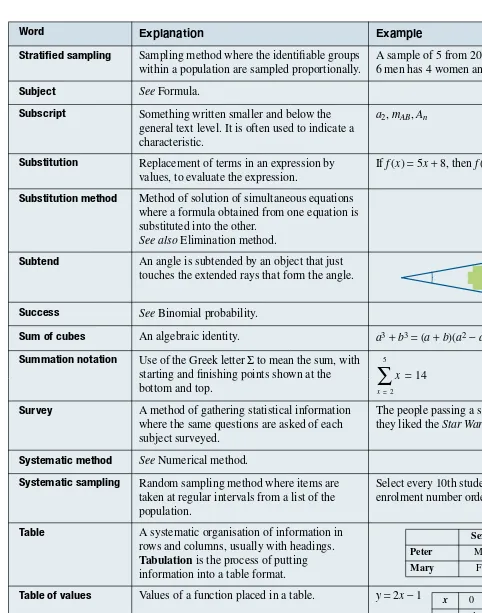
Stratified sampling Sampling method where the identifiable groups within a population are sampled proportionally.
A sample of 5 from 20 women and 6 men has 4 women and 1 man.
Subject See Formula.
Subscript Something written smaller and below the general text level. It is often used to indicate a characteristic.
a2, mAB, An
Substitution Replacement of terms in an expression by values, to evaluate the expression.
If f(x) = 5x + 8, then f(7) = 43.
Substitution method Method of solution of simultaneous equations where a formula obtained from one equation is substituted into the other.
See also Elimination method.
Subtend An angle is subtended by an object that just touches the extended rays that form the angle.
Success See Binomial probability.
Sum of cubes An algebraic identity. a3+ b3= (a + b)(a2− ab + b2)
Summation notation Use of the Greek letter Σ to mean the sum, with starting and finishing points shown at the bottom and top.
= 14
Survey A method of gathering statistical information where the same questions are asked of each subject surveyed.
The people passing a shop were asked if they liked the Star Wars films.
Systematic method See Numerical method.
Systematic sampling Random sampling method where items are taken at regular intervals from a list of the population.
Select every 10th student from a list in enrolment number order.
Table A systematic organisation of information in rows and columns, usually with headings. Tabulation is the process of putting information into a table format.
Table of values Values of a function placed in a table. y = 2x − 1
Tabulation See Table.
Tally marks See Frequency table.
Tangent to a curve A straight line drawn so that it just touches a curve.
See also Secant, Chord.
x
x=2 5
∑
Sex Age
Peter M 17
Mary F 16
x 0 1 2 3
y −1 1 3 5
Tangent (tan) 1. For angles θ such that 0° θ 90°: the ratio of the opposite side to the adjacent of the right-angled triangle containing θ.
2. For all angles: the quotient of the y-coordinate and x-coordinate of the trigonometric point P(x,y) with angle θ on a unit circle.
The tangent function is the resulting periodic function, and we usually use the variable x instead of θ, so y = tan x.
tan 30°=
=
tan θ =
tan =
Term See Sequence.
Theoretical probability
Calculation of chances using a sample space. A desired outcome is called an event, and the number of sample points is written as n(event). The number of sample points in the sample space is written as n(S). The probability is calculated from the ratio of n(event) to n(S). The probability, written as P(event), is between 0 and 1.
See also Probability, Sample space, Experimental probability.
When a card is drawn from a normal pack, the probability of obtaining a king is given by:
P(king)=
= =
≈ 0.077 ≈ 7.7%
Transformation of formula
Changing the subject of a formula. See also Formula.
y = x + 5a ⇒ x = y − 5a
Translation The effect on a graph of adding a quantity to one of the variables. See also Phase shift.
If y1= f(x), then y2= f(x + a) + b is translated: a horizontally and b vertically.
Trapezium formula See Definite integral approximations.
Tree diagram A method of showing multi-stage probability situations as a branched sequence.
Trial See Experimental probability.
Trial-and-error Empirical method where guesses are tried in succession until a solution is found.
Trigonometric point Point at an angle from the x-axis on the circumference of a unit circle used for the calculation of trigonometric ratios. See also cos, sin, tan.
Trinomial See Quadratic.
O A
----30° O
A 1
3
---y x
--θ
1 P(x, y) 4π
3 --- 3
x y
−π
y = tan x
π
n(king) n S( )
---4 52 --- 1
13
---Tossing 2 coins H = HH 1st toss 2nd toss
T = HT H = TH T = TT H
T
θ
1
True bearing See Bearing.
True class limits See Class.
Turning point See Stationary point.
Undefined See Not defined.
Unimodal Having only one mode. See also Mode, Bimodal.
Unit circle A circle of radius 1, especially that used for trigonometric ratios.
See also Trigonometric point, cos, sin, tan.
Unit triangle See Standard triangle.
Variable 1. Algebra: quantity that can have a range of values. Usually shown by a letter. May be preceded by a number called
the coefficient.
2. Statistics: attribute that varies in value. See also Constant.
5x has variable x and coefficient 5.
The age of a respondent is a variable.
Velocity The rate of change of displacement with time. It has both a direction and a size.
See also Speed.
The velocity of a car is 5 m/s SE.
Vertical line A line perpendicular to the surface of the Earth, shown up-and-down on a page.
Vertical line test A test of functionality by checking that no two points on the graph of a function are in the same vertical line.
Not a function.
Vertices The corners of a shape. Singular is vertex.
x-axis, x-coordinate See Coordinate.
x-intercept See Intercept.
y-axis, y-coordinate See Coordinate.
y-intercept See Intercept.
Zero of a function An x-intercept of the graph of a function. See also Intercept.
y
x