Volume 2007, Article ID 58416,14pages doi:10.1155/2007/58416
Research Article
On a Class of Parametric Transforms and Its Application to
Image Compression
Susanna Minasyan,1Jaakko Astola,1and David Guevorkian2
1Institute of Signal Processing, Tampere University of Technology (TUT), P.O. Box 527, 33101 Tampere, Finland 2Nokia Research Center, P.O. Box 100, 33721 Tampere, Finland
Received 14 July 2006; Revised 29 January 2007; Accepted 27 April 2007
Recommended by Mauro Barni
A class of parametric transforms that are based on unified representation of transform matrices in the form of sparse matrix products is described. Different families of transforms are defined within the introduced class. All transforms of one family can be computed with fast algorithms similar in structure to each other. In particular, the family of Haar-like transforms consists of discrete orthogonal transforms of arbitrary order such that they all may be computed with a fast algorithm that is in structure similar to classical fast Haar transform. A method for parameter selection is proposed that allows synthesizing specific transforms with matrices containing predefined row(s). The potential of the proposed class of Haar-like parametric transforms to improve the performance of fixed block transforms in image compression is investigated. With this purpose, two image compression schemes are proposed where a number of Haar-like transforms are synthesized each adapted to a certain set of blocks within an image.The nature of the proposed schemes is such that their performance (in terms of PSNR versus compression ratio) cannot be worse than a scheme based on classical discrete cosine transform (DCT). Simulations show that a significant performance improvement can be achieved for certain types of images such as medical X-ray images and compound images.
Copyright © 2007 Susanna Minasyan et al. This is an open access article distributed under the Creative Commons Attribution License, which permits unrestricted use, distribution, and reproduction in any medium, provided the original work is properly cited.
1. INTRODUCTION
Many traditional image compression methods are based on fixed transforms. Early image compression systems were based on splitting images into fixed-size blocks and applying a fixed block transform to each block. For example, the JPEG image compression standard [1] is based on the discrete co-sine transform (DCT). Also other fixed block transforms like Fourier, Walsh, Haar, and Sine transforms, were used for spe-cial types of images [2–13]. Modern image compression sys-tems support the JPEG2000 standard [14], which is based on wavelet transforms that are applied to whole image.
The wavelet based image compression methods are com-monly known to outperform the block transform-based methods [15]. However, the block transform-based methods still have potential of being improved by making them more adaptive to image content. For example, in [16], a DCT-based image compression method is proposed that signifi-cantly outperforms the JPEG2000, in particular, by adapting the block size (and the DCT size) according to activity of the image content in different regions. Let us, however, note that
the used transform is fixed and only its size is adapted to im-age in the method of [16].
A potential of further improving the performance of im-age compression methods by adapting the used transforms to different image regions may exist since each fixed trans-form is optimal for a specific class of inputs but none of them may provide satisfactory solution to a wide range of possible inputs. From this point of view, parametric transforms with matrices described in a unified form and based on a set of pa-rameters have become important. In this context, parametric transform, actually, means a wide class of discrete orthogo-nal transforms (DOTs) that may include classical transforms and an infinite number of new transforms with the possi-bility to select the desired transform according to parameter values. A unified software/hardware tool can be used to im-plement the whole class of transforms with the possibility to adapt a transform by varying the parameters. Various meth-ods to synthesize parametric transforms have been developed in [2,4–6,11–13,17–23].
of sparse block-diagonal matrices and permutation matri-ces, has been proposed. Several families of transforms have been defined within this class such that all transforms of one family can be computed with a fast algorithm of the same structure. In particular, a family of Haar-like transforms that can all be computed with fast algorithm in structure simi-lar to classical fast Haar transform algorithm has been pro-posed. A methodology to synthesize a Haar-like transform such that its matrix contains desired predefined basis func-tion(s) has also been developed (first presented in [22] and later also in [23]). Similarly, a family of Hadamard-like trans-forms and a family of slant-like transtrans-forms have been intro-duced in [22,23].
The general goal of this paper is to analyze the potential advantages of adaptive transform-based image compression methods over the fixed transform-based ones. Specifically, a class of parametric transforms is defined and its potential to improve block transform-based image compression meth-ods is investigated. With this aim, two parametric Haar-like transform-based adaptive image compression algorithms are proposed and their performances are compared to the per-formance of the similar algorithm that is based on the fixed DCT. In both algorithms, the classical DCT is used along with new transforms that are synthesized according to in-put image within the defined parametric class of transforms. The first algorithm is based on an iterative scheme where the classical DCT is used at the first iteration and iteratively syn-thesized Haar-like transforms are used at the following ations to refine the compression quality. The process is iter-ated as long as a rewarding performance improvement may be achieved. In the second compression algorithm the classi-cal DCT transform and several image dependent Haar-like transforms are applied in parallel to each nonoverlapping 8×8 block of the input image. The transform that achieves the best result is then selected to be assigned to the corre-sponding block. Let us note that both compression schemes have a performance that at least cannot be worse than a DCT-based compression scheme. Extensive simulations were con-ducted to compare the performance of the parametric Haar-like transform-based adaptive image compression methods with the performance of the similar algorithm that is based on fixed DCT. Several types of images were simulated. Exper-iments illustrated a moderate performance improvement for natural images and significant performance improvement for images of certain types such as medical images and complex images consisting of fragments of essentially different types.
The paper is organized as follows. InSection 2we review the parametric representation of a general class of fast trans-forms and define families of Haar-like, Hadamard-like, and slant-like transforms. A methodology of synthesizing para-metric transforms of arbitrary order with one or more pre-defined basis function(s) is also presented in this section. The proposed image compression algorithms are described in Section 3. The results of experiments and performance analysis of the algorithms are given inSection 4. A unified hardware architecture to synthesize and implement the fast parametric transforms is presented inSection 5. The conclu-sions are given inSection 6.
2. GENERALIZED FAST PARAMETRIC TRANSFORMS
In this section we present a unified parametric representa-tion of widely used fast algorithms for many fixed discrete orthogonal transforms in a generalized form for arbitrary or-der (size of the transform matrix). This approach not only allows of describing many existing fast transform algorithms in a unified form but also gives an opportunity to synthesize a broad family of new orthogonal transforms a priori hav-ing fast algorithms for their computation. In particular, fam-ilies of Haar-like, Hadamard-like, and slant-like transforms are defined based on this approach.
2.1. The class of parametric transforms
LetHN be an orthogonal (N×N)-matrix and let
y=HN·x (1)
be the corresponding discrete orthogonal transform (DOT) of (N×1)-vectorx.
The inverse DOT is defined as
x= 1
NH
∗
N ·y, (2)
where HN∗ is the conjugate transpose of the matrix HN. Obviously, the computational complexities of both the di-rect DOT (1) and the inverse DOT (2) are estimated as
C(DOT) = O(N2) operations in the general case. In
prac-tical applications, faster real-time computation is needed. Therefore, numerous fast algorithms have been developed for different fixed DOTs, for example, the well-known fast fourier transforms (FFT), fast cosine transforms (FDCT), fast Walsh-Hadamard transform (FWHT), fast Haar trans-form (FHT), and so forth (see, e.g., [2–8]). Analyzing these algorithms one can see that most of them can be described in a unified form. In [2,4–6,11–13,17–21] several unified rep-resentations of the fast transform algorithms are described. These representations can be generalized (see [20,21]) to the following representation of the transform matrix as the prod-uct:
HN=P(m+1)
1
j=m
H(j)P(j) (3)
of sparse matricesH(j), j = 1,. . .,m, which are (N ×N)
block-diagonal matrices with square blocks (spectral kernels) on the main diagonal, andP(j),j=1,. . .,m+ 1, are (N×N)
permutation matrices.1
Typically, the order N of the fast transform is consid-ered to be a composite number (most often a power of two or of another integer). Even though the composite number
x0 x1 x2
. . . xN−2 xN−1
Γ(1) Γ(2) Γ(m) Γ(m+1) V(1,0)
. . .
V(1,N1−1)
V(2,0)
. . .
. . .
. .
. ...
V(2,N1−1)
· · ·
V(m,0)
V(m,N1−1)
x1 x2 xm−1 y
y1
yN−2 yN−1
(a)
V(j,s) a
b cd c=uj,s×a +vj,s×b
d=vj,s×a−uj,s×b V(j,s)=
uj,s vj,s vj,s −uj,s
(b)
Figure1: The unified flowgraph of fast transform algorithms: (a) flowgraph structure; (b) the basic (butterfly) operation.
can formally be an arbitrary positive integer, the efficiency of the corresponding fast algorithm is not high for numbers presented with a small number of prime factors. In partic-ular, ifNis a prime number, the corresponding “fast” algo-rithm becomes, in fact, the direct matrix-vector multiplica-tion method with the computamultiplica-tional complexity ofO(N2).
Here we define a class of parametric transforms of arbi-trary orderNsuch that the efficiency of the corresponding fast algorithm does not depend on the number of factors of
N.
Definition 1. Define the classΩof discrete orthogonal
trans-forms such that their matrices may be presented in the form of (3), whereP(j),j=1,. . .,m+ 1, are (N×N) permutation
matrices, andH(j),j=1,. . .,m, are (N×N) block-diagonal
matrices of the form
H(j)=
k
s=0
V(j,s)
⊕INmod 2⊕
N/2
s=k+1
Vj,s
, (4)
wherek ∈ {0, 1,. . .,N/2 −1},V(j,s)are (2×2) matrices
calledspectral kernels,Ipis either an identity matrix of order 1 ifp=1 or an empty matrix ifp=0, the sign⊕stands for the direct sum of matrices, and the signafor the smallest integer larger or equal toa.
Obviously, the transform matrix presented in the form (3) is orthogonal if the spectral kernels in (4) are orthogonal. It should be noted that the spectral kernels and the permuta-tion matrices as well as the numbersmandkplay the role of parameters varying which different transforms fromΩmay be synthesized. In other words, by choosing various sets of permutation matrices and spectral kernels, it is possible to synthesize various orthogonal basesHN produced from (3).
Transforms fromΩ can be computed with a fast algo-rithm inmiterative stages:
x0=x; xj=H(j)·
P(j)x
j−1 , j=1,. . .,m;
y=P(m+1)x
m.
(5)
At the stage j =1,. . .,m; the input vectorxj−1to that stage
is first permuted according toP(j)and then the result is
mul-tiplied by the block diagonal matrixH(j), which is
equiva-lent to multiplying the corresponding (2×2) spectral kernels to corresponding (2×1) subvectors of the permuted vec-tor. Since the matrixH(j), j = 1,. . .,m, contains at most
4N/2 ≈ 2N nonzero entries, the complexity of the algo-rithm (5) is estimated asO(mN) operations at the most in-stead of O(N2) in the direct method. Thus, the transforms
fromΩpossess fast algorithms.
The fast transform algorithm (5) may nicely be pre-sented by the flowgraph, generically illustrated inFigure 1. The nodes of the flowgraph (bold dotes) are divided into
m + 1 levels, the jth level representing the vector xj,
j = 0,. . .,m, from (5). There are directed edges only
between nodes of adjacent levels. Sets of edges denoted
Γ(1),Γ(2),. . .,Γ(m+1) in Figure 1 correspond to permutation
matricesP(1),P(2),. . .,P(m+1) so that the outputs of the Γ(j)
block (which are marked with small circles), represent the vector xj = (P(j)xj−1). Blocks V(j,s), j = 1,. . .,m, s =
0,. . .,Nj −1, on Figure 1, represent executions of the
ba-sic operations, which are simple 2-point discrete orthogonal transforms (multiplication of a 2×2 orthogonal matrix by a 2-point vector or “butterfly”). Recall that the general form of an orthogonal 2×2 matrix is
V =
u v
v −u
, (6)
whereu2+v2 =1 and the “minus” sign may float to any of
the four entries.
Let us now consider two families of transforms within
Ω, the families of Hadamard-like and Haar-like transforms, which are of a particular interest since they are generaliza-tions of the classical Hadamard and Haar transforms.
Definition 2. Within the class Ω consider the family Ω of
x0 x1 x10 V(1,0) V(1,1) V(1,2) V(1,3) V(1,4)
H(1) P(2) V(2,0)
V(2,1)
V(2,2)
V(2,3)
V(2,4)
H(2) P(3) V(3,0)
V(3,1)
V(3,2)
V(3,3)
V(3,4)
H(3) P(4) V(4,0) V(4,1) V(4,2) V(4,3) V(4,4) H(4) y0 y1 y10
x1 x2 x3
x0=x y=x4
H(j)=I1 4
s=0
V(j,s),j=1, 3 H(2)= 4
s=0
V(2,s)
I1 P(1)=P(5)=I11
H(4)= 2
s=0
V(4,s)I1 4
s=3
V(4,s) P(2)=P(4)=I
1Psh(10) P(3)=Psh(10)I1
Figure2: The fast Hadamard-like transform of orderN=11.
The classical Hadamard transform belongs to the family
Ωof Hadamard-like transforms and corresponds to the fol-lowing choice of the parameters:m=log2N,N=2m,k≡0,
P(j),j=1,. . .,m, are all the perfect shuffle permutation
ma-trices,2and
V(j,s)= √1
2·
1 1 1 −1
, (7)
j = 1,. . .,m,s = 0,. . .,N/2−1. Let us note that
multi-plications with the coefficient 1/√2 may be collected from stage to stage to be pre- or post-performed before or after the fast Hadamard transform algorithm. Therefore, only addi-tions/subtractions will be performed during this algorithm.
An example of a new Hadamard-like fast transform flow-graph of orderN=11 is shown inFigure 2.
Note that for transforms from Ω, every matrix H(j),
j=1,. . .,m, contains exactly 4N/2 ≈2Nnonzero entries.
Therefore, the complexity of the algorithm (5) is estimated asO(mN) for transforms fromΩ.
Definition 3. Within the class Ω consider the family Ω of
Haar-like orthogonal transforms such that all the spectral kernels are orthogonal and
(1) all the entries of the spectral kernels V(j,s), j =
1,. . .,m, are nonzero for s = 0,. . .,Nj −1, where
Nj=
jtimes
· · · N/2/2/· · ·/2; (2) V(j,s)=I
2fors=Nj,. . .,N/2 −1,j=1,. . .,m;
(3) P(j)=P(j)
1 ⊕IN−Nj, whereP
(j)
1 is a permutation
ma-trix of orderNj.
2The perfect shuffle operator of order 2Ncollects allNeven components
onto the first half and theNodd components onto the second half of the output vector. x0 x1 x10 V(1,0) V(1,1) V(1,2) V(1,3) V(1,4)
H(1) P(2) V(2,0)
V(2,1)
V(2,2)
H(2) P(3)
V(3,0) H(3) V(4,0) H(4) y0 y1 y10
x1 x2 x3
x0=x y=x4
H(1)=I
1
4
s=0
V(1,s) H(2)= 2
s=0
V(2,s)
I5
H(3)=I
1V(3,0)I8
H(4)=V(4,0)I 9
P(1)=P(4)=P(5)=I
11 P(2)=I1
Psh(10) P(3)=Psh(6)I 5
Figure3: The fast Haar-like transform of orderN=11.
Haar transform is the classical representative ofΩ. It is ob-tained by takingm=log2N,k≡0,P1(j),j=1,. . .,m, is the
perfect shuffle permutation matrix of orderNj = N/2j, andV(j,s)=(1/√2)[1 1
1−1],j=1,. . .,m,s=0,. . .,N/2j−1.
Again, multiplications to the coefficient 1/√2 may be col-lected from stage to stage to be pre- or post-performed.
An example of a Haar-like fast transform flowgraph of orderN=11 is shown inFigure 3.
Note that for transforms fromΩ, the matrixH(j), j =
1,. . .,m, contains only 4Nj≈N/2j−3nonzero entries.
There-fore, the complexity of the algorithm of (5) is estimated as O(N). Thus, the transforms from Ω possess fast algo-rithms, which are even faster than those for the family
Ω, for which the complexity is O(mN). This can also be noted from the structures of the flowgraphs. While the flow-graphs of Hadamard-like transforms all have a “semirectan-gular” structure (equal number of nodes (butterflies) at every stage), the flowgraphs of Haar-like transforms all have “semi-triangular” structure (approximately twice reduced number of nodes from a stage to the next).
2.2. Synthesis of fast Haar-like and Hadamard-like
transforms with a predefined basis functions
We now present an algorithm for synthesizing a transform fromΩ, the matrixHN of which has an arbitrary predefined normalized vector h (h = 1) on its first row. Since HN should be orthogonal the latter condition means
HNhT =[1, 0,. . ., 0]T. (8)
Therefore, the problem is reduced to defining the sets of edges and spectral kernels in a flowgraph of the structure shown onFigure 1so that the first outputy0of the flowgraph
the number of nonzero input components at each of them
stages until only one nonzero component is left.
Algorithm 1(synthesis ofHN ∈Ωwithhin the first row).
Step 1. Assume that the desired normalized vectorhis the
input to a flowgraph of a fast transform that has at least
log2Nstages, the jth stage, j =1,. . .,m, consisting of at leastNj= N/2jbutterflies.
Step 2. For the first stage do the following.
Step 2.1. Arbitrarily define the set of edgesΓ(1)(or
equiva-lently, arbitrarily define the permutation matrixP(1)).
Step 2.2. Define spectral kernels
V(1,s)= 1
u1,s 2+
v1,s 2
u1,s v1,s
v1,s −u1,s
, s=0,. . .,N1−1
(9) by assigning to the pair [u1,s,v1,s] the values of the corre-sponding two components of the vectorhthat are input to thesth operation of the first stage of the flowgraph. If, how-ever, both of these components are equal to zero, then arbi-trarily define the corresponding spectral kernel. If only one of these components is nonzero, then define the correspond-ing spectral kernel to be an identity matrix of size 2×2. Note that this definition of spectral kernels implies that the second outputs of all butterflies are always zeros.
Step 2.3. Apply the first stage of the flowgraph to the input
vectorhand obtain vectorx1.
Step 3. For every stagej=2,. . .,mdo the following.
Step 3.1. Define the set of edgesΓ(j)so that it passes the first
(nonzero) outputs of butterflies of the previous stage to the inputs of uppermost butterflies of the current stage. Note that all theN/2jnonzero outputs of the previous stage will be distributed amongNj= N/2jbutterflies of the previous stage.
Step 3.2. Define the spectral kernels
V(j,s)= 1
uj,s 2+
vj,s 2
uj,s vj,s
v1,s −uj,s
, (10)
where [uj,s,vj,s] are the corresponding two components of the vector xj−1 that are passed to the sth operation of the
current stage of the flowgraph. Again if both of these com-ponents are equal to zero, then arbitrarily define the corre-sponding orthogonal kernel, and if only one of these com-ponents is nonzero, then define the corresponding spectral kernel to be an identity 2×2 matrix.
Step 3.3. Apply the jth stage of the flowgraph to the vector
xj−1, and obtain vectorxj.
Step 4. Arbitrarily define the set of edgesΓm+1 but so that it
does not change the position of the first component.
Since the number of nonzero components approximately halves from stage to stage and since the number of stages is
m ≥ log2N, only the first output of the flowgraph will be nonzero and equal to unity (the inputh was normalized). Thus, the corresponding transform: (a) will have an orthog-onal matrix (spectral kernels were selected orthogorthog-onal); (b) may be computed with a fast algorithm; (c) will contain the desired predefined vectorhin its first row.
Let us consider an example of synthesizing a Haar-like transform of orderN = 8 with the generating vector h = (1/√204)·[1, 2, 3, 4, 5, 6, 7, 8] as its first row. The matrixH8
of the desired transform can be presented as
H8=P(4)H(3)P(3)H(2)P(2)H(1)P(1), (11)
where we defineP(1)=P(4)=I
8. Then, according toStep 2.2
ofAlgorithm 1we define
H(1)=√1
5
1 2 2 −1
⊕1
5
3 4 4 −3
⊕√1
61
5 6 6 −5
⊕√1
113
7 8 8 −7
.
(12)
With this matrix we obtain the result of the first stage:
x1=H(1)h=
1
√
204 √
5, 0, 5, 0,√61, 0,√113, 0T.
(13)
We then define the permutation matrixP(2) =Psh(8) to be
the perfect shuffle of order 8. ApplyingP(2)tox
1results in
P(2)x1=
1
√
204
·√5, 5,√61,√113, 0, 0, 0, 0T.
(14)
Now, according toStep 3.2, we defineH(2)as
H(2)= √1
30 √
5 5 5 −√5
⊕√1
174
√
61 √113
√
113 −√61
⊕I4.
(15)
Applying this matrix toP(2)x 1yields
x2=H(2)P(2)x1=√1
204· √
30, 0,√174, 0, 0, 0, 0T.
(16)
TakingP(3)=P(sh)(4)⊕I
4and defining
H(3)= √1
204
√
30 √174
√
174 −√30
⊕I6, (17)
we will find
A fixed transform
Quantization and hard threshold
Lossless coding
Channel/ storage
Lossless decoding Dequantization
Inverse transform
Figure 4: Generic transform-based image compression/decom-pression system.
Substituting the defined matrices into the factorization (11) ofH8we obtain the desired transform matrix
H8≈
1
√
204· ⎡ ⎢ ⎢ ⎢ ⎢ ⎢ ⎢ ⎢ ⎢ ⎢ ⎢ ⎢ ⎢ ⎣
1 2 3 4 5 6 7 8
2.4 4.8 7.2 9.6 −2.1 −2.5 −2.9 −3.3 5.8 11.7 −3.5 −4.7 0 0 0 0
0 0 0 0 7.4 8.8 −5.6 −6.4 12.8 −6.4 0 0 0 0 0 0
0 0 11.4 −8.6 0 0 0 0 0 0 0 0 10.9 −9.1 0 0 0 0 0 0 0 0 10.7 −9.4
⎤ ⎥ ⎥ ⎥ ⎥ ⎥ ⎥ ⎥ ⎥ ⎥ ⎥ ⎥ ⎥ ⎦ .
(19)
Note that the obtained matrix has a structure similar to that of classical Haar transform matrix in the sense of dis-tribution of positive, negative, and zero entries. At the same time it has the desired generating vector as its first row.
2.3. Fast Haar-slant and Hadamard-slant transforms
In this section, we further develop Algorithm 1 and con-struct orthogonal N × N matrices (arbitrary N) having the representations (3), (4) and involving more than one given orthogonal vectors as rows. In particular, one can consider the case of slant-like transforms wherein the first row of the matrix is the normalized constant vector e =
(1/√N)· [1, 1,. . ., 1] of length N, and the second row is a normalized slant (monotonically decreasing) vector a =
[α0,α1,. . .,αN−1] of arbitrary slanting angleγ=tan−1(αi+1−
αi),i=0,. . .,N−2 and orthogonal to the first row. The
ma-trixHNof the desired Haar-slant (or Hadamard-slant) trans-form may be found as the product
HN =
I1⊕HN− 1 HN, (20)
whereHN ∈Ω(orHN ∈Ω) is a matrix havingeat its first row, andHN− 1∈Ω(orHN−1∈Ω) is an (N−1)×(N−1)
matrix having the lastN−1 components of the vectorHNaT at its first row. Both matricesHN andHNmay be obtained byAlgorithm 1with corresponding input vectors. Similarly more than two predefined vectors, orthogonal to each other, may be involved into the transform matrix.
3. IMAGE COMPRESSION ALGORITHMS
A traditional block transform-based image compression scheme (see Figure 4) applies a fixed transform to every
subimage (8×8 block) and implements the actual compres-sion in the transform domain by quantizing the transform coefficients followed by lossless encoding of the quantized values. Obtained bitstream is sent to the decoder, which im-plements inverse procedures to obtain an estimate of the en-coded image. This scheme is motivated by the fact that, for most of natural images, content within small blocks is rather flat meaning high correlation between image pixels. When a proper transform (typically 2D separable DCT) is applied to such a flat block the largest portion of energy tends to be concentrated within relatively small number of transform co-efficients. The better the transform concentrates the energy, the better is the performance of the compression scheme meaning closeness of the estimate on the decoder output to the original image on the encoder input at given compres-sion ratio (ratio between the number of bits representing the original image and the number of bits representing the compressed image). The known fixed transforms, including DCT, perform rather well for flat image blocks but typically fail for active blocks with low correlation between pixels. The performance of the block-based image compression scheme could potentially be improved by possibility to use several transforms each specifically synthesized for a certain type of blocks. Parametric transforms ofSection 2and the method of synthesizing them may offer such an opportunity.
Based on (8), it is clear that parametric transforms are able to concentrate arbitrary image block energy into just one transform coefficient, which would be the ideal energy concentration. For this, however, a transform should be syn-thesized per each column and per each row of an image block used as generating vectors of these transforms. Apply-ing these transforms to the image block so that each of them is applied to its generating vector would result into a matrix with only nonzero entry at the up-left corner. However, there is also maximally large overhead in such an approach since all the generating vectors, that is whole the original input image block, should also be sent to the decoder.
The overhead may and should be reduced by compro-mising the energy concentration property. There are diff er-ent opportunities for such a tradeoff. In a priori research we have compared several approaches with extensive simula-tions. Currently the following approaches described in Algo-rithms2and3were considered being suitable ones. In both approaches, parametric transforms are synthesized accord-ing to generataccord-ing vectors that are obtained as averages of dif-ferently formed image subvectors (block rows and columns). The basic (experimentally confirmed) assumption here is that average of several vectors (say xi,i = 1,. . .,n) having similar properties tends to preserve shapes of these vectors. Therefore, the parametric transform synthesized according to the generating vector being an average of several vectors,
sayxi,i=1,. . .,n, would still efficiently concentrate energy
of each of the vectorsxi,i = 1,. . .,n. In order to classify image subvectors (block rows and columns) the efficiency of DCT-based compression could be used.
Input image
8
×
8s
u
b
im
ag
es
Transform 0 (DCT)
Parametric transform 1 Parametric transform 2 Parametric transformk
Generating vectors Adaptive
transforms that are synthesized until improvement may be achieved in the compression quality
Selection (for every subimage
the transformed block with the best compression quality
is selected)
Quantization
and/or
thr
esholding
Form a matrix CLASS, indicating
the numbers of selected transforms for every subimage
L
o
ssless
enc
oding Bitstream
Figure5: Image coder of proposed compression algorithm.
each synthesized and adapted to a certain type of blocks. The proposed compression schemes have performance that can-not be worse than a DCT-based scheme.
3.1. Iterative image compression scheme (IICS)
The first proposed scheme is iterative one where the classical DCT is used at the first iteration and iteratively synthesized Haar-like transforms are used at the following iterations. The main idea of the algorithm is to apply few parametric Haar-like transforms, each specifically designed for a specific class of blocks. Transforms are iteratively synthesized based on the blocks for which lowest compression efficiency was achieved with the previous transform (DCT being the initial one). The iterative process is continued as long as a worth-while over-all compression efficiency improvement is observed for the whole image. The diagram of the image coder is depicted byFigure 5. A more detailed, step-by-step description of the proposed scheme follows.
Algorithm 2(IICS).
Step 1. Apply the traditional image compression scheme as
shown inFigure 4. In our current implementation, the in-putN×Mimage is partitioned into 8×8 blocks, which are DCT transformed, uniformly quantized, and hard thresh-olded. Then, zig-zag scanning followed by lossless encoding is applied to form the output bitstream.
Step 2. Initialize ann×mmatrix CLASS (n=N/8,M=m/8)
with all the zero entries. The matrix CLASS will iteratively be updated to contain the indices of transforms assigned to the blocks. The DCT is indexed by zero and the transforms
synthesized at the following iterations are indexed by the numbers of corresponding iterations.
Step 3. Measure the compression efficiency for every block
and collect blocks with worst compression efficiency values. To measure the compression efficiency for a blockBwe used the following functional:
CE(B)= 1
c1·SE(B) +c2·NB(B)
, (21)
wherec1,c2 are parameters that control the relative signifi-cance between the compression ratio and the distortion; NB is the number of bits representing the block after coding (DCT, quantization and lossless encoding); SE is the absolute difference between the original and the reconstructed image block. Higher CE value indicates better compression. The re-lation between parametersc1 andc2 is such that
c1= c
max
allB
SEDCT(B)
, c2=
1−c
max
allB
NBDCT(B)
,
(22)
where 0< c <1, SEDCT(B) and NBDCT(B) are corresponding
characteristics obtained by DCT coding the block B. Note that larger value ofcmeans more significance of achieving less distortion rather than achieving higher compression.
To collect blocks with the worst coding efficiency we use the condition
CE(B)< α·mean
allB
CE(B), (23)
whereαis a parameter. Blocks satisfying this condition were collected.
Step 4. Synthesize a new 2D parametric transform adapted
for the blocks collected atStep 3. In current implementation, a separable 2D transform is synthesized such that each block is multiplied by a matrixH(1) from the left-hand side, and
by another matrixH(2)from the right-hand side. The
para-metric transformH(1)is generated by the transposed mean
column and the transformH(2)is generated by the mean row
of the collected worst blocks.
Step 5. Apply the new synthesized transform to every block
of the image. For every block, if the current transform gives a smaller value of CE(B) than the previous transform, assign the current transform to the given block. Update the matrix CLASS correspondingly. Note that in calculation of CE(B) the overhead bits for presenting the generating vectors and the CLASS matrix must be taken into account.
Step 6. Lossless encode the generating vectors and the CLASS
Bitstream Lossless decoder and IQ
Optimally decoded
blocks Generating
vectors Matix CLASS
Block distribution to transforms
according to matrix
0 1
k
IDCT IPT 1
. . . IPTk Synthesis of inverse parametric transforms
Rec. image
Figure6: General scheme of an image decoder for two proposed compression algorithms.
Decoder performs the reconstruction of the blocks ac-cording to the matrix CLASS, elements of which show to de-coder the number of the received generating vector based on which decoder constructs inverse transform and implements the reconstruction of the image. The decoder of the proposed scheme is illustrated inFigure 6.
3.2. Multiple transform-based image compression
(MTIC) algorithm
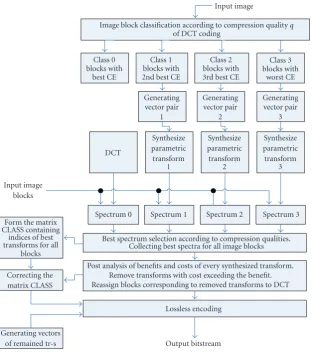
The idea of the second proposed scheme is to apply multi-ple transforms to each image block and to select the best one according to a quality functional. Multiple transform-based image coder diagram is shown inFigure 7. The decoder in this algorithm performs the same procedure as in the pre-vious scheme (see Figure 6). A more detailed, step-by-step description of the proposed scheme follows.
Algorithm 3(MTIC).
Step 1. At this step a JPEG-like or DCT-based image
com-pression scheme is applied to the givenN×Mimage.
Step 2. For each nonoverlapping 8×8 image blockBof the
input image the quality functional CE(B) according to (21) is calculated. The values of the quality functional for all blocks are collected in a CEMmatrix of order (N/8)×(M/8) which is then scaled to contain entries between zero and one. Thus, the matrixQM contains coding efficiency information ob-tained after the DCT-based compression of the original im-age.
Step 3. This is the block classification stage. At first, the range
[min, max] is determined, where min and max indicate the minimal and maximal values of theQMmatrix, respectively. Then, a series of subdivisions is applied to the range such that at each time the left half of previous division is selected for the following subdivision. Currently we apply only three sub-divisions since the more the number of subranges, the more overhead and the complexity of the algorithm. Blocks
corre-sponding to one subrange are collected together. Therefore, after classification we will have four types of blocks corre-sponding to four sequential subranges. Note that, on the av-erage, smoother image blocks will fall into the subranges on the right side of the original range and less smooth blocks to the left subranges.
Step 4. Three new parametric 2D transforms are synthesized
based on blocks collected to the lefter subranges. For every separable parametric 2D transformH(i),i=1, 2, 3, a matrix
Hi(1), that is multiplied to a block from the left-hand side and another matrixHi(2)that is multiplied from the right-hand side are synthesized. The parametric transformHi(1)is gener-ated by the transposed mean column and the transformHi(2) is generated by the mean row of the collected blocks within
ith subrange. Therefore, three parametric 2D transforms are synthesized which correspond to three subranges.
Step 5. Initializen×mmatrix CLASS (n=N/8,m=M/8)
that will contain the indices of transforms assigned to the blocks. DCT is indexed by zero and the three newly synthe-sized transforms are indexed from 1 to 3.
Step 6. Every 8×8 block is processed by four transforms,
that is, 2D DCT and the three new synthesized parametric 2D transforms, are applied to every image block. Then, all trans-formed blocks are quantized, hard thresholded, and entropy encoded. Here the best transform out of four is selected for each block according to the quality functional CE (see (21)).
Step 7. Image blocks which are compressed with the “best”
selected transforms are collected in a separate matrix. Since there is an overhead due to using parametric transforms, the question of “benefit” and “cost” of the parametric transforms becomes crucial. To solve this problem we need to verify the following condition: if the total “benefit” from using certain parametric transform over all blocks where it was selected is less than the cost of using that transform, it is not used. Every block where this transform was selected as the “best” is replaced with the DCT processed block. Otherwise, if the “benefit” is more than the cost, the corresponding transform is used.
Step 8. Update the block classification matrix CLASS
corre-spondingly.
Step 9. The optimally coded blocks, the lossless-coded
gener-ating vectors, and the lossless-coded CLASS matrix represent the information, which is sent to the storage or channel.
Input image
Image block classification according to compression qualityq of DCT coding
Class 0 blocks with
best CE
Class 1 blocks with 2nd best CE
Class 2 blocks with 3rd best CE
Class 3 blocks with
worst CE Generating
vector pair 1
Generating vector pair
2
Generating vector pair
3
DCT
Synthesize parametric transform
1
Synthesize parametric transform
2
Synthesize parametric transform
3 Input image
blocks
Spectrum 0 Spectrum 1 Spectrum 2 Spectrum 3 Form the matrix
CLASS containing indices of best transforms for all
blocks Correcting the matrix CLASS
Generating vectors of remained tr-s
Post analysis of benefits and costs of every synthesized transform. Remove transforms with cost exceeding the benefit. Reassign blocks corresponding to removed transforms to DCT
Best spectrum selection according to compression qualities. Collecting best spectra for all image blocks
Lossless encoding
Output bitstream
Figure7: Multiple transform-based image coder.
updated atStep 8. Therefore, the overhead’s influence to the overall coding quality can never be larger than the improve-ment due to using the final set of parametric transforms, that is, the performance of the proposed algorithm cannot be worse than that of the pure DCT-based algorithm.
4. SIMULATIONS
Both parametric transform-based image compression schemes were experimented on different test images and compared to the similar image compression scheme based on fixed DCT.
Some results obtained by the iterative compression scheme (Algorithm 2) are presented inTable 1. In this ta-ble, the results of the first iteration (presented in first rows for each image) correspond to the DCT-based compression scheme. Next iterations correspond to the case where para-metric Haar-like transforms are also used. The last column in Table 1presents parameters used in the experiments where
cis the constant used in compression efficiency functional calculation (see (21), (22)),αis the constant used to check “compressability” of the given block according to (23), and
Qis the quantization step that controls the bitrate in
com-Table1: Simulation results ofAlgorithm 2(IICS).
Image Iterat. Comp.
ratio PSNR Parameters
Cameraman
1 6.29 38.17 c=0.05
2 6.30 38.52 α=1
3 6.28 38.54 Q=12.8
Medicalim
1 4.35 45.78 c=0.9
2 4.39 46.14 α=0.8
3 4.35 46.19 Q=4
Kidney
1 20.15 41.67 c=0.6
2 20.74 42.05 α=1.2
3 20.28 42.09 Q=12
Oesoph
1 20.93 42.87 c=0.8
2 24.09 43.60 α=0.9
3 24.09 43.60 Q=13.6
Table2: Simulation results ofAlgorithm 3(MTIC).
Image Transform Comp.
ratio PSNR Parameters
Compound
DCT
8.3
38.86 c=0.67,Q=20
q1=12
q2=10
q3=8
Proposed 44.43
Lena
DCT
8.7
34.73 c=0.58,Q=19.2
q1=24.96
q2=23.04
q3=7.68
Proposed 35.58
Cameraman
DCT
7.3
36.66 c=0.37,Q=16
q1=16
q2=14.4
q3=12.8
Proposed 38.34
Mandril
DCT
8.4
28.38 c=0.1,Q=36
q1=43.2
q2=39.6
q3=36
Proposed 28.41
current iteration. Therefore, the final (the best) result of the proposed algorithm corresponds to the result of the penul-timate iteration (highlighted with bold font type). One can see fromTable 1that, for approximately the same compres-sion ratios, PSNR is increased up to penultimate iteration for all the images.
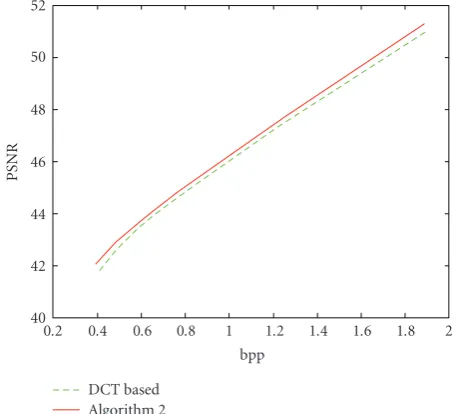
To analyze the performance ofAlgorithm 2, PSNR ver-sus bitrate (bpp) plots were also obtained for several im-ages. In these experiments, the values of parametersc and
αwere fixed for every image and the parameterQwas varied to achieve different bitrates.Figure 8shows plots for several images. One can see that essential performance is achieved especially for the image “Compound.”
Table 2 presents some results of experiments for Algorithm 3in comparison with the DCT-based scheme. The last column indicates the parameter values used in the cor-responding experiments. Here c is the same as in Table 1 (see (21), (22)), Q is the quantization step used in DCT-based coding (both at the first step of Algorithm 3and in the reference DCT-based scheme), andq1,q2,q3 are quan-tization steps used in association with corresponding three parametric transforms synthesized according toAlgorithm 3. Table 2 illustrates the essential performance improvement for all the test images.Figure 9shows PSNR versus bitrate plots ofAlgorithm 3for different images.
To visualize the performance of the parametric-trans-form-based image compression schemes, Figure 10 illus-trates comparative performance of Algorithms2and3with that of the DCT-based scheme for the medical image “kid-ney” (as known in [15], visual quality is the most important characteristic of medical image compression schemes).
It should also be noted that both Algorithms2 and3 do not only perform image compression but also implement block classification. Such classification is an important
prop-40 42 44 46 48 50 52
PSNR
0.2 0.4 0.6 0.8 1 1.2 1.4 1.6 1.8 2 bpp
DCT based Algorithm 2
(a) Kidney image:Algorithm 2versus DCT-based compression
32 34 36 38 40 42 44 46 48
PSNR
0.5 0.6 0.7 0.8 0.9 1 1.1 1.2 1.3 1.4 1.5 bpp
DCT based Algorithm 2
(b) Compound image:Algorithm 2versus DCT-based compression
Figure8: PSNR versus bitrate plots for images: (a) “Kidney” (c= 0.9,α=1); (b) “Compound” (c=0.5,α=1).
erty, especially for images composed of subimages of several types. Figure 11 presents plots of the matrices CLASS ob-tained by Algorithms2and3for the Compound image. The black pixels in this plot correspond to the use of DCT, while white pixels correspond to the use of parametric Haar-like transforms.
26 28 30 32 34 36 38 40 42 44 46
PSNR
0.2 0.4 0.6 0.8 1 1.2 1.4 1.6 1.8 2 2.2 bpp
DCT based Algorithm 3
(a) Cameraman image:Algorithm 3versus DCT-based com-pression
26 28 30 32 34 36 38 40 42 44
PSNR
0 0.5 1 1.5 2 2.5
bpp DCT based
Algorithm 3
(b) Lena image:Algorithm 3versus DCT-based compression
40 42 44 46 48 50 52 54
PSNR
0.2 0.4 0.6 0.8 1 1.2 1.4 1.6 1.8 2 bpp
DCT based Algorithm 3
(c) Kidney image:Algorithm 3versus DCT compression
Figure9: PSNR versus bitrate plots for images: (a) “Cameraman;” (b) “Lena;” (c) “Compound.” For all imagesc=0.5,Q=8· · ·80,
q1=Q,q2=0.9Q,q3=08Q.
(a) (b)
(c) (d)
Figure 10: Medical image “Kidney”: (a) the original image; (b) 6.53 times DCT compressed image; (c) 6.67 times compressed
image with Algorithm 2; (d) 6.72 times compressed image with
Algorithm 3.
(a) (b) (c)
Figure11: Results for “Compound” image: (a) original image; (b)
matrix CLASS obtained byAlgorithm 2; (c) matrix CLASS obtained
byAlgorithm 3.
5. UNIFIED ARCHITECTURE FOR SYNTHESIS AND IMPLEMENTATION OF PARAMETRIC TRANSFORMS
MUX
MUX u
v
x
x c1c2
c1c2
c1
c1
TG
TG
+/− X−1/2
Shift
re
gi
st
er
s
Shift
re
gi
st
er
s
Figure12: The structure of the generic PE for unified architectures for parametric transform synthesis and implementation.
the literature. However, to the best of our knowledge, no uni-fied architecture that may synthesize a transform according to a set of parameters and then implement the synthesized transform is known. In this section, we propose architectures that operate in two modes: synthesis mode and implemen-tation mode. In the synthesis mode, the architecture has a desired vectorh in its input and computes the parameters (spectral kernels) that correspond to an orthogonal trans-form of a given type (Haar-like, Hadamard-like, etc.). These parameters are stored in registers and then are used in the im-plementation mode where the synthesized transform is ap-plied to an arbitrary input vector.
Most of the architectures for fixed transforms or trans-form families are designed by mapping the flowgraph of the corresponding fast transform algorithm into architectures of one or another type (pipelined, iterative, parallel pipelined, folded, etc.). Vertical projections of the flowgraph to chains of processing elements (PEs) that implement the “butter-flies” lead to pipelined designs. In pipelined designs, stages of the flowgraph are performed in parallel while the butter-flies of a stage are performed sequentially. Typically, shift reg-isters, delays, and multiplexers are used to implement per-mutations according to the sets of edges of the correspond-ing flowgraph. Horizontal projections to arrays of PEs lead to iterative processors. Permutations according to the sets of edges are implemented within the interconnection network between PEs. Actually, the flowgraph itself where the blocks corresponding to spectral kernels are replaced by PEs may, in principle, be considered as a parallel-pipelined (or stream) architecture. To reduce the size of the architectures, usually folding is applied where the number of PEs is used, so that each PE implements a number of “butterflies.”
Here, we will not go into deeper architectural details but will concentrate on a generic PE structure that, when used in any architecture for a fast transform algorithm involving “butterflies,” allows synthesizing new transforms based on
Algorithm 1and at the same time efficiently implements the “butterflies.” The generic PE structure is shown onFigure 12. It operates in two modes. In synthesis mode, the control signalc1c2to multiplexers is first set toc1c2 =00 so that its
every input is multiplied to itself. The results of multiplica-tions (squarings) are added within the adder and the sum is then inverted within the “Inv (1/x)” block. Then the control signal to the multiplexers is set toc1c2=01 so that the result
(1/(u2+v2)) is sent to the two multipliers which obtain the
two desired parametersu/(u2+v2) andv/(u2+v2) which are
stored in the shift register file (at this point the transmitter gate “TG” is open). In the shift register file there are as many registers as many “butterflies” the PE will be implementing in the implementation mode. When parameters for all but-terflies assigned to the given PE are computed, the control signal is set toc1c2=10 which switches PE to the
implemen-tation mode. The parameters from shift registers are sent to multipliers so that the first row of the spectral kernel is mul-tiplied to the input vector. At the next step the control signal is set toc1c2=11 so that the second row of the spectral
ker-nel is multiplied with the input pair. The results are sent to the next, within the given architecture, PE for computing the parameters of butterflies that correspond to that PE.
Note that the square root divider block within the PE is the most complicated block. Its complexity is approximately the same as of the divider (see, e.g., [26]). However, this block is out of the critical path in the implementation mode so that the speed of the proposed PE in this mode is approximately the same as if it was designed only to implement a fixed trans-form. It is much slower in the synthesis mode. In most of the applications synthesizing is applied much less frequently compared to the implementation of the transforms (see Al-gorithms2and3). One way to exclude the square root di-vider block from the PE could be creating a look-up table (LUT) outside of the PE and reuse this LUT for every PE within the architecture for transforms. Efficiency of this ap-proach depends on the working precision of the architec-ture and the size of the transforms being implemented. An-other way to exclude this complex block could be based on computing the parameters of the transform outside of the hardware architecture for the transform and then “manually” tuning the PE to the desired transform by directly loading computed parameters to the shift registers. However, the al-ternative presented onFigure 12allows also automatic gen-eration of transform parameters meaning that the transform may automatically be adapted to the input signal or image.
6. CONCLUSION
REFERENCES
[1] W. B. Pennebaker and J. L. Mitchell,JPEG Still Image Data
Compression Standard, Van Nostrand Reinhold, New York, NY, USA, 1993.
[2] S. S. Agaian, “Optimal algorithms of fast orthogonal
trans-forms and their implementation on computers,” in
Kiber-netika I Vichislitelnaya Tekhnika, issue 2, pp. 231–319, Nauka, Moscow, Russia, 1986.
[3] S. S. Agaian, J. Astola, and K. Egiazarian,Binary Polynomial
Transforms and Non-linear Digital Filters, Marcel Dekker, New York, NY, USA, 1995.
[4] S. S. Agaian and A. K. Matevosian, “Generalized Haar trans-forms and automation systems for testing quality of circuits,”
Acta Cybernetica, vol. 5, pp. 345–362, 1981.
[5] N. U. Ahmed and K. R. Rao,Orthogonal Transforms for Digital
Signal Processing, Springer, Secaucus, NJ, USA, 1975.
[6] O. K. Ersoy, “A comparative review of real and complex Fourier-related transforms,”Proceedings of the IEEE, vol. 82, no. 3, pp. 429–447, 1994.
[7] A. K. Jain,Fundamentals of Digital Image Processing, Prentice-Hall, Englewood Cliffs, NJ, USA, 1989.
[8] A. D. Poularikas, Ed.,The Transforms and Applications
Hand-book, CRC Press, Boca Raton, Fla, USA, 1996.
[9] H. S. Malvar,Signal Processing with Lapped Transforms, Artech House, Norwood, Mass, USA, 1992.
[10] M. V. Wickerhauser,Adapted Wavelet Analysis from Theory to
Software, IEEE Press, A. K. Peters, Wellesley, Mass, USA, 1994. [11] V. G. Labunets, “A unified approach to fast
transfor-mation algorithms,” in Primeneniye Ortogonalnix Metodov
pri Obrabotke Signalov i Analize System, pp. 4–14, UPI, Sverdlovsk, Russia, 1980.
[12] M. Traxtman and V. A. Traxtman,Osnovi Teorii Discretnix
Signalov na Konechnix Intervalax, Sovetskoye Radio, Moscow, Russia, 1975.
[13] L. P. Yaroslavskiy, “Some questions of the theory of discrete orthogonal transforms of signals,” inCifrovaya Obrabotka Sig-nalov I ee Primeneniya, pp. 33–71, Nauka, Moscow, Russia, 1981.
[14] C. Christopoulos, A. Skodras, and T. Ebrahimi, “The JPEG
2000 still image coding system: an overview,”IEEE
Transac-tions on Consumer Electronics, vol. 46, no. 4, pp. 1103–1127, 2000.
[15] D. H. Foos, E. Muka, R. M. Slone, et al., “JPEG 2000
compres-sion of medical imagery,” inMedical Imaging 2000: PACS
De-sign and Evaluation: Engineering and Clinical Issues, vol. 3980 of Proceedings of SPIE, pp. 85–96, San Diego, Calif, USA, February 2000.
[16] N. Ponomarenko, V. Lukin, K. Egiazarian, and J. Astola, “DCT
based high quality image compression,” inProceedings of the
14th Scandinavian Conference on Image Analysis (SCIA ’05), pp. 1177–1185, Joensuu, Finland, June 2005.
[17] A. I. Solodovnikov, I. I. Kanatov, and A. M. Spivakovskii, “Syn-thesis of orthogonal bases from a generalized spectral kernel,” inVoprosy Teorii Sistem Avtomaticheskogo Upravleniya, vol. 2, pp. 99–112, LGU, Leningrad, Russia, 1978.
[18] A. I. Solodovnikov, “Synthesis of complete orthonormal
sys-tems of functions having fast transform algorithm,” in
Vo-prosy Teorii System Avtomaticheskogo Upravleniya, vol. 4, pp. 94–105, LGU, Leningrad, Russia, 1978.
[19] H. C. Andrews and K. L. Caspary, “A generalized technique for spectral analysis,”IEEE Transactions on Computers, vol. 19, no. 1, pp. 16–25, 1970.
[20] S. S. Agaian and D. Z. Gevorkian, “Complexity and parallel algorithms of discrete orthogonal transforms,” inKibernetika I Vichislitelnaya Tekhnika, issue 4, pp. 124–169, Nauka, Moscow, Russia, 1988.
[21] S. S. Agaian and D. Gevorkian, “Synthesis of a class of orthogo-nal transforms: parallel SIMD-algorithms and specialized pro-cessors,”Pattern Recognition and Image Analysis, vol. 2, no. 4, pp. 394–408, 1992.
[22] S. Minasyan, D. Guevorkian, and H. Sarukhanyan, “On pa-rameterized fast Haar- and Hadamard-like transforms of arbi-trary order,” inProceedings of the 3rd International Conference on Computer Science and Information Technologies (CSIT ’01), pp. 294–298, Yerevan, Armenia, September 2001.
[23] S. Minasyan, D. Guevorkian, S. S. Agaian, and H. Sarukhanyan, “On “slant-like” fast orthogonal
trans-forms of arbitrary order,” inProceedings of the 4th EURASIP
IEEE Region and International Symposium on Video/Image Processing and Multimedia Communications (VIPromCom ’02), pp. 309–314, Zadar, Croatia, June 2002.
[24] S. Minasyan, J. Astola, and D. Guevorkian, “An image com-pression scheme based on parametric Haar-like transform,” in
Proceedings of IEEE International Symposium on Circuits and Systems (ISCAS ’05), vol. 3, pp. 2088–2091, Kobe, Japan, May 2005.
[25] J. Astola, S. Minasyan, and D. Guevorkian, “Multiple
trans-form based image compression technique,” in Proceedings
of the 5th IASTED International Conference on Visualization, Imaging, and Image Processing, Benidorm, Spain, September 2005.
[26] P. Soderquist and M. Leeser, “Division and square root: choos-ing the right implementation,”IEEE Micro, vol. 17, no. 4, pp. 56–66, 1997.
Susanna Minasyangraduated from Yerevan State Engineering University of Armenia (SEUA) where in 1996 she got her Diploma with honors in the field of automated sys-tems of information processing and man-agement and in 1998 she received her M.S. degree in mathematics. From 1998 to 2001 she worked as a lecturer at the Department of Mathematics, SEUA. From 2001 to 2004, she was with Institute for Informatics and
Automation Problems, National Academy of Sciences of Arme-nia. In 2004, she moved to Tampere University of Technology (TUT), Finland, first as a Visiting Researcher at Tampere Interna-tional Center of Signal Processing and then as a Ph.D. student and researcher. Her research areas include adaptive transform-based methods in signal and image processing, and spectral techniques.
Jaakko Astolareceived his Ph.D. degree in mathematics from Turku University, Fin-land, in 1978. From 1976 to 1977 he was with the Research Institute for Mathemat-ical Sciences of Kyoto University, Kyoto, Japan. Between 1979 and 1987 he was with the Department of Information ogy, Lappeenranta University of Technol-ogy, Lappeenranta, Finland. In 1984 he worked as a Visiting Scientist in Eindhoven
processing at Tampere University of Technology and is currently Head of Academy of Finland Centre of Excellence in Signal Pro-cessing leading a group of about 80 scientists. His research interests include signal processing, coding theory, spectral techniques, and statistics.
David Guevorkian received his M.S. de-gree (with honors) in applied mathemat-ics from Yerevan State University, Arme-nia, in 1983, his Ph.D. degree in cybernetics and computational mathematics from Kiev State University, Ukraine, in 1987, and his Dr. Tech. degree in signal and image pro-cessing from Tampere University of Tech-nology, Finland, in 1997. He was with the Institute for Problems of Informatics and