Implementing the Principles and
Infrastructure of Cloud Computing To
the Degree of IAAS
1
Roddam Ruhina &
2Kummara Rangaswamy
1
Assistant Professor, Department of CSE, ANANTHALAKSHMI INSTITUTE OF TECHNOLOGY AND SCIENCES, Ananthapuram , Andrapradesh, India.
2Assistant Professor, Department of CSE, ANANTHALAKSHMI INSTITUTE OF TECHNOLOGY AND
SCIENCES, Ananthapuram , Andrapradesh, India.
ABSTRACT─
The IT industry has recently been included as a significant actor in global greenhouse gas (GHG) emissions, at approximately 2-3% of emissions, roughly equivalent to the international airline industry [IUSE, 2009]. An ever increasing innovation cycle with shorter product lifecycles, exponentially increasing demand for data and processing power, and more energy intensive processing have fueled this emissions increase. We suggest a strategy that can substantially dematerialize the industry by increasing computing utilization rates through centralization of computing power, and distribution of computing as a service. This concept, cloud computing, has been emerging for the past decade, but only to a certain degree, and without any evidence of dematerialization. As an academic demonstration, we seek to show the potential that cloud computing has to fully services the computing industry, significantly reducing material and energy consumption while enhancing performance and productivity.
I.
INTRODUCTIONThe concept of cloud computing can be implemented to varying degrees. In its most simple and existing form, it offers online data storage on a remote server that can be accessed via the internet. The next level of the cloud is where not only data but applications are accessed via the cloud, known as software as a service (SAAS) or platform as a service (PAAS) deployment [Right Scale]. This eliminates the need to install and manage the hardware-software interface internally and can ease the burden of providing sufficient computing power and IT management for a firm. Companies such as Google, Amazon, and Microsoft have begun investing in this type of infrastructure, and Google Docs is a simplified application of this concept. The ultimate level of cloud computing, known as infrastructure as a service (IAAS) is where software , operating systems, and server hardware and infrastructure are all managed as a service within the cloud. Computing resources can be distributed amongst one or many remote servers and computers, and delivered via the internet to the
end user. The potential energy, material, time and cost savings for this ultimate form of cloud computing are vast. The utilization rates of a common desktop in a business environment are between 10-20% [Zhou, 2009]. By centralizing the computing power in the cloud, the need for end-user processor power is minimized, and utilization rates can be vastly increased to as high as 80-90% [Zhou, 2009]. Not only is this far more energy efficient, but reduces the material needs for procuring local machines. Instead of high performance desktops, thin- client machines can be used that are vastly simpler, lighter smaller, and less energy intensive. Programs like Windows Remote Desktop and GoToMyPC.com are the closest thing to true cloud computing that exists today, however these services our not intended to
necessarily replace your desktop, but to
complement it. Coordination between machine
makers, software designers, and internet
II. RELATED WORK
The goal of our analysis is to show that even on a small scale, implementing the principles and infrastructure of cloud computing to the degree of IAAS can reduce both environmental and economic costs of computing. Additionally, because the benefits of cloud computing come primarily from
dematerialization and productivity increase,
environmental and economic costs are highly correlated. The economies of scale of a national scale cloud computing infrastructure are a complex system to simulate. For the purposes of our analysis, we chose to compare the life cycle of a collection of 100 traditional desktops vs. a network of 100 thin-client machines (w/server allocation) to simulate a micro-scale version of a cloud. This 100 client cloud system is comparable to the computing needs of a small business. Small businesses often do not have the capital to invest in internal computing infrastructure and IT, and cloud computing would perfectly suit their needs. Companies such as Right Scale are targeting these kinds of customers for their cloud services. Full cloud computing for larger firms is less realistic, as they have their own IT capabilities, higher utilization rates, and security concerns that would discourage cloud use, at least in its infancy stages before security and lock-in issues are resolved [Right Scale]. The scope of our analysis is small, and it should be recognized that economies of scale in a true cloud infrastructure would further enhance the potential economic and environmental savings. Our analysis looks at the life cycle of a thin-client + server, desktop, from material procurement, pre-component and pre-component production, final product assembly, use, and disposal. Our quantitative analysis focuses on manufacturing and use phase environmental and economic costs. Quantitatively we only consider global warming potential (GWP) as an environmental indicator while waste, water, and toxicity indicators are described qualitatively.
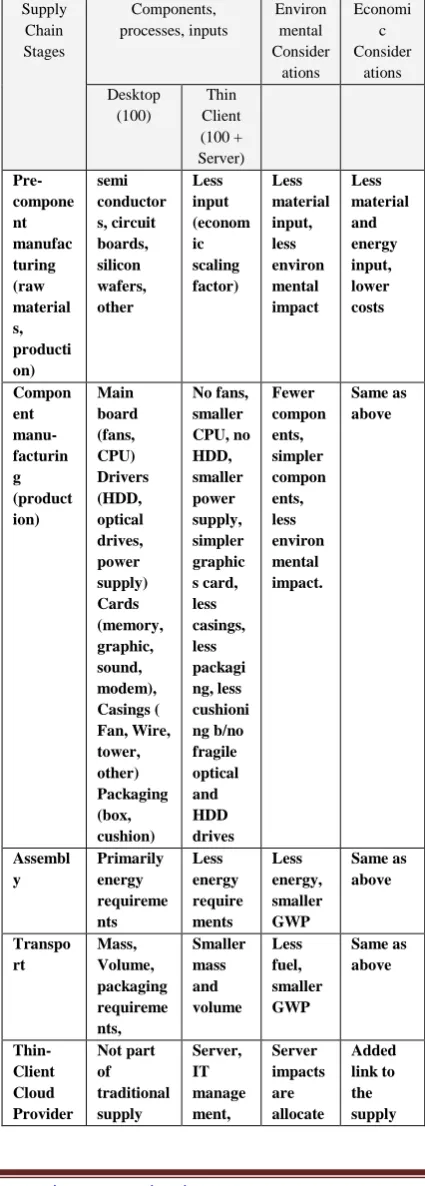
III. DESCRIPTION OF THE SUPPLY CHAIN Rather than individual supply chains descriptions, a simultaneous supply chain comparison is more useful in this case because the actual stages of the supply chain are nearly identical. The critical differences along most stages are less material and energy inputs, and so in most cases a simple scaling
and end-user.
Error! Reference source not
found.
describes the traditional supply chain of the desktop and identifies changes and reductions in inputs when comparing the thin client cloud system. In most cases environmental and economic consideration are linked to dematerialization and lower energy requirements.Table 1-Supply Chain of the Desktop vs. Thin–Client (w/ server share)
chain (server and infrastr ucture) d amongst thin clients. chain. Distribut ed server costs and labor costs (IT) End Use Desktop
power requireme nts (~130 Whr per user), and maintenan ce Thin client power require ments (~12 Whr per user). Simpler machine , less mainten ance GWP directly related to power require ments Costs related to power require ments and mainten ance. Disposal (recyclin g, reuse, landfill) Volume, Mass, materials toxicity. Product life cycle, ~ 3 years
Less material , less disposal . Less material input and longer lifecycle . Similar to environ mental costs Total Economi c Cost
$500 $350
IV.ENVIRONMENTAL VALUATION Methodology and Scaling Factors
Inventory values for modeling in this analysis were used from Eric Williams’ study titled ‘Energy Intensity of Computer Manufacturing: Hybrid Assessment Combining Processes and Economic
Input-Output Methods’ published in the
Environmental Science and Technology Journal (2004). No data was available to assess the environmental impacts of the thin-client unit. A series of scaling factors were calculated to adjust the desktop inventory values from Williams 2004 to estimate the impact from the manufacturing of a thin-client.
Economic Scaling Factor
Because the energy inventory for manufacturing is only available for a desktop, an economic scaling factor was used to project the environmental impact of thin-client manufacturing. The thin-client has fewer printed circuit boards, no hard disk, no fan,
slower processor speeds and less overall
components which result in an overall lower environmental impact from manufacturing.
Equation 1 - Economic/Environmental Scaling Factor
41
.
2
200
$
482
$
price priceThinClient
Desktop
1.Sample CalculationDesktop computer assembly requires 35.5 MJ of direct fossil energy and 51.2kWh of electricity [Williams 2004]. Using the economic scaling factor, the impact of the thin client’s assembly process can be projected:
MJ MJ
7
.
14
41
.
2
5
.
35
kWh21
.
2
MJ41
.
2
2
.
51
Full series of calculations found in
Error!
Reference source not found.
.V.POWER USAGE CALCULATION
The inventory values for the desktop are several years old (2004), so an adjustment was required to account for the increased power efficiency of a newer machine. The electricity used in the use phase was calculated with the specs for the machines in this analysis.
Type Desktop Thin Client
Server
Model Dell Optiplex 745 HP T5145 2DLW Serv N20
Energy Demand – Active (watts)
123 11.4 865 (full utilization) Energy Demand –
Sleep (watts)
Equation 2-Thin Client Power (Use Phase- 1 Year)
kWh
111
1000
1
*
)
1
*
6680
4
.
11
*
2080
(
Equation 3 - Desktop Power (Use Phase - 1 Year)
kWh
276
1000
1
*
)
3
*
6680
123
*
2080
(
VI.TRANSPORTATION/LOGISTICS SCALING FACTOR
There are considerable environmental gains that can be achieved with respect to transportation logistics.
Type Desktop Thin Client Model Dell Optiplex
745
HP T5145 Dimensions
(inches)
4.5x15.7x13.9 7x7x2
Volume 982 98
Packaging Surface Area
702.86 154
Mass (lbs) 23 3
The size of the thin-client is considerably smaller than the standard desktop used in this analysis. In addition, the mass of a thin-client is only 3lbs compared to the desktop that weighs 23lbs. More units can be packed into the same container volume and shipped from OEMs to distribution outlets and consumers.
Equation 4 - Transportation Scaling Factor
10 98
982
3 3
_
Inches Inches Client
Thin Desktop
or calingFact TransportS
Volume Volume
Box Box
For every desktop that is shipped, it is estimated that 10 thin-clients can fit in the same volume of a container or
package. To ensure that mass would not be an additional constraint while shipping, the weights of each
shipping box are compared:
Mass of 10 thin-clients Mass of 1 Desktop
3lbs*10=30lbs 23lb
The mass is not significantly more for the grouped package, so the likely shipping constraint is the volume of
the container.
Packaging Scaling Factor
The smaller packages that return transportation gains also require less packaging for shipping. To calculate the
packaging scaling factor, the surface area of material that is required to package the container was used.
Type Desktop Thin Client
Model Dell Optiplex 745 HP T5145
Instantaneous Power Demand for Thin Clients and Desktops
0 20 40 60 80 100 120 140
Thin Client + Server Allocation Desktop
w
a
tts
5
.
4
154
703
3 3
_
Inches Inches
Client Thin
Desktop
or
calingFact
PackagingS
a
SurfaceAre
a
SurfaceAre
Box Box
For each box shipped, it is estimated that 4.5 times less packaging will be required due to the considerable size
differential.
Table 1 – Coefficients provided by PE International GaBi4.3
Type Coefficient Unit
Electricity Generation (US Average) 0.804 Kg/kWh
Fossil Fuel Use 0.223 Kg/MJ
Fig.3 Use phase is estimated to be three years.
Greenhouse Gas Equivalent for Production and Use Phases for Computers
0 200 400 600 800 1000 1200 1400 1600 1800
Desktop Thin Client/Server
k
g
C
O
2
e
qu
iv
a
le
nt
Server Production Allocation
Use Electricity
Production Electricity
Direct Fossil use
Total Impact for Small Business with 100 Machines
0 20000 40000 60000 80000 100000 120000 140000 160000 180000
k
g
C
O
2
E
qu
iv
.
Fig.4 Total Impact Values.
Economic Evaluation of Thin-Clients
The following scenario assumes that a business purchases the server for the internal computation and storage
power to run a small company.
Type Desktop Thin Client Server
Model Dell Optiplex 745 HP T5145 DLW Serv N20
Price ($) 482 200 4000
The server can handle the computational power of approximately 20 machines performing common business tasks and applications (Linux Terminal Service Project 2009). The cost of the server is allocated at a ratio of 1/20.
Equation 5 per workstation
s
ThinClient
ServerCost
tion
CostAlloca
$
150
_20
4000
$
Total Impact for Small Business with 100 Machines
0 20000 40000 60000 80000 100000 120000 140000 160000 180000
k
g
C
O
2
E
qu
iv
.
Desktop
Thin-Client
Life Cycle Cost of Desktop and Thin Client/Server Allocation
$100 $200 $300 $400 $500 $600 $700
C
os
t
($
)
Fig. 1 - Cost for three years of operation
A rate of 10% was used to discount the electrical cost cash flows on an annual basis. If a company purchased the equipment internally (server + thin-clients) the cost savings would be significant over the three years. For a typical small business with 100 machines, the savings returned would be approximately $20,000 over three years.
Computing as a Service:
If the computational power and data storage services were provided by an external agent even greater efficiency gains would be obtained through increased optimization and economies of scale for cooling. In addition, a small company would need less internal information technology staff to run their systems if the servers were offsite.
The utilization rate for the server’s computational power would increase because the cloud service company can take advantage of national economies of scale. The peak computational demand required by businesses would be more evenly distributed because of the time zones in the country. A three year time span was used for this analysis, but there are no technical constraints limiting the thin-client to such a short-lifespan. It is feasible that the hardware could last much longer (5+ years) because they are not as performance-dependent as a desktop machine. The servers can be upgraded centrally rather than the individual desktop machines, but with the thin-client setup, users still receive the same unit of computing at their desks. If the internet can reliably and quickly route business machine computational power, the market for traditional desktop machines could be affected. Companies that provide desktop business machines (Dell) would need to shift their business models. A greater reliance on high-performance centralized servers will likely drive the market for computing in coming years. Innovation in computational service contracts will emerge and small companies will have less risk investing in IT equipment. Cloud providers could provide the thin-clients for free or a monthly rental rate similar to the approach currently utilized by cable companies. Because the thin-clients do not need to be upgraded as frequently because computation occurs offsite, cloud providers could re-use thin-clients further decreasing the environmental burdens.
VII.CONSTRAINTS AND CHALLENGES
Reliability and Security
With any reliance on new technology, businesses may be hesitant to fully move to a cloud based thin-client service. If all computational and data storage
is provided live in the cloud, a business is completely reliant on their internet connection. If for any reason the internet goes down, all the workstations would be effectively useless and productivity would suffer.
Businesses may also be wary of outsourcing their sensitive data to external third party companies that provide a cloud service. Privacy issues could hinder deployment of full cloud computing as the importance of data security can trump potential economic and environmental gains.
Switching Costs
If computation and data storage is provided as a service, there could be considerable business costs required to switch service providers. Businesses would essentially be locked into their service provider and even if another company could offer cheaper rates, a considerable transaction cost would have to be considered.
VIII. SCOPE OF ANALYSIS
The only indicator used in this analysis is global warming potential. There are other environmental impacts in computer manufacturing such as human and aquatic toxicity that are important to consider. As much as 70% of the human toxicity impact occurs during the disposal stage of the extended supply chain [Byung-Chul et. al 2004]. However, because the switch to thin-clients (and the cloud) is
essentially a dematerialization strategy for
pollution prevention, all of these other
environmental impacts associated with component manufacturing will be reduced.
When data storage and computation is provided as a service that is routed through the internet, additional network components and electricity will be required. This study omits the impacts associated with an increasing demand requirement for internet infrastructure.
Uncertainty
manufacturing impacts. There is a considerable error margin with our projected GWP reduction of %60.
CONCLUSION
The dematerialization strategy for altering the IT supply chain with thin-clients and computing
resources in the cloud can return both
environmental and economic savings. The
suggestion in literature that increased PC reuse rates and upgradability potential will lead to environmental savings is correct, however no trends in this area are emerging. The usage of thin-clients and cloud computing may turn out to be the preferable route to reduce the environmental impacts of computing. The issue of computer obsolescence may become less of an issue because the thin-client’s performance can increase with additional computational resources from remote servers. This effectively extends the life of the
equipment used in office computing as
computational services in the cloud can always be upgraded. Computing as a service is an exciting proposition and will potentially grow as internet bandwidth becomes cheaper, faster, and more reliable. The switch to the cloud also has the ability to promote innovation and entrepreneurship because small businesses and start-ups will face much lower capital costs for IT and computing. A large focus with computing revolves around the energy-efficiency of chips, however the cloud provides a path for dematerialization that does not rely on re-use and upgradability.
REFERENCES
[1] 1.Choi, Byung-Chul, Hang-Sik Shin,
Su-Yol Lee, and Tak Hur. "Life Cycle Assessment of a Personal Computer and its Effective Recycling Rate." Int. J LCA 11 (2006): 122-28.
[2] 2.Computing Heads for the Clouds 16
Nov. 2007. Business Week. 5 June 2009 <http://www.businessweek.com/technology/content /nov2007/tc20071116_379585.htm>.
[3] 3.Linux Terminal Server Project. 2009.
LTSP.org GaBi 4.3 Software. PE International. 2009.
Institute for Environmental, Safety and Energy Technology, UMSICHT.
[5] 5.Williams, Eric. "Energy Intensity of
Computer Manufacturing: Hybrid Assessment Combining Process and Economic Input-Output Methods." Environ. Sci. Technol. (2004): 6166-174.
[6] 6.Why Right Scale: Cloud Portability,
Right Scale. Accessed June 5th, 2009
http://www.rightscale.com/products/advantages/clo ud-portability.php
[7] 7.Zhou, Ben. "Cloud Computing."
Personal interview. USCB. 03 June 2009.
[8] 8.HP Compaq t5145 Thin Client.
Brochure. 5 June 2009
<http://h20195.www2.hp.com/v2/GetPDF.aspx/c01 555466.pdf>.
[9] 9.Dell Optiplex 745 Tech Specs.
Brochure. 5 June 2009