Communication Complexity of Conditional Disclosure of Secrets
and Attribute-Based Encryption
?Romain Gay??, Iordanis Kerenidis? ? ?, and Hoeteck Wee†
Abstract. We initiate a systematic treatment of the communication complexity of conditional disclosure of secrets (CDS), where two parties want to disclose a secret to a third party if and only if their respective inputs satisfy some predicate. We present a general upper bound and the first non-trivial lower bounds for conditional disclosure of secrets. Moreover, we achieve tight lower bounds for many interesting setting of parameters for CDS with linear reconstruction, the latter being a requirement in the application to attribute-based encryption. In particular, our lower bounds explain the trade-off between ciphertext and secret key sizes of several existing attribute-based encryption schemes based on the dual system methodology.
1 Introduction
We revisit a fundamental question in the foundations of cryptography: what is the communication overhead of privacy in computation? This question has been considered in several different models and settings [12, 41, 2, 14]. In this work, we focus on a very simple and natural model where non-private computation requires very little communication (just a single bit), whereas the best upper bound for private computation is exponential.
Namely, we consider two-party conditional disclosure of secrets (CDS) [19] (c.f. Fig 2), a general-ization of secret sharing [44, 23]: two parties want to disclose a secret to a third party if and only if their respective inputs satisfy some fixed predicateP. Concretely, Alice holds x, Bob holdsy and they both share a secretα∈{0, 1} (along with some additional private randomness), whereas Carol knows
x,y but notα. Alice and Bob want to discloseαto Carol iffP(x,y)=1. How many bits do Alice and Bob need to communicate to Carol? In the non-private setting, Alice or Bob can sendαto Carol, upon which Carol computesP(x,y) and decides whether to outputαor⊥. This trivial protocol with one-bit communication is not private because Carol learnsαeven when the predicate is false; in fact, the best upper bound we have for CDS for general predicates requires that Alice and Bob each transmits 2Ω(|x|+|y|) bits [7]. Here, we are interested not only in the total communication from Alice and Bob to Carol, but also in trade-offs between the length of Alice’s message`Aand that of Bob’s message`B.
Connection to Attribute-based Encryption. Attribute-based encryption (ABE) [43, 20] is a new paradigm
for public-key encryption that enables fine-grained access control for encrypted data. In attribute-based encryption, ciphertexts are associated with descriptive values x in addition to a plaintext, secret keys are associated with values y, and a secret key decrypts the ciphertext if and only if P(x,y) =1 for some boolean predicateP. Note thatxandy are public given the respective ciphertext and secret key.
?An extended abstract of this work appeared in the proceedings of CRYPTO 2015. This is the full version. ??Email:[email protected]. ENS, Paris. Partially supported by ANR Project EnBiD (ANR-14-CE28-0003).
? ? ?Email:[email protected]. CNRS, LIAFA, Univ Paris Diderot. Partially supported by the ERC project QCC and the ANR project RDAM
†Email:[email protected]. ENS, Paris, CNRS, INRIA and Columbia University. Partially supported by ANR Project EnBiD
Here, y together withPmay express an arbitrarily complex access policy, which is in stark contrast to traditional public-key encryption, where access is all or nothing. The simplest example of ABE is that of identity-based encryption (IBE) [45, 8, 13] whereP corresponds to equality. The security requirement for attribute-based encryption enforces resilience to collusion attacks, namely any group of users holding secret keys for different values learns nothing about the plaintext if none of them is individually authorized to decrypt the ciphertext. This should hold even if the adversaryadaptivelydecides which secret keys to ask for.
In [47], Waters introduced the powerfuldual system encryptionmethodology for building adaptively secure IBE in bilinear groups; this has since been extended to obtain adaptively secure ABE for a large class of predicates [31, 35, 38, 33, 30, 40]. In recent works [3, 48], Attrapadung and Wee presented a unifying framework for the design and analysis of dual system ABE schemes, which decouples the predicate P from the security proof. Specifically, the latter work puts forth the notion of predicate encoding, a private-key, one-time, information-theoretic primitive similar to conditional disclosure of secrets, and provides a compiler from predicate encoding for a predicateP into an ABE for the same predicate using the dual system encryption methodology. Moreover, the parameters in the predicate encoding scheme and in CDS correspond naturally to ciphertext and key sizes in the ABE. In particular, Alice’s message corresponds to the ciphertext, and Bob’s message to the secret key. For these applications, we require that Alice’s and Bob’s messages are linear functions of the shared randomness, and also that Carol computes a linear function of the messages to reconstruct the secretα. These applications consider linear functions overZp where p is the order of the underlying bilinear group; in this work, we focus on lower bounds for the casep=2 although our techniques do hold for generalp. Note that while the parameters for ABE schemes coming from predicate encodings are not necessarily the best known parameters, they do match the state-of-the-art in terms of ciphertext and secret key sizes for many predicates such as inner product, index, and read-once formula.
CDS Parameters. Unlike in traditional communication complexity where the primary measure is the
total communication from Alice and from Bob, we make a more fine-grained distinction between the lengths of Alice’s and Bob’s messages`A and`B. For instance, in the application to ABE, `A and `B
correspond to ciphertext and secret key sizes respectively. Note that for ABE ciphertext and key sizes, we ignore the contributions from the descriptive valuesx,yas well as multiplicative factors in the security parameter.1We are particularly interested in three regimes of parameters for (`A,`B):
– How small can`Bbe when`Ais constant? This corresponding to minimizing key sizes for schemes
with constant-size ciphertexts;
– How small can`A be when`B is constant? This corresponding to minimizing ciphertext sizes for
schemes with constant-size keys;
– How small can max(`A,`B) be? This corresponds to minimizing the overall parameter sizes of the
scheme.
We also care about the complexity of the reconstruction function as computed by Carol, as a function of the messages from Alice and Bob; as noted earlier, for ABE, we will require linear reconstruction.
1The latter suppresses the distinction between counting bits and group elements, and also between working overZ 2vsZp,
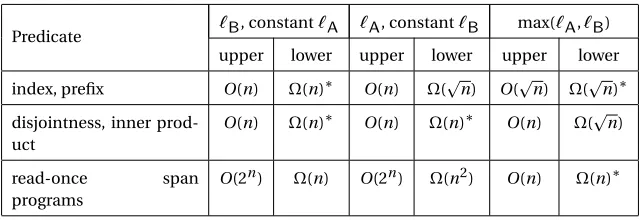
Predicate `B, constant`A `A, constant`B max(`A,`B) upper lower upper lower upper lower
index, prefix O(n) Ω(n)∗ O(n) Ω(pn) O(pn) Ω(pn)∗
disjointness, inner prod-uct
O(n) Ω(n)∗ O(n) Ω(n)∗ O(n) Ω(pn)
read-once span programs
O(2n) Ω(n) O(2n) Ω(n2) O(n) Ω(n)∗
Fig. 1.Summary of our upper and lower bounds for linear CDS, where`Aand`Bdenote the length of the messages from Alice and Bob respectively. We marked the tight lower bounds with an asterisk∗.
Prior works. There have been several works studying CDS protocols (and strengthenings thereof ) for a
large class of predicates [19, 3, 48, 22]: the best general upper bound achieves both linear reconstruction and communication that is linear in the size of the smallest (arithmetic) branching program computing the predicate [19, 22]. However, we basically do not have any techniques for proving lower bounds on the communication complexity of CDS protocols. Here, even the probabilistic method or a counting argument does not seem to yield meaningful lower bounds for a random function (in contrast, these techniques do yield meaningful lower bounds for circuit complexity of a random function).
1.1 Our results
We initiate a systematic treatment of the communication complexity of conditional disclosure of secrets (CDS). We present a general upper bound and the first non-trivial lower bounds for conditional disclosure of secrets, summarized in Fig 1. Moreover, we achieve tight lower bounds for many interesting setting of parameters for CDS with linear reconstruction, the latter being a requirement in the applica-tion to attribute-based encrypapplica-tion; this addresses an open problem posed in [48]. Very informally, for CDS with linear reconstruction, we obtain lower bounds of the form:
`A·`B≥“communication complexity ofP”
For example, for inner product onn-bit vectors, we have`A·`B=Ω(n). Our lower bounds partially
ex-plain the trade-off between ciphertext and secret key sizes of several existing attribute-based encryption schemes based on the dual system methodology, c.f. [31, 35, 39, 48, 3, 10].
Proof techniques. Since we want to argue about the lengths of the messages of Alice and Bob to Carol,
conditional disclosure of secrets (CDS)
Alice x,α
Bob y,α privatew
Carol x,y
learnsαiffP(x,y)=1
mA mB
communication complexity
Alice x
Bob y
publicw
Carol
computesP(x,y)
mA mB
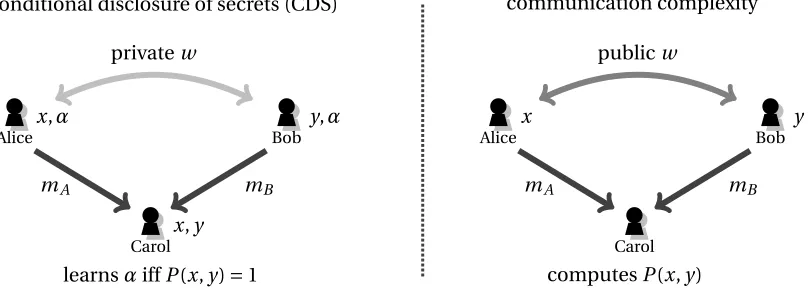
Fig. 2.Pictorial representation of CDS and communication complexity.
Our goal is to leverage the rich literature on lower bounds for communication complexity to obtain lower bounds for CDS. Namely, we want to transform any CDS Πcds for a predicate P into a communication complexity protocolΠccforPwith only a small blow-up in communication complexity. The crucial distinction between CDS and communication complexity is that Carol knowsx,yinΠcdsbut not inΠcc(as shown in Fig 2).
The first attempt would be to show that aΠcdsfor a predicatePis also aΠccforP. Fixx,yto denote the inputs toΠcc. That is, we would like to argue that Alice’s message together with Bob’s message in a CDS (even withoutx,y) must completely determineP(x,y). Intuitively, this ought to be the case because if the CDS messages are consistent with both values ofP(x,y), then they must simultaneously uniquely determineα(via correctness) and hideα(via privacy), a contradiction. Indeed, if this worked out, we would have a lower bound of the form
`A+`B≥“communication complexity forP”
Unfortunately, the above statement is false for inner product. The above statement implies a lower bound of 2n−Ω(1) bits for inner product, but we have a CDS for inner product withn+1 bits! It is instructive to understand why the above attempt fails. The issue arises in using correctness of CDS to argue that Alice’s and Bob’s message must determineα: specifically, it is necessary for Carol to specify inputsx0,y0in order to reconstructαfrom Alice’s and Bob’s messages. In fact, different inputs (x0,y0) could yield different values forα. We need to fix this issue.
– The first idea is to have Alice inΠccalso send the secretα; Carol then tries all possible (x0,y0) for which
P(x0,y0)=1 and output 1 iff for somex,ythe reconstructed secret indeed equalsα. By the correctness of CDS, Carol will output 1 whenP(x,y)=1. However, there could be false positives, since even when
P(x,y)=0, there could be inputs (x0,y0) for whichP(x0,y0)=1 and the reconstructed secret matches α, upon which Carol will incorrectly output 1. In fact, privacy tells us that Carol will recover a random value for the secret for each choice of (x0,y0), and with pretty good probability, at least one of them will matchα.
equalsαin all repetitions of the protocol. By the correctness of CDS, Carol will always output 1 when
P(x,y)=1. On the other hand, ifP(x,y)=0, a straight-forward union bound over (x0,y0)∈P−1(1) tells us Carol outputs 1 with probability at mostP−1(1)·2−N, since Carol recovers a random value in each repetition. For inner product, we need to take a union bound over 22n−1possible pairs, which requires runningN=2n−1 copies of the CDS protocolΠcds; the communication complexity ofΠcc is then 2n−1 times that ofΠcds. This does not yield any non-trivial lower bound forΠcds since we have an upper bound of 2nfor communication complexity.
Here comes our key observation: we can substantially reduce the number of repetitions needed if the CDS protocolΠcds has small communication complexity! SupposeΠcds has total communication `A+`B ¿n bits. Observe that the reconstruction function computed by Carol in Πcds is a function from {0, 1}`A+`B to {0, 1}. Now, instead of having Carol inΠ
ccenumerate over all possible (x,y), she will instead enumerate over all functions from {0, 1}`A+`B to {0, 1}, and output 1 iff for some function the
reconstructed secret equalsαin allN repetitions. By the correctness of CDS, Carol will always output 1 whenP(x,y)=1. Moreover, there are 22`A+`B possible functions, which means we will need to run 2`A+`B
copies ofΠcdsinΠcc; this already implies aΩ(logn) lower bound for inner product! Moreover, if the CDS
Πcds admits linear reconstruction, then Carol inΠcc will also need to enumerate over all 2`A+`B linear functions from {0, 1}`A+`B to {0, 1}, which means we only need to run`
A+`Bcopies ofΠcdsinΠcc; this in turn yields aΩ(pn) lower bound for inner product.
We obtain our lower bounds on CDS for concrete predicates by instantiating the above argument with existing lower bounds in communication complexity [36, 28, 24, 42, 4, 11] (c.f. Section 5). For prefix and read-once monotone span programs, we present tight lower bounds, c.f Appendix D.
Implications for dual system ABE. As observed in [3, 48, 10], underlying most
“information-theoretic” dual system ABE schemes for a predicateP is a CDS for the same predicate, and our lower bounds apply to ciphertext and secret key sizes for these dual system ABE schemes. On the other hand, we do have ABE schemes based on a “computational” dual system argument, such as those in [32, 34, 9, 3, 27], many of which are more efficient and do avoid the lower bounds in this work. Informally, underlying the “computational” dual system argument is a computational analogue of CDS, where the privacy requirement is computational rather than information-theoretic. As it turns out, formalizing the right notion of computational privacy in CDS is quite tricky.
Recall that CDS guarantees privacy of the secretαwheneverP(x,y)=0, and in the application to ABE, we require that privacy holds even if x,y are chosen adaptively, namely Alice’s input x may be chosen depending on Bob’s input y and Bob’s message, and vice versa. Now, if the privacy guarantee is information-theoretic and perfect, then privacy for non-adaptive choices ofx,y implies privacy for adaptive choices2; this equivalence dissipates as soon as we relax the privacy requirement to be statistical or computational. The “right” notion of computational privacy for use in ABE schemes is that of “doubly selective” security [3, 34], where “doubly” refers to the two possibilities depending on whether xor y
is chosen first. Unsurprisingly, proving3and using doubly selective security require substantially more
2The easiest way to see this is via complexity leveraging: an adaptive distinguisher with advantageεcan be converted into
a non-adaptive distinguisher with an exponential loss inεvia random guessing. Since any non-adaptive distinguisher has advantage 0, we must haveε=0 to begin with.
3Typically, this entails two separate reductions, one forxbeing chosen first and the other fory. In [34], these correspond
delicate security reductions, and in most cases, stronger and less desirableq-type assumptions. This raises the natural question of whether the increased complexity in these proofs and assumptions are inherent, or simply a failure to find more clever and efficient CDS with information-theoretic privacy. Our work rules out the latter option.
1.2 Discussion
Perspective. Note that our set-up is quite different from previous lower bounds for private computation
in the literature; to the best of our knowledge, this is the first super-constant lower bound in a setting where the price of privacy in computation is always bounded. For instance, in interactive secure two-party computation, some functions are impossible to compute securely [12], so the cost of privacy is infinite for these functions (whereas ours is bounded for all predicates). For secure computation in the FKN model [15, 14], we do not have any techniques for super-constant gaps. For locally decodable codes, there is no gap for privacy in some ranges of parameters, for instance, when we want to minimize one-way communication from the client and communication from the server is essentially “free”; here, the server needs to send the entire database, whether or not we care about client privacy.
Additional related work. There is a large body of work on lower bounds on share sizes in
secret-sharing (c.f. [5, Section 5]). Most of these works rely on Shannon-type inequalities on entropy of random variables, which do not seem applicable to our setting. Roughly speaking, in secret sharing, Carol either gets a share or not, whereas Alice and Bob in CDS can do more complex computations than simply computing shares and then deciding whether to send each share to Carol. The recent work of Data, Prabhakaran and Prabhakaran [14] draws upon tools from information theory to obtain new communication complexity lower bounds for secure computation in three-party setting. In their model which allows multiple rounds of interaction, the problem we consider admits a secure protocol with a single bit of communication, and their techniques do not yield better bounds in the non-interactive setting.
Open problems. We conclude with a number of open problems:
– explore the power of non-linear reconstruction in CDS (that is, positive results, c.f. [6, 46]);
– tight lower bounds for inner product with linear reconstruction (which we conjecture to beΩ(n));
– obtain better lower bounds for multi-bit secrets (which is related to lower bounds for secret sharing for multi-bit secrets), or obtain upper bounds that are better than the naive “direct product” construction;
– improve the upper or lower bounds in CDS for read-once span programs for constant`Aor constant
`B. A related problem is to prove stronger communication complexity lower bounds for general span
programs (which may not be read-once).
2 Preliminaries
Notations. We denote bys←RSthe fact thatsis picked uniformly at random from a finite setSor from
2.1 Conditional disclosure of secrets
We recall the notion of conditional disclosure of secrets (CDS), c.f. Fig 2. The definition we give here is for two parties Alice and Bob and a referee Carol, where Alice and Bob share randomnessw and want to conditionally disclose a secretαto Carol. The general notion of conditional disclosure of secrets has first been investigated in [19]. Two-party CDS is closely related to the notions of predicate encoding [48, 10] and pairing encoding [3]; in particular, the latter two notions imply two-party CDS with linear reconstruction.
Definition 1 (conditional disclosure of secrets (CDS) [19, 48]). Fix a predicateP :X×Y→ {0, 1}. A
(`A,`B)-conditional disclosure of secrets (CDS)forPis a triplet of deterministic functions(A,B,C)
A:X×W×D→{0, 1}`A, B:Y×W×D→{0, 1}`B, C:X×Y×{0, 1}`A×{0, 1}`B→D satisfying the following properties:
(reconstruction.) For all(x,y)∈X×Ysuch thatP(x,y)=1, for all w∈W, and for allα∈D:
C(x,y,A(x,w,α),B(y,w,α))=α
(privacy.) For all(x,y)∈X×Ysuch thatP(x,y)=0, and for allC∗: {0, 1}`A×{0, 1}`B→D,
Pr w←W,α←RD
h C∗¡
A(x,w,α),B(y,w,α)¢
=αi≤ 1 |D|
Note that the formulation of privacy above with uniformly random secrets is equivalent to standard indistinguishability-based formulations (c.f. Section A).
A useful measure for the complexity of a CDS is the complexity of reconstruction as a function of the outputs ofA,B, as captured by the functionC, with (x,y) hard-wired.
Definition 2 (C-reconstruction).Given a setCof functions from{0, 1}`A×{0, 1}`B→D, we say that a CDS
(A,B,C)admitsC-reconstruction if for all(x,y)such thatP(x,y)=1,C(x,y,·,·)∈C.
Two examples ofCof interest are:
– Callis the set of all functions from {0, 1}`A×{0, 1}`B→D; that is, we do not place any restriction on the complexity of reconstruction. Note that|Call| = |D|2`A+`B.
– Clin is the set of all linear functions over Z2 from {0, 1}`A×{0, 1}`B → D; that is, we require the reconstruction to be linear as a function of the outputs ofAandBas bit strings (but may depend arbitrarily onx,y). This is the analogue of linear reconstruction in linear secret sharing schemes and is a requirement for the applications to attribute-based encryption [48, 3, 10]. In Appendix B, we show that any scheme whereAandBcompute linear functions (again, analogue of linear secret-sharing schemes and a requirement for many cryptographic applications) also satisfies linear reconstruction. Note that|Clinear| ≤ |D|`A+`B for|D| ≥2.
Remark 1. Note that while looking atC, we considerC(x,y,·,·), which has (x,y) hard-wired, and takes an input of total length`A+`B. In particular, it could be thatCruns in time linear in|x| = |y| =n, and yet
`A=`B=O(logn) soChas “exponential” complexity w.r.t.`A+`B.
2.2 Communication complexity
The description of communication complexity in Fig 2 actually refers to the “simultaneous message” model, whereAandBeach sends a message toC. For our actual proof, it suffices to consider one way communication complexity, where there is noC, but eitherAsends a single message toBorBsends a single message toA. We now proceed to recall the basic definitions for communication complexity [49, 29], specifically one-way communication complexity with one-sided error [1, 28, 37].
Definition 4 ([28, 49]).A one-way (A→B) communication protocolfor a predicateP:X×Y→{0, 1}is a
pair of deterministic functions(A,B)where
A:X×W×{0, 1}`→{0, 1}, B:Y×W×{0, 1}`→{0, 1},
and the following properties are satisfied for every(x,y)∈X×Y:
– IfP(x,y)=1, thenPrw←RW[B(y,w,A(x,w))=1]=1 – IfP(x,y)=0, thenPrw←RW[B(y,w,A(x,w))=0]≥1/2.
Theone-way communication complexityofP, denoted byRA→B(P), is the minimum`over all one-way communication protocols(A,B)forP.
We also denote byRB→A(P)the minimum`over all one-way(B→A)communication protocols(A,B), where
A:X×W×{0, 1}`→{0, 1}, B:Y×W×{0, 1}`→{0, 1},
and the following properties are satisfied for every(x,y)∈X×Y:
– IfP(x,y)=1, thenPrw←RW[A(x,w,B(y,w))=1]=1 – IfP(x,y)=0, thenPrw←RW[A(x,w,B(y,w))=0]≥1/2.
3 CDS for General Predicates
We present a general upper bound for linear CDS for any predicate:
Theorem 1 (generic upper bounds for linear CDS).Given any predicateP: {0, 1}n×{0, 1}n→{0, 1}, for
any t≤2n, there exists a linear(t, 2n/t)-CDS forPwithD={0, 1}. In particular, there exists a(1, 2n)-CDS, a(2n, 1)-CDS, a(2n/2, 2n/2)-CDS forP, all three of which are linear.
The result improves upon the (2n/2, 2n/2)-CDS (but not linear) given in [7]; our construction is also considerably simpler.
4 Lower Bounds for CDS
In this section, we present our lower bounds on the communication complexity of CDS.
Theorem 2 (lower bounds for linear CDS).LetP:X×Y→{0, 1}be a predicate. For all linear(`A,`B)-CDS
ofPwith|D| ≥2, we have
`A·(`A+`B+1)≥RA→B(P) and `B·(`A+`B+1)≥RB→A(P).
We then derive our lower bounds for linear CDS by using existing lower bounds on one-way communi-cation complexity; see Section 5. In fact, our techniques are fairly general and also yield lower bounds on non-linear CDS.
Theorem 3 (lower bounds for general CDS).LetP:X×Y→{0, 1}be a predicate. For all(`A,`B)-predicate
CDS ofPwith|D| ≥2, we have
`A+`B≥
1 2log
³
RA→B(P)+RB→A(P)´.
While the lower bounds for general CDS are exponentially smaller than those for linear CDS, we still do obtain non-trivial logarithmic lower bounds for many concrete predicates.
4.1 Main lemma
We obtain both lower bounds via a general reduction from CDS for a predicatePto one-way communi-cation protocols for the same predicate; the communicommuni-cation cost of the reduction depends crucially on the complexity of reconstruction (c.f. Definition 2):
Lemma 1 (main technical lemma).LetP:X×Y→{0, 1}be a predicate. Then, any(`A,`B)-CDS forPwith
|D| ≥2and which admitsC-reconstruction satisfies
(log|C| +1)·`A≥RA→B(P)·log|D| and (log|C| +1)·`B≥RB→A(P)·log|D|
Theorem 2 then follows from instantiating the lemma withC:=Clin, where log|Clin| =(`A+`B)·log|D|.
Similarly, Theorem 3 usesC:=Callwhere log|Call| =2`A+`B·log|D|.
Proof (of Lemma 1). Let N := loglog|C|D|+|1. We build a one-way communication protocol (Ae,Be) for the
predicatePas follows:
– Samplewi←RW,αi←RDfori=1, . . . ,N and set
w:=(w1,α1, . . . ,wN,αN)
– Alice computes
e
A(x,w) :=(A(x,w1,α1), . . . ,A(x,wN,αN))
– Bob outputs 1 iff there exists a functionC∗∈Csuch that
C∗¡
We proceed to analyze the protocol (Ae,Be).
– Completeness. Suppose P(x,y) =1. Then, by the reconstruction property, the function C∗(·) :=
C(x,y,·)∈Csatisfies
C∗(A(x,wi,αi),B(y,wi,αi)¢=αi, ∀i=1, . . . ,N for all (w1,α1, . . . ,wN,αN). Therefore,Beoutputs 1 with probability 1.
– Soundness. SupposeP(x,y)=0. FixC∗∈C. For eachi=1, . . . ,N,α-privacy implies that Pr
wi,αi h
C∗¡
A(x,wi,αi),B(y,wi,αi)
¢
=αi
i
≤|D|1
Since the (wi,αi) are chosen independently at random, we have Pr
w1,α1,...,wN,αN h
C∗¡
A(x,wi,αi),B(y,wi,αi)¢=αi, ∀i=1, . . . ,N
i
≤|D1|N
By a union bound over all|C|functionsC∗∈C, we have PrhBeoutputs 1
i
≤ |C| · |D|−N≤1/2 by our choice ofN.
It is straightforward to check thatAesends
log|C|+1
log|D| ·`Abits toBe. Similarly, we can build a (Be,Ae) protocol
forP, whereBesends
log|C|+1
log|D| ·`Bbits toAe. This completes the proof. ut Remark 2 (extensions). It is easy to see that the reduction also works for CDS with imperfect recon-struction and weak privacy. If the gap between the probability of reconstructing αwhenP(x,y)=1 and the probability of recoveringαwhenP(x,y)=0 isδ, then it suffices to take N :=O³δ1log|C|´via a straightforward application of the Chernoff bound. The ensuing randomized protocol for communica-tion complexity will then have a two-sided error.
Remark 3 (beyond linear CDS).Note that the bounds of Theorem 2 are much more general than just for linear CDS. For instance, if we require that reconstruction be carried out by circuits of size`c for some constantc(where`:=`A+`B), or by polynomials of degreec, then we get lower bounds of the form
`A+`B=Ω
³
(RA→B(P)+RB→A(P))1/(c+1)´
4.2 Lower bounds for multi-bit secrets
We now look at CDS where the secretαis a multi-bit string; that is,Dis of the form {0, 1}d, ford≥1. There is a trivial upper bound ford-bit secrets obtained by runningdtimes a CDS for single-bit secrets. Note, of course, that hiding a secret of sized=1 is the easiest case, since we can simply embed this secret to a largerd-bit string by randomly addingd−1 bits and use the CDS for the secret of sized. Hence, the lower bounds on the message lengths of the CDS for a secret of sized=1 still hold for the CDS of secret of sized≥1. We would like a lower bound that grows withd.
Here, we prove that for any non-trivial predicateP, for any (`A,`B)-CDS ofP, both`Aand`Bneed
output of the predicate is the first bit ofx), for which there is a protocol with`A+`B=d. The intuition is that in any non-trivial predicate, Alice’s message essentially serves as the secret key for a one-time pad, which is needed to “unlock”α∈{0, 1}d from Bob’s message. This means that Alice’s message must itself be at leastdbits.
It is easy to see that the lower bound is tight for the equality predicate. For all other non-trivial predicates, it remains an open problem to close the gap between lower and upper bounds for CDS of multi-bit secrets.
Theorem 4. LetD:={0, 1}d, and let P:X×Y→{0, 1}be a non-trivial predicate that depends on both
inputs x and y; that is, there exists x∗∈X, such thatP(x∗,·)is not constant onY, and there exists y∗∈Y
such thatP(·,y∗)is not constant onX. Then, for any(`
A,`B)-CDS ofP, we have
`A≥d and `B≥d.
Proof. We begin with the lower bound on`A. Letx0,x1∈Xbe such that
P(x0,y∗)=0 and P(x1,y∗)=1
Let C∗ : {0, 1}`A+`B →{0, 1}d be a randomized function defined as follows: on input m
A ∈{0, 1}`A and mB∈{0, 1}`B,
– picks a messagem←R{0, 1}`Aat random (and ignoresmA);
– outputsC(x1,y∗,m,mB).
Byα-reconstruction forP(x1,y∗)=1, for allα∈D,w∈W, we have
C¡
x1,y∗,A(x1,w,α),B(y∗,w,α)¢=α. Therefore, for allα∈D,w∈W, we have
Pr m←R{0,1}`A
h C¡
x1,y∗,A(x1,w,α),B(y∗,w,α)¢
=αandm=A(x1,w,α)i=1/2`A
Thus,
Pr
w←W,α←RD,coins ofC∗ h
C∗¡
A(x1,w,α),B(y∗,w,α)¢
=αi
≥ Pr
w←W,α←RD,m←R{0,1}`A h
C¡
x1,y∗,A(x1,w,α),B(y∗,w,α)¢
=αandm=A(x1,w,α)i=1/2`A
SinceC∗ignoresm
A, this means that for allmA, and in particular formA=A(x0,w,α), we have
Pr
w←W,α←RD,coins ofC∗ h
C∗¡
A(x0,w,α),B(y∗,w,α)¢
=αi≥1/2`A
On the other hand, byα-privacy forP(x0,y∗)=0, we have Pr
w←W,α←RD,coins ofC∗ h
C∗¡
A(x0,w,α),B(y∗,w,α)¢
Combining the two preceding inequalities, we have 1/2`A≤1/2dand thus,
`A≥d.
For the same reason,
`B≥d.
u t
5 Concrete predicates
In this section, we describe how we can combine the results in the previous section with lower bounds in one-way communication complexity to obtain the results in Figure 1. Each of these predicates has been studied in prior works on attribute-based encryption. For each of these predicates, we obtain non-trivial lower bounds for general (`A,`B)-CDS of the form:
`A+`B=Ω(logn).
We focus hence-forth on lower bounds for linear (`A,`B)-CDS, where linearity is over Z2. In the
applications to ABE, we will typically work with linear functions overD=Zp (where logpis linear in the security parameter), in which case we lose a multiplicative logpfactor in the lower bounds.
Index, Prefix. We consider the following predicates:
– Index:X:={0, 1}n,Y:=[n] and
Pindex(x,i)=1 iffxi=1
That is, xis the characteristic vector of a subset of [n]. In the context of ABE, this corresponds to broadcast encryption [16].
– Prefix:X:={0, 1}n,Y:={0, 1}≤nand
Pprefix(x,y)=1 iffyis a prefix ofx
In the context of ABE, this corresponds to hierarchical identity-based encryption [18, 21]. For both predicates, we have tight bounds for one-way communication complexity:
RA→B(P)=Θ(n) and RB→A(P)=Θ(logn) given in [36, 28] for index, and Appendix D for prefix.
By Theorem 2, this means that any linear (`A,`B)-CDS for any of the two predicates must satisfy
`A(`A+`B+1)=Ω(n).
This immediately yields
– `B=Ω(n) if`A=O(1) and more generally,`B=Ω(n/`A) for any`A=o(pn);
– max(`A,`B)=Ω(
p
n).
The first and third lower bounds are tight, as we have a linear (t,n/t)-CDS for anyt∈[n], in [10, 48, 3] for index, and in Appendix C for prefix.
Disjointness, Inner product. We consider the following predicates:
– Disjointness:X=Y:={S⊆[n]} and
Pdisj(X,Y)=1 iffX∩Y = ; In the context of ABE, this is related to a special case of fuzzy IBE [43].
– Inner Product [26]:X=Y:=Znpand
PIP(x,y)=1 iffx>y
=0
For both predicates, we have tight bounds for one-way communication complexity:
RA→B(P)=Θ(n) and RB→A(P)=Θ(n)
given in [24, 42, 4] for disjointness, in [11] for inner product. By Theorem 2, this means that any linear (`A,`B)-CDS for any of the two predicates must satisfy
`A(`A+`B+1)=Ω(n) and `B(`A+`B+1)=Ω(n).
This immediately yields
– `B=Ω(n) if`A=O(1);
– `A=Ω(n) if`B=O(1);
– max(`A,`B)=Ω(pn).
The first and second lower bounds are tight, as we have matching upper bounds in [10, 48, 3]. In Appendix C, we exhibit a linear (t,n−t+O(1))-CDS for these predicates, for anyt∈[n]. It is open whether a CDS with overall parameter size ofO(pn) is possible.
Read-once monotone span programs. We consider the following predicate:
– Read-once monotone span program:X:={0, 1}n,Y:=Zn×np is a collection of read-once monotone span programs [25] specified by a matrixMof heightnand
PMSP(x,M)=1 iffxsatisfiesM
Here,xsatisfiesMiff (1, 0, . . . , 0) lies in the row span of {Mj:xj=1} whereMjis thej’th row ofM. In the context of ABE, this corresponds to key-policy ABE for access structures [20].
In Appendix D, we prove tight lower bounds for one-way communication complexity:
By Theorem 2, this means that any linear (`A,`B)-CDS for both predicates must satisfy
`A(`A+`B+1)=Ω(n) and `B(`A+`B+1)=Ω(n2).
This immediately yields
– `B=Ω(n) if`A=O(1);
– `A=Ω(n2) if`B=O(1);
– max(`A,`B)=Ω(n).
The third lower bound is tight, as we have matching upper bounds in [10, 48, 3] exhibiting a linear (n,n )-CDS for the predicate. It is open what the optimal parameters are when we keep either the key or the ciphertext size constant.
Acknowledgments. We would like to thank Amos Beimel, Yuval Ishai and Sophie Laplante for insightful
and inspiring discussions.
References
[1] F. M. Ablayev. Lower bounds for one-way probabilistic communication complexity and their application to space complexity.Theor. Comput. Sci., 157(2):139–159, 1996.
[2] A. Ada, A. Chattopadhyay, S. A. Cook, L. Fontes, M. Koucký, and T. Pitassi. The hardness of being private. TOCT, 6(1):1, 2014.
[3] N. Attrapadung. Dual system encryption via doubly selective security: Framework, fully secure functional encryption for regular languages, and more. InEUROCRYPT, pages 557–577, 2014.
[4] Z. Bar-Yossef, T. S. Jayram, R. Kumar, and D. Sivakumar. Information theory methods in communication complexity. In IEEE Conference on Computational Complexity, pages 93–102, 2002.
[5] A. Beimel. Secret-sharing schemes: A survey. InCoding and Cryptology - Third International Workshop, IWCC 2011, pages 11–46, 2011.
[6] A. Beimel and Y. Ishai. On the power of nonlinear secrect-sharing. InConference on Computational Complexity, pages 188–202, 2001.
[7] A. Beimel, Y. Ishai, R. Kumaresan, and E. Kushilevitz. On the cryptographic complexity of the worst functions. InTCC, pages 317–342, 2014.
[8] D. Boneh and M. K. Franklin. Identity-based encryption from the Weil pairing.SIAM J. Comput., 32(3):586–615, 2003. [9] J. Chen and H. Wee. Fully, (almost) tightly secure IBE and dual system groups. InCRYPTO (2), pages 435–460, 2013. [10] J. Chen, R. Gay, and H. Wee. Improved dual system ABE in prime-order groups via predicate encodings. InEurocrypt,
pages 595–624, 2015.
[11] B. Chor and O. Goldreich. Unbiased bits from sources of weak randomness and probabilistic communication complexity. SIAM J. Comput., 17(2):230–261, 1988.
[12] B. Chor and E. Kushilevitz. A zero-one law for boolean privacy.SIAM J. Discrete Math., 4(1):36–47, 1991.
[13] C. Cocks. An identity based encryption scheme based on quadratic residues. InIMA Int. Conf., pages 360–363, 2001. [14] D. Data, M. Prabhakaran, and V. M. Prabhakaran. On the communication complexity of secure computation. InCRYPTO
(2), pages 199–216, 2014.
[15] U. Feige, J. Kilian, and M. Naor. A minimal model for secure computation. InSTOC, pages 554–563, 1994. [16] A. Fiat and M. Naor. Broadcast encryption. InCRYPTO, pages 480–491, 1993.
[17] S. Garg, A. Kumarasubramanian, A. Sahai, and B. Waters. Building efficient fully collusion-resilient traitor tracing and revocation schemes. InACM Conference on Computer and Communications Security, pages 121–130, 2010.
[18] C. Gentry and A. Silverberg. Hierarchical ID-based cryptography. InASIACRYPT, pages 548–566, 2002.
[19] Y. Gertner, Y. Ishai, E. Kushilevitz, and T. Malkin. Protecting data privacy in private information retrieval schemes. J. Comput. Syst. Sci., 60(3):592–629, 2000.
[21] J. Horwitz and B. Lynn. Toward hierarchical identity-based encryption. InEUROCRYPT, pages 466–481, 2002. [22] Y. Ishai and H. Wee. Partial garbling schemes and their applications. InICALP (1), pages 650–662, 2014.
[23] M. Ito, A. Saito, and T. Nishizeki. Secret sharing schemes realizing general access structure. InGLOBECOM, pages 99–102, 1987.
[24] B. Kalyanasundaram and G. Schnitger. The probabilistic communication complexity of set intersection.SIAM J. Discrete Math., 5(4):545–557, 1992.
[25] M. Karchmer and A. Wigderson. On span programs. InStructure in Complexity Theory Conference, pages 102–111, 1993. [26] J. Katz, A. Sahai, and B. Waters. Predicate encryption supporting disjunctions, polynomial equations, and inner products.
InEUROCRYPT, pages 146–162, 2008.
[27] L. Kowalczyk and A. B. Lewko. Bilinear entropy expansion from the decisional linear assumption. InCRYPTO, 2015. To appear.
[28] I. Kremer, N. Nisan, and D. Ron. On randomized one-round communication complexity. Computational Complexity, 8 (1):21–49, 1999.
[29] E. Kushilevitz and N. Nisan.Communication complexity. Cambridge University Press, 1997. ISBN 978-0-521-56067-2. [30] A. B. Lewko. Tools for simulating features of composite order bilinear groups in the prime order setting. InEUROCRYPT,
pages 318–335, 2012. Also Cryptology ePrint Archive, Report 2011/490.
[31] A. B. Lewko and B. Waters. New techniques for dual system encryption and fully secure HIBE with short ciphertexts. In TCC, pages 455–479, 2010.
[32] A. B. Lewko and B. Waters. Unbounded HIBE and attribute-based encryption. InEUROCRYPT, pages 547–567, 2011. [33] A. B. Lewko and B. Waters. Decentralizing attribute-based encryption. InEUROCRYPT, pages 568–588, 2011.
[34] A. B. Lewko and B. Waters. New proof methods for attribute-based encryption: Achieving full security through selective techniques. InCRYPTO, pages 180–198, 2012.
[35] A. B. Lewko, T. Okamoto, A. Sahai, K. Takashima, and B. Waters. Fully secure functional encryption: Attribute-based encryption and (hierarchical) inner product encryption. InEUROCRYPT, pages 62–91, 2010.
[36] A. Nayak. Optimal lower bounds for quantum automata and random access codes. InFOCS, pages 369–377, 1999. Also, CoRR quant-ph/9904093.
[37] I. Newman and M. Szegedy. Public vs. private coin flips in one round communication games. InSTOC, pages 561–570, 1996.
[38] T. Okamoto and K. Takashima. Fully secure functional encryption with general relations from the decisional linear assumption. InCRYPTO, pages 191–208, 2010.
[39] T. Okamoto and K. Takashima. Achieving short ciphertexts or short secret-keys for adaptively secure general inner-product encryption. InCANS, pages 138–159, 2011. Also, Cryptology ePrint Archive, Report 2011/648.
[40] T. Okamoto and K. Takashima. Adaptively attribute-hiding (hierarchical) inner product encryption. InEUROCRYPT, pages 591–608, 2012. Also, Cryptology ePrint Archive, Report 2011/543.
[41] R. Ostrovsky and W. E. Skeith III. Communication complexity in algebraic two-party protocols. InCRYPTO, pages 379–396, 2008.
[42] A. A. Razborov. On the distributional complexity of disjointness.Theor. Comput. Sci., 106(2):385–390, 1992. [43] A. Sahai and B. Waters. Fuzzy identity-based encryption. InEUROCRYPT, pages 457–473, 2005.
[44] A. Shamir. Factoring numbers in O(logn) arithmetic steps.Inf. Process. Lett., 8(1):28–31, 1979. [45] A. Shamir. Identity-based cryptosystems and signature schemes. InCRYPTO, pages 47–53, 1984.
[46] V. Vaikuntanathan and P. N. Vasudevan. From statistical zero knowledge to secret sharing. Cryptology ePrint Archive, Report 2015/281, 2015.
[47] B. Waters. Dual system encryption: Realizing fully secure IBE and HIBE under simple assumptions. InCRYPTO, pages 619–636, 2009.
[48] H. Wee. Dual system encryption via predicate encodings. InTCC, pages 616–637, 2014.
A Equivalence of two definitions ofα-privacy
In [48] the notion ofα-privacy is stated differently than in Section 2.1. We show that the two definition of α-privacy are in fact equivalent. That is, we show that the two following statements are equivalent:
1. For all (x,y)∈X×Ysuch thatP(x,y)=0, for allC∗: {0, 1}`A×{0, 1}`B→D,
Pr w←W,α←RD
h C∗¡
A(x,w,α),B(y,w,α)¢
=αi≤ 1 |D|.
2. For all (x,y)∈X×Ysuch thatP(x,y)=0, and for allα∈D, the joint distributionA(x,w,α),B(y,w,α)
perfectlyhidesα. That is, for allα,α0∈D, the following joint distributions areidenticallydistributed:
©
x,y,α,A(x,w,α),B(y,w,α)ª
and ©
x,y,α,A(x,w,α0),B(y,w,α0)ª
where the randomness is taken overw←RW.
Proof. Throughout the proof, fix (x,y)∈X×Ysuch thatP(x,y)=0.
1. implies 2. : Suppose that there exist α,α0 ∈ D such that the following joint distributions are not
identically distributed:
©
x,y,α,A(x,w,α),B(y,w,α)ª and ©x,y,α,A(x,w,α0),B(y,w,α0)ª
where the randomness is taken overw←RW. Then, there exists an adversaryAthat can distinguish
between these two distributions with advantageε>0, that is, such that Pr
w←RW
[A¡
x,y,α,A(x,w,α),B(y,w,α)¢
=1]− Pr w←RW
[A¡
x,y,α,A(x,w,α0),B(y,w,α0)¢
=1]=ε
FromA, we build a functionC∗: {0, 1}`A×{0, 1}`B→Dsuch that
Pr w←W,b←RD
h C∗¡
A(x,w,b),B(y,w,b)¢
=bi> 1 |D|.
The functionC∗has (α,α0,x,y) hard-wired into it and is defined as follows:
C∗(mA,mB) :=
(
αifA(x,y,α,mA,mB)=1
We have:
Pr w←W,b←RD
h C∗¡
A(x,w,b),B(y,w,b)¢
=bi
= Pr
w←W,b←RD h
A¡
x,y,α,A(x,w,b),B(y,w,b)¢
=1 andb=αi
+ Pr
w←W,b←RD h
A¡
x,y,α,A(x,w,b),B(y,w,b)¢
=0 andb=α0
i
= Pr w←W
h A¡
x,y,α,A(x,w,α),B(y,w,α)¢=1i·1/|D| + Pr
w←W
h A¡
x,y,α,A(x,w,α0),B(y,w,α0)¢
=0i·1/|D| = Pr
w←W
h A¡
x,y,α,A(x,w,α),B(y,w,α)¢
=1i·1/|D| +³1− Pr
w←W
h A¡
x,y,α,A(x,w,α0),B(y,w,α0)¢
=1i´·1/|D| =1/|D| +1/|D| ·ε
>1/|D|
2. implies 1. : Suppose that there exists a functionC∗: {0, 1}`A×{0, 1}`B→Dsuch that
Pr w←W,b←RD
h C∗¡
A(x,w,b),B(y,w,b)¢
=bi> 1 |D|.
We need to exhibit a pair (α,α0)∈D2together with a distinguisherAthat is able to distinguish the two following distributions:
©
x,y,α,A(x,w,α),B(y,w,α)ª
and ©
x,y,α,A(x,w,α0),B(y,w,α0)ª
where the randomness is taken overw←RW.
We choose an arbitraryα0∈D(that is, the following is true for allα0∈D). Observe that Pr
α←RD,w←W h
C∗¡
A(x,w,α),B(y,w,α)¢
=αi− Pr
α←RD,w←W h
C∗¡
A(x,w,α0),B(y,w,α0)¢=αi
= Pr
α←RD,w←W h
C∗¡
A(x,w,α),B(y,w,α)¢
=αi− 1 |D|>0
By an averaging argument, this means that there existsα∈Dfor which Pr
w←W
h C∗¡
A(x,w,α),B(y,w,α)¢
=α
i
− Pr w←W
h C∗¡
A(x,w,α0),B(y,w,α0)¢
=α
i
>0
We can then construct a distinguisherAas follows:
A(x,y,α,mA,mB) := (
1 ifC∗(m
A,mB)=α
0 otherwise
Clearly, the distinguisherAhas a positive advantage in distinguishing the two distributions
©
x,y,α,A(x,w,α),B(y,w,α)ª
and ©
u t
B Strongly linear CDS satisfy linear reconstruction
It is natural to restrict the functionsAandBto be linear functions inw whenWis a vector space. We give the notion ofstrongly linearCDS, similar to the predicate encoding definition given in [48].
Fix a primep. Let (A,B,C) be an (`A,`B)-CDS forP:X×Y→{0, 1}, whereXandYmay depend onp.
We say that (A,B,C) isstrongly p-linearif it satisfies the following properties:
(input domains.) D:=Zp, andW:=Z`pWfor some integer`W.
(output domains.) The output ofAandBare vectors overZp: they belong toZ`pA andZ`pB, respectively.
(Alice linearity.) For allx∈X,A(x,·,·) is a linear function of (w,α).
(Bob linearity.) For ally∈Y,B(y,·,·) is a linear function of (w,α).
Lemma 2. For any predicateP, any prime p, and any strongly p-linear CDS(A,B,C)forP, we have the
following property:
(linearα-reconstruction.) For all(x,y)such thatP(x,y)=1, there is aZp-linear functionLx,y :Z`pA×
Z`B
p →Zpsuch that for all w∈Wand for allα∈D:
Lx,y(A(x,w,α),B(y,w,α))=α
Proof. Byp-linearity, we know that for everyx∈X,y∈Y, there exists matricesAx,By such that for every α∈D,w∈W:
A(x,w,α)=Ax
³α w ´
and B(y,w,α)=By
³α w ´
This means that
α mA mB = e1 Ax By µ α w ¶
By a standard argument from linear algebra, this means that for allx,y:
– if e1 ∈span
³A x
By ´
,α is uniquely determined given mA,mB,x,y, for all α,w. This would violate α
-privacy, which meansP(x,y)=1.
– ife1∉span
³
Ax
By ´
,αis uniformly random givenmA,mB,x,y, for a uniformly random (α,w). This would
violateα-reconstruction, which meansP(x,y)=0. Hence,P(x,y)=1 iffe1∈span
³A x
By ´
. Moreover, ife1∈span
³A x
By ´
, then there exists a row vectorv∈Z`A+`B
p such that
e1=v
µ Ax By ¶ =⇒v µm A mB ¶
=e1
³α w ´
=α
C Concrete Strongly Linear CDS
For completeness, we extend here several strongly linear CDS (as defined in Appendix B) from [3, 48] in order to provide a trade-off between the lengths of the two messages. In these CDS, it suffices for Bob to knowα, and we removeαfrom Alice’s inputs (this only makes the upper bounds stronger).
Throughout this appendix,pis a given prime. For all vectorsu, we denote by|u|the size ofu, byui thei’th coordinate of vectoru, and for any matrixM, we denote byMi,jthe (i,j)’th entry ofM. Finally, we denote byZ≤n
p (resp.Z<pn) the set of vectors of length at mostn(resp. less thann).
Equality. Here,X=Y:=Zpand
PEq(x,y)=1 iffx=y strongly linear(1, 1)-CDS:
– W:=Zp×Zp.
– A(x, (u,v)) :=ux+v∈Zp
– B(y, (u,v),α) :=u y+v+α∈Zp
– C(x,y,c,d) :=d−c
Forα-privacy, we exploit the fact thatux+v,u y+vare pairwise independent whenx6=y.
Remark 4 (multi-bit secret CDS).Note that we can handle larger spaceDsuch asD:=Zdp, ford>1, by simply usingdCDS for equality, each with independent randomness. That is:
– W:=(Zp×Zp)d.
– A¡
x, ((u1,v1), . . . , (ud,vd))
¢
:=(u1x+v1, . . . ,udx+vd)∈Zdp
– B¡
y, ((u1,v1), . . . , (ud,vd)), (α1, . . . ,αd)¢:=(α1+u1y+v1, . . . ,αd+udx+vd)∈Zdp
– C(x,y,c,d) :=d−c
Note that this multi-bit secret CDS for equality is optimal, according to Theorem 4.
Inner Product (IP)
Predicate [26]: Here,X=Y:=Znpand
P(x,y)=1 iffx>y
=0
strongly linear(n−t+1,t+1)-CDS:
– W:=Znp×Zp×Zp;
– A(x, (w,u,u0)) :=
³ Pt
i=1xiwi+u0,u
µxt+1 .. . xn
¶
+
µwt+1 .. . wn
¶´
∈Zn−t+p 1
– B(y, (w,u,u0)) :=
³ u
µy1 .. . yt
¶
+
µw1 .. . wt
¶
,Pn
i=t+1yiwi−u0+α
´
∈Zt+p 1
– C(x,y, (c0,c), (d,d0)) :=d0+c0−
µx1 .. . xt
¶>
d−c>
µyt+1 .. . yn
Correctness: SupposeP(x,y)=1. Observe that
C¡
x,y,A(x, (w,u,u0)),B(y, (w,u,u0))¢=(
n
X
i=t+1
yiwi+α−u0)+( t
X
i=1
xiwi+u0)− t
X
i=1
xiwi− n
X
i=t+1
yiwi−ux>y
=α−ux>y
=α
We use the fact thatx>y=0 in the last equality.
Privacy: The constructions exploit the following simple algebraic fact: givenx,y,ux+w,y>w+α, – ifx>y=0, then we can recoverα.
– ifx>y6=0, thenαis masked byux>y.
Index predicate (Broadcast encryption)
Predicate [16]: Here,X:={0, 1}n,Y:=[n] and
P(x,i)=1 iffxi=1
That is, xis the characteristic vector of a subset of [n]. For notational convenience, we rewrite the predicate as follows:X:=({0, 1}n/t)t,Y:=[t]×[n/t] and
P((x1, . . . ,xt), (i1,i2))=1 iffx>i1ei2=1
where (i1,i2) is the unique pair of integers satisfyingi=(i1−1)·n/t+i2and 0<i2≤n/t, and (e1, . . . ,en/t) is the standard basis ofZnq/t.
strongly linear(t,n/t)-CDS [17]:
– W:=Ztp×Znp/t.
– A(x, (w,u)) :=(w1+x>1u, . . . ,wt+x>tu)∈Ztp
– B((i1,i2), (w,u)) :=(wi1+α)·ei2+u∈Z
n/t p
– C(x, (i1,i2),c,d) :=x>
i1d−ci1
Correctness. SupposeP(x, (i1,i2))=1. Observe that
C¡
x, (i1,i2),A(x, (w,u)),B((i1,i2), (w,u))
¢
=x>
i1 ¡
(wi1+α)·ei2+u ¢
−wi1−x >
i1u=α
Privacy. Privacy follows readily from the fact that:
– For all j6=i1,wj+x>jureveals no information aboutu;
– Ifx>
i1ei2=0, thenαis perfectly hidden givenxi1, (α+wi1)·ei2+u, andwi1+x >
Prefix. Here,X:={0, 1}n,Y:={0, 1}≤nand
Pprefix(x,y)=1 iffyis a prefix ofx
For notational convenience, we rewrite the predicate as follows: X := ({0, 1}n/t)t, Y= ({0, 1}n/t)<t× {0, 1}≤n/tand
P((x1, . . . ,xt), (y1, . . . ,yt2))=1 ifft≥t2∧xi=yifori=1, . . . ,t2−1 ∧yt2is a prefix ofxt2.
We also writeW:=Znp×Ztpas (Znp/t×Zp)t.
strongly linear(t,n/t)-CDS:
– W:=(Znp/t×Zp)t.
– A(x, (w,u)) :=(x>
1w1+u1, . . . ,x>twt+ut)∈Ztp.
– B(y, (w,u),α) :=³Pt2−1
i=1(y>iwi+ui)+
³y
t2
0 ´>
wt2+ut2+α, (wt2)|yt2|+1, . . . , (wt2)n/t ´
∈Zn/t−|yt2|+1
p , where
³yt 2
0 ´
∈Znp/t, and (wt2)|yt2|+1, . . . , (wt2)n/tare the lastn/t− |yt2|coordinates ofwt2.
– C(x,y,c, (d0,d)) :=d0+Pn/t−|yt2|
j=1 dj(xt2)|yt2|+j− Pt2
i=1ci, where (xt2)|yt2|+1, . . . , (xt2)n/t are the lastn/t−
|yt2|coordinates ofxt2.
Correctness. Supposeyis a prefix ofx. Observe that
C(x,y,A(x, (w,u)),B(y, (w,u),α))=α+ t2−1
X
i=1 (y>
iwi+ui)+
³y
t2
0 ´>
wt2+ut2+
n/t
X
i=|yt2|+1
(xt2)i(wt2)i−
t2 X
i=1 (x>
iwi+ui)
=α+³yt2
0 ´>
wt2+ut2+
n/t
X
i=|yt2|+1
(xt2)i(wt2)i−(x >
t2wt2+ut2)
=α
We use the fact thatyi=xi for alli=1, . . . ,t2−1 in the second equality, and the fact thatyt2 is a prefix of
xt2 in the last equality.
Privacy. Supposeyis not a prefix ofx. One of the following is true:
1. yj6=xjfor somej≤t2−1, which implies thatx>jwj+uj andy>jwj+uj are pairwise independent. 2. yt2is not a prefix ofxt2, which implies thatx
>
t2wt2+ut2and ³y
t2
0 ´>
wt2+ut2are pairwise independent.
Privacy follows readily.
Disjointness. Here,X=Y:={S⊆[n]} and
As a warm-up, here is a linear (n,n+1)-CDS: Alice sends {wi:i∉X}, Bob sends {wj:j∉Y} along with α+w1+ · · · +wn. (The messages are padded to vectors of lengthnandn+1 respectively.) Correctness and privacy follow readily from the fact that
X∩Y = ; ⇐⇒X¯∪Y¯=[n] where ¯Xis the set complement ofX.
strongly linear(t+1,n−t+1)-CDS:
– W:=Zn+p 1
– A(X, (w,u)) :=¡{wi:i∈X¯∩{1, . . . ,t}},u+Pi∈X∩{t+1,...,n}wi¢(padded to a vector inZt+p 1)
– B(Y, (w,u),α) :=¡α+u+P
i∈Y∩{1,...,t}wi, {wi:i∈Y¯∩{t+1, . . . ,n}}¢(padded to a vector inZn−t+p 1)
– C(X,Y, (c,c0), (d0,d)) :=d0−P
i∈Y∩{1,...,t}wi−c0+Pj∈X∩{t+1,...,n}wj. Correctness is straightforward.
Privacy. SupposeP(X,Y)=0 so thatX∩Y 6= ;. Fixj∈X∩Y. One of the following is true: 1. j∈{1, . . . ,t}, therefore,αis masked bywj.
2. j∈{t+1, . . . ,n}, therefore,uis masked bywj, andαis masked byu.
D Lower bound on the communication complexity of predicates.
For completeness, we describe here the lower bounds on the one-way communication complexity of
PprefixandPMSP. Note that the upper bounds are given by the trivial protocols.
First, we present a straightforward lemma that allows us to lower bound the randomized one-way communication complexity of a predicate, where the correctness is over the public coins used in the protocol, by its distributional one-way communication complexity, where we consider deterministic protocols whose correctness is over a probability distribution over theinputs. This lemma is implied by a theorem due to Yao [50].
Lemma 3 ([50]).LetP:X×Y→{0, 1}be a predicate, and(A,B)be a one-way(A→B)communication
protocol forP, with
A:X×W→{0, 1}`, B:Y×W×{0, 1}`→{0, 1}.
For all distributionsµ over X×Y, there exists a deterministic protocol(Ae,Be) of same communication complexity as(A,B), such that
Pr (x,y)←Rµ
[Be(y,Ae(x))=P(x,y)]≥1−δ/2
whereδ:= Pr (x,y)←Rµ
[P(x,y)=0]. A similar statement holds for one-way(B→A)protocols.
– for all (x,y)∈X×Ysuch thatP(x,y)=1, Pr w←RW
[B(y,w,A(x,w))=1]=1
– for all (x,y)∈X×Ysuch thatP(x,y)=0, Pr w←RW
[B(y,w,A(x,w))=0]≥1/2.
Therefore,
Pr w←RW,(x,y)←Rµ
[B(y,w,A(x,w))=P(x,y)]
= Pr
w←RW,(x,y)←Rµ
[B(y,w,A(x,w))=1|P(x,y)=1]· Pr (x,y)←Rµ
[P(x,y)=1]
+ Pr
w←RW,(x,y)←Rµ
[B(y,w,A(x,w))=0|P(x,y)=0]· Pr (x,y)←Rµ
[P(x,y)=0] ≥1·(1−δ)+1/2·δ
=1−δ/2
By an averaging argument, there exists aw∗∈Wsuch that Pr
(x,y)←Rµ
[B(y,w∗,A(x,w∗))=P(x,y)]≥1−δ/2.
The deterministic protocol (Ae,Be) is the protocol (A,B) where the random stringw∈Wis fixed tow∗. ut
The second lemma, due to Nayak [36], gives a lower bound on the distributional complexity of the
augmentedindex predicate, which is an easier version of the index predicate, and which will be used to prove lower bounds on the one-way communication complexity ofPprefix.
Augmented index. Here,X:={0, 1}n,Y:=[n]×{0, 1}≤nand
PAug.index(x, (i,y))=1 iff (y=(x1, . . . ,xi−1))∧(xi=1).
Lemma 4 ([36]).LetX:={0, 1}n,Y:=[n]×{0, 1}≤nandε∈[0, 1]. Letµ∗the following input distribution
µ∗:x←
R{0, 1}n,i←R[n],y:=(x1, . . . ,xi−1).
Then, for any deterministic one-way(A→B)protocol(A,B)of communication complexity`with
Pr (x,(i,y))←Rµ∗
h B¡
(i,y),A(x)¢
=PAug.index¡x, (i,y)¢
i
≥1−ε,
we have