Cluster Computing in Zero Knowledge
(extended version)
Alessandro Chiesa
[email protected]ETH Zurich
Eran Tromer
[email protected]Tel Aviv University
Madars Virza
[email protected]MIT
April 28, 2015
Abstract
Large computations, when amenable to distributed parallel execution, are often executed on computer clusters, for scalability and cost reasons. Such computations are used in many applications, including, to name but a few, machine learning, webgraph mining, and statistical machine translation. Oftentimes, though, the input data is private and only the result of the computation can be published. Zero-knowledge proofs would allow, in such settings, to verify correctness of the output without leaking (additional) information about the input.
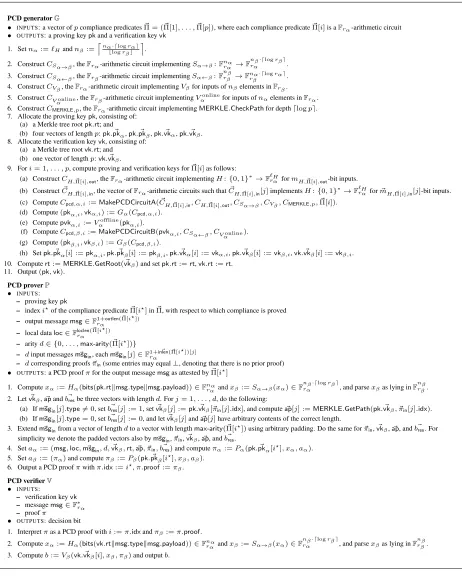
In this work, we investigate theoretical and practical aspects ofzero-knowledge proofs for cluster computations. We design, build, and evaluate zero-knowledge proof systems for which: (i) a proof attests to the correct execution of a cluster computation; and (ii) generating the proof is itself a cluster computation that is similar in structure and com-plexity to the original one. Concretely, we focus on MapReduce, an elegant and popular form of cluster computing.
Previous zero-knowledge proof systems can in principle prove a MapReduce computation’s correctness, via a monolithic NP statement that reasons about all mappers, all reducers, and shuffling. However, it is not clear how to generate the proof for such monolithic statements via parallel execution by a distributed system. Our work demon-strates, by theory and implementation, that proof generation can be similar in structure and complexity to the original cluster computation.
Our main technique is a bootstrapping theorem for succinct non-interactive arguments of knowledge (SNARKs) that shows how, via recursive proof composition and Proof-Carrying Data, it is possible to transform any SNARK into adistributed SNARK for MapReducewhich proves, piecewise and in a distributed way, the correctness of every step in the original MapReduce computation as well as their global consistency.
Contents
1 Introduction 3
1.1 Motivation . . . 3
1.2 Our focus: MapReduce . . . 4
1.3 Our contributions . . . 4
1.4 Prior work . . . 5
1.5 Summary of challenges and techniques . . . 5
1.6 Roadmap . . . 6
2 Preliminaries 7 2.1 Basic notations . . . 7
2.2 Commitments . . . 7
2.3 Merkle trees . . . 7
2.4 MapReduce . . . 7
3 Definition of distributed zk-SNARKs for MapReduce 10 3.1 Non-distributed zk-SNARKs for MapReduce . . . 10
3.2 Distributed zk-SNARKs for MapReduce . . . 10
4 Definition of multi-predicate PCD 11 5 Step II: from multi-predicate PCD to distributed zk-SNARKs for MapReduce 13 5.1 Compliance engineering for MapReduce . . . 13
5.2 Construction of distributed zk-SNARKs for MapReduce . . . 20
6 Step I: construction of multi-predicate PCD 21 6.1 Arithmetic circuits and preprocessing zk-SNARKs . . . 21
6.2 Review of the [BCTV14a] construction . . . 21
6.3 Overview of our construction . . . 22
6.4 Details of our construction . . . 23
6.5 Optimizations and extensions . . . 24
7 Implementation 27
8 Evaluation 28
9 Conclusion 29
Acknowledgments 30
A Formal definition of (non-distributed) zk-SNARKs for MapReduce 31
B Formal definition of PCD with multiple predicates 32
C Formal definition of preprocessing zk-SNARKs 33
D More details for the construction of~ΠMR 34
E More details for the construction ofMR.Prove 36
1
Introduction
We study theoretical and concrete aspects ofzero-knowledge proofs for cluster computations, seeking proofs for which: (i) the output of the cluster computation carries a zero-knowledge proof of its correctness; and (ii) generating a proof is itself a cluster computation that is similar in structure and complexity to the original one.
1.1
Motivation
Consider the following motivating example. A server owns a private databasex, and a client wishes to learny:=F(x) for a public functionF, selected either by himself or someone else. A (hiding) commitmentcmtoxis known publicly. For example,xmay be a database containing genetic data, andF may be a machine-learning algorithm that uses the genetic data to compute a classifiery. On the one hand, the client seeksintegrity of computation: he wants to ensure that the server reports the correct outputy(because the classifierymay be used for critical medical decisions). On the other hand, the server seeksconfidentialityof his own input: he is willing to discloseyto the client, but no additional information aboutxbeyondy(because the genetic dataxmay contain sensitive personal information).
Zero-knowledge proofs. Achieving the combination of the aforementioned security requirements seems paradoxical; after all, the client does not have the inputx, and the server is not willing to share it. Nevertheless, cryptography offers a powerful tool that is able to do just that: zero-knowledge proofs[GMR89]. More precisely, the server, acting as the prover, attempts to convince the client, acting as the verifier, that the followingNPstatement is true: “there exists˜x such thaty=F(˜x)and˜xis a decommitment ofcm”. Indeed: (a) the proof system’ssoundnessproperty addresses the client’s integrity concern, because it guarantees that, if theNPstatement is false, the prover cannot convince the verifier (with high probability);1 and (b) the proof system’s zero-knowledgeproperty addresses the server’s confidentiality
concern, because it guarantees that, if theNPstatement is true, the prover can convince the verifier without leaking any information aboutx(beyond was is leaked by the outputy).
Cluster computations. WhenF is amenable to parallel execution by a distributed system, it is often desirable, for scalability and cost reasons, to computey := F(x)on acomputer cluster. A computer cluster consists of nodes (e.g., commodity machines) connected via a network, and each node performs local computations as coordinated via messages with other nodes. Thus, to compute F(x), a cluster may break x down into chunks and use these to assign sub-tasks to different nodes; the results of these sub-tasks may require further computation, so that nodes further coordinate, deduce more sub-tasks, and so on, until the final resulty can be collected. Parallel execution by a distributed system is possible in many settings, including the aforementioned one of running machine-learning algorithms on private genetic data. Indeed, “cloud” service providers do offer users distributed programming interfaces (e.g., Amazon’s “EMR” and Rackspace’s “Big Data”, both of which use the Hadoop framework).
The problem: how to do cluster computing in zero knowledge? In principle, any zero-knowledge proof system forNPcan be used to express anNPstatement that capturesF’s correct execution.
However, whileF may have been efficient to execute on a computer cluster, the process of generating a proof attesting to its correctness may not be. Suppose, for example, that theNPstatement to be proved must be expressed as an instance of circuit satisfiability. Then, one would have to construct a single circuit that expresses the correctness of the computation of every node in the cluster, as well as the correctness of communication among them. Proving the satisfiability of the resulting monolithic circuit via off-the-shelf zero-knowledge proof systems is a computation that looks nothing like the original one and, moreover, may not be suitable for efficient execution on a cluster.
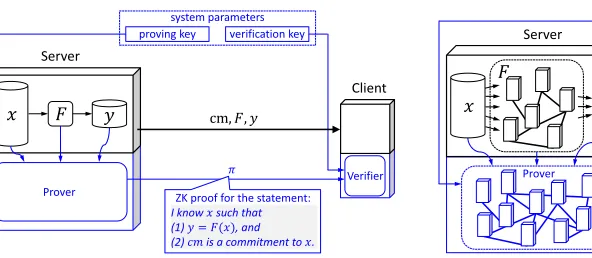
Ideally, the proving process should be a distributed computation that is similar to the original one, in that the complexity of producing the proof is not much larger than that of the original computation and, likewise, has a cluster-friendly communication structure (compare Figure 1 and Figure 2).
We thus ask the following question:
To what extent can one efficiently perform cluster computing in zero knowledge?
1Sometimes a property stronger than soundness is required:proof of knowledge[GMR89, BG93], which guarantees that, whenever the client is
1 𝐹
𝑥 𝑦
𝜋 Server
Client
Prover
Verifier proving key verification key
system parameters
cm, 𝐹, 𝑦
I know 𝑥 such that (1) 𝑦 = 𝐹(𝑥), and (2) 𝑐𝑚 is a commitment to 𝑥.
ZK proof for the statement:
Figure 1: In the classical setting of zero-knowledge proofs, (i) the computation being proved is executed on a single machine, and (ii) the proving process is itself a computation that is executed on a single machine.
2
𝐹
𝑥 𝑦
Prover
2
Server
Client
Verifier proving key verification key
system parameters
cm, 𝐹, 𝑦
𝜋
I know 𝑥 such that (1) 𝑦 = 𝐹(𝑥), and (2) 𝑐𝑚 is a commitment to 𝑥.
ZK proof for the statement:
Figure 2: We study zero-knowledge proofs for cluster computations. In this setting, (i) the computation being proved is a cluster computation, and (ii) the proving process is itself a cluster computation (that is similar in structure and complexity to the original one).
1.2
Our focus: MapReduce
Cluster computing is a hypernym that encompasses numerous forms of distributed computing, as determined by the cluster’s architecture (i.e., its programming model and its execution framework). Indeed, a cluster’s architecture often depends on the class of envisioned applications (e.g., indexing the World Wide Web, performing astrophysicalN-body simulations, executing machine-learning algorithms on genetic data, and so on).
In this work, we focus on a concrete, yet elegant and powerful, distributed architecture: MapReduce [DG04]. We review MapReduce later (in Section 2), and now only say that MapReduce can express many useful computa-tions, including ones used for machine learning [CKLY+06, WHK08, PHBB09], graph mining and processing [LS10, KCF12], statistical machine translation [BPXOD07, DCML08, LD10, PWB12], document similarity [Lin09], and bioinformatics [LSLPS09, Sch09]. For concreteness, we specialize to MapReduce the question raised in Section 1.1:
Can one obtain zero-knowledge proofs attesting to the correctness of MapReduce computations, in which the proving process is itself distributed and can be efficiently expressed via MapReduce computations?
1.3
Our contributions
In this paper we present two main results, both contributing to the feasibility of cluster computing in zero knowledge. 1. MapReduce in zero knowledge.Under knowledge-of-exponent assumptions [Dam92, HT98, BP04], we construct a zero-knowledge proof system in which: (i) a proof attests to the correct execution of a MapReduce computa-tion; and (ii) generating a proof consists of MapReduce computations with similar complexity as the original one. Moreover, the proof system is succinct and non-interactive, i.e., is azk-SNARK[GW11, BCCT12, BCIOP13]. 2. A working prototype. We design, build, and evaluate a working prototype for the aforementioned construction.
The code implementing the prototype is integrated withlibsnark[SCI], aC++library for zk-SNARKs. At the heart of our construction (and implementation) lies anew bootstrapping theoremfor zk-SNARKs. Informally:
Assuming collision-resistant hashing, there is an efficient transformation that takes as input a zk-SNARK (even one with expensive preprocessing) and outputs a distributed zk-SNARK for MapReduce, i.e., a zk-SNARK for MapReduce where the prover can be efficiently implemented via MapReduce.
The transformation consists of the following two steps.
The theory for the first step is due to [BCCT13]; a special case was implemented in [BCTV14a], and our imple-mentation generalizes it to support the MapReduce application. The second step is novel and is an example of using “compliance engineering” to conduct and prove correctness of non-trivial distributed computations. From an imple-mentation standpoint, both steps require significant and careful engineering, as we explain later.
1.4
Prior work
zk-SNARKs. We study zero-knowledge proofs [GMR89] that are non-interactive [BFM88, NY90, BDSMP91]. Specifically, we study non-interactive zero-knowledge proofs that aresuccinct, i.e., short and easy to verify [Mic00]; these are known aszk-SNARKs[GW11, BCCT12, BCIOP13].
There are many zk-SNARK constructions in the literature, with different properties in efficiency and supported lan-guages. Inpreprocessing zk-SNARKs, the complexity of the setup of public parameters grows with the size of the com-putation being proved [Gro10, Lip12, BCIOP13, GGPR13, PGHR13, BCGTV13, Lip13, FLZ13, BCTV14b, Lip14, KPPS+14, ZPK14, DFGK14, WSRBW15, BBFR15, CFHK+15]; infully-succinct zk-SNARKs, that complexity is in-dependent of computation size [Mic00, Val08, Mie08, DL08, BCCT12, DFH12, GLR11, BC12, BCCT13, BCTV14a, BCCG+14]. Working prototypes have been achieved both for preprocessing zk-SNARKs [PGHR13, BCGTV13, BCTV14b, KPPS+14, ZPK14, CFHK+15] and for fully-succinct ones [BCTV14a]. Several works have also explored more in depth various applications of zk-SNARKs [CKLM13, BFRS+13, DFKP13, BCGG+14, FL14].
Prior work has not sought (or achieved) distributed zk-SNARKs for MapReduce. Of course, non-distributed zk-SNARKs for MapReduce (i.e., where the prover is not amenable to parallel distributed execution) can be achieved, trivially, via any zk-SNARK forNP: (a) express (the correctness of) the MapReduce computation via a suitableNP statement; then (b) prove satisfiability of thatNPstatement by using the zk-SNARK.
Finally, known zk-SNARK constructions (including the one in this work) rely on fairly strong assumptions. This may be partially justified in light of the work of Gentry and Wichs [GW11], which shows that no non-interactive succinct argument can be proven sound via a black-box reduction to a falsifiable assumption [Nao03].
Proof-carrying data. Proof-Carrying Data(PCD) [CT10, CT12] is a framework for enforcing local invariants in distributed computations; it is captured via a cryptographic primitive calledPCD system. Proof-Carrying Data covers, as special examples, incrementally-verifiable computation [Val08] and targeted malleability [BSW12]. Its role in bootstrapping zk-SNARKs was shown in [BCCT13], and an implementation of it was achieved in [BCTV14a]. Outsourcing MapReduce computations. Braun et al. [BFRS+13] construct (and implement) an interactive protocol for verifiably outsourcing MapReduce computations to untrusted servers. When interacting with the prover, the client has to perform himself the MapReduce shuffling phase; hence, their protocol is neither succinct nor zero knowledge.
Schuster et al. [SCFG+15] construct (and implement) a protocol for verifiably outsourcing MapReduce computa-tions to a cluster in which each node is equipped with a trusted processor. Their protocol additionally provides certain confidentiality guarantees (the client may hide from the cluster all information about the outsourced computation except for some “structural” details such as key-repetition patterns in the shuffle phase).
Both of the above works do not obtain a zk-SNARK and, a fortiori, neither a distributed zk-SNARK.
Other works on outsourcing computations. Numerous works [GKR08, KR09, AIK10, CKV10, GGP10, BGV11, CRR12, CTY11, SBW11, FG12, SMBW12, SVPB+12, SBVB+13, CMT12, TRMP12, VSBW13, Tha13, BFRS+13, BTVW14, PR14] seek to verifiably outsource various classes of computation to untrusted powerful servers, e.g., in order to leverage cheaper cycles or storage. Some of these works have achieved working prototypes of their protocols. Verifiable outsourcing of computationsis not our goal. Rather, we study theoretical and practical aspects of zero-knowledge proofs for cluster computations. Zero-zero-knowledge proofs are useful even when applied to relatively-small computations, and even with high overheads (e.g., see [MGGR13] for a recent example).2
1.5
Summary of challenges and techniques
Our construction (and implementation) rely on a new bootstrapping theorem for zk-SNARKs: any zk-SNARK can be transformed into a distributed zk-SNARK for MapReduce. The transformation is done in two steps, as follows.
2In this paper’s setting, the client does not have the server’s input, and so cannot conduct the computation on his own. It is thusnot meaningfulto
1.5.1 From the zk-SNARK to a multi-predicate PCD system
The transformation’s first step uses the given zk-SNARK to construct aPCD system[CT10, CT12], a cryptographic primitive that enforces a given local invariant, known as thecompliance predicate, in distributed computations. Such a transformation was described by [BCCT13], following [Val08] and [CT10]. It was implemented by [BCTV14a], and used for obtaining scalable zero-knowledge proofs for random-access machine executions.
These prior works are constrained to enforcing a single compliance predicate at all nodes in the distributed compu-tation. However, in MapReduce computations (as in many others), different nodes are subject to different requirements. In principle one can create a single compliance predicate expressing the disjunction of all these requirements; but the resulting predicate is large (its cost is the sum of each requirement’s cost) and entails a large cost in proving time.
We thus extend [BCTV14a] to define, construct, and implement a multi-predicate PCD system, where different nodes may be subject to different compliance predicates, and yet the cost of producing the proof, at each node, depends merely on the compliance predicate to which this particular node is subject. The presence of multiple compliance predicates complicates the construction of the arithmetic circuits for performing recursive proof composition, as these must now verify a zk-SNARK proof relative to one out of a (potentially large) number of compliance predicates, each with its own verification key, at a cost that is essentially independent of the predicates that are not locally relevant.
Additional restrictions in the prior works, which we also relax, are that node arity (the number of input messages to a node) was fixed, and that a node’s input lengths had to equal its output length. While not fundamental, these limitations cause sizable overheads in heterogenous distributed computations (of which MapReduce is an example).
1.5.2 From a multi-predicate PCD system to a distributed zk-SNARK for MapReduce
The transformation’s second step uses the aforementioned multi-predicate PCD system to construct a distributed zk-SNARK for MapReduce.
For each individual mapper node or reducer node, correctness of the local computation is independent of other computations; so it is fairly straightforward to distill local “map” and “reduce” compliance predicates. However, the shuffle phase of the MapReduce computation is a global computation that involves all of the mappers’ outputs. We wish to ensuregloballycorrect shuffling, while only enforcing (via the PCD system) the preservation of a compliance predicate,locallyat each node. (Of course, one could always consider a big shuffler node that takes all the shuffled messages as inputs, but doing so would prevent the proof generation from being distributed.)
We thus show how to decompose correct shuffling into a collection of simple local predicates, while preserving zero knowledge (which introduces subtleties). Roughly, we show that there is a parallel distributed algorithm to simultaneously compute, for each unique keyk, a proof attesting that the list of values associated tokin the output of the shuffling process contains all the those values, and only those, that were paired withkby some mapper.
Subsequently, we use the map and reduce compliance predicates, along with those used to prove correct shuffling, and obtain a collection of compliance predicates with the property that any distributed computation that is complaint with these corresponds to a correct MapReduce computation.
Note how the extensions to basic PCD, mentioned in Section 1.5.1, come into play. First, we specify multiple compliance predicate, for the different stages of the computation, and only pay for the applicable one at every point. Second, because MapReduce computation has a communication pattern that is input-dependent and not very homoge-nous, we require PCD to support (directly and thus more efficiently) flexible communication patterns, with variable node arity and varying input and output message lengths.
1.6
Roadmap
2
Preliminaries
We give notations and definitions needed for this paper’s technical discussions.
2.1
Basic notations
We denote byλthe security parameter. We writef = Oλ(g)to mean that there isc > 0 such thatf = O(λcg). We write|a| to denote the number of bits needed to storea(whetherabe a vector, a circuit, and so on); ifais a vector,len(a)denotes the number of components ina. We writecost(A)to denote the cost of computingA: ifAis a machine, this is its running time; ifAis a circuit, this is its number of gates.
To simplify notation, we do not make explicit adversaries’ auxiliary inputs. We also do not make explicit the public parameters of some cryptographic primitives (e.g., commitment schemes, collision-resistant functions); such primitives require a parameter setup that involves sampling from a certain distribution and then publishing the result.
2.2
Commitments
Acommitment schemeis a pairCOMM= (COMM.Gen,COMM.Ver)with the following syntax:
• COMM.Gen(z)→(cm,cr). On input dataz, thecommitment generatorCOMM.Genprobabilistically samples a commitmentcmofzand corresponding commitment randomnesscr.
• COMM.Ver(z,cm,cr) →b. On input dataz, commitmentcm, and commitment randomnesscr, thecommitment verifierCOMM.Veroutputsb= 1ifcmis a valid commitment ofzwith respect to the randomnesscr.
The schemeCOMMsatisfies the natural completeness, (computational) binding, and (statistical) hiding properties. We assume thatcmdoes not even leak|z|, and thus|cm|is a fixed polynomial in the security parameter.
2.3
Merkle trees
We use Merkle trees [Mer89] (based on some collision-resistant function) as non-hiding succinct commitments to lists of values, in the familiar way. AMerkle-tree schemeis a tupleMERKLE= (MERKLE.GetRoot,MERKLE.GetPath, MERKLE.CheckPath)with the following syntax:
• MERKLE.GetRoot(~z)→rt. Given input list~z= (zi)ni=1, theroot generatorMERKLE.GetRootdeterministically computes a rootrtof the Merkle tree with the list~zat its leaves.
• MERKLE.GetPath(~z, i)→ap. Given input list~zand indexi, theauthentication path generatorMERKLE.GetPath deterministically computes the authentication pathapforzi.
• MERKLE.CheckPath(rt, i, zi,ap)→b. Given rootrt, input datazi, indexi, and authentication pathap, thepath
checkerMERKLE.CheckPathoutputsb= 1ifapis a valid path forzias thei-th leaf in a Merkle tree with rootrt. The schemeMERKLEsatisfies the natural completeness and (computational) binding properties.
2.4
MapReduce
We recall MapReduce, introduce useful notation for MapReduce, and then mention some extensions of MapReduce to which our results continue to apply.
2.4.1 Overview of MapReduce
MapReduce is a programming model for describing data-parallel computations to be run on computer clusters [DG04]. AMapReduce jobconsists of two functions,MapandReduce, and an input,x, which is a list of key-value pairs; executing the job results into an output,y, which also is a list of key-value pairs. Computingyrequires three phases: (i)Map phase: the function Mapis separately invoked on each key-value pair in the list x; each such invocation produces an intermediate sub-list of key-value pairs. (ii)Shuffle phase: all the intermediate sub-lists of key-value pairs are jointly shuffled so that pairs that share the same key are gathered together into groups. (iii)Reduce phase:
Naturally, efficiently computing the three phases on a computer cluster requires a suitable framework to assign computers toMaptasks, implement the distributed shuffle of intermediate key-value pairs, assign computers toReduce tasks, and collect the various outputs; this is typically orchestrated by a master node. For now, we focus on the definition of the programming model and not the details of a framework that implements it.
2.4.2 Notation for MapReduce
We introduce notation that enables us to discuss MapReduce in more detail.
Keys, values, and records. First, we discuss the data associated to a MapReduce job. The main “unit of data” is a
record, which is a pair(k, v)wherekis itskeyandvis itsvalue. We distinguish between different kinds of records, depending on which phase they belong to: input records are ofphase1and lie inK1× V1; intermediate records are of phase2and lie inK2× V2; and output records are ofphase3lie inK3× V3.
MapReduce pairs. Next, we discuss the functions associated to a MapReduce job. AMapReduce pair is a pair (Map,Reduce)whereMap:K1× V1→(K2× V2)∗is itsMap functionandReduce:K2×(V2)∗→(K3× V3)is its Reduce function; both must run in polynomial time. In other words, on input a phase-1record(k1, v1)∈(K1× V1), Mapoutputs a list of phase-2records (k2i, v2i)i∈(K2× V2)∗. Instead, on input a phase-2keyk2∈ K2and a list of
phase-2values(v2
i)i ∈(V2)∗,Reduceoutputs a phase-3record(k3, v3)∈(K3× V3).
MapReduce executions. Finally, we discuss how functions operate on data so toexecutea MapReduce job. Given a MapReduce pair(Map,Reduce)and an inputx∈(K1× V1)∗, the output of the execution of(Map,Reduce)onx,
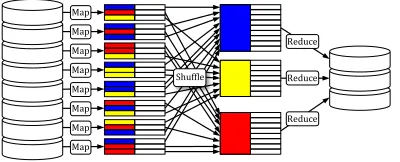
denoted[Map,Reduce](x), is the resulty∈(K3× V3)∗of the following (abstract) computation (see Figure 3).
1. Map step.For eachi∈ {1, . . . ,len(x)}, letting(ki1, vi1)be thei-th phase-1record inx, compute the list of phase-2 records (k2i,j, v2i,j)j:=Map(ki1, vi1). This step produces a list of intermediate recordsz= (k2i,j, v2i,j)i,j. 2. Shuffle step.Shuffle the listzso that records with the same key are grouped together. This step induces, for each
unique keyk2appearing inz, a corresponding listv~2of values paired withk2.
3. Reduce step. For each unique phase-2 keyk2inzand its corresponding list of phase-2valuesv~2, compute the
phase-3record(k3, v3) =Reduce(k2, ~v2). The outputyequals the concatenation of all of these phase-3records.
We note that MapReduce jobs enjoy certain “symmetries” (which simplify the task of execution on clusters): the order of records inxor inyis irrelevant.3 In terms of complexity measures, we say that the execution of(Map,Reduce)on
xis(m, r, p)-boundedif each individual execution ofMaptakes at mostmtime, each individual execution ofReduce takes at mostrtime, andlen(x)·m+len(y)·r≤p(wherey:= [Map,Reduce](x)).4
The MapReduce language. We express, via a suitable language, the notion of “correct” MapReduce executions: Definition 2.1. For a MapReduce pair(Map,Reduce), the languageL(Map,Reduce)consists of the tuples(x,y)for whichy= [Map,Reduce](x).5
In this work, we consider the setting where an inputxis not known to the user, but only its commitmentcmis (asxis private). Thus, we work with a related relation,R(COMMMap,Reduce), derived fromL(Map,Reduce)and a commitment scheme COMM = (COMM.Gen,COMM.Ver)(using the syntax introduced in Section 2.2). In contrast to L(Map,Reduce), instances inRCOMM
(Map,Reduce)containcminstead ofx, and witnesses are extended to contain decommitment information
(i.e., the input and commitment randomness). More precisely, we define the relationRCOMM(Map,Reduce)as follows.
Definition 2.2. For a MapReduce pair(Map,Reduce)and commitment schemeCOMM, the relationR(COMMMap,Reduce)
consists of instance-witness pairs (cm,y),(x,cr)
such thatCOMM.Ver(x,cm,cr) = 1and(x,y)∈L(Map,Reduce).6
3One only considers Map and Reduce functions that do not introduce asymmetries (by, e.g., leveraging the order of elements in a list). 4For simplicity, we ignore the cost of shuffling because it is typically on the order of the input and output sizes [GM12].
5Due to symmetry,(x,y)∈L
(Map,Reduce)if and only if π(x), π0(y)
∈L(Map,Reduce)for any two permutationsπandπ0(of records).
6One may wonder why we define (and work with) the relationRCOMM
(Map,Reduce)instead of using the corresponding languageL(COMMMap,Reduce). This is
3 3 Map
Map Map Map Map Map Map Map
Reduce Reduce
Reduce Shuffle
Figure 3: A single MapReduce execution.
4 4
(Map , Reduce ) (Map , Reduce )
(Map , Reduce )
(Map , Reduce )
(Map , Reduce )
𝑥 (Map , Reduce ) 𝑦
Figure 4: An execution of a MapReduce sequence of depth6. Here,I1={0},
I2={1},I3={0},I4={2,3},I5={2,3},I6={4,5}.
MapReduce sequences. A single MapReduce execution may be insufficient to run an algorithm. In such cases, instead of a single MapReduce pair, we consider aMapReduce sequenceS: a list (Ii,Mapi,Reducei)
d
i=1such that, for eachi,Ii ⊆ {0, . . . , i−1}and(Mapi,Reducei)is a MapReduce pair. We calldthe depth ofS. The output of the execution ofSon an inputx, denotedS(x), is the resultyobtained as follows: (1) sety(0) := x; (2) for i= 1, . . . , d, computey(i):= [Map
i,Reducei](x(i))wherex(i)is the concatenation of ally(j)withj∈Ii; (3) output y :=y(d);7 see Figure 4. In terms of complexity measures, similarly to above, we say that the execution ofSonx
is(m, r, p)-boundedif each individual execution of anyMapitakes at mostmtime, each individual execution of any Reduceitakes at mostrtime, andP
d
i=1(len(x
(i−1))·m+len(x(i))·r)≤p.
Family of MapReduce sequences. Afamily of MapReduce sequencesis a family(SN)N∈Nwhere eachSN is a MapReduce sequence (IN,i,MapN,i,ReduceN,i)
dN
i=1.
2.4.3 Some extensions of MapReduce
Sometimes one considers a more general definition of MapReduce in which the Reduce function outputs a list of phase-3records; instead, the above discussions focus on the case where the Reduce function outputs asinglerecord.
In addition, the cryptographic setting that we consider motivates other extensions that are not typically considered. Specifically, it is natural to let a Map or Reduce function take two additional inputs: (i)MapReduce parameters, which allow a user to specify different settings even after a MapReduce pair has been fixed (e.g., zk-SNARK keys for a particular pair have already been generated); and (ii) anauxiliary input, which provides a further non-deterministic input that, unlike the “primary” inputx, is not fixed by the commitmentcm.
This paper’s results extend to cover the extensions above (and, in fact, our working prototype supports them).
3
Definition of distributed zk-SNARKs for MapReduce
We (informally) define non-distributed zk-SNARKs for MapReduce, and then distributed zk-SNARKs for MapReduce. Throughout, we assume familiarity with the notations and definitions for MapReduce introduced in Section 2.4.
3.1
Non-distributed zk-SNARKs for MapReduce
A (non-distributed)zk-SNARK for MapReduceis a zk-SNARK for proving knowledge of witnesses inR(COMMMap,Reduce), for a user-specified MapReduce pair(Map,Reduce)and a fixed choice of commitment schemeCOMM. That is, it is a cryptographic primitive that provides short and easy-to-verify non-interactive zero-knowledge proofs of knowledge for the relationR(COMMMap,Reduce). Concretely, the primitive consists of a tuple(COMM,MR.KeyGen,MR.Prove,MR.Verify) with the following syntax.
• MR.KeyGen(1λ,Map,Reduce)→(pk,vk). On input a security parameterλ(presented in unary) and a MapReduce pair(Map,Reduce), thekey generatorMR.KeyGenprobabilistically samples a proving keypkand a verification key vk. We assume, without loss of generality, thatpkcontains (a description of) the MapReduce pair(Map,Reduce).
The keyspkandvkare published as public parameters and can be used, any number of times, to prove/verify knowl-edge of witnesses in the relationRCOMM
(Map,Reduce), as follows.
• MR.Prove(pk,cm,y,x,cr)→ πMR. On input a proving keypk, instance(cm,y), and witness(x,cr), theprover MR.Proveoutputs a proofπMRfor the statement “there is(x,cr)such that (cm,y),(x,cr)
∈RCOMM (Map,Reduce)”. • MR.Verify(vk,cm,y, πMR) → b. On input a verification keyvk, commitmentcm, outputy, and proofπMR, the
verifierMR.Verifyoutputsb= 1if he is convinced that there is(x,cr)such that (cm,y),(x,cr)
∈RCOMM (Map,Reduce). As in other zk-SNARKs, the above tuple satisfies (variants of) the properties of completeness, succinctness, (com-putational) proof of knowledge, and (statistical) zero knowledge; we describe these in Appendix A. Here we recall succinctness: an honestly-generated proofπMRhasOλ(1)bits, andMR.Verify(vk,cm,y, πMR)runs in timeOλ(|y|). Costs of key generation. The above implies that(pk,vk)is generated in timeOλ(1)·poly(cost(Map)+cost(Reduce)), |pk| =Oλ(1)·poly(cost(Map) +cost(Reduce)), and|vk| =Oλ(1)(sinceMR.Verifyruns in timeOλ(|y|)for any y). These key-generation costs are between those of a preprocessing zk-SNARK (where key generation costs as much as theentire computation being proved) and a fully-succinct zk-SNARK (where key generation costs only a fixed polynomial inλ), because they do not depend on the number of mappers and reducers in the MapReduce computation. One could strengthen the definition above to require “full succinctness”, i.e., to further require that key generation depends polynomially on the security parameter only (and, in particular, that the MapReduce pair is not hard-coded into the keys). The results presented in this paper extend to achieve this stronger definition.
3.2
Distributed zk-SNARKs for MapReduce
Adistributed zk-SNARK for MapReduceis a zk-SNARK for MapReduce where the prover consists of few MapReduce computations whose overall complexity is similar to the MapReduce computation being proved. More precisely, for every MapReduce pair(Map,Reduce)and(pk,vk)output byMR.KeyGen(1λ,Map,Reduce),MR.Prove(pk,·,·,·,·) is a family of MapReduce sequences that is(Map,Reduce)-complexity-preserving, a property defined below.
Definition 3.1. Given a MapReduce pair(Map,Reduce), a family of MapReduce sequences(SN)N∈Nis(Map,Reduce) -complexity-preserving if, for allN ∈Nand (cm,y),(x,cr)∈R(COMMMap,Reduce)withlen(x) +len(y)≤N:
• the depth ofSN is logarithmic inN, i.e.,dN =O(logN); and
4
Definition of multi-predicate PCD
Proof-carrying data (PCD) [CT10, CT12] is a cryptographic primitive that encapsulates the security guarantees achiev-able via recursive composition of proofs. Since recursive proof composition naturally involves multiple (physical or virtual) parties, PCD is phrased in the language of adistributed computationamong computing nodes, who perform local computations, based on local data and input messages, and then produce output messages. Given a compli-ance predicateΠto express local checks, the goal of PCD is to ensure that any given messagemsgin the distributed computation isΠ-compliant, i.e., is consistent with a history in which each node’s local computation satisfiesΠ. This formulation covers, as special cases, incrementally-verifiable computation [Val08] and targeted malleability [BSW12]. Extending PCD to multiple predicates. The definition of PCD naturally generalizes to compliance with respect to avectorΠ~ of compliance predicates (rather than a single predicate). Namely, amsgis~Π-compliantif it is consistent with a history in which each node’s local computation satisfies some predicateΠin the vectorΠ. Moreover, a message~ msgcomprises two parts: thetype, which records what kind of node outputmsg, and thepayload, which is the rest.
The abovemulti-predicate PCDcan be “simulated” via asingle-predicate PCD, by folding all the predicates in the vector~Πinto a single predicateΠ?that (a) reasons about which predicate inΠ~ to use at a give node, and (b) enforces a message’s type and payload separation. However, this simulation incurs a significant overhead: the cost ofΠ? is the sum of the costs of all the predicates in~Π, and this cost is incurred at every node regardless of which predicate is actually used to check compliance at a node. In contrast, in our construction of multi-predicate PCD (see Section 6), we incur, at each node, only the cost of the predicate that is actually used to check compliance.
Implications for MapReduce. As we discuss in Section 5, reducing the correctness of MapReduce computations to compliance of distributed computations involves multiple predicates that perform checks with different semantics: a predicate for mapper nodes, a predicate for reducer nodes, and various other predicates for other nodes that reason about shuffling. These predicates have different costs and, thus, it is crucial to leverage the flexibility offered by multi-predicate PCD (so to then obtain a distributed zk-SNARK for MapReduce).
Next, we define distributed-computation transcripts (our formal notion of distributed computations), compliance of a transcriptTwith respect to a given vectorΠ~ of compliance predicates, multi-predicate PCD, and transcript generators. Transcripts. A(distributed-computation) transcriptis a tupleT= (G,TYPE,LOC,PAYLOAD), where: • G= (V, E)is a directed acyclic graph with node setV and edge setE⊆V ×V;
• TYPE :V →Nare node labels;
• LOC :V → {0,1}∗are (another kind of) node labels; and
• PAYLOAD :E→ {0,1}∗are edge labels.
Themessageof an edge(v, w) ∈ Eis the pairMSG(v, w) := (TYPE(v),PAYLOAD(v, w)). Theoutputsof the transcriptT, denotedOUTS(T), is the set of messagesMSG(˜v,w)˜ where(˜v,w)˜ ∈Eandw˜is a sink. Typically, we denote a message bymsg, and its type and payload bymsg.typeandmsg.payload.
Compliant transcripts and messages. Acompliance predicateΠis a function with atype, denotedΠ.type. Given a vectorΠ~ of compliance predicates, we say that:
• a transcriptT= (G,LOC,TYPE,PAYLOAD)is~Π-compliant, denotedΠ(~ T) =OK, if: (i) for eachv∈V,TYPE(v) = 0if and only ifvis a source; and
(ii) for each non-sourcev∈V and eachw∈children(v), there isΠ∈~ΠwithTYPE(v) = Π.typesuch that ΠMSG(v, w),LOC(v), MSG(u, v)u∈parents(v)accepts.
• a messagemsgisΠ-compliant~ if there is a transcriptTsuch thatΠ(~ T) =OKandmsg∈OUTS(T).
Multi-predicate PCD systems. Amulti-predicate PCD systemis a triple of polynomial-time algorithms(G,P,V),
calledkey generator,prover, andverifier. The key generatorGis given as input a vector of predicates~Π, and outputs a proving keypkand verification keyvk; these allow anyone to prove/verify that a messagemsgisΠ-compliant. This~ is achieved by attaching a short and easy-to-verify proof to each message: givenpk, input messagesmsg~ inwith proofs ~
πin, local dataloc, and an output messagemsg(allegedly,Π-compliant), the prover~ Pcomputes a new proofπto attach
tomsg; the verifierV(vk,msg, π)checks thatmsgis~Π-compliant. The triple(G,P,V)must satisfy completeness,
succinctness, (computational) proof of knowledge, and (statistical) zero knowledge; we describe these in Appendix B. Here we recall succinctness: an honestly-generated proofπhasOλ(1)bits, andV(vk,msg, π)runs in timeOλ(|msg|). Transcript generators. We sometimes think of a transcript as dynamically generated rather than as a static object, in the following sense. Atranscript generatoris an interactive algorithmTGenthat works as follows: given the empty string,TGenanswers with a first transcript extensionte1; then, given a second empty string,TGenanswers with a second transcript extensionte2; and so on, untilTGenhalts and outputs a set of messagesfin. Atranscript extension
is an instruction specifying how to extend the growing transcriptT;TGen’s output, obtained after all the extensions, equalsOUTS(T). More precisely, the transcript generated byTGenis defined via the following iterative procedure.
• InitializeT= (G,TYPE,LOC,PAYLOAD)to be an empty transcript andInactivesto be an empty map.
• Start runningTGenand, fori= 1,2, . . ., do the following untilTGenhalts and outputsfin. 1. Keep runningTGenuntil it outputs the next transcript extensiontei.
2. Ifteilooks like(v, w,msg), do as follows.
(a) Check that(v, w)6∈Eand@u∈Vs.t.(u, v)∈E.
(b) If any ofvorwis not inV, add it toV; then add(v, w)toE.
(c) Check thatmsg.type= 0; then setTYPE(v) :=msg.typeandMSG(v, w) :=msg. 3. Ifteilooks like (v, w,msg),loc,(~u, ~msgin, ~b)
, do as follows.
(a) Check that: (i)v∈ V; (ii)(v, w)6∈ E; (iii)Inactives(v,msg) = 0; (iv)~u =parents(v); (v)~u, ~msgin, ~bare
vectors of a same lengthd; (vi) forj= 1, . . . , d,~u[j]∈V,(~u[j], v)∈E, andMSG(~u[j], v) =msg~ in[j]. (b) If∃w0∈V s.t.(v, w0)∈E, check thatTYPE(v) =msg.typeandLOC(v) =loc; otherwise, setTYPE(v) :=
msg.typeandLOC(v) :=loc.
(c) Ifw6∈V then addwtoV; then add(v, w)toE. (d) SetMSG(v, w) :=msg.
(e) Forj= 1, . . . , d, if~b[j] = 1then setInactives(~u[j], ~msgin[j]) := 1.
• Check thatfin= OUTS(T)and that no message infinhas a set bit inInactives.
• If any check above fails, output an empty transcript; else outputT.
The vector~bin a transcript extension denotes which non-output messages are used for the last time as an input to a node;~bis exposed for efficiency reasons (as explained later down below). We use the language of transcript generators to formalize the completeness property for PCD systems (in Appendix B), as well as to state a theorem (in Section 5.1). To each transcript generatorTGen, we associate a matchingPCD meta-proverTPrvthat, given a proving keypk, generates proofs of compliance on the fly, ultimately producing proofs for the outputs of the distributed computation.
• InitializeActiveProofsto be an empty map.
• Start runningTGenand, fori= 1,2, . . ., do the following untilTGenhalts and outputsfin. 1. Keep runningTGenuntil it outputs the next transcript extensiontei.
2. Ifteilooks like(v, w,msg), setActiveProofs(v,msg) :=⊥.
3. Ifteilooks like (v, w,msg),loc,(~u, ~msgin, ~b)
, do as follows. (a) Forj= 1, . . . , d, set~πin[j] :=ActiveProofs(~u[j], ~msgin[j]).
(b) Compute the PCD proofπ:=P(pk,msg,loc, ~msgin, ~πin), and setActiveProofs(v,msg) :=π.
(c) Forj= 1, . . . , d, if~b[j] = 1then delete fromActiveProofsthe entry for(~u[j], ~msgin[j]). 4. Output the proofs inActiveProofsfor the messages infin.
5
Step II: from multi-predicate PCD to distributed zk-SNARKs for MapReduce
We discuss Step II of our bootstrapping theorem: constructing a distributed zk-SNARK for MapReduce from a multi-predicate PCD system. This step itself consists of two main parts.
• Compliance engineering(Section 5.1): a reduction from the correctness of MapReduce computations to a question about the compliance of distributed computations with respect to a certain vector~ΠMRof predicates.
• Construction of the proof system(Section 5.2): suitably invoke the multi-predicate PCD system on the vector ~
ΠMRin order to construct a distributed zk-SNARK for MapReduce.
The combination of compliance engineering and PCD systems, exemplified via the above two steps, is a powerful tool for constructing zero-knowledge proofs for distributed computations: compliance engineering allows us to express the desired properties as the compliance of distributed computations, while PCD systems allow us to prove, in a distributed way (and in zero knowledge), the compliance of such distributed computations.
5.1
Compliance engineering for MapReduce
Given any MapReduce pair(Map,Reduce), we show how to construct a vectorΠ~MRof compliance predicates for
which suitableΠ~MR-compliant transcripts correspond to instance-witness pairs in the relationR(COMMMap,Reduce). Let us first clarify what “suitable” means, via the following definition.
Definition 5.1. For an instance(cm,y), a transcriptTis(cm,y)-compatibleifOUTS(T)contains a message with type1and payload(cm,len(y))and, for eachi∈ {1, . . . ,len(y)}, a message with type2and payload(cm,yi).8 Next, via the theorem below, we show how one can translate a question of the form
“Given an instance(cm,y), is there a witness(x,cr)such that (cm,y),(x,cr)
is inRCOMM (Map,Reduce)?” to a question of the form
“Given an instance(cm,y), is there aΠ~MR-compliant(cm,y)-compatible transcriptT?”
Theorem 5.2. There exists a commitment schemeCOMMsuch that, for every MapReduce pair(Map,Reduce), there exist a vectorΠ~MRof compliance predicates and two algorithmsTGen,TExtsatisfying the following properties.
• EFFICIENCY.
– The vectorΠ~MRconsists of7predicates, with the following sizes and (per-input) costs:
|Π~MR[1]|=O
λ(|Map|) cost(Π~MR[1]) =Oλ(cost(Map)) |Π~MR[2]|=O
λ(|Reduce|) cost(Π~MR[2]) =Oλ(cost(Reduce)) |Π~MR[3]|=O
λ(1) cost(Π~MR[3]) =Oλ(1)
..
. ...
|Π~MR[7]|=Oλ(1) cost(Π~MR[7]) =Oλ(1)
.
– The algorithmTGenis(Map,Reduce)-complexity-preserving.
– The algorithmTExtis linear time.
• COMPLETENESS. For any instance(cm,y), if there is(x,cr)such that (cm,y),(x,cr)is inR(COMMMap,Reduce), then there is aΠ~MR-compliant(cm,y)-compatible transcriptT; also,Tis the transcript generated byTGen(cm,y,x,cr).
• PROOF OF KNOWLEDGE. For any instance(cm,y), if there is a~ΠMR-compliant(cm,y)-compatible transcriptT, thenTExt(T)outputs(x,cr)such that (cm,y),(x,cr)is inR(COMMMap,Reduce).
We now sketch a proof of the theorem. Recall proof of knowledge: we must construct a vectorΠ~MRof predicates
with the property that, given(cm,y), if there is a distributed-computation transcriptTthat is bothΠ~MR-compliant and(cm,y)-compatible, then we can find(x,cr)for whichCOMM.Ver(x,cm,cr) = 1andy = [Map,Reduce](x). Intuitively, we achieve proof of knowledge by engineering the predicates inΠ~MR so that the transcriptTis forced
to encode within it a “history” of a correct MapReduce execution. Technically, the main challenge is that we are restricted to local checks: each predicate only sees input and output messages of a single node; in contrast, correct execution of a MapReduce computation (also) involves global properties, such as correct shuffling.
We introduce our approach in steps, by first describing two “failed attempts”. For simplicity, we focus on the (artificial) case where each mapper outputs asinglephase-2record; later, we explain how this restriction can be lifted.
5.1.1 Failed attempt #1
It is natural to begin by designing two predicates that simply capture the correct execution of a mapper node and a re-ducer node, respectively; call theseΠMap
exe andΠReduceexe , and see Figure 6 for pseudocode. SetΠ~MR:= (ΠMapexe,ΠReduceexe ). Now suppose thatmsgis aΠ~MR-compliant message. What can we deduce about the history of computations that led tomsg? Ifmsg.type = ΠMapexe.type, thenmsg was output by a node at which the predicateΠMapexe was checked; similarly, ifmsg.type= ΠReduceexe .type, thenmsgwas output by a node at which the predicateΠReduceexe was checked. Suppose, for example, thatmsg.type= ΠReduceexe .type. By construction ofΠReduceexe , we deduce that: (i)msg.payload is a phase-3record(k3, v3), and (ii) there is a list of input messagesmsg~
inwhose payloads contain phase-2records
(k2
j, vj2)
jthat all share the same key and, moreover, result in(k
3, v3)when given as input toReduce.
However, as soon as we try to “dig further into the past”, and deduce what properties each phase-2record(k2
j, vj2) satisfies, we run into issues not addressed by the present construction ofΠMap
exe andΠReduceexe . Namely, • Issue I:How can we ascertain that each phase-2record(k2
i, vi2)was the correct output of some mapper node? • Issue II:Even if so, where did that mapper node obtain its input phase-1record?
5.1.2 Failed attempt #2
We augmentΠMap
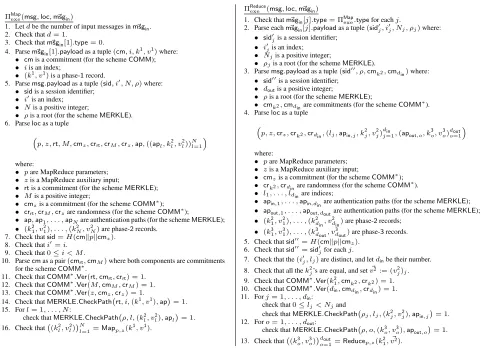
exe andΠReduceexe to address these issues. We address Issue I by inspecting message types:ΠMapexe ensures
that its input messages have type0(i.e., are not output by previous nodes); whileΠReduce
exe ensures that they have type ΠMap
exe.type(i.e., are output by mapper nodes). We address Issue II by augmenting messages with a commitmentcmto the (overall) inputxand extendingΠMapexe to authenticate the received phase-1record. We now explain these ideas.
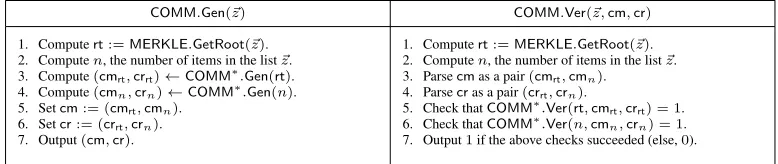
First, we describe the commitment schemeCOMMthat we use to createcm. Essentially,COMMconsists of (i) a Merkle-tree followed by a commitment to the resulting root, and also (ii) a commitment to the size of the committed data. See Figure 5 for more details; we denote the underlying commitment scheme byCOMM∗and the Merkle-tree scheme byMERKLE(and use notation introduced in Section 2.2 and Section 2.3).
Next, see Figure 7 for pseudocode of the two (updated) predicatesΠMap
exe andΠReduceexe . SetΠ~MR:= (ΠMapexe,ΠReduceexe ). Now suppose thatmsgis a~ΠMR-compliant message withmsg.type = ΠReduce
exe .type. By (the new) construction
ofΠReduce
exe , we know thatmsg.payload = (cm, k3, v3), wherecmis a commitment and(k3, v3)is a phase-3record; moreover, we also know that there is a list of messagesmsg~ in such that: (i) for eachj,msg~ in[j].type= ΠMap
exe.type andmsg~ in[j].payload = (cm, k2, v2
j), where(k2, vj2)is a phase-2record; (ii)(k3, v3) =Reduce(k2,(vj2)j). In turn, each messagemsg~ in[j]isΠ~MR-compliant and, by (the new) construction ofΠMapexe, we know that(k2, v2j)is the result of runningMapon some phase-1record authenticated with respect tocm.
Overall, each~ΠMR-compliant messagemsgwithmsg.type= ΠReduceexe .typeandmsg.payload= (cm, k3, v3)is the result of applyingReduceto some phase-2records sharing the same key, each of which is in turn the result of applying
COMM.Gen(~z) COMM.Ver(~z,cm,cr)
1. Computert:=MERKLE.GetRoot(~z). 2. Computen, the number of items in the list~z. 3. Compute(cmrt,crrt)←COMM∗.Gen(rt).
4. Compute(cmn,crn)←COMM∗.Gen(n). 5. Setcm:= (cmrt,cmn).
6. Setcr:= (crrt,crn). 7. Output(cm,cr).
1. Computert:=MERKLE.GetRoot(~z). 2. Computen, the number of items in the list~z. 3. Parsecmas a pair(cmrt,cmn).
4. Parsecras a pair(crrt,crn).
5. Check thatCOMM∗.Ver(rt,cmrt,crrt) = 1.
6. Check thatCOMM∗.Ver(n,cmn,crn) = 1. 7. Output1if the above checks succeeded (else,0).
Mapto some phase-1record authenticated relative tocm. However, these guarantees are not enough to imply a correct MapReduce computation, as we still need to tackle the following issue.
• Issue III:How do we ascertain the correctness of the shuffling phase? Namely, how do we ascertain that each list of phase-2records (received by a particular reducer node) containsallthe records having that same key?
Indeed, in principle, some phase-2records may have been duplicated, dropped, or sent to the wrong reducer node (e.g., to different reducer nodes even if sharing the same key).
5.1.3 Our approach
Unlike previous ones, Issue III is conceptually more complex: tackling it requires ensuring correct shuffling, which is a global computation involving all phase-2records (all the mappers’ outputs); in contrast, we are restricted to only perform local checks encoded in compliance predicates. Nevertheless, we show how we can further extendΠMap
exe and ΠReduce
exe , and also introduce additional compliance predicates, to ensure correct shuffling in a distributed manner. Further extendingΠMap
exe andΠ Reduce
exe . First, we extendΠ Map
exe to store, in the output message, the indexirelative to which the input message’s phase-1record was authenticated; subsequently, when receiving several input messages, ΠReduce
exe checks that all the indices contained in them are distinct.
The additional check inΠReduceexe prevents duplicate messages from being sent to the same reducer node. However, it does not prevent the same message from being sent to multiple reducer nodes, messages with the same key from being sent to multiple reducer nodes, or a message from being dropped. Additional “distributed bookkeeping” is required.
We thus further extendΠReduceexe to store in its output message two additional pieces of information: the phase-2key k2shared among its input messages and the numberdin of these input messages. More precisely, only commitments
to these are stored, and we denote themcmk2andcmdin. The commitments preserve zero knowledge, by not exposing internals of the MapReduce computation in output messages of reducer nodes.
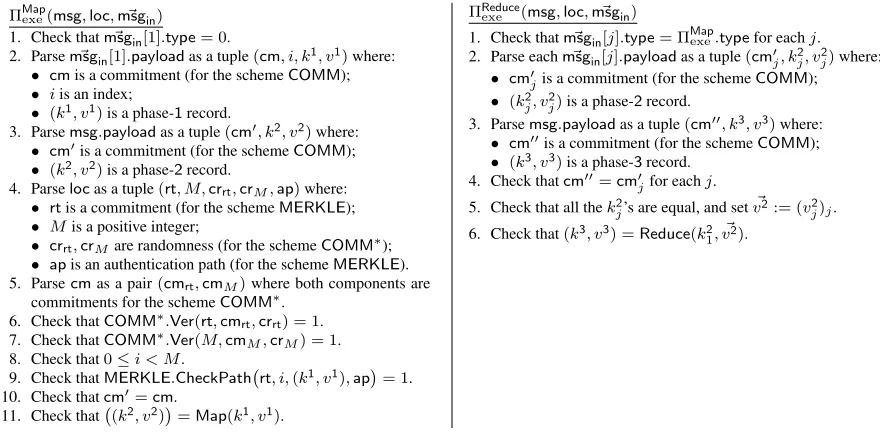
See Figure 8 for pseudocode of the new construction ofΠMap
exe andΠReduceexe ; the changes from the previous
con-struction (see Figure 7) are highlighted in blue.
We now explain how we leverage, and verify, the messages’ new information maintained byΠMap
exe andΠReduceexe . At high level, we introduce new compliance predicates for checking two main distributed sub-computations: a tree-like distributed sub-computation that aggregates information stored by output messages of mapper nodes, and another tree-like distributed sub-computation that aggregates information stored by output messages of reducer nodes. By comparing the final outputs of these two tree-like sub-computations, we can check if correct shuffling occurred. Aggregating mappers’ outputs. We first describe the tree-like distributed sub-computation that aggregates the output messages of mapper nodes. Recall that each output message of a mapper node has a payload that looks like (cm, i, k2, v2), wherecmis a commitment,iis an index, and(k2, v2)is a phase-2record.
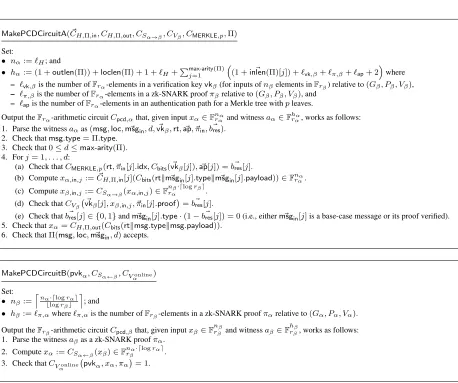
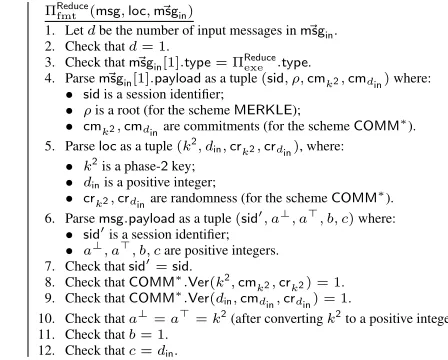
For each output message, we introduce a node to reformat the message into a new one with payload(cm, a⊥, a>, b, c) wherea⊥=a>=i,b= 1, andc= 1; we design a compliance predicate,ΠMap
fmt, to check this reformatting and add it toΠ~MR. Intuitively,a⊥anda>denote the smallest and largest index seen so far;bcounts the number of mappers; and ccounts the number of phase-2records output by mappers.9
Then, we introduce a tree of nodes to aggregate the reformatted messages into a final message, by pairwise trans-forming two input messages(cm, a⊥
1, a>1, b1, c2)and(cm, a⊥2, a>2, b2, c2)to the message(cm, a⊥1, a2>, b1+b2, c1+c2), provided thata>
1 < a
⊥
2; we design a compliance predicate,ΠMapsum, to check this aggregation and add it toΠ~MR. The final message, output by the “root node” has payload (cm,1, M, M, S), where M is the total number of mapper nodes andSis the total number of phase-2records output by all mappers. Crucially, one can see that if any output message of a mapper node is either duplicated or dropped, then it is not possible to obtain aΠ~MR-compliant
message with typeΠMap
sum.typeand payload(cm,1, M, M, S).
See Figure 11 and Figure 12 for pseudocode ofΠMapfmt andΠMapsum, respectively; in terms of efficiency, both predicates are “small” in that they have size and costOλ(1).
Aggregating reducers’ outputs. We now turn to the tree-like distributed sub-computation that aggregates output messages of reducer nodes. Recall that each output message of a reducer node has a payload that looks like(cm, k3,
ΠMapexe(msg,loc, ~msgin)
1. Parsemsg~ in[1].payloadas a phase-1record(k1, v1).
2. Parsemsg.payloadas a phase-2record(k2, v2).
3. Check that (k2, v2)
=Map(k1, v1).
ΠReduce
exe (msg,loc, ~msgin)
1. Parse eachmsg~ in[j].payloadas a phase-2record(kj2, vj2).
2. Parsemsg.payloadas a phase-3record(k3, v3).
3. Check that all thek2
j’s are equal, and setv~2:= (vj2)j
4. Check that(k3, v3) =Reduce(k2
1, ~v2).
Figure 6: Summary of the construction ofΠMapexe andΠReduceexe for “Failed attempt #1” (see Section 5.1.1).
ΠMapexe(msg,loc, ~msgin)
1. Check thatmsg~ in[1].type= 0.
2. Parsemsg~ in[1].payloadas a tuple(cm, i, k1, v1)where: • cmis a commitment (for the schemeCOMM);
• iis an index;
• (k1, v1)is a phase-1record.
3. Parsemsg.payloadas a tuple(cm0, k2, v2)where: • cm0is a commitment (for the schemeCOMM); • (k2, v2)is a phase-2record.
4. Parselocas a tuple(rt, M,crrt,crM,ap)where: • rtis a commitment (for the schemeMERKLE);
• Mis a positive integer;
• crrt,crM are randomness (for the schemeCOMM∗); • apis an authentication path (for the schemeMERKLE). 5. Parsecmas a pair(cmrt,cmM)where both components are
commitments for the schemeCOMM∗. 6. Check thatCOMM∗.Ver(rt,cmrt,crrt) = 1.
7. Check thatCOMM∗.Ver(M,cmM,crM) = 1.
8. Check that0≤i < M.
9. Check thatMERKLE.CheckPath rt, i,(k1, v1),ap
= 1. 10. Check thatcm0=cm.
11. Check that (k2, v2)
=Map(k1, v1).
ΠReduce
exe (msg,loc, ~msgin)
1. Check thatmsg~ in[j].type= Π Map
exe.typefor eachj.
2. Parse eachmsg~ in[j].payloadas a tuple(cm0j, k2j, vj2)where: • cm0jis a commitment (for the schemeCOMM);
• (k2
j, v2j)is a phase-2record.
3. Parsemsg.payloadas a tuple(cm00, k3, v3)where: • cm00is a commitment (for the schemeCOMM);
• (k3, v3)is a phase-3record.
4. Check thatcm00=cm0jfor eachj. 5. Check that all thek2
j’s are equal, and setv~2:= (vj2)j.
6. Check that(k3, v3) =Reduce(k2
1, ~v2).
Figure 7: Summary of the construction ofΠMapexe andΠReduceexe for “Failed attempt #2” (see Section 5.1.2).
ΠMapexe(msg,loc, ~msgin)
1. Check thatmsg~ in[1].type= 0.
2. Parsemsg~ in[1].payloadas a tuple(cm, i, k1, v1)where: • cmis a commitment (for the schemeCOMM);
• iis an index;
• (k1, v1)is a phase-1record.
3. Parsemsg.payloadas a tuple(cm0,i0,k2, v2)where: • cm0is a commitment (for the schemeCOMM); • i0is an index;
• (k2, v2)is a phase-2record.
4. Parselocas a tuple(rt, M,crrt,crM,ap)where: • rtis a commitment (for the schemeMERKLE);
• Mis a positive integer;
• crrt,crM are randomness (for the schemeCOMM∗); • apis an authentication path (for the schemeMERKLE). 5. Parsecmas a pair(cmrt,cmM)where both components are
commitments for the schemeCOMM∗. 6. Check thatCOMM∗.Ver(rt,cmrt,crrt) = 1.
7. Check thatCOMM∗.Ver(M,cmM,crM) = 1.
8. Check that0≤i < M.
9. Check thatMERKLE.CheckPath rt, i,(k1, v1),ap
= 1. 10. Check thatcm0=cmandi0=i.
11. Check that (k2, v2)
=Map(k1, v1).
ΠReduce
exe (msg,loc, ~msgin)
1. Check thatmsg~ in[j].type= Π Map
exe.typefor eachj.
2. Parse eachmsg~ in[j].payloadas a tuple(cm0j,i 0
j,kj2, v2j)where: • cm0
jis a commitment (for the schemeCOMM); • i0jis an index;
• (k2
j, v2j)is a phase-2record.
3. Parsemsg.payloadas a tuple(cm00, k3, v3,cm
k2,cmdin)where: • cm00is a commitment (for the schemeCOMM);
• (k3, v3)is a phase-3record;
• cmk2,cmdinare commitments (for the schemeCOMM ∗).
4. Parselocas a tuple(crk2,crdin)where:
• crk2,crdinare randomness (for the schemeCOMM ∗).
5. Check thatcm00=cm0
jfor eachj.
6. Check that thei0
jare distinct, and letdinbe their number.
7. Check that all thek2
j’s are equal, and setv~2:= (vj2)j.
8. Check thatCOMM∗.Ver(k12,cmk2,crk2) = 1.
9. Check thatCOMM∗.Ver(din,cmdin,crdin) = 1.
10. Check that(k3, v3) =Reduce(k2
1, ~v2).
Figure 8: Summary of the construction ofΠMapexe andΠReduceexe for “Our approach” (see Section 5.1.3). The text that is highlighted in blue denotes
v3,cmk2,cmdin), wherecmis a commitment (for the schemeCOMM),(k
3, v3)is a phase-3record, andcm
k2,cmdin are commitments (for the schemeCOMM∗).
Similarly (but not equal) to above, for each output message, we introduce a node to reformat the message into a new one with payload(cm, a⊥, a>, b, c)wherea⊥ = a> = k2,b = 1, andc = d
in;10 we design a compliance
predicate,ΠReduce
fmt , to check this reformatting and add it toΠ~MR. Intuitively,a
⊥anda>denote the smallest and largest phase-2keys so far;bcounts the number of reducers; andccounts the number of phase-2records received by reducers. Then, again similarly to above, we introduce a tree of nodes to aggregate the reformatted messages into a final message, by pairwise transforming two input messages(cm, a⊥
1, a
>
1, b1, c2)and(cm, a⊥2, a
>
2, b2, c2)to the message (cm, a⊥
1, a
>
2, b1+b2, c1+c2), provided that a>1 < a
⊥
2; we design a compliance predicate,Π Reduce
sum , to check this aggregation and add it toΠ~MR.
The final message, output by the “root node”, has payload (cm, k2 min, k
2
max, R, S), wherekmin2 andk 2 max are respectively the least and largest phase-2keys encountered,Ris the total number of reducer nodes, andSis the total number of phase-2records received by all reducers. Crucially, one can see that if any output message of a reducer node is either duplicated or dropped, then it is not possible to obtain a~ΠMR-compliant message with typeΠReduce
sum .type and payload(cm, k2
min, kmax2 , R, S).
See Figure 11 and Figure 12 for pseudocode ofΠReduce
fmt andΠReducesum , respectively; in terms of efficiency, both
predicates are “small” in that they have size and costOλ(1).
Consistency between aggregations. In sum, the above two tree-like distributed sub-computations result into two messages, respectively with payloads(cm,1, M, M, S)and(cm, k2
min, k2max, R, S).
We introduce a final node that compares the two messages and outputs a final message with payload(cm, R).11
Specifically, we design, and add toΠ~MR, a new compliance predicate,Π
fin, which checks that: (i)cmis the same in both messages; (ii)Sis the same in both messages; and (iii)M is the size of the data committed incm(this can be done by receiving decommitment information as part of the node’s local dataloc). These checks ensure, in particular, that the outputs of all mappers were correctly shuffled and then given as input to the reducers. See Figure 13.
Summing up. The vector Π~MR of compliance predicates is (ΠMap
exe,ΠReduceexe ,Π Map fmt,Π
Map
sum,ΠReducefmt ,ΠReducesum ,Πfin). We fix the types of these predicates to arbitrary but distinct values. Each predicate constrains the types of its input messages as follows: (1)ΠMapexe accepts only input messages with type0; (2)ΠReduceexe with typeΠMapexe.type; (3)ΠMapfmt with typeΠMap
exe.type; (4)ΠMapsum with typeΠMapexe.typeorΠ Map
fmt.type; (5)Π Reduce
fmt with typeΠ Reduce
exe .type; (6)ΠReducesum with typeΠReduceexe .typeorΠReducefmt .type; (7)Πfinwith typeΠMapexe.typeorΠ
Map
fmt.typefor the first input message, and
ΠReduceexe .typeorΠReducefmt .typefor the second input message. These constraints on message types induce a “data flow”
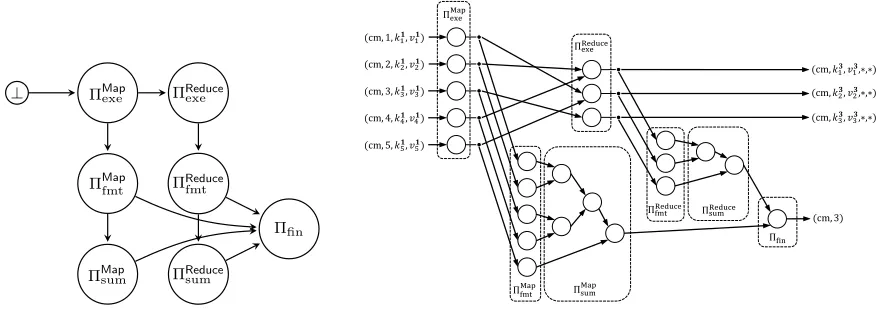
in the distributed computation that we summarized in Figure 9.
If the underlying MapReduce computation results into the outputy = (k3
1, v13), . . . ,(k3R, v
3
R)
, the distributed computation results into R + 1 outputs: (i) a message with type Πfin.type and payload (cm, R); and (ii) for i = 1, . . . , R, a message with type ΠReduce
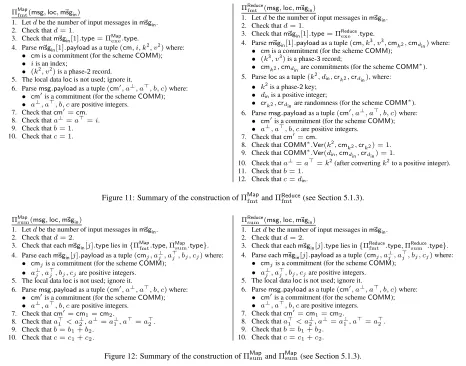
exe .type and payload (cm, k3i, v3i,∗,∗) where ∗ denotes arbitrary data. These outputs make the distributed computation (cm,y)-compatible (see Definition 5.1). Moreover, one can see that the outputs of the distributed computation can be computed by a transcript generatorTGenthat is(Map,Reduce )-complexity-preserving; see Figure 10 for a diagram of the various parts of the distributed computation conducted by TGen. This provides the completeness property claimed in Theorem 5.2.
Conversely, if a message with payload (cm, R)(and suitable type) isΠ~MR-compliant, then we can deduce the
correct execution of a MapReduce computation relative to the dataxcommitted incmand resulting in some outputy withRoutput records. Moreover, if a message with payload(cm, k3
i, vi3,∗,∗)(and suitable type) is~ΠMR-compliant, then we can deduce that(k3
i, v3i)is the i-th record ofy. In fact, one can see that any transcriptT that yields such outputs contains a witness for the instance(cm,y), which can be obtained in linear time by an extractorTExt. This provides the proof-of-knowledge property claimed in Theorem 5.2.
5.1.4 From sketch to the full construction
The above discussion omits several details. First, we have considered only the (artificial) case where each mapper outputs a single phase-2record; the case of multiple outputs necessitates further extending the predicates inΠ~MR. For
10The valuesk2andd
incan be obtained by receiving decommitment information as part of the node’s local dataloc.
⊥ ΠMapexe ΠReduceexe
ΠMapfmt ΠReduce
fmt
ΠMapsum ΠReducesum
Πfin
Figure 9: The compliance predicates constrain the types of input messages. This induces a “data flow” in the distributed computation, which can be sum-marized via the above diagram.
5 5
Π
Π Π
Π
Π
Π
Π
(cm, 3) (cm, 𝑘𝟑, 𝑣𝟑,∗,∗)
(cm, 𝑘𝟑, 𝑣𝟑,∗,∗)
(cm, 𝑘𝟑, 𝑣𝟑,∗,∗) (cm, 1, 𝑘𝟏, 𝑣𝟏)
(cm, 2, 𝑘𝟏, 𝑣𝟏)
(cm, 3, 𝑘𝟏, 𝑣𝟏)
(cm, 4, 𝑘𝟏, 𝑣𝟏)
(cm, 5, 𝑘𝟏, 𝑣𝟏)
Figure 10: Diagram of the distributed computation for a MapReduce computation with
5input records and3output records. The dashed regions show which output messages are checked by which compliance predicate. The two tree-like sub-computations in the bottom part correspond to the aggregation of mappers’ outputs (left) and the aggregation of reducers’ outputs (right).
completeness, in Appendix D we provide details on how to support the case of multiple mapper outputs, as well as on how to support the extensions mentioned in Section 2.4.3 (including multiple reducer outputs).