Impossible Differential Cryptanalysis on
Deoxys-BC-256
Alireza Mehrdad, Farokhlagha Moazami, Hadi Soleimany
Cyberspace Research Institute Shahid Beheshti University, G.C. P.O. Box 1983963113, Tehran, Iran
[email protected],f [email protected],h [email protected]
Abstract. Deoxys is a final-round candidate of the CAESAR competi-tion. Deoxys is built upon an internal tweakable block cipher Deoxys-BC, where in addition to the plaintext and key, it takes an extra non-secret input called a tweak. This paper presents the first impossible differential cryptanalysis of Deoxys-BC-256 which is used in Deoxys as an internal tweakable block cipher. First, we find a 4.5-round ID characteristic by utilizing a miss-in-the-middle-approach. We then present several crypt-analysis based upon the 4.5 rounds distinguisher against round-reduced Deoxys-BC-256 in both single-key and related-key settings. Our contribu-tions include impossible differential attacks on up to 8-round Deoxys-BC-256 in the single-key model. Our attack reaches 9 rounds in the related-key related-tweak model which has a slightly higher data complexity than the best previous results obtained by a related-key related-tweak rectangle attack presented at FSE 2018, but requires a lower memory complexity with an equal time complexity.
Keywords:CAESAR competition, Deoxys-BC, Impossible Differential Cryptanalysis, distinguisher.
1
Introduction
block cipher Deoxys-BC has two variants, each with a block size of 128 bits and a tweak size of 128 bits, but two different key lengths: 128 and 256 bits. These variants are called Deoxys-BC-256 and Deoxys-BC-384, respectively. We note that the specification of Deoxys-BC has been slightly changed during the competition. In this paper, we study the last version submitted to the CAESAR competition called Deoxys v1.41.
The security of Deoxys-BC was studied against a wide variety of cryptanal-yses by the designers and as was proved by them, the cipher is secure against several known attacks. However, impossible differential cryptanalysis was not covered by the designers in the original proposal, instead, third-party experts are encouraged to investigate the security of Deoxys-BC against impossible differ-ential cryptanalysis in different settings. The aim of this work is to evaluate the security of Deoxys-BC-256 against impossible differential cryptanalysis which is an important class of cryptanalytic techniques applicable to a wide variety of block ciphers. Impossible differential cryptanalysis was proposed by Knud-sen and independently by Biham. Impossible differential cryptanalysis exploits differential characteristic with a probability of (exactly) zero to eliminate the wrong key candidates of some key bits involved in outer rounds that lead to such impossible differences.
Previous Works and Our Contributions
Carlos Cid et al. [1], present a related-key related-tweak rectangle attack against up to the 9 rounds of Deoxys-BC-256 with a data complexity of 2117, a mem-ory complexity of 2117 states and a time complexity of 2118. They also present a related-key related-tweak cryptanalysis on a particular variant of 10-round Deoxys-BC-256 in which the key length is greater than 204 and the tweak length is less than 52. The described cryptanalysis is not applicable to the cipher with the key length of 128-bits. In addition, the proposed cryptanalysis on the 10-round Deoxys-BC-256 requires 2127.58 chosen plainetexts while the maximum permitted amount of data for a given key in the Doexys scheme is 2t−4wheret denotes the size of the tweak.
In this paper, we present several impossible differential cryptanalysis on the round-reduced variants of Deoxys-BC-256:
– First, we study the security of Deoxys-BC-256 in the related-tweak single-key model. We describe how to mount an impossible differential attack on the 8 rounds of Deoxys-BC-256 given 2118plaintext-ciphertext pairs and 2102 memories.
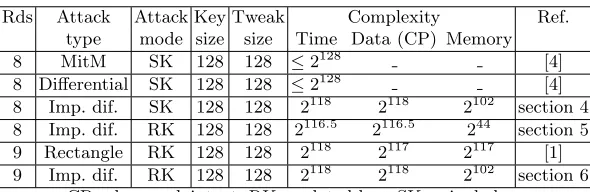
The results of our attacks compared with the previous attacks on Deoxys-BC-256 in the single-key and related-key models are summarized in Table 1. The designers presented an upper bound for an efficient related-key related-tweak differential cryptanalysis on 8 rounds of Deoxys-BC-256 without proposing a specific attack. However, our contributions include impossible differential attacks on 8-round Deoxys-BC-256 in the related-tweak single-key model. In addition, we present an impossible differential cryptanalysis on 9-round Deoxys-BC-256 in the related-key related-tweak model in which the required data is two times more than the rectangle attack while the memorey complexity is decreased by a factor of 215.
After the submission of this paper and uploaded our results in Cryptology ePrint Archive, we noticed that Jiang and Jin presented a single-key impossible differential cryptanalysis on 8-Round Deoxys-BC-256 in [2]. In addition, during the preparation the final version of this paper Zong et. al published a key-recovery attack on 10 rounds of Deoxys-BC-256 which is applicable only when the key size ≥174 and the tweak size≤82 [3]. However, the hpermutation is not considered correctly in both published papers and it should be interpreted the other way. So the results are not valid. In addition, our paper includes more results in both single-key and related-key settings.
Table 1.Results of attacks on Deoxys-BC-256.
Rds Attack Attack Key Tweak Complexity Ref. type mode size size Time Data (CP) Memory
8 MitM SK 128 128 ≤2128 [4]
8 Differential SK 128 128 ≤2128 [4] 8 Imp. dif. SK 128 128 2118 2118 2102 section 4 8 Imp. dif. RK 128 128 2116.5 2116.5 244 section 5 9 Rectangle RK 128 128 2118 2117 2117 [1] 9 Imp. dif. RK 128 128 2118 2118 2102 section 6
CP=chosen plaintext; RK= related-key; SK= single-key.
Outline of the Paper
2
Description of Deoxys and Deoxys-BC
In this section, we describe Deoxys and Deoxys-BC-256. The section starts with a short description of Deoxys authenticated encryption. This is followed by a specification of the internal tweakable block cipher Deoxys-BC-256. We assume the reader is familiar with the concept of tweaks and keys for block ciphers and also the standard block cipher AES; otherwise, we refer to [5] and [6] respectively for the full specification details.
2.1 Deoxys Authenticated Encryption Scheme
The designers of Deoxys proposed two operating modes, called Deoxys-I and Deoxys-II. The former mode, Deoxys-I, is a nonce-based scheme which is proven to be secure against nonce-respecting adversaries. The latter mode, Deoxys-II, is a nonce-based AEAD scheme that provides security in the nonce misuse model in which the adversary can query different plaintexts while keeping the nonce constant. In this section, we only present a brief description of Deoxys-I. We refer the readers to the original proposal [4] for more details.
The encryption process, in the nonce-respecting mode with no padding is described in Table 2.
Table 2. Encryption algorithm when we have no padding to associated data and message.
Processing associated data 1 divide A to 128-bit blocksA1 toAla
2 Auth←0
3 for i = 0 tola−1 do
4 Auth←Auth⊕EK(0010||i, Ai+1) 5 end
Message encryption and tag generation 6 divide M to 128-bit blocksM1 toMl
7 Checksum←0 8 for j = 0 tol−1 do
9 Checksum←Checksum⊕Mj
10Cj←EK(0000||N||j, Mj+1) 11 end
12 Final←EK(0001||N||l, Checksum)
13 tag←Final⊕Auth
2.2 Deoxys-BC-256
framework is a general method to concatenate the tweak and key as a unified state called tweakey. Deoxys-BC has two variants, each with a block size of 128 bits, but a different tweakey size of 128 and 256 bits which are called Deoxys-BC-256 and Deoxys-BC-384, respectively. Since the aim of this paper is to study the security of to Deoxys-BC-256 against impossible differential cryptanalysis, we only describe Deoxys-BC-256 in this section.
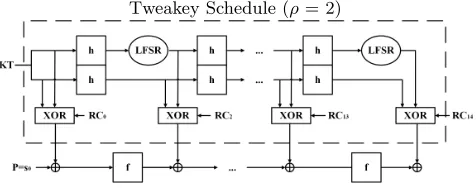
Deoxys-BC-256 has 14 rounds. The round function reuses the existing com-ponents of AES, with the main differences with the tweakeys that are used every round as the round subkeys. One round of the Deoxys-BC (f-function in Fig 1) consists of the following four transformations:
– AddRoundTweakey – xor the subtweakey and internal state.
– SubBytes – Apply the AES S-box to the 16 bytes of the internal state. – ShiftRows – Rotatei-th row left byi positions, wherei= (0,1,2,3). – MixColumns – Multiply the four input bytes in each column by the MDS
matrix of AES.
To achieve the ciphertext, a final AddRoundTweakey operation is performed after the last round.
Tweakey Schedule (ρ= 2)
Fig. 1.TWEAKEY framework for Deoxys-BC.
Definition of the subtweakeys.
LetKTbe the concatenation of key and tweak. In Deoxys-BC-256, we denote the most significant 128-bit of KT by T K1
0 and the least significant 128-bit of
KT by T K2
0. For Deoxys-BC-256, a subtweakey ST Ki is defined as ST Ki =
T K1
i ⊕T Ki2⊕RCi where T Ki1 is the most significant 128-bit and T Ki2 is the
least significant 128-bit of the tweakey of roundi.
The 128-bit wordsT Kij+1 produces recursively fromT Kij by a byte permu-tationhand anLF SRas follows:
T Ki1+1=h(T Ki1), T Ki2+1=h(LF SR(T Ki2)).
where the byte permutationh, is defined as:
0 1 2 3 4 5 6 7 8 9 10 11 12 13 14 15 1 6 11 12 5 10 15 0 9 14 3 4 13 2 7 8
in which we use the byte indexing as follows:
0 4 8 12 1 5 9 13 2 6 10 14 3 7 11 15
.
Also, theLF SRfunction is defined as follows:
LF SR:
(x7kx6kx5kx4kx3kx2kx1k x0 ) ↓
(x6kx5kx4kx3kx2kx1kx0kx7⊕x5)
.
2.3 Notations
We use the following notations throughout the paper: – xI
i: The input of the round i.
– xS
i: The SubBytes output of the round i.
– xR
i : The ShiftRows output of the round i.
– xM
i : The MixColumns output of the round i.
– xOi : The AddRoundTweakey output of the round i. – xi,col(j): The j-th column ofxi, where j= (0,1,2,3).
– ST Ki: The Subtweakey of the round i.
– Ki: The Subkey of the round i.
– Ti: The tweak of the round i.
– RCi: The key schedule round constant of round i.
– T Ri: The result of xoring ofTi andRCi.
Also, we use the following enumeration [0,1,2,· · ·,15]. By this enumeration,
x[l] represents thel-th byte of thex.
Since MixColumns and AddRoundTweakey operations are linear, they can be interchanged, that is, we can first do AddRoundTweakey and then MixColumns. Hence, we first begin by xoring the internal state with a corresponding subkey and after that use the MixColumns and finally, xor the obtained value with round tweak andRCi. We indicate the corresponding subkey by wi =M C−1(ki). Let
xAwi represent the result of the xoring ofxRi andwi of the round i.
3
4.5-round Impossible Differential Characteristic
By the subtweakey schedule, one can easily check that if4ST Ki[15] is an
active byte then the structure of the subtweakey of other rounds is like Fig 2. Since the difference of subtweakeys is only due to the difference between tweaks and keys, the difference values of gray bytes can be zero in special cases.
That is to say, after eight rounds, the subtweakeys difference, is just like the arrangement of first round difference(4ST Ki=4ST Ki+8). This repetition may be efficient for some future probable attack.
Fig. 2.Subtweakeys difference Schedule used for impossible differential characteristic.
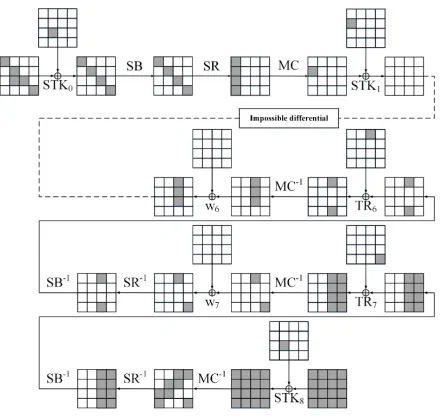
Fig 3 shows an illustration of an impossible differential of 4.5-round Deoxys. The gray boxes denote the (active) bytes in which the pair differs while the white boxes refer to the equal (passive) bytes in the pair. The black boxes refer to the byte that can be active or passive.
In forward direction, we use a tweakey difference with one non-zero difference byte4ST Ki[0]6= 0 that leads to one active byte,xOi [0]. According to the process
of producing subtweakey, we know 4ST Ki[0] 6= 0 leads to4ST Ki+1[7] 6= 0. That leads to the five active bytes, xOi+1[0,1,2,3,7]. This process always gives eleven active bytes,xOi+2[0,1,2,3,4,5,6,7,12,13,15], at the end of round i+2.
In backward direction, three active bytes, xR
i+4[8,9,10] or xRi+4[8,9,11] or
xR
i+4[8,10,11] afford one zero difference column in xRi+3. This passive column brings one zero difference byte at each column of xI
i+3 which contradicts with 4xO
i+2,col(0,1)6= 0.
Thus, according to this 4.5-round impossible differential, a plaintext pair which is equal at all bytes, after 4.5-round Deoxys encryption cannot convert to the ciphertext pair which is equal at all bytes except three bytes: [8,9,10] or [8,9,11] or [8,10,11].
We will use this 4.5-round impossible characteristic for both the single key mode and related key mode. What’s important is that in single key mode, the subtweakey differences are only caused by the difference of the tweaks (4ST Ki=
4Ti), but in the case of the related key attack, the subtweakey differences are
Fig. 3.4.5-round impossible differential characteristic of Deoxys
4
8-round Single-Key Impossible Differential Attack
We achieve a single key impossible differential cryptanalysis of 8-round Deoxys, using impossible differential characteristic of 4.5-round Deoxys as shown in Fig 3. We extend our impossible differential characteristic by one round at the begin-ning and 2.5-round at the end. Fig 4 shows this attack.
In this attack, we use an improvement that is suggested by Lu et al. [14] and is based on the following observation.
Observation I: Given a random pair (4X,4Y) as input and output dif-ferences of the AES S-box, there is on average one pair of (X, X0), such that
S(X)⊕S(X0) =4Y.
Before we explain details of the attack, we define the concept ofstructure
andset of plaintexts.
A structureLconsists of 240plaintextsP
i which all of them are different in
the bytesPi[0,5,6,10,15] and equal at other bytes. Each 232plaintextsPiof one
structure that have equal 6th byte value of plaintextsPi, form a setS. The value
of Ti
0[6] is equal to Pi[6], so a dedicated tweak T0i[6] (and Pi[6]) is assigned to
Fig. 4.8-round single key impossible differential trail
Also, we can choose 228
different sets from a structure to be sure that the 6th byte is active too. Totally, we can build about 228
×232×(28−1)4≈279pairs per structure, that have five active bytes in positions [0,5,6,10,15].
The attack procedure has two phases, online phase and precomputation (of-fline phase). Algorithm 1 illustrates a high level of the attack procedure. The details of the attack is as follows.
4.1 Precomputation Phase
The number of pairs (xM
1,col(0), x
0M
1,col(0)) that are different only in byte position
xM1 [1] and the difference is equal to the difference of two tweaksT1[1] andT10[1] (4xM1 [1] =4T1[1]6= 0), is equal to 28×(28−1)×(28)3≈240. For all these 240 pairs, compute four bytes [0, 5, 10, 15] ofxI
1 andx01I:
xI
1[0,5,10,15] =SB−1◦SR−1◦M C−1(xM1,col(0)) and
x0I
1[0,5,10,15] =SB−1◦SR−1◦M C−1(x01M,col(0)). Then, store the pairs (xI
1, x01I) in a hash table Hp indexed by (4xI1 || 4T1[1]). By considering the fact that 4T0[6] = T0[6]⊕T00[6] = 4T1[1] the value of (4xI
1 || 4T1[1]) is equal to (4xI1 || 4T0[6]). These parameters can take 240 different values (232 distinct values for 4xI
1 and 28 unequal values for4T0[6]). Each value represents a row in theHp. Since, we have 240pairs (xM1 , x01M), then on averageHp has one pair (xI1, x01I) in each row; where first parameter specifies the difference4xI
Algorithm 18-round Single-Key Attack on Deoxys-BC
Precomputation Phasemake a listHpof 240valid first round constructions.
Online Phase
for all 2118 chosen plaintextsdo
keep corresponding ciphertexts which have only two active last columnsxI8,col(2,3). for all 28 possible values of4xAw7 [15] that leads to4x
R
8[3,6,9,12]do computew8[3,6,9,12].
for all28possible values of4xAw7 [8] that leads to4xR8[2,5,8,15]do computew8[2,5,8,15].
for all 3×255 possible values of4xAw6,col(2) that leads to4x
R
7[8,15]do computew7[8,15].
for all 237remaining pairsdo
discard eachST K0[0,5,10,15] that is inHp.
end for end for end for end for end for
Do exhaustive search for all remaining subkey bits.
4.2 Online Phase
1. We take 2n structures, which produce about 2n×279= 2n+79possible plain-text pairs. Then we ask for the corresponding cipherplain-texts:Ci=ET
i
K(Pi). The
difference of last round subtweakey 4ST K8 is only dependent on the dif-ference of tweaks4T8 that we know. So we can invert the final subtweakey xor and mixcolumn and compute 4xR
8 = M C−1◦(4C⊕ 4ST K8). We just select the pairs that corresponding to 4xR
8, have eight active bytes [2,3,5,6,8,9,12,15]. Since we must have eight equal bytes 4xR
8 in posi-tions [0,1,4,7,10,11,13,14], the expected number of remaining pairs is 2n+79× 2−64= 2n+15.
2. Since we know the value of (C, C0) and 4ST K8, the difference4xS8,col(3) can be determined. Thus, by knowing the value of4xAw7,col(3), we can obtain the values ofxS
8,col(3)andx
0S
8,col(3)according to observationI. Since we know 4xAw7 [15] 6= 0, we have only 28−1 different possible values of 4xAw7,col(3). Therefore, this step can be done as follows:
Initialize 232 empty lists, for each guess ofw
8[3,6,9,12].
For each remaining pair (C, C0), and for each possible value of 4xAw
7 [15], calculate the keyw8[3,6,9,12] that leads the pair (C, C0) to4xAw7,col(3), and add this pair to the list related to the guessed key.
3. Similar to step 2, we initialize 232empty lists for each guess ofw
8[2,5,8,15]. For each remaining pair (C, C0), and for each possible value of 4xAw
7 [8], calculate the keyw8[2,5,8,15] that leads the pair (C, C0) to4xAw7,col(2), and add this pair to the list related to the guessed key.
Due to observationI, for each pair and distinction guess, on average we have one suggested key. Since these 2n−9×255≈2n−1suggestions are distributed over all 232 possible keys, we have about 2n−1/232 = 2n−33 pairs for each guess ofw8[2,5,8,15].
4. We use Lu et al. improvement again. Since we want 4xAw
6,col(2) to have an active byte in the 8th position and two of three other bytes, there are 3×2553 possible differences and only 3×255 of these differences lead to a difference of4xM
6,col(2) where only two bytes 4x
M
6 [8,11] are active. So, for each pair and each guess ofw7[8,15] we must check whether4xM6,col(2)belongs to these 3×255 differences. According to observationI, when we have4xAw
7 [8,15] as output and4xM
6 [8,11] as input difference of the S-box, we can compute the values ofxM
6 [8,11] andx06M[8,11] and therefore determine the value of
w7[8,15]. At this step, we have about 3×2n−25candidates forw7[8,15]. From the 2n−33 pairs and the 3×255 differences which are distributed over the 216 possible values ofw
7[8,15]. Consequently, for a given guess ofw7[8,15], we have about 3×2n−25/216= 3×2n−41 pairs which for each guess of the considered bytes in w8 and w7, lead the input difference to the impossible differential.
5. First we create a list A of all 232 4-byte keys ST K
0[0,5,10,15] and for all remaining pairs (Pi, Pj), we compute four bytes [0, 5, 10, 15] ofxI1 andx01I:
xI
1=Pi[0,5,10,15]⊕ST K0[0,5,10,15],
x0I
1 =Pj[0,5,10,15]⊕ST K0[0,5,10,15].
Note that theST K0 only has one non-zero difference byte4ST K0[6]6= 0, and4ST K0[6] =4P[6].
From precomputation, we know on averageHphas one pair (xI1, x0
I
1) in each row. For each tuple (xI1, x01I,4T0[6]) which is obtained at this stage, we discard the P⊕xI1 from the related indexed row of the hash table. Since with respect to the precomputation (offline phase), we are sure that such a a key leads to an impossible differential, resulting in a wrong key.
Finally, ifA is not empty, output the remaining value(s) in A with corre-sponding key guess ofw7[8,15] andw8[2,3,5,6,8,9,12,15].
4.3 Complexity analysis
– Data Complexity
We know 2−(cin+cout) = 2−32×2−48×3×2−8 ≈ 2−86.4 and we guessed
32-bit ofkinand (64 + 16)-bit ofKout. So, we can easily compute the data
complexityD:
Sincen = 78 then 278×240 = 2118 chosen plaintexts, are required for the attack.
– Time Complexity
1. The precomputationrequires about 2×240×4/16 = 239 one-round decryptions, which is equal to 239/8 = 236 8-round decryptions.
2. Since we neednis equal to 78, step 1 requires 2(78+40) = 2118 8-round encryptions.
3. Based on observationI,step 2can be done by a look-up table. So, this step needs about 255×278+15≈2101 memory accesses.
4. We considered 255 differences of the 32-bit key guessesw8[3,6,9,12] and 255 differences for 32-bit guesses of keyw8[2,5,8,15]. Therefore,Step 3 requires about 255×255×278+15≈2109memory accesses.
5. For each 264 guesses of w8[2,3,5,6,8,9,12,15], we need 278−33×3× 255 ≈278−23.4 memory accesses in a lookup table to achieve the guess forw7[8,15] from the differences 4x
M,col(2)
6 . So,step 4requires about 264×278−23.4= 2118.6 memory accesses.
6. For each remaining pair,step 5is repeated 280 times (for each possible values of w7 and w8), and on average for each repetition, we need to access to hash tableHpand listA. So, this step requires about 2×280× 278−39.4= 2119.6memory accesses.
7. We already have obtained eight bytes of the key w8 and an exhaus-tive search is needed to achieve the remaining key bytes which cost 28×8= 264encryption. But the time complexity of this step is negligible compared to the other steps.
As a rule of thumb method adopted in most of the works (e.g look at [12]), we assume the time complexity of 16 memory access equals to the time complexity of one round, since in each round the Sbox is called 16 times. Consequently, the 8 rounds are at least equal to 16×8 = 27memory accesses. So we can assume that each memory access is equivalent to 1/(16×8) = 2−7 8-round encryption.
Totally, time complexity is about (236+ 2118)Enc+ (2101+ 2109+ 2118.6+ 2119.6)M A≈(2118+ 2120.2×2−7)Enc≈2118Enc.
– Memory Complexity
Theprecomputation phase needs about 240×(4 + 4 + 1) ≈ 243.2 bytes of memory for storing xI1[0,5,10,15], xI1[0,5,10,15] and 4T0[6]. With the simple approach, we need 28×(8+2+4) bytes to store the deleted values of
5
8-round Related-Tweakey Impossible Differential
Attack
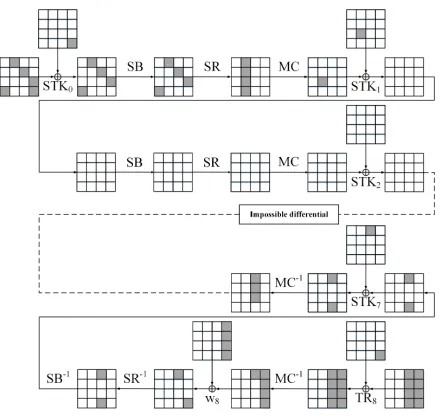
In this section, we present a related key impossible differential cryptanalysis of 8-round Deoxys by extending our impossible differential characteristic by two rounds at the beginning and 1.5-round at the end. This attack on the reduced 8-round Deoxys requires about 2116.5 chosen plaintexts, 248 words of memory and 2116.5 8-round Deoxys encryptions. Fig 5 illustrates this attack.
For our analysis, we consider a situation in which the value of the key differ-ence in round 2 is exactly equal to the value of the tweak differdiffer-ence in the second round (4K2[1] = 4T2[1]). In other words, we assume that two users encrypt data with two different keys, and that these two keys have a non-zero difference of one byte,4K0[15]. In this case, we select the tweaks in a way that the value of the4K2[1] exactly matches the value of the4T2[1]. Considering this condition, the definition of structure and set of plaintexts is a little different from what described in section 4.
A structureLconsists of 240 plaintextsPi all of which are different in bytes
Pi[3,4,9,14,15] and equal at other bytes. Each 232plaintextsPiof one structure
that have equal 15th byte value of plaintexts Pi, form a set S. The value of
ST Ki
0[15] is equal toPi[15], so a dedicatedST K0i[15] (andPi[15]) is assigned to
each set. Clearly, there exist 28 sets in each structure. In our attack procedure, we need the pair of plaintext-tweakeys ((P, ST K),(P0, ST K0)) such thatP⊕P0
has an active byte in positions [3,4,9,14,15] and P[15]⊕P0[15] = ST K[15]⊕
ST K0[15]. We can build about 232×(28−1)4≈264distinct pairs that have four active bytes [3,4,9,14]. Also, we can choose 228
different sets from a structure to be sure that the 15th byte is active too. Totally, we can build about 228
× 232×(28−1)4≈279pairs per structure, that have five active bytes in positions [3,4,9,14,15].
5.1 Attack Procedure
Algorithm 2 illustrates a high level of the attack procedure. In what follows, we describe the attack procedure in details:
1. We take 2n ×279 = 2n+79 possible plaintext pairs. Then we ask for the corresponding ciphertexts:Ci =ET
i
Ki(Pi). We just select the pairs, so that
corresponding pairs (xM
8 , x08M), have just eight active bytes in the last two columns. So the expected number of remaining pairs is 2n+79×2−64= 2n+15. 2. For all pairs (xM
8 , x08M) that passed step 1, we compute4xAw8,col(2,3):4x
Aw
8 =
M C−1◦(4xM
8 ).
We keep pairs where only 4xAw
8 [8,12,13,14,15] are active bytes and also the differences of bytes in the positions 4xAw
8 [12,13,14] are equal to the differences of bytes in the positions 4w8[12,13,14]. Since we must have three zero-difference bytes,4xAw
8 [9,10,11] = 0 and three special difference bytes4xAw
Fig. 5.8-round related key impossible differential trail
Algorithm 28-round Related-Key Attack on Deoxys-BC for all K2[1] =T2[1] &K20[1] =T20[1]do
for all 2116.5 chosen plaintextsdo
keep corresponding ciphertexts which have only two active last columns. for all 291.5remaining ciphertext pairsdo
check if only two bytesxR
8[8,15] are active. for all 216 possible values ofw8[8,15]do
computexO
7,col(2).
for all 243.5remaining pairsdo check ifxR
7,col(2)have only one passive byte atx
R
7[9] orxR7[10] orxR7[11]. for all remaining pairsdo
discard eachST K0[3,4,9,14] leads to passivexO
1. end for
end for end for end for end for end for
3. We guess the 16-bit values of w8[8,15]. Since we know the relation of sub-tweakeys, we can computew08[15] easily. Then for each pairs (C, w8),(C0, w80) that has passed step 2, compute four bytes ofxO
7,col(2) andx
0O
7,col(2):
xO7 =SB−1◦SR−1◦(w8⊕(M C−1◦(T R8⊕C))),
x07O=SB−1◦SR−1◦(w08⊕(M C−1◦(T R08⊕C0))).
From step 1 we are sure that only two bytes4xO7[8,11] are active. So we have no filtering here.
4. Consider the value of4ST K7[8], check that4xR7,col(2)has three active bytes in positions [8,9,11] or [8,9,11] or [8,10,11]. At the end of this step, the expected number of remaining pairs is about 2n−33×2−8×3≈2n−39.4. 5. We guess 32-bit values of ST K0[3,4,9,14] and for all remaining pairs from
the above steps, we compute four-bytesxM1,col(1) andx01M,col(1):
xM
1 =M C◦SR◦SB◦(P⊕ST K0),
x0M
1 =M C◦SR◦SB◦(P0⊕ST K00). We only consider the pairs that 4xM
1,col(1) = 4ST K1,col(1). So, we only choose pairs in which4xM
1 [6] =4ST K1[6] and 4xM1 [4,5,7] = 0. In other word, we only choose pairs that at the end of round one, we are sure that there is no active byte at 4xO
1,col(1). Since, we must have four zero-difference bytes 4xO1,col(1) = 0, the number of remaining pairs is about 2n−39.4×(2−8)4= 2n−71.4.
Since we initially considered the difference4K2[1] equal to4T2[1], then we are sure that the differential characteristic passes the forward path correctly. The keys that pass all above steps and lead such a difference (that is im-possible), are wrong keys and must be discarded. We remove such a keyK0 for each 16-bit guess of output corresponding keyw8. Since only one of the keys is the correct key, if we choose proper data complexity and perform the above operation for all remaining pairs of step 4, we can be sure we have reached the correct key.
5.2 Complexity Analysis
– Data Complexity
The bit conditions are about 2−(cin+cout)= 2−32×2−48×3×2−8≈2−86.4
and|kinSkout |is equal to 32 + 16 = 48 so the data complexityDis:
(1−2−(86.4))D<1/248→e−(2−86.4×D)
<1/248→ →D≈291.5= 2n+15→n= 76.5.
Sincen= 76.5 then 276.5×240= 2116.5 chosen plaintexts, are required for the attack.
– Time Complexity
1. Step 1requires 2(76.5+40)= 2116.5 8-round encryptions.
3. Step 5 needs about 2×216×232×276.5−39.4 = 286.1 one-round 4/16 encryptions, which is equal to 286.1×4/16×1/8 = 281.18-round encryp-tions.
Consequently , total complexity is about (2116.5+255.5+281.1)Enc≈2116.5Enc. – Memory Complexity
For storing the list of discard keys, we need 28×(2+4) = 248 bytes of mem-ory for storing the deleted values ofw8[8,15] andK0[3,4,9,14]. Therefore, memory complexity is 248bytes or 244 states.
6
9-round Related-Tweakey Impossible Differential
Attack
Similar to the attack that was applied to the 8-round Deoxys, we can analyse the 9-round Deoxys, using impossible differential characteristic of 4.5-round Deoxys as shown in Fig 3. We extend our impossible differential by two rounds at the beginning and 2.5-round at the end. Fig 6 shows this attack. In this section, we use observationI again.
The attack procedure has two phases, online phase and precomputation (of-fline phase). Algorithm 3 illustrates a high level of the attack procedure. The details of the attack are as follows.
Algorithm 39-round Related-Key Attack on Deoxys-BC
Precomputation Phasemake a listHpof 240valid first round constructions.
Online Phase
for all K2[1] =T2[1] &K20[1] =T
0
2[1]do for all 2118 chosen plaintextsdo
keep corresponding ciphertexts which have only two active last columns xI
9,col(2,3).
for all 28 possible values of4xAw
8 [15] that leads to4xR9[3,6,9,12]do computew9[3,6,9,12].
for all 28 possible values of4xAw
8 [8] that leads to4xR9[2,5,8,15]do computew9[2,5,8,15].
for all 3×255 possible values of4xAw
7,col(2) that leads to4x
R
8[8,15]do computew8[8,15].
for all 237remaining pairsdo
discard eachST K0[3,4,9,14] that is inHp.
end for end for end for end for end for end for
Do exhaustive search for all remaining subkey bits.
6.1 Precomputation Phase
The number of pairs (xM
1,col(1), x0
M
1,col(1)) that are different only in byte position
xM
1 [6] and the difference is equal to the difference of two subtweakeysST K1[6] andST K10[6] (4xM
1 [6] =4ST K1[6]6= 0), is equal to 28×(28−1)×(28)3≈240. For all these 240 pairs, compute four bytes [0, 5, 10, 15] ofxI
1 andx01I:
xI1[3,4,9,14] =SB−1◦SR−1◦M C−1(xM1,col(1)) and
x0I
1[3,4,9,14] =SB−1◦SR−1◦M C−1(x01M,col(1)).
Since the 4ST K1[6] leads to a special 4ST K0[15], we can store the pairs (xI
1, x01I) in a hash tableHp indexed by (4xI1|| 4ST K0[15]). These parameters can take 240 different values (232 distinct values for4xI
1 and 28unequal values for 4ST K0[15]). Each value represents a row inHp. Since, we have 240 pairs
(xM
1 , x01M), then on averageHp has one pair (xI1, x01I) in each row. In which the first parameter specifies the value of4xI
6.2 Online Phase
1. We take 2n structures, which produce about 2n×279= 2n+79possible plain-text pairs. Then we ask for the corresponding cipherplain-texts:Ci = ET
i
K(Pi).
We can invert the final subtweaky xor and compute4xR
9 =M C−1◦(4C⊕ 4ST K9). We just select the pairs that corresponding 4xR9, have eight ac-tive bytes [2,3,5,6,8,9,12,15]. Since we must have eight equal bytes4xR
9 in positions [0,1,4,7,10,11,13,14], the expected number of remaining pairs is 2n+79×2−64= 2n+15.
2. Since we know the value of (C, C0) and 4ST K9, the difference4xS9,col(3) can be determined. Thus, by knowing the value of4xAw
8,col(3), we can obtain the values ofxS
9,col(3) andx
0S
9,col(3)according to observationI. Since we have 28−1 different values of4xR
8[15], because of fix subkey difference notice to the tweak difference, finally we have only 28−1 different values of4xAw
8,col(3). Therefore, this step can be done as follows:
Initialize 232empty lists, for each guess ofw
9[3,6,9,12] we can easily obtain the value ofw90[3,6,9,12], which is different fromw9[3,6,9,12] only atw9[6] due to the subtweakey difference schedule.
For each remaining pair (C, C0), and for each possible value of 4xAw
8,col(3), calculate the keyw9[3,6,9,12] that leads the pair (C, C0) to 4xAw8,col(3) and add this pair to the list related to the guessed key.
Due to observation I, for each pair and distinction guess, on average we have one key suggestion. Since these 2n+15 ×28 = 2n+23 suggestions are distributed over all 232possible keys, we have about 2n+23/232= 2n−9pairs for each guess ofw9[3,6,9,12].
3. Similar to step 2, we initialize 232empty lists for each guess ofw
9[2,5,8,15]. For each remaining pair (C, C0), and for each possible value of 4xAw
8 [8], calculate the keyw9[2,5,8,15] that leads the pair (C, C0) to4xAw8,col(2), and add this pair to the list related to the guessed key.
Due to observationI, for each pair and distinction guess, on average we have one suggested key. Since these 2n−9×255≈2n−1suggestions are distributed over all 232 possible keys, we have about 2n−1/232 = 2n−33 pairs for each guess ofw9[2,5,8,15].
4. We use Lu et al. improvement again. Since we want 4xR
7,col(2) to have an active byte in the 8th position and two of other three bytes and also the subkey difference is fix, there are 3×2553 possible differences for4xAw7,col(2)
and only 3×2553/2552 = 3×255 of these differences lead to a difference 4xM7,col(2) so that only two bytes4xM7 [8,11] are active.
So, for each pair and each guess ofw8[8,15] we must check whether4xM7,col(2) belongs to these 3×255 differences. According to observationI, when we have 4xR
8[8,15] as output and4xM7 [8,11] as input difference of the S-box, we can compute the values ofxM
7 [8,11] and x07M[8,11] and therefore determine the value ofw8[8,15]. At this step, we have about 3×255×2−33 = 3×2n−25 candidates for w8[8,15]. From the 2n−33 pairs and the 3×255 differences which are distributed over the 216possible values ofw
for a given guess ofw8[8,15], we have about 3×2n−25/216= 3×2n−41pairs which for each guess of the considered bytes inw9 and w8, lead the input difference to the impossible differential.
5. First we create a list A of all 232 4-byte keys ST K0[3,4,9,14] and for all remaining pairs (Pi, Pj), we compute four bytes [3, 4, 9, 14] ofxI1 andx01I:
xI1=Pi[3,4,9,14]⊕ST K0[3,4,9,14],
x01I =Pj[3,4,9,14]⊕ST K0[3,4,9,14].
Note that theST K0only has one non-zero difference byte4ST K0[15]6= 0, which4ST K0[15] =4P[15].
From precomputation, we know on averageHphas one pair (xI1, x01I) in each row. For each tuple (xI
1, x01I,4ST K0[15]) which is obtained at this stage, we discard the P⊕xI
1 from the related indexed row of the hash table. Since with respect to the precomputation (offline phase), we are sure that such a key leads to the impossible differential, resulting in a wrong key.
Since we initially considered the difference 4K2[1] to be equal to 4T2[1], then we are sure that the differential characteristic passes the forward path correctly.
Finally, ifA is not empty, output the remaining value(s) in A with corre-sponding key guess ofw8[8,15] andw9[2,3,5,6,8,9,12,15].
6.3 Complexity analysis
– Data Complexity
The data complexityD is:
(1−2−(86.4))D<1/2112→e−(2−86.4×D)
<1/2112→ →D≈293= 2n+15→n= 78.
Where 2−(cin+cout) = 2−32×2−48×3×2−8 ≈2−86.4 and | k
inSkout | is
equal to 32 + 64 + 16 = 112. Since n = 78 then 278×240 = 2118 chosen plaintexts, are required for the attack.
– Time Complexity
1. The precomputationrequires about 2×240×4/16 = 239 one-round decryptions, which is equal to 239/9≈235.99-round decryptions. 2. Sincenwas considered to be 78,step 1requires 2(78+40)= 21189-round
encryptions.
3. Based on Lu et al. method,step 2can be done by a look-up table. So, this step needs about 255×278+15≈2101memory accesses.
4. Step 3requires about 255×255×278+15≈2109memory accesses. 5. For each 264 guesses of w9[2,3,5,6,8,9,12,15], we need 278−33×3×
255 ≈278−23.4 memory accesses in a lookup table to achieve the guess forw8[8,15] from the differences 4x
M,col(2)
7 . So,step 4requires about 264×278−23.4= 2118.6 memory accesses.
7. Exhaustive searchis negligible.
As it is mentioned before in Sec 4, the time complexity of 9 rounds is equal to at least 16×9 memory access. So we can estimate each memory access as 1/(16×9)≈2−7 9-round encryption.
Totally, time complexity is about (235.9+ 2118)Enc+ (2101+ 2109+ 2118.6+ 2119.6)M A≈(2118+ 2120.2×2−7)Enc≈2118Enc.
– Memory Complexity
Theprecomputationphase needs about 240×(4 + 4 + 1)≈243.2 bytes of memory for storingxI1[3,4,9,14],xI1[3,4,9,14] and4ST K0[15]. we apply the attack individually for each guess of the key and for the remaining bytes of each guess that is not discarded, perform an exhaustive search. So, we store about 2n+31 = 2109 suggestions that remain after Step 2. Each suggestion consists of one pair. So, the memory complexity of the attack is about 243.2+ 2114≈2114 bytes or 2110states.
7
Conclusion
This paper describes several impossible differential cryptanalysis on the round-reduced variants of Deoxys-BC-256. As a possible direction for future research, one can investigate the security of Deoxys-BC-256 against impossible differen-tial by considering a beyond full-codebook scenario, since the tweak in Deoxys-BC can provide extra plaintext-ciphertext pairs in contradiction to the classical model.
This paper describes several impossible differential cryptanalysis on the round-reduced variants of Deoxys-BC-256. This work presents the first third-party cryptanalysis of the tweakable block cipher Deoxys-BC-256 in the single-key model. We also propose impossible differential attacks up to the 9-round Deoxys-BC-256 in the related-tweak related-key model which has a lower memory com-plexity than the best previous attack.
The cryptanalysis presented in this paper cannot be exploited to mount a key-recovery attack on Deoxys-II authenticated encryption scheme. However, as it is discussed in Section 6 of [1] the results can be applied on the Deoxys-I authenticated encryption.
As a possible direction for future research, one can investigate the security of Deoxys-BC-256 against impossible differential by considering a beyond full-codebook scenario, since the tweak in Deoxys-BC can provide extra plaintext-ciphertext pairs in contradiction to the classical model.
8
Acknowledgement
References
1. C. Cid, T. Huang, T. Peyrin, Y. Sasaki, and L. Song, “A security analysis of De-oxys and its internal tweakable block ciphers”, IACR Transactions on Symmetric Cryptology, 2017(3):73107, 2017.
2. Z. Jiang and C. Jin, “Impossible Differential Cryptanalysis of 8-Round Deoxys-BC-256”, IEEE Access, Vol. 6, pp. 8890–8895, 2018.
3. R. Zong, X. Dong, X. Wang, “Related-Tweakey Impossible Differential Attack on Reduced-Round Deoxys-BC-256”, SCIENCE CHINA Information Sciences. 4. J. Jean, I. Nikolic, T. Peyrin, and Y. Seurin, “Deoxys v1.41”, Submitted to
CAE-SAR, October 2016.
5. J. Jean, I. Nikoli´c, and T. Peyrin, “Tweaks and Keys for Block Ciphers : the TWEAKEY Framework”, Advances in Cryptology - ASIACRYPT 2014 - 20th Inter-national Conference on the Theory and Application of Cryptology and Information Security, Kaoshiung, Taiwan, R.O.C., December 7-11, 2014, Proceedings, Part II, volume 8874 of Lecture Notes in Computer Science, pages 274288. Springer, 2014. 6. J. Daemen, V. Rijmen, “AES Proposal : Rijndael”, NIST AES proposal, 1998. 7. E. Biham, A. Biryukov, A. Shamir, “Miss in the middle attacks on IDEA and
Khufu”, In L. Knudsen, editor, Fast Software Encryption, 6th international Work-shop, Volume 1636 of Lecture Notes in Computer Science, pages 124138, Rome, Italy, Springer-Verlag 1999.
8. E. Biham, A. Biryukov, A. Shamir, “Cryptanalysis of Skipjack Reduced to 31 Rounds using Impossible Differentials”, in International Conference on the Theory and Applications of Cryptographic Techniques, 1999, pp. 12-23.
9. M. Minier and M. Naya-Plasencia, “A related key impossible differential attack against 22 rounds of the lightweight block cipher LBlock”, In Information Processing Letters, Volume 112, Issue 16, 2012, Pages 624-629, ISSN 0020-0190.
10. J. Chen, Y. Wei, Y. Hu, “A New Method for Impossible Differential Cryptanaly-sis of 7-round Advanced Encryption Standard”, Proceedings of International Con-ference on Communications, Circuits and Systems Proceedings 2006, Vol. 3, pp. 1577-1579, IEEE, 2006.
11. C. Boura, M. Naya-Plasencia, and V. Suder,“Scrutinizing and Improving Impos-sible Differential Attacks: Applications to CLEFIA, Camellia, LBlock and Simon”, In ASIACRYPT 2014, Lecture Notes in Computer Science , volume 8873, pages 179-199, Springer, 2014.
12. B. Bahrak and M. R. Aref, “Impossible differential attack on seven-round AES-128”, IET Information Security journal, Vol. 2, Number 2, pp. 2832, IET, 2008. 13. B. Bahrak and M. R. Aref, “A Novel Impossible Differential Cryptanalysis of AES”,
proceedings of the Western European Workshop on Research in Cryptology 2007, Bochum, Germany, 2007.