ISSN 2348 – 7968
A Post Processing Approach for Ringing-Artifact Reduction
1Bobby Lukose, Associate Professor, 2P.Roobini, Mphil Scholar,
1,2Pg & Research Department Of Computer Science,
Hindusthan College Of Arts And Science, Coimbatore, India
Abstract
This paper proposes a new ringing-artifact reduction method for image resizing in a block discrete cosine transform (DCT) domain. The proposed method reduces ringing artifacts without further blurring, whereas previous approaches must find a compromise between blurring and ringing artifacts. The proposed method consists of DCT-domain filtering and image-domain post-processing, which reduces ripples on smooth regions as well as overshoot near strong edges. By generating a mask map of the overshoot regions, we combine a ripple-reduced image and an overshoot-reduced image according to the maskmap in the image domain to obtain a ringing-artifact reduced image. The experimental results show that the proposed method produces visually finer images than previous ringing-artifact reduction approaches.
Keywords: Author Guide, Article, Camera-Ready Format, Paper Specifications, Paper Submission.
1. Introduction
IMAGE RESIZING is a fundamental and important operation for image display on various display systems and for image transmission through various networks having different bandwidths. The image resizing operation can be performed in either the spatial or transform domain. Because many video sequences and images are compressed in the discrete cosine transform (DCT) domain, several researchers developed a number of image resizing methods in the DCT domain and those methods are more efficient than spatial domain approaches, especially in terms of image quality and computational complexity [1]–[4]. The DCT-domain image resizing methods use a truncation operation that discards high-frequency coefficients to downsize an image and a zero-padding operation to upsize an image. These two operations achieve an acceptable
performance because images generally have most information in lowfrequency range rather than high-frequency range. However, these truncation and zero-padding operations generate ringing artifacts near object boundaries that have a difference in contrast.
Ringing artifacts can be reduced by applying bell-shaped filters in the DCT domain, such as a cosine filter, an exponential filter, and a Vandeven filter [5], [6]. However, these filtering operations usually cause serious blurring at the edges and details of the image. Therefore, more sophisticated algorithms were developed to reduce the ringing artifacts without blurring of the details or edges [7], [8]. Beermann et al. proposed an adaptive median filter by estimating the maximum ringing magnitude [8]. There are also many ringing-artifact reduction approaches for the compressed images, which are applicable for reducing the ringing artifacts in the resized images [9], [10]. They reduce the ringing artifacts with a smoothing filter and protect the edges from blurring by reconstructing an edge map. Based on the analysis of the ringing artifacts caused by the DCT-domain resizing operation, the proposed method reduces the ringing artifacts and preserves the details or edges by combining overshoot-reduced image and ripple-reduced image.
ISSN 2348 – 7968
2
. DCT-Domain Resizing Operation
This section describes the zero-padding and truncation operations in the type-II DCT domain and analyzes the ringing artifacts generated by the operations. Because DCT is a separable transform, the 2-D resizing operation can be implemented by applying 1-D operations sequentially in vertical and horizontal directions. The type-II DCT of a sequence is equal to the discrete Fourier transform (DFT) of its symmetrically extended signal with 1/2-sample delay [11], [12]. In addition, the DFT-domain zero-padding and truncation correspond to convolution with a discrete sine function in the spatial domain [11]. Therefore, the spatial-domain processes that correspond to the DCT domain zero-padding and truncation operations can be derived. The low-pass filters for the DFT-domain resizing that corresponds to the domain resizing. The ringing artifacts from the DCT-domain zero-padding operation, we define an input signal as the step function of length N. The difference between the ith and (i + 1)th ripples is proportional to the sum of the magnitudes of the (N −1−i)th and ith side lobes.
The relation between the ripples and the side lobes for the DCT-domain downsizing is similar to that of the upsizing. From this result, the relation between the ringing artifacts and the filter’s impulse response can be derived: the decaying rate between neighboring ripples is proportional to the magnitude sum of the corresponding side lobes. Therefore, the overshoot, which is the first ripple, can be reduced by applying a filter which has small energy on the first side lobe. The ripples except for the overshoot can be reduced by applying a filter that has most energy on the first side lobe rather than the other side lobes; however, the overshoot is amplified. To utilize this property for the ringing-artifact reduction, we propose two new low-pass filters in which the first side lobes have smaller and larger energies, respectively, than the rectangular filter
3.Proposed Method
The Proposed system is a segmentation-based post-processing method to remove compression artifacts from JPEG document images. JPEG images typically exhibit ringing and blocking artifacts, which can be objectionable to the viewer above certain
compression levels. The ringing is more dominant around textual regions while the blocking is more visible in natural images. Despite extensive research, reducing these artifacts in an effective manner still remains challenging. Document images are often segmented for various reasons. As a result, the segmentation information in many instances is available without requiring additional computation. We have developed a low computational cost method to reduce ringing and blocking artifacts for segmented document images. The method assumes the textual parts and pictorial regions in the document have been separated from each other by an automatic segmentation technique. It performs simple image processing techniques to clean out ringing and blocking artifacts from these regions. The proposed method reduces ringing artifacts without further blurring, whereas previous approaches must find a compromise between blurring and ringing artifacts. The proposed method consists of DCT-domain filtering and image-domain post-processing, which reduces ripples on smooth regions as well as overshoot near strong edges. By generating a mask map of the overshoot regions, we combine a ripple-reduced image and an overshoot -reduced image according to the mask map in the image domain to obtain a ringing-artifact reduced image. The experimental results show that the proposed method is computationally faster and produces visually finer images than previous ringing-artifact reduction approaches.
4. Overshoot-Ripple Filter
We propose a new low-pass filter, called an OR filter. The OR filter is applied to the upsized signal in the DFT. By the convolution multiplication property of the DFT, the OR filtering operation in the spatial domain can be calculated. By the convolution-multiplication property of the DCT [12], the OR filtering operation can be performed in the DCT domain. The filtering for the upsized signal, the OR filtering operation for the downsized DCT coefficients of (5) can be performed. For R-fold upsized and downsized 2-D DCT block, the OR filtering operations are performed.
The side lobes of the OR filter is changed by the parameter α which represents the relative rate of the ripple ratio. As α
ISSN 2348 – 7968
increases, the first side lobe becomes larger whereas the other side lobes become smaller. As shown in Fig. 6, the OR filtering with α < 1 causes overshoot of the first side lobe to be reduced and the OR filtering with α>1 causes ripples on the smooth regions to be reduced. The main-lobe width is the distance from the origin to the location where the main-lobe amplitude is equivalent to the maximum side-lobe amplitude in the impulse response and the ripple ratio is the ratio of the main-lobe amplitude to the maximum side-lobe amplitude [13]. A low-pass filter that satisfies the required condition on the impulse response can be derived by utilizing the ultra spherical window functions whose characteristics are adjustable by parameters of μ and xμ [13], [14].
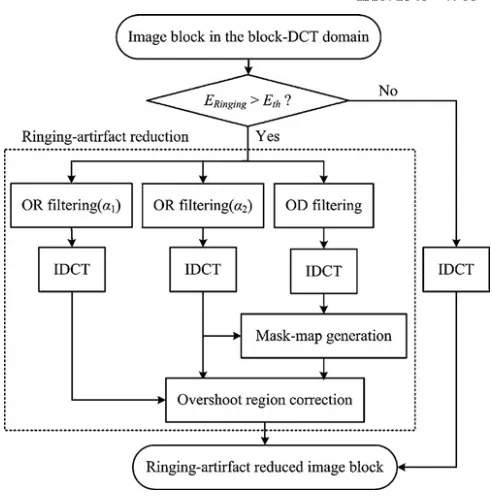
Using Bergen’s method [13], we can calculate xμ for a given μ, with which the ultra spherical window satisfies a specific main-lobe width or ripple ratio [13]. The OR filter withα < 1 reduces overshoot while increasing ripples and the OR filter with α > 1 reduces ripples while increasing overshoot. By using this characteristics, we can obtain ringing-artifact reduced image by combining the overshoot reduced image and ripple-reduced image, which are obtained by OR filtering with α < 1 and α > 1, respectively. The blocks with negligible ringing artifacts are not filtered in the proposed method, whereas the blocks having more substantial ringing artifacts are filtered by the OR filters with α1 and α2, where α1 < 1 and α2 > 1. To estimate the overshoot regions in the OR-filtered image with α2, the block is also filtered by a new low-pass filter, called an overshoot detector (OD) filter. Then, a mask map is generated, which is a binary image with 1 for the overshoot regions and 0 for the normal regions.
Fig. 1. Block diagram of the proposed ringing-artifact reduction method.
Mask-Map Generation
The overshoot regions in the OR-filtered image with α2 are estimated by applying the OD filter to the resized DCT block. The OD filter, HOD|DFT (k)2RN, is a low-pass filter which makes the OD-filtered image different from the OR-filtered image mostly on the overshoot regions rather than the normal regions.
5.Experimental Results
ISSN 2348 – 7968
Resized
image
Beermann Popovici Kong Proposed
baboon 36.64 36.73 36.81 36.95
Boat 36.48 36.50 36.59 36.62
building 36.02 36.10 36.17 36.32
Bird 38.48 38.49 38.57 38.61
fireman 28.49 28.57 28.58 28.61
The proposed method and the previous methods of Beermann [8], Popovici [9], and Kong [10] were compared in terms of the objective and subjective quality. The ringing artifact reduction methods were applied to the resized images that were initially downsized with truncation and then upsized with zero-padding operations in the block-DCT domain, where an 8×8 block DCT was used. The PSNR values were measured from the difference between the original images and the ringing-artifact reduced images. Table I shows that none of the methods causes any serious PSNR degradation in the ringing-artifact reduced images. The PSNR may not be appropriate for assessing the algorithm of the ringing-artifact reduction because the ringing-artifact reduction methods decrease the PSNR of the resized images. The zero-padding and truncation operations are theoretically optimal solutions in terms of the PSNR.
The block-DCT-domain filtering operation can introduce blocking artifacts. The blocking artifacts in the resized image are not increased noticeably by the proposed method. It is because the low-frequency coefficients of the OR filter are not quite different from those of the rectangular filter.
6. Conclusion
This paper proposed a DCT-domain filtering and image domain post-processing method that reduces the ringing artifacts on the resized images in the block-DCT domain. We built two OR filters in which the first side lobes have smaller and larger side-lobe energies, respectively, than the rectangular filter. The ringing-artifact reduced image is constructed from two OR-filtered images by the image-domain masking operation. In short, the proposed method removes ringing artifacts more effectively than previous ringing-artifact reduction approaches.
.
References
[1] R. Dugad and N. Ahuja, “A fast scheme for image size change in the compressed domain,” IEEE Trans. Circuits Syst. Video Technol., vol. 11, no. 4, pp. 461–474, Apr. 2001.
[2] J. Mukherjee and S. K. Mitra, “Image resizing in the compressed domain using subband DCT,” IEEE Trans. Circuits Syst. Video Technol., vol. 12, no. 7, pp. 620–627, Jul. 2002. [3] H. W. Park, Y. S. Park, and S. K. Oh, “L/M-fold image resizing in block-DCT domain using symmetric convolution,”
IEEE Trans. Image Process., vol. 12, no. 9, pp. 1016–1034, Sep. 2003.
[4] Y. S. Park and H. W. Park, “Arbitrary-ratio image resizing using fast DCT of composite length for DCT-based transcoder,”
IEEE Trans. Image Process., vol. 15, no. 2, pp. 494–500, Feb. 2006.
[5] H. Vandeven, “Family of spectral filters for discontinuous problems,” J. Sci. Comput. Archive, vol. 6, no. 2, pp. 159–192, 1991.
[6] D. Gottlieb and C. W. Shu, “On the Gibbs phenomenon and its resolution,” Soc. Ind. Appl. Math., vol. 39, no. 4, pp. 644– 668, 1997.
[7] A. Krylov and A. Nasonov, “Adaptive total variation deringing method for image interpolation,” in Proc. IEEE Int. Conf. Image Process., Oct. 2008, pp. 2608–2611.
[8] M. Beermann, A. Jalil, and J.-R. Ohm, “Thresholded weighted median filters for ringing reduction in processed images,” in Proc. 7th IEEE Workshop Multimed. Sign. Process., Oct.–Nov. 2005, pp. 1–4.
ISSN 2348 – 7968
[9] I. Popovici and W. D. Withers, “Locating edges and removing ringing artifacts in JPEG images by frequency-domain analysis,” IEEE Trans. Image Process., vol. 16, no. 5, pp. 1470– 1474, May 2007.
[10] H.-S. Kong, A. Vetro, and H. Sun, “Edge map guided adaptive post filter for blocking and ringing artifacts removal,” in
Proc. IEEE Int. Symp. Circuits Syst., vol. 3. May 2004, pp. 929– 932.
[11] L. Yaroslavsky, “Boundary effect free and adaptive discrete signal sinc interpolation algorithms for signal and image resampling,” Appl. Opt., vol. 42, no. 32, p. 6495, 2003.
[12] S. A. Martucci, “Symmetric convolution and the discrete sine and cosine transforms,” IEEE Trans. Signal Process., vol. 42, no. 5, pp. 1038–1051, May 1994.
[13] S. W. A. Bergen and A. Antoniou, “Design of ultraspherical window functions with prescribed spectral characteristics,”
EURASIP J. Appl. Signal Process., vol. 2004, no. 13, pp. 2053– 2065, 2004.
[14] S. W. A. Bergen and A. Antoniou, “Generation of ultra spherical window functions,” in Proc. 11th Eur. Signal Process. Conf., vol. 2. Sep. 2002, pp. 607–610.