IOT Based Surveillance System
Vishwa Prem.A
1; Mayank Kumar
2&
Dr.T.Saravanan
31,2 UG Student, Dept. Of Electronics and Telecommunication Engineering, Bharath University ,India 3Associate. Professor & HEAD, Dept. Of Electronics and Telecommunication Engineering, Bharath
University, India
ABSTRACT
Internet of things is the interchange of anything with any other thing, the interchange mainly fetch of useable data, like a sensor in a room to observe and control the temperature. The home environment has seen a rapid introduction of network enabled digital technology. It is estimated that by 2020 there will be 50 billion internet-enabled tools. This paper aims to outline a security alarm system using low processing power chips using Internet of things which helps to observe and get alarms when motion is detected and convey photos and videos to a cloud server. Also, internet of things based application can be used remotely to view the agitation and get notifications when movement is detected. The photos and videos are sent directly to a cloud server, when the cloud is not available then the data is stored locally on the Raspberry Pi and sent when the connection restarts. Hence, advantages like these make this application ideal for monitoring homes in absence.
KEYWORDS: Internet of Things; detection of
movement; cloud; tools; environment; internet.
1 INTRODUCTION
Internet of Things (lOT) is an growing progress of the Internet by which everyday 'things' objects have communication capabilities which allow them to send and receive data. There was a need to automate home so that users can take advantage of the technological advancement in such a way that a person can send a control signal to the home control center when he forget to turn off devices such as air conditioner instead of returning home. Environment that improves
the quality of the resident’s life by facilitating a flexible, comfortable, healthy, and safe environment . It is expected to connect systems, devices, sensors which can communicate without the need of machine-to-machine communication. lOT refers to an enormous variety of devices such as sensors that assist fire fighters in rescue and search operations, heart beat and blood pressure measuring devices, bio-chips that are implanted in farm animals. It is expected that by 2020, 20 billion devices will be connected with the Internet. The Internet of things presently is being used in the fields of automobiles, agriculture, security surveillance, building management, smart-homes, and health care. The IOT expects to use low-cost computing devices where there is less energy consumption and limited impact to theenvironment.
II. ADVANTAGES
In CCTV systems there should be a dedicated PC for the module which is eliminated here.
A PC can be hacked and the files can be erased while this system overcomes those problems.
In this system, authentication is required on the user side in order to view the streamed video in the browser.
Very less expensive when compared to the other existing systems.
DESIGN AND IMPLEMENTATION
2.1 Block diagram
Fig Block Diagram
PIR SENSOR:
PIR sensors, often referred to as, "Passive Infrared" or "IR motion" sensors, enable you to sense motion. Everything emits a small amount of infrared radiation, and the hotter something is, the more radiation is emitted. PIR sensors are able to detect a change in IR levels of their detection zone (e.g. when a human enters a room) and hence sense motion.
The PIR sensors we’ll be using in this Project have a range of approximately 7 meters, and a 110° x 70° detection range, so it’s great for monitoring a door or the corner of a room.
Fig PIR Sensor
How it Works:
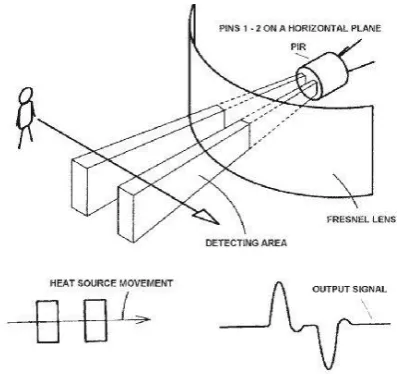
The PIR sensor itself has two slots in it, each slot is made of a special material that is sensitive to IR. The lens used here is not really doing much and so we see that the two slots can 'see' out past some distance (basically the sensitivity of the sensor). When the sensor is idle, both slots detect the same amount of IR, the ambient amount radiated from the room or walls or outdoors. When a warm body like a human or animal passes by, it first intercepts one half of the PIR
sensor, which causes a positive
differential change between the two halves. When the warm body leaves the sensing area, the reverse happens, whereby the sensor generates a negative differential change. These change pulses are what is detected.
Fig PIR sensor working
Description
2.1 Block Diagram
Cloud/ Dropbox
Mobile or Computer
Video recording/ Image capture
Motion sensor
Buzzer and LED Array
PI CAMERA
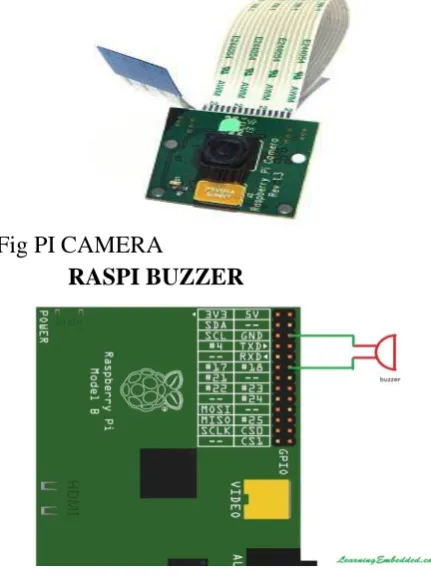
The Raspberry Pi camera module is capable of taking full HD 1080p photo and video and can be controlled programmatically.This camera is for
general work. It should work for anything as long as the light is required. With a weight of just over 3g, the camera is perfect for applications where the size and weight are important such as drones or tiny mobile robots.The 5 megapixels sensor is capable to support 1080p30, 720p60 and 640x480p60/90 video and a maximum resolution of 2592 x 1944 pixels for static images.
The Pi camera was released for sale on the 14th of May 2013 and the initial production was 10k units.
Fig PI CAMERA
RASPI BUZZER
Fig.Buzzer
A buzzer or beeper is an audio signalling device, which may be mechanical, electromechanical, or piezoelectric. Typical uses of buzzers and beepers include alarm devices, timers and confirmation of user input such as a mouse click or keystroke.
Pin Description:
MQTT PROTOCOL
MQTT stands for MQ Telemetry Transport. It is a publish/subscribe, extremely simple and lightweight messaging protocol, designed for constrained devices and low-bandwidth, high-latency or unreliable networks. The design principles are to minimise network bandwidth and device resource requirements whilst also attempting to ensure reliability and some degree of assurance of delivery. These principles also turn out to make the protocol ideal of the emerging “machine-to-machine” (M2M) or “Internet of Things” world of connected devices, and for mobile applications where bandwidth and battery power are at a premium.
The publish-subscribe messaging pattern requires a message broker. The broker is responsible for distributing messages to interested clients based on the topic of a message.
MQTT defines methods (sometimes referred to as verbs) to indicate the desired action to be performed on the identified resource. What this resource represents, whether pre-existing data or data that is generated dynamically, depends on the implementation of the server. Often, the resource corresponds to a file or the output of an executable residing on the server.
Connect
Waits for a connection to be established with the server.
Disconnect
Pin
No Function Name
1 Supply voltage; 5V
(+3.5V to 5V) Vcc
Waits for the MQTT client to finish any work it must do, and for the TCP/IP session to disconnect.
Subscribe
Waits for completion of the Subscribe or UnSubscribe method.
UnSubscribe
Requests the server unsubscribe the client from one or more topics.
Publish
Returns immediately to the application thread after passing the request to the MQTT client.
Fig MQTT Publish/subscribe
APPLICATIONS
•
Keep-Alive message (PINGREQ, PINGRESP) • Broker can detect client disconnection (if it doesn’t send explicit DISCONNECT)• Will message : specified in CONNECT message with topic, QoS and retain. On unexpected client disconnection, it is sent to subscribed clients
• Retain message : a PUBLISH message on a topic is kept on the broker. A new connected subscriber on the same topic receives this message (last known good message)
• Durable subscription : on client disconnection, all subscriptions are kept on the broker and recovered on client reconnection
HTTP vs MQTT
•
Request/Response (1-1, 1-n more POST) • Push on client with (long) polling (or WebSocket)• More bandwidth (ASCII, headers, …) • More battery consumption
• No “messaging middleware” integration • Client more complex (ASCII parser) • No Quality of Service
• Security based on SSL/TLS
RASPBERRY PI
It is a credit card sized PC in a 45g SOC
Developed by pi foundation from university of Cambridge, UK
Cheap with low driving power of 5W
Basic aim was to promote computer teaching aid for school going students
SCHEMATIC AND DESIGN
All models feature a Broadcom system on a chip (SOC) which include an ARM compatible CPU and an on chip graphics processing unit GPU (a VideoCore IV).
All in all it is a capable little computer which can be used for the same tasks which can be done with a normal desktop computer. For instance, reading emails, surf-ing on the websites, word-processing or watching high-definition videos. Also it is very popular in different kind of electronic projects and as a tool for learning the programming.
Fig Raspberry Pi
Specifications:
Chip: Broadcom BCM2836 SoC
Core architecture: Quad-core ARM
Cortex-A7
Memory: 1GB LPDDR2
Operating System: Boots from Micro
SD card, running a version of the Linux operating system
Dimensions: 85 x 56 x 17mm
Power : Micro USB socket 5V, 2A
GPU: Dual Core VideoCore IV®
Multimedia Co-Processor.
Connectors:
Ethernet: 10/100 BaseT Ethernet socket
Video Output : HDMI (rev 1.3 & 1.4)
Audio Output : 3.5mm jack,HDMI
USB: 4 x USB 2.0 Connector
GPIO Connector: 40-pin 2.54 mm (100
mil) expansion header: 2x20 strip providing 27 GPIO pins as well as +3.3 V, +5 V and GND supply lines.
Camera Connector: 15-pin MIPI
Camera Serial Interface (CSI-2)
Display Connector: Display Serial
Interface (DSI) 15 way flat flex cable connector with two data lanes and a clock lane
Memory Card Slot: Micro SDIO
DROPBOX
Dropbox is a file hosting service operated by Dropbox, Inc., headquartered in San Francisco, California, that offers cloud storage, file synchronization, personal cloud, and client software.
Dropbox allows users to create a special folder on their computers, which Dropbox then synchronizes so that it appears to be the same folder (with the same contents) regardless of which device is used to view it. Files placed in this folder are also accessible via the Dropbox website and mobile apps. Dropbox uses a freemium business model, wherein users are offered a free account with a set storage size and paid subscriptions for accounts with more capacity.
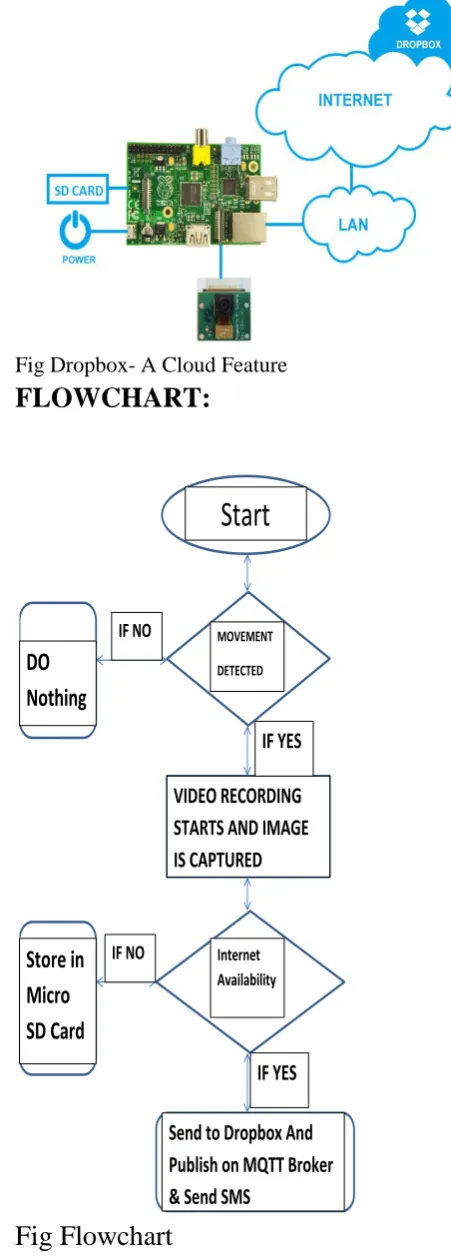
Fig Dropbox- A Cloud Feature
FLOWCHART:
Fig Flowchart
Start
MOVEMENT
DETECTED
VIDEO RECORDING STARTS AND IMAGE IS CAPTURED
Internet Availability
Send to Dropbox And Publish on MQTT Broker & Send SMS
IF YES
DO Nothing
IF NO
IF YES
Store in Micro SD Card
BRINGING IT ALL TOGETHER
The PIR sensors detects for motion and when on detection
Switches on the Camera.
When no motion is detected it is programmed to keep sensing for movement.
The buzzer is turned on a starts the alaram
The LED is on showing the status till the time movement is detectable.
The camera first captures an Image and stores it locally in micro SD card.
Then video is captured for 10 seconds and is again stored locally in micro SD card in a folder called Downloads.
When Connected to the Internet both the image and video files are sent to the Dropbox.
A message is published on to a MQTT server (Broker) so that all subscribers on that topic receive the message.
An SMS is sent to the Programmed mobile number.
RESULT
On Detection of NO MOVEMENT
Output: Movement Not Detected
Buzzer:Off
Camera:Off
LED :Off
On Detectionof MOVEMENT
Output: Movement Detected
Buzzer:On
Camera:captures image and
records video. MQTT:message is sent to
MQTT Server. Dropbox:Image
captured and recorded video is sent
to dropbox. LED:On
SMS:SMS is sent to the
concerned mobile.
FINAL DESIGN
CONCLUSION
Henceforth, by enhancing the capabilities of these technologies and integrating them, we hope to introduce the 'Motion Detection' system and to contribute to the current security system. This system would be an alternative for expensive security systems being used in the present day. This system does not require any special modifications to the infrastructure where installation is required and can be implemented without any hassle. I have tested this system for 30 days and have found 99% accurate notifications and results.
FUTURE SCOPE
REFERENCES
[1]. Sharma, Rupam Kumar, et al. "Android interface based GSM homesecurity system." Issues and Challenges in Intelligent ComputingTechniques (ICICT), 2014NInternational Conference on. IEEE,2014.
[2]. De Luca, Gabriele, et al. "The use of NFC and Android technologies to enable a KNX-based smart home." Software, Telecommunications and Computer Networks (SoftCOM), 2013 21st International Conference on. IEEE, 2013.
[3].Gu, Yi, et al. "Design and Implementation of UPnP-Based Surveillance Camera System for Home Security." Information Science and Applications (ICISA), 2013 International Conference on.IEEE, 2013.