can process Boolean masked values. Several proposals have been pub-lished that can realize these approaches securely and efficiently in soft-ware. But to the best of our knowledge, no hardware design exists that fulfills relevant properties such as efficiency and security at the same time.
In this paper, we present two design strategies to realize a secure and efficient arithmetic adder for Boolean-masked values. First, we introduce an architecture based on the ripple-carry adder that targets low-cost applications. The second architecture is based on a pipelined Kogge-Stone adder and targets high-performance applications. In particular, all our implementations adopt the threshold implementation approach to improve their resistance against SCA attacks even in the presence of glitches. We evaluated the security of our designs practically against SCA using a non-specific statistical t-test. Based on our analysis, we show that our constructions not only achieve resistance against first-and (univariate) second-order attacks but also require fewer rfirst-andom bits per operation compared to any existing software-based approach.
Keywords: Side-channel analysis, threshold implementation, Boolean masking, arithmetic modular addition
1
Introduction
Side-channel analysis (SCA) poses a serious threat to any cryptographic imple-mentation. If no dedicated countermeasure is applied, the secret of the underlying device can be easily extracted by SCA. A popular approach to increase the se-curity of a cryptographic implementation is the use ofmasking. It is achieved by blinding the processed values by means of random masks [21] so that it should become impossible for an attacker to predict intermediate values.
algorithm [21]. Note that nearly all proposed ciphers employ both logical and arithmetic operations.
As an example, ARX-based designs consist of three operations: integer addi-tion, rotaaddi-tion, and XOR. Such constructions are the foundation for block ciphers (like FEAL [23] or Threefish [13]), stream ciphers (Salsa20 [5], ChaCha [4], HC-128 [35]) and hash functions (BLAKE [2], Skein [13]). There are further examples that also include a mixture of Boolean and arithmetic operations like the TEA family of block ciphers [34] and SHA-2 [30]. To realize a masked implementation of these constructions, one option is to employ both Boolean and arithmetic masking schemes. Rotation and XOR operations can be protected by Boolean masking, while arithmetic masking is advantageous for the addition operations. However, the required conversions between both operations can also be the tar-get of an SCA attacker and hence need to be implemented in a secure way. In particular, many existing results discussing this method identified the conversion between arithmetic and Boolean masking as a major hurdle [3, 9, 14].
Related Works
We now briefly highlight several works on the conversion between Boolean and arithmetic masking. The conversion techniques can be categorized into those which use precomputation [12] and thosewithout precomputation [17]; however most of them were designed specifically for software platforms. Unfortunately, these constructions cannot be easily mapped to a dedicated hardware module without violating their claims on security. Roughly speaking, this is mainly due to critical glitches that occur inside masked circuits [22]. To avoid this prob-lem, every step would need to be separated by a register stage which would be detrimental to the performance.
We like to remark that a hardware design for such conversions has been proposed in [15], but since both the mask and masked data are involved in the processes of the proposed techniques, such constructions are expected to still have first-order leakages (see [25]). Another problem is the transformation of conversion algorithms to higher orders. It has been shown in [10] how to secure the conversions against higher-order attacks, but this feature comes with a prohibitive overhead for any cryptographic implementation.
Along the same lines, in order to avoid the conversions a technique to se-curely perform modular arithmetic addition on Boolean masked operands has been introduced in [18]. However, this scheme has been developed to be used in software applications and cannot be easily applied on a hardware platform where performance is a key factor.
(a) throughput and (b) SCA security order. With respect to performance (i.e., throughput) we consider two designs to implement a 32-bit arithmetic adder that is required by many cryptographic algorithms:
1. Ripple-Carry Adder (RCA) that requires 32 clock cycles to perform a com-plete addition, and
2. Kogge-Stone Adder (KSA) with 6 clock cycles latency and a fully pipelined architecture.
We present the first-order and (univariate) second-order secure threshold imple-mentation of the two above mentioned designs. We show that our designs not only outperform the inefficient approaches of [10] but also reduce the number of fresh random mask bits required for each addition. We also present practical SCA evaluations performed on a Spartan-6 FPGA to confirm the claimed se-curity levels. To the best of our knowledge, our four proposed architectures are the only available hardware-dedicated solutions that are supported by security proofs as well as by practical investigations.
2
Background
In this section, we introduce the used notations and present the basic ideas behind our designs.
2.1 Notations
In the following all equations are bit-level operations. Ann-bit integer operanda
is represented as (an−1an−2· · ·a1a0) wherea0 is the least significant bit. These
2.2 Ripple-Carry Adder
In [18] the authors presented a way to securely add two Boolean masked values. Instead of three conventional steps (conversion, addition, reconversion), the addi-tion can be implemented in just one step. Depending on the applicaaddi-tion, this can signficantly increase the performance over the classical approach. The algorithm introduced in [18] is based on a ripple-carry adder (RCA). This adder has been rewritten into a sequence of Boolean operations that take the Boolean masks into consideration. The algorithm is word-oriented for efficiency in software but not in hardware.
Similarly, our design is based on the basic algorithm described in [18]. The underlying algorithm builds on the fact that one bit of sumscan be computed as
si=ai⊕bi⊕ci . (1)
Therefore, the addition is replaced by a simple XOR of the two operandsaand
b and the carry c. The only unknown part in such an equation is the carry bit which can be computed using a recursive formula
ci+1=ai∧bi ⊕ ai∧ci ⊕ bi∧ci, (2)
where c0 = 0. The costly part of the RCA is the recursive carry computation.
Its function has to be evaluated iteratively which leads to a high circuit depth in case of a fully combinatorial design.
2.3 Kogge-Stone Adder
Another addition circuit with a lower depth is given by the Kogge-Stone adder (KSA) [19] that splits the carry generation into generate (g) and propagate (p) functions. Instead of evaluating the carry function recursively, the KSA benefits from a tree-like structure and achieves a logarithmic complexity. For a hardware design, a KSA can significantly increase the overall performance.
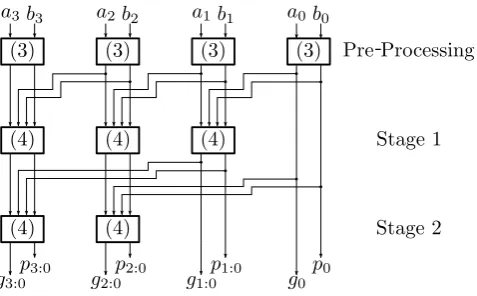
The basic structure of KSA forn= 4-bit operands is shown in Figure 1. For operandsaandbit computes the carry bits in three steps. During preprocessing the initialgi andpi values are generated as
gi =ai∧bi , pi=ai⊕bi . (3)
In the following stages a function is used to combine thegandpvalues of different bit positions. This function receives 4 bits as input and returns 2 output bits. Fori > j the output values are computed as
gi:j=gi⊕gj∧pi , pi:j =pi∧pj . (4)
After log2(n= 4) = 2 stages, the computation is finished and all carry bits can
be derived as
ci∈{2...n}=gi−1:0 , c1=g0 , c0= 0.
Fig. 1.The structure of the carry generation for 4-bit operands using the KSA
2.4 Threshold Implementations
In order to realize secure masked implementations and avoid the leakage caused by glitches (e.g., [22, 25]), the threshold implementation (TI) scheme has been introduced and developed in [7, 27–29]. Based on the algebraic degree t of the targeted non-linear function (Sbox) as well as the desired order1 of security d, the minimum number of input shares sin and the minimum number of output
sharessout are defined as
sin=t × d + 1 , sout=
s
in
t
.
The input x of the e.g., Sbox is represented by (x1, . . . , xsin) in such a way
that x=
sin
L
i=1
xi. The output of the TI of the corresponding Sbox (y1, . . . , ysout)
should be also a shared representation of y = S(x) =
sout
L
j=1
yj while each yj
is provided by a component function fj(. . .) over a subset of input shares
(x1, . . . , xsin). This property is known as correctness while non-completeness
is referred to the fact that any d(security order) selection of component func-tionsf1(. . .), . . . , fsout(. . .) is independent of at least one input share. These two
properties are relatively easy to achieve, but the third property uniformity is challenging. As the security of masking schemes is based on the uniform distri-bution of the masks, the output of a TI Sbox must be uniform as it is used as input in further parts of the implementation.
Suppose that for a certain input x all possible sharings n(1x1, . . . ,1xsin),
(2x1, . . . ,2xsin), . . . , (px1, . . . ,pxsin)
o
are given to the TI Sbox. The tuple
1
f1(. . .), . . . ,fsout(. . .)should be drawn uniformly from the set
n
(1y1, . . . ,1ysout),
(2y1, . . . ,2ysout), . . . ,(
qy 1, . . . ,
qy
sout)oas all possible sharings of y =S(x).
An important point is that the output of the component functions must be stored in dedicated registers to avoid the propagation of glitches. Another issue is related to the uniformity of the TI functions of security orderd > 1. In such a case, the number of output shares sout is usually higher than the number of
input shares sin; hence uniformity cannot be achieved. Therefore, some of the
registered output shares should be combined to reduce the number of output shares tosinat most. After such a combination the uniformity can be examined.
For more detailed information, the interested reader is referred to the original works [7, 29].
3
Implementation
We present two designs of a modulo 232 adder that provides resistance against first- and second-order SCA. This is a quite common type of addition used in many cryptographic algorithms (e.g., Salsa20, HC-128, SHA-2), but our archi-tectures can be also easily adapted to other bit lengths.
3.1 Ripple-Carry Adder (First-Order SCA-Resistant)
Based on the scheme presented in Section 2.2 we build a first-order SCA-resistant adder. To achieve this, Equations (1) and (2) should be transformed to meet the three required TI properties.
Given that Equation (2) is of degree 2, at least 3 shares (for input as well as for output) are necessary. It is supposed that each processed value, e.g., ai, is
split into 3 shares as (a1i, a2i, a3i). In case of Equation (1), due to its linearity the shares are easily combined via XOR as
s1i =a1i ⊕b1i ⊕c1i , s2i =a2i ⊕b2i ⊕c2i , s3i =a3i ⊕b3i ⊕c3i . (5)
As mentioned before, Equation (2) is non-linear and has algebraic degree of 2. Following direct sharing approach represented in [8], we can construct a correct and uniform shared implementation of such a function. The shares of the carry bit can be computed as
c1i+1=a2i∧b2i⊕a2i∧bi3⊕a3i∧b2i⊕a2i∧c2i⊕ai2∧c3i⊕a3i∧c2i⊕b2i∧c2i⊕b2i∧c3i⊕b3i∧c2i (6)
c2i+1=a3i∧b3i⊕a3i∧bi1⊕a1i∧b3i⊕a3i∧c3i⊕ai3∧c1i⊕a1i∧c3i⊕b3i∧c3i⊕b3i∧c1i⊕b1i∧c3i (7)
c3i+1=a1i∧b1i⊕a1i∧bi2⊕a2i∧b1i⊕a1i∧c1i⊕ai1∧c2i⊕a2i∧c1i⊕b1i∧c1i⊕b1i∧c2i⊕b2i∧c1i (8)
Here we should note that Equations (1) and (2) can be seen as a function
f : (ai, bi, ci) 7→ (si, ci+1). At a first glance one may think of examining the
uniformity of the (si, ci+1) tuple2. However, such a tuple is never supplied to
2 If sharing ofx and y are uniform, the tuple of sharing of (x, y) is not necessarily
Fig. 2.Structure of the first-order secure adder based on RCA
any function within the RCA algorithm. Note thatsiis an output bit and is not
propagated whileci+1is given to the next stage where it is combined withai+1
andbi+1which are independent ofci+1. Hence the uniformity ofci+1 suffices to
fulfill the corresponding property.
During the implementation of such a design we encountered an issue that has never been reported before. The output of the shared carry computation function (Equation (6) to (8)) cannot be directly used as feedback signal since the output of a function from a previous cycle is used as input in the next clock cycle.
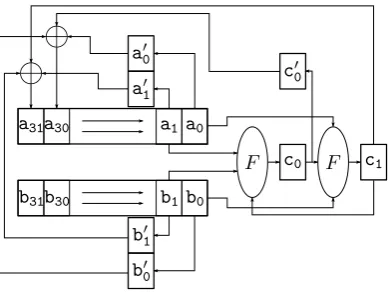
As a remedy we constructed a two-stage design as depicted in Figure 2. The three shares of the two operandsaandbare stored in shift registers. The RCA algorithm and the deployment of shift registers supports an efficient scanning of operand bits. Two instances of the shared carry computation function are implemented whose outputs are stored in carry registers c0 andc1. The carry
registers are enabled alternately while the other intermediate registers (c00, a00, a01,b00andb01) are enabled every second clock cycle synchronized with that ofc1.
The operand registers are also shifted two bits every other second clock cycle. The additional registers, i.e.,c00,a00,a01,b00, andb01synchronize the computation of the sum bits, which need to be performed one clock cycle after that of the carry bits. Note that we use the shift register of operandato save the result of the addition.
Another issue is related to the first stage, i.e., when i = 0. In our designs we suppose that input carry c0 = 0 so that (c10, c20, c30) should be a shared
representation of 0. Therefore, both carry registers have to be initialized with a random set representing 0. In other words, our design requires four fresh mask bitsf m1,. . .,f m4 only at the start of the addition to initializec0and c1 with
(f m1, f m2, f m1⊕f m2) and (f m3, f m4, f m3⊕f m4) respectively. Note that all
design is considerably more efficient than the solutions proposed in [18], [10] and [11].
3.2 Ripple-Carry Adder (Second-Order SCA-Resistant)
The design described above can be simply transformed to support resistance against higher-order attacks. We now present a solution for the second-order resistant design. We increase the number of input sharessinto 5 and all
corre-sponding functions have to be chosen according to the principles of higher-order TI [7].
Equation (5) just needs to be adapted to the increased number of shares. The computation of the carry has to be split up into two steps. In the first step,
sout = 10 component functions generate 10 output shares. Following the same
concept presented in [7], these intermediate shares are then again reduced to 5 shares in the second step.
No major changes to the basic structure depicted in Figure 2 are necessary for implementation. Just the registers have to be adjusted to the increased number of shares and the F block is split by an additional register stage. All uniform equations for theF function, obtained by direct sharing, are described in detail in the appendix of this work.
As a consequence, the amount of utilized resources increases and the number of clock cycles needed for the carry computation doubles. Just as before, the carry registers need fresh randomness during the initialization. Therefore, the number of required fresh random masks increases to 8 bits.
3.3 Kogge-Stone Adder (First-Order SCA-Resistant)
The design based on the RCA has low requirements for space and randomness. However, the number of clock cycles for one addition grows linearly with the bit length of the operands. For increased performance we therefore implemented a design that uses a KSA as foundation and which is still secure against first-order attacks.
Equations (3) and (4) need to be split into shares. Since all the corresponding formulas are of degree two, similar to that of the RCA, at least 3 shares are required to realize a functional TI.
The two outputs of the preprocessing step are both given to the next stages; thus, the uniformity of each tuple (gi, pi) must be taken into account. One part
of Equation (3) needs to be implemented by the AND of the two operands for which no uniform TI with 3 shares exists [29]. For this, fresh mask bits have to be used to make it uniform (see remasking in [8, 26]). In our design, we adopted the solution from [8] with only a single virtual share. One fresh random bit mi
is required for every invocation of the function in the preprocessing step:
g1i =a2i ∧b2i ⊕a2i ∧b3i ⊕a3i ∧b2i ⊕mi (9)
g2i =a 3 i ∧b
3 i ⊕a
1 i ∧b
3 i ⊕a
3 i ∧b
1 i ⊕a
1
gi:j =gi ⊕gj ∧pi ⊕gj∧pi ⊕gj ∧pi (12)
g2i:j =g3i ⊕gj3∧p3i ⊕g1j∧p3i ⊕gj3∧p1i (13)
g3i:j =g1i ⊕gj1∧p1i ⊕g1j∧p2i ⊕gj2∧p1i . (14)
The other part (computation ofp) of Equation (4) can be implemented similar to Equation (9). To reduce the amount of required fresh random bits, we replaced
mi with g1j. This bit is not used in this equation and can take the role of a
mask. Although our construction does not closely follow the assumptions in [8] considering the construction of virtual shares, we can demonstrate that this has no impact on security. Our simulation results show not only the uniformity of shared pi:j but also the uniformity of the shared tuple (pi:j, gi:j). We need to
emphasize that due to the specific architecture of the KSA algorithm,g1j is only used once as a mask to introduce uniformity into the computation of ap. In other words, the mask bitg1
j is never reused again what could potentially violate the
uniformity in later stages.
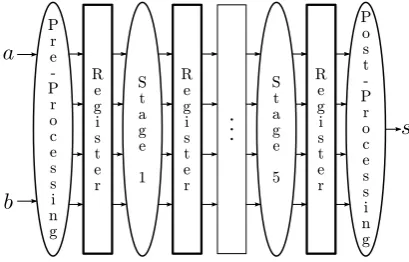
Our design is optimized for maximum throughput by using a fully pipelined architecture. Figure 3 depicts the basic structure of our design. Since only the preprocessing step requires fresh random bits and – as stated above – all other stages are computed without additional mask, the total number of required fresh mask bits isn= 32. Compared to the other solutions like [18], [10] and [11] this is still reasonable.
3.4 Kogge-Stone Adder (Second-Order SCA-Resistant)
Similar as for the RCA, the design based on the KSA is also easily extensible to higher orders. We outline the exemplary procedure for second-order security. In this case, the number of input shares is again set to 5. The four aforementioned equations are adjusted to meet the requirements of the second-order TI.
The XOR part of Equation (3) is implemented as before but adapted to the higher number of shares. The AND part to compute gi of Equation (3) is
P r e -P r o c e s s i n g R e g i s t e r R e g i s t e r R e g i s t e r S t a g e 1 S t a g e 5 P o s t -P r o c e s s i n g
Fig. 3.Block diagram of the first-order secure adder based on KSA
four fresh random bits are necessary. The two functions of the following stages are also split into two steps. For the computation of gi:j of Equation (4) we
use the second-order TI representation of the AND/XOR function given in [7]. For the pi:j part (the AND operation) we use the same construction of gi of
the preprocessing step. Instead of four fresh mask bits, we used 4 shares ofgj
as fresh masks to reduce the required randomness. Details of the underlying uniform equations can be found in the appendix.
The basic structure as shown in Figure 3 is also the template for the archi-tecture of most other parts. It has mainly to be adapted to 5 shares and the functions need to be split into two steps with a register in between. Hence the number of clock cycles for one addition is doubled. In terms of randomness the demand of our implementation quadruples, because each invocation of the AND operation in the preprocessing step requires 4 random bits.
3.5 Comparison
We now compare our designs in terms of size and performance that are imple-mented on a Spartan-6 FPGA with other solutions. All our findings are summa-rized in Table 1. In terms of size, the RCA-based variant is clearly superior to other solutions due to the iterative structure. On the contrary, the designs based on the KSA provide low latency and high-performance applications.
Due to the different implementation platforms, we cannot fairly compare our hardware designs with software-based solutions [18], [10] and [11]. Therefore, Table 1 restricts the comparison to the number of required fresh random bits.
masks ford-order KSA withd≥2 can be decreased even further. Ford= 1 we can use the trick presented in [8] that requires only one fresh mask bit for an AND operation. Such a construction – with one virtual variable – might be also found for higher-order TI of the AND operation thereby reducing the number of required fresh mask bits.
4
Analysis
For the practical SCA evaluations we employed a SAKURA-G platform [1] pop-ulated with a Spartan-6 FPGA as target. All SCA traces have been collected by a digital oscilloscope while measuring the voltage drop over a 1 Ω resistor in Vdd path. In order to obtain clean signals and reduce the electrical noise, we used the embedded amplifier of the SAKURA-G and restricted the bandwidth of the oscilloscope to 20 MHz.
As evaluation metric we applied a non-specific statistical t-test [16]. The feature of this test is to indicate the existence of any leakage at a defined order in the power traces. Following the concept of non-specific t-test, power traces corresponding to fixed and randomly selected inputs are collected. Hence this scheme is also denoted as fixed vs. randomt-test. During the measurements the fixed and random inputs need to be randomly interleaved. Then, the traces T
are categorized into two groupsG1andG2with respect to the fixed and random
inputs, respectively. In the following explanation, we consider only one point of the collected traces for the sake of simplicity:
Recall that Welch’s (two-tailed)t-test is computed as
t= µq(T ∈G1)−µ(T ∈G2)
δ2(T∈G 1) |G1| +
δ2(T∈G 2) |G2|
,
where µandδ2 denote the sample mean and sample variance respectively, and
If the null hypothesis is correct, it can be concluded with a high level of confi-dence that the device under test does not have any first-order leakage, given the recorded traces.
For such a conclusion the Student’st-distribution function (in addition to the degree of freedom) is applied to determine the probability of rejecting the afore-mentioned hypothesis (cf. [16] and [7]). For typical evaluations, a threshold for
|t|as>4.5 is defined to reject the null hypothesis and indicate that a first-order attack is feasible. This process is repeated at each sample point independently to obtain a curve oft value.
The aforementioned scheme can be easily extended to higher orders by pre-processing the traces as, for example, centered square (for the second-order), standardized cube (for the third order), etc. It is noteworthy that the same eval-uation scheme has been applied in [7] and [20] to investigate the existence of first- and higher-order leakages. For detailed information on how to conduct the tests at higher orders the interested reader is referred to [33].
4.1 Ripple-Carry Adder
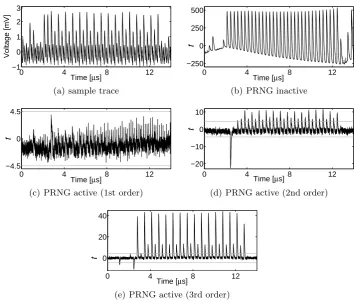
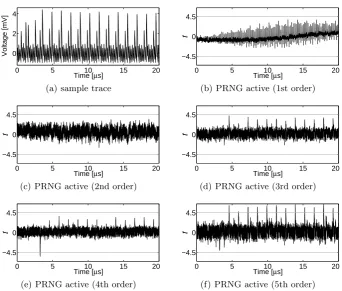
Now we analyze the security of our first-order SCA-resistant RCA design. A sample trace of such a design is shown in Figure 4(a). In order to have a reference for the existing leakage in our platform as well as an evidence for the suitability of the applied evaluation scheme, we first turned the PRNG off that provides the randomness for initial sharing and fresh masks. Hence all outputs of the PRNG are set to zero and the underlying design receives unshared inputs as (a,0,0) and (b,0,0). With such a setting we collected 100 000 traces corresponding to a mixture of fixed and random inputs. Therefore, we expect the t-test to report clearly exploitable first-order leakages, which is confirmed by the corresponding result shown in Figure 4(b). It can be seen that thet value exceeds 400 during the cryptographic operation exceeding the defined threshold by far.
As the next step we activated the PRNG so that the adder circuit receives randomly shared inputs and fresh random masks. Hence the design is expected to provide first-order security. In order to examine this we collected 100 000 000 traces and performed the t-test up to third order. The corresponding results shown in Figure 4 indicate the resistance of the design to first-order attacks and – as expected – its vulnerability to second- and third-order attacks.
0 4 8 12 −4.5
Time [μs]
(c) PRNG active (1st order)
0 4 8 12
−20
Time [μs]
(d) PRNG active (2nd order)
0 4 8 12
0 20 40
t
Time [μs]
(e) PRNG active (3rd order)
Fig. 4.RCA 1st order, t-test results using 100 000 000 traces
4.2 Kogge-Stone Adder
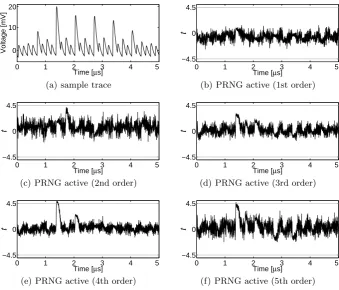
Both analyses on the first- and second-order RCA were repeated on the first- and second-order SCA-resistant KSA designs. We even collected the same number of traces, i.e., 100 000 000 traces to evaluate the 1st-order KSA and 300 000 000 traces for the second-order KSA. The results which confirm the resistance of our constructions are shown in Figure 6 and Figure 7, respectively.
4.3 Higher-Order Security
0 5 10 15 20 0 2 4 Voltage [mV] Time [μs]
(a) sample trace
0 5 10 15 20
−4.5 0 4.5
t
Time [μs]
(b) PRNG active (1st order)
0 5 10 15 20
−4.5 0 4.5
t
Time [μs]
(c) PRNG active (2nd order)
0 5 10 15 20
−4.5 0 4.5
t
Time [μs]
(d) PRNG active (3rd order)
0 5 10 15 20
−4.5 0 4.5
t
Time [μs]
(e) PRNG active (4th order)
0 5 10 15 20
−4.5 0 4.5
t
Time [μs]
(f) PRNG active (5th order)
Fig. 5.RCA 2nd order,t-test results using 300 000 000 traces
0 1 2 3
−3 0 3 6
Voltage [mV]
Time [μs]
(a) sample trace
0 1 2 3
−4.5 0 4.5
t
Time [μs]
(b) PRNG active (1st order)
0 1 2 3
0 100 200
t
Time [μs]
(c) PRNG active (2nd order)
0 1 2 3
0 30 60
t
Time [μs]
(d) PRNG active (3rd order)
0 1 2 3 4 5 −4.5
Time [μs]
(c) PRNG active (2nd order)
0 1 2 3 4 5
−4.5
Time [μs]
(d) PRNG active (3rd order)
0 1 2 3 4 5
−4.5 0 4.5
t
Time [μs]
(e) PRNG active (4th order)
0 1 2 3 4 5
−4.5 0 4.5
t
Time [μs]
(f) PRNG active (5th order)
Fig. 7.KSA 2nd order,t-test results using 300 000 000 traces
in the model of univariate higher-order attacks, all lemmas and proofs as given in [7] remain valid. Furthermore, this is backed by our practical investigations as shown above. Still we need to highlight that the second-order TI designs we presented in this work are designed to resist against univariate second-order attacks.
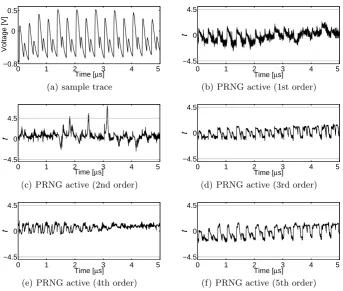
In this context, it has been previously shown in [24] that multivariate leakages can be easily summed up and be represented in a univariate form. The suggested approaches for such a combination include (a) running the target device at a relatively high frequency, e.g., 24 MHz - 48 MHz, and (b) making use of a DC blocker and/or certain amplifiers in the measurement setup. Both techniques cause overlapping the power peaks of adjacent clock cycles, and hence the leakage associated to consecutive clock cycles are somehow added together. In [24] it has been shown that employing any of the aforementioned techniques causes an implementation of a univariate second-order resistant design to be vulnerable to a univariate second-order attack.
0 1 2 3 4 5 −0.8
0 0.5
Voltage [V]
Time [μs]
(a) sample trace
0 1 2 3 4 5
−4.5 0 4.5
t
Time [μs]
(b) PRNG active (1st order)
0 1 2 3 4 5
−4.5 0 4.5
t
Time [μs]
(c) PRNG active (2nd order)
0 1 2 3 4 5
−4.5 0 4.5
t
Time [μs]
(d) PRNG active (3rd order)
0 1 2 3 4 5
−4.5 0 4.5
t
Time [μs]
(e) PRNG active (4th order)
0 1 2 3 4 5
−4.5 0 4.5
t
Time [μs]
(f) PRNG active (5th order)
Fig. 8.(modified measurement setup) KSA 2nd order,t-test results using 300 000 000 traces
have not been fully investigated yet.
Acknowledgment
The authors would like to thank Beg¨ul Bilgin from Katholieke Universiteit Leu-ven, Dept. ESAT/SCD-COSIC and Iminds (Belgium) for her helpful discussions and comments. The research in this work was supported in part by the DFG Research Training Group GRK 1817/1.
References
1. Side-channel AttacK User Reference Architecture. http://satoh.cs.uec.ac.jp/ SAKURA/index.html.
2. J.-P. Aumasson, L. Henzen, W. Meier, and R. C.-W. Phan. SHA-3 proposal BLAKE. Submission to NIST, 2008.
3. O. Benoˆıt and T. Peyrin. Side-Channel Analysis of Six SHA-3 Candidates. In CHES 2010, volume 6225 ofLNCS, pages 140–157. Springer, 2010.
4. D. J. Bernstein. ChaCha, a variant of Salsa20. In Workshop Record of SASC, volume 8, 2008.
5. D. J. Bernstein. The Salsa20 Family of Stream Ciphers. In New Stream Cipher Designs - The eSTREAM Finalists, volume 4986 ofLNCS, pages 84–97. Springer, 2008.
6. B. Bilgin, B. Gierlichs, S. Nikova, V. Nikov, and V. Rijmen. A More Efficient AES Threshold Implementation. InAFRICACRYPT 2014, volume 8469 ofLNCS, pages 267–284. Springer, 2014.
7. B. Bilgin, B. Gierlichs, S. Nikova, V. Nikov, and V. Rijmen. Higher-Order Thresh-old Implementations. InASIACRYPT 2014, LNCS. Springer, 2014. to appear. 8. B. Bilgin, S. Nikova, V. Nikov, V. Rijmen, and G. St¨utz. Threshold
Implementa-tions of All 3×3 and 4×4 S-Boxes. InCHES 2012, volume 7428 ofLNCS, pages 76–91. Springer, 2012.
9. C. Boura, S. L´evˆeque, and D. Vigilant. Side-Channel Analysis of Grøstl and Skein. InSymposium on Security and Privacy Workshops 2012, pages 16–26. IEEE Com-puter Society, 2012.
11. J. Coron, J. Großsch¨adl, P. K. Vadnala, and M. Tibouchi. Conversion from Arithmetic to Boolean Masking with Logarithmic Complexity. Cryptology ePrint Archive, Report 2014/891, 2014. http://eprint.iacr.org/.
12. B. Debraize. Efficient and Provably Secure Methods for Switching from Arith-metic to Boolean Masking. InCHES 2012, volume 7428 ofLNCS, pages 107–121. Springer, 2012.
13. N. Ferguson, S. Lucks, B. Schneier, D. Whiting, M. Bellare, T. Kohno, J. Callas, and J. Walker. The Skein Hash Function Family. http://www.skein-hash.info/sites/default/files/skein1.3.pdf, 2010.
14. B. Gierlichs, L. Batina, C. Clavier, T. Eisenbarth, A. Gouget, H. Handschuh, T. Kasper, K. Lemke-Rust, S. Mangard, A. Moradi, and E. Oswald. Suscepti-bility of eSTREAM Candidates Towards Side-Channel Analysis. Proceedings of SASC, pages 123–150, 2008.
15. J. D. Golic. Techniques for Random Masking in Hardware.IEEE Trans. on Circuits and Systems, 54-I(2):291–300, 2007.
16. G. Goodwill, B. Jun, J. Jaffe, and P. Rohatgi. A testing method-ology for side channel resistance validation. In NIST non-invasive attack testing workshop, 2011. http://csrc.nist.gov/news_events/
non-invasive-attack-testing-workshop/papers/08_Goodwill.pdf.
17. L. Goubin. A Sound Method for Switching between Boolean and Arithmetic Mask-ing. InCHES 2001, volume 2162 ofLNCS, pages 3–15. Springer, 2001.
18. M. Karroumi, B. Richard, and M. Joye. Addition with Blinded Operands. In COSADE 2014, volume 8622 ofLNCS, pages 41–55. Springer, 2014.
19. P. M. Kogge and H. S. Stone. A Parallel Algorithm for the Efficient Solution of a General Class of Recurrence Equations. IEEE Trans. Comput., 22(8):786–793, 1973.
20. A. J. Leiserson, M. E. Marson, and M. A. Wachs. Gate-Level Masking under a Path-Based Leakage Metric. InCHES 2014, volume 8731 ofLNCS, pages 580–597. Springer, 2014.
21. S. Mangard, E. Oswald, and T. Popp. Power Analysis Attacks - Revealing the Secrets of Smart Cards. Springer, 2007.
22. S. Mangard, N. Pramstaller, and E. Oswald. Successfully Attacking Masked AES Hardware Implementations. InCHES 2005, volume 3659 ofLNCS, pages 157–171. Springer, 2005.
23. S. Miyaguchi. The FEAL Cipher Family. InCRYPTO 90, volume 537 ofLNCS, pages 627–638. Springer, 1991.
24. A. Moradi and O. Mischke. On the Simplicity of Converting Leakages from Mul-tivariate to Univariate - (Case Study of a Glitch-Resistant Masking Scheme). In CHES 2013, volume 8086 ofLNCS, pages 1–20. Springer, 2013.
25. A. Moradi, O. Mischke, and T. Eisenbarth. Correlation-Enhanced Power Analysis Collision Attack. InCHES 2010, volume 6225 ofLNCS, pages 125–139. Springer, 2010.
26. A. Moradi, A. Poschmann, S. Ling, C. Paar, and H. Wang. Pushing the Limits: A Very Compact and a Threshold Implementation of AES. InEUROCRYPT 2011, volume 6632 ofLNCS, pages 69–88. Springer, 2011.
27. S. Nikova, C. Rechberger, and V. Rijmen. Threshold Implementations Against Side-Channel Attacks and Glitches. InICICS 2006, volume 4307 ofLNCS, pages 529–545. Springer, 2006.
TREAM Finalists, volume 4986 ofLNCS, pages 39–47. Springer, 2008.
A
Second-Order RCA
A.1 Carry (1. Step)
e
c1i+1=a2i∧b2i⊕a1i∧bi2⊕a2i∧b1i⊕a2i∧c2i⊕ai1∧c2i⊕a2i∧c1i⊕c2i∧b2i⊕c1i∧b2i⊕c2i∧b1i (15)
e
c2i+1=a3i∧b3i⊕a1i∧bi3⊕a3i∧b1i⊕a3i∧c3i⊕ai1∧c3i⊕a3i∧c1i⊕c3i∧b3i⊕c1i∧b3i⊕c3i∧b1i (16)
e
c3i+1=a4i∧b4i⊕a1i∧bi4⊕a4i∧b1i⊕a4i∧c4i⊕ai1∧c4i⊕a4i∧c1i⊕c4i∧b4i⊕c1i∧b4i⊕c4i∧b1i (17)
e
c4i+1=a1i∧b1i⊕a1i∧bi5⊕a5i∧b1i⊕a1i∧c1i⊕ai1∧c5i⊕a5i∧c1i⊕c1i∧b1i⊕c1i∧b5i⊕c5i∧b1i (18)
e
c5i+1=a2i ∧b3i ⊕a3i ∧b2i ⊕a2i ∧ci3⊕a3i ∧c2i ⊕c2i ∧b3i ⊕c3i ∧b2i (19)
e
c6i+1=a2i ∧b4i ⊕a4i ∧b2i ⊕a2i ∧ci4⊕a4i ∧c2i ⊕c2i ∧b4i ⊕c4i ∧b2i (20)
e
c7i+1=a5i∧b5i⊕a2i∧bi5⊕a5i∧b2i⊕a5i∧c5i⊕ai2∧c5i⊕a5i∧c2i⊕c5i∧b5i⊕c2i∧b5i⊕c5i∧b2i (21)
e
c8i+1=a 3 i ∧b
4 i ⊕a
4 i ∧b
3 i ⊕a
3 i ∧c
4 i ⊕a
4 i ∧c
3 i ⊕c
3 i ∧b
4 i ⊕c
4 i ∧b
3
i (22)
e
c9i+1=a3i ∧b5i ⊕a5i ∧b3i ⊕a3i ∧ci5⊕a5i ∧c3i ⊕c3i ∧b5i ⊕c5i ∧b3i (23)
e
c10i+1=a4i ∧b5i ⊕a5i ∧b4i ⊕a4i ∧ci5⊕a5i ∧c4i ⊕c4i ∧b5i ⊕c5i ∧b4i (24)
A.2 Carry (2. Step)
c1i+1=ec1i+1 (25)
c2i+1=ec2i+1 (26)
c3i+1=ec
3
i+1 (27)
c4i+1=ec4i+1 (28)
c5i+1=ec
5 i+1⊕ec
6 i+1⊕ec
7 i+1⊕ec
8 i+1⊕ec
9 i+1⊕ec
10
B
Second-Order KSA
B.1 AND (1. Step)
e
g1i =a2i ∧b2i ⊕a1i ∧b2i ⊕a2i ∧b1i ⊕m1i (30)
e
g2i =a3i ∧b3i ⊕a1i ∧b3i ⊕a3i ∧b1i ⊕m2i (31)
e
g3i =a4i ∧b4i ⊕a1i ∧b4i ⊕a4i ∧b1i ⊕m3i (32)
e
g4i =a1i ∧b1i ⊕a1i ∧b5i ⊕a5i ∧b1i ⊕m4i (33)
e
gi5=a2i ∧bi3⊕a3i ∧b2i (34)
e
gi6=a2i ∧b4i ⊕a4i ∧b2i ⊕m1i (35)
e
g7i =a5i ∧b5i ⊕ai2∧b5i ⊕a5i ∧b2i (36)
e
gi8=a3i ∧b4i ⊕a4i ∧b3i ⊕m2i (37)
e
gi9=a3i ∧b5i ⊕a5i ∧b3i ⊕m3i (38)
e
gi10=a4i ∧b5i ⊕a5i ∧b4i ⊕m4i (39)
B.2 AND/XOR (1. Step)
e
g1i:j =g2i ⊕gj2∧p2i ⊕g1j∧p2i ⊕gj2∧p1i (40)
e
g2i:j =g3i ⊕gj3∧p3i ⊕g1j∧p3i ⊕gj3∧p1i (41)
e
g3i:j =g4i ⊕gj4∧p4i ⊕g1j∧p4i ⊕gj4∧p1i (42)
e
g4i:j =g1i ⊕gj1∧p1i ⊕g1j∧p5i ⊕gj5∧p1i (43)
e
g5i:j =g2j∧pi3⊕gj3∧p2i (44)
e
g6i:j =g2j∧pi4⊕gj4∧p2i (45)
e
g7i:j =g5i ⊕gj5∧p5i ⊕g2j∧p5i ⊕gj5∧p2i (46)
e
g8i:j =g3j∧pi4⊕gj4∧p3i (47)
e
g9i:j =g3j∧pi5⊕gj5∧p3i (48)
e