Mapping the Complexity of Forensic Science:
Implications for Forensic Science Education
Ahmad Nabil Samarji
School of Education
Faculty of Arts, Education, and Human Development
Victoria University
Submitted in fulfilment of the requirements of the degree of
Doctor of Philosophy in Education
II
ABSTRACT
Over the past two decades the field of forensic science has experienced a remarkable development and a substantially enhanced public profile. The prominence of forensic science has resulted from scientific and technological advances, increased reliance of law enforcement agencies and judicial systems and its popularisation through the mass media. Consequently, forensic science education has been characterised by a rapid expansion in both the number of forensic science courses and the number of students enrolling in such courses. However, very little is published on forensic science education. This research aims to identify how best to organise and deliver forensic science education. By doing so, the research aims to generate graduates who are more proficient and with the knowledge and expertise needed for them to cope with the technological advances revolutionising forensic science and with ongoing security demands and challenges.
In order to meet its aim, the research has investigated forensic science education from its determining factors: forensic science knowledge, practice, and identity. The research adopted a qualitative approach to undertake the investigation. A document analysis of the published curricula of 190 forensic science academic programs offered worldwide produced an overview of the current status of forensic science education. Secondly, the research employed semi-structured interviews with a number of forensic science educators, forensic science practitioners, and members of professions associated with forensic science about their conceptions of forensic science knowledge, practice, and identity. This outcome of the methodology has been the proposition of critical features relating to the nature of forensic science. These critical features have become the basis for a consideration of the form of forensic science education.
IV
Student Declaration
“I, Ahmad Nabil Samarji, declare that the PhD thesis entitled ‘Mapping the Complexity of Forensic Science: Implications for Forensic Science Education’ is no more than 100,000 words in length including quotes and exclusive of tables, figures, appendices, bibliography, references and footnotes. This thesis contains no material that has been submitted previously, in whole or in part, for the award of any other academic degree or diploma. Except where otherwise indicated, this thesis is my own work”.
Ahmad Nabil Samarji
Ahmad Samarji
First & Last, All Praises unto Allah, the Almighty, for His
guidance, for providing me with the effort and the patience to
VI
Acknowledgements
I like to acknowledge the invaluable and thoughtful guidance and assistance provided by my supervisors, Associate Professor Tony Kruger and Doctor Neil Hooley, during the research journey and writing of this thesis. Throughout this undertaking, their understanding, support, feedback, and constructive critique have helped keep me focused, challenged, and productive. I would also like to thank the staff of the school of education for treating me as a member of the group in a friendly environment of knowledge, support, and care.
To my Mother, Ghazwa, the most precious person in my
life,
To my Father, Nabil, my role model and great support,
To my Sisters: Rima & Zeina,
To my Brothers: Tarek, Omar, and Ahmad el Hakeem,
To my Grandmother, Najda, the blessing of our family,
To my Aunty Raoha, the aunt, the sister, and the best
friend,
To my Uncle Barrack, the uncle, the brother, and the
best friend,
With love,
VIII
Table of Contents
ABSTRACT ... II
STUDENT DECLARATION ... IV
ACKNOWLEDGEMENTS ... VI
TABLE OF CONTENTS ... VIII
LIST OF FIGURES ... XV
CHAPTER 1: INTRODUCTION ... 1
1.1-THE SUBJECT OF THE STUDY ... 1
1.2- FORENSIC SCIENCE:AFIELD UNDER THE MICROSCOPE ... 3
1.3- FORENSIC SCIENCE:DEFINITIONS AND LANDSCAPE ... 5
1.3.1-DEFINITIONS ... 5
1.3.2-LANDSCAPE ... 6
1.4-FORENSIC SCIENCE DEVELOPMENT AND EDUCATION THROUGH HISTORY ... 9
1.4.1-PERIOD 287BC-1850AD ... 9
1.4.2-PERIOD 1851-1950 ... 9
1.4.3-PERIOD 1951- PRESENT ... 11
1.5-FORENSIC SCIENCE IN PUBLIC ... 12
1.6-PUBLIC INTEREST CONSEQUENCES ... 14
1.7-WHAT IS FORENSIC SCIENCE EDUCATION?A PRELIMINARY EXAMINATION ... 14
1.8- FORENSIC SCIENCE EDUCATION ... 16
1.9- FORENSIC SCIENCE KNOWLEDGE ... 19
1.10-FORENSIC SCIENCE PRACTICE ... 20
1.11-FORENSIC SCIENCE IDENTITY ... 22
1.12-PROBLEM IDENTIFICATION ... 23
1.13-RESEARCH AIMS &QUESTIONS ... 24
1.14-RESEARCH STANCE ... 25
1.15-RESEARCH DESIGN ... 26
1.16-APPROPRIATENESS OF THE METHODOLOGICAL APPROACH ... 28
1.18-SIGNIFICANCE OF THE STUDY ... 30
1.19-THESIS STRUCTURE ... 30
1.20-CHAPTER SUMMARY ... 33
CHAPTER 2: LITERATURE REVIEW ... 35
2.1-INTRODUCTION ... 35
2.2-THE EDUCATION BODY OF LITERATURE ... 36
2.2.1-TERTIARY EDUCATION AND CURRICULA ... 38
2.2.2-SCIENCE EDUCATION ... 45
2.2.3-ACOMPARATIVE CASE STUDY:MEDICAL EDUCATION ... 54
2.2.4-CURRICULAR INTEGRATION ... 60
2.2.5-PEDAGOGIES AND LEARNING APPROACHES ... 67
2.2.6-DECISION-MAKING ABOUT CURRICULAR AND PEDAGOGICAL APPROACHES FROM A SOCIAL SCIENCE PERSPECTIVE ... 81
2.2.7-THE ROLE OF HIGHER EDUCATION IN PROMOTING DISCIPLINE-SPECIFIC SKILLS,GENERIC SKILLS, AND GRADUATE ATTRIBUTES. ... 84
2.3-THE FORENSIC SCIENCE EDUCATION BODY OF LITERATURE ... 87
2.3.1-FORENSIC SCIENCE IN HIGHER EDUCATION ... 87
2.3.2-THE DETERMINING FACTORS OF FORENSIC SCIENCE EDUCATION:KNOWLEDGE,PRACTICE, AND IDENTITY ... 95
2.4-THE TWO BODIES OF LITERATURE:AN INFORMATIVE LANDSCAPE ... 116
2.5-CHAPTER SUMMARY ... 118
CHAPTER 3: METHODOLOGY ... 120
3.1- INTRODUCTION ... 120
3.2- METHODS OF INQUIRY IN EDUCATION ... 121
3.3- QUALITATIVE RESEARCH:DEFINITIONS AND CHARACTERISTICS ... 122
3.4- RESEARCH CASES WHICH REQUIRES QUALITATIVE METHODOLOGY ... 122
3.5- STRATEGIES WITHIN QUALITATIVE INQUIRIES ... 124
3.6- THE QUALITATIVE NATURE OF THE STUDY ... 124
3.7- CHOICE OF METHODOLOGICAL APPROACH ... 125
3.7.1-DOCUMENT ANALYSIS ... 127
3.7.2-SEMI-STRUCTURED INTERVIEWING ... 131
X
3.8- METHODOLOGY LIMITATIONS ... 140
3.9-CHAPTER SUMMARY ... 141
CHAPTER 4: DOCUMENT ANALYSIS ... 143
4.1- INTRODUCTION ... 143
4.2- LIST OF THE PARTICIPATING PROGRAMS ... 144
4.3- SELECTION CRITERIA ... 145
4.3.1-THE FIRST STAGE OF SELECTION:EXCLUSION-BASED CRITERION ... 146
4.3.2-THE SECOND STAGE OF SELECTION:REPRESENTATIVE CLASSIFICATION CRITERION ... 149
4.3.3-THE THIRD STAGE OF THE SELECTION:POINTS-BASED CRITERION ... 154
4.4- DATA CODING ... 157
4.5- DATA ANALYSIS AND IMPLICATIONS ... 159
4.5.1-KNOWLEDGE CONCEPTUAL ATTRIBUTES ... 159
4.5.2-PRACTICE CONCEPTUAL ATTRIBUTES ... 166
4.5.3-IDENTITY CONCEPTUAL ATTRIBUTES ... 170
4.6- THEMES GENERATED BY DOCUMENT ANALYSIS... 179
4.7-GREY AREAS AWAITING CLARIFICATION ... 184
CHAPTER 5: CONCEPTIONS OF FORENSIC SCIENCE KNOWLEDGE ... 187
5.1-INTRODUCTION ... 187
5.2-TOPIC CODING:CATEGORIES OF CONCEPTUAL KNOWLEDGE ATTRIBUTES ... 190
5.2.1-CATEGORY 1:EDUCATION BACKGROUNDS AND EXPERIENCES OF PARTICIPANTS ... 190
5.2.2-CATEGORY 2:EMPHASISED FORENSIC SCIENCE KNOWLEDGE BASE AND COMPETENCIES. ... 195
5.2.3-CATEGORY 3:CURRICULAR APPROACHES THROUGH WHICH FORENSIC SCIENCE KNOWLEDGE IS TO BE ORGANISED... 206
5.2.4-CATEGORY 4:PEDAGOGIES REQUIRED TO EMPHASISE FORENSIC SCIENCE KNOWLEDGE ... 210
5.2.5-CATEGORY 5:DIFFERENTIATION BETWEEN THE KNOWLEDGE-BASE AND COMPETENCIES OF FORENSIC SCIENCE EXPERTS WITH TERTIARY EDUCATION AND THOSE WITHOUT. ... 214
5.3-INTER-CATEGORICAL ANALYSIS ... 219
5.3.1-INTER-CATEGORICAL ANALYSIS ACROSS THE FIRST KNOWLEDGE CATEGORY OF DESCRIPTION ... 219
5.3.2-INTER-CATEGORICAL ANALYSIS ACROSS THE SECOND KNOWLEDGE CATEGORY OF DESCRIPTION ... 221
5.3.3-INTER-CATEGORICAL ANALYSIS ACROSS THE THIRD KNOWLEDGE CATEGORY OF DESCRIPTION ... 225
5.3.4-INTER-CATEGORICAL ANALYSIS ACROSS THE FOURTH KNOWLEDGE CATEGORY OF DESCRIPTION ... 226
5.3.6-SUMMARY OF THE INTER-CATEGORICAL CONCEPTUAL ATTRIBUTES ACROSS THE FIVE CONCEPTUAL
KNOWLEDGE CATEGORIES. ... 228
5.4-FORENSIC SCIENCE KNOWLEDGE:ACROSS-CATEGORICAL SYNTHESIS ... 229
5.4.1-THE NATURE OF FORENSIC SCIENCE FROM A KNOWLEDGE PERSPECTIVE ... 231
5.4.2-THE GENERAL SET OF FORENSIC KNOWLEDGE EXEMPLARS ... 234
5.4.3-EDUCATION WHICH RESPONDS TO THE NATURE OF FORENSIC SCIENCE KNOWLEDGE AND EMPHASISES KNOWLEDGE EXEMPLARS ... 240
5.5-CHAPTER SUMMARY ... 245
CHAPTER 6: CONCEPTIONS OF FORENSIC SCIENCE PRACTICE ... 247
6.1-INTRODUCTION ... 247
6.2-TOPIC CODING:CATEGORIES OF CONCEPTUAL PRACTICE ATTRIBUTES ... 249
6.2.1-CATEGORY 1:THE PLACE OF THE CRIME SCENE IN FORENSIC PRACTICE ... 249
6.2.2-CATEGORY 2: THE NOTIONS OF FORENSIC SCIENCE PRACTICE ... 252
6.2.3-CATEGORY 3:SEGMENTATION WITHIN FORENSIC SCIENCE PRACTICE ... 257
6.2.4-CATEGORY 4:ESSENTIAL FORENSIC PRACTICE COMPETENCIES ... 261
6.3-INTER-CATEGORICAL ANALYSIS ... 264
6.3.1-INTER-CATEGORICAL ANALYSIS ACROSS THE FIRST PRACTICE CATEGORY OF DESCRIPTION ... 264
6.3.2-INTER-CATEGORICAL ANALYSIS ACROSS THE SECOND PRACTICE CATEGORY OF DESCRIPTION ... 265
6.3.3-INTER-CATEGORICAL ANALYSIS ACROSS THE THIRD PRACTICE CATEGORY OF DESCRIPTION ... 267
6.3.4-INTER-CATEGORICAL ANALYSIS ACROSS THE FOURTH PRACTICE CATEGORY OF DESCRIPTION ... 268
6.3.5-SUMMARY OF THE INTER-CATEGORICAL CONCEPTUAL ATTRIBUTES ACROSS THE FOUR CATEGORIES OF DESCRIPTION ... 270
6.4-FORENSIC SCIENCE PRACTICE:ACROSS-CATEGORICAL SYNTHESIS ... 271
6.4.1-THE NATURE OF FORENSIC SCIENCE PRACTICE ... 272
6.4.2-THE GENERAL SET OF PRACTICE EXEMPLARS ... 275
6.4.3-THE EDUCATION WHICH RESPONDS TO THE NATURE OF PRACTICE AND EMPHASISES THE IDENTIFIED PRACTICE EXEMPLARS ... 284
6.5-CHAPTER SUMMARY ... 286
CHAPTER 7: CONCEPTIONS OF FORENSIC SCIENCE IDENTITY ... 288
7.1-INTRODUCTION ... 288
7.2-TOPIC CODING:CATEGORIES OF CONCEPTUAL IDENTITY ATTRIBUTES ... 290
XII
7.2.2-CATEGORY 2:STRUCTURAL IDENTITY OF FORENSIC SCIENCE ... 301
7.2.3-CATEGORY 3:FORENSIC SCIENCE IDENTITY IN COMPARISON TO OTHER PROFESSIONS ... 308
7.2.4-CATEGORY 4:FORENSIC SCIENCE IN TERTIARY EDUCATION ... 315
7.3-INTER-CATEGORICAL ANALYSIS ... 324
7.3.1-INTER-CATEGORICAL ANALYSIS ACROSS THE FIRST CATEGORY OF DESCRIPTION ... 325
7.3.2-INTER-CATEGORICAL ANALYSIS ACROSS THE SECOND CATEGORY OF DESCRIPTION ... 327
7.3.3-INTER-CATEGORICAL ANALYSIS ACROSS THE THIRD CATEGORY OF DESCRIPTION ... 328
7.3.4-INTER-CATEGORICAL ANALYSIS ACROSS THE FOURTH CATEGORY OF DESCRIPTION ... 330
7.3.5-SUMMARY OF THE INTER-CATEGORICAL CONCEPTUAL ATTRIBUTES ACROSS THE FOUR CATEGORIES OF DESCRIPTION ... 333
7.4-TOWARDS A FORENSIC SCIENCE IDENTITY:ACROSS-CATEGORICAL SYNTHESIS ... 334
7.4.1-THE NATURE OF FORENSIC SCIENCE FROM AN IDENTITY PERSPECTIVE ... 335
7.4.2-THE GENERAL SET OF IDENTITY EXEMPLARS ... 337
7.4.3-EDUCATION WHICH RESPONDS TO THE NATURE OF FORENSIC SCIENCE IDENTITY AND EMPHASISES THE IDENTIFIED IDENTITY EXEMPLARS ... 344
7.5-CHAPTER SUMMARY ... 347
CHAPTER 8: DISCUSSIONS RELATED TO THE NATURE OF FORENSIC SCIENCE ... 348
8.1-INTRODUCTION ... 348
8.2-SUMMARY OF DATA ANALYSIS ... 348
8.2.1-SUMMARY OF THE FINDINGS OF CHAPTER 4:DOCUMENT ANALYSIS ... 350
8.2.2-SUMMARY OF THE FINDINGS OF CHAPTER 5:CONCEPTIONS OF FORENSIC SCIENCE KNOWLEDGE .... 351
8.2.3-SUMMARY OF THE FINDINGS OF CHAPTER 6:CONCEPTIONS OF FORENSIC SCIENCE PRACTICE ... 352
8.2.4-SUMMARY OF THE FINDINGS OF CHAPTER 7:CONCEPTIONS OF FORENSIC SCIENCE IDENTITY ... 353
8.3-THE PEDAGOGICAL DISCOURSE ACROSS KNOWLEDGE,PRACTICE, AND IDENTITY:APPROACHING THE EPISTEMOLOGICAL COMPLEXITY OF FORENSIC SCIENCE ... 354
8.3.1-THE CONTEXTUALISED NATURE OF THE SCIENCE COMPONENT ... 354
8.3.2-THE THEORETICAL NATURE OF UNDERPINNING FRAMEWORK ... 355
8.3.3-THE TACIT NATURE OF THE VOCATIONAL COMPONENT ... 356
8.3.4-THE ESSENTIAL FORENSIC SCIENCE CAPABILITIES ... 358
8.3.5-THE EPISTEMOLOGICAL NATURE OF FORENSIC SCIENCE ... 359
8.3.6-THE NATURE OF FORENSIC SCIENCE KNOWLEDGE:SUMMARY OF FINDINGS ... 362
8.4.1-THE SEGMENTED NATURE OF FORENSIC SCIENCE PRACTICE ... 362
8.4.2-THE FORENSIC POWER GROUPS ... 365
8.4.3-THE NATURE OF FORENSIC SCIENCE PRACTICE:SUMMARY OF FINDINGS ... 378
8.5-THE PEDAGOGICAL DISCOURSE BETWEEN KNOWLEDGE,PRACTICE, AND IDENTITY:APPROACHING THE IDENTITY OF FORENSIC SCIENCE AS A FIELD OF STUDY AND PRACTICE ... 378
8.5.1-CULTURES CONFLICT:THREE CULTURES,ONE FIELD! ... 379
8.5.2-THE INCOMPLETE PARADIGM SHIFT ... 382
8.5.3-THE NATURE OF FORENSIC SCIENCE IDENTITY:SUMMARY OF FINDINGS ... 387
8.6-AHOLISTIC APPROACH TOWARDS THE UNDERSTANDING OF THE NATURE OF FORENSIC SCIENCE ... 387
8.7-EDUCATION CONCERNS ARISING FROM THE IDENTIFIED NATURE OF FORENSIC SCIENCE ... 390
8.8-CHAPTER SUMMARY ... 391
CHAPTER 9: DISCUSSIONS RELATING TO THE NATURE OF FORENSIC SCIENCE EDUCATION ... 393
9.1-INTRODUCTION ... 393
9.2-EDUCATION WHICH RESPONDS TO THE IDENTIFIED NATURE OF FORENSIC SCIENCE ... 394
9.3-CHALLENGES FACING FORENSIC SCIENCE EDUCATION... 396
9.4-MANAGING THE CHALLENGES FACING FORENSIC SCIENCE EDUCATION ... 401
9.5-TOWARDS ORGANISING A FORENSIC SCIENCE COURSE ... 404
9.5.1-FEATURES OF A FORENSIC SCIENCE COURSE ... 404
9.5.2-CURRICULAR APPROACH ORGANISING FORENSIC SCIENCE EDUCATION ... 406
9.5.3-TOWARDS A PEDAGOGICAL APPROACH IN FORENSIC SCIENCE EDUCATION... 410
9.5.4-DECISIONS REGARDING FORENSIC SCIENCE EDUCATION... 414
9.5.5-SECTION SUMMARY ... 416
9.6-THE CURRENT STATUS OF FORENSIC SCIENCE EDUCATION ... 417
9.7-THE FUTURE OF FORENSIC SCIENCE EDUCATION ... 419
9.8-REFLECTIONS AND SUGGESTIONS ... 422
9.8.1-REFLECTIONS ON THE RESEARCH JOURNEY ... 422
9.8.2-THE LIMITATIONS OF THE FINDINGS ... 423
9.8.3-SUGGESTIONS FOR FUTURE RESEARCH ... 423
9.9-CHAPTER SUMMARY ... 425
XIV
LIST OF APPENDICES ... 478
APPENDIX A ... 478
APPENDIX B ... 482
APPENDIX C ... 486
APPENDIX D ... 487
APPENDIX E ... 491
APPENDIX F ... 495
APPENDIX G ... 499
APPENDIX H ... 502
APPENDIX I ... 503
APPENDIX J ... 519
List of Figures
Figure 2a Australian Qualification Framework (modified and expanded)...40
Figure 2b Paradigm representing PBL process...72
Figure 2c The four phases of the learning inquiry within PBL... 72
Figure 2d PBL cognitive processing... 73
Figure 3a Analytical strategy in research methodology...139
Figure 4a Programs’ distribution across administering departments...151
Figure 4b Programs’ distribution across various levels of academic offer...152
Figure 5a The various stages of data analysis process in Chapter 5...189
Figure 5b Demonstration of the pedagogic discourse across attributes...230
Figure 6a The various stages of data analysis process in Chapter 6...248
Figure 7a The various stages of data analysis process in Chapter 7...289
Figure 7b Factors impacting forensic science identity...326
Figure 8a The four zones of forensic science knowledge...360
Figure 8b The first phase of restructuring...367
Figure 8c The second phase of restructuring...370
Figure 8d The third phase of restructuring...373
Figure 8e The fourth phase of restructuring...377
Figure 8f The incomplete paradigm shift of forensic science...386
Figure 8g The cyclic relation between forensic science knowledge, practice and identity....389
XVI
List of Tables
Table 1a Disciplines falling within the landscape of forensic science...8
Table 1b Sample table of typology (complete table attached at Appendix B)...15
Table 2a Collection-code type curriculum versus integrated-code type curriculum...63
Table 2b Advantages versus disadvantages of LBL...69
Table 2c Formal versus informal learning settings...77
Table 2d Arguments about the science nature of forensic science techniques...110
Table 2e Notions informing the research...116
Table 4a List of the 190 institutes offering forensic science programs (Appendix I) Table 4b Sample table of the Exclusion-Based Criterion (complete table attached at Appendix I)...147
Table 4c The outcome of the implementation of the Exclusion-Based Criterion...148
Table 4d List of the forensic science programs nominated for the Second Stage of the ...Selection...148
Table 4e Sample Table of the categorisation and classification of the 78 passed programs ...( complete table attached at Appendix I)...150
Table4f Application of the weighted representative percentage (WRP)...153
Table 4g Sample Table representing the implementation of the point-based criterion ...( complete table attached at Appendix I)...155
Table 4h List of the set of the 15 final selected forensic science programs...156
Table 4i Distribution of programs across administering departments...171
Table 4j Distribution of programs across various levels of academic offer...173
Table 5a Education backgrounds 1st Table 5b Education backgrounds 2 Group Participants...220
nd Table 5c Education backgrounds 3 Group Participants...220
rd Table 5d Groups’ positions from the knowledge base of forensic science...222
Group Participants...220
Table 5e Additional Knowledge Components and Competencies...223
Table 5f Groups’ positions from the curricular approach needed to organise forensic science ...education...225
Table 5g Groups’ positions from the pedagogies required to deliver forensic science ...education...226
Table 5h Reported differences in skills and knowledge base between practitioners...227
Table 5i Summary of the Inter-categorical Knowledge Conceptual Attributes...228
Table 5j General set of forensic knowledge exemplars...235
Table 5k Examples of Specific Vocational Knowledge...238
Table 6a Groups’ perceptions of the relation between crime scene and forensic practice...264
Table 6b Groups’ perceptions about the features of forensic science practice...265
Table 6c Common Perceptions about the features of forensic science practice...266
Table 6d Groups’ perceptions about forensic practice segmentation...267
Table 6e Groups’ perceptions of essential forensic science competencies...269
Table 6f Summary of the Inter-categorical Practice Conceptual Attributes...270
Table 6g General set of forensic practice exemplars...276
Table 6h Forensic social groups- practice perspective...284
Table 7a representation of each numerical value (response of participants)...291
Table 7b 1st Table 7b group’s position from listed identity factors...291
* Table 7c 2 connotations related to Table 7b...292
nd Table 7c group’s position from listed identity factors...294
* Table 7d 3 connotations related to Table 7c...294
rd Table 7d group’s position from listed identity factors...298
* Table 7e 1 connotations related to Table 7d...298
st Table 7f 2 group’s position of Structural Identity of Forensic Science...302
nd Table 7g 3 group’s position of Structural Identity of Forensic Science...303
rd Table 7h Overall position from listed identity factors...325
group’s position of Structural Identity of Forensic Science...307
Table 7i Overall position from the Structural Identity of Forensic Science... 328
Table 7j Differences VS similarities between forensic science and other applied sciences...329
Table 7k Overall position from forensic science education...331
Table 7l Summary of the Inter-categorical Identity Conceptual Attributes...333
Table 7m General set of forensic identity exemplars...338
Table 8a Summary of findings of Chapter 4...350
Table 8b Summary of findings of Chapter 5...351
Table 8c Summary of findings of Chapter 6...352
Table 8d Summary of findings of Chapter 7...353
Table 8e competencies required at various levels of forensic science knowledge and ...practice...359
Table 8f Segmentation between laboratory practice and field practice across ...Chapters 4,5,6,&7...363
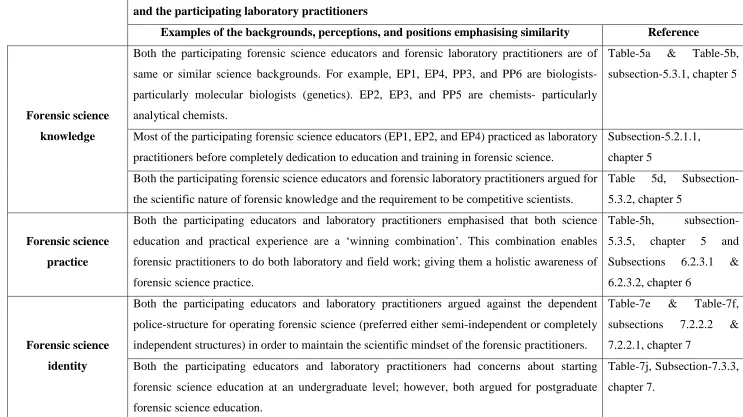
Table 8g Similarities between forensic science educators and laboratory practitioners...372
Table 9a Summary of findings of chapter 8...395
Table 9b Epistemological and associated ontological complexity components...397
1
Chapter 1: Introduction
1.1- The Subject of the Study
Over the last two decades, forensic science has emerged as one of the fields of study in academia with hundreds of universities and colleges worldwide offering forensic science programs (Quarino & Brettell, 2009; NIFS1, 2006). The high profile that forensic science has enjoyed is mainly attributed to two major factors. The first is the “immense” need by the criminal justice system for forensic laboratory services, majorly forensic DNA profiling (NIJ2, 1999). Such a need urged the expansion of these laboratory services, which in turn created new forensic science positions to be filled by individuals with the essential skills and science education specifically in the areas of chemistry, biology, and biochemistry (Quarino & Brettell, 2009).
The second factor is the media concentration on forensic science especially the “CSI” show and its “sibling” programs (Smallwood, 2002; Kobus & Liddy, 2008). Media concentration has resulted in the public developing ‘a fascination with and respect for science as an exciting and important profession unseen since the Apollo space program’ (Houck, 2006:5). Public interest in these shows has reflected on forensic science education to an extent where Max Houck, the project director of the Forensic Science Initiative at West Virginia University, remarked: ‘every third person on the planet wants to be a forensic scientist’ (Smallwood, 2002:1).
As a result, forensic science education has enjoyed an exponential increase in both the number of forensic science programs offered worldwide, and the number of students enrolling in these programs (Houck, 2006; Mennell, 2006).
This substantial increase in forensic science programs in academia suffers from arbitrariness and randomness. Some forensic science programs are well organised, where the curricula of these courses are structured, content is delivered in close collaboration with industry, and graduates are often employed by forensic science centres or law enforcement agencies. On the other hand, a number of forensic science programs are randomly organised, where the curricula of these courses are unstructured, content is delivered in isolation from industry, and graduates are not sought after by forensic science agencies.
Conferences and committees worldwide (e.g. international symposia organised by the ANZFSS3, reports and studies conducted by BAFS4, FSS5, NIJ6, NIFS7) have called for a review of current forensic science academic programs in attempt to organise forensic science education, liaise it with the forensic science industry, and develop it to meet forensic practitioners’ requirements and needs.
This research examines forensic science education from two perspectives:
a) The current status of forensic science education as reflected by the published curricula of forensic science courses/programs offered worldwide, and
b) The perceptions and informed opinions about the nature of forensic science and its education held by a number of forensic science educators, practitioners, and members of associated professions.
The research aims from such an examination to generate a comprehensive and thorough understanding of the ontological and epistemological nature of forensic science, in an attempt to identify implications for forensic science education. The research will provide a window into how possible forensic science courses could be
3 ANZFSS= Australian and New Zealand Forensic Science Society 4 BAFS= British Academy of Forensic Sciences
5 FSS= The Forensic Science Society (U.K.) 6 NIJ=National Institute of Justice (U.S.A.)
3 structured, leading to the graduation of more knowledgeable and effective forensic scientists, thus, benefiting forensic science educators, forensic science practitioners and the associated groups who rely on forensic science practice.
1.2- Forensic Science: A Field under the Microscope
The field of forensic science has always incorporated complexities and controversies throughout human history from Napoleon’s poisoning (1821) to O.J. Simpson’s case (1994), passing by ‘Australia’s forensic nightmare’, the Lindy Chamberlain case (1980s), and many other cases (Evans, 2003:172). ‘The evolution of forensic science has been a long, complex, and fascinating journey’ which has incorporated not only stories of triumph, but also stories of failure in the ‘never-ending battle to close the loopholes through which criminals slip’ (Evans, 2003:1).
Forensic science is a ‘critical and integral part’ of the judicial system, because forensic science is one of the primary means through which ‘democratic governments fulfil one of the most fundamental obligations to their citizens: public safety insurance in a just manner’ (Houck, 2006:5). Forensic scientists are obliged to work with very high professionalism within minute margins of error, if any. The evidence that a forensic practitioner might find on a crime scene, might be the only clue that was mistakenly left over by a predator and that might have survived contamination or harsh environmental conditions. Therefore, forensic scientists’ practice is so critical and important as one piece of evidence may have the potential to change juries’ deliberations and judges’ sentences from guilt to innocence or vice versa. In this respect one study revealed that ‘about one quarter of the citizens who had served on juries which were presented with scientific evidence believed that had such evidence been absent, they would have changed their verdicts- from guilty to not guilty’ (Peterson, Ryan, Houlden & Mihajlovic, 1987:1748).
practitioners, 2) the increased scrutiny on experts’ interpretations and testimonies as their opinions are now ‘generally based on more objective and verifiable measures’, and 3) the recognition by the organs of the law of the ‘relative unreliability of eyewitness evidence which rarely approaches the standards of good physical evidence, such as DNA profiles which are capable of revealing facts independent of memory shortage and many other human psychological and physiological complications’ (Liverpool John Moores University, Electronic8).
Forensic science nowadays is required to ‘answer questions of interest to the justice system’ and ‘in the security space’ (Robertson, 2008:5). Over the last decade, forensic science has been experiencing an increased pressure from governments as a result of the emergence of terrorist activities in addition to everyday homicides and criminal offences. This pressure on forensic science is often experienced consequent to events as large and shocking as the recent terrorist acts (London Bombings in July 2005, Assassination of Former Lebanese Prime Minister Rafic Hariri in February 2005, Madrid Bombings in March 2004, and World Trade Centre Bombing in September 2001), or as personal, yet shocking, as The Wee Waa Case, the sexual assault of an old woman in her 90s in a small town in New South Wales, Australia. In such cases, forensic practitioners, through seemingly unending work hours, have worked not only with victims, corpses, and human remains to identify the manner and cause of deaths or assault, but also with the community, including victim’s families and friends, who attach great significance to human life and wellbeing (James & Nordby, 2005).
Despite the importance forensic science has gained on both governmental and public levels, and the expansion within higher education it has achieved as a result (Kobus & Liddy, 2008; Mennell, 2006), forensic science academic programs are characterised by a great deal of randomness and uncertainty. Forensic science suffers a non-consensus within the academic community on whether it is a stand-alone and distinct applied field of knowledge, an associate field of study, or merely a technical derivative of existing
8
5 fields. Moreover, some scholars argue in the extreme whether or not forensic science education is a necessity at all within higher education.
This chapter explores in depth forensic science definitions, landscape, history, and prominence within media. Chapter One then addresses forensic science education, emphasising the various factors impacting such education. Finally, Chapter One identifies the research problem and addresses the research questions which are likely to propose solutions for the research problem when answered.
1.3- Forensic Science: Definitions and Landscape
1.3.1- Definitions
The word ‘forensic’ is derived from the Latin word forensis (Cassell’s Latin Dictionary9, 1987: 713) meaning:
‘of, belonging to or inhabiting the forum’ (Oxford Latin Dictionary, 1971:721), where the word forum is ‘where the law courts of ancient Rome were held’ (Camenson, 2001:1).
‘public discussion, argumentative, rhetorical’, giving the opportunity to debate or discussion (AAFS10, Electronic).
‘used in courts of law’ (Fridell, 2007:6);
The word “forensics” means ‘the art or study of formal debate; argumentation’ (The American Heritage® Dictionary, 2006). However, the word forensics has been very closely associated with the scientific field to the extent that many dictionaries nowadays interchangeably use “forensics” and “forensic science” (Camenson, 2001). The Oxford English Dictionary records that one of the first uses of the phrase “forensic
9 Cassell’s Latin- English & English-Latin Dictionary 10 AAFS: American Academy of Forensic Sciences,
science” was to describe it as “a mixed science” (Oxford English Dictionary, 2005).
Nowadays, forensic science is defined as:
‘Science as it pertains to the law’ (Tilstone, Savage & Clark 2006:161).
‘Science used in public, in a court or in the justice system; any science, used for the purposes of the law’ (AAFS, Electronic11).
Science that is ‘pertaining to, connected with, or used in courts of law’ (Camenson, 2001:1).
‘The application of the techniques of science to legal matters, both criminal and civil’ (Bell, 2004:142).
‘A blanket term for many fields and disciplines, all related to the application of science to law enforcement and to any matters that are the subject of litigation’(Eastern Washington University, Electronic12).
‘A broad term that embraces all of the scientific disciplines that are utilized in investigations with the goal of bringing criminals to justice’ (Nickell & Fischer, 1999:1).
1.3.2- Landscape
Forensic science is a very broad field as any science or piece of knowledge used to assist in resolving a legal issue or case can enjoy the adjective ‘forensic’ in such context (Robertson, 2002). Complementing Robertson, Keith Inman and Norah Rudin assert that, as a field, forensic science is very broad because ‘any profession, discipline,
11
7 craft, or art may potentially be invited into the legal arena’ ( 2001:1). Forensic science employs physical, biological, medical and even behavioural sciences to examine, analyse and evaluate physical evidence (biological and non-biological), human beings (victims and suspects) and even trace evidence (e.g. pollutants in air) to matters pertaining to law (University of Illinios Chicago, Electronic13). Unlike what some may perceive, forensic science is not restricted to criminal law matters and criminal cases. Its landscape expands to cover civil laws and cases (Bell, 2004). For example, forensic science deals with family litigation (e.g. cases of paternity proof), environmental issues (e.g. suspected source of pollution or contamination) and other security legislation (e.g. custom check). The term ‘criminalistics’ is often confused with forensic science; however, criminalistics is ‘the largest subdivision of forensic science’ that encompasses the collection, preservation, and analysis of physical evidence by applying the laws of physical sciences and natural sciences (Bell, 2004: 142).
In its broadest sense, forensic science encompasses a large number of different disciplines some of which are addressed in Table-1A (definitions and descriptions of the disciplines listed in Table-1A are attached in Appendix A).
Because forensic science is a broad field, it is nearly impossible to conceive such a field of study that comprises all these underpinning disciplines, applications and specialisations. Therefore, this research will focus on a working definition of forensic science that is confined to the application of physical sciences, biological sciences, and other uniquely forensic forms of inquiry and techniques (e.g. crime scene processing, fingerprinting, etc) to matters relating to both criminal and civil law. In other words, the working definition of forensic science will be limited to criminalistics. Hence, it will exclude many other areas related to the forensic science field such as forensic pathology, anthropology, odontology, entomology, psychiatry, computing, accounting, etc. The confining of the working definition will simplify the conduct of this research. However, it cannot ignore the epistemological complexity of forensic science which will be a challenge for any university forensic science course.
Disciplines which Fall within the Landscape of Forensic Science
Pure Sciences
a. Chemistry (Bell, 2006; Genege, 2002)
b. Biological Sciences (Butler, 2005; Gunn, 2008; Robertson, 2004)
c. Mathematics (Lucy, 2005)
d. Physics (Wilkinson et al., 2002)
Science
Applications
a. Forensic Pathology (Eckert 1997; Houck & Siege 2006)
b. Toxicology (Houck & Siege, 2006)
c. Forensic Nursing (Camenson, 2001)
d. Forensic Anthropology (Katzenberg & Saunders, 2008; Platt, 2003)
e. Forensic Archaeology (Chicora, 2003; Ferllini & Wecht, 2002)
f. Forensic Entomology (Gennard, 2007; Greenberg & Kunich, 2002)
g. Forensic Odontology (British Association for Forensic Odontology, 2002)
h. Forensic Geology (Eckert, 1997)
i. Forensic Computing (Camenson, 2001; Vacca, 2002)
j. Forensic Engineering (Houck & Siege, 2006)
k. Forensic Accounting (Bell, 2004)
l. Forensic Economics (Camenson, 2001)
m. Forensic Psychiatry & Psychology (Eckert, 1997; Houck & Siege, 2006)
Uniquely
Forensic Forms
of Inquiry
a. Crime Scene Investigation (Bell, 2004; White, 2004).
b. Fingerprinting (Tilstone et al., 2006; White, 2004)
c. Footwear and Shoeprints (Bodziak, 2000)
d. Questioned Document Examination (Kelly, 2006; White, 2004)
e. Tool Mark Examination (Kiely, 2006)
f. Photography and Imaging (Blitzer & Jacobia, 2002; Russ, 2001)
g. Firearms and Ballistics Examination (Bell, 2004; Rinker, 2005).
h. Arson (Bouguard, 2004)
i. Explosives (Yinon, 1999)
j. Other Forensic Applications: Ear print identification, Voice Identification and Speech Analysis, etc (Geradts & Sommer, 2006)
9
1.4- Forensic Science Development and Education through History
The history of forensic science may be classified into three periods (Eckert, 1997; Gerber & Saferstein, 1997; Evans, 2006). The first period was prior to the first half of the nineteenth century. This period incorporated minor forensic science events and activities. The second period extended from the second half of the nineteenth century to the first half of the twentieth century. This period was characterised by the interest in the identification of individuals using physical means. Such interest led to a number of major developments in forensic science. The third period extends from the second half of the twentieth century up until present. This period is considered to be the critical phase for the emergence of forensic science as a scientific field playing a major role in law enforcement.
1.4.1- Period 287 BC- 1850 AD
The first documented code of law that governed the practice of medicine goes back to Hammurabi, king of Babylon, around 2200 BC. In ancient Rome following his assassination in 44 BC, Julius Caesar’s body was examined by a physician (Tilstone et al., 2006). In the period 287-212 BC, Archimedes, by using the principles of water displacement to examine density and buoyancy, was able to identify a fraudulent crown that was claimed to be made up of gold. A Chinese scientist, in 1284, was the first to describe how the cause of death alters the appearance of a body (Platt, 2003). In 1609, the first serious work on systematic document examinationwas published bythe French Francois Demelle (Inman & Rudin, 2001). The first medico-legal journal was published in Berlin in 1782 (Tilstone et al., 2006). In 1814, Mathieu Orfila published the first scientific article on poison detection (Trimm, 2005).
1.4.2- Period 1851- 1950
human identification’ that is based on the hypothesis that ‘no two humans-not even identical twins- looked exactly alike (Evans, 2006:1). He published his findings in his first book on anthropometry (Trimm, 2005). Bertillon’s identification hypothesis was based on anthropologic measurements and calculations and was supported by photographic documentation (Eckert, 1997). Bertillion’s technique had been adopted to arrest offenders for a period until 1894, when it was proven to be inaccurate and to incorporate some fatal errors (Evans, 2006). In 1892, Sir Francis Galton, an English scientist, was the first to devise a method for fingerprint classification (Platt, 2003). Galton published these findings in his book Fingerprints which aided police in using fingerprinting as a mean of identification after Bertillion’s system of identification was abandoned as a result of a very famous case which proved that it is possible for two different people to have the same anthropometric measurements (Trimm, 2005). Fingerprinting has proved thereafter to be one of the arguably unique and more precise method of identification in the forensic science field (Eckert, 1997).
During this period, two German scientists, Karl Landsteiner and Paul Uhlenhuth, conducted experiments on the ABO blood grouping system and blood origin (White, 2004). These experiments on blood nature and type led to substantial advances in crime fighting (Evans, 2006). In 1893, Hans Gross, an Austrian scientist published the world’s first treatise in criminalistics which was considered to set the fundamental guidelines for criminal investigation. Gross’ work was later translated into English. The English version of Gross’ work Criminal Investigation was issued by John Adams and J. Collyer Adam in 1906 (Gerber & Saferstein, 1997). In 1910, Edmond Locard, a French scientist, established a crime laboratory at Lyon Police Department. Locard is regarded as the “father of forensic science” because he was able to define an ontological foundation for forensic science, particularly his famous guiding forensic science principle: “Every contact leaves a trace” (Trimm, 2005: 5).
11 little opportunity for formal education and training in any of the fields associated with forensic science. The first academic legal department was set up at Harvard University after World War II had finished. The majority of forensic work undertaken by chemists or medical practitioners was usually on an ‘ad hoc’ or ‘extracurricular basis’. Curricula and pedagogies that organised education in the field of forensic toxicology were random and disorganised to the extent that students had to search hard themselves for a suitable course if they wished to pursue a career in forensic toxicology (Gerber & Saferstein, 1997).
1.4.3- Period 1951- present
In the second half of the twentieth century, Paul Kirk, an American criminalist, published Crime Investigation in 1953. This book is considered one of the first inclusive criminalistics and crime investigation publications which covered both theory and practice (Inman & Rudin, 2001). As a result of his substantial contributions, Kirk is considered to be the “father of criminalistics” (AAFS: Electronic14). In the same year (1953), James WatsonandFrancis Crick reported thestructure of DNA (Edelson, 1998). In the period between 1960- 1975 much research was conducted on blood and blood stain related issues and related protocols were set up as a result. Since the 1970s, analytical chemistry has progressed to become more responsive to biological inquiries after being explicitly dedicated to chemistry (Bell, 2006). Such progress was one of the major contributors in the development of the different areas of forensic science, particularly forensic chemistry and biology (Laitinen, 1989).
In 1985, Sir Alec Jeffrey, a British geneticist, discovered a method for DNA profiling which was one of the most important revolutionary turning points in the forensic science field (Butler 2005). In 1986, DNA profiling was used for the first time to exonerate an innocent suspect and identify the murderer of two young girls in the English Midlands (Inman & Rudin, 2001). In 1989 in the U.S.A, Gary Dotson
14
became the first person in history who was proven innocent from a rape case after his conviction had been overturned on the basis of DNA evidence (Butler, 2005).
From the 1990s until the present, forensic science has advanced through developments in the scientific techniques which can be applied within forensic science, particularly the techniques of molecular biology and analytical chemistry (Butler, 2005). Advances in DNA technology- which mainly resulted from developments in analytical biochemistry- made DNA profiling more practical and reliable (Inman and Rudin, 2001). During this period, forensic science also enjoyed the establishment of computerised national databases for fingerprints, DNA, and ballistics in many countries such as United States, United Kingdom and Australia. This facilitated the way evidence, profiles, and prints are stored, searched for and examined (Tilstone et al., 2006). Scientific and technological advancements in forensic science have also impacted education and training in this field. Since the 1990s, the number of higher education providers which offer forensic science courses/programs have steadily increased in the USA, UK, Australia and many other countries (Mennell, 2006; NIFS, 2006).
1.5- Forensic Science in Public
Forensic science thrives by ‘embracing human intrigue and frailties, great mysteries and tragedies, and scientific triumphs and disgraces’ (Bell, 2008:1). Instances such as the O.J. Simpson’s Case and the Chamberlain’s Case made the public aware of forensic science. In addition, crime scene investigation shows such as the “CSI” show are often how the public learn about forensic science (Tilstone et. al., 2006). The general public has shown increased interest in forensic science and formed various perceptions of forensic related issues mainly through:
13 b) Media: The high profile forensic science has gained is mainly attributed to the prominence given to forensic science practices in the media (SEMTA15, 2004). Media focus on forensic science has been mainly through:
i. News: Controversial cases have always occupied news headlines all over the world such as: the assassination of John F. Kennedy (1963), Lindy Chamberlain’s case (1980s), O.J. Simpson’s case (1994), and many others (Evans, 2003). Such cases have pushed forensic science to become a matter of public interest (Duquesne University, 2000).
ii. Television dramas: Forensics had not been ‘popular or popularised’ until the “very popular” C.S.I show started broadcasting, followed by many related programs: CSI: Miami, CSI: NY, NCIS, and Bones (Houck, 2006:1). These TV shows have brought the recent glamorous advances in forensic science techniques to public attention and popularity. These programs are argued to have created an influence of unrealistic perceptions of forensic science in the public in relation to what a forensic practitioner can in reality do and the timeframe it takes to obtain results and answers (Robertson (media), 2010).
The exaggerated expectations of forensic science are referred to as the “CSI effect” or “CSI Syndrome” (Lovgren 2004, Rincon 2005). The “CSI effect” is strongly argued to be reflected in the public’s perceptions of what forensic science can or can’t do, in students’ high interest in forensic science courses and their high expectations of those courses, and in jurors’ demand of unreasonable levels of forensic evidence through trials (Lovgren, 2004; Rincon, 2005; Houck, 2006).
iii. Documentaries: Forensics has been the topic of many documentaries and
reality-based shows in channels such as the Learning Channel and Discovery Channel (Smallwood, 2002).
1.6- Public Interest Consequences
Forensic science has enjoyed popularity and prominence as a result of the increased media and public attention (Houck, 2006; Mennell, 2006; Smallwood, 2002). This popularity and prominence prompted the development of specific courses of preparation in universities. For example, in the United Kingdom there are currently more than 500 courses with the word ‘forensic’ in the courses’ title distributed over the British universities (Daéid & Roux, 2010). A second example is Australia, where there are currently around 23 forensic science programs covering various specialisations and academic levels ((NIFS, Electronic16). A third example is the forensic program at West Virginia University in the U.S.A, where the program has grown from 4 students in year 1997 to more than 500 students in year 2006 (Houck, 2006). Such an expansion prompts an investigation into the nature of forensic science education: What is forensic science education? How is such education organised? Where does forensic science stand in academia?
1.7- What is forensic science education? A preliminary examination
In an attempt to investigate what forensic science education is, a typology of the published curricula of a number of the forensic science courses/programs offered worldwide was conducted. Published curricula of higher education courses generally incorporate details in regard to curriculum organisation, disciplines involved, and pedagogies adopted. Therefore, the preliminary examination of the curricula of a number of forensic science courses may be expected to produce preliminary insights about the nature and current status of forensic science education.
The preliminary examination considered 16 forensic science courses offered by institutes in various regions of the world. The names of the education providers
15 offering these courses have been coded to keep program names anonymous. This procedure has been taken in compliance with the ethics requirements of the research. Coded names involved three letters followed by a 3 digit number. The three letters constitute the first three letters of the word ‘typology’. The three digit numbers have been arbitrarily chosen (e.g. TYP104).
This preliminary examination focused on attributes relating to: 1) course title, 2) administering department, 3) academic level of offer through which the course is offered, 4) incorporated disciplines, 5) place and extent of practice within the organizing curriculum, and 6) career opportunities. The results of the typology are attached at Appendix B. Table-1b contains a sample of the typology results.
Table-1b
University/
Country
Sample Table of the Typology including 16 Universities Offering a Forensic Science Program
TYP-106
UK
Level of Offer: Undergraduate- Course Title(s): Bachelor of forensic science
Administering Department: School of biological sciences
Syllabus: heavy biology component, with light forensic and chemistry components
Place of Practice: 1 year of work placement between the 2nd and 3rd years in one of the forensic centres or law enforcement agencies.
Career Opportunities: both public and private forensic laboratories
TYP-102
Australia
Level of Offer: Non-award TAFE degree- Course Title(s): Certificate IV in forensic science
Administering Department: Department of public safety and sciences
Syllabus: forensic subjects of vocational nature (e.g. fingerprinting, physical evidence, crime scene processing, etc)
Place of Practice: Syllabus is delivered by current forensic science practitioners
Career Opportunities: Course intended to provide further training for personnel already employed as forensic practitioners, law enforcement officers, and security officers. The course
also provides entry level employment opportunities in the forensic science industry
TYP-105
USA
Level of Offer: Undergraduate- Course Title(s): Bachelor of science in forensic science
Administering Department: Department of criminal justice
Syllabus: Balance between science, forensic science, and law subjects
Place of Practice: close association with state police department and state forensic medical laboratory; students are exposed to mock courtroom and real forensic laboratories
The preliminary data, revealed by this examination, strongly suggests that forensic science education is arbitrarily organised as the considered forensic science courses possessed no clear pattern(s) of:
a) The knowledge fields which should be incorporated (e.g. chemistry, biology, mathematics, physics, law, and/or forensic subjects),
b) The place and extent of practice, and
c) The identity of the field as indicated by: 1) the arbitrariness in the identity of the department administering forensic science courses (e.g. chemistry department, department of criminal justice, or school of bimolecular sciences); and 2) the non-consensus on the academic level at which forensic science education should start (non-award, undergraduate, and/or postgraduate).
These preliminary findings strongly support a further investigation on:
i. the way the forensic science knowledge base is created, organised, and taught; ii. how this knowledge base reflects the nature of everyday practice and responds
to industry needs and requirements; and
iii. the identity of forensic science and its relationship with forensic science education and everyday practice.
1.8- Forensic Science Education
Until the 1950s, forensic science lacked the existence of boards of review, boards of examination, formal education and training, organisations to run conferences and seminars, and regular forensic journals. Forensic science pedagogical frameworks and curricular activities were unpredictable and dissimilar to an extent that students had to search by themselves for a suitable course, should they wish to pursue a career in the forensic science field (Gerber & Saferstein, 1997).
17
The American Academy of Forensic Sciences (AAFS): Established in 1948, AAFS started initially as an American academy, and has become an international organisation that represents United States, Canada, and 55 other countries. The AAFS objective is to promote professional forensic science education and practice through: 1) its recognized international scientific journal: Journal of Forensic Sciences, 2) newsletters, 3) seminars and workshops, 4) conferences, and 5) annual scientific meetings. Following a recommendation by the National Institute of Justice in U.S.A. for the need to set up national standards and an accreditation system for forensic science education programs, AAFS initiated an accreditation commission (FEPAC17) in 2002 to develop, maintain, and administer an accreditation program that recognises high quality tertiary forensic science programs (undergraduate & postgraduate) (AAFS, Electronic18). To be eligible for accreditation a forensic science program must: 1) be offered by an accredited educational provider, 2) offer at least a bachelor’s degree in forensic science or in a natural science with forensic science concentration, 3) have graduated at least two classes prior to applying for accreditation and 4) have met the standards set out by the commission (FEPAC, 2003; 2009). However, the FEPAC has not yet been recognised as an accrediting organisation by the American Federal Board of Education (U.S. Department of Education, 2007) or by any federal agency (Hurley, 2007). This makes this accreditation process neither an obligation prior to establishing a forensic science program within a college or university, nor a requirement for admission to a forensic science career.
National Institute of Forensic Science (NIFS): Established in 1991 in Australia, the core functions of NIFS are to sponsor and support research and training in forensic science and assist with the coordination and development of forensic science services. NIFS is concerned with raising the ‘profile’ of forensic science; therefore, it conducts quality assurance programs as part of the training it provides (NIFS,
17 FEPAC: Forensic Science Education Programs Accreditation Commission.
2005).
Forensic science has proved itself to be a prominent area of science within the last 10 years (Mennell, 2006) enjoying a ‘huge increase in public interest’ (NIFS, 2006:7). As a result of the field’s prominence and popularity (Mennell, 2006), the number of education providers offering forensic science courses and the number of students enrolling in these courses have exponentially increased (Engber, 2005; NIFS, 2006).
Despite all its prominence and popularity, forensic science has not possessed a uniform curriculum or a consensus of what the educational requirements should be in specialised forensic science subjects (Jonakait, 1991). Moreover, despite the many strong forensic science courses offered worldwide, there are some arguments that forensic science education suffers from some weak and loosely organised courses (NIFS, 2006). The increase in the number of students studying forensic science comes in an era of decline in the number of students enrolling in higher education science courses (Mennell, 2006). These science courses are often chemistry courses in origin and have been threatened with closure as a result of this decline (NIFS, 2006). Some coordinators of science courses- chemistry in particular- have taken advantage of the recent flow in public interest towards forensic science (SEMTA, 2004). These coordinators have incorporated ‘greater or lesser amount of forensic content- sometimes by name only-’ in their curricula, in order to add or associate the adjective ‘forensic’ with the title of the offered courses; hence, the courses become more attractive and enrol more students (NIFS, 2006:10).
19 academic study in the area of forensic sciences’ versus a steady growing ‘demand for certificate and graduate education in the forensic sciences’ (Duquesne University, 2000:1).
The random expansion in forensic science education worldwide, in addition to, the inconsistency and lack of clarity in the huge range of forensic science courses on offer have led to inconsistencies in skills and competencies acquired by the graduates seeking employment in the field, and hence to criticisms by potential employers (Lewis, Brightman, & Roux, 2005). Moreover, forensic science education departments lack formal arrangement with employers to discuss course content. Instead ‘what exists is a series of ad hoc arrangements’ which occur on an individual basis between employers and universities through which ‘employers liaise with universities about particular courses’ (SEMTA, 2004:88).
1.9- Forensic Science Knowledge
Forensic science is a very broad field. It applies physical, biological, medical, behavioural sciences and various technologies into matters relating to law (Gaensslen, 2003). This is supported by the argument that any science, scientific application, piece of knowledge, or craft may be invited into the judicial arena to solve a criminal or civil case (Inman & Rudin, 1997). This research has limited the working definition of forensic science to “that profession and scientific discipline directed to the recognition, identification, individualisation and evaluation of physical evidence by application of the natural sciences to law-science matters” (Nickell & Fischer 1999:2). Hence the knowledge base incorporated in forensic science- subsequent to the limitations set by the working definition- mainly comprises chemistry, biology, maths, physics, and knowledge about uniquely forensic forms of inquiry such as fingerprinting, firearms, tool mark examination, etc.
The forensic science knowledge base is based on:
2001); and
ii. a foundation of explicit ‘forensic principles’ which explains the way evidence is created, identified, and individualised (Horswell, 2004; Broeders, 2006).
The way forensic science knowledge is created, organised and transmitted is complex. This is supported by Barclay (2003) who argues that forensic science should be perceived in terms of its role in investigations and the outputs displayed as a result, rather than by trying to define forensic science in terms of its epistemology, as its epistemological definition is too complex.
1.10- Forensic Science Practice
Until the 1950s, the majority of forensic practice was performed by chemists and medical practitioners on an ‘ad hoc’ or ‘extracurricular basis’ as a result of the absence of formal education (Gerber & Saferstein, 1997). However, since forensic educators have echoed the educational value of forensic science (Allen, Berkowitz, Hunt & Louden, 1999; Gernant, 1991), there has been emphasis on the importance that students, within forensic science courses, learn the practices of a discipline and undertake the discovery of knowledge through experimental work (Burnett, Brand & Meister, 2001). The ways forensic practitioners perceive knowledge in their investigations derive from the broad disciplines of knowledge that underpin forensic science (Barclay, 2003). Forensic science curriculum has changed to explore practical experience and law in addition to core knowledge as the contents of forensic science courses have proven to be influenced by both the demands of law and the nature of practice (Abeyasinghe, 2002).
21 science career. Smallwood (2002:3) quotes Carla Noziglia, a retired forensic laboratory director, that “there’s still a lot of controversy over hiring someone with a chemistry degree or a bachelor’s in forensic science”. According to the FBI Quality Assurance Standards for Forensic DNA Testing Laboratories, "…the technical manager or leader of a DNA section or laboratory shall have at minimum a Master’s degree in biology, chemistry or a forensic science-related area" (University of California Davis, Electronic19).
From the legal perspective, Sides (2003) asserts that there is no consensus between members of the Australian Supreme Court on whether competence and expertise in forensic science practice can be achieved by either practical experience or field of study (Clarke v Ryan, 1960: 491-2, 498-99) or that expertise should be gained through a course of study (Clarke v Ryan, 1960:591-2). The American Federal Rules of Evidence – specifically Rule 702- admit scientific testimony from experts that are either qualified by education or skilled by training and experience (Jones, 2007). Hence, scientific tertiary education is not a prerequisite to practice forensic science. However, some scholars argue that even fingerprinting identification experts should have a sound scientific background. This is because fingerprinting identification became so readily accepted and used worldwide mainly because their effectiveness had been demonstrated by Galton, a foremost anthropologist and statistician in the 19th
19
century, who enjoyed an enormous stature in the scientific world (Thornton, 2000). There have also been some recent discussions within the forensic community on the necessity of re-considering the appropriate level of qualification needed as a prerequisite for entry into forensic science practice in both field and laboratory, due to three main reasons: 1) ‘the fact that much of science is now moving from the laboratory to the field’, 2) the increased duty of care incumbent upon supervisors regarding the use of chemicals and abiding with occupational health and safety requirements (NIFS, 2006:13), and 3) the recurrence of “abuse cases” where forensic evidence presented to courts is based on an unreliable scientific premise- ‘junk
science’- because law enforcement personnel lacked a proper scientific background (Giannelli, 2006:312).
1.11- Forensic Science Identity
Forensic science has drawn media and public attention (Smallwood, 2002; Kobus & Liddy, 2008), a fascination with science unseen since the Apollo Space Program following human advancement in astronomy (Houck, 2006). Despite the prominence and high stature forensic science has gained within the general public and the consequent expansion it has achieved within higher education institutions, forensic science ‘has not enjoyed a similar rise in stature within the academic community’ (Jonakait, 1991:6). Garrison (1991:1) asserts that forensic science identity is complex because it is the ‘product of an uneasy and unholy mating of science, the objective seeker of truth and knowledge, and forensics, the argumentative persuader of courtroom advocacy’. Similarly Inman and Rudin (2000) argue that the identity of forensic science remains complex and can be partly approached from society’s perceptions.
Forensic science disciplinary uncertainty is reflected in the argument that forensic science hasn’t yet emerged as a ‘stand-alone’ discipline and often is delivered merely as a technical derivative of existing fields (Smallwood, 2002). Forensic science programs are often housed in a chemistry department and treated as a chemistry derivative (Smallwood, 2002) although it may include other sciences and applications that can be invited to solve cases pertaining to law (Inman & Rudin, 1997). On top of disciplinary uncertainty, forensic science identity suffers dilemmas, controversy, and a great deal of uncertainty with respect to the nature of the ‘science’ in forensic science:
a) Whether or not forensic science is a ‘science’; Whether or not this ‘science’ is unique and enjoys valid and reliable techniques (Giannelli, 2003, 2006; Henderson, 2004; Risinger & Saks, 2003).
23 and civil cases (Kiely, 2006).
These dilemmas add up to forensic science complexity and uncertainty and urge more research and scrutiny to identify the nature and identity of forensic science.
1.12- Problem Identification
As addressed in section 1.3 (history of forensic science education) the majority of publications, research and curricular activities of forensic science were conducted starting the 1950s. Since the 2nd half of the 20th century, the forensic science field has experienced the emergence of boards of review and examination, formal education and training, conferences and seminars, and regular forensic journals and publications (Gerber & Saferstein, 1997). Therefore, forensic science is a relatively new and developing field in terms of its education, practice and stature.
Forensic science definition and identity are complex (Inman & Rudin, 2001, Barclay 2003) because ‘any profession, discipline, craft, or art may potentially be invited into the judicial arena, simply, by adding the adjective ‘forensic’ to it (Inman & Rudin, 1997:3). On the same issue, Taylor and Meux (1997) argue that forensic practitioners find applying knowledge, expertise and research findings into daily practice complicated and problematic due to the constantly changing circumstances surrounding forensic science practice in real life. Therefore, complexity and uncertainty issues are experienced at the epistemological level of forensic science, in the nature of the actual practice, and within a wide grasp of images, profiles, impressions expectations, and perceptions that attempt to shape the identity of the field.
traditional science curriculum, a specialised stand-alone forensic science course, or an interdisciplinary model of pure sciences and forensic sciences.
The problem arises in how a forensic science curriculum might respond to its inherent epistemological complexity and uncertainty. Furthermore, the problem ramifies when it comes to developing a forensic science course/ program in academia which: a) comprises the forensic science knowledge base, b) reflects the nature of forensic science practices, c) possesses the identity and image of the forensic science field, and d) responds to industry needs and requirements.
1.13- Research Aims & Questions
The aim of this research is to approach the question of how do the curriculum and pedagogy of forensic science courses reflect the nature of forensic science by recognizing its complexity and disciplinary uncertainty as a starting point. Its elusive quality notwithstanding, forensic science has emerged in the last 100 years as a prominent professional domain with high social status and increasing political significance. The research, therefore intends to locate itself in the practices of forensic science and of forensic scientists and forensic science educators. The aim of the research is to approach forensic science epistemological complexity through generating an understanding of the knowledge base of forensic science education from a consideration of both current forensic science courses and the perceptions and conceptualisations held by forensic science educators, practitioners, and members of associated professions about: a) The professional practices of forensic science; b) The ways in which knowledge and understanding about forensic science are created organised and transmitted, and c) The identity of the forensic science field; that is the extent to which forensic science is a distinct applied knowledge field or merely a technical derivative of existing fields.
25
Major Research Question
“How do the Curriculum and Pedagogy of Forensic Science Courses Reflect the
Practice, Knowledge and Identity of the Forensic Science Field?”
:
1- How do published curriculum documents of a selected set of current forensic science courses portray the nature of the practice, knowledge and identity of the forensic science field?
Supporting Research Questions:
2- What are the perceptions of forensic science practice, knowledge and identity held by a selected group of Australian forensic practitioners, educators and members of profession?
3- What are the perceptions of current forensic science courses held by a selected group of Australian forensic practitioners, educators and members of profession?
4- In what ways do those perceptions indicate the complexity, if any, of forensic science and forensic science education?
5- How can a comparison of the document analysis of current forensic science courses with the analysis of interviewees’ perceptions provide a curriculum and pedagogical framework for forensic science education?