IJISET - International Journal of Innovative Science, Engineering & Technology, Vol. 2 Issue 7, July 2015. www.ijiset.com
ISSN 2348 – 7968
Multi-function Modification of cotton fabrics for
improving utilization of reactive dyes
H. M. IbrahimP
1*
P
and M. M. RedaP
2
P
1
P
National Research Center, Textile Research Division, Dokki, Cairo, Egypt
P
2
P
High institute of applied arts, the 5P
th
P
District, Cairo, Egypt
Abstract
The cotton fabrics was chemically modified by carboxymethyl chitosan (CMCS) which has good antibacterial properties. CMCS was synthesis by the reaction of chitosan with monochlororacetic acid in the presence of sodium hydroxide via carboxymethylation reaction. CMCS was characterized by Fourier transform infrared (FTIR) spectroscopy, nitrogen content, carboxyl content. The structure of both untreated and treated cotton fabrics were compared and investigated by FTIR and scanning electronic microscopy (SEM). The dyeing properties of the treated cotton fabrics were discussed It was found that the total dye utilization of treated cotton by the salt-free dyeing was much higher than that of untreated one by the conventional dyeing. The color fastness properties, the dyeing levelness and the tear strength of treated cotton could meet application demand. Antibacterial properties of untreated and treated cotton fabrics were evaluated. The treated fabrics show good antibacterial and enhance the dye-ability of cotton properties.
Keywords: Cotton fabrics; chemical modification; Carboxymethyl chitosan; dye utilization, Antibacterial properties.
1. Introduction
Cotton fabric is the most widely used textile in the world and is composed almost entirely of cellulose (90-96% based on weight of fibers) (1; 2). The cotton fabric has excellent physical and chemical properties, such as, stability, comfortable to wear, absorb high water and high dyeability. In industrial process, reactive dyes was widely used for cotton fabric dyeing, to it has wide color gamut and high wet fastness (3). However, reactive dyeing systems require large amounts of electrolyte to overcome the repulsive charge between cotton and reactive dyes. After dyeing, these electrolytes are neither exhausted nor destroyed and only 60–65% dye utilization is attainable (4). The residual dyes and electrolytes have caused severe environmental problem and disorders in living organisms (5).
Many researcher try to enhance fabric-dye affinity for improving utilization of the reactive dyes and eliminating or reducing the electrolyte (6-11).
Introducing cationic groups, via carboxymethylchitosan, into cotton fabrics can enhance interactions between cotton and reactive dyes. (12; 13).
Chitosan is a copolymer of glucosamine and N-acetyl glucosamine units linked by 1, 4-D-glucosidic bonds (14)
Carboxymethyl chitosan is a chitosan derivative of the most intensively investigated due to its water solubility in wider pH range compared with the parent compound, thus extended its use in various applications (15). Carboxymethyl chitosan (CMCS) is an amphiprotic ether derivative, which contains active hydroxyl (–OH), carboxyl (–COOH) and amine (–NH2) groups in the molecule. CMCS is soluble in water at neutral pH (16)
In the present study, CMCS polymer was prepared have been prepared and characterized.
CMCS was applied to modify cotton fabrics. The dyeing effect of the modified cotton fabrics in salt-free dyeing was tested and compared with that of raw cotton fabrics in conventional dyeing. Also antibacterial activity of the dyeing fabrics was evaluated.
2. Experimental part
2.1. Materials
The polymers used are chitosan (CS), and Carboxymethylchitosan (CMCS).The chitosan was obtained from Aldrich Company with viscosity 1860 cps, deacetylation 78.0%. Carboxymethylchitosan were synthesized as discussed later. Sodium hydroxide (Modern Lab chemicals, Egypt), and monochloroacetic (Fluka, Geremany) are used without further purification. Methyl alcohol, ethyl alcohol, acetic acid and isopropyl alcohol (Sisco Research Laboratories, India) and all other chemicals used are analytical grade.
The commercial reactive dye, Reactive Blue 6 and C.I. Reactive Black 5 were obtained from sinochem ningbo Dyestuff Co., Ltd., india.
2.2. Preparation of Carboxymethylchitosan (CMCS)
The carboxymethylation of chitosan was performed based on (17;18), with some modifications. Briefly, chitosan (5g), sodium hydroxide (10-70%), isopropanol (80 ml) and water (20 ml) were added into a three necked flask (250 ml) to swell at room temperature for one hour. The monochloroacetic acid (1-5 M) was dissolved in isopropanol (20 ml), and added into the reaction mixture drop wise for 30 minutes and left to react for proper time (0.5-12 hrs.) at temperature (30-90°C), then the reaction stopped by adding 80% ethyl alcohol. The solid was filtered and rinsed in 70-90% ethyl alcohol to desalt and dewater and dried at room temperature, followed by estimation of nitrogen and carboxylic contents.
2.3. Chemical modification of cotton fabrics
10 g/L of carboxymethylchitosan solution was prepared with distilled water and the pH value of the polymer solution was adjusted to 8.5. The wet pickup was adjusted at 100%. Cotton fabrics were soaked and padded in the above solution. Subsequently, the treated cotton fabric was dried at 80 ºC for 15min. Then it was cured at 130oC for 50min (19).
2.4 Characterization
Nitrogen content was determined using micro- Kehjeldal Procedure (10). Carboxyl Content of O-CMCS was determined according to a reported method (11) The FTIR spectra of the samples were recorded by using an FT- IR spectrophotometer (Nexus 670, Nicolet, USA) in the region of 4000-400cm-1 with spectra resolution of 4 cm-1.
2.5 Dyeing procedures
2.5.1 Dyeing procedure for the modified cotton
The exhaust dyeing was performed in the absence of salt. The modified cotton fabric was immerged in 4% dye solution (o.w.f, weight percent of dye relative to fiber) with a liquor ratio of 1:30. The dyeing temperature was kept at 25 ºC for 30 min and then was gradually raised to 60 ºC in 20 minutes. Subsequently, 15 g/L Na2CO3 was added to the dye solution with stirring and the dyeing temperature
was kept at 60 ºC for 60 min. After dyeing, the dyed cotton fabric was introduced in a solution containing 1 g/L nonionic surfactant (Triton X-100) at 90 ºC for 20 min at liquor ratio 1:15, and then rinsed and allowed to air dry.
2.5.2 Dyeing procedure for the untreated cotton
The untreated cotton fabric was immerged in 4% dye solution (o.w.f) with a liquor ratio of 1:30. 25 g/L NaCl was added to the dye bath with stirring. The dyeing temperature was kept at 25 ºC for 30 min. Another 25 g/L NaCl was added to the dye bath and the dyeing temperature was also slowly raised to 60 ºC in 20 minutes. Then 20 g/L Na2CO3 was put into the dye solution with stirring and the dyeing
temperature was kept at 60 ºC for 60 min. After dyeing, the dyed fabrics was introduced in a solution containing 1 g/L nonionic surfactant (Triton X-100) at 90 ºC for 20 min at liquor ratio 1:30, and then rinsed and allowed to air dry.
2.5.3. Determination of dye exhaustion and fixation
The dye exhaustion (E) was determined according to Eq. (1), where A0 was the absorbance of the
original dye solution, A1 was the absorbance of the residual dye solution after dyeing. And the dye
fixation (F) was determined according to Eq. (2) and the total utilization of the original dye (T) was determined according to Eq. (3), where A2 was the absorbance of the soap bath after soaping. The
absorbance of the dye solution was measured at maximum absorbance of dye using a Shimadzu
2.5.4. Color yield analysis
The color yield strength expressed as K/S value was obtained from the Kubelka–Munk equation
(Eq. (4)). The reflectance ratio (R) was determined at the minimum reflectance of dye using a
CM-2600d Spectrophotometer (Konica Minolta). Eight separate points on each cotton fabric sample
were measured. The levelness of the dyed cotton fabric was evaluated by Sr(λ). The lower Sr(λ) meant
better levelness (22;23). Sr(λ) was 158 calculated according to Eq. (5) and (6).
2.5.5. Color fastness and tear strength testing
The washing fastness test of the dyed cotton fabric was performed according to the standard (ISO
105-C06 (C2S)) on SW-12 (Dongyuan testing Machinery) washing machine. The rubbing fastness test
were performed according to the standard (ISO 105-X12) using Y571B (Changzhou Textile Instrument Co., Ltd.) rubbing machine.
3. Results and Discussion
3.1. Preparation of Carboxymethylchitosan as water-soluble chitosan derivative:
stretching vibrations (amide III band), respectively (24;25). The peak at 1377 cm-1 did not increase significantly in the spectra of the O-CMCS, compared to the chitosan spectrum, which indicates that a significant amount of N-carboxymethylation did not take place. (25). The stretching vibration of C–O in the CH2COOH group gives rise to the peak at 1207 cm-1. Peaks located in the range of 1175-878 cm-1 are the result of vibrations of C–O and C–O–C and some other bonds that comprise the polysaccharide chain (24).
Figure 1: FTIR Spectrum of the optimized CMCS Prepared by Reaction of 5 gm Chitosan with 2.5 M MCAA in the Presence of 50% NaOH within 3 hrs. at 60 oC
3.2 FT-IR study of the modified cotton fabric
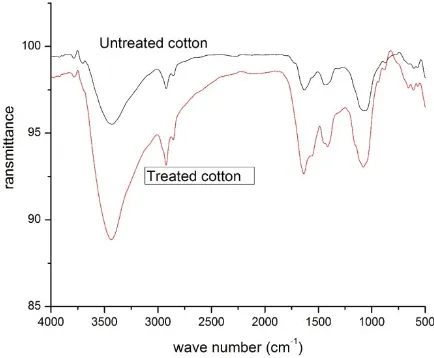
The chemical modification process of cotton fabrics is summarized in Fig.A.2. Under basic conditions, the chloromethyl group of epichlorohydrin–dimethylamine polymer could change into epoxy group and react with the primary hydroxyl groups of cotton fabrics. And then quaternary amine groups could be chemically attached in the cotton fabrics and enhance the affinity of fabric-dye. The FTIR spectrum of untreated cotton and treated cotton were illustrated in Fig.3. Compared with untreated cotton, the absorption peak at about 1460cm-1 appeared in the spectrum of the treated cotton, which was assigned to the bending vibration of C-N. This observation clearly indicated the presence of -CH2-N
+
R3 type
nitrogen (quaternary ammonium groups) (27). It fully demonstrated that the quaternary amine group was chemically absorbed on the treated cotton fabrics. It indicated that the reaction between cotton fabrics and cationic polymer occurred.
Figure 2. FTIR spectra of cotton fabric samples
Table 1 The tear strength and color fastness properties of the dyed cotton fabrics
Fabric Wash fastness Rub fastness
Shade change Staining Dry Wet
Cotton wool
Untreated 4-5 4-5 4-5 4-5 3-4
Treated 4 4-5 4-5 4 3-4
3.3 Fastness properties and tear strength
Table 1 summarized the tear strength and color fastness properties of untreated and treated cotton
fabric. The tear strength of treated cotton fabric was reduced very slightly. The treated cotton fabric
showed equal or lower rub fastness and wash fastness ratings as compared to the untreated one. These
results were relatively good and were up to the application standard for the dyed fabrics. The cationic
modification process had almost no negative influence on the tear strength and color fastness
properties of cotton fabrics.
3.4 Suitability of modified cotton fabrics with other reactive dyes
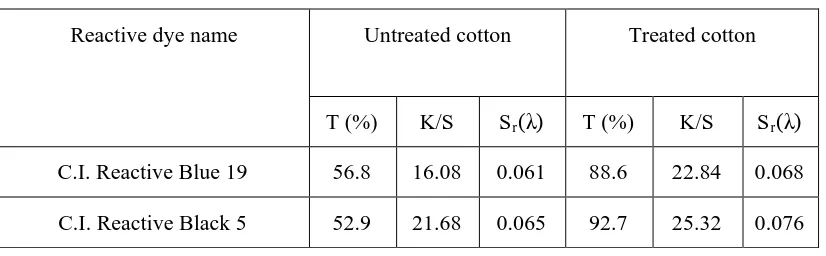
In this section, other reactive dyes were used to assess the suitability of cationic modification. The cationic cotton was dyed without the addition of salt and untreated cotton was dyed with conventional method (adding 50g/L NaCl). Table 2 shows that the color yield and the total dye utilization of the cationic cotton with four reactive dyes were all much higher than those of untreated cotton. In comparison with untreated cotton, the cationic cotton displayed excellent color strength using salt-free dyeing. Though Sr(λ) of the cationic cotton fabric was slightly higher than that of untreated cotton, the
levelness of cationic cotton was relatively good. The cross-section of the dyed cotton sample was examined under the optical microscope, as shown in Fig.A.3. It was found that the inside of the cationic cotton was largely colored and darker than untreated cotton. It demonstrated that the reactive dye had penetrated into the center of fabrics under salt-free dyeing conditions.
Table 2 Dyeing effect of untreated and treated cotton fabrics
Reactive dye name Untreated cotton Treated cotton
T (%) K/S Sr(λ) T (%) K/S Sr(λ)
C.I. Reactive Blue 19 56.8 16.08 0.061 88.6 22.84 0.068
C.I. Reactive Black 5 52.9 21.68 0.065 92.7 25.32 0.076
dye by the elimination reaction, probably due to the existence of positive charges in modified cotton. And the generated small molecule with vinyl sulfone groups could move and attack cellulosate anions to form the conventional dye-fiber bond. Therefore the dyeing levelness of treated cotton could be secured.
4. Conclusions
• Carboxymethyl chitosan (CMCS) synthesized by reaction of chitosan using
monochloroacetic acid (MCAA) in the presence of sodium hydroxide NaOH).
• It was characterized by FTIR, nitrogen, carboxylic content and degree of substitution (DS).
• After the chemical modification of the cotton fabrics, the total utilization of reactive dyes was improved greatly in the absence of salt. Besides, the color fastness properties and levelness of modified cotton fabrics were both satisfactory.
5. References
1. Hashem, M., El-Bisi, M., Sharaf, S., & Refaie, R. (2010). Pre-cationization of cotton fabrics: An effective alternative tool for activation of hydrogen peroxide bleaching process. Carbohydr.
Polym. 79(3) 533-540.
2. Yu, Y., & Zhang, Y. (2012). Controlled Synthesis, Dye-fixing Performance and Dye-fixing Mechanisms on Cotton Fabric of Novel Reactive Cationic Copolymers of N, N-Diallyl-3-hydroxy-azetidinium Chloride and Dimethyldiallylammonium Chloride (P (DHAC-DMDAAC) s). Aust. J. Chem. 65(4), 351-365.
3. Burkinshaw, S. M., & Kabambe, O. (2011). Attempts to reduce water and chemical usage in the removal of bifunctional reactive dyes from cotton: part 2 bis (vinyl sulfone), aminochlorotriazine/vinyl sulfone and bis (aminochlorotriazine/vinyl sulfone) dyes. Dyes Pigm. 88(2), 220-229.
4. Mughal, M. J., Naeem, M., Aleem, A., Saeed, R., & Ahmed, K. (2008). Effect of a cationising agent on the conventional reactive dyeing of cotton. Color. Technol. 124(1), 62-65.
5. Abdou, L. A. W., Hakeim, O. A., Mahmoud, M. S., & El-Naggar, A. M. (2011). Comparative study between the efficiency of electron beam and gamma irradiation for treatment of dye solutions. Chem. Eng. J.168(2), 752-758.
6. Acharya, S., Abidi, N., Rajbhandari, R., & Meulewaeter, F. (2014). Chemical cationization of cotton fabric for improved dye uptake. Cellulose. 21(6), 4693-4706.
7. Ben Ticha, M., Meksi, N., Drira, N., Kechida, M., & Mhenni, M. F. (2013). A promising route to dye cotton by indigo with an ecological exhaustion process: A dyeing process optimization based on a response surface methodology. Ind. Crop. Prod. 46, 350-358.
8. Fang, R., Cheng, X., & Xu, X. (2010). Synthesis of lignin-base cationic flocculant and its application in removing anionic azo-dyes from simulated wastewater. Bioresour. Technol.
101(19), 7323-7329.
9. Fu, S., Hinks, D., Hauser, P., & Ankeny, M. (2013). High efficiency ultra-deep dyeing of cotton via mercerization and cationization. Cellulose. 20(6), 3101-3110.
10. Wang, L., Ma, W., Zhang, S., Teng, X., & Yang, J. (2009). Preparation of cationic cotton with two-bath pad-bake process and its application in salt-free dyeing. Carbohydr. Polym. 78(3), 602-608.
11. Zhang, F., Chen, Y., Lin, H., Wang, H., & Zhao, B. (2008). HBP-NH2 grafted cotton fiber:
Preparation and salt-free dyeing properties. Carbohydr. Polym. 74(2), 250-256.
12. Teng, X., Ma, W., & Zhang, S. (2010). Application of tertiary amine cationic polyacrylamide with high cationic degree in salt-free dyeing of reactive dyes. Chin. J. Chem. Eng. 18(6), 1023-1028.
13. Xu, J., Renfrew, A. H. M., & Phillips, D. A. S. (2006). Functionalisation of lyocell. Part 1: Amination of lyocell with m-phenylenediaminesulphonic acid derivatives. Color. Technol.
122(1), 37-44.
14. European Polymer Journal, 42, 2606–2616
15. Jimtaisong A.and Saewan N..(2014). Utilization of carboxymethyl chitosan in cosmetics. International Journal of Cosmetic Science, 36, 12–21.
16. Chen, L., Du, Y., & Zeng X. (2003). Relationships between the molecular structure and moisture-absorption and moisture-retention abilities of carboxymethylchitosan II. Effect of degree of deacetylation and Carboxymethylation. Carbohydrate Research 338, 333–340. 17. Joshi, J.M. and Sinha, V.K. (2006): Graft copolymerization of 2-hydroxyethylmethacrylate
onto carboxymethylchitosan using CAN as an initiator. Polymer. 47: 2198-2204.
18. NY Abou-Zied, AI Waly, NG Kandile, AA Rushdy, M. A EL-Sheikh, HM Ibrahim (2013). Journal of Materials Science and Engineering with Advanced Technology Volume 7, Number 2, 2013, Pages 93-123
19. Kamel, M. M., El Zawahry, M. M., Ahmed, N. S. E., & Abdelghaffar, F. (2011). Ultrasonic dyeing of cationized cotton fabric with natural dye. Part 2: Cationization of cotton using Quat 188. Ind. Crop. Prod. 34(3), 1410-1417.
20.
A. I. Vogel, “ Text book of Quantitative Chemical Analysis “ 5th revised by G. H.
Jeffery, J. Bassett, J. Mendham and R. C. Denney, Longman Scientific & Technical
co-published in the United State with John Wiley & Sons, Inc., New York, pp.302-303,
(1989).
21.
Solid state production of cellulose–chitosan blends and their modification with the
diglycidyl ether of oligo(ethylene oxide) S.Z. Rogovinaa, T.A. Akopovab,*, G.A.
Vikhorevac, I.N. Gorbachevac, Polymer Degradation and Stability 73, 2001, 557–560
22. Fang, L., Zhang, X., & Sun, D. (2013). Chemical modification of cotton fabrics for improving utilization of reactive dyes. Carbohydr. Polym. 91(1), 363-369.
23. Zhang, M., Ju, B. Z., Zhang, S. F., Ma, W., & Yang, J. Z. (2007). Synthesis of cationic hydrolyzed starch with high DS by dry process and use in salt-free dyeing. Carbohydr. Polym.
69(1), 123-129.
24. Ibrahim, H. M., El-Zairy, E. M. R., & Mosaad, R. M. (2015). Preparation, characterization and median lethal dose (LD50) of carboxymethyl chitosan as target Drug Delivery. International
Journal, 3(1), 865-873.
25. De, H. and Luo, D. (2005): Preparation of carboxymethyl chitosan in aqueous solution under microwave irradiation. Carbohydrate Research. 340: 1351–1356.
26. Wang, L. and Wang, A. (2008): Adsorption behaviors of Congo red on the N,O-carboxymethyl-chitosan/montmorillonite nanocomposite. The Chemical Engineering Journal. 143: 43–50.
27. Anirudhan, T. S., Noeline, B. F., & Manohar, D. M. (2006). Phosphate removal from wastewaters using a weak anion exchanger prepared from a lignocellulosic residue. Environ.
Sci. Technol. 40(8), 2740-2745.