A Study on Negative Impacts of Use of RMC
in Major Construction Projects and Proposing
Effective Measures for Adoption
Faaique Mohammed. O1, Manikandaprabhu. S2
P.G. Student, Department of Civil Engineering, SRM University, Katankalathur, Chennai, India1
Assistant Professor, Department of Civil Engineering, SRM University, Katankalathur, Chennai, India2
ABSTRACT: Ready Mix Concrete is continuously growing industry in India. This industry is exposed to risks during preparation, transportation and utilization of RMC. It is important to address these risks, so that industry shall gain confidence of the customers, and shall have expected profit margins. Proposed paper presents a negative impacts caused during preparation, transportation and utilization of RMC plants in India. Unless the risks are addressed properly, the RMC industry in India shall not gain confidence of customers and will also cause reduction in profit margins. The risk causes can be categorized into internal risk causes and external risks causes. Thus, the risks related to RMC plants can be classified as internal as well as external risks. Internal risks and External risks cannot be avoided completely; yet, suitable strategies can definitely be adopted to manage these risks. This paper proposes an approach to mitigate risks in RMC plants in Indian context. Once risks are identified, mitigation measures can be adopted to treat the risks related issues. This shall help in achieving the objectives of RMC business in terms of production and supply cost.
KEYWORDS: Ready Mix Concrete, risk mitigation.
I. INTRODUCTION
IS 4926-2003 (Bureau of Indian Standard 2003) defines Ready Mix Concrete (RMC) as “Concrete delivered at site or into purchaser’s vehicle in the plastic condition and requiring no further treatment before being placed in a position in which it is to be set and hardened”. Ready Mix concrete is preferred over site mix concrete because it is environmental friendly. It is a solution to a messy and time consuming manufacturing of concrete at construction sites. It offers solutions to customer’s specific problems, ensures customer satisfaction and provides uniform quality. It also eliminates the need to store materials used to manufacture concrete at project sites. Currently, RMC is a matured industry both in Europe and USA. The data from National Ready Mix Association (March, 2007) indicate that RMC is a $ 30 billion industry in USA, with annual output of 351 million cubic Meters. In these countries, nearly 75% consumption of cement is through the RMC route (National Ready Mix Concrete Association),R.C.walke. (2012) The main objective of project is to identify the factors involved in preparation, transportation and utilization of RMC and to find out the risks involved in preparation of RMC based on the risk involved various mitigating measures will be adopted.The reliability of project is to make Ready Mix Concrete free from negative impacts caused by RMC so that the RMC industry in India shall gain confidence of the customers and shall increase the profit margins. The main hypothesis of these paper is to find out the risk involved in RMC plants based on the risk involved various mitigating measures will be adopted.
II.MIX DESIGN
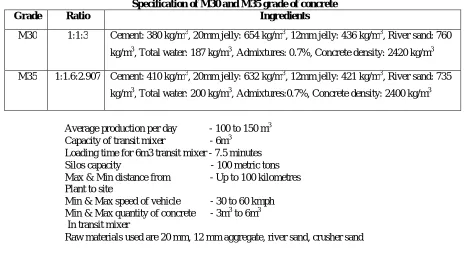
Mix design is very important step. The various quantity is decided the tested or received material is supplied to the laboratory where mix design is done. This laboratory is approved or authorized to do the mix design (Hanumant P. et. ol ). To investigate and predict the behavior of concrete made from two of the locally most common types of cement CEM I 32.5 R & CEM I 42.5 N, experimental and numerical techniques will be presented in this study (Mostafa A.M.Abdeen, HossamHodhod). Data collected from 3 different RMC plant located in Chennai, the grade of concrete used are listed in table 1.
Table 1
Specification of M30 and M35 grade of concrete Grade Ratio Ingredients
M30 1:1:3 Cement: 380 kg/m3, 20mm jelly: 654 kg/m3, 12mm jelly: 436 kg/m3, River sand: 760
kg/m3, Total water: 187 kg/m3, Admixtures: 0.7%, Concrete density: 2420 kg/m3
M35 1:1.6:2.907 Cement: 410 kg/m3, 20mm jelly: 632 kg/m3, 12mm jelly: 421 kg/m3, River sand: 735
kg/m3, Total water: 200 kg/m3, Admixtures:0.7%, Concrete density: 2400 kg/m3
Average production per day - 100 to 150 m3
Capacity of transit mixer - 6m3
Loading time for 6m3 transit mixer - 7.5 minutes
Silos capacity - 100 metric tons
Max & Min distance from - Up to 100 kilometres Plant to site
Min & Max speed of vehicle - 30 to 60 kmph
Min & Max quantity of concrete - 3m3 to 6m3 In transit mixer
Raw materials used are 20 mm, 12 mm aggregate, river sand, crusher sand
III. FACTORS INFLUENCING RMC PLANT
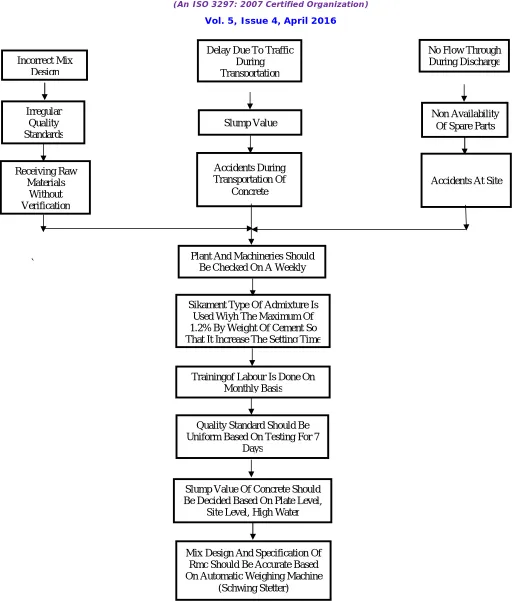
The following flowchart shows the factors influencing RMC plants in Chennai based on the factors various mitigating measures has been identified.
Ready Mix Concrete
Preparation Transportation Utilization
Improper Use Of Admixture
Frequent Breakdown Of
Machine
`
Fig 1: Factors influencing RMC plants Incorrect Mix
Design
Irregular Quality Standards
Receiving Raw Materials
Without Verification
Slump Value
Accidents During Transportation Of
Concrete
No Flow Through During Discharge
Non Availability Of Spare Parts
Accidents At Site Delay Due To Traffic
During Transportation
Plant And Machineries Should Be Checked On A Weekly
Sikament Type Of Admixture Is Used Wiyh The Maximum Of 1.2% By Weight Of Cement So That It Increase The Setting Time
Trainingof Labour Is Done On Monthly Basis
Quality Standard Should Be Uniform Based On Testing For 7
Days
Slump Value Of Concrete Should Be Decided Based On Plate Level,
Site Level, High Water
Mix Design And Specification Of Rmc Should Be Accurate Based On Automatic Weighing Machine
3.1 IMPROPER USE OF ADMIXTURE
Inappropriate use of admixture is a result of lack of expertise training in concrete technology among the skilled labour. Inappropriate use of admixture also affects pumping and dispersion of concrete and hence should be properly addressed. The techniques of admixture should be thought to labour to avoid inappropriate use of admixture. Proper supervision team should be setup for checking admixture proportion in batching plant.
3.2 RECEIVING RAW MATERIALS WITHOUT VERIFICATION
Identify the component materials that your company uses in the manufacture of RMC. Component materials may include, but are not limited to Portland cement, fly ash, slag, chemical admixture, fine aggregate, coarse aggregate and water. The materials required based on the project specification or the mix design selected.The material selected should be based on economy so that it reduce the material expenses.
3.3 DELAY IN TRANSPORTATION ON MATERIALS:
The concrete delivery process begins when the transit mixer leaves the plant and ends when the truck returns to the plant or other designated facility. For tracking transit mixer we use computer software fleet management system. Fleet management system is fully integrated with the concrete batch computer software. All the transit mixers are equipped with GPS (Global Positioning system) which link to the fleet management software.
3.4 FREQUENT BREAKDOWN OF MACHINE:
The equipment should be checked on a weekly basis so that to avoid breakdown of equipment. The breakdown of a equipment continuous to be one of the most widespread covers within this context, together with construction. Inspect the dust collection system on accordance with the manufacturer’s recommendations. For aggregate provide physical separation of aggregates.
3.5 NON AVAILABILITY OF SPARE PARTS:
Proper maintenance avoids the need for replacement of machinery spare parts and hence the problem of no availability of spare parts can be overcome to some extent possible. Monitor the high bin indicators, anti overfill device and pressure sensors for correct operations. Monitor transfer devices, turn head limit switches, and full bin signals for correct operations. In case of chemical admixtures confirm that admixture storage containers are properly identified with the chemicals stored within.
3.6 NO FLOW THROUGH PIPES DURING DISCHARGE:
Concrete pump failure due to internal and external failures. Internal factors such as mechanical failures, improper maintenance, wear and tear of rolling stocks, engine failures etc or due to external reasons such as pumping unsuitable mixes through concrete pump. In order to avoid such failure due to external factors the mix is proportioned in such a way that it is able to bind all the constituent materials together under pressure from the pump and thereby avoiding bleeding and segregation.
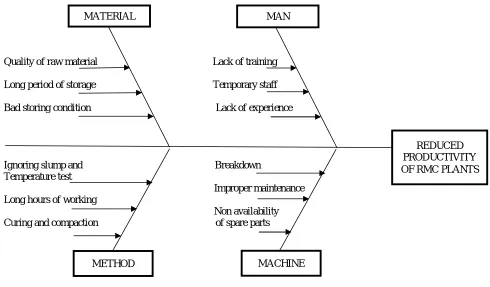
Quality of raw material Lack of training
Long period of storage Temporary staff
Bad storing condition Lack of experience
Ignoring slump and Breakdown Temperature test
Improper maintenance Long hours of working
Non availability Curing and compaction of spare parts
Fig 2: Fishbone Diagram for cause for reduced productivity of RMC
IV. CONCLUSION
The proposed project presents the negative impacts caused during preparation, transportation and utilization of RMC. The information is gathered through the interviews and discussion with the team of key personnel working in RMC plants in Chennai. A list of negative impacts has been prepared based on the data collected and according to those negative impacts mitigating measures has been listed down so that RMC industry will be free from risk and it will increase the production and supply cost of RMC plant in Chennai.
REFERENCES
[1] Ashish H., “An approach for ready mix concrete selection for construction companies through analytic hierarchy process.” IJETT. Vol 7 (7), pp 65, 2013.
[2] Chiara F. Ferraris.,“Concrete Mixing Methods and Concrete.”Journal of Research of the National Institute of Standards and Technology. Vol 106, (2), pp 391-399, 2001.
[3] Hanumant P, Swati D, Rajesh D.,“Model Chart of Quality Control Process for Ready Mixed” IOSR Vol 5 (2), pp50, 2013.
[4] Mohamed Marzouk∗, Ahmed Younes,“A Simulation Based Decision Tool for Transportation of Ready Mix Concrete International Journal of Architecture, Engineering and Construction. Vol 2, No 4 (4), pp 60, 2013.
[5] R.c.walke., “Qualitative analysis of internal and external risks for ready mix concrete plants”, IOSR journal of engineering, Vol 2 (5), pp 56, 2012.
[6] Roopdarshan.W., “Risk Quantification Using EMV Analysis”, .IJSCIintenational journal of computer science issues, Vol 7 (5), pp 60, 2010.
REDUCED PRODUCTIVITY OF RMC PLANTS MAN
MATERIAL