Black Cotton Soil Stabilization Using Lime for
Subgrade Construction
Manish Kumar Kesharwani1, Karan Parbhakar2
P.G. Student, Department of Civil Engineering, Career Point University, Kota, Rajasthan, India1 Assistant Professor, Department of Civil Engineering, Career Point University, Kota, Rajasthan, India2
ABSTRACT: The plan of stabilization on black cotton soil (expansive soil) has dependably been a troublesome assignment for the engineers as the structure laying on black cotton soil splits all of a sudden with no notice. Black cotton soil is found in Madhya Pradesh, Maharashtra, Andhra Pradesh, Karnataka, in India. Soil proportion changes depending upon their constituents, i.e. water content, density, bulk density, angle of friction, shear strength etc. The properties of black cotton soil can be changed by settling the soil with the utilization of admixtures or by mechanical methods. In this undertaking stabilization of the soil has been finished utilizing lime. Experimental work has been finished by including 3 % and 5 % of lime content operating at a black cotton soil and different soil parameters checked. The experimental work is based on different percentages of lime content in soil on tests for soil Liquid limit, Plastic limit, Shrinkage limit, compaction test, O.M.C., M.D.D, Bulk density and Dry density and C.B.R. test, Grain size analysis and Swelling pressure. The point is to improve the designing properties of the soil to such an extent that the structure laying on this soil can be capably withstanding applied load. It was discovered that when the lime is added to the soil for soil stabilization, the engineering properties of black cotton soil significantly upgraded by option of lime.
KEYWORDS:Black Cotton Soil, Lime, Stabilization, Engineering properties, etc.
I. INTRODUCTION
Transport in the Republic of India is an imperative piece of the country's economy. Roads are the imperative helps of the economy making conceivable exchange and business. They are the most favoured methods of transportation and considered as one of the practical modes. It is wanted to advance productive and very much stablished system of roads for satisfies the need of transportation framework for financial improvement.
To withstand distinctive types of load, the roads must be planned and built with most extreme care. The execution of the road relies upon the prevalence of materials for road development.
Subgrade is the layer whereupon the road layer is laid upon. The subgrade soils can be a vital factor in execution of a road. On the off chance that the soil accessible in neighbourhoods not fit for supporting the heaps, suitable strategies used to stabilize the soil and upgrade the properties of soil. Soil stabilization is one of the techniques. Stabilization of the soil subgrade and base with an appropriate substance stabilizer rises subgrade solidness, and lessens extension propensities, it executes as an establishment (ready to help and convey stacks under soaked conditions).
II. MATERIALS
Black Cotton Soil:
Lime:
Lime is an inorganic mineral containing calcium in which rich amount of oxides and hydroxides present. This is derived from lime stone. Different types of lime are used in building construction like quick lime, slaked lime, fate lime and hydrated lime.
III.EXPERIMENTAL WORK
The various tests conducted on the sample are the following: 1. Compaction test 2. CBR Test and 3. Atterberg’s Limit
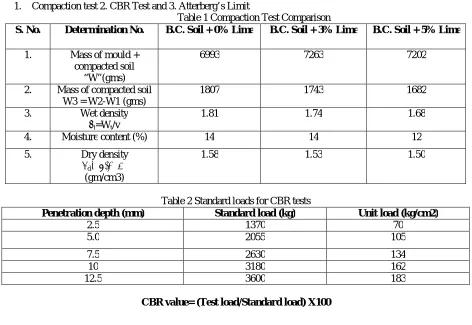
Table 1 Compaction Test Comparison
S. No. Determination No. B.C. Soil + 0% Lime B.C. Soil + 3% Lime B.C. Soil + 5% Lime
1. Mass of mould + compacted soil
“W”(gms)
6993 7263 7202
2. Mass of compacted soil W3 = W2-W1 (gms)
1807 1743 1682 3. Wet density
γt=Wt/v
1.81 1.74 1.68 4. Moisture content (%) 14 14 12 5. Dry density
Ρd= ρ/1+W
(gm/cm3)
1.58 1.53 1.50
Table 2 Standard loads for CBR tests
Penetration depth (mm) Standard load (kg) Unit load (kg/cm2)
2.5 1370 70
5.0 2055 105
7.5 2630 134
10 3180 162
12.5 3600 183
CBR value= (Test load/Standard load) X100
S. No. Composition of soil C.B.R. value
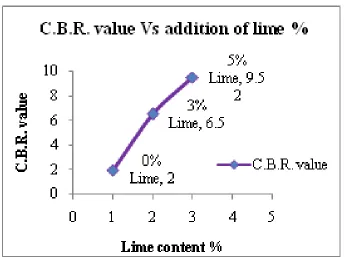
Graph 1 CBR value Vs Addition of lime
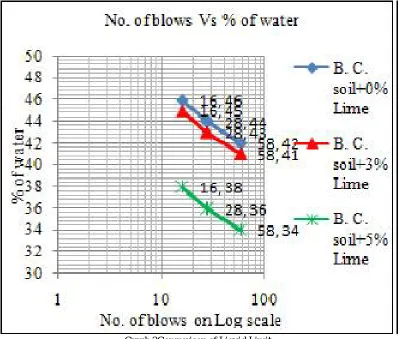
Table 3 Comparison of Liquid Limit
S.No. Black Cotton soil+0% Lime
Black Cotton soil+3% Lime
Black Cotton soil+5% Lime
% of water No. of blows
% of water
No. of blows % of water
No. of blows
1 42 58 41 28 34 38 2 44 28 43 17 36 32 3 46 16 45 11 38 16
Graph 2Comparison of Liquid Limit Table 4 Comparison of Plastic Limit
S. No. Composition of soil Plastic Limit
1 Black Cotton soil+0% Lime 30% 2 Black Cotton soil+3% Lime Non- Plastic 3 Black Cotton soil+5% Lime Non- Plastic
Plasticity Index:
Table 5Plasticity Index
S. No. Composition of soil Plasticity Index (P.I.) P.I. = L.L.- P.L.
IV.RESULTS AND DISCUSSION
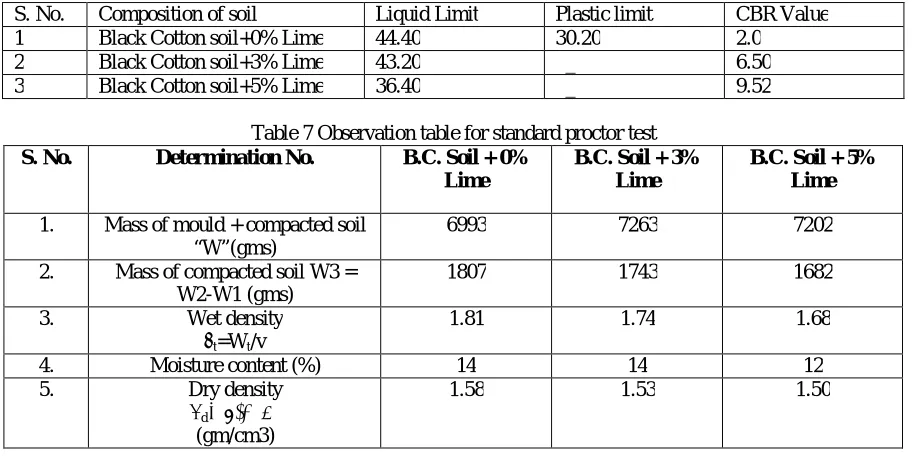
In this project work we study briefly about the properties of the BC soil and lime and perform varies test to found out weather lime is use for stabilization of BC soil or not and for that we conducted following test by using different proportion of lime and soil. Here are the test which are performed in this study-:
1. Compaction test 2.Atterberg test 3.CBR test
the basis of study and experimental work by conducting different tests we found values which are given below Table 6 Observations of experimental work
S. No. Composition of soil Liquid Limit Plastic limit CBR Value 1 Black Cotton soil+0% Lime 44.40 30.20 2.0
2 Black Cotton soil+3% Lime 43.20 _ 6.50 3 Black Cotton soil+5% Lime 36.40 _ 9.52
Table 7 Observation table for standard proctor test
S. No. Determination No. B.C. Soil + 0% Lime
B.C. Soil + 3% Lime
B.C. Soil + 5% Lime
1. Mass of mould + compacted soil “W”(gms)
6993 7263 7202 2. Mass of compacted soil W3 =
W2-W1 (gms)
1807 1743 1682 3. Wet density
γt=Wt/v
1.81 1.74 1.68 4. Moisture content (%) 14 14 12 5. Dry density
Ρd= ρ/1+W
(gm/cm3)
1.58 1.53 1.50
So by the observations of CBR test standard proctor test and Atterberg test we found that 5% lime proportion is best for stabilization of black cotton soil.
V. CONCLUSION
Points which were drawn from this study are listed below-
It is found that when 3% of lime is added, the liquid limit decreases by 2.70% while when 5% added it reflects a decrease of 15.27%.
M.D.D. is rises slightly by 6.29% at 3% and 5.59% at 5% lime content.
It is also found that there is a decrease in O.M.C. of 3.4% at 3% and 10.7% at 5% lime content.
This is also observed that C.B.R. value improve considerably to 3.25 times with 3% and 4.76 times with 5% lime.
REFERENCES
[1] H.N.RAMESH,A.J.KRISHNAIAH AND S.SHILPA SHET (2013),“EFFECT OF LIME ON THE INDEX PROPERTIES OF BLACK COTTON SOIL AND MINE TAILINGS MIXTURES”IOSRJOURNAL OF ENGINEERING,(IOSRJEN), VOL-3.
[2] Nadgouda, K.A. and Hegde, R.A. (2010), “The Effect of Lime Stabilization on Properties of Black Cotton Soil” Indian Geotechnical Conference 2010, IGS Mumbai Chapter & IIT Bombay, 511-514.
(2013) International Journal of Science and Research (IJSR) ISSN (Online): 2319-7064 Index Copernicus Value (2013): 6.14 | Impact Factor (2013): 4.438
[4] BairwaRamlakhan, Saxena Anil Kumar, Arora T.R. “Effect of lime and fly ash on Engineering Properties of Black Cotton Soil” (2013) International Journal of Emerging Technology and Advanced Engineering Website: www.ijetae.com (ISSN 2250-2459, ISO 9001:2008 Certified Journal, Volume 3, Issue 11, November 2013)
[5] Pravin Patel, Dr. H.K. Mahiyar “A Experimental study of Black Cotton Soil, Stabilized with Rice Husk ash, Fly Ash and Lime (2014) A Experimental Study of Black Cotton Soil, Stabilized with Rice Husk Ash, Fly Ash and Lime IJERT ISSN: 2278-0181 Vol. 3 Issue 11, November-2014
[6] Amruta A. Badge, Lobhesh N. Muley, Kunal R. Rau “Quality Assessment for Stabilization of Black Cotton Soil by Using Lime” (2015) Quality Assessment for Stabilization of Black Cotton Soil by Using Lime IJITE ISSN 2319-1058 Vol 5 Issue 2 April 2015.
[7] Darshitkumar R. Gohel, Sachin P. Jayaswal and Nilesh S. Masne “Stabilization of Black cotton soil by using Fly ash and Lime” IJMTER-2016 ISSN 2349-9745 Vol. 3.518