Saccharomyces cerevisiae MPT5
and
SSD1
Function in Parallel Pathways to
Promote Cell Wall Integrity
Matt Kaeberlein
1and Leonard Guarente
2Department of Biology, Massachusetts Institute of Technology, Cambridge, Massachusetts 02139 Manuscript received June 8, 2001
Accepted for publication October 26, 2001
ABSTRACT
YeastMPT5(UTH4) is a limiting component for longevity. We show here thatMPT5also functions to promote cell wall integrity. Loss of Mpt5p results in phenotypes associated with a weakened cell wall, including sorbitol-remedial temperature sensitivity and sensitivities to calcofluor white and sodium dodecyl sulfate. Additionally, we find that mutation ofMPT5, in the absence ofSSD1-V, is lethal in combination with loss of either Ccr4p or Swi4p. These synthetic lethal interactions are suppressed by theSSD1-Vallele. Furthermore, we have provided evidence that the short life span caused by loss of Mpt5p is due to a weakened cell wall. This cell wall defect may be the result of abnormal chitin biosynthesis or accumulation. These analyses have defined three genetic pathways that function in parallel to promote cell integrity: an Mpt5p-containing pathway, an Ssd1p-containing pathway, and a Pkc1p-dependent pathway. This work also provides evidence that post-transcriptional regulation is likely to be important both for maintaining cell integrity and for promoting longevity.
C
ELL integrity in the budding yeast Saccharomyces PKC1signaling pathway. The polymorphic locus SSD1cerevisiaeis governed by the regulated expression is an example of one such gene. Two types of SSD1
of many genes. The cell wall must be remodeled in alleles have been described from different laboratory
response to environmental cues, as well as cell-cycle- strains:SSD1-Vandssd1-d.SSD1-Valleles are defined by specific changes such as budding and mating (reviewed the ability to confer viability on a sit4 mutant, while in Cid et al. 1995). This highly coordinated process ssd1-dalleles are synthetically lethal in combination with requires precise transcriptional regulation, much of a deletion ofSIT4(Suttonet al. 1991).SSD1has been which is accomplished via signaling through a mitogen- shown to interact genetically with genes downstream of
activated protein kinase (MAPK) cascade regulated by PKC1. A single copy ofSSD1-Vexpressed from an
ARS-the Pkc1 protein kinase (Heinischet al. 1999). CEN plasmid is sufficient to restore growth at 37⬚ to
Pkc1p is a homolog of the mammalian protein kinase cells lacking Bck1p (Costiganet al. 1992). Mutation of C. It is activated by the Rho-like GTPase, Rho1p, which SSD1also reduces the permissive temperature of a strain
binds to Pkc1p in a GTP-dependent manner (Nonaka mutant for SLT2from 37⬚ to 30⬚(Leeet al. 1993) and
et al. 1995;Kamadaet al.1996). On the basis of genetic increases its sensitivity to caffeine (Martinet al. 1996). andin vitro data, activated Pkc1p is thought to phos- These observations suggest thatSSD1-Vcould act in par-phorylate the MAPKKK Bck1p (Levinet al. 1994), which allel to PKC1to promote cell integrity.
in turn is thought to phosphorylate the redundant In addition to suppressing mutations in thePKC1
path-MAPKKs, Mkk1p and Mkk2p (Irie et al. 1993). These way, SSD1-V alleles have been shown to affect several
proteins then activate the MAPK Slt2p, which phosphor- other cellular processes. For example,SSD1-Vhas been ylates downstream targets, including the transcription isolated as a suppressor of mutations in genes involved
factors Swi4p and Swi6p (Madden et al. 1997). Muta- in the response to cAMP (Suttonet al. 1991;Uesono
tions that perturb signaling through this pathway can et al. 1994), genes coding for subunits of RNA polymer-result in sensitivity to changes in external osmolarity, ase III (Stettler et al. 1993), and genes coding for
defective budding, and cell lysis (LevinandBartlett- splicing factors (Luukkonen and Seraphin 1999).
Heubusch1992). Ssd1p has homology to several ribonucleases and
prefer-Many of the genes important for promoting proper entially binds poly(A) mRNA (Uesonoet al. 1997). It
cell wall structure and cell integrity have been identified has been speculated that Ssd1p acts as a
post-transcrip-by their genetic interactions with components of the tional regulator.
TheMPT5(UTH4) gene shares some striking
similari-ties to SSD1. MPT5 interacts genetically with PKC1
1Present address:Longenity Inc., Medford, MA 02153.
(Hata et al. 1998), affects diverse cellular processes,
2Corresponding author:Department of Biology, Massachusetts
Insti-and can function as a post-transcriptional regulator
tute of Technology, 77 Massachusetts Ave., Bldg. 68-120, Cambridge,
MA 02139. E-mail: [email protected] (Tadauchiet al. 2001). Mpt5p is required for growth
MATERIALS AND METHODS
at high temperature (Kikuchiet al. 1994), affects
telo-meric silencing and Sir2/3/4p localization within the Strains and genetic techniques:The strains used in this study cell (Gotta et al. 1997; Cockell et al. 1998), and is are listed in Table 1. All strains were derived from W303R involved in the haploid response to pheromone (Chen (described inMillset al. 1999). Genetic crosses, sporulation, and tetrad analysis were carried out as described (Sherman
andKurjan1997).MPT5has also been identified as a
andHicks1991). The genotype of inviable spore clones was
gene required for resistance to starvation and for
wild-inferred when possible on the basis of marker segregation in
type life span (Kennedyet al.1995). Overexpression of
viable spore clones from the same tetrad. Unless otherwise
Mpt5p extends life span, demonstrating that Mpt5p is noted, cells were cultured in YPD or synthetic media prepared a limiting determinant of longevity in wild-type cells using conventional methods (GuthrieandFink1991). YPDS is YPD supplemented with 1msorbitol. YPDCFW is YPD
sup-(Kennedyet al.1997).
plemented with 0.05 mg/ml calcofluor white (Fluorescent
MPT5 was independently identified as a multicopy
Brightener 28; Sigma, St. Louis). YPDSDS is YPD
supple-suppressor ofPOP2andCCR4(Hataet al. 1998). Pop2p
mented with 0.02% SDS. YPDN is YPD supplemented with 5
is a member of the Ccr4p transcriptional complex
mg/mld-glucosamine.
(Draperet al. 1995;Liu et al. 1997). This complex is Yeast transformation was accomplished by the lithium ace-required for transcription of several genes involved in tate method (Gietzet al. 1992). Theccr4::HIS3, swi6::TRP1, mpt5::LEU2, andmpt5::HIS3disruptions were constructed
us-nonfermentative growth (Denis 1984) and includes
ing the described plasmids (Table 2). All other gene deletions
Ccr4p, Pop2p (Malvaret al. 1992), Dbf2p (Liu et al.
were generated by transforming cells with PCR-amplified
dis-1997), and Not1-4p (Liuet al. 1998). In addition to its
ruption cassettes as described (Kaeberlein et al. 1999). In
role in the transcriptional response to glucose, Ccr4p each case, the entire open reading frame (ORF) was removed also functions as one component of a distinct RNA poly- except for theswi4::HIS3disruption, which replaces the first merase II complex along with Paf1p, Cdc73p, and 2 kb of theSWI4ORF withHIS3. All disruptions were verified
phenotypically or by PCR.
Hpr1p (Chang et al. 1999). The primary role of this
Serial dilutions:Serial dilution assays were performed by
complex appears to be thePKC1-dependent
transcrip-growing cells overnight in YPD at 30⬚. Cells were then diluted
tional regulation of genes required for proper cell wall
back 50-fold in fresh YPD and cultured for 3–4 hr. For each
structure. Loss of Ccr4p causes decreased transcription strain, a series of 10-fold dilutions was prepared in fresh YEP of several genes involved in cell wall biosynthesis, includ- over a range of concentrations from 10⫺1to 10⫺5, relative to the initial culture. A total of 5l of the original culture and
ingKRE6,VAN2, andMNN1.
each dilution was spotted sequentially onto the appropriate
A secondPKC1-dependent transcriptional activator is
media. The cells were then grown at 30⬚for 2 days prior to
Swi4p. Swi4p interacts with Swi6p to form the
hetero-visualization.
dimeric transcriptional complex SBF (Andrews and
Synthetic lethality:To verify the synthetic lethality between Herskowitz 1989), which is primarily involved in the deletions ofCCR4andMPT5,mpt5 ccr4 ssd1-d2pYK690 cells cell-cycle-regulated transcription of the G1 cyclinsCLN1 were grown overnight in YPD. Fifty-microliter aliquots were then plated onto either SC-URA or synthetic media
supple-andCLN2(NasmythandDirick1991). In addition to
mented with 1.2 mg/ml 5-fluoroorotic acid (5-FOA) and
incu-its role in cell-cycle progression,SWI4is also required
bated at 30⬚ for 3 days. Only cells that have lost the URA3
for the cell-cycle-regulated transcription of the cell wall
plasmid are able to form colonies in the presence of 5-FOA.
biosynthetic genes FKS1, GAS1, KRE6, MNN1, VAN2, To verify the synthetic lethality between deletions ofSWI4and andCSD2(Igualet al. 1996). Mutation of eitherSWI4 MPT5, the same procedure was used withmpt5 swi4 ssd1-d2
or SWI6 results in sensitivity to both sodium dodecyl pSWI4 cells.
Generation ofSSD1-Vstrains:W303R has been previously
sulfate (SDS) and calcofluor white (CFW), indicating a
shown to carry thessd1-d2allele (Suttonet al. 1991).SSD1-V
defect in cell wall integrity. Genetic analysis suggests
integrating plasmids containing either TRP1or URA3 were
that the role of Swi4p in regulating cell wall biosynthesis
constructed by PCR amplifying theSSD1-Vallele from pFK1CU
consists of both aPKC1-dependent andPKC1-indepen- (Kikuchiet al.1994) and cloning into theNotI andBamHI sites dent component (Maddenet al.1997). LikeMPT5, the of pRS404 or pRS406 (Sikorski and Hieter1989). Unless slow growth and temperature sensitivity caused by loss otherwise indicated, all SSD1-V strains contain SSD1-V
inte-grated at the marker locus and still carry thessd1-d2allele at
of Swi4p can be suppressed bySSD1-V(Cvrckovaand
theSSD1locus. Deletion ofssd1-d2does not affect life span, Nasmyth1993;ChenandRosamond1998).
growth, or sensitivity to CFW (not shown), suggesting that
On the basis of the genetic relationships described
ssd1-d2is a null allele. Integration ofSSD1-Vat theSSD1locus
above, we hypothesized that the post-transcriptional
reg-has the same effects as integration at the marker locus for all
ulatorsMPT5andSSD1may share overlapping functions phenotypes tested.
with the CCR4 complex and SBF, both of which are Life-span analysis:Life spans were performed as described
(Kaeberlein et al. 1999) with the following modifications.
important for transcriptional regulation. We therefore
Cells were grown overnight at 30⬚on fresh YPD for two
consec-examined the effect of mutations in eitherCCR4or SBF
utive days. Cells were then patched onto fresh YPD and
incu-in combincu-ination withMPT5deletion. We describe here
bated at 30⬚for 3 hr. Using a micromanipulator, individual
the resulting synthetic lethal interactions. Furthermore, cells were isolated and allowed to undergo at least one cell we show that these synthetic effects are dependent on cycle. Virgin daughter cells were then isolated and life span theSSD1gene and define at least three genetic pathways was measured. Life span is defined as the number of daughter cells produced by an individual cell prior to senescence. Virgin
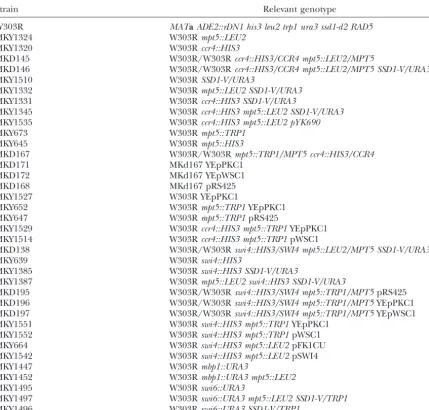
TABLE 1
Yeast strains used in this study
Strain Relevant genotype
W303R MATaADE2::rDN1 his3 leu2 trp1 ura3 ssd1-d2 RAD5
MKY1324 W303Rmpt5::LEU2
MKY1320 W303Rccr4::HIS3
MKD145 W303R/W303Rccr4::HIS3/CCR4 mpt5::LEU2/MPT5
MKD146 W303R/W303Rccr4::HIS3/CCR4 mpt5::LEU2/MPT5 SSD1-V/URA3
MKY1510 W303RSSD1-V/URA3
MKY1332 W303Rmpt5::LEU2 SSD1-V/URA3
MKY1331 W303Rccr4::HIS3 SSD1-V/URA3
MKY1345 W303Rccr4::HIS3 mpt5::LEU2 SSD1-V/URA3
MKY1535 W303Rccr4::HIS3 mpt5::LEU2 pYK690
MKY673 W303Rmpt5::TRP1
MKY645 W303Rmpt5::HIS3
MKD167 W303R/W303Rmpt5::TRP1/MPT5 ccr4::HIS3/CCR4
MKD171 MKd167 YEpPKC1
MKD172 MKd167 YEpWSC1
MKD168 MKd167 pRS425
MKY1527 W303R YEpPKC1
MKY652 W303Rmpt5::TRP1YEpPKC1
MKY647 W303Rmpt5::TRP1pRS425
MKY1529 W303Rccr4::HIS3 mpt5::TRP1YEpPKC1
MKY1514 W303Rccr4::HIS3 mpt5::TRP1pWSC1
MKD138 W303R/W303Rswi4::HIS3/SWI4 mpt5::LEU2/MPT5 SSD1-V/URA3
MKY639 W303Rswi4::HIS3
MKY1385 W303Rswi4::HIS3 SSD1-V/URA3
MKY1387 W303Rmpt5::LEU2 swi4::HIS3 SSD1-V/URA3
MKD195 W303R/W303Rswi4::HIS3/SWI4 mpt5::TRP1/MPT5pRS425
MKD196 W303R/W303Rswi4::HIS3/SWI4 mpt5::TRP1/MPT5YEpPKC1
MKD197 W303R/W303Rswi4::HIS3/SWI4 mpt5::TRP1/MPT5YEpWSC1
MKY1551 W303Rswi4::HIS3 mpt5::TRP1YEpPKC1
MKY1552 W303Rswi4::HIS3 mpt5::TRP1pWSC1
MKY664 W303Rswi4::HIS3 mpt5::LEU2pFK1CU
MKY1542 W303Rswi4::HIS3 mpt5::LEU2pSWI4
MKY1447 W303Rmbp1::URA3
MKY1452 W303Rmbp1::URA3 mpt5::LEU2
MKY1495 W303Rswi6::URA3
MKY1497 W303Rswi6::URA3 mpt5::LEU2 SSD1-V/TRP1
MKY1496 W303Rswi6::URA3 SSD1-V/TRP1
All strains are isogenic to W303R. MKY strains numbered less than MKY1000 are haploid and derived by direct transformation. MKY strains numbered greater than MKY1000 are haploid and derived by crossing. MKD strains are diploid.
cells that fail to produce at least one daughter were not in- selection, cells were grown overnight at 30⬚in 10 ml of SC-LEU. Ten-microliter aliquots were then spread onto YPD agar and cluded in the viability curves. Terminal morphology is defined
as the morphology of a cell upon senescence and prior to allowed to dry into the plates. After incubation at 30⬚for 1 hr, individual cells were isolated and life span was measured directly. lysis. Cells were tallied as having a chain-forming morphology
if a mother cell could not be detached from a daughter cell by Microscopy: Differential interference contrast (DIC) mi-croscopy was performed on a Nikon E600 microscope with a micromanipulation and if that daughter cell had undergone at
least one cell division. For the purposes of calculating life Plan Apo⫻100 objective lens. Logarithmically growing cells in YPD or YPDN were placed on a slide with a coverslip and span, daughters of chain-forming mothers were included only
if those cells subsequently produced at least one daughter. visualized directly. For CFW staining, cells were grown over-night in YPD. Overover-night cultures were diluted 1:50 into fresh During the course of each life-span experiment, cells were
incubated at 30⬚during the day and 10⬚overnight. Statistical YPD and incubated at 30⬚for 3–4 hr. Cells were then resus-pended in fresh YPD supplemented with 0.01% CFW at a significance was determined by a Wilcoxon rank-sum test.
Av-erage life span is stated to be different forP⬍ 0.05. Each density of 107cells/ml. Cells were incubated at 30⬚for 5 min and then washed with fresh YPD prior to visualization. Digital figure represents data derived from a single experiment.
The described life-span procedure was modified as follows images were obtained using a CCD camera controlled by OpenLab image acquisition software.
TABLE 2
Plasmids used in this study
Plasmid Description Source
YEpMPT5 2LEU2 MPT5 Hataet al.(1998)
YEpPKC1 2LEU2 PKC1 Hataet al.(1998)
pWSC1 2LEU2 WSC1 VernaandBallester(1999)
p⌬UTH4 mpt5::LEU2deletion plasmid Kennedyet al.(1997) p⌬CCR4 ccr4::HIS3deletion plasmid Hataet al.(1998) p⌬MPT5 mpt5::HIS3deletion plasmid Hataet al.(1998)
p⌬SWI6 swi6::TRP1deletion plasmid NasmythandDirick(1991)
pYK690 ARS-CENURA3 MPT5 Kikuchiet al.(1994)
pFK1CU ARS-CENURA3 SSD1-V Kikuchiet al.(1994)
pSWI4 ARS-CENURA3 SWI4 NasmythandDirick(1991)
p406SSD1 IntegratingURA3 SSD1-V This study
p404SSD1 IntegratingTRP1 SSD1-V This study
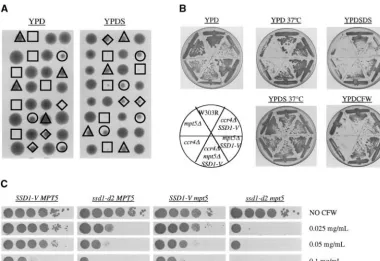
RESULTS 3). Microscopic examination of these spores revealed
that most formed microcolonies with 1–10 enlarged
Mutation of both CCR4 and MPT5 results inSSD1
-cells prior to cell lysis. A few ccr4 mpt5 ssd1-d2 spore
dependent spore inviability:Mpt5p and Ccr4p both act
clones formed mini-colonies with ⬎50 cells, but when as multicopy suppressors of pop2 (Hata et al. 1998).
streaked to fresh YPD no viable colonies were recovered. Therefore, we began our analysis of Mpt5p function by
SSD1-Vsuppresses the temperature-sensitive cell lysis examining the possibility that accr4 mpt5double mutant
phenotype of the mpt5 ssd1-d2 haploid (Figure 1B;
might be inviable. Our wild-type strain, W303R, carries
Kikuchi et al. 1994). We were, therefore, interested thessd1-d2allele (Suttonet al. 1991). It is worth noting
in determining whether SSD1-Vis able to suppress the that this allele behaves as a null allele for all phenotypes
inviability of theccr4 mpt5 ssd1-d2spore clones. A single we have tested (seematerials and methods). AMATa
copy of the SSD1-V allele was integrated at the URA3 ccr4::HIS3 ssd1-d2haploid was constructed and crossed
locus in a ccr4::HIS3/CCR4 mpt5::LEU2/MPT5 ssd1-d2/
with aMAT␣mpt5::LEU2 ssd1-d2haploid. The resulting
ssd1-d2diploid. The resulting strain was sporulated and diploid was sporulated and tetrads were dissected. Out
tetrads were dissected.SSD1-Vwas able to fully suppress of 23 expectedccr4 mpt5 ssd1-d2double-mutant spores,
none were able to form colonies (Figure 1A and Table the inability of the ccr4 mpt5 ssd1-d2 spores to form
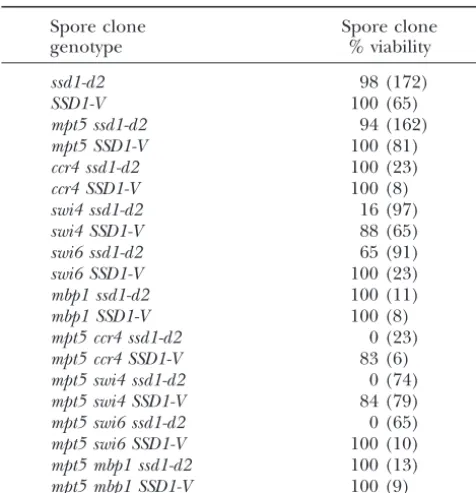
TABLE 3 when restreaked onto YPD the cells rapidly lysed and were unable to form colonies (not shown). Theccr4 mpt5
Spore clone viability
ssd1-d2cells grown on YPD underwent lysis as primarily (⬎80%) large-budded cells (not shown). This
pheno-Spore clone Spore clone
genotype % viability type is indistinguishable frommpt5 ssd1-d2cells grown on YPD at 37⬚(Kikuchiet al.1994; M.Kaeberleinand
ssd1-d2 98 (172)
L. Guarente, unpublished results) and suggests that
SSD1-V 100 (65)
the inviability of mpt5 ccr4 ssd1-d2 cells is due to the
mpt5 ssd1-d2 94 (162)
same defect that causes temperature sensitivity inmpt5
mpt5 SSD1-V 100 (81)
ccr4 ssd1-d2 100 (23) ssd1-d2cells.
ccr4 SSD1-V 100 (8) In addition to osmotic stabilization, we observed that swi4 ssd1-d2 16 (97) overexpression of eitherPKC1orWSC1is sufficient to swi4 SSD1-V 88 (65) suppress the inviability of the
ccr4 mpt5 ssd1-d2spores
swi6 ssd1-d2 65 (91)
(Table 5). Pkc1p is a central regulator of cell integrity
swi6 SSD1-V 100 (23)
that acts to promote transcription of cell wall
biosyn-mbp1 ssd1-d2 100 (11)
thetic genes, and Wsc1p is a transmembrane sensor
mbp1 SSD1-V 100 (8)
mpt5 ccr4 ssd1-d2 0 (23) that functions as an upstream activator ofPKC1. Doubly
mpt5 ccr4 SSD1-V 83 (6) heterozygous diploids with plasmids containing either mpt5 swi4 ssd1-d2 0 (74) PKC1orWSC1were able to form viableccr4 mpt5 ssd1-d2 mpt5 swi4 SSD1-V 84 (79)
spore clones only when the spores received the plasmid.
mpt5 swi6 ssd1-d2 0 (65)
Diploid cells transformed with a vector control were
mpt5 swi6 SSD1-V 100 (10)
unable to produce viable double-mutant spores (not
mpt5 mbp1 ssd1-d2 100 (13)
shown).
mpt5 mbp1 SSD1-V 100 (9)
It has been demonstrated that mutation ofCCR4
re-Tetrads were dissected onto YPD and incubated at 30⬚. Spore
sults in altered transcription of some cell wall
biosyn-clones that failed to form visible colonies after 4 days were
thetic genes and in sensitivity to the cell wall perturbing
examined microscopically to verify inviability. Numbers in
pa-agents SDS and CFW (Igual et al. 1996; Chang et al.
rentheses give the total number of representative spores
ana-lyzed. 1999). We therefore tested thempt5 ssd1-d2mutant for
similar phenotypes. Relative to wild-type cells,mpt5 ssd1-d2 andccr4 ssd1-d2haploid cells are sensitive to both SDS
colonies (Table 3). Furthermore,SSD1-Vwas also able and CFW (Figure 1B and Table 4). These defects are
to suppress the growth defect of theccr4 ssd1-d2hap- completely suppressed by the presence ofSSD1-V. loid at 37⬚(Figure 1B). This is the first reported genetic To further characterize this phenotype, we
quantita-interaction betweenSSD1andCCR4. tively examined the sensitivity to CFW caused by loss of
We verified that the inviability of mpt5 ccr4 ssd1-d2 Mpt5p. Mutation of both MPT5 and SSD1 results in
spores represented a true synthetic lethality by generat- increased sensitivity at 0.025 mg/ml, 0.05 mg/ml, and ingccr4 mpt5 ssd1-d2cells carrying the MPT5gene on 0.1 mg/ml CFW, relative to cells that carry mutations
an URA3 ARS-CEN plasmid. These cells were unable in either one of these genes (Figure 1C). Sensitivity
to grow in the presence of 5-FOA, indicating that the appears to be increased between 10- and 100-fold.
Inter-plasmid is required for viability (see materials and estingly,MPT5 SSD1-Vcells are more resistant to CFW
methods). The same effect was observed when aURA3 than either mpt5 SSD1-V or MPT5 ssd1-d2 cells. Thus,
plasmid carrying SSD1-V was used instead. Therefore, MPT5andSSD1act synergistically with respect to CFW
this can be considered a case of three-gene synthetic sensitivity, as predicted for genes in parallel pathways.
lethality. Simultaneous mutation ofMPT5, CCR4, and Taken together, the synthetic lethality, suppression
SSD1results in inviability, but the presence of a func- by osmotic stabilization and increased Pkc1p activity,
tional copy of any one of these genes allows growth. and sensitivities to SDS and CFW all suggest thatMPT5
Mutation of MPT5 results in a loss of cell integrity andCCR4function in parallel pathways to ensure cell
during mitotic growth:The ability ofSSD1-Vto suppress integrity by promoting stabilization of the cell wall.SSD1 the cell lysis phenotype of theccr4 mpt5spores suggests defines a third pathway in this process.
that the double mutant suffers from a defect in the cell MPT5 is required for viability in the absence of SBF
wall. To test this hypothesis, tetrads were dissected onto andSSD1-V:In addition to the Ccr4p complex, the
tran-YPD supplemented with 1 m sorbitol (YPDS), which scriptional activator SBF has also been shown to
func-provides osmotic stabilization and prevents lysis caused tion downstream of Pkc1p to regulate cell wall
biosyn-by a weakened cell wall. Under these conditions it was thesis (Madden et al. 1997). SBF is a heterodimeric
possible to obtain very-slow-growing ccr4 mpt5 ssd1-d2 complex of Swi4p and Swi6p.SWI4is required for the
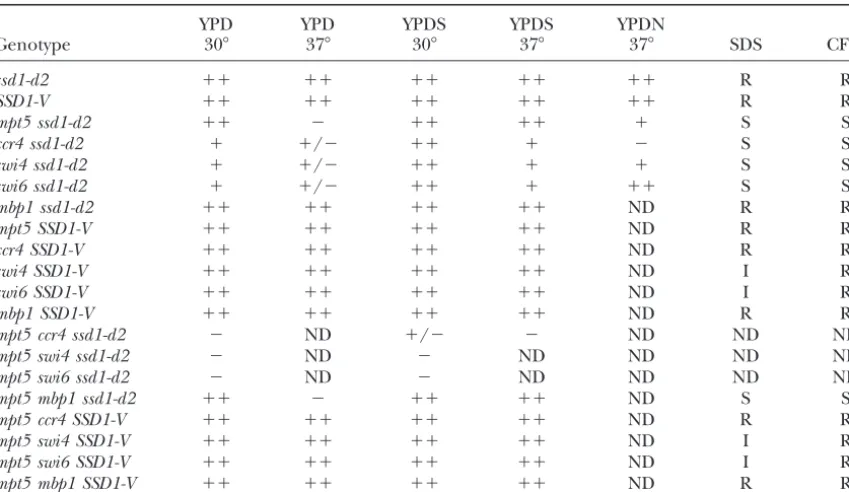
TABLE 4
Summary of cell integrity phenotypes tested in this study
YPD YPD YPDS YPDS YPDN
Genotype 30⬚ 37⬚ 30⬚ 37⬚ 37⬚ SDS CFW
ssd1-d2 ⫹⫹ ⫹⫹ ⫹⫹ ⫹⫹ ⫹⫹ R R
SSD1-V ⫹⫹ ⫹⫹ ⫹⫹ ⫹⫹ ⫹⫹ R R
mpt5 ssd1-d2 ⫹⫹ ⫺ ⫹⫹ ⫹⫹ ⫹ S S
ccr4 ssd1-d2 ⫹ ⫹/⫺ ⫹⫹ ⫹ ⫺ S S
swi4 ssd1-d2 ⫹ ⫹/⫺ ⫹⫹ ⫹ ⫹ S S
swi6 ssd1-d2 ⫹ ⫹/⫺ ⫹⫹ ⫹ ⫹⫹ S S
mbp1 ssd1-d2 ⫹⫹ ⫹⫹ ⫹⫹ ⫹⫹ ND R R
mpt5 SSD1-V ⫹⫹ ⫹⫹ ⫹⫹ ⫹⫹ ND R R
ccr4 SSD1-V ⫹⫹ ⫹⫹ ⫹⫹ ⫹⫹ ND R R
swi4 SSD1-V ⫹⫹ ⫹⫹ ⫹⫹ ⫹⫹ ND I R
swi6 SSD1-V ⫹⫹ ⫹⫹ ⫹⫹ ⫹⫹ ND I R
mbp1 SSD1-V ⫹⫹ ⫹⫹ ⫹⫹ ⫹⫹ ND R R
mpt5 ccr4 ssd1-d2 ⫺ ND ⫹/⫺ ⫺ ND ND ND
mpt5 swi4 ssd1-d2 ⫺ ND ⫺ ND ND ND ND
mpt5 swi6 ssd1-d2 ⫺ ND ⫺ ND ND ND ND
mpt5 mbp1 ssd1-d2 ⫹⫹ ⫺ ⫹⫹ ⫹⫹ ND S S
mpt5 ccr4 SSD1-V ⫹⫹ ⫹⫹ ⫹⫹ ⫹⫹ ND R R
mpt5 swi4 SSD1-V ⫹⫹ ⫹⫹ ⫹⫹ ⫹⫹ ND I R
mpt5 swi6 SSD1-V ⫹⫹ ⫹⫹ ⫹⫹ ⫹⫹ ND I R
mpt5 mbp1 SSD1-V ⫹⫹ ⫹⫹ ⫹⫹ ⫹⫹ ND R R
Growth was measured by visual observation of cells incubated under the conditions indicated for 3 or 4 days.⫹⫹, wild-type levels of growth;⫹, slow growth;⫹/⫺, very slow growth;⫺, no observable growth; ND, the experiment was not performed. For SDS and CFW sensitivities R indicates the given strain is resistant and grew well and S indicates the cells are sensitive and grew poorly or not at all in the presence of 0.05 mg/ml CFW or 0.02% SDS. I indicates that cell growth was intermediate between wild-type and sensitive strains.
growth and sensitivity to SDS and CFW (Igual et al. of thempt5 swi4 ssd1-d2triple mutant is suppressed by
the presence of SSD1-V (Tables 3 and 5). mpt5 swi4
1996). We therefore wished to place the SWI4 gene
relative to the genetic pathways described above. SSD1-V haploid cells showed mitotic growth
compar-able to wild type, andSSD1-Vwas able to suppress the NasmythandDirick(1991) reported thatswi4
mu-tants are inviable in the W3031-A background; however, sensitivity of aswi4 ssd1-d2strain to CFW (Figure 2B). In contrast to theccr4 mpt5 ssd1-d2strain, we were unable we were able to obtainswi4haploids in our W303R strain
both by tetrad dissection and by direct transformation of to obtain viable swi4 mpt5 ssd1-d2 spore clones by dis-secting tetrads on YPD supplemented with 1msorbitol haploid cells (seematerials and methods). Theswi4
ssd1-d2mutant is slow growing, exhibits lowered spore (Figure 2A and Table 4). This may indicate that the defect in theswi4 mpt5 ssd1-d2strain is more severe than viability (Table 3), and has an altered cell morphology.
To determine whether any synthetic effects are between in theccr4 mpt5 ssd1-d2strain. Overexpression of either PKC1orWSC1, however, was sufficient to confer viability SWI4andMPT5, a mpt5/MPT5 swi4/SWI4
ssd1-d2/ssd1-d2diploid was constructed and a single copy ofSSD1-V on theswi4 mpt5 ssd1-d2double-mutant cells (Table 5). The synthetic lethality betweenMPT5andSWI4 sug-was integrated at theURA3locus. This diploid was
sporu-lated and tetrads were dissected. As was the case for gests that SBF andMPT5operate in parallel pathways
to promote cell integrity. Consistent with this hypothe-mpt5 ccr4 ssd1-d2spores,mpt5 swi4 ssd1-d2spore clones
were inviable. None of the 74 spores with this inferred sis, we observed thatmpt5 swi6 ssd1-d2spore clones are also unable to form colonies (Table 3). As was the case genotype were able to form colonies (Table 3 and Figure
2A). When examined microscopically, these spores in- with SWI4, a single copy ofSSD1-V suppresses the
syn-thetic lethality between deletions of MPT5 and SWI6. variably formed mini-colonies containing one to six
lysed cells. Haploidmpt5 swi4 ssd1-d2cells were able to Likewise, theswi6 ssd1-d2mutant demonstrates
sensitivi-ties to CFW and SDS that are suppressed by SSD1-V
grow in the presence an ARS-CEN plasmid carrying
URA3 andSWI4, but were unable to lose this plasmid (Table 4).
In addition to SBF, Swi6p also forms a second hetero-as evidenced by their inability to grow on 5-FOA (not
shown; seematerials and methods). dimeric complex with Mbp1p, known as MBF (Kochet
ported (Igual et al.1996), mutation ofMBP1 did not result in sensitivity to CFW or SDS (Table 4). Thus, SBF, but not MBF, is required for viability in the absence of functional Mpt5p and Ssd1p.
SSD1-Vrestores wild-type life span to thempt5mutant
but not theccr4 or swi4 mutants: MPT5is a regulator of yeast life span. We therefore wished to determine whether the role of Mpt5p in cell wall stability is related to its role in promoting longevity. Life spans were mea-sured for mpt5 ssd1-d2, mpt5 SSD1-V, ccr4 ssd1-d2, ccr4 SSD1-V, and mpt5 ccr4 SSD1-V haploid strains. As
ex-pected, mutation of MPT5 in an ssd1-d2 background
results in a life span that isⵑ50% shorter than wild type
(Figure 3A). Mutation ofCCR4leads to an even more
dramatic 80% reduction in life span (Figure 3B). A single copy of the SSD1-Vallele is able to suppress the short life span caused by loss of Mpt5p (Figure 3A). In contrast, SSD1-V is unable to suppress the extremely short life span of the ccr4 ssd1-d2 or mpt5 ccr4 ssd1-d2 strains (Figure 3B), even though it does suppress the cell wall defects associated with loss of Ccr4p.
Mutation ofSWI4in anssd1-d2background results in
a more severe growth defect at 30⬚ than mutation of
eitherMPT5orCCR4. Not surprisingly, theswi4 ssd1-d2 strain also has an extremely short life span (Figure 3C). This life-span defect is partially suppressed by the pres-ence of theSSD1-Vallele, but the mean life span of the swi4 SSD1-V strain is stillⵑ80% shorter than the wild-type life span. The life span of the mpt5 swi4 SSD1-V strain is comparable to theswi4 SSD1-Vstrain. Thus, the
short life spans caused by mutation of CCR4 or SWI4
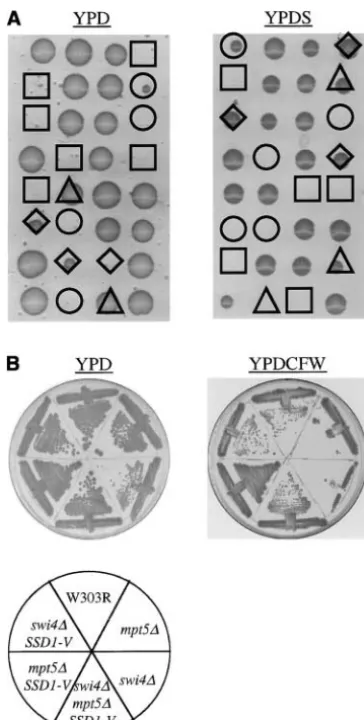
Figure 2.—Growth ofmpt5, swi4, andSSD1-Vstrains. (A)
are apparently due to something other than the cell
Strain MKd138 was sporulated and tetrads were dissected onto
integrity defect.
either YPD or YPDS. Growth after 4 days at 30⬚ is shown.
Genotypes are shown forswi4 SSD1-V(䉭),swi4 ssd1-d2(䊊), SSD1-V alters the morphology of a swi4 mutant: In
swi4 mpt5 SSD1-V(䉫), andswi4 mpt5 ssd1-d2(䊐) spore clones. addition to a shortened life span, theswi4 ssd1-d2strain (B) Strains were incubated overnight on YPD at 30⬚and then
also displayed abnormal cellular senescence. Nearly all
streaked onto the designated media. The pictures show cells
wild-type virgin cells produced one or more daughters.
after growth for 3 days.
In contrast,ⵑ35% of swi4 ssd1-d2virgin cells failed to produce even a single daughter (not shown). Instead, these cells became grossly enlarged and arrested in the also lethal in combination with mutation ofMPT5, we
unbudded state. This likely reflects an inability of these
generated an mpt5/MPT5 mbp1/MBP1 ssd1-d2/ssd1-d2
cells to accumulate G1 cyclins and proceed into S phase diploid and examined spore viability. In contrast toSWI4
(Nasmyth and Dirick 1991). After a few hours, the and SWI6, we observed no synthetic interactions
be-tween MPT5 and MBP1 (Table 3). As previously re- enlarged unbudded cells lysed, perhaps due to the cell
TABLE 5
Suppressors of the synthetic lethal interactions described in this study
Synthetic lethal interaction YEpPKC1 2WSC1 SSD1-V 1msorbitol
mpt5 ccr4 YES YES YES YES
mpt5 swi4 YES YES YES NO
mpt5 swi4 YES YES YES NO
Figure3.—Life-span analysis of mpt5, ccr4, swi4, andSSD1-Vstrains. (A) Life spans were determined for W303R (䉬),mpt5 ssd1-d2(䊏), andmpt5 SSD1-V(䉱) strains. Mean life spans and number of cells analyzed were W303R 22.7 (n⫽40),mpt5 ssd1-d2 10.2 (n⫽40), andmpt5 SSD1-V19.5 (n⫽40). (B) Life spans were determined for W303R (䉬),ccr4 ssd1-d2(䊏),ccr4 SSD1-V (䉱), andmpt5 ccr4 SSD1-V(䊉) strains. Mean life spans and number of cells analyzed were W303R 22.4 (n⫽50),ccr4 ssd1-d2 3.2 (n⫽47),ccr4 SSD1-V4.0 (n⫽46), andccr4 mpt5 SSD1-V3.5 (n⫽46). (C) Life spans were determined for W303R (䉬),swi4 ssd1-d2(䊏),swi4 SSD1-V(䉱), andmpt5 swi4 SSD1-V(䊉) strains. Mean life spans and number of cells analyzed were W303R 22.4 (n⫽50),swi4 ssd1-d2 1.8 (n⫽33),swi4 SSD1-V 5.3 (n⫽50), andswi4 mpt5 SSD1-V3.6 (n⫽49). (D) Terminal morphology of W303R,swi4 ssd1-d2, and swi4 SSD1-Vmother cells. A cell was defined as senescent and terminal morphology was recorded if it failed to divide after 12 hr incubation at 30⬚or upon lysis.
integrity defect. The presence of theSSD1-Vallele fully cells senesce as unbudded cells prior to lysis, again likely reflecting a defect in G1 cyclin accumulation. (Note suppresses this phenotype. Whileswi4 SSD1-Vvirgin cells
still showed delayed exit from G1 and became enlarged, that these data do not include those virgin cells that fail to produce at least one daughter. If these cells were the cells failed to lyse and usually completed at least
one cell cycle prior to senescence. Virgin cells that failed included, the fraction of unbudded swi4 ssd1-d2 cells would be even greater.) In contrast,swi4 SSD1-Vcells are to produce at least one daughter are excluded from the
data used to generate the life-span curves (seemateri- likely to senesce with a large-budded or chain-forming morphology. Cells were defined as having a chain-form-als and methods).
Terminal morphology of mother cells has recently ing morphology if mother cells senesced while attached
to at least one daughter cell that divided at least one been shown to provide information regarding the
mech-anisms of senescence in different mutant backgrounds time. No difference in terminal morphology was
ob-served betweenSWI4 ssd1-d2andSWI4 SSD1-Vcells (not (McVeyet al. 2001). We therefore examined the
termi-nal morphology of swi4 ssd1-d2 and swi4 SSD1-V cells shown).
swi4 SSD1-Vmutants appear to have a defect in
cytoki-that produced at least one daughter (Figure 3D).
larged vacuoles or a clearly altered cellular morphology, perhaps just preceding lysis. These phenotypes were largely suppressed by the presence ofSSD1-V.
The chain-forming morphology of swi4 SSD1-V cells
suggested a defect in cytokinesis. To further examine this possibility, we microscopically analyzed cells stained with CFW, a fluorescent molecule that preferentially binds chitin in the cell wall. Wild-type andswi4 ssd1-d2 cells showed relatively normal CFW staining (Figure 4, D and E). In contrast,swi4 SSD1-Vcells often had brightly staining chitin rings between mother and daughter cells present in the chains (Figure 4F). Often a single central mother was present with three or more daughters still attached. We propose that mutation ofswi4results in several different defects: delayed accumulation of G1 cyclins, a defect in cell wall stability during G1, and incomplete cytokinesis.SSD1-Vis apparently able to sup-press the cell wall defect and prevent lysis, but is unable to suppress the other phenotypes.
Glucosamine alters phenotypes caused by mutation of SWI4 and MPT5: The swi4 SSD1-V strain displays a defect in cytokinesis and chitin distribution during loga-rithmic growth in YPD. A similar defect in cytokinesis was observed in aswi4 agm1 double mutant (Igual et al. 1997). This defect was suppressed by addition of
glucosamine to the media.AGM1codes for an enzyme
involved in chitin biosynthesis, and glucosamine is a precursor of chitin. We therefore wished to determine whether glucosamine could also suppress the cytokinesis defect of theswi4 SSD1-Vstrain.
Wild-type cells grown in YPDN (YPD supplemented with 5 mg/ml glucosamine) grew normally and showed no obvious changes in morphology relative to untreated cells (Figure 4G). Surprisingly, growth in YPDN caused swi4 ssd1-d2cells to adopt a chain-forming morphology similar to that of theswi4 SSD1-Vcells in YPD (Figure 4H), suggesting that glucosamine may act likeSSD1-V to prevent lysis prior to budding. Addition of glucosa-mine failed to suppress the cytokinesis defect of the swi4 SSD1-Vcells (Figure 4I).
We also examined whether glucosamine could sup-press any of the phenotypes associated with mutation ofMPT5. Glucosamine had no effect on the growth of mpt5 ssd1-d2ormpt5 SSD1-Vcells at 30⬚; however,mpt5
Figure4.—Microscopic analysis of W303R (A, D, G),swi4
ssd1-d2cells were able to grow on YPDN at 37⬚(Table
ssd1-d2(B, E, H), andswi4 SSD1-V(C, F, I) cells. For A–C,
4).mpt5 ssd1-d2cells were unable to grow on YPD
supple-cells were grown in YPD and visualized using DIC microscopy.
mented with either 5 mg/ml glucose or 5 mg/ml
sorbi-For D–F, cells were grown in YPD, stained with CFW, and
visualized with the 4⬘6-diamidino-2-phenylindole channel. For tol at 37⬚, demonstrating that this effect is specific to G–I, cells were grown in YPDN and visualized using DIC mi- glucosamine. The ability of glucosamine to suppress the croscopy.
temperature sensitivity caused by loss of Mpt5p may suggest thatmpt5 ssd1-d2 cells suffer from a defect in chitin biosynthesis or chitin distribution.
forming morphology would be apparent in a
logarithmi-The short life span caused by loss of Mpt5p is likely
cally growing culture. Indeed, we observed that a large
to be caused by a defective cell wall:Is the role ofMPT5 proportion ofswi4 SSD1-V cells were found in clumps
in life-span regulation related to its role in cell integrity? or chains (Figure 4C). These chains were observed only
Overexpression of Mpt5p extends life span in W303R infrequently in swi4 ssd1-d2 cultures (Figure 4B) and
byⵑ20% (Figure 5A) and deletion shortens life span almost never in wild-type cultures (Figure 4A). In
Figure5.—Cell wall integrity and life span. (A) Life spans were determined for (䉬) W303R and (䊏) W303R overexpressing Mpt5p (W303RADH_MPT5). Mean life spans and number of cells analyzed were W303R 20.1 (n⫽40) and W303RADH_MPT5 25.1 (n⫽40). (B) Life spans were determined for W303R grown on YPD (䉬),mpt5 ssd1-d2grown on YPD (䊏), andmpt5 ssd1-d2grown on YPD supplemented with 1msorbitol (YPDS) (䉱). Mean life spans and number of cells analyzed were W303R YPD 23.0 (n⫽40),mpt5 ssd1-d2YPD 10.7 (n⫽40), andmpt5 ssd1-d2YPDS 20.6 (n⫽40). (C) Life spans were determined for W303R grown on YPD (䉬), W303R grown on YPD supplemented with 0.5 mg/mld-glucosamine (YPDN) (䊏),mpt5 ssd1-d2grown on YPD (䉱), andmpt5 ssd1-d2grown on YPDN (䊉). Mean life spans and number of cells analyzed were W303R YPD 23.2 (n⫽40), W303R YPDN 23.8 (n⫽40),mpt5 ssd1-d2YPD 9.0 (n⫽40), andmpt5 ssd1-d2YPDN 17.6 (n⫽40). (D) Life spans were determined for W303R pRS425 (䉬),mpt5 ssd1-d2pRS425 (䊏), W303R YEpPKC1 (䉱), andmpt5 ssd1-d2YEpPKC1 (䊉) strains. Mean life spans and number of cells analyzed were W303R pRS425 17.7 (n⫽40),mpt5 ssd1-d2pRS425 8.3 (n⫽40), W303R YEpPKC1 16.9 (n⫽ 40), andmpt5 ssd1-d2YEpPKC1 10.0 (n⫽40).
suppressors of the temperature sensitivity caused by mu- ing factors within the nucleus, life span, and resistance to environmental stress. We show here that genetic anal-tation of MPT5, we wished to determine whether life
span was also affected.SSD1-Vsuppressed the short life ysis places MPT5parallel toSSD1in one pathway pro-moting cell integrity and also parallel to PKC1, CCR4, caused by loss of Mpt5p to the level of wild type (Figure
3A). Likewise, growth in the presence of 1 m sorbitol andSBFin a second pathway (Figure 6). Strains carrying mutations in all three pathways are inviable, whereas (Figure 5B) or 5 mg/ml glucosamine (Figure 5C) largely
suppressed the short life span of thempt5 ssd1-d2strain. the cell is able to survive loss of function in any two pathways. We also provide evidence that the short life Overexpression ofPKC1only slightly extended the life
span of thempt5mutant, and neither glucosamine nor span caused by loss of Mpt5p is due to a defect in cell
wall stability, perhaps related to chitin biosynthesis. PKC1overexpression was capable of extending wild-type
life span (Figure 5, C and D). Our three-pathway model is based on the discovery
of synthetic lethal interactions between MPT5, CCR4, andSSD1and betweenMPT5, SBF, andSSD1. One
con-DISCUSSION cern with using synthetic lethality to construct parallel
silenc-SDS or CFW in the Mpt5p-overexpressing strain (not shown). It is possible, however, that in Mpt5p-overex-pressing cells, the cell wall structure could be stabilized, yet not result in enhanced resistance to these chemicals. Several treatments that suppress the temperature sen-sitivity caused by loss of Mpt5p also suppress the life-span defect.SSD1-V, osmotic stabilization, and growth in the presence of glucosamine all restored wild-type
longevity to the mpt5 ssd1-d2 mutant (Figure 3A and
Figure 5, B and C). Overexpression ofPKC1 failed to fully suppress the life-span defect; however, hyperactiva-tion of thePKC1pathway is known to be toxic ( Wata-nabe et al. 1995), which could account for the slow growth and short life span of these cells. We, therefore, favor the interpretation that the short life span of the mpt5 ssd1-d2strain is likely to be caused by a defect in the cell wall. It remains to be determined whether the life-span extension observed in cells overexpressing MPT5 is due to increased cell wall stability or to an additional function of Mpt5p, such as the regulation of Sir2p localization.
The short life span caused by loss of either Ccr4p or Swi4p is likely due to a defect other than a weakened
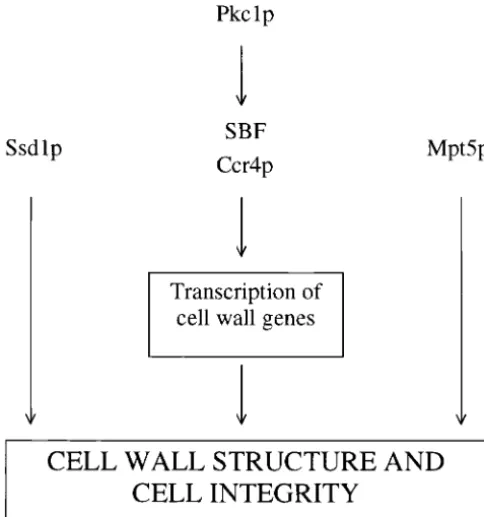
Figure 6.—Genetic model describing the function of
cell wall. This is evidenced by the fact thatSSD1-V is
Mpt5p and Ssd1p in cell wall integrity. Mpt5p, Ssd1p, and
able to suppress the sensitivity of these strains to CFW
Pkc1p define three parallel pathways that regulate cell
integ-rity. SBF and Ccr4p function as transcriptional activators down- or SDS, but fails to restore wild-type life span. We do stream of Pkc1p. Mpt5p and Ssd1p could act either post- not propose that mutation of eitherccr4orswi4results transcriptionally to regulate genes involved in cell wall
biosyn-in premature agbiosyn-ingper se. Rather, it seems likely that
thesis or as upstream regulators that promote cell integrity by
these mutations result in defects that shorten replicative
an indirect mechanism.
capacity by a mechanism unrelated to the normal aging process.
Function ofSSD1-VandMPT5in promoting cell
integ-that happen to result in inviability when simultaneously
disrupted. We do not believe this is the case here for rity: How do MPT5 and SSD1-V act to promote cell
integrity? The ability of glucosamine to suppress the several reasons. First, mutants forMPT5,CCR4, or SBF
all display phenotypes associated with a weakened cell temperature sensitivity and short life span caused by
mutation ofMPT5suggests a role for Mpt5p in chitin wall, such as sorbitol-remedial temperature sensitivity
and sensitivity to CFW and SDS. Second, these pheno- biosynthesis or accumulation. Interestingly, mutation of the chitin synthaseCHS3also results in sorbitol-remedial types are suppressed either bySSD1-Vor by
overexpres-sion ofPKC1. Third,SSD1-Vpromotes increased resis- temperature sensitivity in some strain backgrounds
(Bulawa 1992). We speculate that, like the cases for tance to CFW even in the presence of functional Mpt5p,
Ccr4p, and SBF. Finally, bothCCR4and SBF are known MPT5,CCR4, andSWI4, the strain-specific phenotypes
associated with loss ofCHS3are due to the presence of to act downstream ofPKC1to regulate cell wall
biosyn-thesis. Taken together, we conclude that it is likely that differentSSD1alleles.
Mpt5p shares homology with the Drosophila transla-all of these proteins have a role in promoting cell wtransla-all
stability. Thus, we feel that it is appropriate to use syn- tional repressor pumilio (Kennedy et al. 1997) and is
required for post-transcriptional repression of HO
thetic lethality to order these genes into three parallel
pathways. (Tadauchi et al. 2001). It is interesting to note that
SWI4andSWI6were originally identified as regulators
MPT5,CCR4, andSWI4are required for wild-type life
span: The fact that MPT5 functions to promote both of HO expression, as well (Breeden and Nasmyth 1987). LikeMPT5,SSD1-Valso shares homology to RNA-longevity and cell integrity might suggest that the cell
wall can become a limiting factor in old cells. Overex- binding proteins and it has been proposed that SSD1-V functions as a post-transcriptional regulator of mRNA pression of Mpt5p could extend life span by increasing
cell integrity and preventing lysis. This hypothesis makes stability. Uesono et al.(1997) have shown that Ssd1p preferentially binds poly(A) RNA, although no catalytic two predictions: first, overexpression of Mpt5p should
result in increased cell wall stability, and second, treat- activity has been detected.
One intriguing model is thatCCR4,SWI4,MPT5, and ments that suppress the temperature sensitivity of the
would act at the level of mRNA transcription to regulate LITERATURE CITED
basal and cell-cycle-specific expression of these genes. Amon, A., M. Tyers, B. FutcherandK. Nasmyth, 1993
Mecha-nisms that help the yeast cell cycle clock tick: G2 cyclins
transcrip-The mRNA-binding factors Mpt5p and Ssd1p would act
tionally activate G2 cyclins and repress G1 cyclins. Cell74:993–
post-transcriptionally to regulate translational efficiency
1007.
and mRNA stability. Reports that both Mpt5p and Ssd1p Andrews, B. J., andI. Herskowitz, 1989 The yeast SWI4 protein
contains a motif present in developmental regulators and is part
are cytoplasmically localized are consistent with such a
of a complex involved in cell-cycle-dependent transcription.
Na-model (Uesonoet al.1997; K.Millsand L.Guarente,
ture342:830–833.
unpublished results). Breeden, L., andK. Nasmyth, 1987 Cell cycle control of the yeast
HO gene: cis- and trans-acting regulators. Cell48:389–397.
An alternative possibility is that Mpt5p and/or Ssd1p
Bulawa, C. E., 1992 CSD2, CSD3, and CSD4, genes required for
act indirectly by regulating gene expression of upstream
chitin synthesis in Saccharomyces cerevisiae: the CSD2 gene
prod-factors. These factors would then act to regulate expres- uct is related to chitin synthases and to developmentally regulated
proteins in Rhizobium species and Xenopus laevis. Mol. Cell.
sion of genes important for cell integrity. Consistent
Biol.12:1764–1776.
with an upstream regulatory role, Mpt5p has been
Chang, M., D. French-Cornay, H. Y. Fan, H. Klein, C. L. Denis shown to interact physically with the cyclin-dependent et al., 1999 A complex containing RNA polymerase II, Paf1p,
Cdc73p, Hpr1p, and Ccr4p plays a role in protein kinase C
signal-kinase Cdc28p (Chen andKurjan 1997). Cdc28p, in
ing. Mol. Cell. Biol.19:1056–1067.
turn, is known to activate both Pkc1p (Marini et al.
Chen, C. Y., andJ. Rosamond, 1998 Candida albicans SSD1 can
1996) and Swi4p (Amonet al.1993;SiegmundandNas- suppress multiple mutations in Saccharomyces cerevisiae.
Micro-biology144:2941–2950.
myth1996). Likewise, there is ample evidence thatSSD1
Chen, T., andJ. Kurjan, 1997 Saccharomyces cerevisiae Mpt5p
in-affects a wide variety of cellular processes, suggesting a
teracts with Sst2p and plays roles in pheromone sensitivity and
more global role for this gene. recovery from pheromone arrest. Mol. Cell. Biol.17:3429–3439.
Cid, V. J., A. Duran, F. del Rey, M. P. Snyder, C. Nombelaet al.,
Finally, it is also possible that Mpt5p and Ssd1p could
1995 Molecular basis of cell integrity and morphogenesis in
act transcriptionally, or post-transcriptionally, to
in-Saccharomyces cerevisiae. Microbiol. Rev.59:345–386.
crease expression of Ccr4p, Swi4p, and Swi6p. We have Cockell, M., H. Renauld, P. WattandS. M. Gasser, 1998 Sif2p
interacts with Sir4p amino-terminal domain and antagonizes
telo-used microarray analysis to examine the transcriptional
meric silencing in yeast. Curr. Biol.8:787–790.
profile of SSD1-V cells relative to ssd1-d cells. We find
Costigan, C., S. GehrungandM. Snyder, 1992 A synthetic lethal
thatSSD1-Vdoes not significantly alter the abundance screen identifies SLK1, a novel protein kinase homolog
impli-cated in yeast cell morphogenesis and cell growth. Mol. Cell.
of SWI6, SWI4, or CCR4 transcripts in logarithmically
Biol.12:1162–1178.
growing cells (M.Kaeberlein, A.Andalis, G.Finkand
Cvrckova, F., andK. Nasmyth, 1993 Yeast G1 cyclins CLN1 and
L.Guarente, unpublished data). Moreover, this model CLN2 and a GAP-like protein have a role in bud formation.
EMBO J.12:5277–5286.
fails to explain why the presence of functional Mpt5p
Denis, C. L., 1984 Identification of new genes involved in the
regula-or Ssd1p is sufficient fregula-or viability in the absence of Ccr4p
tion of yeast alcohol dehydrogenase II. Genetics108:833–844.
or SBF. If Mpt5p and Ssd1p promote cell integrity by Draper, M. P., C. SalvadoreandC. L. Denis, 1995 Identification
of a mouse protein whose homolog in Saccharomyces cerevisiae
acting as activators of CCR4, SWI4, and SWI6, then
is a component of the CCR4 transcriptional regulatory complex.
Mpt5p and Ssd1p should have no effect in strains
mu-Mol. Cell. Biol.15:3487–3495.
tant for these genes. In contrast, we find that either Gietz, D., A. St. Jean, R. A. WoodsandR. H. Schiestl, 1992
Im-proved method for high efficiency transformation of intact yeast
Ssd1p or Mpt5p is absolutely required for viability under
cells. Nucleic Acids Res.20:1425.
these conditions. Therefore, we do not favor this model
Gotta, M., S. Strahl-Bolsinger, H. Renauld, T. Laroche, B. K.
to explain the function of Mpt5p and Ssd1p. Kennedy et al., 1997 Localization of Sir2p: the nucleolus as
a compartment for silent information regulators. EMBO J.16:
Mpt5p and Ssd1p have many features in common.
3243–3255.
Both are likely to regulate gene expression
post-tran-Guthrie, C., andG. R. Fink, 1991 Guide to Yeast Genetics and Molecular scriptionally by binding mRNA. MPT5 and SSD1 are Biology(Methods in Enzymology, Vol. 194). Academic Press, San
Diego.
both polymorphic loci, and mutation of either gene
Hata, H., H. Mitsui, H. Liu, Y. Bai, C. L. Deniset al., 1998 Dhh1p,
results in pleiotropic phenotypes affecting diverse
cellu-a putcellu-ative RNA heliccellu-ase, cellu-associcellu-ates with the genercellu-al trcellu-anscription
lar processes. We have shown here that both genes are factors Pop2p and Ccr4p fromSaccharomyces cerevisiae. Genetics
148:571–579.
involved in promoting cell integrity by functioning
par-Heinisch, J. J., A. Lorberg, H. P. SchmitzandJ. J. Jacoby, 1999
allel to a pathway containing CCR4, SWI4, andPKC1.
The protein kinase C-mediated MAP kinase pathway involved in
In addition, both genes act as positive regulators of the maintenance of cellular integrity in Saccharomyces cerevisiae.
Mol. Microbiol.32:671–680.
longevity. Further research should be directed toward
Igual, J. C., A. L. JohnsonandL. H. Johnston, 1996 Coordinated
determining the precise transcripts that these proteins
regulation of gene expression by the cell cycle transcription factor
bind to and regulate. Swi4 and the protein kinase C MAP kinase pathway for yeast cell
integrity. EMBO J.15:5001–5013. We thank H. Tissenbaum, M. McVey, and T. Kaeberlein for reading
Igual, J. C., W. M. TooneandL. H. Johnston, 1997 A genetic the manuscript and other members of the Guarente Lab for discussion
screen reveals a role for the late G1-specific transcription factor and insight. Many thanks to S. Epstein for the use of his lab space Swi4p in diverse cellular functions including cytokinesis. J. Cell and equipment. We also thank A. Sakai, Y. Kikuchi, and K. Nasmyth Sci.110:1647–1654.
Kaeberlein, M., M. McVeyandL. Guarente, 1999 The SIR2/3/ Martin, H., M. C. Castellanos, R. Cenamor, M. Sanchez, M.
Mol-4 complex and SIR2 alone promote longevity in Saccharomyces inaet al., 1996 Molecular and functional characterization of a cerevisiae by two different mechanisms. Genes Dev. 13:2570– mutant allele of the mitogen-activated protein-kinase gene 2580. SLT2(MPK1) rescued from yeast autolytic mutants. Curr. Genet.
Kamada, Y., H. Qadota, C. P. Python, Y. Anraku, Y. Ohyaet al., 29:516–522.
1996 Activation of yeast protein kinase C by Rho1 GTPase. J. McVey, M., M. Kaeberlein, H. A. TissenbaumandL. Guarente, Biol. Chem.271:9193–9196. 2001 The short life span ofSaccharomyces cerevisiaesgs1 and srs2
Kennedy, B. K., N. R. Austriaco, Jr., J. ZhangandL. Guarente, mutants is a composite of normal aging processes and mitotic 1995 Mutation in the silencing gene SIR4 can delay aging in arrest due to defective recombination. Genetics157:1531–1542. S. cerevisiae. Cell80:485–496. Mills, K. D., D. A. SinclairandL. Guarente, 1999
MEC1-depen-Kennedy, B. K., M. Gotta, D. A. Sinclair, K. Mills, D. S. McNabb dent redistribution of the Sir3 silencing protein from telomeres et al., 1997 Redistribution of silencing proteins from telomeres to DNA double-strand breaks. Cell97:609–620.
to the nucleolus is associated with extension of life span in S. Nasmyth, K., andL. Dirick, 1991 The role of SWI4 and SWI6 in cerevisiae. Cell89:381–391. the activity of G1 cyclins in yeast. Cell66:995–1013.
Kikuchi, Y., Y.Oka, M.Kobayashi, Y.Uesono, A.Toh-eet al., 1994 Nonaka, H., K. Tanaka, H. Hirano, T. Fujiwara, H. Kohnoet al., A new yeast gene, HTR1, required for growth at high tempera- 1995 A downstream target of RHO1 small GTP-binding protein ture, is needed for recovery from mating pheromone-induced is PKC1, a homolog of protein kinase C, which leads to activation G1 arrest. Mol. Gen. Genet.245:107–116. of the MAP kinase cascade in Saccharomyces cerevisiae. EMBO
Koch, C., T. Moll, M. Neuberg, H. AhornandK. Nasmyth, 1993 J.14:5931–5938.
A role for the transcription factors Mbp1 and Swi4 in progression Sherman, F., andJ. Hicks, 1991 Micromanipulation and dissection from G1 to S phase. Science261:1551–1557. of asci. Methods Enzymol.194:21–37.
Lee, K. S., K. Irie, Y. Gotoh, Y. Watanabe, H. Arakiet al., 1993
Siegmund, R. F., andK. A. Nasmyth, 1996 The Saccharomyces cere-A yeast mitogen-activated protein kinase homolog (Mpk1p) medi- visiae Start-specific transcription factor Swi4 interacts through ates signalling by protein kinase C. Mol. Cell. Biol.13:3067–3075.
the ankyrin repeats with the mitotic Clb2/Cdc28 kinase and
Levin, D. E., andE. Bartlett-Heubusch, 1992 Mutants in the S.
through its conserved carboxy terminus with Swi6. Mol. Cell. cerevisiae PKC1 gene display a cell cycle-specific osmotic stability
Biol.16:2647–2655. defect. J. Cell Biol.116:1221–1229.
Sikorski, R. S., andP. Hieter, 1989 A system of shuttle vectors and
Levin, D. E., B. Bowers, C. Y. Chen, Y. KamadaandM. Watanabe,
yeast host strains designed for efficient manipulation of DNA in 1994 Dissecting the protein kinase C/MAP kinase signalling
Saccharomyces cerevisiae. Genetics122:19–27. pathway of Saccharomyces cerevisiae. Cell. Mol. Biol. Res. 40:
Stettler, S., N. Chiannilkulchai, S. Hermann-Le Denmat, D. 229–239.
Lalo, F.Lacrouteet al., 1993 A general suppressor of RNA
Liu, H. Y., J. H. Toyn, Y. C. Chiang, M. P. Draper, L. H. Johnstonet
polymerase I, II and III mutations in Saccharomyces cerevisiae.
al., 1997 DBF2, a cell cycle-regulated protein kinase, is physically
Mol. Gen. Genet.239:169–176. and functionally associated with the CCR4 transcriptional
regula-Sutton, A., D. ImmanuelandK. T. Arndt, 1991 The SIT4 protein tory complex. EMBO J.16:5289–5298.
phosphatase functions in late G1 for progression into S phase.
Liu, H. Y., V. Badarinarayana, D. C. Audino, J. Rappsilber, M.
Mol. Cell. Biol.11:2133–2148.
Mann et al., 1998 The NOT proteins are part of the CCR4
Tadauchi, T., K. Matsumoto, I. HerskowitzandK. Irie, 2001 transcriptional complex and affect gene expression both
posi-Post-transcriptional regulation through the HO 3⬘-UTR by Mpt5, tively and negatively. EMBO J.17:1096–1106.
a yeast homolog of Pumilio and FBF. EMBO J.20:552–561.
Luukkonen, B. G., andB. Seraphin, 1999 A conditional U5 snRNA
Uesono, Y., A.Fujita, A.Toh-eand Y.Kikuchi, 1994 The MCS1/ mutation affecting pre-mRNA splicing and nuclear pre-mRNA
SSD1/SRK1/SSL1 gene is involved in stable maintenance of the retention identifies SSD1/SRK1 as a general splicing mutant
sup-chromosome in yeast. Gene143:135–138. pressor. Nucleic Acids Res.27:3455–3465.
Uesono, Y., A.Toh-E and Y.Kikuchi, 1997 Ssd1p of Saccharomyces
Madden, K., Y. J. Sheu, K. Baetz, B. AndrewsandM. Snyder, 1997
cerevisiae associates with RNA. J. Biol. Chem.272:16103–16109. SBF cell cycle regulator as a target of the yeast PKC-MAP kinase
Verna, J., andR. Ballester, 1999 A novel role for the mating pathway. Science275:1781–1784.
Malvar, T., R. W. Biron, D. B. KabackandC. L. Denis, 1992 The type (MAT) locus in the maintenance of cell wall integrity in CCR4 protein fromSaccharomyces cerevisiaecontains a leucine-rich Saccharomyces cerevisiae. Mol. Gen. Genet.261:681–689. repeat region which is required for its control of ADH2 gene Watanabe, Y., K. IrieandK. Matsumoto, 1995 Yeast RLM1 en-expression. Genetics132:951–962. codes a serum response factor-like protein that may function
Marini, N. J., E. Meldrum, B. Buehrer, A. V. Hubberstey, D. E. downstream of the Mpk1 (Slt2) mitogen-activated protein kinase
Stone et al., 1996 A pathway in the yeast cell division cycle pathway. Mol. Cell. Biol.15:5740–5749. linking protein kinase C (Pkc1) to activation of Cdc28 at START.