Optimization of Transesterification Process of
Cottonseed Oil Using Box-Behnken Design
with Response Surface Methodology
CH. Murali Krishna1, G. Viswanatha Reddy2
Assistant Professor, Department of General Engineering and Basic science, Sri Vidyanikethan Engineering College,
Tirupati, Andhrapradesh, India1
Professor, Department of Mathematics, Sri Venkateswara University, Tirupati, Andhrapradesh, India2
ABSTRACT: Optimization of transesterification process of cottonseed oil with methanol and Sodium hydroxide (NaOH) was carried out in this study. The effects of three variables (molar ratio, amount of catalyst and reaction time) were considered. The biodiesel production process (transesterification) was optimized by the application of Box-Behnken design and response surface methodology (RSM). The combined effects of catalyst concentration, reaction time, and molar ratio of alcohol in relation to oil at constant reaction temperature of 60°c were investigated and optimized using response surface methodology.The optimum parameters of the process were found to be molar ratio of 5:1, catalyst concentration of 0.4gm and reaction time of 1.5 hrs. The optimized condition was validated with the actual yield of 90.5% of cottonseed oil methyl ester. Thus, it can be concluded that Box-Behnken design with RSM has been used successfully in optimization of trasesterification of cotton seed oil.
KEYWORDS: Transesterification, Response Surface Methodology (RSM), biodiesel, Optimization etc.
I.INTRODUCTION
to evaluate the effect of transesterification process parameters like molar ratio of oil to alcohol, catalyst concentration, and reaction time on the biodiesel yield from cottonseed oil and to optimize the reaction conditions using Response Surface Methodology(RSM)
II.RELATEDWORK
Collection of materials and reagents:
Cottonseed oil was purchased commercially from a local firm was used as a feedstock for biodiesel production. Methanol and Sodium hydroxide was obtained from Himedia and Nice chemicals pvt ltd for transesterification process.
Transesterification process:
Initially, a known volume of cotton seed oil was poured into a 250ml glass reactor. The reactor assembly was then heated to the desired temperature by using hot plate. A measured amount of methanol and NaOH catalyst was added to the reactor. The reaction was timed as soon as mechanical stirrer was turned on for 1 hour. The transesterification was carried out at optimum reaction time and agitation speed to achieve maximum conversion with temperature being maintained at 600c. The reaction parameters were chosen as follows: molar ratio of methanol to oil from 5:1 to 7:1, mass ratio of catalyst varied from 0.3%, 0.5%.and 0.7% and reaction time of 1.5, 2 and 2.5hrs. These procedures are used for each experiments executed at different parameters using the experimental design matrix. The biodiesel yield of cottonseed oil was determined by the formula given below.
PercentageofBiodieselyield =
x100 (1)
Experimental Design:
In this study, statistical analysis of methyl ester yield and free fatty acid conversion in biodiesel production was performed using Design Expert 8 software trail version. Methanol-to-oil ratio, catalyst concentration, and reaction time were chosen as independent variables, and the yield of methyl ester is the dependent variable. The experimental range and levels of independent variables for biodiesel production are given in Table 1.
Table1. Input parameters.
Independent variable Range and level
-1 0 +1
Molar ratio 5:1 6:1 7:1
Catalyst 0.3 0.5 0.7
Reaction time 1.5 2.0 2.5
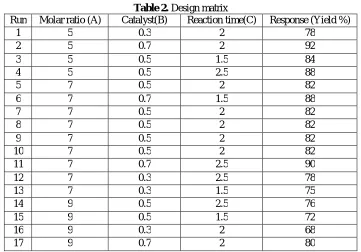
Table 2. Design matrix
Run Molar ratio (A) Catalyst(B) Reaction time(C) Response (Yield %)
1 5 0.3 2 78
2 5 0.7 2 92
3 5 0.5 1.5 84
4 5 0.5 2.5 88
5 7 0.5 2 82
6 7 0.7 1.5 88
7 7 0.5 2 82
8 7 0.5 2 82
9 7 0.5 2 82
10 7 0.5 2 82
11 7 0.7 2.5 90
12 7 0.3 2.5 78
13 7 0.3 1.5 75
14 9 0.5 2.5 76
15 9 0.5 1.5 72
16 9 0.3 2 68
17 9 0.7 2 80
III. RESULTSANDDISCUSSION
Analysis of the model:
It is known that the most important parameters affecting the yield of the biodiesel production are molar ratio (A), concentration of catalyst (B), and time (C) for reaction. In order to study the interaction factors (combined effect of these factors), experiments were performed varying physical parameters, using experimental design. By applying multiple regression analysis on the, the experimental results of the box behnken method were fitted to the polynomial Eq. (2). The quadratic models for the responses are developed in terms of actual factor. The principal model analysis was based on the analysis of variance (ANOVA) which provides numerical information for the probability p- value. The ANOVA for response parameters are given in Table3. The models found to be significant as the values of p were less than 0.05.
2 2 2
51.43750 6.93750 42.5 5.5 1.25 3.44169 15 2.5 0.65625 3.125 2.5
Y A B C AB E AC BC A B C (2)
Evaluation of the model:
Table 3. ANOVA for responses indicating the values of probability value.
Source p-valve
Model <0.0001
A-Molar ratio <0.0001
B-Catalyst Concentration <0.0001
C-Reaction time <0.0001
AB 0.0856
AC 1*
BC 0.3506*
A2 <0.0001
B2 0.6237*
C2 0.0373
*
The insignificance of the input parameter over the output responses as the value of ‘p’ was greater than 0.05.Table 4.Response surface model evaluation
Mean 81.12
Std.Deviation 0.5
Model degree Quadratic
R2 0.9973
Adj.R2 0.9938
Pred.R2 0.9565
Interactive effect of molar ration and catalyst:
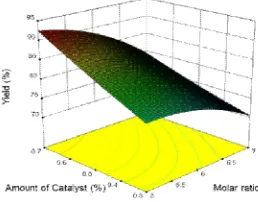
The effect of molar ratio and catalyst on the response is shown in the fig 1.
Fig 1. Effect of molar ratio and catalyst
to triglyceride, since this reaction involves the conversion of one ester and an alcohol towards another ester and another alcohol, as an excess of alcohol is used to drive the reaction near completion. Excess alcohol was employed for the complete transterification of cottonseed oil to cottonseed oil methyl ester. Therefore yield was gradually decreased with increase in molar ratio. This is due to the reversible reaction of transterification and also due to the first most significant factor being the molar ratio, and to its effect being negative. In same time yield increased with increase in catalyst at constant molar ratio. Reduction of catalyst provided less amount of yield and increase in molar ratio provided reduction in cottonseed oil methyl ester production.
Interactive effect of molar ratio and reaction time:
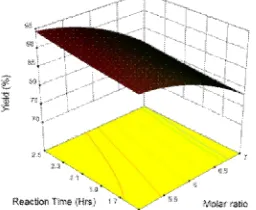
Interactive effect of molar ratio and reaction time is shown in fig 2. Increase in reaction time at constant molar ratio and constant catalyst helped the reaction to produce more cottonseed oil methyl esters. Reaction time has the linear characteristics with molar ratio. More reaction time allowed the transterification reaction to utilize the excess methanol and catalyst. Even though the molar ratio have the negative impact on cottonseed oil methyl ester production but increased in reaction time helped the reaction to complete. Lowering the reaction time and increasing the molar ratio caused more glycerol formation.
Fig 2. Effect of reaction time and molar ratio
Interactive effect of catalyst and reaction time:
Interactive effect of catalyst and reaction time is shown in the fig 3. Catalyst concentration and reaction time has similar character behaviour with molar ratio. More reaction time allowed the proper utilization of catalyst in transterification process.
Fig 3. Effect of catalyst and reaction time
IV. CONCLUSION
In this study, the optimization of parameters affecting the trasesterification of cottonseed oil was performed. The process parameters, like molar ratio (A), catalyst concentration (B) and reaction time (C) were optimized using RSM under Box-Behnken design. For optimization of process, a quadratic model was developed and validated. Analysis of Variance (ANOVA) was performed, which indicates that the three linear terms has the more significant effect on percentage of yield, further one cross product term (AB) and two quadratic term (A2,C2) were found significant. The maximum cottonseed oil methyl ester yield of 91.5% was predicted when molar ratio, catalyst concentration and reaction time, were 5:1, 0.4gm and 1.5 hrs respectively. This study clearly shows that response surface methodology was a suitable method to optimize the operating conditions in order to maximize the cottonseed oil methyl esters production.
REFERENCES
[1] A.Banerjeea, R. Chakraborty ,"Parametric sensitivity in transesterification of waste cooking oil for biodiesel production – a review'', Resources, Conservation and Recycling,53(9):490–497,2009.
[2] Antonlin G, Tinaut FV, Briceno Y, Castano V, Perez C, Ramirez AI." Optimisation of biodiesel production by sunflower oil
transesterification", Bioresource. Technology, 83(2), 111-4, 2002.
[3] Ramadhas A S, Jayaraj S, Muraleedharan C. ''Biodiesel production from high FFA rubber seed oil''. Fuel 84(4), , 335-40, 2005.
[4] A.K. Agarwal, Biofuels (alcohols and biodiesel) applications as fuels for internal combustion engines, Progress in. Energy Combustion. Science, Vol.33, Isuue3, 233–271, 2007
[5] M R Shahbazi , B. Khoshandam ,M.Nasiri , M.Ghazvini ,"Biodiesel production via alkali-catalyzed transesterification of Malaysian RBD palm oil-Characterization, kinetics model",Journal of the Taiwan Institute of Chemical Engineers, 43, 504–510, 2012.
[6] I C Andrade, J P Santiago, J R Sodre, J S Pathiyamattom and C A G Fajardo,'' Transesterification Reaction of Waste Cooking Oil and Chicken Fat by Homogeneous Catalysis'', Journal of Chemistry and Chemical. Engineering. 8 736-743. 2014.
[7] A. Sakthi Saravanan, K.Ramesh, N.G Muralidharan N.Yasvanthrajan, P. Sivakumar, ''Alkali-catalyzed transesterification of rapeseed oil'', Journal of Chemical and Pharmaceutical Sciences, 2, 152-154, 2014.
[8] K.G. Georgogianni, M.G. Kontominas, P.J. Pomonis, D. Avlonitis, V. Gergis, ''Conventional and in situ transesterification of sunflower seed oil for the production of biodiesel'', Fuel Process. Technol. 89 ,503–509, 2012.
[9] K.G. Georgogianni, M.G. Kontominas, P.J. Pomonis, D. Avlonitis, V. Gergis, ''Alkaline conventional and in situ transesterification of cottonseed oil for the production of biodiesel'', Energy Fuels 22 (3), 2110–2115, 2008.
[10] Fangrui Ma, L.D. Clements, M. Hanna, ''Biodiesel fuel from animal fat. Ancillary studies on transesterification of beef tallow'', Ind. Eng. Chem. Res. 37, 3768–3771, 1998.
[11] M.Mathiyazhagan and A.Ganapathi, ''Factors Affecting Biodiesel Production'', Research in Plant Biology, 1(2) 01-05, 2011.
[12] Y.C.Wong, Y.P.Tan, Y.H.Taufiq-Yap & I. Ramli, ''An Optimization Study for Transesterification of Palm Oil using Response Surface Methodology (RSM)'', Sains Malaysiana, 44(2) ,281–290, 2015.
[13] M. Mansourpoor and Dr. A Shariati, ''Optimization of Biodiesel Production from Sunflower Oil Using Response Surface Methodology'', Journal of Chemical Engineering & Process Technology. Vol.3, Issue 4, 1-5, 2012.
[14] H.Hamze, M.Akia, F.Yazdani, ''Optimization of biodiesel production from the waste cooking oil using response surface methodology", Process safety and environmental protection.Vol.94, 1-10, 2015.
[15] N.B Dharmesh Kumar and M C Math, "Application of Response Surface Methodology for Optimization of Biodiesel Production by Transesterification of Animal Fat with Methanol", International Journal of Renewable Energy Research. Vol.6, No.1, 74-79, 2016.