DOI: 10.1534/genetics.105.046995
Fixation of the Human-Specific CMP-N-Acetylneuraminic Acid Hydroxylase
Pseudogene and Implications of Haplotype Diversity for Human Evolution
Toshiyuki Hayakawa,* Ikuko Aki,* Ajit Varki,
†Yoko Satta* and Naoyuki Takahata*
,1*Department of Biosystems Science, Graduate University for Advanced Studies (Sokendai), Hayama, Kanagawa 240-0193, Japan and †Glycobiology Research and Training Center, Departments of Medicine and Cellular and Molecular Medicine, University of
California, San Diego, California 92093-0687
Manuscript received June 17, 2005 Accepted for publication October 16, 2005
ABSTRACT
The human CMP-N-acetylneuraminic acid hydroxylase gene (CMAH) suffered deletion of an exon that encodes an active center for the enzyme3.2 million years ago (MYA). We analyzed a 7.3-kb intronic region of 132 CMAH genes to explore the fixation process of this pseudogene and the demographic implication of its haplotype diversity. Fifty-six variable sites were sorted into 18 different haplotypes with significant linkage disequilibrium. Despite the rather low nucleotide diversity, the most recent common ancestor atCMAHdates to 2.9 MYA. This deep genealogy follows shortly after the original exon deletion, indicating that the deletion has fixed in the population, although whether this fixation was facilitated by natural selection remains to be resolved. Remarkable features are exceptionally long persistence of two lineages and the confinement of one lineage in Africa, implying that some African local populations were in relative isolation while others were directly involved in multiple African exoduses of the genus Homo. Importantly, haplotypes found in Eurasia suggest interbreeding between then-contemporaneous human species. Although population structure within Africa complicates the interpretation of phylogeographic information of haplotypes, the data support a single origin of modern humans, but not with complete replacement of archaic inhabitants by modern humans.
S
IALIC acids are components of cell-surface glycans and play an important role in cell-cell communi-cation as well as in pathogen-host interactions during infectious processes (Angataand Varki2002). The twomost common forms of sialic acids found on mam-malian cells areN-acetylneuraminic acid (Neu5Ac) and
N-glycolylneuraminic acid (Neu5Gc). Neu5Gc is derived from Neu5Ac at the nucleotide sugar level through an en-zymatic process catalyzed by CMP-N-acetylneuraminic acid hydroxylase (CMAH). Interestingly, the level of Neu5Gc is extremely low in the brain even in species with large amounts of Neu5Gc being expressed in other tissues (Kawanoet al. 1995). The suppression of Neu5Gc
is most conspicuous in humans in that there is no de-tectable level of Neu5Gc in almost all tissues (Muchmore
et al. 1998). This was explained by the finding that the human CMAH locus is genetically inactivated despite the fact that it is a single-copy gene located on 6p21 (Chou et al. 1998; Irie et al. 1998), and it has been
suggested that this defective mutation might be respon-sible for some biochemical or physiological character-istics specific to humans (Varki2002).
The humanCMAHgene is inactivated by deletion of the 92-bp exon (exon 6) that encodes an active center for the enzyme (Chouet al. 1998; Irieet al. 1998; Varki
2002). Hayakawaet al. (2001) studied the genomic
se-quences around exon 6 of various primate species and found that whereas the exon and a nearby AluSq ele-ment are present in all nonhuman primates, they are completely replaced by a youngAluY element in humans. On the basis of the finding of a potential target-priming sequence by theAlupoly(A) tail located in the 59region immediately adjacent to the upstream deletion bound-ary, anAlu-mediated replacement of a genomic region was proposed as the underlying molecular mechanism (Hayakawaet al. 2001). Subsequently, Chouet al. (2002)
took multiple approaches to estimate the timing of thisAlu-mediated replacement. A method that extracts and identifies sialic acids from bones and bony fossils was developed and applied to samples, including two Neanderthal fossils. The absence of Neu5Gc in Nean-derthal fossils strongly suggested that the inactivation of the human CMAHgene took place prior to the di-vergence of Neanderthals,0.5 million years ago (MYA). Moreover, two other approaches using phylogeny of human-specificAlu’s and molecular clocks consistently dated the much earlier occurrence of the inactiva-tion that predated the first emergence of the genus Homo and of brain expansion in hominids (Chouet al.
2002).
Sequence data from this article have been deposited with the DDBJ/ EMBL/GenBank Data Libraries under accession nos. AB089127– AB089137.
1Corresponding author: Graduate University for Advanced Studies
(Sokendai), Hayama, Kanagawa 240-0193, Japan. E-mail: [email protected]
CMAHis one of several human-specific functionless genes that have been caused by disruption or deletion of the coding frame and such loss of function might play some roles in evolution of human characteristics (Varki
2004). These human-specific functionless genes include those for T-cell receptor gamma chain V10 (Zhanget al.
1996), some olfactory receptors (Sharon et al. 1999;
Gilad et al. 2003), type I hair keratin (Winter et al.
2001), myosin heavy chain (Stedman et al. 2004),
SIGLEC13 (Angataet al. 2004), and bitter taste
recep-tors (Conteet al. 2003; Goet al. 2005). UnlikeCMAH,
however, the others are generally members of multi-gene families with potential functional compensation by other paralogs. Recently, a systematic approach to-ward identifying human-specific gene death in the ge-nome was developed. Since this approach needed to be very conservative, it could discover only four additional human-specific pseudogenes: vascular noninflamma-tory vanin, G-coupled receptor 33, double C2 gamma, and glycine receptor subunit (InternationalHuman
GenomeSequencingConsortium2004). In any event,
it is important to ask when and how such human-specific loss of function appeared and spread over the world in relation to physiological or biochemical influences as well as human demographic history. It also needs to be examined whether such loss of function is actually fixed in the human population.
In this article, we focus on an7.3-kbCMAHintronic region that encompasses the deleted exon 6. Using a sample of 132 chromosomes from 18 populations world-wide, we determined the linkage phase of the nucleotide sequences by allele-specific PCR (AS-PCR) or cloning and carried out the genealogical analysis of haplotypes under significant linkage disequilibium. We not only studied the fixation process of theCMAHpseudogene but also used its haplotype information to address hu-man demographic history in the Plio–Pleistocene period.
MATERIALS AND METHODS
DNA samples and intron sequences: We purchased 66 human genomic DNAs from the Coriell Cell Repositories (CCR) and the American Type Culture Collection (ATCC). These genomic DNAs come from 13 Africans and 53 non-Africans (Table 1). The chimpanzee and gorilla genomic DNAs are generous gifts of Colm O’hUigin (Max Planck Institut fu¨ r Biologie, Tu¨bingen, Germany; currently at the National Cancer Institute). We selected an intronic region ranging from position 9809 to 17,435 of the humanCMAH pseudo-gene (GenBank accession no. AB009668). This region is 8100 and 8099 bp long for the gorilla and the chimpanzee, re-spectively, but it varies from 7611 to 7637 bp in the human. The region contains a human-specific AluY that replaced a genomic region, including functionally important exon 6 (Hayakawa et al. 2001). The AluY insertion is found in all human chromosomes examined, but not in the chimpanzee or in the gorilla. If we exclude theAluY and all other insertions or deletions (indels), the number of nucleotides that can be compared is 7302 bp long. The usage of purchased samples
in this project was approved by a review board at CCR and ATCC.
Haplotype determination: To unambiguously determine the linkage phase of all heterozygous sites, we employed both AS-PCR and cloning strategies. The AS-PCR strategy consisted of three procedures; detection of polymorphic sites, AS-PCR, and nested PCR (nPCR). The intronic region was amplified by primers CH-9 and CH-13, and the amplified PCR products were directly sequenced using an ABI Prism BigDye termina-tor cycle sequencing FS ready reaction kit (Applied Biosys-tems, Foster City, CA). Heterozygous sites were detected as double peaks indicated as ‘‘N’’ on an ABI Prism 377 fluores-cent automated DNA sequencer (Applied Biosystems). These heterozygous sites were then used to design 14 pairs of AS-PCR primers in combination with primers 9, 13, and CH-36. The AS-PCR was performed with 20 pmol of each primer and 100 ng of human genomic DNA in a total volume of 50ml containing 200mmdNTPs and 2.5 units of Ampli Taq Gold DNA polymerase (Applied Biosystems) in PCR buffer containing 1.5 mmMgCl2. A RoboCycler gradient 96 (Strat-agene, La Jolla, CA) was used under the following conditions: denaturation at 95°for 15 min followed by 45 amplification cycles of 95°for 1 min, 62°–67°for 1 min, 69°for 5–7 min, and extension at 69° for 10 min. The AS-PCR products were purified through QIAquick PCR purification kits (QIAGEN, Chatsworth, CA) and used as templates for the nPCR that followed.
The nPCR was carried out to obtain a sufficient amount of appropriate AS-PCR products for sequencing. Primers CH-8, 40, and 59 were used instead of 9, 13, and CH-36. The PCR reaction was performed with 20 pmol of each primer and 1ml of purified AS-PCR products in a total volume of 50ml containing 200mmdNTPs and 2.5 units of ExTaqDNA polymerase (Takara, Berkeley, CA) in a Takara ExTaqbuffer containing 2 mmMgCl
2. The PCR conditions were as follows: denaturation at 95°for 5 min followed by 30 cycles of 95°for 1 min, 60°–67°for 1 min, 69°for 7 min, and extension at 69° for 10 min. Products were directly sequenced in the same way as above. The haplotypes of five Africans including Biaka and Mbuti Pygmies were determined by this strategy.
The cloning strategy was performed as below. Genomic PCRs were performed with several primer sets (CH-9, CH-11, CH-13, CH-34, CH-36, CH-38, CH-43, CH-149, CH-157) according to the reported conditions (Hayakawa et al. 2001). Obtained genomic PCR products were purified as described above and were then cloned by using TOPO TA cloning kits (Invitrogen, San Diego). Finally, five to six clones from each of the cloned PCR products were sequenced.
For the chimpanzee genomic DNA, the AS-PCR strategy did not detect any heterozygous site so that the same PCR primers (CH-9, CH-10, CH-13, CH-34, CH-36, and CH-38) as those for the human were used. For the gorilla genomic DNA, the AS-PCR strategy was successful. In addition to the primers CH-8, CH-9, CH-36, and CH-40, new primers GoV-1A, GoV-1G, GoV-2C, and GoV-2G were used in both AS-PCR and nPCR to determine one haplotype. Temperatures of 58° and 62° were adopted for the PCR annealing step. Se-quencing of these PCR products was carried out as for the human. The primer sequences of AS-PCR and genomic PCR are given in supplemental Table 1 at http://www.genetics. org/supplemental/.
2003) and MEGA3.1 software (Kumaret al.2004), respectively. Some other statistical tests were performed on Mathematica.
RESULTS AND DISCUSSION
Nucleotide diversity and linkage disequilibrium:The
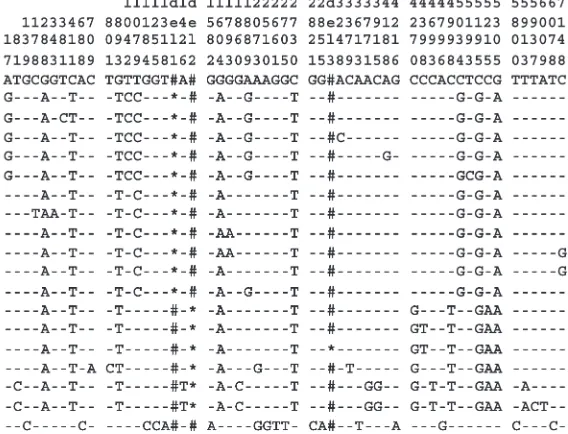
sample of 132 sequences was divided into 18 haplotypes on the basis of 56 variable sites observed in the 7302-bp
intronic region; 53 segregating sites and three indel sites (Table 1 and Figure 1). The average number of pairwise nucleotide differences is 3.8, which amounts to nucle-otide diversityp¼0.052%. This is about half the com-monly accepted value (Li and Sadler 1991, but see
also Przeworskiet al. 2000; InternationalSNP Map
Working Group 2001) and results from a low level
of sequence differences (0.020%) in the non-African
TABLE 1
Occurrences of 18CMAHhaplotypes in worldwide populations
Haplotype
Africa Europe Asia America
Total
Af Pb Pm Ad Ru Dr Cu Am At Ch Jp Cm Ml My Kr Su Wr Qu
A0 2 1 4 4 1 4 5 5 6 6 5 8 5 8 8 2 6 80
A1 1 1
A2 2 2
A3 1 1
A4 1 1 4 1 1 1 1 10
B0 4 2 3 1 10
B1 1 1
B2 3 1 2 1 1 8
B3 1 1
B4 2 2
B5 1 1
C0 1 1
C1 1 4 5
C2 2 2
C3 3 3
C4 1 1
C5 1 1
P 2 2
Total 6 10 10 8 8 8 4 8 8 8 6 6 8 8 8 8 2 8 132
Af, African (ethnicity unknown); Pb, pygmy Biaka; Pm, pygmy Mbuti; Ad, Adygei; Ru, Russian; Dr, Druze; Cu, Caucasian (ethnicity unknown); Am, Ami; At, Atayal; Ch, Chinese; Jp, Japanese; Cm, Cambodian Khmer; Ml, Melanesian; My, Mayan; Kr, Karitiana; Su, Surui; Wr, Waorani; Qu, Quechua. Populations are categorized geographically into four groups: Africa: Af, Pb, and Pm; Europe: Ad, Ru, Dr, and Cu; Asia: Am, At, Ch, Jp, Cm, and Ml; and America: My, Kr, Su, Wr, and Qu.
sample relative to 0.127% in the African sample. In the non-African sample with predominance of haplotype A0 (Table 1), there are a number of identical pairs of haplotypes and the mismatch distribution (pairwise nucleotide differences) is confined in a narrow range (Figure 2). The significantly negative D-value (D ¼ 1.84,P,0.05; Tajima1989) or the significant excess
in the number of segregating sites relative topis con-sistent with a large proportion (5 of 9 haplotypes) of locality-specific young haplotypes in the non-African sample (Table 1 and Figure 1). One possibility for these features is the recent expansion of non-African popula-tions (Excoffier2002). On the other hand, in the African
sample, there are only 25 identical pairs among 325 com-parisons, the mismatch distribution is ragged in a large range (Figure 2), and the negativeD-value of1.06 is insignificantly different from 0 (P . 0.10). There is no evidence for population expansion within Africa (Excoffier 2002). We also found significantly high
homozygosity (P,0.05,x2d.f.¼1¼4.70) in the total
popu-lation, but no such excess (x2d.f.¼1¼1.98) in the non-African sample. This suggests nonrandom mating within Africa as well as in the entire population (see below).
Among the 53 segregating sites, 34 are singletons and 19 are phylogenetically informative. Of these, there are two phylogenetically incompatible sites (position 1793 or 7148 and position 2073 in Figure 1), which stem from parallel nucleotide substitutions, as we explain below. As for the indel sites, two are informative and compatible with each other and to most of the segregating sites. To quantify the tight linkage among the 21 informative sites, we applied the four-gamete test (Hudson 1987;
Takahataand Satta1998). Of a total of 210 pairwise
comparisons, only 9 pairs of sites are incompatible with each other, the proportion (9/210) being much lower than the 25/528 observed at the nearby
hemochroma-tosis (HFE) locus (Toomajianand Kreitman2002).
Con-sistent with this, many pairs of informative sites atCMAH
are under significant linkage disequilibrium (Weir1990)
and the proportion (81/210) of those pairs is much higher than that (86/528) atHFE. If the recombination rate atHFEis close to the genomic average (Przeworski
et al. 2000; Frisseet al. 2001; Toomajianand Kreitman
2002),CMAHmust have undergone a lowered level of recombination. Since these observations indicate that
CMAHsamples are almost free from recombination, we used the entire region and all the haplotypes in the following phylogeographic analysis.
Fixation and time frame of CMAH genealogy: To
define the time frame in theCMAHhaplotype geneal-ogy, we also determined the chimpanzee and gorilla orthologous sequences. The mean nucleotide divergence between the human and the chimpanzee is 0.826 0.11%. Although the value is slightly smaller than that of other autosomal loci (Satta and Takahata
2004), an even smaller value (0.69%) is observed atHFE
(Toomajian and Kreitman 2002). Actually, however,
these small values are close to the mode (0.75%) of nu-cleotide divergences in.30,000 comparisons of human and chimpanzee BAC end sequences (Fujiyamaet al.
2002). If the human and the chimpanzee diverged 6 MYA (Haile-Selassie2001; Burnetet al. 2002; Haile
-Selassie et al. 2004), the nucleotide substitution rate
(m) atCMAHcan be estimated as 0.6860.093109/ site/year. However, this relatively low m-value does not result from a demographic cause such as recent introgression from the chimpanzee to the human or vice versa. Rather, it reflects the intrinsic mutation rate, because almost the same rate (0.7160.083109/site/ year) is obtained from the sequence divergence between the human and the gorilla (1.1060.12%) assuming that they diverged from each other 7.7 MYA (Horaiet al.
1992; Kumarand Hedges1998). The relative rate test
with the gorilla sequence as an outgroup also shows no significant rate heterogeneity between the human and chimpanzee lineages (data not shown).
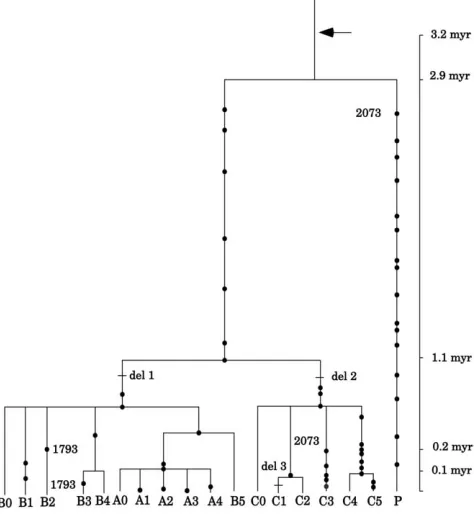
TheCMAHhaplotypes exhibit two distinct lineages: the P lineage, which has left a single descendant hap-lotype P that is represented by two heterozygous individ-uals in the sub-Saharan Biaka pygmy population, and the non-P lineage, which has been extensively diversi-fied to produce A, B, and C sublineages (Figure 3). Haplotype P is most distantly related and connected to the non-P haplotypes through the most common recent ancestor (MRCA). The average sequence divergence between the two lineages is 0.4060.07% and is nearly half of that between the human and the chimpanzee. With m ¼ 0.68 3 109, the time back to the MRCA (TMRCA) can be estimated as 2.96 0.5 million years (MY). This value is in contrast to rather shallow gene-alogies of most loci studied thus far in the human pop-ulation (Takahataet al. 2001; Satta and Takahata
2002, 2004; Templeton 2002). An exception is the
Figure2.—The mismatch distribution of nucleotide differ-ences within Africans (solid circles and scale on the left) and within non-Africans (open circles and scale on the right). The
eosinophil-derived neurotoxin locus (Zhang and
Rosenberg2000) at which the TMRCA is estimated as
3 MY (Satta and Takahata 2004) or even greater
(Templeton2002), although the dating is subject to a
large sampling error owing to a small number of seg-regating sites in the region examined. One may wonder
if such an ancient MRCA results from the hitchhiking effect of neighboring polymorphic loci under balancing selection. Indeed, CMAH is located in a telomeric re-gion 5 Mb apart from the highly polymorphic human leucocyte antigen (HLA) complex on chromosome 6. However,HFEis located 1 Mb closer toHLAthanCMAH, but the former locus does not show any evidence for the hitchhiking effect (Toomajianand Kreitman 2002).
This observation argues strongly against the likelihood of the hitchhiking effect at even distantly locatedCMAH. We also examined if the number of polymorphic sites is consistent with the number of nucleotide differences between species, as expected under neutrality (Hudson
et al.1987). Despite the long-lasting P lineage in the African population, CMAH does not show any significant de-viation from other loci (Table 2). Thus,CMAHprovides compelling evidence for a presumably neutral locus with TMRCA.2 MY and suggests that MRCAs at some nuclear loci, even though evolving in a neutral fashion, can be found during the era of Australopithecines. In other words, CMAH provides another example of the African origin of human genetic variation and in-creases the proportion of the African MRCA (Sattaand
Takahata2004) up to 93% among the total of 15
nu-clear loci studied thus far.
Our original estimate of CMAHinactivation was 2.8 MYA (Chouet al. 2002). This was based on the
assump-tion of the 5.3-MY divergence time between the human and the chimpanzee. Recent findings of more ancient hominid fossils pushed the assumed divergence time back to 6–7 MY (Haile-Selassie 2001; Burnet et al.
2002; Haile-Selassieet al. 2004). If we assume a 6-MY
divergence time, our estimate of CMAH inactivation time (T) becomes 3.2 MY and that of TMRCA in the sample becomes 2.9 MY, suggesting that the deletion mutation fixed in the human population long ago. Of particular interest is that TMRCA is fairly close to
TABLE 2
HKA tests for neutrality betweenCMAHand other loci
Locus Location
Lengtha Sample sizeb
Dc Kd x2 P
L1 L2 n1 n2
a-Globin 16p13.3 310 310 553 1 6 6 0.002 0.966
b-Globin 11p15.5 2320 2320 326 1 18 35 2.083 0.149
ECP 14q24–q31 1203 1203 108 1 7 16 1.194 0.275
EDN 14q24–q31 1214 1214 134 1 9 9 0.039 0.844
HFE 6p21.3 11214 11214 60 1 41 77 0.549 0.459
Mc1r 16q24.3 955 954 242 1 6 17 2.853 0.091
PDHA1 Xp22.11 4149 4149 34 2 23 42 0.011 0.915
Xq13.3 Xq13.3 10163 10163 69 1 33 94 1.380 0.240
ZFX Xp21.3 1215 1173 335 1 10 17 0.422 0.516
CMAH 6p21.32 7302 7302 132 1 53 60 — —
a
L1is the length compared within humans andL2is that between humans and chimpanzees.
b
n1is the sample size from humans andn2is that from chimpanzees.
c
The number of polymorphic sites in humans.
d
The mean number of nucleotide differences between humans and chimpanzees. Figure3.—Gene tree of 18 humanCMAHhaplotypes when
T: There is a mere 0.3-MY difference between Tand TMRCA (Figure 3). To explore what this relatively short duration time tells us about the evolutionary force in the fixation process of theCMAHpseudogene, it is neces-sary to have some idea about the effective size of the human population during the Plio–Pleistocene period. It is conceivable that since Australopithecines expanded widely over the African continent, there was fairly strong isolation among rather sessile local populations (Klein
and Takahata2002). TheCMAHgenealogy is
consis-tent with such a view that Australopithecines were geo-graphically structured and genetically differentiated and suggests that the transformation to the genus Homo occurred in some such local populations. Indeed, prior genetic data and theoretical consideration (Takahata
1995) suggested that the human population had its effective size (Ne) of the order of 105before the
emer-gence of the genus Homo2 MYA. This large effective size may be partly due to limited amounts of gene flow among local populations (Nei and Takahata 1993;
Takahata1995). In any event, if the effective size was as
large as 105throughout the Pliocene period, it would have taken more than a few million years for theCMAH
deletion mutation to become fixed in the population by random genetic drift alone (Kimuraand Ohta1969).
If the mutation had long been segregated in the human population with low frequencies, it is possible that ex-tensive allelic diversification within this particular mu-tation would have been retarded and that the TMRCA would have become much smaller thanT, contrary to the current observation. Alternatively, since Neu5Gc is a tar-get for some microorganisms to gain entry into mam-malian cells (Angataand Varki2002), it is possible that
a virulent pathogen with such a binding affinity might have selected for an increased frequency of theCMAH
deletion mutation in a certain ancestral Australopithe-cine population.
One can then ask to what extent the fixation process of theCMAHdeletion mutation could affect its TMRCA among the descendants if it was somehow selectively advantageous and could rapidly increase its frequency. We examined the effect of selection by carrying out computer simulation and compared the distribution of TMRCA with and without genic selection. Following Takahata(1995), we also assumed a sudden reduction
inNefrom 105to 104T1¼2 MYA. Provided that the
deletion mutation aroseT¼3.2 MYA (1.63105 gener-ations for the generation time of 20 years) and has eventually fixed in the population, we recorded the neu-tral gene genealogy of the present-day descendants. To perform this time-consuming simulation forward in time, we assumed a smallNe, reducing from 100 to 10; a strong
selection intensity ofs¼0.5; and a high neutral mutation rate ofm¼0.1/gene/unit time. This unit time actually corresponds to 1000 generations so that the deletion mutation arose 160 units of time ago in the simulation. We then obtained the TMRCA in each simulation and
the distribution over 1000 cases of the fixation. The prob-ability that TMRCA.2 MY (or 100 units of time) tended to be high with selection, but the excess was slight and as a whole the distribution itself was insensitive to selection (data not shown). This overall insensitivity results from the fact that the Pleistocene period is long enough to erase the footprint of an ancient action of natural selection on the genealogy, even if exerted. In fact, if we use smallerTandT1values than the above, the
ef-fect of selection becomes visible and the TMRCA be-comes long. For instance, ifT¼1.6 MY andT1¼1 MY,
the mean and standard deviation of TMRCA become 4.506 2.98 (3 104) with selection, whereas they be-come 3.566 3.23 (3104) without selection.
Haplotype distribution and human demography:The
haplotype originally arose in Africa and then migrated into Asia.
On the other hand, all cosmopolitan haplotypes (A0, A4, and B0) belong to either the A or B sublineage (Figures 3 and 4). Despite the young age (0.1 MY), A0 is a major cosmopolitan haplotype and increases its frequency dramatically from Africa (11.5%) to Europe (46.4%) to Asia (79.5%) and then to America (85.3%), similar to the textbook example of the blood-type O antigen. The genealogical relationships among A sub-lineage haplotypes clearly suggest that A0 is ancestral to one minor cosmopolitan A4, one African A3, and two non-African-specific A1 and A2 (Table 1, Figures 3 and 4). If A0 emerged in Africa and expanded worldwide, it is likely that the African A3 is an early descendant and the other A sublineages are relatively young descen-dants of emigrating A0. These phylogeographic patterns can be most parsimoniously accounted for if an out-of-Africa migration of modern humans occurred before diversification of the A sublineage 0.1 MYA, but after the divergence of the A sublineage from the ancestral B5 haplotype0.4 MYA (Figure 3). Such a migration is in agreement with the major expansion of modern humans that took place 0.08 to 0.15 MYA, as suggested by mitochondrial DNA (Cannet al.1987; Ingmanet al.
2000) and Y chromosomes (Thomsonet al.2000).
By contrast, the B sublineage provides information about more ancient human migration than the A sub-lineage. Cosmopolitan B0 is an immediate ancestor of B1, B2, B3, and B4. Notably, B2 is not found in Africa, but B1, B3, and B4 are confined to Africa (Figure 4). To discuss the genealogical relationships among these haplotypes, it is necessary to pay attention to the G/A polymorphism at position 1793 that is incompatible with the great majority of polymorphic sites and is shared by B2 and B3. One possibility for this incompatible poly-morphism is that either B2 is a recombinant between B0 and B3 or B3 is a recombinant between B2 and B4. However, because of the rarity of B3 and B4, both of which are confined to Africa, this possibility is less likely than the alternative that the G/A transitions in B2 and B3 result from parallel nucleotide substitutions. Under this alternative, we assume that B0 arose in Africa and B2 arose somewhere in Eurasia. Since B0 can be traced back to1 MYA and B2 descended0.2 MYA (Figure 3), cosmopolitan B0 might have migrated out of Africa dur-ing the period from 0.2 to 1 MYA. In other words, migra-tion of B0 took place earlier than that of A0, suggesting that both B0 and B2 in Eurasian populations of archaic humans were transmitted to modern humans by inter-breeding (Lewin1998; Templeton2002). It was argued
that northeastern African populations served as genetic reservoirs and migration therefrom was biased toward Eurasia (Tishkoff et al. 1996; Satta and Takahata
2004). It is then possible that B2 originally arose in north-eastern Africa, but subsequently it was lost or became so rare as to be undetected in the present African sample.
In either case, our data strongly suggest direct trans-mission of B2 from archaic to modern humans in north-eastern Africa or in Eurasia. In conclusion, the expansion of the relatively young A0 haplotype has undoubtedly made a major impact on theCMAHdiversity in the hu-man population. However, the presence of relatively old B0 and its direct descendant B2 in Asia supports the hypothesis of a single African origin of modern hu-mans, but not with complete replacement of archaic inhabitants.
We thank Mineyo Iwase for technical advice and Michael Kryshak for editorial assistance. This work was supported in part by the Japan Society for Promotion of Science grant 12304046 to N.T. and by grant GM32373 to A.V.
LITERATURE CITED
Angata, T., and A. Varki, 2002 Chemical diversity in the sialic acids and related alpha-keto acids: an evolutionary perspective. Chem. Rev.102:439–470.
Angata, T., E. H. Margulies, E. D. Green and A. Varki, 2004 Large-scale sequencing of the CD33-related Siglec gene cluster in five mammalian species reveals rapid evolution by mul-tiple mechanisms. Proc. Natl. Acad. Sci. USA101:13251–13256. Brunet, M., F. Guy, D. Pilbeam, H. T. Mackaye, A. Likiuset al., 2002 A new hominid from the upper Miocene of Chad, central Africa. Nature418:145–151.
Cann, R. L., M. Stonekingand A. C. Wilson, 1987 Mitochondrial DNA and human evolution. Nature325:31–36.
Chou, H.-H., H. Takematsu, S. Diaz, J. Iber, E. Nickersonet al., 1998 A mutation in human CMP-sialic acid hydroxylase oc-curred after the Homo-Pan divergence. Proc. Natl. Acad. Sci. USA95:11751–11756.
Chou, H.-H., T. Hayakawa, S. Diaz, M. Krings, E. Indriatiet al., 2002 Inactivation of CMP-N-acetylneuraminic acid hydroxylase occurred prior to brain expansion during human evolution. Proc. Natl. Acad. Sci. USA99:11736–11741.
Conte, C., M. Ebeling, A. Marcuz, P. Nefand P. J. Andres-Barquin, 2003 Evolutionary relationships of the Tas2r receptor gene fam-ilies in mouse and human. Physiol. Genomics14:73–82. Excoffier, L., 2002 Human demographic history: refining the
re-cent African origin model. Curr. Opin. Genet. Dev.12:675–682. Frisse, L., R. R. Hudson, A. Bartoszewicz, J. D. Wall, J. Donfack
et al., 2001 Gene conversion and different population histories may explain the contrast between polymorphism and linkage dis-equilibrium levels. Am. J. Hum. Genet.69:831–843.
Fujiyama, A., H. Watanabe, A. Toyoda, T. D. Taylor, T. Itohet al., 2002 Construction and analysis of a human-chimpanzee com-parative clone map. Science295:131–134.
Gilad, Y., O. Man, S. Pa¨ a¨ boand D. Lancet, 2003 Human specific loss of olfactory receptor genes. Proc. Natl. Acad. Sci. USA100: 3324–3327.
Go, Y., Y. Satta, O. Takenakaand N. Takahata, 2005 Lineage-specific loss of function of bitter taste receptor genes in humans and non-human primates. Genetics170:313–326.
Griffiths, R. C., 2002 Ancestral inference from gene trees, pp. 94– 117 inModern Developments in Theoretical Population Genetics, ed-ited by M. Slatkinand M. Veuille. Oxford University Press, New York.
Griffiths, R. C., and S. Tavare´, 1994 Simulating probability distri-bution in the coalescent. Theor. Popul. Biol.46:131–159. Haile-Selassie, Y., 2001 Late Miocene hominids from the middle
Awash, Ethiopia. Nature412:178–181.
Haile-Selassie, Y., G. Suwaand T. D. White, 2004 Late Miocene teeth from middle Awash, Ethiopia, and early hominid dental evolution. Science303:1503–1505.
Horai, S., Y. Satta, K. Hayasaka, R. Kondo, T. Inoue et al., 1992 Man’s place in hominoidea revealed by mitochondrial DNA genealogy. J. Mol. Evol.35:32–43.
Hudson, R. R., 1987 Estimating the recombination parameter of a fi-nite population model without selection. Genet. Res.50:245–250. Hudson, R. R., M. Kreitmanand M. Aguade´, 1987 A test of neutral molecular evolution based on nucleotide data. Genetics 116: 153–159.
Ingman, M., H. Kaessmann, S. Pa¨ a¨ boand U. Gyllensten, 2000 Mito-chondrial genome variation and the origin of modern humans. Nature408:708–713.
InternationalHumanGenomeSequencingConsortium, 2004 Fin-ishing the euchromatic sequence of the human genome. Nature 431:931–945.
InternationalSNP MapWorkingGroup, 2001 A map of human genome sequence variation containing 1.42 million single nucle-otide polymorphisms. Nature409:928–933.
Irie, A., S. Koyama, Y. Kozutsumi, T. Kawasaki and A. Suzuki, 1998 The molecular basis for the absence of N-glycolylneura-minic acid in humans. J. Biol. Chem.273:15866–15871. Kawano, T., S. Koyama, H. Takematsu, Y. Kozutsumi, H. Kawasaki
et al., 1995 Molecular cloning of cytidine monophospho-N-acetylneuraminic acid hydroxylase. Regulation of species- and tissue-specific expression of N-glycolylneuraminic acid. J. Biol. Chem.270:16458–16463.
Kimura, M., and T. Ohta, 1969 The average number of generations until fixation of mutant genes in a finite population. Genetics61: 763–771.
Klein, J., and N. Takahata, 2002 Where Do We Come From? The
Mo-lecular Evidence for Human Descent.Springer-Verlag, Berlin. Kumar, S., and S. B. Hedges, 1998 A molecular timescale for
verte-brate evolution. Nature392:917–920.
Kumar, S., K. Tamuraand M. Nei, 2004 MEGA 3: integrated soft-ware for molecular evolutionary genetics analysis and sequence alignment. Brief. Bioinformatics5:150–163.
Lewin, R., 1998 Principles of Human Evolution.Blackwell Scientific, Oxford.
Li, W.-H., and L. A. Sadler, 1991 Low nucleotide diversity in man. Genetics129:513–523.
Muchmore, E. A., S. Diazand A. Varki, 1998 A structural differ-ence between the cell surfaces of humans and the great apes. Am. J. Phys. Anthropol.107:187–198.
Nei, M., and N. Takahata, 1993 Effective population size, genetic diversity, and coalescence time in subdivided populations. J. Mol. Evol.37:240–244.
Przeworski, M., R. R. Hudsonand A. DiRienzo, 2000 Adjusting the focus on human variation. Trends Genet.16:296–302. Rozas, J., J. C. Sa´ nchez-DelBarrio, X. Messegyerand R. Rozas,
2003 DnaSP, DNA polymorphism analyses by the coalescent and other methods. Bioinformatics19:2496–2497.
Satta, Y., and N. Takahata, 2002 Out of Africa with regional inter-breeding? Modern human origins. BioEssays24:871–875.
Satta, Y., and N. Takahata, 2004 The distribution of the ancestral haplotype in finite stepping-stone models with population ex-pansion. Mol. Ecol.13:877–886.
Sharon, D., G. Glusma, Y. Pilpel, M. Khen, F. Gruetzneret al., 1999 Primate evolution of an olfactory receptor cluster: diversi-fication by gene conservation and recent emergence of pseudo-genes. Genomics61:24–36.
Stedman, H. H., B. W. Kozyak, A. Nelson, D. M. Thesier, L. T. Su
et al., 2004 Myosin gene mutation correlates with anatomical changes in the human lineage. Nature428:415–418.
Tajima, F., 1989 Statistical method for testing the neutral mutation hypothesis by DNA polymorphism. Genetics123:585–595. Takahata, N., 1995 A genetic perspective on the origin and history
of humans. Annu. Rev. Ecol. Syst.26:343–372.
Takahata, N., and Y. Satta, 1998 Footprints of intragenic recom-bination atHLAloci. Immunogenetics47:430–441.
Takahata, N., S.-H. Leeand Y. Satta, 2001 Testing multiregionality of modern human origins. Mol. Biol. Evol.18:172–183. Templeton, A., 2002 Out of Africa again and again. Nature416:45–
51.
Thomson, R., J. K. Pritchard, P. Shen, P. J. Oefnerand M. W. Feldman, 2000 Recent common ancestry of human Y chromosomes: evi-dence from DNA sequence data. Proc. Natl. Acad. Sci. USA97: 7360–7365.
Tishkoff, S. A., E. Dietzsch, W. Speed, A. J. Pakstis, J. R. Kidd
et al., 1996 Global patterns of linkage disequilibrium at the CD4 locus and modern human origins. Science 271: 1380– 1387.
Toomajian, C., and M. Kreitman, 2002 Sequence variation and haplotype structure at the human HFE locus. Genetics 161: 1609–1623.
Varki, A., 2002 Loss of N-glycolylneuraminic acid in humans: mech-anisms, consequences and implications for hominid evolution. Yearb. Phys. Anthropol.44:54–69.
Varki, A., 2004 How to make an ape brain. Nat. Genet.36:1034– 1036.
Weir, B. S., 1990 Genetic Data Analysis. Sinauer Associates, Sunderland, MA.
Winter, H., L. Langbein, M. Krawczak, D. N. Cooper, L. F. Jave -Suarez et al., 2001 Human type I hair keratin pseudogene chHaAhas functional orthologs in the chimpanzee and gorilla: evidence for recent inactivation of the human gene after the Pan-Homo divergence. Hum. Genet.108:37–42.
Zhang, J., and H. F. Rosenberg, 2000 Sequence variation at two eosinophil-associated ribonuclease loci in humans. Genetics 156:1949–1958.
Zhang, X. M., G. Cathala, Z. Soua, M. P. Lefrancand S. Huch, 1996 The human T-cell receptor gamma variable pseudogene V10 is a distinctive marker of human speciation. Immunogenetics 43:196–203.