High Quality Multi-Level Block Trunction
Code Algorithm for Color Image
Amit Kumar, Prof. Navneet Kaur
M. Tech. Scholar, Dept. of Electronics and Communication, SIRT, Bhopal, India Associate Professor, Dept. of Electronics and Communication, SIRT, Bhopal, India
ABSTRACT: This paper aims to proposed multi-level block truncation code (BTC) based image compression of continuous tone still image to achieve low bit rate and high quality. The algorithm has been proposed by combining bit map and quantization. The algorithms are proposed based on the assumption that the computing power is not the limiting factor. The parameters considered for evaluating the performance of the proposed methods are compression ratio and subjective quality of the reconstructed images. The performance of proposed algorithm including color image compression, progressive image transmission is quite good. The effectiveness of the proposed schemes is established by comparing the performance with that of the existing methods.
KEYWORDS: Block Truncation Code (BTC), Bit Map, Multi-level, Quantization I. INTRODUCTION
small or zero-valued coefficients corresponding to the high-frequency components of the image. Due to the large number of small coefficients, the transformed signal is often easier to code than the original signal itself [6]. JPEG 2000 standard is based on transform coding employing DWT. It achieves high compression ratio and improved subjective quality especially at low bit rates than the previous DCT-based JPEG [7].
II. ELEMENTS OF LOSSY IMAGE COMPRESSION SYSTEM
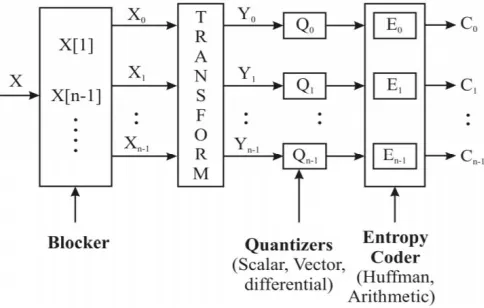
In transform based image compression, the image is subjected to transformation and then the transformed data are encoded to produce the compressed bit stream. The general structure of a transform-based image compression system is shown in Figure 1. There are two versions of transform coding. One is frame based and the other is the block based. The block based approach requires fewer computations and allows adaptive quantization of coefficients.
In Figure 1, X represents the original image pixel values; Yi denotes the transformed values of the original image. All the transformed coefficients are then quantized and entropy coded which are represented by Ci. These compressed bit streams are either transmitted or stored. Reconstructed image can be obtained by decompressing the coded signal. The goal is to design a system so that the coded signal Ci can be represented with fewer bits than the original image X [8]. In the 1980’s, almost all transform based compression approaches were using the DCT. Later, the trend moved to compression schemes based on the DWT. DWT overcomes the effect of blocking artifacts associated with DCT. Perhaps the most significant improvement in conventional coding is achieved by the use of arithmetic coders instead of simple Huffman coders, which increases the compression ratio by 5-8%. However, the multimedia content in daily life is growing exponentially; therefore, a performance gain of about 10% in ten years does not satisfy the demand. Therefore, researchers have been looking for new solutions that could solve the problem of the stagnating image compression performance.
Figure 1: Transform-based image compression system
Finally, the quantized coefficients are coded to produce the compressed bit stream. The coding process typically exploits a statistical model in order to code symbols with fewer bits for symbols that has higher probability of occurrence. In doing so, the size of the compressed bit stream is reduced. Assuming that the transform employed is truly invertible, the only potential cause for information loss is in the coefficient quantization, as the quantized coefficients are coded in a lossless manner [9]. The decompression process simply mirrors the process used for compression. The compressed bit stream is decoded to obtain the quantized transform coefficients. Then, the inverse of the transform used during compression is employed to obtain the reconstructed image.
III. IMAGE QUALITY MEASURES
original. The difference between the original and reconstructed signal is referred to as approximation error or distortion. Generally, the performance is evaluated in terms of compression ratio and image fidelity [10]. A good image compression algorithm results in a high compression ratio and high fidelity. Unfortunately, both requirements cannot be achieved simultaneously. Although many metrics exist for quantifying distortion, it is most commonly expressed in terms of means squared error (MSE) or peak-signal-to-noise ratio (PSNR). The performance of image compression systems is measured by the metric defined in equations (1) and (2). It is based on the assumption that the digital image is represented as
N
1
N
2 matrix, whereN
1andN
2 denote the number of rows and columns of the image respectively. Also,f
(
i
,
j
)
andg
(
i
,
j
)
denote pixel values of the original image before compression and degraded image after compression respectively.Mean Square Error (MSE)
2 1 1 1 2 2 1))
,
(
)
,
(
(
1
N j N ij
i
g
j
i
f
N
N
(1)Peak Signal to Noise Ratio (PSNR) in dB
10
log
(
255
)
2 10
MSE
(2)Evidently, smaller MSE and larger PSNR values correspond to lower levels of distortion. Although these metrics are frequently employed, it can be observed that the MSE and PSNR metrics do not always correlate well with image quality as perceived by the human visual system. For this reason, it is preferable to supplement any objective lossy compression performance measurement by subjective tests such as the Mean Opinion Score (MOS) to ensure that the objective results are not misleading [11].
Sometimes compression is quantified by stating the Bit Rate (BR) achieved by compression algorithm expressed in bpp (bits per pixel). Another parameter that measures the amount of compression is the Compression Ratio (CR) which is defined as
size
image
Compressed
size
image
Original
CR
(3)IV. PROPOSED METHODOLOGY
Codebook era section is the important thing element of Vector Quantization (VQ). The set of rules for the layout of superior VQ is normally known as the Linde-Buzo-gray (LBG) set of rules. Research efforts in codebook era techniques have been concentrated in two instructions: to generate a codebook that strategies international best solution, and to reduce the computational complexity of the LBG set of rules. Many techniques for lowering the time for codebook era have regarded in literature.
Figure 2: Block Diagram of Proposed Algorithm
For this reason, in BTC approach for every photograph block one Q-stage sample of length n×n and Q distinctive gray values are required to reconstruct the picture block. In multi-level BTC method, instead of determining the Q-level pattern based on the block statistics, it is selected from a set of, say, M, predefined Q-level patterns show in Figure 5. The pattern should satisfy some image quality in the best way with respect to the candidate block. Thus, at the time of reconstruction of a block, the index of selected pattern and Q gray values are sufficient.
(3)
(4)
p = No. of 0’s in the bit map and q = No. of 1’s in the bit map
V. SIMULATION RESULT
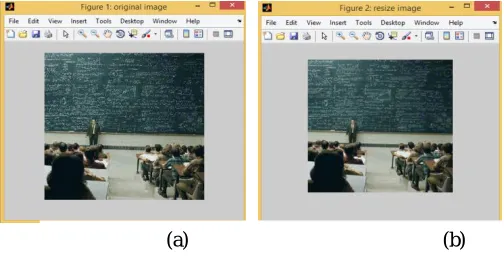
Figure 3; shows the class image of 2×2 block pixel. In this figure 3 (a) show the random image of the class image and resize the image of the 512×512 in the Satellite image shown in figure 3 (b). The compressed image is 2×2 block pixel of class image shown in figure 3 (c) respectively.
q
p
H
/
2
P
q
L
/
2
Figure 6: Multi-level BTC and pattern fitting Algorithm applied on Real Image of block size 4×4: (a) Original Image (b) image of size 255*255 (c) Logical Matrix Image (d) Compressed Image
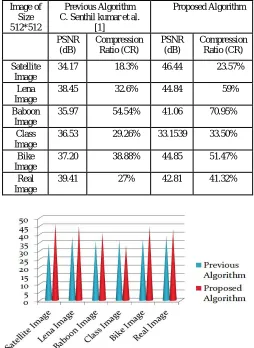
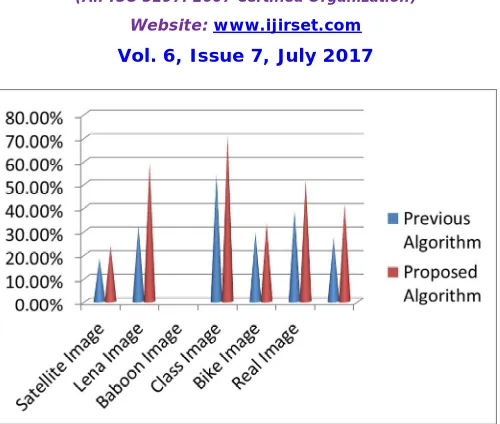
As shown in table 1 the peak signal to noise ratio (PSNR) and computation time are obtained from the proposed multi-level block truncation code algorithm. The values obtained for various block sizes is the average value of red, blue and green component of the image.
Table 1: Comparative Study of Existing Algorithm and Proposed Method on different images
Image of Size 512*512
Previous Algorithm C. Senthil kumar et al.
[1]
Proposed Algorithm
PSNR (dB)
Compression Ratio (CR)
PSNR (dB)
Compression Ratio (CR)
Satellite Image
34.17 18.3% 46.44 23.57%
Lena Image
38.45 32.6% 44.84 59%
Baboon Image
35.97 54.54% 41.06 70.95%
Class Image
36.53 29.26% 33.1539 33.50%
Bike Image
37.20 38.88% 44.85 51.47%
Real Image
39.41 27% 42.81 41.32%
VI. CONCLUSION
Multi-level BTC is a critical step in any color filter array based digital camera processing chain. The proposed multi-level BTC algorithm is shown to be a fast low complexity option for multi-multi-level BTC when a minor reduction in quality is acceptable. The proposed method of multi-level BTC has proven to be a fast low complexity multi-level BTC option capable of producing reasonable quality results when applied to artificially mosaiced data which has been gamma corrected, white-balanced, and color corrected. In a typical processing chain these corrections are preformed between the multi-level BTC step and the color-space transform, which presents a problem in relation to the proposed multi-level BTC method since there is no intermediate RGB stage.
REFRENCES
[1] C. Senthil kumar, “Color and Multispectral Image Compression using Enhanced Block Truncation Coding [E-BTC] Scheme”, accepted to be
presented at the IEEE WiSPNET, PP. 01-06, 2016 IEEE.
[2] Jing-Ming Guo, Senior Member, IEEE, and Yun-Fu Liu, Member, IEEE, “Improved Block Truncation Coding Using Optimized Dot
Diffusion”, IEEE TRANSACTIONS ON IMAGE PROCESSING, VOL. 23, NO. 3, MARCH 2014.
[3] Jayamol Mathews, Madhu S. Nair, “Modified BTC Algorithm for Gray Scale Images using max-min Quantizer”, 978-1-4673-5090-7/13/$31.00
©2013 IEEE.
[4] Ki-Won Oh and Kang-Sun Choi, “Parallel Implementation of Hybrid Vector Quantizerbased Block Truncation Coding for Mobile Display
Stream Compression”, IEEE ISCE 2014 1569954165.
[5] Seddeq E. Ghrare and Ahmed R. Khobaiz, “Digital Image Compression using Block Truncation
Coding and Walsh Hadamard Transform Hybrid Technique”, 2014 IEEE 2014 International Conference on Computer, Communication, and Control Technology (I4CT 2014), September 2 - 4, 2014 - Langkawi, Kedah, Malaysia.
[6] M. Brunig and W. Niehsen. Fast full search block matching. IEEE Transactions on Circuits and Systems for Video Technology, 11:241 – 247,
2001.
[7] K. W. Chan and K. L. Chan. Optimisation of multi-level block truncation coding. Signal Processing: Image Communication, 16:445 – 459,
2001.
[8] C. C. Chang and T. S. Chen. New tree-structured vector quantization with closed-coupled multipath searching method. Optical Engineering,
36:1713 – 1720, 1997.
[9] C. C. Chang, H. C. Hsia, and T. S. Chen. A progressive image transmission scheme based on block truncation coding. In LNCS Vol 2105,
pages 383–397, 2001.
[10] William H.Equitz, 1989: “ A New Vector Quantization Clustering Algorithm” IEEE Transactions on Acoustics, Speech and Signal Processing,
Vol. 37, No. 10, pp. 1568-1575.
[11] Wu X. and Zhang K., 1991: “ A Better Tree-Structured Vector Quantizer”, in IEEE Proceedings of Data Compression Conference, Snowbird,
UT, pp. 392-4
[12] Yang S.B., 2005: “ Smooth Side-match Weighted Vector Quantizer with Variable Block Size for Image Coding”, IEEE Proceedings – Visual
Image Signal Processing, Vol. 152, No. 6, pp. 763-770