LINKAGE I N PRIMULA S I N E N S I S
EDGAR ALTENBURG
[Received May 24, 19161
Primula Sinensis is one of the few plants in which linkage between several pairs of Mendelian factors is kn0wn.l The work of GREGORY
(191 I a, b)has indicated a relationship between these factors essentially
similar to that previously established especially well in Drosophila a;mpelophila.2 No such large numbers of individuals, however, were studied by GREGORY as are customary with the animal workers using such a short-cycled and easily handled type as the pomace fly. It seemed desirable, therefore, to obtain more extensive figures on a form other than Drosophila, in order to have sufficient data on which to base general conclusions on this most recent and important phase of genetics, -the mathematical relationships between linked factors.
Two pairs of factors are said to be linked, if, in an individual heterozy- gous for them, the parental combinations occur more often than the recombinations (or new combinations). Thus, when two germ-cells unite, one containing the factors for long style and red flower color, and the other those for short style and magenta flower color, an individual is formed most of the gametes of which will contain the parental combi- nations of factors, namely, some gametes with the factors for long style and red flower, and others with the factors for short style and magenta flower; but a smaller proportion of the gametes will contain the new combinations of factors, namely, gametes with the factors for long style and magenta flower, and others with the factors for short style and red flower. I n MENDEL’S experiments involving two pairs of factors, the combination and the recombination classes of gametes were equally numerous; such factors are said to show random segregation. The term “crossover” has been used to apply to new combinations between linked factors, not to the random segregation described by MENDEL.
‘ A group of five pairs of linked factors is known in this plant.
355
Investigators in this field have found themselves divided into two camps,-those who adhere to the original reduplication hypothesis of
BATESON, and those who find in the chromosomes and their behavior the basis of all Mendelian heredity. I t should be a simple matter to test experimentally the hypothesis which states that the members of linked pairs of allelomorphic factors undergo so-called vegetative reductions early in the development of an individual, and that the cells containing certain haploid combinations of factors thus produced (corresponding to the gametic combinations) undergo more rapid division than cells with other combinations, the end result being the production of more gametes of certain classes (the original parental combinations) than those of other classes (the recombination classes). An attempt to test this view will be described later.
The parent plants in my experiments were grown from seed sent t o me by
R.
P. GREGORY, to whomI
wish to express my sincerest thanks. One of the parents had the three linked factors, long style(I),
red flower( Y ) , and red stigma (s). The other had the three allelomorphic domi- nants, short style ( L )
,
magenta flower ( R ),
green stigma (S) .3 Plants with these characters have been adequately described by GREGORYI r s
(1911 a). The F,,
rR3
,
was back-crossed* to the triple recessive,l r s
l r s
Seeds for the F, plants used in the back-cross were planted in the greenhouse during the summer of 1914. The plants started to bloom about the middle of December. The pollinations were made during De- cember, 1914, and January and February, 1915. During these months there were few or no pollen-carrying insects in the greenhouse. The long-styled, red-flowered, red-stigma plants were used in most cases as the female. Examination of many of these long-styled flowers showed
'The latter plant appeared pale pink, however, because it differed from the normal magenta in a pair of allelomorphs other than the pair by which normal magenta differs from -the red;. the pale pink factor is recessive to its allelomorph in the normal magenta (which allelomorph is also gossessed by the red).
The pale pink parent was heterozygous f o r &ort and long style. I rejected the long-styled F, plants.
'This method of crossing is very desirable because the factors possessed by the hybrid gametes are shown directly by rhe character of the resulting offspring, since the other #parent introduces no dominants to obscure the factors introduced by the heter- ozygote. Thus the heterozygote LI X ZZ gives one-half L1 (short style) and one-half
I1 (long style), the gametes of Ll also being one-half short, and one-half long, style.
LIXKAGE IK PRIMULA S I N E N S I S
-
EDGAR ALTENBURG
356
that they rarely, i f ever, set seed without hand pollination. Moreover, the anthers of these plants did ilot develop properly during these months, being small, brown and hard, and sterile; they also failed to open. Plants used as female parents in crosses were nevertheless emasculated and sacked before the flowers opened, except in a few instances which were recorded. Plants used as male parents were also sacked before the flowers opened. The sterile anthers of long-styled female plants were removed generally just before pollination or several days previously. This was done by tearing the entire corolla lengthwise in two and then removing the halves, care being taken in so doing not to touch the stigma with any of the other parts of the flower. Most of the seed resulting from the back-cross was planted earlier than usual, in May and June of
1915;
but the plants did not bloom before December - about the usual time of blooming. In all cases a record was made of the particular plant and capsule which produced the seed. Records were also made of the particular plant used as the pollen parent, and in certain cases also, of all the seeds resulting from the pollination with single anthers. The seed was planted in pans of sterilized soil, and the young seedlings transplanted to successively larger pots ; about 800 plants were allowed to bloom in two and two-and-a-half inch pots, the rest matured in three, four and five inch pots. Individuals grown in small pots produced per- fectly normal flowers (possibly a trifle smaller than those of plants in larger pots), but the number of flowers produced per plant was, of course, smaller.An interesting feature in connection with the culture of primulas is
the extreme cold in which they can thrive. The bulk of my plants was kept in cold-frames for the greater part of the winter, during which time they were probably subjected to temperatures considerably below freezing, since the outside temperature on several occasions was at or near zero Fahrenheit, and no artificial heat was used in the cold- frame^.^ These plants were much more vigorous and produced a better bloom than similar plants cultivated in the greenhouse.
'ildditional covering of boards o r straw mats was applied at night.
It is also interesting that no watering during the entire winter was necessary, and although the soil became very dry, the plants did not droop or seem t o suffer in a n y way.
'Commercial growers as a rule transfer primulas from cold-frames t o the green- house late in fall, but I know of no previous instance in whidh they were kept outdoors all winter in a climate as cold as that of New York.
LISECAGE IN PRIMULA SINE.VSIS 357
Primulas demand a light, rather dry soil in a moist, cool greenhouse
( 45°--600F.). Over-watering is especially harmful to young plants before they become pot-bound ; individuals so treated are sickly, yellow- leaved, with poorly developed flowers, the characters of which can not be well distinguished.
Whenever plants froze, failed to bloom properly, or were not included in the counts for any reason, a record of the fact was usually made.
A few further matters of technique should be mentioned. The factor for green stigma also makes the flower color, whether magenta or red, lighter. Tbese light magentas and light reds are rather difficult to dis- tinguish from each other at times. The flowers of poorly developed (especially over-watered) plants with green stigmas may appear light magenta, but the plant may really possess only the red factor. Any weak plants, therefore, with green stigmas and poorly developed flowers could not be included in the records, and were discarded. This would lower somewhat the number of individuals in classes 2 , 3, 5, and pos- sibly 8 (table I a ) , but as the number of such discarded individuals was
very small (not over 2 5 ) , these figures would not be appreciably altered. The light red and light magenta flowers of plants grown in small pots were as a rule not much, or no more, difficult to distinguish than the flowers of plants grown in larger pots. Especial care had to be exercised in not including in class 8 individuals which did not belong there, since a relatively few mistakes could alter appreciably the ratio of this class to the total. As a rule, where there was a possibility of con- fusion the plant was re-examined at a later period when new flowers were produced, and the two observations compared; and the individual was not recorded until there was certainty as to its proper classification. When there was any doubt as to the classification of the light individuals belonging to the larger classes 3 and
5,
such plants were either re- examined later, or placed without re-examination in the class where they presumably belonged; in the latter case a note was always made of the extent to which the classification was questionable. Thus the color of twenty individuals of class 3 and of four of class 5 was somewhat doubtful. The color of fourteen individuals of class 3 and seven of class 5 was doubtful. There may have been several plants which be- longed to class 8 but which were included in class 2 , because all of the flowers on these plants appeared light magenta at the time the record was made, although the plants were light red genetically. This may explain partly the fact that class 8 is smaller than class 7, which it shouldSuch plants must be discarded.
E D G i R ALTENBURG
358
about equal. Moreover, a lot of about 300 plants grown in small pots is included in the records, and plants of this lot which were of uncertain color, especially such as might belong to class 8, were not classified. This again would lower somewhat the number of individuals of class 8. The red stigma is most easily distinguished in the very young un- opened flower. As the flower becomes older the stigma color becomes less distinct.
One hundred and eight plants grown in the cold-frames were killed by frost. There should be no resultant disproportionate lowering of any particular class or classes, since probably the frost had no selective action on one or more classes of plants. There were about 225 plants in small pots which
I
failed to count either because they had not produced a sufficiently abundant bloom at the time that I had opportunity to make counts. or because they were past their blooming period. These plants will be transferred to larger pots in an effort to induce them to bloom next winter.There are eight J classes corresponding to the eight types of gametes, each class including one member of each of the three pairs of allelomorphs involved. It is
desirable to report the results in this manner, as is explained below. An examination of table I a shows that the percentage of crossovers between the allelomorphic pairs
r R
and s S is 31.5 percent (column 2 )+
2.52 percent (column 4 ) = 34.02 percent. That between I L and r Ris 9.1 percent (column 3 )
+
2.52 percent (column 4) = 11.62 percent. When the factors are placed in the order given in table I (I, r, s, orL, R,
S ) , a single crossover between the pairs of allelomorphs 2 L and r R, or between the pairs r R and s S results in a separation of, or cross- over between, E and s (or L and S ),
but two simultaneous crossovers, one between 1L
and r R, the other between r R and s S, do not result in a separation ofI
and s (or L and Sy. The percentage of such simulta- neous crossovers, or double crossovers, is 2.52 (table I a, column 4). Ifthe F, had been homozygous for r ( o r
R),
there is no reason to doubt that essentially similar processes involving linkage would have taken' place, viz., the same number of double crossovers would have taken place between the pairs of factors E L, r r (or RR ) ,
and s S ; but the parental combinations or non-crossovers I,r
(or R ) , s, and L, r (or R ) , S, would have been indistinguishable from the double crossovers I, r (or R ) , s,and L, r (or R ) , S. In other words, in an individual homozygous for r (or R ) , but heterozygous for E L and s S, we should be unaware of the existence of double crossovers, since the factors E and s (or L and S )
LINK.4GE I N P R I M U L A SINEhrSIS
Percent of
T A B L E I
a. O f f s p r i n g of back-cross
-)
and reciprocal. Total number of individuals 3684.1 = long style L = short style
r = red flower L = magenta flower
s = red stigma S = green stigma
56.9
359
3. 4 r, S 484 Sum of
contrary classes
S. E, R, S 173
Column I Column 2
Non-crossovers Single crossovers
I. l , r , s 137 3. l , r , S 42 2. L , R , S 129 4. L , R , s 65
-
-
Sum of
contrary 266 107
classes
Percent of 67.6 27.2
total (392)
I
I, 1, r, s IO32 3. I, r, S 526 I
5. l , R , S 7 7. l , R , s z 6. L , r , s 4 8. L , r , S 6
-
-
I 1 8
2.8 2.21
2. L, R, S 1063
2095 1 1 6 0
31.5
Column 3
Single crossovers
5. 1. R, S 180
6. L, r, s 156 -
336
Sum of
contrary classes
Percent of total (3292
I. 1, r, s &j
182!
55.5 22.0
6. L, r, s 152
-
325
9.9
Column 4
Double crossovers
8. L. r,
s
39-
93
02.52
2.55
c. Offspring o f
ks
xhs>
only ( 9 lzeterozygous).(Included above under a.)
L , R , s 1, r, s
EDG.\R ‘ILTENBURG
would not separate and gametes containing them would as a result be indistinguishable from the non-crossovers. Any diff erence which exists between the sum of the number of single crossovers between I L and r R, and r R and s S on the one hand, and 1 L and s S on the other, is due to the double crossovers. These facts are directly indicated when the three factors, one from each of the three pairs of allelomorphs involved, are reported together; but if the
F,
is heterozygous for only two pairs offactors at a time (i.e., 1 L and r R, or r R and s S, or 1 L and s S ) , then any difference in the sum of the percentages of crossovers between 1 L and r R, and r R and s S on the one hand, and the percentage of cross- overs between
I
L and s S 6n the other, may not represent a difference due to double crossovers, but may be due to variations in the percentages of crossovers which take place in different individuals a t different times.Geneticists are not agreed upon the explanation of linkage. BATESON’S view that the various gametic ratios are due to reduplication implies a segregation of these types in different parts of the plant. It would fol- low on this hypothesis in its original form that entire anthers or ovaries should contain one gametic type. To test the latter view it was only
TABLE 2
Offspring resulting from p o l h a t i o m w i t h single anthers of the heterozygous plants. T h e record of these individuals is included in table I .
Number I L 1 L 1 L 1 L
of capsule. r R r R R 7 R Y
S S S s S S
s
s
( I ) 4.2 I; 1-2 ( 2 ) 4.2 a z - I (3) 4.2 ‘a 2-2
( 5 ) 4.2 a z - 4 (6) 4.2 a2-5
( 7 ) 4.2 c 1-2 (8) 4.2 c 1-3
( 3 ) 4.2 C 1-4
(4) 4.2 a2-3
36 43
48 48
20 26
17 18
5 8
3 8
I8 I3
24 33
21 21
I8 16 26 6 8 3 9 IO 2 30 33 41 I4 I 2 I 2 6 5 I O 5 I2 I1 6 4 4 3 I 0 7 I1 I1 8 9 4 2 0 0
0 0
2 I
4 I
2 0
2 0
0 0
0 0
0 I
I I
361 LINKAGE I N P R I M U L A SZNENSIS
TABLE 3
Offsp&g grozon from seeds of single capsules of the heterozygous plants. The record of these indizaduals is included in table la.
_ _ _ _ _ _ _ _ _ ~ --__- ~ _ _ _ _ _ _ _ _ _ _ _ _ _ _
1 L 1 L l L 1 L
of capsule. r R r R R r R r
S S S S S S s s
Number I73 I74 I75 176 I77 178 I80 I81 I82
1 83 184 190 191 I99 200 204 205 206 207 216 218 212
4 9
4 4
5 4
6 6
8 6
7 2
6 5
I 7
7 8
5 3
8 3
4 4
4 5
5 3
2 5
5 3
6 5
8 3
5 3
6 6
6 3
2 2
3 0 I 2 4 3 I 0 0 I 2 0 3 2 I 4 0 0 0 I ' I 0 4 3 4 3 0 I I 3 5 4 2 2 I 2 I 0 0 3 4 6 5 I I I 0 I 0 0 0 0 0 0 0 0 0 0 0 0 2 I 0 0 0 I 0 0 0 0 0 0 0 0 0 0 0 0 0 0 I 0 I I 0 0 0 I
0 I
0 0
0 0
0 0
0 0
0 0
0 0
0 0
I 0
0 I
0 0
0 0
0 0
0 0
0 0
0 0
0 0
0 2
0 0
0 0
0 0
0 0
~ ~
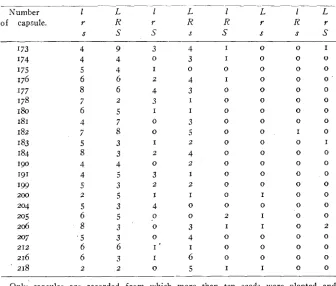
Only capsules are recorded from which more than ten seeds were planted and grown to maturity.
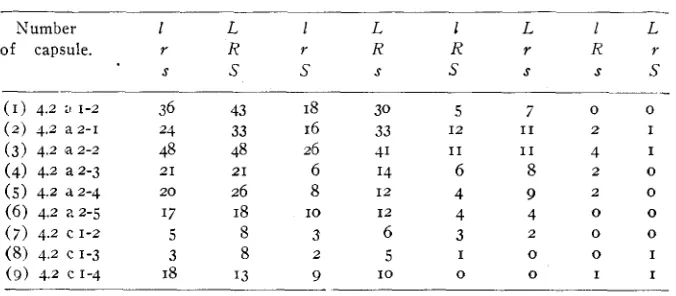
necessary, therefore, to keep separate, seeds resulting from the single heterozygous anthers or ovaries. Table 2 gives the results obtained by
using single anthers. I n each instance all the expected classes are real- ized (except the very small class of double crossovers in some cases) ;
and they occur in about their expected proportions. The ovaries, as shown by table 3, gave similar results, but the number of seeds that are produced by a single capsule is too small (20-40) to make the ratios significant. Suffice it to state that in no instance ( 2 2 cases in all) did
any heterozygous ovary produce only one type of gamete. I t follows, therefore, that reduction must take place within the anthers and ovaries, owing to some peculiarity which must occur in cell processes and cell divisions at this stage. Such peculiarities are indeed found in the spo- rangia, namely, at the reduction divisions. This leads us to the other explanation of linkage, based on the parallelism in the distribution of
EDG-IR ALTEXBiURG
362
the chromosomes and of Mendelian factors. Especially striking and complete in all its details is the identical distribution of sex-linked factors and the sex chromosomes of Drosophila (MORGAN 1911). Thus, for instance, the cytological evidence shows that a male transmits his sex chromosome to his daughters only, not to his sons; he also transmits a certain group of factors (sex-linked) to his daughters only, and not t o his sons. The results of all crosses show that wherever the sex chromo- some goes, there also these factors go. Even when, in exceptional cases, the chromosomal distribution is abnormal, there is a corresponding ab- normal distribution of these sex-linked factors ( BRIDGES 1916). Be- cause of this complete association, these factors are supposed to constitute, in part, the sex chromosome. Now, all sex-linked factors have been found to be linked to each other ( a linkage group). All factors in the same chromosome, in other words, are linked. The chromosome con- tains many distinct (i.e., separable) factors, which are considered a s occupying definite loci within it, in linear arrangement ( STURTEVANT
This material continuity is broken only when there is an interchange of similar portions of homologous chromosomes resulting in a new combination of factors, or a crossover.7 Factors that are allelomorphic are thought to occupy corresponding. loci in the homologous chrom- osomes.
I n harmony with all this observation and theory is the further fact that many other Mendelian factors which have been identified in Dro- sophila and which do not follow the sex chromosomes in their distribution to the offspring, are also never linked to those in the sex chromosome group. These non-sex-linked factors, however, form linkage groups of their own, and as the theory demands, these groups are equal in number to the pairs of chromosomes ; and curiously enough, the number of identified factors in each group has so far been found to be roughly proportional to the size of the chromosomes (MULLER 1914, 1916).
Finally, just as the pairs of chromosomes segregate independently of
each other, so also any pair of factors in one linkage group segregates independently of any pair in all other linkage groups.
The experimental evidence that the segregation of sex-linked factors happens at the same time as the reduction of the sex chromosomes is
complete. The
19131 1915) *
Here we are not dealing with theory, but with fact.
LINKAGE I N PRIMULA SINENSIS 363
inference as to similarity in the mechanism involved extends to those cases in which the homologous chromosomes are not differentiated. In these cases, the direct evidence could not be obtained, because one chro- mosome can not be distinguished from the other when in association, in an individual, with a Mendelian character.
I n general, the facts of linkage find a rather simple explanation on the chromosome hypothesis. When only three linked factors are in- volved in an experiment, it is difficult or impossible to draw conclusions, from the mathematical relationships alone, of the probable nature of the processes which are responsible for these values. Such conclusions must be based on the values afforded by many factors, all linked, in which case the various complex or special mathematical relationships may be conceived of as the result of some spatial relationship of the factors, as is believed to be true on the hypothesis of linear arrangement of the factors in the chromosomes. I t would therefore be desirable to get accurate data on a reasonably large series of linked factors in Primula or some other easily handled plant, f o r the sake of comparison with the results which have been gained on Drosophila and which have received, in general, a simple explanation on the chromosome hypothesis.
When an individual is heterozygous for three pairs of linked factors there are various proportions of the different classes of gametes possible on a priori grounds. I have attempted to establish accurately the par- ticular values given in the case of Primula, especiaIIy the numericaf pro- portions of the double crossover classes recorded in column 4, table ra. On the simple assumption that crossovers between I L and r R do not influence those between r
R
and s S, the percentage of crossovers be- tween I L and rR
(11.62 percent) should be as great when crossovers take place between rR
and s S (i.e., 11.62 percent of 34.02 percent = 3.95 percent) as when the latter do not occur. From table I , column 4,it will be seen that the percentage of double crossovers follows this simple assumption of their random occurrence, the realized percentage
of 2 . 5 2 percent being somewhat below the expectation of 3.95 percent.
The deviation from this value may be due to the fact that class 8 (column
4, table r a ) is lower than it really should be, as was explained above. The darker-colored classes I , 4, 6 and
7,
give more reliable results. Ifthese classes alone are considered the double crossovers form 2.87 per- cent of the total (i.e., 54 = 2.87 percent of 1876). The percentage expected on the simple assumption of random occurrence of double cross- overs is 2.80 percent (8.3 percent of 33.7 percent), a very close ap-
EDIGAR ALTESBURG 364
proximation to the realized percentage. These results would be explained on the chromosome hypothesis on the assumption that the factors have a linear arrangement in the chromosome in the order
I,
r, s (or L, R, S ),
and that there is no interference of crossing over between
I,
r and r, s(or L, R, and R, S ) . A double crossover, when .the factors have this arrangement, does not result in the separation of the two outer factors
( I
and .s, orL
and S ) . The sum of the percentages of crossing over be- tween l and r, and I and s is 45.64 percent (34.02 percent+
11.62 per- cent). The percentage of single crossing over between IL
and s S is 31.5percent
+
9.1 percent = 40.6 percent. The difference between 45.64 percent and 40.6 percent is due to the double crossovers, for if the factors have a linear arrangement in the order mentioned, I, r, s (orL,
R, S ) a double crossover between 1 and s (or L and 5’) does not result in the separation of these factors.
This random occurrence of double crossovers occurs in Drosophila in cases involving rather loose linkage (i.e., a rather high percentage of crossovers). I n cases involving tight linkage in this animal the number of double crossovers is below expectation. MULLER (1916) bas pointed out this disparity in the latter case, and proposed the term “interference” for it. I n our present state of knowledge, it is impossible to state whether one of the crossovers taking place tends to prevent the other, or whether they mutually prevent each other. In the latter case, there would be fewer total single crossovers than in the former case, other things being equal. W e do not know, however, exactly what these percentages would be without interference, and therefore cannot tell how the latter operates.
On the other extreme, we are confronted with those cases in Dro- sophila in which very loose linkage is involved, and in which the number of double crossovers is far in excess of the simple expectation that one crossover does not involve the other. Between these two extremes of almost complete interference and of great excess of double crossovers there occur all intermediate values. These values are probably some function of the linkage strengths involved. Since, therefore, in different cases these values may be widely different, including all the mathematical possibilities, it is impossible to postulate with certainty any spatial rela- tionship simply from the values given by only three pairs of linked factors.
LINKAGE I N PRIMULA S I N E N S I S 36.5
is, much less does it show us the cause of interference, although i t sug- gests a number of possibilities. The loops of JANSSEN'S (1905, J 909)
chiasmatype seem too frequent for each to represent a crossovel-, and they are too short to account for the facts of interference. In thiy con- nection also we must consider some of the recent researches of BON " T E
(1908) and of VEJDOVSKY (1911-12). The latter holds that thc per- sistent element of the chromosome is really a long, thin, spirally w m n d thread or chromonema, lying within an envelope ordinarily conbidered the chromosome. If the factors have a linear arrangement, it m,lst be along this chromonema. The best opportunity for the exact side-l):q-side juxtaposition of allelomorphic factors such as is demanded on the chias- matype hypothesis would be at a stage when the chromosomes appvxr as long, thin threads, as in the leptotene spireme. At this stage the twisrs are extremely short and numerous and could hardly represent c: ch a crossover; how one crossover would interfere with another at even short distances from it a t such a stage is difficult to conceive, for such short distances themselves (say one-tenth of the length of the leptotene tlil-pad) contain numerous twists.
Finally, the different linkage values given by the two sexes in aii,inals
is an enigma. I n Drosophila and moths no recombinations occiir be- tween linked factors in the heterozygous sex (male in Drosophila, !t"le in moths). Although the details of synapsis have not been workc 1 out in these forms, there seems to be no reason to doubt that they ;ire es- sentially similar to those in Batrachoceps, in which the twisti.) J. of
chromatin threads about each other has been observed in the heter zy- gous sex (the male) ; but it may be that crossing over occurs in the male Batrachoceps, as it does in the male mammal (rats, CASTLE and WRIGHT
So f a r as my figures go, no great dissimilarity in the linkage values given by the two sexes occurs in Primula. Table I , b and c, gives t lese values for both the anthers and ovaries. The difference shown in the ratios is probably not significant, since the percentages of the various classes produced by the heterozygous females are based on small counts. Some of my plants were grown at Columbia University, but most bf
them at the New York Botanical Garden. 191.5).
SUMMARY
( I ) In Primula Sinensis the pairs of factors studied may be arranged in the order: long or short style, red or magenta flower, red stigma or green stigma.
3% EDlG.4R A L T E N B U R G
( 2 ) Crossovers between the pairs of linked factors, long or short
style, and red or magenta flower, respectively, take place without ref- erence to the crossovers between the pairs of linked factors, red or magenta flower color and red stigma or green stigma, respectively; that is, there is no interference.
( 3 ) Single anthers and single ovaries of the heterozygous individuals produce all classes of gametes. Reduction of factors must therefore accompany cell divisions occurring within many or all the anthers and ovaries.
(4) The proportions of the various gametic classes of linked factors is about the same for the anthers and the ovaries.
BIBLIOGRAPHY
BATESON, W., and PUNNETT, R. C., 1911
BONNEVIE, K., 1908 Chromosomenstudien. -4rch. f . Zellf. 1 : 450-514.
BRIDGES, C. B., IQ14 T h e chromosome hypothesis of linkage applied to cases in sweet
Genet- T w o color mutations of rats which show partial On gametic series involving reduplication of certain terms. Jour. Gen. 1 : 293-302.
peas and Primula. Am. "at. 4 8 : 524-534.
ics 1 : 1-52, 107-163.
CASTLE, W . E., and WRIGHT, S., 1915 coupling.
GREGORY, R. P., IQII a Experiments with Primula Sinemis. Jour. Gen. 1 : 73-132.
1916 Non-disjunction as proof of the chromosome theory of heredity.
Science N.S. 42 : 193-195.
1911 b On gametic coupling and repulsion in Primula Sinensis. Proc. Roy. Soc.
JANSSENS, F. L4., 1 9 0 5 SpermatogGnPse dans les batraciens. 111. Evolution des auxo-
cytes mi'es du Batrachoceps attenuatus. La Cellule 22 : 377-428.
1909 SpermatogCnPse dans les batraciens. V. La theorie de la chiasmatypie. Nou- velle interpr6tation des cin&es de maturation.
MORGAN, T. H., 1911 An attempt to analyze the constitution of the chromosomes on the basis of sex-limited inheritance in Drosophila. Jour. Exp. Zool. 1 1 :
365-414.
MULLER, H. J., 1914 -4 gene for the fourth chromosome of Drosophila. Jour. Exp. 8 4 : 12-Ij.
L a Cellule 52 : 387-412.
ZOO^. 1 7 : 325-336,
1916 Mechanism of crossing-over. Am. Kat. 50: 193-221, 284-305.
STURTEVANT, A. H., 1913 T h e linear arrangement of six sex-linked factors in Dro-
7 9 1 5 T h e behavior of chromosomes as studied through linkage. Zeitschr. f. ind. TANAKA, Y., 1914 Sexual dimorphism of gametic series in the reduplication. Trans.
1915 Occurrence of different systems of gametic reduplication in male and female TROW, A. H I 1912 Forms of reduplication:-primary and secondary. Jour. Gen. 2 :
VEJDOVSKY, W., 1911-12 Zum Problem der Vererbungstrager. 184 pp. P r a g : Verlag sophila as 'shown by $heir mode of association. Jour. Exp. 2001. 1 4 : 43-59.
Abst. U. Vererb. 1 3 : 234-287.
Sapporo Nat. Hist. Soc. 5. 61-64.
hybrids. Zeitschr. f . ind. Abst. U. Vererb. 14: 12-30
313-324.