Scientific studies on effective application of
some important essential elements Nitrogen
(N), Phosphorus (P) and Zinc (Zn) Nutritional
values on spike and Floret development in
gladiolus crop
Dr. Sunita Arya1, Dr. Rajesh Kr Dubey2
Associate Prof. Department of Zoology, DG P.G. College, Kanpur (U.P.) India1
Director, UGC-HRDC, JNVU, Jodhpur, Rajasthan, India2
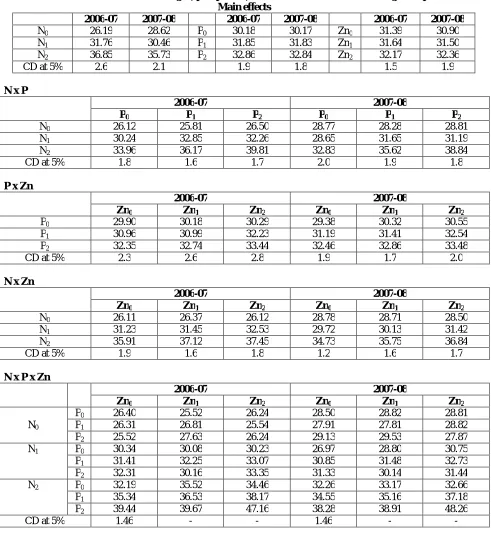
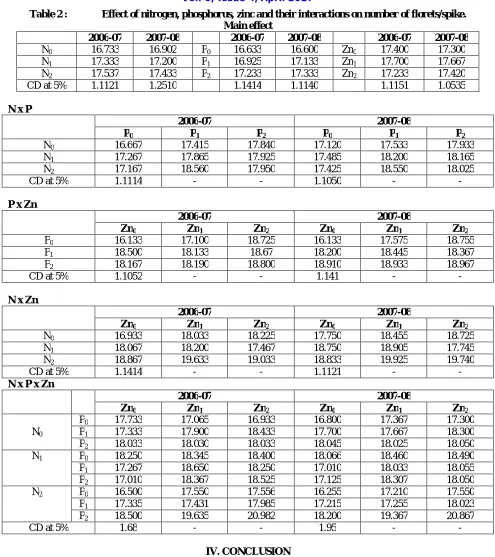
ABSTRACT: Gladiolus is the second most popular flower in the world, specially from the commercial point of view. It has great economic value and wide market in world, however the yield, quality of flower and year round supply have not achieved up to the mark. There is a great scope of establishing a commercial production of corm and cormels. Gladiolus (Gladiolus grandiflorus L.) cv. Eurovision was studied in respect of N, P, Zn nutrition for spike growth and development and florets number at D.G. College, Kanpur and Prakrati Bharti, Lucknow during 2006-07 and 2007-08. Single application of N, P, Zn, N2, P2, Zn2 produced 36.85, 32.86, 32.17 cm and 35.73, 32.84, 32.36 cm spike length during 2006-07 and 2007-08, respectively. Combined treatments of N2xP2, N2xZn2 revealed considerable effects for spike length. Application of N2xP2xZn2 treatment showed best effect with maximum spike length 47.16 and 48.26 cm in 2006-07 and 2007-08, respectively. Application of N, P, Zn treatments were found to have favorable response to number of florets/spike in gladiolus.
I. INTRODUCTION
Gladiolus occupies a special rank in flowering bulbous crops (Basu and Bose, 1970; Jakhar 1993). In irridaceae family it is known as "Queen of flowers" and holds position in Indian floriculture industry (Hegde, 2009; Chadha, 1993). Gladiolus botanically known as Gladiolus hybridus Hort. The long flower spike bears an economic and aesthetic value for its beauty and excellent elegance (Jankiram, 2009; Sindhu and Kumar 2009). Nutrient elements – Nitrogen and phosphorus alongwith micro nutrients have a special role for production of healthy spike with quality flowers (Sindhu and Arora, 1989; Dadlani, 1996). It has great potential industry for export for earning income (Prasad
et al., 1998; Swarup, 1993). The herbaceous plant sprouts from axillary buds of an underground structure, the corm, a
condensed vertical root stock covered with dried leaf base.
Zinc functions as an activator of certain enzymes which concerns protein metholism (Kumar, 2003). In recent researches Zn deficiency in soils has been reported in Northern region and its application was observed useful (Kumar, 2003). With this view experiments were conducted for growth and development of spike and florets. Nitrogen is the one of the most important nutrients producing growth and yield responses in gladiolus. The quantity of Phosphorus required by gladiolus is about one-tenth of the nitrogen expressed in terms of foliar analysis. Foliar application with NPK in addition to soil application significantly affects vegetative growth and floral Characters (Ray et al., 1995). Nutrition plays an important role in the overall growth performance of the gladiolus crop. Plant analysis has been found to be a useful diagnostic tool to work out the amount of fertilizers to be applied (Rajhansa et al. 2010).
The growers do not have any recommended doses of chemical fertilizers for quality corm and cormel production. Even the flower produces multiply their seeds without applying any chemical fertilizers. As a result, they are deprived to get optimum sized corms and cormels for flower cultivation. So, there is a good scope of increasing the yield and vigorous corm and cormel production of gladiolus from cormel by the use of appropriate amount of N and K under he agro climatic condition of India. However, information regarding nutritional requirment for corm and cormel production in Kanpur is lacing. Keeping these in views, the present study was undertaken to investigate the effect of N, K and Zn on growth and flowering of gladiolus with in short period (Chanda et al. 2000).
II. MATERIAL AND METHODS
In nutrient trials N (N0, N1-100, N2-200), P (P0, P1, P1-25, P2-50 kg and Zn (Zn-0, Zn1-5, Zn2-10 kg) per hectare single and combined doses were applied in the soil. Disease free healthy corms of Gladiolus Cv. Eurovision were sown in randomized block design and three replications trials at D.G. College, Kanpur and Prakrati Bharti, Lucknow during 2006-07 and 2007-08. Data were recorded in observations and the same were subjected for statistical analysis as per methods of Panse and Sukhatme (1961).
The observations on different parameters and biochemical parameters were recorded in field and pot both. The pots were filled by the medium (Soil : Sand : FYM – 1:1:1) @ 5 kg per pot. One healthy corm was planted in on pot. Nutrients were applied as per treatments at planting time and two split doses of N at 30 and 60 days after planting. For the vase life out flowers were kept in flask containing distilled water and number of days up to wilting was counted. Length of spike was calculated by measuring the length from the base of spike to the last of the florets. Diameters and length of floret was measured by electronic digital caliper in cm, horizontal at full bloom stage.
III. RESULTS AND DISCUSSION
Data of table 1-2, showed favourable results of N, P and Zn on spike development and florets production. Treatments in single and combination of N, P and Zn revealed positive and significant effect. Plant growth was found 36.85, 32.86 and 32.17 cm with NxP, NxZn and PxZn in combinations gave encouraging effect of spike growth and development respectively. This might be due to the reason that nitrogen, being the growth enha`ncing element, has the tendency to enforce the growth of plant. Present findings are in agreement with those of Singh and Singh (2000), Sewedon et al. (2012) and Chauhan et al. (2014).
kg of N and 10 kg Zn per hectare. Present findings are in congruence with the observations of Singh and Bijimal (2013), Sharma et al. (2010); Ahir et al. (2011); Amin et al. (2012) are in tube rose.
Table 1 : Effect of nitrogen, phosphorus, zinc and their interactions on length of spike. Main effects
2006-07 2007-08 2006-07 2007-08 2006-07 2007-08
N0 26.19 28.62 P0 30.18 30.17 Zn0 31.39 30.90
N1 31.76 30.46 P1 31.85 31.83 Zn1 31.64 31.50
N2 36.85 35.73 P2 32.86 32.84 Zn2 32.17 32.36
CD at 5% 2.6 2.1 1.9 1.8 1.5 1.9
N x P
2006-07 2007-08
P0 P1 P2 P0 P1 P2
N0 26.12 25.81 26.50 28.77 28.28 28.81
N1 30.24 32.85 32.26 28.65 31.65 31.19
N2 33.96 36.17 39.81 32.83 35.62 38.84
CD at 5% 1.8 1.6 1.7 2.0 1.9 1.8
P x Zn
2006-07 2007-08
Zn0 Zn1 Zn2 Zn0 Zn1 Zn2
P0 29.90 30.18 30.29 29.38 30.32 30.55
P1 30.96 30.99 32.23 31.19 31.41 32.54
P2 32.35 32.74 33.44 32.46 32.86 33.48
CD at 5% 2.3 2.6 2.8 1.9 1.7 2.0
N x Zn
2006-07 2007-08
Zn0 Zn1 Zn2 Zn0 Zn1 Zn2
N0 26.11 26.37 26.12 28.78 28.71 28.50
N1 31.23 31.45 32.53 29.72 30.13 31.42
N2 35.91 37.12 37.45 34.73 35.75 36.84
CD at 5% 1.9 1.6 1.8 1.2 1.6 1.7
N x P x Zn
2006-07 2007-08
Zn0 Zn1 Zn2 Zn0 Zn1 Zn2
N0
P0 26.40 25.52 26.24 28.50 28.82 28.81
P1 26.31 26.81 25.54 27.91 27.81 28.82
P2 25.52 27.63 26.24 29.13 29.53 27.87
N1 P0 30.34 30.08 30.23 26.97 28.80 30.75
P1 31.41 32.25 33.07 30.85 31.48 32.73
P2 32.31 30.16 33.35 31.33 30.14 31.44
N2 P0 32.19 35.52 34.46 32.26 33.17 32.66
P1 35.34 36.53 38.17 34.55 35.16 37.18
P2 39.44 39.67 47.16 38.28 38.91 48.26
Table 2 : Effect of nitrogen, phosphorus, zinc and their interactions on number of florets/spike. Main effect
2006-07 2007-08 2006-07 2007-08 2006-07 2007-08
N0 16.733 16.902 P0 16.633 16.600 Zn0 17.400 17.300
N1 17.333 17.200 P1 16.925 17.133 Zn1 17.700 17.667
N2 17.537 17.433 P2 17.233 17.333 Zn2 17.233 17.420
CD at 5% 1.1121 1.2510 1.1414 1.1140 1.1151 1.0535
N x P
2006-07 2007-08
P0 P1 P2 P0 P1 P2
N0 16.667 17.415 17.840 17.120 17.533 17.933
N1 17.267 17.865 17.925 17.485 18.200 18.165
N2 17.167 18.560 17.950 17.425 18.550 18.025
CD at 5% 1.1114 - - 1.1050 - -
P x Zn
2006-07 2007-08
Zn0 Zn1 Zn2 Zn0 Zn1 Zn2
P0 16.133 17.100 18.725 16.133 17.575 18.755
P1 18.500 18.133 18.67 18.200 18.445 18.367
P2 18.167 18.190 18.800 18.910 18.933 18.967
CD at 5% 1.1052 - - 1.141 - -
N x Zn
2006-07 2007-08
Zn0 Zn1 Zn2 Zn0 Zn1 Zn2
N0 16.933 18.033 18.225 17.750 18.455 18.725
N1 18.067 18.200 17.467 18.750 18.905 17.745
N2 18.867 19.633 19.033 18.833 19.925 19.740
CD at 5% 1.1414 - - 1.1121 - -
N x P x Zn
2006-07 2007-08
Zn0 Zn1 Zn2 Zn0 Zn1 Zn2
N0
P0 17.733 17.065 16.933 16.800 17.367 17.300
P1 17.333 17.900 18.433 17.700 17.667 18.300
P2 18.033 18.030 18.033 18.045 18.025 18.050
N1 P0 18.250 18.345 18.400 18.066 18.460 18.490
P1 17.267 18.650 18.250 17.010 18.033 18.055
P2 17.010 18.367 18.525 17.125 18.307 18.050
N2 P0 16.500 17.550 17.556 16.255 17.210 17.550
P1 17.335 17.431 17.985 17.215 17.255 18.023
P2 18.500 19.635 20.982 18.200 19.367 20.867
CD at 5% 1.68 - - 1.95 - -
IV. CONCLUSION
wasteful but also results in adverse affects on both plant and soil structure. Phosphorus 25 kg and Zn 5 Kg per hectare also showed signficiant results during investigation period.
REFERENCES
1. Ahir, T.R., R.B. Patel, S.L. Chawla and D.M. Rathod 2011. Effect of integrated nutrient management in gladiolus (Gladiolus grandiflorus L.).
J. Orna. Hort. 14 (1-2) : 83-86.
2. Amin, R.; Faridujjaman, M. and Uddin, AFM (2012). Phosphorus levels on growth and flowering of tuberose (Polianthus tuberosa Linn.)
Bangladesh Res. Pub. J., 7 (4) : 324-330.
3. Basu, A. and T.K. Bose 1970. The Ornamental plants. Indian Hort. 27 : 21-22.
4. Burman, D.; Rajini, K.; Paul, R. and Upadhyaye, R.C. (2005). Corm multiplication of gladiolus influence by application of Potassium and spike
removal. J. Orna. Hort., 8 (2) : 104-107.
5. Chadha, K.L. 1993. Floriculture Research. J. Orna. Hort. 1 (1) : 1-12.
6. Chanda, S.; Barma, G. and Roychaudhury, N. (2000). Influence of different level of nitrogen, phosporus and potassium on growth and
flowering of gladiolus. The Hort. J., 13 (1) : 76-86.
7. Chauhan, P.; M. Vidya Shankar and V. Rathor (2014). Effect of NPK on Physico-chemical parameters of Gladiolus (Gladiolus hybridus Hort.)
cv. white prosperity. International J. Sci. Res. Pub., 4 (12) : 1-4.
8. Dadlani, N.K. 1996. Prospects of floriculture Industry in India. Floriculture Today. 1 : 15-17.
9. Hegde, S.N. 2009. Diversification in floriculture. Nat. Conf. Flori. livelihood and Profitability. PP : 14-21.
10. Jakhar, B.R. 1993. New Horizans In Agriculture in India : 1-306.
11. Jankiram, T. 2009. Performance of I. I.H.R. Orchids, gladiolus cultivars. Indian J. Hort. 9 (1) : 61-62.
12. Kumar, P. 2003. Effect of Boran, Calcium and Zinc on gladiolus. J. Orna. Hort. 6 (1) : 83-84.
13. Mishra, H.P. (2004). Response of gladiolus to different levels of nitrogen and phosphorus on growth, spike and corm production in calcareous
soil. Indian J. Hort., 61 (2) : 168-170.
14. Panse, P.G. and P.V. Sukhatme 1961. Statistical methods for agricultural Workers, I.C.A.R., New Delhi.
15. Prasad, A., R. Kumar and S. Arya 1998. Export potentiality of floricultural Products. Sci. J. Hort. 1 : 38-40.
16. Rajhansa, K.C.; Chaurasia, P.C.; Tirkey, T.; Eshu and Verma, K.N. (2010). Effect of integrated nitrogen management on growth yield and
flower quality of gladiolus cv. Candyman. J. Orna. Hort., 13 (3) : 243-245.
17. Sewedan, E.; L. Maggar, H.; Osman, A. (2012). Effect of nitrogen and diphenylamine on gladiolus hybrida. cv. Sancera production. J. Orna.
Hort. Sci. 2 Orna. Hort., 10 (1) : 52-54.
18. Sharma, G.; Singh, J.P. and Yadav, A. (2010). Effect of nitrogen and potassium dihydrogen phophate on the nutritional and metabolital status
of plant and production of corms in gladiolus. Annals of Hort., 3 (1) : 47-57.
19. Sidhu, S.S. and J.S. Arora 1989. Response of gladiolus varieties to Nitrogen application. Indian J. Hort. 42 (2) : 250-254.
20. Sidhu, S.S. and P.N. Kumar 2009. Research Highlights in Floriculture. Nat. Conf. Flori. livelihood and Profitability : 74-82.
21. Singh, A.K. and Bijimol (2003). Effect of spacing and nitrogen on gladiolus. J. Orna. Hort., 6 (1): 73-75.
22. Singh, A.K. and Singh, S. (2000). Effect of spacing and zinc on growth and corm production in gladiolus (Gladiolus grandiflorous L.) raised
from cormels. The Hort. J., 13 (1) : 87-92.