ABSTRACT
LI, YINGJIE. Modeling the Effects of Time Lag in a Virtual Reality (VR)-Based Haptic Surgical Simulator. (Under the direction of Dr. David B. Kaber and Dr. Yuan-Shin Lee).
The goal of this research was to evaluate a virtual reality (VR)-based simulation of a surgical task by using a model of human motor-control behavior to describe performance. The study was to serve as a basis for formulating general simulator design guidelines.
A simple surgical simulator was developed for the study. User performance was tested in virtual tissue cutting (with a virtual scalpel) under different system lag conditions and settings of task difficulty. Four levels of lag were introduced in the response of the simulation to a haptic control device including 0 msec, 50 msec, 100 msec and 150 msec. Two levels of task complexity were investigated,as described by Fitts’ index of difficulty (ID; 4 and 5). During training trials before the formal experiments, subjects were asked to repeat the cutting task with lag=0 and ID=4 until they were able to fully control the virtual scalpel. Under each combination of test conditions, the user was asked to use the stylus of a PHANTOM haptic device, control the virtual scalpel to reach a marked area on the tissue, cut to a desired depth, and cut along a marked path on the surface to an end point. The time and position of the virtual scalpel tip was recorded throughout the process. The root mean square error (RMSE) of scalpel position for the path tracking in the plane of the tissue surface and in the plane perpendicular to the surface was recorded in each test trial.
parameter settings of the haptic control model on the VR application accuracy that interacted with the lag condition.
This research demonstrated that motor behavior in a simple VR-based surgical simulation conforms to Fitts’ Law across levels of ID. Consequently, if simulated surgical tasks impose stringent requirements on user response time, designers need to carefully control the computational load of a simulation and time lag. An extended Fitts’ model was validated in this study, allowing one to predict the acceptable time lag in control if desired ranges of user response times and levels of surgical difficulty (described in terms of ID) can be specified. Lag appears to also have important subjective affect on the stability and perceived realism of a haptic model and VR simulators. The tracking results motivate additional research of haptic model parameters for VR to realistically simulate specific forms of tissue. Additional work is needed to determine design parameters to balance user feelings of realism with the need for system stability in the presence of time lags.
Modeling the Effects of Time Lag in a Virtual Reality (VR)-Based Haptic
Surgical Simulator
by
Yingjie Li
A thesis submitted to the Graduate Faculty of North Carolina State University
In partial fulfillment of the Requirements for the Degree of
Master of Science
INDUSTRIAL AND SYSTEMS ENGINEERING
Raleigh, North Carolina 2007
APPROVED BY:
Dr. David B. Kaber Dr. Yuan-Shin Lee Chair of Advisory Committee Co-Chair of Advisory Committee
DEDICATION
BIOGRAPHY
ACKNOWLEDGEMENTS
I would like to express my deep appreciation and gratitude to my advisors, Dr. David B. Kaber and Dr. Yuan-Shin Lee for their patience, suggestion and encouragement during my academic and research work at North Carolina State University. Without their guidance and continuous support, I would never have finished my study. I would like to thank Dr. Simon M. Hsiang for his support and service on my Master’s Thesis Committee.
I greatly appreciate, and would like to thank, my research group members: Shiyong Lin, Dr. Yongfu Ren, Dr. Susana K. Laiyuen, Deyao Ren, Apichart Boonma, Plawut Wongwiwat, Plamen Kirilov Velinski, Ronald L. Aman and Eui Seok Kim for their valuable consultation, suggestions, advice and help during my research.
TABLE OF CONTENTS
Page
LIST OF TABLES ... vii
LIST OF FIGURES ... viii
LIST OF ABBREVIATIONS ... ix
Chapter 1Introduction ... 1
1.1. RESEARCH MOTIVATION ... 1
1.2. REVIEW OF SURGICAL SIMULATORS AND VIRTUAL TISSUE MODELING ... 1
Chapter 2Preliminary Survey ... 10
Chapter 3Modeling and Evaluating Motor Behavior in Surgical Simulation ... 12
3.1 FITTS’LAW AND AN EXTENDED MOTOR CONTROL MODEL ... 12
3.2 MODELS OF TRACKING TASK PERFORMANCE ... 15
Chapter 4Problem Statement ... 19
Chapter 5Methods ... 21
5.1 SIMULATOR SETUP AND SURGICAL TASK ... 21
5.2 EXPERIMENT DESIGN ... 23
5.3 PROCEDURE ... 24
5.5 HYPOTHESES ... 27
Chapter 6Result and Discussion ... 29
6.1 FITTS’TASK ... 29
6.2 CONTINUOUS TRACKING TASK ... 32
6.3 SUBJECTIVE SURVEY RESULTS ... 38
Chapter 7Conclusion ... 42
7.1FUTURE RESEARCH AND CAVEATS ... 43
REFERENCES ... 45
APPENDIX A: SURGICAL SIMULATOR DEVELOPMENT SURVEY FOR SURGEONS ... 48
APPENDIX B: NORTH CAROLINA STATE UNIVERSITY INFORMED CONSENT FORM FOR RESEARCH ... 52
APPENDIX C: SUBJECT SURVEY ... 55
LIST OF TABLES
LIST OF FIGURES
Figure 1.1. Spring unit in tissue modeling (Lin, 2007). ... 6
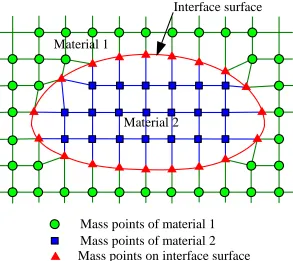
Figure 1.2. Mass-Spring model for heterogeneous tissue (Lin, 2007). ... 6
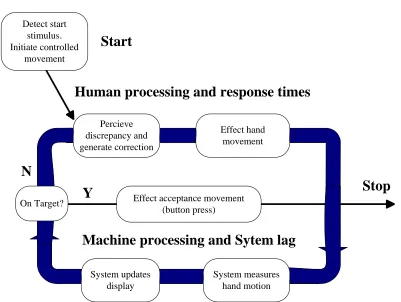
Figure 3.1. Human processing and response times ... 14
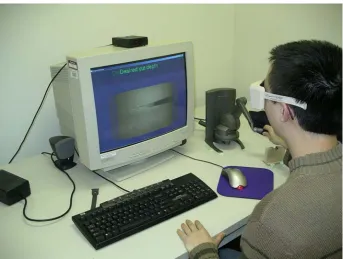
Figure 5.1. Sensable Technologies PHANTOM® Desktop™ haptic device integrated with the VR workstation and virtual surgical simulation. ... 21
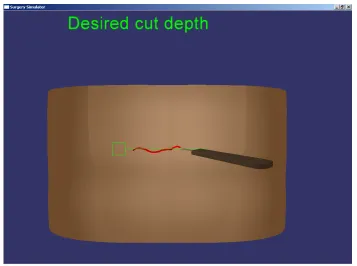
Figure 5.2. A close-up view of the surgical simulator, user’s interface. ... 22
Figure 5.3. Simulator display when cutting too deep ... 26
Figure 6.1. Mean Response time according to delay ... 31
Figure 6.2. Tracking RMSE in the plane parallel to the tissue surface for each setting of lag. ... 35
Figure 6.3. Tracking RMSE in depth for each combination of lag and ID setting. ... 35
LIST OF ABBREVIATIONS
ANOVA Analysis of Variance
BEM Boundary Element Model
CR Ratio Control/ Response Ratio
DOF Degree of Freedom
FEM Finite Element Model
ID Index of Difficulty
MIS Minimally Invasive Surgery
RMSE Root Mean Square Error
SOP Successive Organization of Perception
Chapter 1
Introduction
1.1.Research Motivation
Great developments have been achieved in the past decades in the areas of computer graphics and virtual reality (VR) applications, including a wide variety of simulations for product design (Gironimo, Lanzotti et al. 2006; Kim, Yang et al. 2006), military training (Kaber, Wright et al. 2006), surgical training (Liu, Tendick et al. 2003), etc . This study focused on the design of surgical simulation for effective training for operations. Stereoscopic displays, virtual tissue models and haptic force feedback devices all make VR highly conducive for surgical simulator development. How to develop a surgical simulation that effectively exploits these advances with high fidelity and that can be used efficiently for training was the overarching research question addressed by this study.
1.2.Review of Surgical Simulators and Virtual Tissue modeling
The importance of surgical simulation has increasingly been recognized in medical education programs (Liu, Tendick et al. 2003; Gallagher, Ritter et al. 2005). There are a number of reasons for this:
at a medical education facility with appendicitis, the residents learn the technical aspects of appendectomy and how to address them surgically. Ideally, over the course of a residency, the surgical resident participates in the care of enough patients with various diseases such that (s)he becomes competent in the academic and technical aspects of the chosen surgical specialty. However, there is no guarantee that this will be the case (Liu, Tendick et al. 2003).
2 Another motivation for the use of simulators is rising health care costs. Health insurance carriers encourage participants to choose outpatient over traditional inpatient surgery (Grant 1992). Consequently, there are fewer patient contact hours available for medical education. Related to this, residents also face time constraints that may further limit their exposure to actual patients (Liu, Tendick et al. 2003).
3 The rapid expansion of minimally invasive surgery (MIS) has reduced the applicability of the traditional model of training surgical skills, “see one, do one, teach one”. The MIS revolution has forced the surgical community to rethink how they train residents and adapt to new technologies and approaches. This rethinking has driven the search for innovative training solutions, including VR-based simulators.
al. 2003). The surgical task training explored in this thesis is related to both minimally invasive and open surgery.
Any computer-based surgical simulation system has both technical and cognitive aspects. The technical components include (1) a virtual-patient model, and (2) specialized input and output devices. The degree of realism of the patient model is largely dictated by the consistency of rendering relative to a live patient. For example, soft tissue should have the same texture and consistency as live tissue and should deform under contact pressure. Realistic visual representation of the patient model, such as tissue bleeding, etc, may also be necessary for perceived realism.
One focus of virtual patient modeling has been representation of deformation of human organs and tissues. Deformable object modeling has been studied for sometime and has been used successfully in VR applications, including surgical simulators (Liu, Tendick et al. 2003; Kim, Yang et al. 2006), virtual sculpting tools (Knopf and Igwe 2005; Kim, Yang et al. 2006), and virtual painting systems (Bill Baxter 2005). Several modeling methods have been proposed, including linked volume models, Mass Spring Models (Castaneda and Cosio 2004; Nealen, Muller et al. 2006), Finite Element Models (FEM) (Cash, Miga et al. 2005; Djotyan, Soong et al. 2006; Nealen, Muller et al. 2006) and Boundary Element Models (BEM) (Monserrat, Meier et al. 2001).
the computational complexity of tissue modeling algorithms. Mass Spring and Finite Element Models are the most common modeling methods. Finite Element Models are based on the continuum of mechanics over small elements for an entire object (Nealen, Muller et al. 2006). FEM is an accurate method, but its computational cost is high and small tissue deformation is often assumed, which may not be representative of actual deformations occurring in surgeries. On the contrary, Mass Spring Models consist of discrete mass points connected by springs (Nealen, Muller et al. 2006) . Although this type of model may be less accurate than FEM, it is more efficient in computation, which is critical in real-time applications, such as surgical simulation (Liu, Tendick et al. 2003). Simulations must not only look realistic to a user but they must respond in a realistic way as well. In addition, Mass Spring Models are capable of simulating dynamic behaviors of deformable objects, as well as large tissue deformations often occurring in surgical tasks. Therefore, there are technological tradeoffs in the simulator design, particularly concerning the virtual tissue model that designers should consider in terms of potential human performance implications.
mass point
layer spring
shear spring
structural spring
Figure 1.1. Spring unit in tissue modeling (Lin, 2007).
Material 1
Interface surface
Material 2
Mass points of material 1 Mass points of material 2
Mass points on interface surface
The near real-time computational performance of Lin’s (2007) algorithm also provides the possibility for artificial delays in the responsiveness of a simulator to be introduced and manipulated in order to assess the impact on perceived realism and effectiveness for skill training. Graphical rendering of tissues and force feedback through an experimental simulator, including virtual material deformation, may provide users with a relatively realistic cutting experience. In general, such a mass-spring model makes it possible for simulator design research to focus on other aspects of VR in surgical skill training, such as potential lag effects on user performance.
One limitation of the virtual tissue model used in this study is that force feedback can only be provided in the direction of depth. There are several major research challenges to applying force feedback in different directions in a surgical simulator:
for the scale of the force, but also the direction of the force. These requirements make the algorithm very complicated and increase computational load.
2. Algorithm developed for calculating forces on the tissue surface plane: An accurate and fast tissue modeling algorithm is needed to calculate forces at the tissue surface. Bielser’s (2000) research considered the static friction force, dynamic friction force and force to open the molecular structure of the tissue during cutting on the tissue plane. Bielser observed that significant computational power was a big challenge for implementing such modeling methods.
Addressing these haptic rendering and algorithm challenges is beyond the scope of the present research. They represent future work for effective simulator design.
procedural knowledge (e.g., sequence of navigation of landmarks, rules of proper use of an instrument), or explicit knowledge of how to perform a procedure has traditionally been tested verbally. This type of knowledge can also be assessed in simulation training. Metrics for perceptual-motor skills include time, accuracy, or task-based criteria.
In general, surgical skills are non-verbal, relying on perceptual-motor abilities or non-verbal reasoning. Skills involving both perception and motion in surgery can range from coordinated two handed manipulations of tissue to complex motor skills, such as suturing. Higher level cognition may also be required such as (3-D) spatial reasoning or diagnostic reasoning. Simulators have an advantage in training such skills. Visual or haptic guidance can be used to train motor skills and enhance spatial perception in the simulation as well as support diagnostic tasks.
Chapter 2
Preliminary Survey
This study began with a survey of professional surgeons. The overall objective was to identify simulation features that might be critical to training effectiveness. The survey covered the following areas: (1) the utility of simulations for training; (2) approaches to on-the-job surgical training; and (3) types of sensory feedback critical to surgical task performance. Appendix A presents the survey form that was used. Ten surveys were distributed to surgeons and three responded. Results included:
• Surgeons thought medical students could benefit from simulations of surgeries, such as
simulation through the use of haptic control devices.
•Surgeon respondents said that on-site experience in surgical training starts with watching
actual operations by expert surgeons. However, several surgeons commented that, “You can’t really learn until you do it on a human under close supervision. Therefore, practicing on humans is inevitably required to learn such tasks.”
These comments suggested that a surgical simulation needs to provide users not only with visual feedback on particular surgical tasks, but haptic feedback as well. The comments also suggest that no matter how good a simulation may be, surgeons feel strongly that practice on actual patients is needed for learning.
• The survey respondents said that during surgery, they mostly rely on visual information.
On a rating scale from 1 (not important) to 5 (highly important), 100% of surgeons gave a score of 5 for visual feedback. In rating the importance of haptic feedback in simulations, one surgeon gave a score 5, one gave a score of 3, and the other gave a score of 2.
These responses raise the question, to what degree will a VR simulation with haptic feedback make a difference in surgical task training, as compared to simulations providing only visual feedback?
Chapter 3
Modeling and Evaluating Motor Behavior in Surgical Simulation
This research focused on evaluating the fidelity/realism of a VR-based surgical task simulation, integrating a stereoscopic display and haptic control/device, through use of a model of human motor-control behavior for describing performance. In addition, models incorporating task and system factors were considered in assessing tradeoffs made between simulation complexity in terms of human perceived realism and computational (rendering) load on system processes or performance. The results of investigating such models were expected to address the main research question and provide a basis for recommendations on realistic simulator design to promote effective surgical training. The human performance model evaluation was also expected to provide a basis for recommendations on how to optimize the allocation of computational resources to process haptic (force-feedback control) device input and output to facilitate user perceptions of realism for effective training.
3.1 Fitts’ Law and an Extended Motor Control Model
Movement Time (MT)=C1 +C2log2(D/W +0.5)
where
D: Distance to the center of the target from the task starting point W: Target width
C1, C2: Experimentally determined constants
According to Balakrishnan (1994) identified the index of task difficulty (ID) in this equation as the term, log2(D/W +0.5). (The constant in the log function is intended to prevent erroneous or negative results.) Fitts’(1954) original form of ID was log2(2A/W),
where A represented the amplitude of distance to the task target. Through empirical study, Fitts observed a linear relationship between ID and mean task time for various combinations of target distances and widths. Fitts’ law has been validated to describe discrete movement performance in many domains, including teleoperations (Thompson, McAree et al. 2005), neurophysiology (Selen, van Dieen et al. 2006), graphical computer interface design (Michalski, Grobelny et al. 2006), computer input/control system development (Chin, Barreto et al. 2006; Francis and Oxtoby 2006), wheelchair driving (Dicianno, Spaeth et al. 2006), etc.
task target, until the probe actually falls within the target area. Once the probe reaches the target it may not come to a complete stop; instead a series of corrections may be applied in a dynamic feedback loop to cause centering of the cursor on the target. This control loop is illustrated in Figure 3.1 (Balakrishnan 1994). The control loop is assumed to govern guided movement in a computer graphics environment. As the machine component measures human hand motion at the (stylus) interface and updates the visual display, time delay or lag may occur in the responsiveness of the machine to human control actions.
Detect start stimulus. Initiate controlled movement Percieve discrepancy and generate correction Effect hand movement
Effect acceptance movement (button press) On Target? System updates display System measures hand motion
N
Y
Machine processing and Sytem lag
Human processing and response times
Stop
Start
The modified form of Fitts equation, developed based on this control scenario, is as follows:
MT=C1+C2(C3 +MachineLag)log2(D/W +0.5)
C3 is the human processing time required to make a corrective movement and “MachineLag” represents the machine processing time to respond to the corrective movement. The term C2 multiplied by the ID represents the average number of iterations of the control loop, and C1 represents the sum of the initial time and the time required to confirm the acquisition of the target. This expanded equation can be used to describe human motor behavior in computer-based target acquisition tasks with machine processing delays.
3.2 Models of Tracking Task Performance
(Jagacinski and Hah 1988) for a more recent review) labeled this taxonomy of tracking behavior as, “successive organization of perception (SOP)” theory. According to Krendel and McRuer’s taxonomy, subject behavior in a surgical simulation in cut path tracking would be considered as error nulling behavior, since they must rely on the real-time visual and haptic feedback to minimize the tracking error from the target. If system lag is introduced, subject behavior changes to the construction mode, since they need to estimate/predict the virtual scalpel position under the lag condition. This kind of estimation is based on previous task experience and memory, as a form of proprioceptive information.
Related to Krendel and McRuer’s taxonomy on learning in tracking and performance, previous empirical research on human performance with six degree of freedom (DOF) input controls and tracking (Zhai 1995) has been identified the following general characteristics:
(1) Rich visual and haptic feedback is necessary for a user to associate control actions with system responses.
(2) The visual representation of a user’s task actions should be designed to allow immediate feedback to ensure tracking performance.
contributes to control accuracy. Other research (Zhai 1995) also suggests that proprioceptive cues, as introduced by different types of control loading (e.g. elastic), may improve static position control accuracy as well as dynamic aspects of control performance. The basis for this observation may be that there are multiple neurophysiological sources of proprioception, some of which respond to force stimuli and others to movement stimuli. Elastic feedback control devices may elicit activation of more sources of proprioception and enhance tracking accuracy.
In general, the role of proprioception in motor tasks is controversial. Different studies have put different degrees of emphasis on its importance in motor control. The notion that humans may dynamically use proprioceptive cues provided by a control device for tracking performance was further demonstrated by Pew, Duffendack, and Fensch (1967). They studied sine wave tracking with elastic controls in position control mode at various frequencies of system oscillation. With extended practice, subject performance was disproportionately better at certain critical frequencies. Furthermore, it was found that these critical frequencies changed with the elastic stiffness of the control. Subjects appeared to learn to use the natural resonant frequency of the input device (an arm-stick combination) to match the frequency of the target movement being tracked.
Chapter 4
Problem Statement
In the development of VR-based simulations, designers often need to achieve a balance between simulation fidelity (or perceived realism) and computational load on system processors to ensure system responsiveness. The greater the rendering load, the slower the response of the simulation to user actions and the lower user perceptions of realism. This may be particularly relevant for continuous tracking task performance when simulation update rate is critical to control accuracy.
Fitts’ Law can be used to assess the level of fidelity of a VR simulation for surgical task training by determining if user motor control behavior in virtual tasks conforms with the established model of discrete movement performance. The extension of Fitts’ Law, proposed by Balakrishnan (1994), can help identify whether time lag in a VR system presenting a surgical task simulation is also a significant predictor of motor behavior, in addition to target position and size; thus, establishing the potential role of lag not only in perceived realism but training performance as well.
characterized using an extension of Fitts’ Law. The work also sought to determine whether Fitts’ Law was robust for representing motor control in VR across different levels of task complexity (ID) and if the impact of computational load on the conformance of motor control behavior with Fitts’ Law varied across task settings.
Chapter 5
Methods
5.1 Simulator Setup and Surgical Task
A simple VR-based surgical simulator was developed for this study. The experiment setup included a high-performance Dell graphics workstation, a stereoscopic monitor presenting visual imagery with a resolution of 1280 x 1024 and a refresh rate of 120Hz. A Sensable Technologies PHANTOM® Desktop™ haptic device was integrated with the workstation (see Figure 5.1 for the experimental setup).
The heterogeneous tissue modeling algorithm developed by Lin (Lin, Narayan et al. 2007) was used to model the virtual tissue in the simulation in order to provide realistic visual and haptic effects during the experiment. The simulation also included a virtual scalpel that was controlled by the haptic device and other graphics representing the point at which tissue cutting was the start along with the defined cut path. The Virtual Environment Software Sandbox (VESS), a suite of C++ libraries, developed by the University of Central Florida's Institute for Simulation and Training, was used to integrate all the graphical objects and to impart behaviors to them. The VESS also controlled graphic rendering of the VE through the stereoscopic display (see Figure 5.2 for a close-up view of the simulator display).
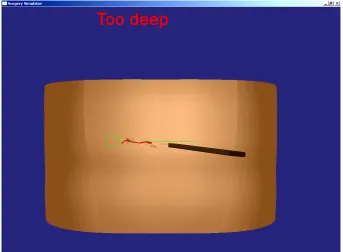
In the experiment trials, subjects were asked to use the stylus as part of the haptic device to control the virtual scalpel. When the virtual scalpel touched the virtual tissue surface, subjects were able to sense force feedback from the scalpel. The force was determined as a linear function of the cutting depth. Young’s modulus and damping parameters were selected for the virtual tissue model. The Young’s modulus determined how “soft” or “hard” the tissue seemed to the user and the damping parameter controlled the oscillatory response of the tissue during cutting. These parameters were important to providing a realistic haptic experience through the VR. A mass-spring model with stiffness parameter (k) 0.7 and damping parameter (b) 0.1 was used. In this way, subjects could sense the cut depth through the stylus and feel the resistance of, and vibrations in, the tissue. They also could see a graphical rendering of the cut on the tissue surface, formed according to the cutting depth. The deeper the user cut, the larger the cut and deformation of the tissue surface that was displayed. Subjects also used this visual feedback on the tissue surface to sense their cutting depth and direction relative to the predefined cut path. In addition, a text display warned subjects about the cutting depth, if the appropriate cut had been achieved or if it was too deep (see Figures 5.2 and 5.3).
5.2 Experiment Design
levels of time delay (response of the simulation to the haptic device), including 0 msec, 50 msec, 100 msec and 150 msec, and two levels of task complexity, as described by Fitts’ ID=4 and ID=5. The starting position of the virtual scalpel in the simulation remained the same from trial to trial along with the distance (D) to the tissue target area (marking the start of the cut) from the default stylus position. However, the size of the target area (W) was manipulated, including an 8 unit square target (at a 124 unit distance) for the ID=4 condition and a 4 unit square target (at a 124 unit distance) for the ID=5 condition. The minimum required cutting depth remained consistent in all trials (0.5 units), but the target range varied from 0.5 units to 1.0 unit. Finally, the direction and length of the cutting path were always the same. Consequently, the experiment followed a 4×2, completely within-subjects design. That is, all subjects experienced all combinations of lag and ID during the course of experiment. The entire design was replicated with each subject performing 8 trials under each condition.
5.3 Procedure
medical experience was 1.08 with a range from 1 to 2. In each trial, the subjects were asked to pick up the physical stylus of the PHANTOM device from a fixed-position cradle, control the virtual scalpel to reach the marked area on the tissue, cut to a desired depth, and cut along the marked cut path on the tissue surface. Each subject held the PHANTOM stylus in their right hand. They were instructed to pick up the stylus from the cradle to guarantee that they always started the task from the same starting point. They were instructed to move the virtual scalpel to the target on tissue surface as fast as they could. At the same time, a timer was started to record the time they required for performance. Also, the position of virtual scalpel tip in the world coordinate system was written to a file.
After touching the virtual tissue surface with the virtual scalpel, subjects were told to cut into the tissue until the text “desired cut depth” appeared on the VR display screen in “green”. They were instructed to hold the stylus at that position with the “green” text showing for 2 seconds, and then they started to cut along the marked path. If they cut too deep at any point along the path, the text “too deep” was displayed in “red” (see Figure 5.3). Therefore, the tracking task was 3D in nature and, based on the small range of the acceptable cut depth, required high accuracy.
under the various condition combinations. Testing was completed for all combinations of ID and delay, which remained constant throughout blocks. Subject exposure to blocks (lag×ID conditions) was ordered according to a Latin Square randomization procedure.
Figure 5.3. Simulator display when cutting too deep
5.4 Dependent Variables and Data Analysis
The simulated surgical task was broken-down and analyzed as two subtasks. From the point at which the subject picked up the PHANTOM stylus to the time at which the virtual scalpel reached the marked tissue area was considered as a Fitts’ target acquisition task. Cutting along the marked cut path was considered to be a continuous tracking task. These are fundamental subtasks in a surgical operation.
For the first subtask, the time to completion was recorded. In the cut-path tracking task, deviations of the virtual scalpel position from the path were recorded (once every 100ms) in the plane of the tissue surface and in the plane perpendicular to the surface. The root mean square error (RMSE) of scalpel position was then calculated for each test trial in each plane.
5.5 Hypotheses
The specific hypothesis for this experiment included the following:
• Based on the fidelity of the simulator, human performance under the no lag condition
across levels of task complexity in the virtual scalpel positioning task was expected to conform with Fitts’ Law.
• Simulator system lag in responding to human control inputs at the haptic device was
expected to significantly degrade performance in the Fitts subtask across levels of ID. • The expanded form of Fitts law, including both human and machine components, was
the various lag conditions.
• Lag in the responsiveness of the surgical simulator to haptic input was expected to
significantly degrade tracking task time and accuracy, as compared to no lag conditions.
• Finally, simulator lag was expected to degrade subject perceptions of virtual tissue
properties (damping coefficient, stress-strain potential) and the perceived realism of the overall simulation.
Chapter 6
Result and Discussion
6.1 Fitts’ Task
It was hypothesized that the first subtask would model a Fitts’ task and the performance data collected under the no lag could be explained in terms of Fitts’ Law, even given the use of the VR technology. It was also expected that Fitts’ Law would hold across the levels of ID in the surgical task, as a result of the fidelity of the simulation. However, it was expected that the artificial control lag would cause motor control performance in the virtual task to deviate from Fitts’ Law and that an expanded form of Fitts’ model would be necessary to accurately predict task time under lag conditions. For analyzing data from the lag trials, a term was added to Fitts’ Law to reflect this machine characteristic in the performance of the discrete movement tasks, as in the Balakrishnan (1994) adaption of Fitts’ work.
real discrete movement scenarios.
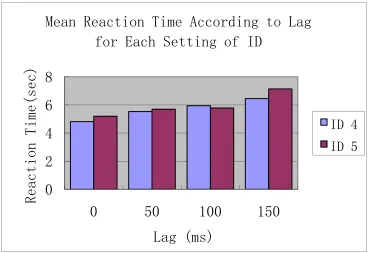
The extended model of human motor performance in the surgical training simulation, incorporating a machine component parameter, appeared to be highly significant in explaining the data for the time delay conditions. In general, user performance in the Fitts task appeared to degrade with increasing time lag, as shown in Figure 6.1. ANOVA results revealed the model to be significant at the p<0.0001 level with F (15,560) =18.85. That is, in general, the data from this study verified Balakrishnan’s (1994) model of discrete movement performance in the VR-based surgical simulation. ANOVA results also confirmed a significant main effect of lag (F (3,213) =2.89, P=0.0366) on movement time across levels of ID. Tukey’s test results revealed significant differences among mean movement time under the 150ms lag condition as compared to the no lag condition (p<0.05).
Balakrishnan’s model.
0
2
4
6
8
0
50
100
150
Reaction
Time(sec)
Lag (ms)
Mean Reaction Time According to Lag
for Each Setting of ID
ID 4
ID 5
Figure 6.1 Mean Movement time according to delay
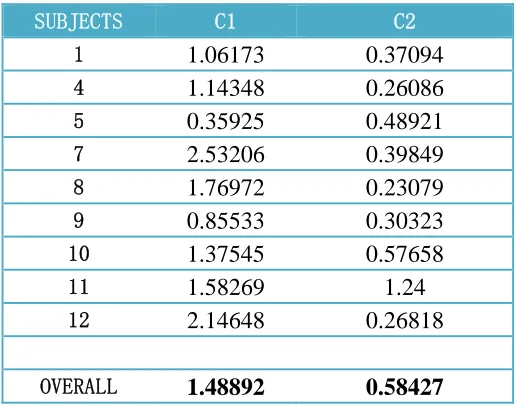
Table 6.1 C1 and C2 from the Fitts’ Law regression model
SUBJECTS C1 C2
1 1.06173 0.37094
4 1.14348 0.26086
5 0.35925 0.48921
7 2.53206 0.39849
8 1.76972 0.23079
9 0.85533 0.30323
10 1.37545 0.57658
11 1.58269 1.24
12 2.14648 0.26818
OVERALL 1.48892 0.58427
The impact of ID on movement time was not significant (F (1,71) =0.39 p=0.5334). It is important to note that the F-tests for ID and Lag main effects, as well as the interaction test, used the model mean square error as a denominator. Although ID and Lag were significant in the presence of chance, there were significant individual differences in performance in the surgical task simulation and the effects may not have been pervasive across subjects.
6.2 Continuous Tracking Task
expected to serve as an additional basis for designers to predict whether certain computational loads (and associated lags) may be unacceptable from a motor skills training perspective. That is, the results of any model of RMSE in scalpel cutting, based on simulator lag, could be compared with accepted tolerances of cut deviations in actual surgical operations to determine the viability of a simulation for imparting some minimum level of scalpel skill. Beyond this, it was expected that some interaction of the control lag setting in the experimental trials and the parameters of the heterogeneous tissue modeling algorithm could influence cut-path tracking accuracy and subject perceptions of realism in the simulation.
0 0.2 0.4 0.6 0.8 1
0 50 100 150
Mean
X-Y RMSE
Lag (ms)
RMSE
Figure 6.2 Tracking RMSE in the plane parallel to the tissue surface for each setting of lag. 0 0.1 0.2 0.3 0.4 0.5 0.6 0.7
0 50 100 150
Mean
Y-Z RMSE
Lag (ms)
ID=4 ID=5
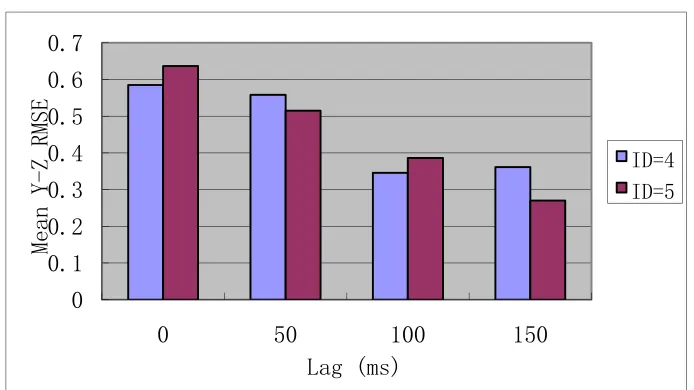
Figure 6.3 Tracking RMSE in depth for each combination of lag and ID setting.
As described in the experiment setup section, a suitable Young’s modulus and damping
parameter ( 0.7
0 0 = =
L EA
respect to Young’s modulus, the value was set according to the physical properties of living tissue. Figure 6.4 shows the results of a set of biaxial experiments on rabbit abdomen skin. It reveals the stress-strain relationship of the live tissue. Of course the parameters in the diagram will be different for human tissue and there will be differences between individuals; however, one can see that before the stress reaches the critical failure point, the stress-strain relationship is near linear. The slope of this curve was used as basis for the k parameter in the mass-spring model of the tissue in the simulation. However, since the mass-spring model for the virtual tissue was an approximation of the real tissue, it still may not respond to user action in the same way. Furthermore, if the value of the damping parameter in the model was too large, the virtual tissue may not have exhibited an elastic response at certain points in performance. On the other hand, if the damping parameter was too small, the entire system could have been unstable and oscillated out of control.
One of the reasons that subject performance declined as lag increased may have been the spring frequencies for the tissue model used in the experiment. Frequencies ranged from 1.3135 Hz to 1.09734 Hz (calculated based on a single virtual spring). However, it is possible that the optimal frequency for the tissue model was larger than 1.3135, so subject performance declined as frequency increased.
F,
mN
Figure 6.4 Force vs. stretch ratio curves for body length (x) experiments (λyfixed,λx
varied; solid curves) and for body width (y) experiments (λxfixed; dashed curve). (Fung
1993)
6.3 Subjective Survey Results
As previously mentioned, the post-experiment questionnaire asked subjects to rate the usefulness of the haptic feedback device. Related to the experiment hypotheses, the survey was also used to subjectively assess whether the haptic cues contributed to user perceptions of realism of the simulation.
perform more accurately; (2) allowed them to better sense the state of the tissue in the simulation environment; and (3) gave them a better sense of control over the scalpel in making cuts. Ten out-of 12 subjects thought haptic feedback helped them accomplish the cuts they wanted to make more quickly than with no feedback. The majority of subjects (nine out-of 12) found the haptic feedback to be extremely useful for controlling the tissue cut depth. In the first task, subjects could sense contact of the scalpel with the virtual tissue and they could control the scalpel motion (i.e., puncture, cut, stop) in an intuitive way by using the haptic feedback.
In the post-experiment survey, subjects also made suggestions on other kinds of interface feedback that might contribute to the perceived realism of the surgical simulator. A list of common suggestions with descriptions is provided below.
• Zoom in/out features - Recent research (Tani, Kawamura et al. 2006) has shown that
camera views are typically used for surgical tasks.
• Sound cues - Subjects mentioned that it was difficult for them to focus on the scalpel
cutting position and text display warning of the desired cut depth at the same time. They suggested that sound cues may be useful for this purpose in a surgical skill trainer.
• Other kinds of visual cues (e.g., bleeding caused by deep cutting) – Subjects
suggested additional visual cues to promote realism and awareness of errors. Several subjects mentioned that for training purposes, modeling physiological responses to surgical failures may also be helpful for users to learn certain operations and how to avoid mistakes.
• Augmented reality features - Subjects suggested including displays in the VR
showing how far a desired position is from the current scalpel position, like scalpel and target coordinates displayed on screen and updated in real-time. Of course, such features would not be realistic for modeling traditional surgery training, but they might be useful for novices to develop basic skills in scalpel control and positioning. • More realistic tissue textures - Several subjects suggested this would help them to
friction and forces along the cutting path of the tissue surface. As previously described, rendering such forces is a major challenge for future tissue modeling and surgical simulation research.
• Using a 1:1 control/response (C/R) ratio for scaling hand movements to display
Chapter 7
Conclusion
This research demonstrated that motor behavior in a simple VR-based surgical simulation conforms to an established law (Fitts’ Law) of motor performance across levels of task difficulty. Consequently, for surgical training simulations, if the simulated task imposes constraints on user response time, designers need to carefully control the computational load of a simulation and the time lag in machine responsiveness to trainee control actions, particularly when using a haptic input device. From the model of discrete movement control validated in this study and the results of the regression analysis, one can predict the acceptable time lag, if the desired range of user response times and levels of surgical task difficulty (described in terms of Fitts’ ID) are known in advance. In the context of surgical task simulation for the limited range of IDs investigated in this study, the implications of machine lag on motor performance appear to interact with the level of task difficulty. Therefore, models of human motor performance need to incorporate first and second order terms, like Balakrishnan’s (1994) model for representing machine components. Subjective survey findings also indicate that machine lag has important affects on perceived system stability and perceived realism of a haptic model and VR simulator.
coefficients for realistically representing specific forms of virtual tissue. Additional work is needed to determine design parameters to balance user feelings of realism with the need for system stability in the presence of time lags, which are common with VR systems. This work also revealed that a simple mass-spring model for representing virtual deformable objects (tissue) may be convenient to use because of the capability to specify few deformable properties for real-time applications; however, the model may not be sufficient for providing subjects with a realistic feeling of tissues and for facilitating realistic human performance. Future research is needed to determine whether highly realistic simulation experiences can be provided by using a mass-spring model for tissue representation and adjusting parameters in the algorithm.
In general, the findings of this work support predictions on levels of human performance under various surgical simulator design conditions and for determination of whether certain VR-based simulator designs may be unacceptable from a training perspective. Results indicated that the VR task performance conformed with a model of real-world motor behavior. Therefore, the simulator was considered to achieve concurrent validity and may have applicability for real surgical task training.
7.1 Future Research and Caveats
settings will be further studied and graphic and haptic rendering qualities will be carefully balanced with system stability. In addition to the mass-spring model, other modeling methods or modified mass-spring models will be used with more tissue properties modeled. For example, if one considers the viscoelastic property of tissue, the cutting speed in a surgical task should also be variable in calculating the force feedback (Bielser et al. 2000). In general, it is expected that Fitts law could predict motor behavior under these tissue model conditions as well.
With respect to the experiment design, in the current study subjects were novices and not expert surgeons, so their perceptions of VE fidelity and the utility of the haptic device may have been less critical than experts. In the future, subjects with different levels of surgical experience may be used to identify these potential issues. In addition, since the difference between the subjects in the experiment were quite significant, future experiment should also evaluate a broader range of levels of ID to further identify the role lf task complexity in surgical simulation.
REFERENCES
Bahrick, H. P., W. F. Bennett, et al. (1955). "Accuracy of positioning responses as a function of spring loading in a control." J Exp Psychol 49(6): 437-44.
Balakrishnan, C. W. a. R. (1994). "Reaching for objects in VR displays: lag and frame rate." ACM Trans. Comput.-Hum. Interact. 1(4): 331--356.
Bill Baxter, V. S., Ming C. Lin, Dinesh Manocha (2005). DAB: interactive haptic painting with 3D virtual brushes SIGGRAPH '05: ACM SIGGRAPH 2005 Courses. Los Angeles, California, ACM Press.
Briggs, G. E., P. M. Fitts, et al. (1957). "Effects of force and amplitude cues on learning and performance in a complex tracking task." J Exp Psychol 54(4): 262-8.
Cash, D. M., M. I. Miga, et al. (2005). "Compensating for intraoperative soft-tissue deformations using incomplete surface data and finite elements." Medical Imaging, IEEE Transactions on 24(11): 1479-1491.
Castaneda, M. A. P. and F. A. Cosio (2004). "Deformable model of the prostate for TURP surgery simulation." Computers & Graphics-Uk 28(5): 767-777.
Chin, C., A. Barreto, et al. (2006). Electromyogram-based cursor control system for users with motor disabilities. Computers Helping People with Special Needs, Proceedings.
4061: 905-912.
Dicianno, B. E., D. M. Spaeth, et al. (2006). "Advancements in power wheelchair joystick technology: Effects of isometric joysticks and signal conditioning on driving performance." American Journal of Physical Medicine & Rehabilitation 85(8): 631-639.
Djotyan, G. P., H. K. Soong, et al. (2006). "Finite-element modeling of posterior lamellar keratoplasty: Construction of theoretical nomograms for induced refractive errors." Ophthalmic Research 38(6): 329-334.
Fitts, P. M. (1954). "The information capacity of the human motor system in controlling the amplitude of movement." Journal of Experimental Psychology 47(6): 381-391.
entry." Human Factors 48(2): 279-287.
Fung, Y. C. (1993). Biomechanics: Mechanical Properties of Living Tissues, Springer.
Gallagher, A. G., E. M. Ritter, et al. (2005). "Virtual reality simulation for the operating room - Proficiency-based training as a paradigm shift in surgical skills training." Annals of Surgery 241(2): 364-372.
Gironimo, G. D., A. Lanzotti, et al. (2006). "Concept design for quality in virtual environment." Computers & Graphics 30(6): 1011-1019.
Grant, R. B. (1992). "Outpatient surgery: helping to contain health care costs." Mon Labor Rev 115(11): 33-6.
Jagacinski, R. J. and S. Hah (1988). "Progression-regression effects in tracking repeated patterns." J Exp Psychol Hum Percept Perform 14(1): 77-88.
Johansen, K. and D. M. Heimbach (2003). So you want to be a Surgeon... A medical student’s guide to surgery residencies, American College of Surgeons Online Publications.
Kaber, D. B., M. C. Wright, et al. (2006). "Investigation of multi-modal interface features for adaptive automation of a human-robot system." International Journal of Human-Computer Studies 64(6): 527-540.
Kim, Y.-S., J. Yang, et al. (2006). "A multichannel visualization module for virtual manufacturing." Computers in Industry 57(7): 653-662.
Knopf, G. K. and P. C. Igwe (2005). "Deformable mesh for virtual shape sculpting." Robotics and Computer-Integrated Manufacturing 21(4-5): 302-311.
Krendel, E. S. and D. T. McRuer (1960). "A servomechanisms approach to skill development." Journal of the Franklin Institute 269(1): 24-42.
Lin, S., R. Narayan, et al. (2007). Three-dimensional cutting simulation on heterogeneous deformable models: 28.
characteristics on human-computer interaction task efficiency." International Journal of Industrial Ergonomics 36(11): 959-977.
Monserrat, C., U. Meier, et al. (2001). "A new approach for the real-time simulation of tissue deformations in surgery simulation." Computer Methods and Programs in Biomedicine 64(2): 77-85.
Nealen, A., M. Muller, et al. (2006). "Physically based deformable models in computer graphics." Computer Graphics Forum 25(4): 809-836.
Selen, L. P. J., J. H. van Dieen, et al. (2006). "Impedance modulation and feedback corrections in tracking targets of variable size and frequency." Journal of Neurophysiology 96(5): 2750-2759.
Tani, K., T. Kawamura, et al. (2006). Experimental investigation on integral cognition by multiple senses. Interactive Technologies and Sociotechnical Systems. 4270:
456-465.
Thompson, R. L., P. R. McAree, et al. (2005). "Operator matching during visually aided teleoperation." Robotics and Autonomous Systems 50(1): 69-80.
Weiss, B. (1954). "The role of proprioceptive feedback in positioning response." Journal of Experimental Psychology 47(3): 215-224.
APPENDIX A: SURGICAL SIMULATOR DEVELOPMENT SURVEY FOR
Surgical Simulator Development Survey for Surgeons
[For researcher use only.] Subject ID:
Surgical Training and Simulations:
1. Please describe typical approaches to practicing surgical skills. (Describe any surgical skill you think is critical for a surgeon to know or not easy to master.)
a. Please indicate how long or how often you need to practice specific skills before you can actually perform them in an operation on a human patient.
b. What are the advantages/disadvantages of existing surgical training methods?
2. Have you ever used any kind of surgical simulator to learn certain surgical skills? If yes, please briefly describe the simulator and the practical result.
3. In your opinion, for what kind of surgeries are simulators most needed to help medical school
students develop their skills? (Please address virtual reality-based simulations.)
Critical Cues in Surgical Operations:
4. Please rate the importance of the below items in perceiving a surgical operation and facilitating decision making in the surgery. Use a scale from 1 to 5 with a rating of “1” indicating the surgery
depends little on the item and “5” identifying the item of greatest importance for your decision process.
a. Vision
b. Hearing c. Touch
d. Smell e. Intuition
f. Experience (e.g., making judgments according to a patient’s description of
their condition). (Please describe below the experience you think is important here.) g. Other (Please specify other faculties which you rely on for decision making
during an operation)
5. For vision, if you ranked this modality greater than “3”, please give an example the type of visual
6. For hearing, if you ranked this modality greater than “3”, please give an example of the type of auditory cues you seek to support your decisions.
7. For feeling, if you ranked this modality greater than “3”, please give an example of the type of tactile cues you seek to support your decisions.
8. Please provide descriptions of any other ways you obtain information from the surgical environment to help you make decisions during an operation.
Haptic Sensations in Surgical Procedures:
(Please respond to the following questions based on your experience in a surgical procedure for which
you think computer simulation is needed and for which a simulation could be suitably constructed.)
9. What is the surgical procedure?
10. Please describe the tools you use in the surgery. (Please feel free to provided drawings of tools.)
11. Please describe the major motions of your hands/wrists in the surgery.
12. Please provide a drawing of the tool path for the major incision as part of the operation. (For example, a straight line, curves, spiral shape, etc.) Please specify the size and depth of the cut.
13. Please briefly describe the changes in force you feel at your cutting hand in the surgical process. We would prefer that you provide a rough description of your experience along with the surgical steps. For example, “From the point at which my cutting tool touches the skin and I begin to cut
through the tissue, the force that I must exert is about N (lbs.). I can feel this force during the procedure.”
15. For important organs/nerves/vessels that you are not supposed to cut, and that you can’t actually see, what kind of measures do you use to protect the tissues?
16. Do the forces you experience at your hand in the target operation vary significantly from patient
to patient, or due to different health states of patients (e.g., high stress making muscle tissue tough)?
17. What is your usual tissue cutting speed in the target operation? For example, “I would typically
cut the skin at about inches per second.” Please provide details about the cut.
18. Could you please recommend a textbook or other material that we should refer to for detailed information about the surgery you described above?
Title:
NORTH CAROLINA STATE UNIVERSITY INFORMED CONSENT FORM FOR RESEARCH
Title of Study Defining lag tolerance range for a haptic device in simulated surgical tasks: Simulation Experiment Phase
Principal Investigator Yingjie Li Faculty Sponsor Dr. David B. Kaber
We are asking you to participate in a research study. The purpose of this study is to evaluate a model of human motor-control behavior for describing performance in a surgical task simulation. The study is also to
serve as a basis for formulating guidelines on simulator design, including approaches to haptic feedback. The model and evaluation and guideline development are to be based on lab experiment results.
INFORMATION
If you agree to participate in this study, you will be asked to perform a simulated surgical (tissue cutting) task in a virtual environment. The task will be presented to you with a high-performance graphics workstation and a stereoscopic monitor. You will be asked to wear 3D goggles to view the stereoscopic monitor and to use a
force-feedback hand control (a Sensable Technologies PHANTOM® Desktop™ haptic device) to control a virtual scalpel in the simulation environment. The haptic device includes a stylus and a mounting stand. In each experiment trial, you will hold the stylus in your hand to sense the surface of virtual tissue and to apply cutting
forces.
The experiment will involve 64 test trials under eight combinations of task difficulty and control lag. The size of the cut to be made in the tissue and the responsiveness of the haptic feedback device will be manipulated from trial to trial. The entire experiment is expected to take approximately 2 hours to complete. The following steps
are to be completed during this time: (1) 10 minutes for reading and endorsement of this informed consent; (2) 10 minutes for your completion of an anthropometric survey; (3) 20 minutes for training and warm-up trials;
and (4) approximately 1 hour for the 64 test trials. After the test trials, you will be debriefed and ask to complete a post-experiment questionnaire, which is expected to take 20 minutes.
RISKS
The risks associated with participation in this study are unlikely and minimal. They include potential visual
strain and/or fatigue from viewing the task display on a stereoscopic PC-monitor for extended periods. These risks are not substantially different from those associated with everyday PC use and are reversible. In the event that a subject indicates fatigue or discomfort during the described experiment, a rest period will be
provided. If abnormal physiologic conditions persist, subject participation in the experiment will be terminated.
BENEFITS
understanding of human factors research methods and insight into the design and development of surgical simulations for physician training.
CONFIDENTIALITY
The information in the study records will be kept strictly confidential. Data will be stored securely and will
only be made available to persons conducting the study. No reference will be made in oral or written reports which could link you to the study.
COMPENSATION (if applicable)
Your participation in this study is completely voluntary. There will be no compensation provided for the
experiment. You may withdraw at any time.
CONTACT
If you have questions at any time about the study or the procedures, you may contact Dr. David Kaber, at
the Department of Industrial Engineering, Box 7906, North Carolina State University, or (919) 515 3086. If you feel you have not been treated according to the descriptions in this form, or your rights as a participant in research have been violated during the course of this project, you may contact Dr. Matthew
Zingraff, Chair of the NCSU IRB for the Use of Human Subjects in Research Committee, Box 7514, NCSU Campus (919/513-1834) or Mr. Matthew Ronning, Assistant Vice Chancellor, Research
Administration, Box 7514, NCSU Campus (919/513-2148).
PARTICIPATION
Your participation in this study is voluntary; you may decline to participate without penalty. If you decide to participate, you may withdraw from the study at any time without penalty and without loss of
benefits to which you are otherwise entitled.
CONSENT
“I have read and understand the above information. I have received a copy of this form. I agree to participate in this study with the understanding that I may withdraw at any time.”
Subject's signature_______________________________________ Date _________________
Subject Survey
Subject ID (to be filled in by experimenter): _____________
Age: ____________
Gender (circle one): Male Female
Handedness (circle one): Right Left
Corrected Visual Acuity: Left Eye: 20/________ Right Eye: 20/_________
For the following questions, please use this scale:
1 2 3 4 5
---None Occasional Frequent
1. Rate your video gaming experience: ____________
2. Rate your PC experience: _____________
3. Rate your medical experience (as a surgeon): _______________
4. Rate your experience performing precision cutting tasks with knives: ______________
If you answered anything other than ‘1’ for video gaming experience, please summarize the types and amount of games you play (i.e. 50% of time on car racing games, 25% of time on card games, 25% of time on adventure games):
POST-EXPERIMENT QUESTIONNAIRE
Please answer the following questions regarding your experience throughout the experimental trials.
1. On a scale of 1-7 (where 1=not useful at all and 7=extremely useful), how useful was the haptic feedback for the task versus using the visual display only? _____________
2. Do you think the haptic feedback caused you to perform more accurately? (circle one answer) Yes No I Don’t Know
3. Did the haptic feedback allow you to better sense the state of the tissue on the display?
(circle one answer) Yes No I Don’t Know
4. Did the haptic feedback cause you to think more about how to control the scalpel and make cuts? (circle one answer) Yes No I Don’t Know
5. Did you feel like that haptic feedback helped you accomplish what you wanted to do more quickly than with no feedback? (circle one answer)
Yes No I Don’t Know
6. How did you use the haptic feedback to adjust your manual control of the scalpel?