ISSN(Online): 2319-8753 ISSN (Print): 2347-6710
I
nternational
J
ournal of
I
nnovative
R
esearch in
S
cience,
E
ngineering and
T
echnology
(A High Impact Factor & UGC Approved Journal) Website: www.ijirset.com
Vol. 6, Issue 9, September 2017
Improved Energy Detection Algorithm
in Cognitive Radio
Rama Kumari Sathi, Dr.K.Babulu
M.Tech, Dept. of Electronics and Communication Engineering, JNTU, Kakinada, India
Professor, JNTU, Kakinada, India
ABSTRACT :In the rapid development of current wireless communication systems, how to effectively utilize the limited system spectrum to provide the high-speed data rate service becomes a very critical issue for the system operators. The utilization efficiency of the wireless spectrum has to be improved so the cognitive radio had been proposed currently. The key issue of applying the Cognitive radio technique successfully is how to sense exactly and quickly whether or not the primary user exists, and looking for the spectrum holes to provide the secondary user. This paper deals with an energy-based maximum likelihood (ML) spectrum sensing method for the CR. The proposed method avoids the troublesome calculation of the required threshold and has almost the optimal performance for the conventional energy-based method. For cognitive radio to achieve this objective, the Physical Layer needs to be highly flexible and adaptable. It is believed that OFDM will play an important role in realizing cognitive radio concept by providing a proven, scalable, and adaptive technology for air interface.
KEYWORDS: Cognitive radio; False alarm probability Maximum likelihood ; OFDM;Probability of detection; Spectrum sensing;
I. INTRODUCTION
ISSN(Online): 2319-8753 ISSN (Print): 2347-6710
I
nternational
J
ournal of
I
nnovative
R
esearch in
S
cience,
E
ngineering and
T
echnology
(A High Impact Factor & UGC Approved Journal) Website: www.ijirset.com
Vol. 6, Issue 9, September 2017
transmits its own data in that frequency band. However, if the PU begins to transmit data, SU should stop the transmission immediately to avoid the signal collisions with the PU. The SU can perform the spectrum sensing again to find another white spectrum or spectrum hole for data transmission in the CR. Therefore, spectrum sensing is the fundamental and the critical issue should be solved properly if applying the CR concept in the practical implementation.
In literatures, three kinds of spectrum sensing techniques can be classified, i.e., the energy-based detection, the matched-filter detection, and the cyclostationary featured detection . Basically, energy-based detection determines the condition of the spectrum via the received signal energy. If the energy of the received signal exceeds a predefined threshold, SU will decide that the frequency is currently occupied by the PU. For the matched-filter detection method, SU uses a particular preamble or sequences to determine the condition of the spectrum. Like the operation of the match filter (MF), if the correlation calculation for the received signal with the preamble is greater than a predefined value, SU will regard the spectrum as in busy. For the cyclostationary feature detection, the method uses the inherit cyclic feature of the signal to determine the condition of a particular spectrum. For example, in OFDM system, the transmitted symbol contains the cyclic-prefix (CP) which is the duplication of the tail sequences of the transmitted OFDM symbol to avoid the inter-symbol interference (ISI). Currently, the concept of the cooperative sensing is also proposed to further enhance the detection probability of the spectrum sensing [7]. Among these methods, the energy-based detection method has the most simple and easy implementation advantages over the other methods. In this paper, an energy-based spectrum sensing method based on the maximum likelihood (ML) criterion will be proposed. The proposed method avoids the troublesome calculation of the required threshold in the conventional energy-based method and has almost the same performance as the adoption of optimal threshold.The paper is organized as follows, Section II describes the conventional energy-based spectrum sensing and the proposed ML scheme. Section III describes the Proposed model and the ratio value for particular frequency Section IV describes the Simulation Results,The energy detector typically operates without prior knowledge of the primary signal parameters. proposed ML scheme is evaluated. Finally, some conclusions of this paper are summarized in Section V
II. METHODS DESCRIPTIONS
2.1 Signal Model
To formulate the spectrum sensing, a binary hypothesis test (BHT) is used to analyze the
performance of energy-based detection method [3]. In Eq. (1), let H0 and H1 denote the twodistinct cases when only the additive white Gaussian noise (AWGN) w(n) or signal with noise s(n)+w(n) for the received signal y(n) at the n-th time instant.
Ho : y(n) =w(n) (1) H1: y(n)=s(n) +w(n)
In Fig. 1, assume that the usage condition of the frequency band is the same during the detection interval. After the band pass filtering (BPF) of the received signal, the signal at the particular frequency band is sampled and accumulated the energy within an interval U to calculate the decision variable T(y) for the BHT. If the accumulated energy T(y) exceeds a pre-determined threshold TH, the energy-based method will decide that the frequency is currently occupied by the PU (H1 case). Otherwise, if T(y) is less than the threshold, it will be decided that the frequency is available for the SU (H0 case), i.e.,
H0 : T(y)<TH (2)
H1:T(y)>TH (3) Basically, the accumulated energy T(y) follows the central
Chi-square distribution in the H0 case and non-central Chi-Chi-square distribution in the H1 case [10]. For both cases, T(y) has the degree of freedom 2U. Besides, the probability of detection (Pd), the probability of miss detection (Pm) and the probability of false alarm (Pf ) can be defined as below Eqations and the probability of error (Pe) can be defined as the summation of the Pm and Pf ,i.e., Pe=Pm+Pf Pd is the case that the PU occupies the frequency and the T(y) also exceeds
ISSN(Online): 2319-8753 ISSN (Print): 2347-6710
I
nternational
J
ournal of
I
nnovative
R
esearch in
S
cience,
E
ngineering and
T
echnology
(A High Impact Factor & UGC Approved Journal) Website: www.ijirset.com
Vol. 6, Issue 9, September 2017
probability Pm. False alarm defines the case that the frequency is not in use but the SU regards the frequency is busy because the accumulated energy exceeds the threshold.As mentioned, the critical issue for the energy-based spectrum sensing is how to determine an appropriate threshold TH for detection. The appropriate threshold is very difficult to be determined in advance because in a wireless communications, the energy of the received signal is varied at both the spectral and time domain S. That is, channel conditions between the Tx and Rx at different frequency and time instants are quite different. And this drawback makes the energy-based method has a poor performance
Fig1: The energy-based spectrum sensing method
compared with the matched-filter detection and the cyclostationary feature detection. Figures 2 and 3 illustrate the influence and the importance of the selection of an appropriate threshold. In the view point of the probability of error (Pe) at a particular frequency, the optimal threshold should be the intersection of the probability density functions of the central Chi square and non-central Chi-square
Fig2Threshold selection for Signal model
Equation (6) P(x)0 =
2
)
2
/
(
2 / 2
/
.
2
2 2 1 2 /
w
d
e
x
d d
w x d
Equation (7)
P(x)1=
(
.
)
2
)
(
2
1
2 2 /2
2 4
2
2 2
w wy
x
x
r
e
x
I
d dw
ISSN(Online): 2319-8753 ISSN (Print): 2347-6710
I
nternational
J
ournal of
I
nnovative
R
esearch in
S
cience,
E
ngineering and
T
echnology
(A High Impact Factor & UGC Approved Journal) Website: www.ijirset.com
Vol. 6, Issue 9, September 2017
where X=
U n 1
Y
n
2
|
)
(
|
,d is the degree of freedom, is the non-centrality parameter,
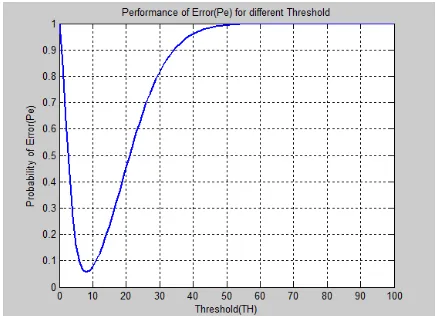
2wis the energy of the noise, is the modified Bessel function of the first kind. Figure 3 shows that if the optimal threshold can be selected, the energy-based spectrum sensing will have the best performance in terms of the probability of error (TH = 10 in this example). However, the exact solution for the central Chi-square and non-central Chi-square functions cannot be acquired directly from the Equations. Therefore, a ML method for the energy-based spectrum sensing is proposed to avoid the troublesome threshold selection for the energy-based spectrum sensing and will be shown to have almost the same performance as the adoption of the optimal threshold.
Fig. 3 Performance of Pe for different threshold
III. PROPOSED ENERGY-BASED MAXIMUM LIKELIHOOD DETECTION (EMLD) METHOD
Assume that a spectrum band of interest contains N sub-carriers with N–K sub-carriers are used to transmit data and K sub-carriers are unused. The spectrum of the received signal with T observation times can be expressed as
Xn= [Y 1 Y 2 Y 3 ...Y T] =
) ( ) ( ) 3 ( ) 2 ( ) 1 ( ) 1 ( ) 1 ( ) 1 ( 1 1 1 3 2 1 N N
Y
Y
Y
Y
Y
Y
Y
Y
T T WhereYt=[Y(1) Y(2) Y(3) ... ... Y(N)]T is the N X 1 spectrum vector at time t, [.]T denotes the transpose operation. The
autocorrelation matrix of the Xn is
R=E[Xn .XnH]= A.E[ssH].AH+E[wwH] (9) =A.Rss.AH +
WI
2
The singular value decomposition (SVD) of the R can be
V
HU
ISSN(Online): 2319-8753 ISSN (Print): 2347-6710
I
nternational
J
ournal of
I
nnovative
R
esearch in
S
cience,
E
ngineering and
T
echnology
(A High Impact Factor & UGC Approved Journal) Website: www.ijirset.com
Vol. 6, Issue 9, September 2017
N 0 0 0 0 0 0 2 1 where (.)H is the Hermitian operation, U and V are the unitary matrices, R is a diagonal matrix. Let Ed =diag{∑}=
} ,..., ,..., , { 2
1
NK N the proposed method uses the following steps to calculate the required non-centralityparameter ϒ, and the energy of the noise σw2 in applying the ML criteria.
Step 1: Sorting Ed(n) in a descending order, n = 1. . .N.
Step 2: The estimated number of used subcarriers can be calculated as (N-K)=maxnE(n) ,n=1,2,N-1, where
E(n)=Ed(n)/Ed(n+1), and maxn(.) is to find the index n with the maximum value.
Step 3 :The estimated noise energy can be
K
N K
N
W
(
1...
)
/
2
Step 4: The estimated non-centrality parameter can be
(
1
...
NK)
(
N
K
)
W2=|
(
)
|
1
n
s
U n
2Step 5 For a particular sub-carrier of interest, define
D=P(x)1/P(x)0 is the likelihood ratio(LR), where P(x)0 and P(x)1are the distributions . If the LR is greaterthan 1 (D[1),
the proposed method will decide that the sub carrier is occupied by the PU (H1 case). Otherwise, the sub-carrier will be decided as available for the SU (H0 case).
Basically, the proposed method uses the SVD method to estimated the noise energy and the non-centrality parameter. In Step 2, the index with the maximum value in E(n) is selected as the estimated number of the sub-carrier in use. This comes from the fact that ratio of the eigen value
n
s has its maximum value theoretically if
sand
nare the eigen values for the signal vector and noise vector respectively. With Step 2, the proposed method can avoid the complicated clustering calculation of the number of signals as the MUltiple SIgnal Classification (MUSIC) algorithm and speed up the calculation of the required signal and noise energy for later processing. After determining the number of used and unused sub-carriers. The noise energy and non-centrality parameter can be easily determined by the Step 3 and Step 4. In Step 5, theISSN(Online): 2319-8753 ISSN (Print): 2347-6710
I
nternational
J
ournal of
I
nnovative
R
esearch in
S
cience,
E
ngineering and
T
echnology
(A High Impact Factor & UGC Approved Journal) Website: www.ijirset.com
Vol. 6, Issue 9, September 2017
IV. SIMULATION RESULTS
1) Threshold
A pre-defined threshold is required to decide whether the target signal is absent or present. This threshold determines all performance metrics, Pd , Pf and Pmd. Since it varies from 0 to 1, selection of operating threshold is important. The operating threshold thus can be determined based on the target value of the performance metric of interest. When the threshold increases (or decreases), both Pf and Pd decrease (or increase). For known N and _w, the common practice of setting the threshold is based on a constant false alarm probability Pf . The selected threshold based on Pf can be given as
(
1(
)
)
)
2
2wf
f
Q
p
N
N
However, this threshold may not guarantee that the energy detector achieves the target detection probability (e.g., 0.9 specified in the IEEE 802.22 WRAN). Thus, threshold selection can be viewed as an optimization problem to balance the two conflicting objectives (i.e., maximize Pd while minimizing Pf ).
Fig. 4: Threshold selection of the energy-based spectrum sensing
ISSN(Online): 2319-8753 ISSN (Print): 2347-6710
I
nternational
J
ournal of
I
nnovative
R
esearch in
S
cience,
E
ngineering and
T
echnology
(A High Impact Factor & UGC Approved Journal) Website: www.ijirset.com
Vol. 6, Issue 9, September 2017
Fig 7:Plot between Pd and SNR for simulated and theoretical results
V. CONCLUSION
In this paper, an energy-based ML spectrum sensing method for the CR is proposed. The proposed method avoids the troublesome calculation of the required threshold in the conventional energy-based method. Basically, the proposed method uses the SVD method and a simple ratio test of the eigen value to estimate the noise energy and the non-centrality parameters required for the LRT. Since all these steps can be easily conducted at the SU, the proposed methods can be applied to the energy-based spectrum sensing to improve the detection performance in practical implementations.
REFERENCES
1. FCC. (2002). Spectrum policy task force report. In Proceedings of the Federal Communications Commission (FCC’03). Washington, DC, USA. 2. Mitola, J., & Maguire, G. Q, Jr. (1999). Cognitive radio: Making software radio more personal. IEEE Personal Communications, 6(4), 13–18. 3. Yarkan, S. (2015). A generic measurement setup for implementation and performance evaluation of spectrum sensing techniques: Indoor environments. IEEE Transactions on Instrumentation and Measurement,
64(3), 606–614.
4. Zeng, Y., Liang, Y.-C., Hoang, A. T., & Zhang, R. (2010). A review on spectrum sensing for cognitive radio: challenges and solutions. EURASIP Journal on Advances in Signal Processing 2010, 2010(1), 1–15.
5. Yucek, T., & Arslan, H. (2009). A survey of spectrum sensing algorithms for cognitive radio applications. IEEE Communications Surveys and Tutorials, 11(1), 116–130.
6. Sansoy, M., & Buttar, A. S. (2015). Spectrum sensing algorithms in cognitive radio: A survey. In IEEE International Conference on Electrical, Computer and Communication Technologies (ICECCT).
7. Yang, G., et al. (2015). Cooperative spectrum sensing in heterogeneous cognitiveradio networks based on normalized energy detection. IEEE
Transactions on Vehicular Technology,. doi:10.1109/TVT.2015.2413787.
8. Nair, P. R., Vinod, A. P., & Krishna, A. K. (2010). An adaptive threshold based energy detector for spectrum sensing in cognitive radio at low SNR. In IEEE International Conference on Communication
Systems (ICCS), (pp. 574–578) November.
9. Xie, S., Shen, L., & Liu, J. (2009). Optimal threshold of energy detection for spectrum sensing in cognitive radio. In International Conference on Wireless Communications and Signal Processing (WCSP 2009), (pp. 1–5) November.
10. Proakis, J. G., & Salehi, M. (2007). Digital communications (5th ed.). New York: McGraw-Hill
11 Energy-Based Maximum Likelihood Spectrum Sensing Method for the Cognitive Radio Chi-Min Li1 • Szu-Hsien Lu1 _ Springer Science+Business Media New York 2016