Location Based Services using Productive
Filtering and Review Analysis
Praveen Raut, V. L. Kolhe
Department of Computer Engineering, D. Y. Patil College of Engineering Akurdi, Pune, India
ABSTRACT: In today’s world, location based services are usedin many application. In these systems, any user request forparticular service through query to a server and server givesfeedback according tolocation. For providing this facility, a pushmodel or server initiate model is used. For using this facility user has to enter their interest for finding
their need, becauseof this model user gets related information which is going tohelp them to get exact match. System create index, based on Rtree by collecting the tokens into R-tree nodes. Using this modelit reduces some unnecessary information by filtering algorithmwhich helps to increase efficiency of system and also reduces cost of
publisher/subscriber application. Our approach is to design asystem which helps user to get the relevant information throughtrusted reviews. Manipulated reviews are identified using NaveBayes algorithm which increases the trustworthiness between the publisher and subscriber. Nave Bayes algorithm is applied onresults generated by R tree which helps to find fake review andranking of results. It helps to increase accuracy of results.
KEYWORDS: Indexing, Location, Nave Bayes,publish/subscribe, R-Tree, Review,
I. INTRODUCTION
Services which are made based on location are very useful for academic and industrial purpose. There are many other location based services available and it has to be located and accepted because they offer location aware experience. In this type of services user enter their choices and it response to user with location aware answer. For providing this facility to user, one push model is designed. For using this model user has to register spatio text for
finding their interest and the publisher send text messages. This model gives a new experience to user for finding their
queries about location. Consider an example, a user wants to find ATM machine, so he/she just put a query ATM
machine and LBS(location base services) system gives output which is depend on keyword and location which user entered. There are number of models used for finding locations. Following are some steps in models:
Group on:
In this user insert their interest with keywords and location, then the service provider reply to the user through messagewho is interested in message.
Location aware Adsense:
In this the service provider register his/her advertised so thatif any user wants to search any particular location.
Feedback:
In this the service provider check their feedback about theirservice and their product.In all these models, there are lot of big problem of get-ting high performance. Because the service provider/systemshould support millions of customers and send them messagesaccording to their queries. The reply of customers queriescontain both text information and location basedinformation. For solving the above problem, system builds a token basedR-tree based Rtree indexstructure, (this is known as Rtree).This can be done by collecting every R tree node with apack of tokens which are selected with the help of R tree andthen apply a strategy of filter and verification so that messageget
particularly its content based incarnation, has shown its competence in alarge figure of domains. In most fields in which
content-basedpublish-contribute catches its normal submission, an active message paradigm wants to take into account the position inwhich the material to be connected is consumed and produced.
II. REVIEW OF LITERATURE
Publish/Subscribe systems is a key technology for informationdissemination. Each participant in a pub messagesystem can also take the role of a publisher as well asthe subscriber of information. Publishers create informationin form of processes, which is used by subscribers issuingsubscriptions representing their interest only in specific events.
A.Topic-based Model :
Notifications and messages are grouped in topics i.e., asubscriber declares its interest for a particular topic and
willreceive all procedures and events related to that topic. Eachtopic corresponds to some channel ideally which are logicalconnecting to each possible publisher to all interested subscribers.For the broadness, the difference between topics and channel is that topics are carried within an event as a specialattribute. Using coarse grain correspondence, whichever networkmulticast services or diffusion trees, one for each topic, can be used to distribute events to interested subscribers[12].The main disadvantages of the topic-based model is the limitedarticulateness it offers to subscribers. A subscriber interested in a division of events related to a specific topic receives alsoall the other events that belong to the
same topic. To addressproblems related to very low expressiveness of topics, several solutions are abused in pub/sub implementations.
B. Content based Model:
Subscribers tell their interest by specifying conditions overthe content of messages and notifications they want
to receive.A filter in a subscription is a query formed by a set ofconstraints over the values of attributes of the notificationconstruct through conjunction or disjunction operators. Possiblelimitations depend on the subscription language and on the attribute type. Most subscription languages comparisonoperators and comprise equality as well as regular expressions.The complexity of the subscription language obviously effects the complexity of matching operation. So it is not common tosubscription of languages allowing queries more complex thanthose in conjunctive. A complete specification of content based subscription models explain in following examples of systemsthat fall under the content-based category are Subscribe, Ready [1],Gryphon SIENA [2], JEDI [3], Hermes [4], Elvin[5].
C. Type-based:
The type-based [8, 9] pub/sub variant events are actuallyobjects belonging to a specific domain, which will
thusencapsulate attributes as well as methods. With respect to unstructured models, simple, Types represent a more robustdata model for enforcing type safety application developer atthe pub/sub system, rather than inside the application [10].In a type-based subscription the declaration of a desired typeis the main perceptive attribute. That is, with respect to thegood models, type-based pub/sub sits itself somehow in themiddle, by giving a coarse-grained structure on events onwhich fine-grained constraints can be applied over attributes(like in content-based) or over methods.
D. Spatial Keyword Search follow:
relevant objects inthis region.Classifying review manipulation has become one of hot researchsubjects in e-commerce because more and more customersmake their purchase choices based on some individualscomments from virtual societies and e-business websites. Customers consider these personal reviews are more reliable thanthe prevailing internet advertisements. Consequently, someorganization attempts to create fake individual comments to affect customers mind and increase their deals. But, howto classify those manipulated reviews is a tough task forcustomers.As in many websites there are lengthy reviews related to any product but users are mainly concerned about the importantand useful information related to that product, so the proposedsystem will provide relevant information related for any product which will save users time as they need nothave to read those lengthy reviews. Manipulated reviews getsdetected which increases the customer trust. Today there is trend that lots of social networking websites provide the usersreview on any product. The customers read all the reviewswritten by other users and get the idea about the product. These personal comments and reviews might influence themasses thinking and idea about the product. It is
the humantendency that by reading the reviews of other users, one tries to look for that product and might change his/her thinkingabout that. Thus because of this reason many enterprise startgenerating their untrue reviews about their websites, products. Also today many websites manipulate the reviews i.e. whenany customer writes the negative review about any website, enterprise better knows the value of those reviews and thus they manipulate those reviews [11]. The proposed model willdetect these manipulated and fake reviews which will increasethe customers trust towards an enterprise.
III. SYSTEM ARCHITECTURE / SYSTEM OVERVIEW
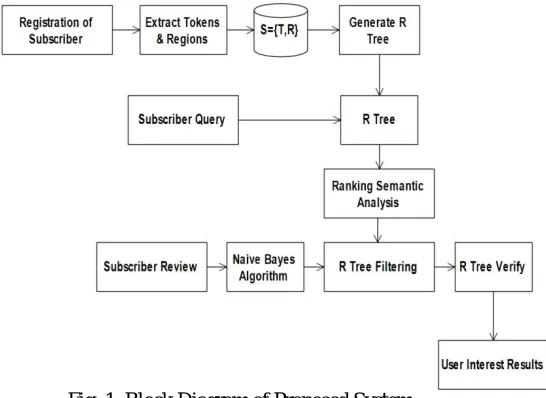
Publisher/subscriber system uses R-tree algorithm with filteringand verification which increases the efficiency
of systemand capture the user interest according to their locations and there reviews. The efficient filtering algorithm
and effectivepruning technique helps to achieve high performance. Forclassification of subscriber reviews naive bayse algorithm isused.
Fig. 1. Block Diagram of Proposed System
A.Registration of a subscriber:
B. Extracts Region and Tokens from subscriber data:
The textual description is used to capture a subscriberscontent-based interests, denoted by a set of tokens .
C. Extracts tokens and regions form publisher message:
A message m posted by a publisher also contains a textualdescription m.T and spatial information m.R, denoted bym=(T,R), which respectively have the same meaning as thoseof subscriptions. Note that the spatial information m.R of amessage can be a point, e.g., mobile users location. If thespatial information of a message is a point, call it point message; otherwise call it range message.
D. Generate R t-tree:
A token based R-tree called R t -tree, by mixing tokens ofsubscriptions into R-tree nodes. R t -tree is a stable searchtree. Every leaf node covers between b and B data entries,where every entry is a subscription. Each internal node hasbetween b and B node entries. Each entry is a triple (Child,MBR, Token Set), where Child is a pointer to its child node, MBR is the minimum bounding rectangle of all entries within this child, and Token Set is a set of tokens selected from subscriptions (or a pointer to the token set). A leaf nodes token set is the union of tokens of all subscriptions withinthis node and an internal nodes token set is the union of token sets of all entries within this node. As an entry corresponds to a node, for simplicity a node is mentioned interchangeably with its corresponding entry if the context is clear.
E. R t -treefiltering and verification:
Algorithm 1. R t -tree filtering
Input: S: A subscription Set; M: A message Output: R Answer of M
Built an R t -tree with root r Initialize a candid node CN=Ø RtFILTER (r,M,CN)
R= RtVerify (M,CN)
For R t -tree pruning system uses two filters, first is MBRfilters which is invalidates spatial constraint as
subscriptionsand second one is token filters which is invalidates textualconstraint. The nodes that are not pruned by the MBR lterand token lter are called candidate nodes. For pruning preordertraversing is used. After finding candidates node apply R t -tree filtering algorithm. In the verication step we verify thesubscriptions in the leaf candidate nodes
generated in the lterstep.
F. Review Analysis using Nave bayes Algorithm:
G. Matching of Reviews and tips:
Three types of similarity are performed for matching re-views and tips. Syntactic similarity if a sentence share sameimportant keyword then it is called as syntactic similarity. Thevector space model is a well established model for keywordsimilarity. Semantic similarity, if a sentence and tip definesthe same concept; even if the same keyword is not
used thenit is called as semantic similarity. Sentiment similarity whentips and opinions share the same sentiments i.e. positive andnegative then it is called as sentiment similarity.
IV. EXPERIMENTAL SETUP
A. Software Requirement
For the experimentation work JSP (Net Beans IDE 8.0) isused with Processor Pentium IV, RAM 1 GB & operatingsystem Windows 7. MySQL server is used for storing reviewdataset, information about publishers and subscribers.
V. SYSTEM ANALYSIS
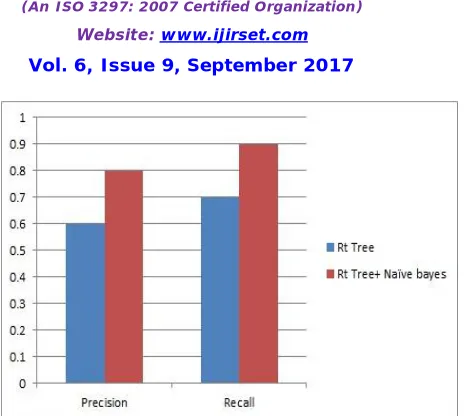
The results of the proposed method have been quantitatively evaluated using accuracy, precision and recall. By applying R -tree we increase efficiency without reducing quality. Nave bayes algorithm classify manipulated and no manipulated reviews. Figure 2 & 3 shows result of proposed method.
TABLE I
COMPARISON R tANDRtWITH NAIVE BAYES
Algorithm Accuracy(%)
R t -tree 84
R t –tree + Nave bayes 93
TABLE II
COMPARISON R tAND RtWITHNAÏVE BAYES
Algorithm Precision Recall
R t -tree 0.6 0.7
Rt-tree+Nave
bayes
Fig. 2. Precision & Recall graph
VI. CONCLUSION
In proposed method, a R-tree is generated from subscriber and publisher data. R tree reduces number of tokens by using filtering and verification method, hence it decrease index size and the efficiency get increased. Proposed
method gives better performance and increase the efficiency without increase in Error Rate. Ranking of results using
reviews improve the accuracy and helps to identified authorized publishers.
Fig. 3. Accuracy Graph
Nave bayes algorithm helps to identify fake reviews and increase customer trust towards enterprise by detecting untrue reviews. This system can be extended by using filters at testing and matching phase.
REFERENCES
[1] R. Gruber, B. Krishnamurthy, and E. Panagos, “The architecture of theREADY event notication service”, In Proceedings of the 19th MiddlewareWorkshop, 1999.
Reliability Engineering, 1998.
[3] G. Cugola, E. D. Nitto, and A. Fuggetta. “The JEDI Event-based Infrastructure and its Application to the Development of the OPSS WFMS”, IEEE Transactions on Software Engineering, 2001.
[4] P. Costa and G. P. Picco, Semi-probabilistic content-based publishsubscribe, in Proc. 25thIEEE Int. Conf. Distrib. Comput. Syst., 2005, pp.
575585
[5] R. Shah, R. Jain, and F. Anjum. “Efcient Dissemination of Personalized Information Using Content-Based Multicast”, In Proceedings of IEEE Infocom, 2002.
[6] I. D. Felipe, V. Hristidis, and N. Rishe, Keyword search on spatial databases, in Proc. Int. Conf. Data Eng., 2008, pp. 656665.
[7] X. Cao, G. Cong, and C. S. Jensen, “Retrieving top-k prestige- based relevant spatial web objects,” Proc. VLDB Endowment, vol. 3, no. 1, pp. 373384, 2010.
[8] ] H. Samet, “Foundations of Multidimensional and Metric Data Structur”,. San Mateo, CA, USA: Morgan Kaufmann, 2006.
[9] M. Sharifzadeh and C. Shahabi, “Approximate voronoi cell computation on spatial data streams,” VLDB J., vol. 18, no. 1, pp. 5775, 2009. [10] D. Wu, M. L. Yiu, C. S. Jensen, and G. Cong, “Efficient continuously moving top-k spatial keyword query processing”, in Proc. Int. Conf. Data Eng., 2011, pp. 541552.