Bacterial Foraging Optimization
Based Audio
Enhancement
Parul Mahajan1, Randhir Singh2, Ritika3
M.Tech Student, Department of ECE, S.S.C.E.T, Badhani, Pathankot, India1 Associate Professor (HOD), Department of ECE, S.S.C.E.T, Badhani, Pathankot, India2
Assistant Professor, Department of ECE, S.S.C.E.T, Badhani, Pathankot, India3
ABSTRACT: The "Audio Enhancement" merely means making the non-noisy audio noise better. In order to separate the various tools in our computer software items into basic groups, with Audio Enhancement and Noise Reduction being two of them. In this paper, the review has shown different audio enhancement techniques. These techniques tried to detect noises as well eliminate noises in order to enhance the audio signals.
KEYWORDS: Audio Enhancement, Cuckoo Breeding Behaviour, Cuckoo Search Algorithm, BFOA.
I. INTRODUCTION
The "Audio Enhancement" resources reveal equal billing with Noise Reduction because in many cases, after the noise is eliminated substantial improvement to the overall noise can nevertheless be achieved. Unlike audio Archival, the goal here is to make the product noise in addition to it possibly can. It may maybe not be worried about the "true" noise from the famous perspective...rather, what makes our ears happy. Or, we could need to adjust the overall noise of the taking in order to obtain it to noise more natural. With Audio Enhancement we may be applying some filters to enhance minimal and top quality; we may use pipe simulators to stimulate dull sounding phrases. We're able to also add indicate or reverb or retention and expansion to help with making something audibly better. The air may be the restrict and, because each set of ears differs, number two people could make exactly the same record alike.
Audio Enhancement (AE) seeks to boost the efficiency of audio connection techniques in loud conditions [1]. AE used in, for instance, to a portable radio connection program, a audio to text program, a speech recognition program, a couple of poor recordings, or to boost the efficiency of products for the experiencing reduced [5, 8]. AE is just a traditional issue in signal processing. Reading support customers often have great problem knowledge audio in a loud background. They an average of require a signal-to-noise ratio SNR of approximately 5–10 dB more than regular experiencing fans to attain exactly the same level of audio knowledge. Thus, many simple and multi-microphone noise decrease methods have already been created for modern experiencing aids. Multi-microphone noise decrease techniques are able to exploit spatial as well as spectral data and are thus preferred to single-microphone techniques [2]. The advancement of a desired audio signal in the current presence of fixed noise using an array of microphones has been studied for several years [3]. Formulas for the advancement of acoustically deformed speech signals are employed for a number of programs such as for instance hands-free devices, cell phones or experiencing aids. Typically applied techniques for (single channel) AE obtain a reduction of worrisome history noise, e.g. but don't (notably) reduce audio disturbances due to room reverberation [4].
making judgments of overall quality. But the number goal evaluate presently exists that correlates large with sometimes kind of distortion or with the entire quality of speech increased by sound suppression methods.
To boost the standard and intelligibility of noisy music, study in SE has dedicated to greater modeling of the speech and sound PDFs, the way the sound contaminates the clear music, the type of sound source, etc. The most frequent distortion in audio is due to additive sound, which can be separate of the clear speech [6]. The AE methods investigated can be collected into two important lessons: 1) the school based on hidden Markov design (HMM), and 2) the school based on transformation of signs, such as for instance MMSE opinion, spectral subtraction and subspace based methods. Ephraim and Truck Trees presented subspace based strategy. Previously, various sound reduction methods have now been proposed. Wavelet-based methods applying coefficient thresholding strategies have also been requested music enhancement. As alternative to these traditional methods is learning speech as a nonlinear dynamical system [7]. While subjective evaluation of AE methods is frequently correct and trusted presented it is conducted below stringiest conditions (e.g., sizeable crowd cell, inclusion of anchor conditions, etc., it's expensive and time consuming. For that reason, significantly energy has been added to establishing goal methods that will anticipate music quality with large correlation.
The quantization and different kinds of disturbances presented by waveform and linear predictive development (LPC)-based speech coders [e.g., signal excited linear forecast (CELP)]; but, are very different from those presented by AE methods. The a posteriori and a priori SNRs are principal purpose for research get purpose applying revised decision-directed strategy. The get purpose used in ideal binary screen for computational oral world analysis is identical to get the purpose of the Optimum a rear (MAP) estimators [8]. While, audio manufactured in the clear presence of sound called “Lombard speech” has been found to be simply clear than audio produced throughout silence. In previous reports, large get in intelligibility can be received by multiplying the noisy signal with the ideal binary screen signal, even at extremely low (-5, -10 dB) SNR degrees. The generation of binary screen with the aid of Bayesian classifier method that is sluggish classification technique. Considering that the classification with the sluggish classifier, the generation of binary screen won't be ideal one. If the binary screen isn't ideal one, it will affect the efficiency of the Audio Enhancement.
Cuckoo Breeding Behaviour: Cuckoo is exciting chickens, not only due to the lovely appears they could produce, but also due to their aggressive replica strategy. Some species like the ani and Guira cuckoos set their eggs in public nests; nevertheless they might remove the other’s eggs to improve the hatching likelihood of their own eggs [9]. Really a number of species engage the obligate brood parasitism by sleeping their eggs in the nests of different number chickens (often different species). You will find three standard kinds of brood parasitism: intra certain brood parasitism, supportive breeding, and nest takeover. Some number chickens may engage direct conflict with the intruding cuckoos. If a number bird finds the eggs are not their possesses, they will both throw these strange eggs out or simply just abandon its nest and build a fresh nest elsewhere. Some cuckoo species like the New World brood-parasitic Tapera have developed in this way that female parasitic cuckoos are often really specific in the mimicry in shade and structure of the eggs of a few selected number species. This reduces the likelihood of their eggs being forgotten and thus raises their reproductivity. Furthermore, the time of egg-laying of some species can be amazing. Parasitic cuckoos usually choose a nest where the number bird just set its own eggs. In general, the cuckoo eggs hatch somewhat prior to when their number eggs. After the initial cuckoo chick is born, the initial reaction activity it will require would be to evict the number eggs by blindly propelling the eggs from the nest, which advances the cuckoo chick's share of food supplied by its number bird. Studies also display that a cuckoo chick may also imitate the call of number women to access more feeding opportunity. On the other give, various reports demonstrate that journey behaviour of several animals and insects has demonstrated the conventional traits of L´evy routes. A recently available study by Reynolds and Frye suggests that good fresh fruit flies or Drosophila melanogaster; examine their landscape using some right journey routes punctuated by a sudden 900 turn, ultimately causing an L´evy-flight-style intermittent scale free search pattern. Studies on human behaviour like the Ju/'hoansi hunter-gatherer foraging styles also display the conventional function of L´evy flights. Also light may be related to L´evy routes. Eventually, such behaviour has been applied to optimization and optimum search, and preliminary benefits display its promising capability.
Cuckoo Search: For simplicity in explaining our new Cuckoo Research, we now utilize the following three idealized rules:
3) The amount of available number nests is fixed, and the egg set with a cuckoo is discovered by the number bird with a probability pa ∈ [0, 1]. In cases like this, the number bird may both throw the egg out or abandon the nest, and build a brand-new nest.
II. RELATED WORK
Bacterial Foraging Optimization Algorithm (BFOA) is really a new comer to the family of character encouraged optimization algorithms. Program of group foraging technique of a swarm of E.coli microorganisms in multi-optimal function optimization is the important thing strategy of this new algorithm. Germs look for nutrients is a fashion to maximise energy obtained per model time. Specific bacterium also communicates with the others by giving signals. A bacterium takes foraging decisions after contemplating two previous factors. The process, by which a bacterium moves by using little steps while looking for nutrients, is called chemotaxis. The key notion of BFOA is mimicking chemotactic movement of electronic microorganisms in the problem search space. Foraging theory is on the basis of the prediction that animals look for and obtain nutrients in a way that boosts their energy intake Elizabeth per model 65 times T spent foraging. Thus, they try to maximise a function like E/T (or they improve their long-term average charge of energy intake). Maximization of such a function gives nutrient sources to survive and additional time for other crucial activities (e.g., fighting, fleeing, mating, reproducing, asleep, or shelter building). Shelter making and companion finding activities sometimes keep characteristics to foraging. Clearly, foraging is different for different species. Herbivores generally find food easily but must eat a lot of it. Carnivores generally find it too difficult to locate food but do not have to consume just as much because their food is of large energy value. The “environment” ensures the pattern of nutrients which are accessible (e.g., via what other organisms are nutrients accessible, geological restrictions such as rivers and hills and temperature patterns) and it places restrictions on obtaining that food (e.g., little parts of food may be separated by big distances). Throughout foraging there might be risks due to predators, the feed may be portable therefore it should be chased and the physiological features of the forager constrain its features and final success. Bacterial Foraging optimization theory is explained by subsequent steps. Chemotaxis, Swarming, Reproduction and Elimination-Dispersal [9].
Chemotaxis: This method mimics the action of an E.coli mobile through swimming and tumbling via flagella. Biologically an E.coli bacterium can move in two various ways. It may swimming for a period of time in the same direction or it could crash and change between both of these methods of operation for your lifetime.
Swarming: An interesting group behaviour has been seen for several motile species of microorganisms including E.coli and S. Typhimurium, wherever complicated and stable spatio-temporal habits (swarms) are shaped in semisolid vitamin medium. Several E.coli cells organize themselves in a touring band by going up the vitamin gradient when put amidst a semisolid matrix with a single vitamin chemo-effecter. The cells when stimulated by way of a higher level of succinate launch an attractant aspertate, which supports them to blend into teams and ergo move as concentric habits of swarms with large bacterial density.
Reproduction: The least healthy microorganisms eventually die when each of the healthiest microorganisms (which yielding lower value of the target function) asexually separate into two microorganisms, which are then placed in the same location. That keeps the swarm measurement constant.
effectation of possibly destroying chemotactic development, but they also have the effectation of encouraging in chemotaxis, since dispersal may possibly position the microorganisms near excellent food sources. From a wide perspective, elimination and dispersal are areas of the population-level long-distance motile behavior [10].
Fig 1. Methodology of the work
III.LITERATURE REVIEW
Kevin M. Passino et al. (2006) [1] to find three major steps followed by bacteria to reach worldwide maximum answer: chemotactic step, replica step, elimination and dispersal step. In chemotactic step of BFOA, a bacterium swims in path of large nutrient floor while they tumble when harmful floor is encountered. Aim of BFOA is always to reduce the price of bacteria's action in large nutrient surface. By the end of this, all bacteria are established in descending obtain of the conditioning value. In replica step, first 1 / 2 of the bacteria with large charge die because they did not get adequate nutrient to survive, while other half (bacteria getting adequate amount to nutrient) are separate into two pieces thus maintaining constant citizenry size. In elimination and dispersal step, bacteria get spread into complete floor thus managing them to obtain trapped in regional optima. The recently produced bacteria inhabit place of removed bacteria. The bacteria with most readily useful conditioning value, that's, minimal charge ultimately represent the clear answer to an aim function. The procedure continues till ideal amount of generations gets exhausted.
V. Ramakrishnan et al. (2011) [2] presented a two-stage method to fix the speech development problem in actual loud world. This process comprises of normal spectral subtraction method followed by a series of perceptually determined post processing algorithms. Subtraction stage eliminates the additive noise but brings some spectral items which are eliminated by post-processing step. Check effects show that efficiency is capable of SNR greater than 0 db.
Binitha et al. (2012) [3] explored the significance of various bio-inspired methods on foundation of the get a grip on variables and application. But this paper did not establish the specific dimension selection which various nature
START
READ AUDIO
APPLY BFOA
ENHANCE AUDIO USING BFOA
RETURN ENHANCEDAUDIO
inspired methods are evaluated. Hence, all these papers give restricted data to the scientists and practitioners about the difficulties and prospects of nature inspired algorithms. In this respect, this paper gifts an extensive review of various nature inspired methods on the cornerstone of the get a grip on variables, key upgrading formula and applied applications. An important contribution of the paper is that it has an understanding on the minimal and maximum dimension search place over which these methods have already been evaluated. In addition, it offers a list various computerized methods designed for direct implementation of algorithms.
A. Narayanan et al. (2012) [4] presented a SNR estimation process which is founded on computational oral scene analysis (CASA). It is just a binary masking scheme. This process can't be employed for short-time SNR estimation. This process requires autocorrelation computation and envelope extraction at each T-F unit. Results of different experiments show that the planned method works better than other long-term SNR estimation algorithms.
N. Yousefian et al. (2013) [5] planned a coherence-based combined mike method for estimation of SNR. That method can be used for hearing aids and cochlear implant devices. Various experiments have now been done in different conditions. The outcome shows that the planned method gives substantial efficiency in anechoic and moderately reverberant conditions.
N. Madhu et al. (2013) [6] experimented with establish a so named binary disguise as the objective of binary disguise estimation. Here, it's shown that practices using binary goggles can improve the intelligibility at low SNR values. For appropriate effects, a low spectral quality patterned utilizing the Bark-spectrum range is to be used. The efficiency of IBM and IWF has compared. Intelligibility check shows the higher intelligibility values of IWF than IBM.
J. B. Crespo et al. (2014) [7] had shown a method for speech support in a case where there are lots of play right back regions. In such an event, signals from region head to other leading to deterioration of speech intelligibility. An easy distortion is employed to enhance the standard or intelligibility. Results display the features of multizone control on the iterated request of simple region algorithm.
D. P. K. Lun et al. (2014) [8] shown greater presentation advancement algorithm based on novel expectation maximization (EM) framework. The traditional TCS method is used to begin the algorithm. The strategy employs the sparsity of speeches in the cepstral domain. The strategy performs effectively once the presentation is altered by the non-stationary noises. Experimental results reveal that the proposed method outperforms other methods for verbal speech. However for unvoiced situation different algorithm alongside proposed algorithm is needed.
T. Mellahi et al. (2015) [9] proposed a fresh iterative Kalman filtering scheme for presentation advancement distorted by AWGN and colored noises. It's been seen that the formant advancement approach (FEM) increases the formant structure of presentation distorted by both forms of noise. For aim benefits, PSEQ, SNR and SegSNR values are compared below various forms of noises. In most cases, the result shows greater performance.
Anil garg et al. (2015) [10] a highly effective sound reduction method for enhancement of speech signs applying enhanced mask is proposed. Originally, the noisy speech indicate is broken into various time–frequency (TF) items and the features are produced by discovering the Amplitude Magnitude Spectrogram (AMS). The signs are then labeled centered on quality percentage into various classes to make the original group of solutions. Therefore, the optimal mask for every single type is created centered on Cuckoo search algorithm. Therefore, in the waveform synthesis period, filtered waveforms are windowed and then increased by the optimal mask value and summed up to obtain the improved target signal. The testing of this method was moved out applying various datasets and the performance is in contrast to the previous methods applying SNR. The results purchased shown the effectiveness of this method and its ability to control sound and improve the speech signal.
IV.EXPERIMENTAL RESULTS
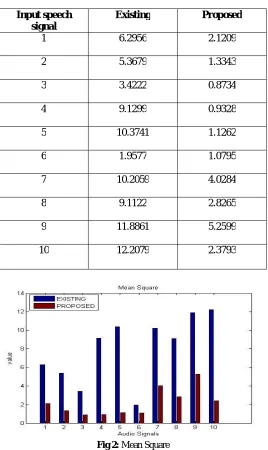
Mean Square:The term mean square is obtained by dividing the term sum of squares by the degrees of freedom.
Table 1: Mean Square
Input speech signal
Existing Proposed
1 6.2956 2.1209
2 5.3679 1.3343
3 3.4222 0.8734
4 9.1299 0.9328
5 10.3741 1.1262
6 1.9577 1.0795
7 10.2059 4.0284
8 9.1122 2.8265
9 11.8861 5.2599
10 12.2079 2.3793
Fig 2: Mean Square
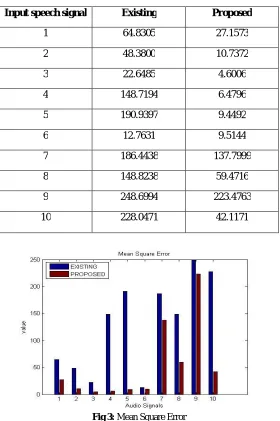
Mean Square Error (MSE): Mean square error is to compute an error signal by subtracting the test signal from the reference, and then computing the average energy of the error signal.
Table 2: Mean Square Error
Input speech signal Existing Proposed
1 64.8305 27.1573
2 48.3800 10.7372
3 22.6485 4.6006
4 148.7194 6.4796
5 190.9397 9.4492
6 12.7631 9.5144
7 186.4438 137.7999
8 148.8238 59.4716
9 248.6994 223.4763
10 228.0471 42.1171
Fig 3: Mean Square Error
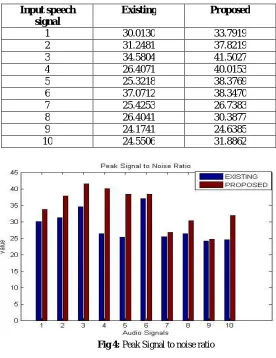
Peak Signal to Noise Ratio (PSNR): Peak square noise ratio is the ratio between the maximum possible value of the signal and the power of the corrupting noise.
Table 3: Peak Signal to Noise ratio
Input speech signal
Existing Proposed
1 30.0130 33.7919 2 31.2481 37.8219 3 34.5804 41.5027 4 26.4071 40.0153 5 25.3218 38.3769 6 37.0712 38.3470 7 25.4253 26.7383 8 26.4041 30.3877 9 24.1741 24.6385 10 24.5506 31.8862
Fig 4: Peak Signal to noise ratio
V. CONCLUSION
Many goal music quality methods have now been proposed in the past to anticipate the subjective quality of audio. Most of these methods, but, were created for the goal of analysing the disturbances presented by speech codecs and/or communication stations. The comparison between different audio enhancement techniques has shown the various benefits and limitations. All these techniques has tried to eliminate noise from audio at great extend but some methods showed better results.
REFERENCES
[1] K. M. Passino, “Biomimicry of Bacterial Foraging for Distributed Optimization and Control”, IEEE Control Systems Magazine, pp. 52-67, 2006.
[2] V. Ramakrishnan, Karthik Shetty, Pawan Kumar G and Chandra Shekhar Seelamantula, “Efficient Post Proceesing Technique for Speech Enhancement”, in NCC, pp. 1-5, 2011.
[3] S. Binitha and S. S. Sathya, “A Survey of Bio inspired Optimization Algorithms, International Journal of Soft Computing and Engineering, Vol.2, No. 2, pp. 137-151, May 2012.
[5] N. Yousefian and Philipos C.Loizou, “A Dual Microphone Algorithm that can Cope with Competing Talkers Scenarios”, IEEE Trans. Audio, Speech, Lang. Process., vol. 21, no. 1, pp. 145-155, January 2013.
[6] N. Madhu, Ann Spriet, Sofie Jansen, Raphael Koning and Jan Wouters, “The Potential for Speech Improvement using the Ideal Binary Mask and the Ideal Wiener Filter in Single Channel Noise Reduction Systems: Application to Auditory Prostheses”, IEEE Trans. Audio, Speech, Lang. Process., vol. 21,no. 1, pp. 63-72, January 2013.
[7] J. B.Crespo and Ricahrd C.Hendriks, “Multizone Speech Reinforcement”, IEEE Trans. Audio, Speech, Lang. Process., vol. 22, no. 1, pp. 54-66, January 2014.
[8] D. P. K.. Lun, Tak-Wai Shen and K.C.Ho, “A Novel Expectation-Maximization Framework for Speech Enhancement in Non-Stationary Noise Environment”, IEEE Trans. Audio, Speech, Lang. Process., vol. 22, no. 2, pp. 335-346, February 2014.
[9] T. Mellahi, Rachid Hamdi, “LPC based formant enhancement method in Kalman filtering for speech enhancement”, in AEU, vol. 69, pp. 545-554, 2015.