Use of Wheat Straw Fibre as Stabilizing
Additive in Stone Matrix Asphalt Mix
Poonam Singh1, Mohit Takhalate2, Pranav Thepe3, Dr Subrat Roy4
P.G. Student, Department of Civil and Environmental Engineering, NITTTR Bhopal, India1
P.G Student, Department of Civil and Environmental Engineering, NITTTR Bhopal, India2
P.G Student, Department of Civil and Environmental Engineering, NITTTR Bhopal, India2
Professor, Department of Civil and Environmental Engineering, NITTTR Bhopal, India4
ABSTRACT.Stone Matrix Asphalt (SMA) is a gap graded mix; characterized by higher proportion of coarse aggregate, lower proportion of middle size aggregate and higher proportion of mineral filler.The prime advantage of Stone matrix asphalt (SMA) is its ability to provide more durable surfacing, as well as its high resistance from damage due to heavy axel loads. However, the initial cost for preparation of SMA is more than the other common asphalt mixes. On the other hand, the utilization of waste and by-products in the construction is still limited, especially in developing countries like India.Agricultural wastes i.e. wheat straw is mostly burnt that cause’s environmental pollution .Utilizing agricultural waste for construction will not only reduce pollution but also reduce the overall construction cost. This paper reports about the experimental investigations carried out on stone matrix asphalt mixes prepared by using wheat straw fibres with VG 30 grade bitumen.Marshall Procedure has been followed to determine the optimum binder and also to study the relative advantages of fibre addition in the SMA mixtures. From the test results it was observed that stone matrix asphalt mix with wheat straw fibre shows better performancethan stone matrix asphalt mix without fibre. It was also observed that SMA Mix with wheat straw fibre worksout cheaper and abundantly available.
KEYWORDS: Stone matrix asphalt, wheat straw fibre, stabilizing additive, Marshall Test, optimum bitumen content, volumetric parameters.
I. INTRODUCTION
II. LITERATUREREVIEW
The present study aimed at the use of wheat straw fibre as stabilizing additive in Stone matrix asphalt for surface course. As cellulose fibres are either costly or not readily available. Various literatures related to SMA have been reviewed and some of them are presented in this chapter.
Prof S.S. Awanti, A. Habbal, P.N. Hiremath, S. Tadibidi & S.N. Hallale (2016) reports about the experimental investigations carried out on stone matrix asphalt mixes prepared by using coconut and cellulose fibres with VG 30 grade bitumen From the test results it was observed that stone matrix asphalt mix with coconut fibre shows better performance than stone matrix asphalt mix with cellulose fibre. It was also seen that SMA Mix with coconut fibre has low cost and easily available.
Goutham Sarang ,B.M.Lekha,G.Krishna & A.U.Ravi Shankar(2016) in their study they reports about the shredded waste plastics(SWP) are used instead of other additives to prepare SMA mixtures with conventional viscosity graded VG30 Bitumen. And other mixture is made with modified bitumen is used as binder material and then comparison is made. On the basis of the currentstudy, waste plastic in suited dosage can be advocated in SMA, instead of a stabilizing additive.
Yanping Sheng,Haibin Li ,Ping Guo,Guijuan Zhao,Huaxin Chen And Rui Xiong(2017) reports about effect of fibres on mixture design of stone matrix asphalt .The test results indicated that while precents of voids and Marshall stability and VMA increased, the bulk specific gravity of SMA mixtures and asphalt saturation decreased with increasing fibre content.
Tejas, Aniket, Gourav, Swapnil, Vijay (2017) reports about suitability of coconut shell charcoal as filler in stone matrix asphalt .The result showed that it improved quality and durability of road pavement.
III. EXPERIMENTALINVESTIGATION
3.1 Material used:
1. Coarse and fine aggregate 2. Cement as filler
3. VG30 Bitumen as binder 4. Wheat straw fibre as stabilizer
3.2 Laboratory tests carried out on SMA Components:
Table 4.1: Properties of SMA components
3.3 Preparation of test samples:
The mix samples were prepared according to the Marshall procedure, which is widelypracticed and popular in India [3]. The coarse aggregates, fine aggregates and cementwere mixed according to the adopted gradation and heated to the required temperature. Required quantity of wheat straw fibres after being cut to small pieces approximately5 mm long, were added directly to the aggregate sample and thoroughly mixed beforeadding required quantity of binder. The entire mixtures were heated separately to theprescribed mixing temperature, mixed properly and compacted using a compactiveeffort of 50 blows on each side [4]. Binder concentrations were varied from 4% to 6% while fibre concentrations were selected as 0.3% to assess theoptimum binder content.
3.4 Testing of test samples:
Marshall Mix design method is a standard laboratory method, which is adoptedin India for determining and reporting the strength and flow characteristics ofbituminous paving mixes. In the absence of modern equipment’s, this method was usedto study various Marshall Characteristics such as Marshall Stability, flow value, unitweight, air voids etc., which helps in determining the Optimum Binder Content (OBC)of the SMA mixes.
The details of experiments carried out for this work as described in Paragraph 3.4.Various Marshall parameters such as air void ratio ,volume of bitumen ,voids in mineral aggregate ,voids filled with bitumen etc. is calculated based on result obtained from Marshall test and presented in this section. These parameters are calculated for both types of mix that is with and without fibre and results are compared and presented.
Test onSMA components
Test methods as per IS procedure
Test result
As per IS Specification
Aggregate crushing value IS:2386 (PIV) 17.84% 18%
Impact value IS:2386 (PIV) 10.58 % 18%
Abrasion value IS:2386 (PIV) 19.44 % 25%
Flakiness Index IS:2386 (PI) 8.4% 30%
Elongation Index IS:2386 (PI) 19.9% 30%
Water Absorption IS:2386 (PIII) 0.85% 2%
Specific gravity of
coarse aggregate IS:2386 (PIII) 2.76 2.6-2.8
Specific gravity of fine aggregates IS:2386 (PIII) 2.72 2.6-2.8
Penetration value of binder VG30 IS1203-1978 67.495 60-70
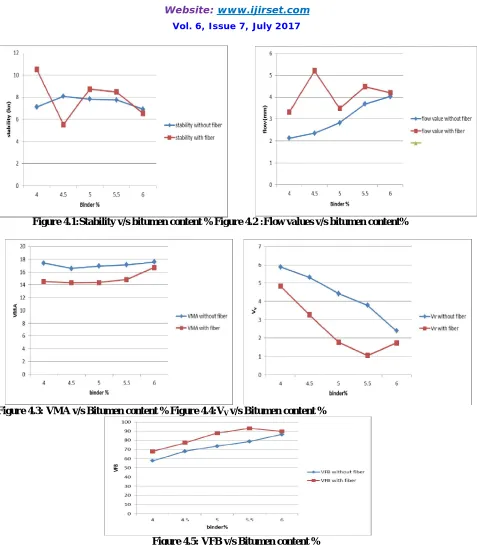
Figure 4.1:Stability v/s bitumen content %Figure 4.2 :Flow values v/s bitumen content%
Figure 4.3: VMA v/s Bitumen content %Figure 4.4:VV v/s Bitumen content %
Table 4.2: Marshall Properties at OBC without fibre
Stability KN Flow mm VMA Vv VFB
7.96 3.5 17% 4% 70.54 %
Table 4.3: Marshall Properties at OBC with wheat straw fibre
Stability( KN) Flow (mm) VMA Vv VFB
7.98 4.5 14.8% 4% 70.2%
IV. INTERPRETATIONOFRESULTS
In this project we have prepared different SMA samples using varying bitumen content of 4%, 4.5%, 5%, 5.5%,6%. It was done to analyze the effect of increasing bitumen content on the stability value. The Optimum binder content for this mix is found in this project work. From the study of graphs it is found that the stability value without fiber increases initially with increase in bitumen content but then decreases gradually. This can be recognized to the fact that with initial increase in bitumen content, the aggregate bitumen bond gradually gets stronger, but with further increase in the bitumen content, the applied load is transmitted as hydrostatic pressure, keeping the fraction across the contact points of aggregates immobilized. This makes the mix weak against plastic deformation and the stability value falls. The same principle applies to mix with fibers, but this mix shows higher stability value at the same binder content than the mix without fibers. It is found that the fibers in the mixes act as stabilizers that not only fills up the voids in the sample but also reduces the drain down, thus holding up the binder in the mix. The homogeneity to the mix provided by addition of fibers. Here in our research it was found that the stability results are higher for samples with fibers except for 4.5%, 6% which may be due to improper mixing.
Flow is the deformation undergone by the specimen at the maximum load where failure occurs. The flow value increases with the increase in the bitumen content both the mixes with and without fibers .The increase is slow initially, but later the rate increases with the increase in the bitumen content. The flow value of mixes with wheat straw fibers is more than that without fibers initially, this may be on the basis that , at lower percent of bitumen content the fibers fill up the voids efficiently adding to the homogeneity and it provides the stability necessary to oppose any deformation under load the homogeneity is lost with decrease in the bitumen content , that leads to the binder property dominates which makes the fibers to form lumps dropping stability and growing deformation under load .
According to previous studies the VMA value, for a given aggregate should hypothetically stay constant. In our study it is observed that, at low percent bitumen content, VMA gradually decreases with the increase in bitumen content, then remains constant over a range, and finally increases at high bitumen content. The early fall in VMA value is due to the reason of re-orientation of the aggregates in the presence of bitumen. At very high bitumen content, due to a thicker bitumen film, the aggregates slightly moves apart resulting in an increase in VMA.
The Air Voids (Vv) valuesfalls with rise in the bitumen content as with increasein bitumen content the air voids gets filled up progressivesly.The Vv of mix with fiber is much less than that without fiber. This is because thefiber already filled up some portion of air voids (Vv) which further decreases as thebitumen fills up the air voids with rise in bitumen content.
V. CONCULSION
Through this study we found out that Stone matrix asphalt with wheat straw fibre gives better result in terms of flow, stability etc. as compared to stone matrix asphalt without fibre that too at lower optimum bitumen content. The usage of wheat straw as stabilizing agent will also lower down drain down and reduces overall construction cost. The problem of air pollution due to burning of wheat fields will also be controlled and farmers will also be benefitted and ecofriendly.
REFERENCES
[1] E. Ahmadinia, M. Zargar, M. R. Karim, M. Abdelaziz and P. Shafigh, “Using waste plastic bottles as additive for stone mastic asphalt” Mater. Des. vol.32, pp. 4844-4849, 2011
[2] A. Criminisi, P. Perez, and K. Toyama, “Region filling and object removal by exemplar-based image imprinting.”, IEEE Transactions onImage Processing, vol. 13, no.9, pp. 1200–1212, 2004.
[3]American Society of Testing Materials (ASTM). D1559. Test method for resistance of plastic flow of Bituminous Mixtures using Marshall Apparatus. West Conshohocken, PA, USA; 198