DOI: 10.1534/genetics.107.075770
State II
Dissociation
Element Formation Following
Activator
Excision in Maize
Liza J. Conrad,* Ling Bai,
†Kevin Ahern,
‡Kelly Dusinberre,
‡Daniel P. Kane
‡and Thomas P. Brutnell
‡,1*Department of Plant Breeding and Genetics and†Department of Plant Biology, Cornell University, Ithaca, New York 14853 and‡Boyce Thompson Institute for Plant Research, Ithaca, New York 14853
Manuscript received May 9, 2007 Accepted for publication August 22, 2007
ABSTRACT
ActiveActivator(Ac) elements undergo mutations to become nonautonomousDissociation(Ds) elements at a low frequency. To understand the mechanism ofDsformation, we have developed high-throughput genetic and molecular screens to identify these rareDsderivatives generated from anyAcinsertion in the maize genome. Using these methods we have identified 15 newDselements derived fromAcinsertions at eight different loci. Approximately half of theDs elements contain filler DNA inserted at the deletion junction that is derived from sequences within or adjacent toAc. In contrast to previous reports, several of theseDselements lack direct repeats flanking the deletion junctions and filler DNA in the donorAc. To accommodate our findings and those of others, we propose a model of slip mispairing during error-prone repair synthesis to explain the formation of state IIDselements in maize. We discuss the use of these lines and molecular techniques developed here to capture somaticDstransposition events in two-component Ac/Dstagging programs in maize.
T
HEActivator/Dissociation(Ac/Ds) transposon family has been extensively characterized since its dis-covery in maize .60 years ago (McClintock 1946;Kunze and Weil2002).Ac/Dsare class II DNA
trans-posons that belong to the hAT superfamily of plant transposable elements (Kunzeand Weil2002).Acis a
4565-bp autonomous element capable of catalyzing the transposition of itself and nonautonomousDselements (McClintock1949, 1951). Ac encodes a 3.5-kb open
reading frame (ORFa) that directs the synthesis of an 807-amino-acid transposase (TPase) essential for both Acand Dstransposition (Fedoroffet al. 1983; Kunze
et al. 1987). The 11 bp imperfect terminal inverted repeats (TIR) and240 bp of subterminal sequences are critical for TPase binding and transposition of bothAcandDs(Couplandet al. 1988, 1989).
In contrast to the highly conserved structure of Ac elements (Fedoroff et al. 1983; Behrens et al. 1984;
Muller-Neumannet al. 1984; Pohlmanet al. 1984),Ds
elements are structurally diverse. State I or ‘‘doubleDs’’ elements consist of nested Ds insertions or contain multipleDsend sequences in close proximity (Doring
et al. 1984, 1989, 1990; Wecket al. 1984; Ralstonet al.
1989; Weiland Wessler1993). State II elements are
likely deletion derivatives ofAc that differ in size and internal structure (reviewed in Kunzeand Weil2002).
For instance, Ds1-like elements contain large internal
deletions sharing only the 59 terminal 13 bp and 39
terminal 26 bp of sequence withAc(Suttonet al. 1984).
TheDs9element is identical toAcwith the exception of a 194-bp simple deletion in the element (Rubin and
Levy1997). Other Dsfamily members, such as wxB4,
share the TIR and subterminal sequence with Ac but carry internal sequences with no homology to Ac (Varagonaand Wessler1990). State I elements often
induce chromosome breakage but rarely transpose whereas state II elements transpose frequently but rarely break chromosomes (McClintock1946, 1949).
AcandDshave been used to clone and characterize many genes in maize (for reviews see Kunzeet al. 1997;
Brutnell 2002; Settles 2005). Strategies to utilize
these elements in gene-tagging programs have been devised that exploit the tendency of Ac and Ds to transpose to closely linked sites (VanSchaikand Brink
1959; Greenblatt1984; Doonerand Belachew1989).
To facilitate the use ofAcin tagging programs, several Acelements have been mapped throughout the maize genome (Augerand Sheridan1999; Cowperthwaite
et al. 2002), including 60 that have been precisely posi-tioned on genetic and physical maps (Singhet al. 2003;
Kolkmanet al. 2005).
AlthoughDshas not been used extensively for gene tagging in maize (Kunze et al. 1997; Brutnell and
Conrad2003), it does afford several advantages overAc.
Foremost, Ds-induced mutations allow for the analysis of either stable or mutable phenotypes. In the absence of anActransposase source,Dsinsertions are stable, facil-itating physiological studies that would be complicated 1Corresponding author:Boyce Thompson Institute, Cornell University,
1 Tower Rd., Ithaca, NY 14853. E-mail: [email protected]
by somatic excision. Stable Ds alleles can also be in-corporated into breeding programs without the risk of losing the desired allele due to transposon excision. When mutable phenotypes are desirable, for instance, in clonal analysis (Emerson1917; Daweand Freeling
1990) or to generate an allelic series (Wessleret al. 1986;
Morenoet al. 1992; Weilet al. 1992; Singhet al. 2003),
the elements can be remobilized by introducing anAc element into the genome through crossing. Unfortu-nately, relatively fewDsinsertions have been genetically or physically mapped in the maize genome, limiting the potential ofDsin directed or regional tagging programs (Conradand Brutnell2005).
The generation of a two-element system from a one-element system was first observed by McClintock when she identified Dsderivatives from Acinsertions at the Bronze1 and Waxy1 loci of maize (McClintock 1955,
1956, 1962, 1963). More recently, Yan et al. (1999)
described the formation of threeDselements from the bz1-m2TAcallele and one from anAcelement inserted
0.05 cM proximal to the Bronze1 locus, designated tac2094TAc. Two related mechanisms have been
pro-posed to account for the formation ofDselements from Ac. Rubinand Levy(1997) concluded that state IIDs
elements are generated through an abortive gap-repair process followingAcexcision. However, in some instan-ces, a synthesis-dependent strand-annealing (SDSA) re-pair mechanism is initiated at the time of this abortive gap repair. In these instances, polymerase slippage during DNA synthesis at the site of direct repeats within Acmay result in the insertion of sequences known as filler DNA at the deletion junction (Rubinand Levy
1997). Yanet al. (1999) proposed thatDselements were
formed through slip mispairing during DNA synthesis resulting both in an internal deletion and in some cases the insertion filler DNA at the deletion junction (Yan
et al. 1999). Both models propose that slip mispairing of direct repeats at the deletion breakpoints within Ac occurs during DNA synthesis.
In addition toAc, the formation of nonautonomous ele-ments via double-strand break (DSB) repair has been stud-ied for several class II transposon families such asMutator in maize (Hsiaand Schnable1996),P-elements in
Dro-sophila (O’hare and Rubin 1983; Takasu-Ishikawa
et al. 1992), andTam3in Antirrhinum (Yamashitaet al.
1999). Although the formation of these nonautono-mous elements is thought to occur through similar DNA repair mechanisms, there are differences in the frequency that repair products arise in each of these transposon families (Yamashita et al. 1999). In
con-trast to P, Mu, and Ac elements, the Tam3 family of elements is extremely conserved in structure due to a lack of the formation of repair products following excision. Yamashitaet al. (1999) suggest that hairpin
formation at the ends of Tam3 prevents gap repair from proceeding into the element, precluding the for-mation of functional nonautonomousTam3 elements.
Although it has been shown that both Mu and Ac ends are capable of forming hairpin structures, these elements still produce nonautonomous derivatives (Yamashita et al. 1999). These studies suggest there
are likely several factors that affect the DSB repair mechanism following excision of an active transposon including secondary structure.
In this report we describe the development of high-throughput genetic and molecular screens to identify newly formed Dselements from previously positioned Acinsertions. Using these methods we identified 15 new Dselements derived fromAcinsertions at eight different sites in the maize genome. Sequence analysis revealed significant differences between these 15 Ds elements and previously reportedDsderivatives (Rubinand Levy
1997; Yanet al. 1999). Specifically, several of these Ds
elements lack direct repeats flanking the deletion junc-tions in the donorAc. Approximately half of theDs ele-ments contain filler DNA inserted at the deletion junction and this filler DNA often, but not always, originated from withinAc. Thus, we propose a modified version of a model proposed by Dooner and colleagues (Yanet al. 1999) that accounts for the formation of all
state II derivatives characterized to date. To further exploit these lines in mutagenesis programs, we de-veloped a ‘‘Ds-casting’’ procedure to capture local so-maticDstransposition events and we discuss the use of these lines in two-componentAc/Dstagging programs in maize.
MATERIALS AND METHODS
Description of maize stocks: All maize stocks used in this study were in the W22 inbred background. AllAclines, with the exception of bti97156TAc, were previously described
(Kolkmanet al. 2005). Thebti97156TAcline contains anAc
insertion 4 cM from thePink Scutellum1(Ps1) gene and has been previously described (Singhet al. 2003). Ther1-sc:m3 Ds
tester line contains aDs6-like insertion in ther1locus that controls anthocyanin accumulation in the aleurone and scute-llar tissues (Allemanand Kermicle1993). In the absence of Ac transposase, this insertion renders the kernels colorless. In the presence ofActransposase, excision of theDsfrom the r1locus can be visualized as purple sectors in the aleurone. Increasing copy numbers ofAcin the genome result in fewer and smaller sectors known as the negative dosage effect (McClintock1951). TheAc-immobilized(Ac-im) stock contains
anAcderivative inserted at 7.02, which is incapable of trans-position but still encodes a functional transposase protein (Conradand Brutnell2005).
Selection forDsderivatives:Acactivity was monitored using ther1-sc:m3 Dstester line described above. Kernels homozy-gous for an Ac insertion were selected on the basis of the canonical negative dosage effect ofAc(McClintock1951).
Kernels were sown in the field and mature plants were testcrossed to the r1-sc:m3 Ds tester line. Colorless kernels resulting from a loss of Ac activity were selected from the progeny ears and plants self-pollinated to generate segregat-ing families. The resultsegregat-ing ears were screened ussegregat-ing one of two methods. When theps1-m8TAcallele was used as a donorAc,
of aps1mutant phenotype with a lack ofAcactivity (Singhet al.
2003; Baiet al. 2007). Progeny ears from all other donorAc
elements were screened using a molecular assay. Ten colorless kernels from self-pollinated F2ears were sown in greenhouse sandbenches. DNA was extracted from seedling leaf tissue and a verification PCR assay was performed on DNA pools as de-scribed below.
DNA extraction:DNA pools were constructed from1 g of seedling leaf tissue that was collected in two-dimensional pools. Seed from each segregating ear was planted in 10-kernel rows. Leaf tissue from these 10 seedlings were pooled and placed in both a row pool, consisting of 10 rows, and a column pool, consisting of one column from each of the 10 rows. Thus, a unique address could be assigned to each of the 100 segregating families using 20 pooled DNA extractions. Positive results were confirmed by extracting DNA from individual family members and repeating the PCR assay. DNA extraction was performed as described by Chenand Dellaporta(1994).
DNA extractions for theDs-casting assay (see below) were conducted in a 96-well format. Two centimeters of leaf tissue were collected from the base of the youngest leaf of field-grown plants50 days after planting. The midrib was removed and tissue was placed in a 96-well plate with two ball bearings. Tissue was frozen in liquid nitrogen and pulverized in a paint shaker for 3 min. A phenol-chloroform extraction was per-formed as previously described (Chenand Dellaporta1994).
PCR amplification: Verification PCR: PCR was performed on pooled DNA extractions described above. PCR primers de-signed forAcinsertion verification described in Kolkmanet al.
(2005) were utilized to amplify a region from the DNA flanking the element into the end of putativeDs derivatives (supple-mental Table 1 at http://www.genetics.org/supple(supple-mental/). Verification PCR was performed using6 ng of total genomic DNA in a 50ml total reaction volume according to reaction conditions described in Conradand Brutnell(2005). PCR
products were fractionated on a 0.8% agarose gel containing ethidium bromide and visualized on a UV light box.
Amplification of Ds elements: The long-range inverse PCR (IPCR-3) protocol described in Kolkmanet al. (2005) was used
to amplify deletion breakpoints from theDsderivatives. PCR was performed on6 ng of genomic DNA extracted from five pooled seedling leaf tissue samples from individual segregat-ing ears. Flanksegregat-ing primers presented in supplemental Table 1 at http://www.genetics.org/supplemental/ were used in con-junction withAcprimers. For theps1-m8TDsalleles D1, D4,
and D5, sequences were amplified with the Ps1-21 primer (supplemental Table 1) while theps1-m8TDs(D3) allele was
amplified with the Ps1-10 primer described in Singhet al.
(2003). Theps1-m8TDs(D2) was amplified with two flanking
primers Ps1-21 (supplemental Table 1) and Ps1-10 (Singhet al.
2003).Acprimers used to amplify toward the 59 Acflanking sequences were: 191.Ac4: 59-CAATAGCCATATCATCTTGAC TCG, TBp34, Ac14, and TBp41 reported in (Kolkmanet al.
2005).Acprimers used to amplify toward the 39 Acflanking sequences were: TEB252.35Ac1: 59-CAGGGATGAAAGTAGGA TGGGAAA, TEB252.35Ac3: 59-CAAGCTGTTGTGTCATTTG TGTGC, Ac2: 59-TTCATGTGAGGTGTGCTTGTC, 191.Ac5: 59-GTGCTAGACTCTGTTATTGCTGCT, TBp38, Tbp40, and JGp2 reported in Kolkmanet al. (2005). PCR products were
fractionated on a 0.8% agarose gel with ethidium bromide and visualized on a UV light box.
Ds casting: A line homozygous for the bti00252TDs(D2)
derivative was used to pollinate a line homozygous for the Ac-im insertion. The resulting progeny were planted in the field and seedling leaf tissue was collected. DNA extractions were performed according to the protocol described above and aDs-casting protocol was adapted from Singhet al. (2003).
Two rounds of nested PCR were performed using the IPCR-3
reaction protocol described in Kolkmanet al. (2005) with
nested flanking andDsend primers (supplemental Figure 2A at http://www.genetics.org/supplemental/). The first round of PCR used primers bti00252A.F2: 59-CTAAGCTGACTGT TGTGTGGGAAG and Ac3: 59-CATATTGCAGTCATCCCGAA with1–3mg of genomic DNA in a total reaction volume of 20 ml. First round products were diluted 1:200 in dH2O and 1ml of this dilution was used as a template for the second round of nested PCR with primers bti00252A.F7: 59-CGTACGTGTCATA ACTTTTGGAAG and TBp35 (described in Kolkman et al.
2005). PCR products were fractionated on a 1% agarose gel with ethidium bromide and visualized on a UV light box (supplemental Figure 2B).
Sequencing: PCR products were separated on a 0.8% agarose gel and purified using the QIAquick gel extraction kit (QIAGEN, Valencia, CA). DNA was cloned into either pGEM-T Easy (Promega, Madison, WI) or the TOPO TA cloning kit for sequencing (Invitrogen, Carlsbad, CA) and sequenced as previously described (Singhet al. 2003).
RESULTS
Genetic selection for newly formed Ds derivatives:
Acdonor lines were selected from a subset of previously characterized insertions (Kolkman et al. 2005) and
from anAcinsertion at thepink scutellum1(ps1) locus, ps1-m8TAc, which conditions a weak mutant phenotype
when homozygous (Bai et al. 2007). Ac activity was
visualized as purple sectors on the kernels resulting from excision of aDselement from ther1locus during kernel development (r1-sc:m3; see materials and methods). Thus, a loss ofAcactivity was scored as the
lack of these purple sectors. To identify deletion deriv-atives ofAc,lines homozygous for an Acinsertion and ther1-sc:m3allele were testcrossed by theDstester line (Figure 1). The majority of progeny kernels from F1 -testcross progeny are coarsely spotted as a consequence of being hemizygous for the original Ac insertion. Approximately 2–4% of the progeny were finely spotted resulting from an increase inAccopy number due to a new transposition (tr-Ac) (Kolkmanet al. 2005). Rare
colorless kernels were selected, grown, and self-pollinated to identify ears that were completely colorless in the F2generation due to a loss ofAcactivity. Conse-quently,Dsderivative events that cosegregate with atr-Ac in the genome would not be detected in our screen.
Approximately 0.6% of the F1-testcross progeny kernels were colorless due to a loss of Ac activity. It is likely that in the majority of these cases, the loss ofAc activity was due to premeiotic excision of Acfollowed by an independent assortment of the donor locus and transposedAc(Greenblatt1984). In rare cases,Acwill
24Acinactivation events, or putativeDselements, were identified at 8 loci, including 6 from the ps1-m8TAc
allele. These putativeDsinsertions were further charac-terized through phenotypic or PCR-based screens to confirm the presence of an insertion at the original locus as detailed below. Importantly, this genetic screen could be applied to detectDs derivatives from anyAc insertion in the maize genome.
Identification of Dsinsertions through a molecular screen:We developed a general PCR assay to distinguish putativeDsderivatives fromAcexcision events. As shown in Figure 1, putativeDsderivatives would be expected to segregate in self-pollinated F2families. Thus, 10 kernels from colorless F2ears were planted in the greenhouse and DNA was extracted from pooled seedling leaf tissue samples (materials and methods). PCR primers were
designed to amplify a fragment immediately adjacent to the originalAcinsertion using a subterminalAc end-and flanking sequence-specific primer pair (supplemen-tal Table 1 at http://www.genetics.org/supplemen(supplemen-tal/). Germinal excisions ofAcwould not result in amplifica-tion products whereas those elements that retained the sequences complementary to the primer at the original insertion site would result in an amplification product of a predicted size. We screened 673 families and identified 18 that contained an Ac-end sequence at the site of the original insertions but lackedAcactivity. These families were selected as carrying putative novelDs insertions.
One limitation of this screen was the requirement for intact Ac end sequences at the priming site. In other words, if a more complex rearrangement ofAcsequences
resulted in the deletion of end sequences containing the primer sequences, the event would not be detected in the screen. Nevertheless, the screen does enrich for events that are likely to generate a functionalDsderivative.
Identification ofDsinsertions through a phenotypic screen: To investigate the diversity of Ac-mediated deletions and more complex rearrangements, we uti-lized anAc insertion at the ps1locus (ps1-m8TAc). In
contrast to the molecular screen described above, this phenotypic screen did not require intact Ac ends or flanking sequences for the identification of aDs deri-vative at this locus.Ps1 encodes an enzyme with lyco-peneb-cyclase activity that catalyses the first committed step in xanthophyll biosynthesis (Singh et al. 2003).
Although the majority of mutations inPs1are lethal, ps1-m8TAckernels germinate at nearly the same frequency
as wild type (Baiet al. 2007). Seedlings homozygous for
theps1-m8TAcallele have slightly pale green leaf sheath
tissue and virescent leaf blade tissue and kernels from self-pollinated ears are slightly pink due to an accumu-lation ofd-carotene in the endosperm (L. Bai,
unpub-lished results; Bai et al. 2007). We reasoned that Ds
derivatives would condition for a similar mutant phe-notype as the donor Ac insertion and thus could be identified as slightly pink kernels lackingAcactivity.
Genetic selections were performed as described above and colorless F2 ears were visually screened for segregation of a weakps1mutant phenotype segregating in a 3:1 Mendelian ratio (Singh et al. 2003; Bai et al.
2007). Six alleles were selected as having a weak mutant phenotype and lacking Ac activity. Ds derivatives that restore wild-typePs1function would not be detected in this screen.
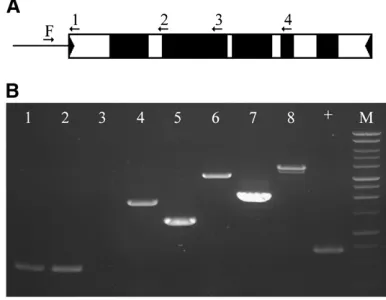
Dsdeletion junction sequence analysis:To define the deletion breakpoints in each of the putative Ds deriva-tives, a long-distance PCR method was utilized to rapidly survey the structure of the element (materials and methods). As illustrated in Figure 2A, PCR primers
de-signed to sequences throughout theAcelement were used in conjunction with anAc-flanking primer as described by Kolkmanet al. (2005). As shown in Figure 2B, if the
primer sequence is contained in the deleted portion of the Ds, a PCR product will not be generated (lane 3) while primers flanking this deletion will give a smaller product (lanes 5 and 7) when compared to a full-length Ac (lanes 6 and 8). PCR products containing the de-letion breakpoint were then sequenced (seematerials and methods). This PCR assay enabled the rapid
iden-tification of the sequences deleted from 15 of the 24 putativeDselements.
The nine derivatives that did not appear to result from simple deletions ofAcwere further characterized. Four contained an apparently full-length Ac element inserted at the original locus, based on PCR product size even though no Acactivity was detected. There are at least two possibilities that could account for the loss of Acactivity in lines that contain an apparently full-length Figure1.—Genetic selection for newly formed Ds
deriva-tives. Lines homozygous for anAcinsertion (shaded triangles) were pollinated by theDstester line. All lines are homozygous for ther1-sc:m3allele (not shown). Colorless kernels either containing a newDs(solid triangles) or a loss ofAcdue to ex-cision (parentheses) were selected from the resulting progeny ears. Colorless kernels were sown and mature plants were self-pollinated resulting in an ear segregating for either a newDs or theAcexcision site. Ears derived from theps1-m8TAclines
Ac. First, small deletions (#50 bp) would not be detected in the PCR assays, but still disruptAc activity. Alterna-tively, epigenetic silencing associated with increased methylation of internal Ac sequences (Schwartz and
Dennis1986; Chometet al. 1987; Kunzeet al. 1987, 1988;
Fusswinkel et al. 1991; Brutnell and Dellaporta
1994; Brutnell et al. 1997) may have resulted in
the loss ofAcactivity. To examine this latter possibility, DNA gel blot analysis was performed on families that contained an apparently full-lengthAcelement at the original locus. To monitor the methylation status of diagnostic nucleotides withinAc,DNA was digested with the methylation-sensitive restriction enzymePvuII and blots were hybridized with the internal Ac900 or Ac700 fragments described in Kolkman et al. (2005). This
analysis suggests at least one of the putativeDselements was methylated at the internal PvuII sites (data not shown), indicating that the loss in activity in some fam-ilies was due to epigenetic modification ofAcsequences. The methylation of the internal PvuII sites does not appear to be the consequence ofDsformation, as deriv-ative bti00228TDs retained two unmethylated PvuII
sites. The five remaining putativeDselements retained Ac end sequences at the original locus but we were unable to amplify products in the long-distance PCR assay, despite repeated attempts. These insertions may have resulted from more complex rearrangements ofAc sequences rather than simple deletions. DNA blot analysis of three of these derivatives indeed suggests a more complex rearrangement of sequences (data not shown).
Frequency of Ds formation: A total of 15 new Ds elements were identified from eight unique Ac inser-tions in the maize genome. Table 1 presents the min-imum frequency of Ds formation for several of the Ac-containing lines screened. Accurate progeny counts were only obtained for fourAcdonor lines and of these, screens of only one line (bti00252TAc) resulted in the
recovery of multipleDsinsertions. In this instance, the frequency ofDsformation was calculated at 0.03%. How-ever, if we consider the total number of kernels screened regardless ofAcdonor, we estimate the frequency ofDs formation at 0.025% (5/19,9233100).
Ds elements contain novel deletions: As predicted from previously published studies (Rubin and Levy
1997; Yanet al. 1999), a preferential size or location of
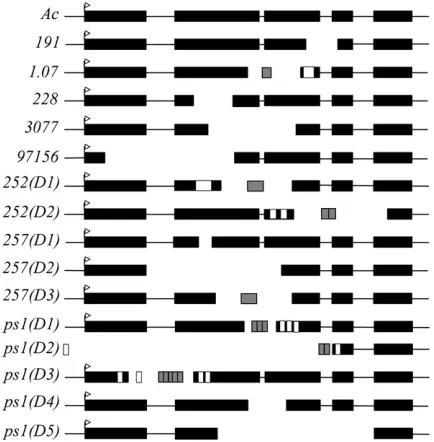
deletedAcsequence was not observed (Figure 3). The size of deletions ranged from 388 bp in bti00191TDs
to 3505 bp inps1-m8TDs(D2)and were not restricted to
any particular region within Ac(Table 2, Figure 3). In-terestingly, bti00257TDs(D1) carries an in-frame
dele-tion of amino acid residues 331–475 of exon 2. This derivative is associated with a tightly linkedAcinsertion but conditions a finely spotted aleurone that appeared nearly colorless in initial kernel selections. This aberrant spotting pattern suggests thatbti00257TDs(D1)encodes
a protein that interacts withAcand alters its activity. We have not yet separated the tightly linked Ac element from this derivative and thus, have not further charac-terized this element in this study. None of the other derivatives encoded proteins with any detectable activity. Seven of the 15Dsderivatives have filler DNA inserted at the deletion junction (Table 2). Filler DNA refers to extraneous nucleotides that are copied into sequence rearrangements from elsewhere in the genome. It is a common result of DSB repair and has been observed in plants, animals, and fungi (for example, see Rothet al.
1989; Sainsard-Chanetand Begel1990; Wessleret al.
1990; Bundock and Hooykaas 1996; Puchta 2005).
The size of the filler DNA varied from 1 to 64 bp and was always found at the deletion junctions. All of the filler DNA originated from sequence in close proximity to the deletion breakpoint and the majority of it is present elsewhere within theDs(Figure 3). The one exception, Figure2.—Amplification acrossDsdeletion junctions. (A)
Ac schematic. Flanking DNA upstream of the Ac/Ds repre-sented by a line andAcsequence shown as rectangle with TIRs as solid triangles, exons as solid boxes, and noncoding se-qeunces as open boxes. Primers are shown as arrows, F is the flanking primer, and 1–4 are internalAcprimers. (B) Ethi-dium bromide-stained agarose gel showing PCR amplification products derived from a newDselement. Lanes 2, 4, 6, and 8 show PCR products generated using bti97156TAc as a
tem-plate and lanes 1, 3, 5, and 7 show PCR products derived from bti97156TDsas a template; the1is a positive control, and the
M is a Promega 1-kb ladder. Primer F was used in all reactions: lanes 1 and 2, F1primer 1; lanes 3 and 4, F1primer 2; lanes 5 and 6, F1primer 3; lanes 7 and 8, F1primer 4.
TABLE 1
Frequency ofDsformation
Acprogenitor Kernels screened Dsidentified
mon03077TAc 9965 1
bti00228TAc 895 1
bti00252TAc 6948 2
bti00257TAc ND 3
1.07TAc ND 1
bti00191TAc 2115 1
bti97156TAc ND 1
ps1-m8TDs(D2), contains filler DNA that originated
from the flanking sequence adjacent to the site ofAc insertion atps1and is missing oneDsend sequence. The derivativesps1-m8TDs(D4)andbti00257TDs(D3)have 1
and 4 bp of filler DNA, respectively, inserted at the deletion junction. As the sequence of the filler DNA occurs multiple times withinAc, it precludes determi-nation of the template DNA. Four of the 7Dsderivatives contain filler DNA that originated from multiple loca-tions and is assembled at the deletion junction (Figure 4 and supplemental Figure 1 at http://www.genetics.org/ supplemental/). Interestingly, these filler sequences are not always arranged at the deletion junction in the same order as they occur in their original context inAc. The most extreme example of this is theps1-m8TDs(D3)
element where there are five tandem pieces of filler DNA inserted at the deletion junction plus two addi-tional nucleotides. This mosaic of filler DNA originates from upstream, downstream, and from within the de-leted sequences of theDswith the same 8 bp of filler sequence being repeated twice at the deletion junction (supplemental Figure 1). In summary, to the extent the filler origin can be determined, it always originates from sequence in close proximity to the deletion, can arise from within or outside the Ac sequence, and may be assembled into tandem arrays.
The current model for the formation ofDsderivatives including the insertion of the filler DNA into the deletion junction is based on the observation that short direct repeats flank both the deletion and the origin of
filler DNA (Yan et al. 1999). However, in this study,
severalDsderivatives do not have direct repeats flanking the deletion junction and/or filler DNA in theAcdonor (Figure 4). We classified theDsderivatives reported here into two types with regard to the presence or absence of these direct repeats. An example of each type is pre-sented in Figure 4. Type I derivatives (8/15) contain direct repeats in the donor Ac flanking the deletion junction and filler DNA as predicted by previous models. Type II derivatives (5/15) do not contain direct repeats flanking either the deletion junction or, when present, the filler DNA. As mentioned above, two derivatives, ps1-m8TDs(D4)andbti00257TDs(D3), contain 1 and 4 bp
of filler DNA, respectively, so it is not possible to classify them as either type I or type II. Thus, at least 33% of the deletions identified lack direct repeats flanking filler DNA or deletion breakpoints in the donorAc, indicating that repeat sequences at deletion/filler breakpoints are not prerequisites for state II Ds element formation in maize.
Dselements capable of somatic transposition: With the exception ofps1-m8TDs(D2), all of theDsderivatives
reported here contain internal deletions and are likely to be transposition competent (Coupland et al. 1988,
1989). To test this prediction and extend the utility of these Dsinsertions in gene-tagging programs, we devel-oped a PCR-based method to capture somatic trans-positions of Ds. This method was modified from the ‘‘Ac-casting’’ procedure described by Singhet al. (2003).
To demonstrate this method, a plant carrying theDs in-sertion bti00252TDs(D2) was crossed by an individual
homozygous forAc-im(materials and methods).Ac-im
is a stabilized source of transposase, capable of mediating TABLE 2
Deletion derivatives identified in this study
Map
position Derivative
Deletion size (bp)
Presence of filler DNA (bp)
Origin of filler DNA
1.01 mon03077TDs 1553 None NA
1.03 bti00228TDs 710 None NA
1.04/1.05 bti00252TDs(D1) 1274 29 Ac
bti00252TDs(D2) 1345 33 Ac
1.05 bti00257TDs(D1) 435 None NA
bti00257TDs(D2) 1848 None NA
bti00257TDs(D3) 1120 4 Ac
1.07 1.07TDs 673 10 Ac
2.02 bti00191TDs 388 None NA
5.04 bti97156TDs(D1) 1806 None NA
5.04 ps1-m8TDs(D1) 1141 38 Ac
ps1-m8TDs(D2) 3505 53111 Ps11Aca
ps1-m8TDs(D3) 815 51 Ac
ps1-m8TDs(D4) 465 None NA
ps1-m8TDs(D5) 1815 None NA
a
Fifty-three base pairs of filler DNA originating from flank-ing DNA and 11 bp originatflank-ing in theAcsequence.
Figure3.—Structures ofDsderivatives. The internal
somatic and germinalDsexcisions (Conradand Brutnell
2005). PCR primers were designed to sequences flank-ing theDsinsertion (GenBank accession no. AY559233) and the 59-Ds end (supplemental Figure 2A at http:// www.genetics.org/supplemental/) to amplify short-range somatic Ds transpositions. Amplification products are expected only when theDselement excises and reinserts upstream of the flanking primer in the opposite orien-tation as the original insertion. The results of Ds casting are shown in supplemental Figure 2. Multiple PCR products were detected and sequenced. Some of these products did not containbti00252flanking DNA and were likely the result of Ds–Ds amplification pro-ducts generated from cryptic Ac-like elements present elsewhere in the maize genome. However, one product was recovered that was the result of a local somatic trans-position from bti00252TDs(D2) (supplemental Figure
2B). Sequence analysis of this fragment revealed that theDselement excised from the original insertion site generating an 8 bp excision allele and reinserted in the opposition orientation 282 bp upstream of the original insertion. These results demonstrate Ds casting as a method to obtain additional genomic sequences flank-ingDselements in the genome and shows thatbti00252T
Ds(D2)is transposition competent.
DISCUSSION
Development of two-component Ac/Ds tagging sys-tems: AcandDsoffer a number of advantages for gene-tagging experiments in maize. Both elements are present at relatively low copy number in the genome facilitating molecular and genetic screens (Fedoroff et al. 1983).
They display a high frequency of somatic excision that can be exploited to confirm the identity of a tagged gene (Schulteset al. 1996; Schauseret al. 1999), to create
an allelic series (Athmaet al. 1992; Morenoet al. 1992),
or to generate stable ‘‘footprint’’ alleles (Weilet al. 1992;
Allemanand Kermicle 1993; Baiet al. 2007). Of
par-ticular value are small in-frame insertions followingAc/ Dsexcision that subtly alter the protein activity (Wessler
et al. 1986; Allemanand Kermicle1993; Girouxet al.
1996; Bai et al. 2007). Finally, bothAcandDsdisplay a
tendency for linked transposition that can be exploited in regional mutagenesis experiments (Hakeet al. 1989;
Athmaet al. 1992; Morenoet al. 1992; Weilet al. 1992;
Alleman and Kermicle 1993; Colasanti et al. 1998)
and to obtain additional gene sequence from closely linked somatic transpositions (Singhet al. 2003).
AlthoughAcandDsshare these common features a major difference is that Ac-induced mutations are genetically unstable. The use ofDsin a two-component tagging approach would allow for the generation of stable or mutable alleles. As outlined above, this can be useful in a range of studies from crop improvement to clonal analysis. Here, we have adapted the Ac-casting method to amplify sequences flankingDsinsertions fol-lowing somatic transposition. We have also shown that it is possible to select for novel Dsderivatives from mul-tipleAcelements throughout the genome. Each of the Ds elements identified carries a unique molecular sig-nature consisting of either filler DNA, a novel break-point, or a combination of the two. These unique molecular tags can be readily exploited in PCR-based techniques to selectively amplify DNA flanking each uniqueDselement. For instance, we are currently ampli-fying germinal transpositions of theDsresident at the r1-sc:m3 locus, by exploiting the unique breakpoint in the Ds6-like element resident as a molecular signature in IPCR (http://www.plantgdb.org/prj/AcDsTagging/). Two component systems have been used for gene characterization extensively in Arabidopsis, tomato and rice (for example, Bancroft et al. 1993; Jones
et al. 1994; James et al. 1995; Sundaresan et al. 1995;
Chin et al. 1999; Meissner et al. 1999). However, in
maize only two genes,Indeterminate1andKnotted1, have been cloned using a two-component directed tagging approach with Ds (Hake et al. 1989; Colasanti et al.
1998). One of the primary factors limitingDstagging in maize is the lack of molecularly mappedDsinsertions in the genome. By definition, a Dselement does not en-code an active transposase, and this has made it difficult to develop genetic screens to mobilize these elements. However, several groups have successfully distributedAc Figure4.—Sequence at Ds deletion
elements throughout the genome (Augerand Sheridan
1999; Cowperthwaiteet al. 2002; Kolkmanet al. 2005).
Currently, 171Acelements distributed throughout the maize genome are available from the Maize Genetics Cooperative Stock Center (http://www.maizegdb.org/ cgi-bin/stockcatalog.cgi#tool). Thus, one approach to distributing Ds insertions throughout the maize ge-nome is to select for Ds derivatives from mapped Ac elements using the methods described here.
To demonstrate the utility of a two-component tagging approach, we identified five Ds insertions at theps1locus of maize. Theps1-m8TAcallele conditions
a weak mutant phenotype that accumulates lycopene in the embryo due to anAcinsertion in the 59-UTR of the lycopeneb-cyclase gene (Baiet al. 2007).Dsinsertions at
this locus provide a viable stable mutant phenotype that can now be used to move the increased lycopene trait into maize breeding lines. Additionally, theseDsinsertions can be used as donor elements to create numerous stableDs insertions throughout this gene for further structure/ function studies. One derivative, ps1-m8TDs(D2), was
identified that contained a single intact end of theAc element, known as a fracturedAc. These elements have been shown to induce chromosome breakage and more complex rearrangements when linked in cis with a functionalAcelement (Doonerand Belachew1991;
Zhangand Peterson 2004). Thus, it should now be
possible to generate deletion derivatives and a number of stableps1derivatives using this series ofDselements.
Frequency ofDselement formation:In this study we identified 15Dsderivatives fromAcinsertions at eight loci. The frequency ofDsformation across these eight loci was0.025%. This estimate is similar to frequency ofDsformation calculated by Dooner and colleagues at bz1-m2TAc (2/3867 3 100 ¼0.05% (Yanet al. 1999).
However, McClintock identified 13 putativeDs deriva-tives from the wx-m9TAc allele in screens of 4737
gametes (McClintock1963). She conducted further
genetic tests on only two of these derivatives and con-firmed that both were Ds derivatives. Thus, the fre-quency ofDsformation fromwx-m9TAcmay be as high
as 0.27% and is minimally 0.04%. Interestingly, we iden-tified a single Ds derivative in screens of only 895 progeny from bti00228TAc, suggesting that the
fre-quency ofDs formation can vary as a function of the Acinsertion site. However, in the absence of additional Ds derivatives from bti00228TAc or an accurate
fre-quency of Ds formation from wx-m9TAc, we can only
speculate on the significance of these findings. Studies ofAcexcision in maize suggest that immediately follow-ingAcexcision, a double-strand break is formed result-ing in hairpin formation of flankresult-ing DNA (Scottet al.
1996; Baiet al. 2007). These hairpins are likely resolved
through endonucleolytic attack resulting in predomi-nant 7- and 8-bp excision alleles (Baiet al. 2007). In rare
instances, hairpin formation does not occur and instead the excision site is repaired through DNA synthesis
using the sister chromatid as a template (Rubin and
Levy1997; Yanet al. 1999). If repair does not execute
faithfully, a derivativeDselement may be produced. It is possible that local chromatin organization or epigenetic modifications can influence the DNA repair process followingAcexcision and therefore influence the fre-quency ofDselement formation.
Model for Ds formation: All 15 Ds elements
se-quenced in this study have a unique deletion junction with the insertion of filler DNA occurring in about half of them (7/15). The filler DNA originates from sequence near the deletion and in one instance comes from genomic sequences flanking theDs insertion. In previous reports of Dsformation, many Ds derivatives contain filler DNA at the deletion junction that origi-nated from sequence nearby, within, and outside Ac (Rubinand Levy1997; Yanet al. 1999). The occurrence
of filler DNA and direct repeats in the template element flanking deleted sequences has also been observed at the deletion breakpoints of nonautonomous transpo-sons derived from P elements in Drosophila (O’hare
and Rubin 1983; Takasu-Ishikawa et al. 1992) and
Mutatorin maize (Hsiaand Schnable1996),
suggest-ing that the insertion of filler DNA is common in the repair of transposon-mediated excision events. As men-tioned above, filler DNA results from mispairing during DNA synthesis following Ac excision (for reviews see Gorbunovaand Levy1999; Puchta2005). The
com-mon feature of filler DNA withinDselements is that the choice of template is dependent on its position relative to the deletion breakpoint.
Interestingly, all of the newly derived Ds derivatives identified by Yanet al. (1999), contained short direct
repeat sequences in the template Ac element at the deletion breakpoints of theDs, suggesting repeats were involved in the mechanism ofDsformation. In studies of nativeDselements in the maize genome, the majority also carried simple deletions that appear to originate at short direct repeats within Ac. However, several Ds insertions were also defined with deletion breakpoints that do not appear to have arisen from simple slip mispairing during repair synthesis (Pohlmanet al. 1984;
Dooner 1986; Rubin and Levy 1997). Thus, it was
unclear if the lack of repeat sequences in theAcelement at theDsdeletion junction was due to secondary muta-tions or simply the outcome of another repair process.
In contrast to these previous reports, several deletion junctions or filler DNA sequences in this study did not include a single copy sequence that is repeated twice in the progenitor element at the deletion junction (min-imally 5/15). Moreover, several of these Dsderivatives contain filler DNA originating from multiple locations withinAcindicating a nonsequential positioning of filler during repair synthesis. For instance, ps1-m8TDs(D3)
on both upper and lower template strands during DNA synthesis and that slip mispairing may occur at least five times during the synthesis of oneDselement. Alterna-tively, these complex insertions of filler DNA could be created through multiple, independent rounds of ex-cision and repair. However, since theDselements in this study formed in a single generation, it is highly unlikely that multiple excision events occurred.
The most recent model forDs formation attributes both deletion formation and insertion of filler DNA to slip mispairing at direct repeat sequences within the template Ac (Yan et al. 1999). However, this model
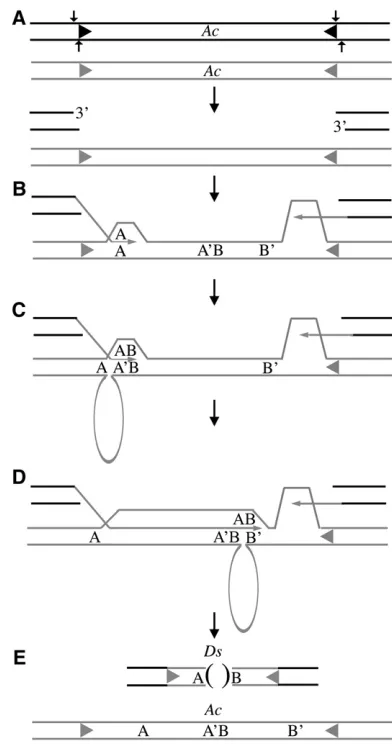
cannot account for the formation of 5/15Dselements identified in this study. Figure 5 illustrates a model ofDs formation that demonstrates how slip mispairing may occur without direct repeats at the deletion junction in the template DNA. Previous studies have established that Ds formation is dependent upon the excision of Ac (Rubin and Levy 1997). Thus, the process of Ds
formation likely begins withAcexcision, initiating a DSB (Figure 5A; reviewed in Kunze and Weil2002).
Typi-cally, this double-strand break is repaired through a hairpin intermediate resulting in Ac footprint forma-tion (Weiland Kunze2000; Baiet al. 2007). However,
in rare instances, the DSB is resolved through 39strand invasion that initiates a SDSA repair pathway with as little as 1–6 bp of homology required to initiate synthesis (Rubin and Levy 1997; Salomon and Puchta 1998;
Gorbunovaand Levy1999; Puchta2005).
We envision DNA repair synthesis initiating from both ends of the excised element using the sister chromatid as a template (Figure 5B). Typically, slip mispairing takes place at short stretches of sequences that occur multiple times within the templateAc(Rubinand Levy
1997; Yanet al. 1999) and it has been suggested that 1–5
bp of homology is sufficient to invoke slippage during DNA synthesis (Yan et al. 1999). For simplicity these
repeat sequences are represented by letters A, A9, B, and B9 in Figure 5, B–E. Following DNA synthesis of sequence A (e.g., 3-bp sequence), slip mispairing occurs followed by reannealing at A9, resulting in a deletion between the repeat sequence A and A9 in the Ac template. This single slip- mispairing event would result in the generation of the type I Ds elements shown in Figure 4 and those previously characterized by Yanet al.
(1999). However, we also observed sequential slippage events, as illustrated in Figure 5D. Here, the short filler DNA sequence B (e.g., 3 bp) is copied into the newDs element adjacent to sequence A (Figure 5C). Immedi-ately following synthesis of sequence B, a second slip mispairing occurs, resulting in reannealing at B9 and another deletion of template DNA in the new Ds elements (Figure 5D) generating a novel junction AB. DNA synthesis is concluded when the template disasso-ciates from the newly synthesized DNA and the mole-cule is ligated to the excision site via nonhomologous end joining (NHEJ) (Figure 5E). As shown in Figure 5E,
the end result is aDselement with a deletion flanked by sequences A and B. However, in the template strand these sequences are not contiguous; they appear as A, A9B, and B9. Thus, by invoking a series of tandem slip-mispairing events, this model can accommodate the formation of both type I and type II Ds elements observed in our study (Figure 4).
Figure5.—Model forDsformation. (A) A DSB is created at
the donor locus throughAcexcision. Arrows indicate a stag-gered cut resulting in a 1-bp 59 overhang (review in Kunze
and Weil2002). The sister chromatid is shown as shaded.
In summary, our data agree with previous models suggesting that error-prone DNA repair initiated through the SDSA pathway gives rise toDsderivatives followingAcexcision (Rubinand Levy1997; Yanet al.
1999). However, our data suggest slip mispairing can occur numerous times during DNA repair synthesis, resulting in complex mosaics of filler DNA that are derived fromAcsequences located both in front of and behind the replication fork as observed inps1-m8TDs(D1)
andps1-m8TDs(D3). Previous models ofDs formation
do not invoke multiple rounds of slippage nor do they suggest a reordering of template DNA copied into the deletion junction as was observed here. Although we could invoke NHEJ or abortive gap repair to explain some type IIDsformation, we prefer the more parsimo-nious model described above that can account for the formation of all state IIDselements.
We acknowledge Marika Olson for conducting molecular screens to identify thebti00191TDselement. We thank Prasit Deewatthanawong
for the 96-well DNA extraction protocol. We also thank Judy Kolkman, Tracy Blasioli, and Phyllis Farmer for providing seed for screening of derivative alleles. We are grateful to Amanda Romag, Andrew Florino, and Lauren Pitt for assistance with tissue collection and genetic analysis. We also thank Erik Vollbrecht and Kazuhiro Kikuchi for critical readings of the manuscript. This work was supported by funding from the National Science Foundation to T.P.B. (DBI-0501713).
LITERATURE CITED
Alleman, M., and J. L. Kermicle, 1993 Somatic variegation and
ger-minal mutability reflect the position of transposable element Dis-sociationwithin the maizeRgene. Genetics135:189–203. Athma, P., E. Grotewoldand T. Peterson, 1992 Insertional
muta-genesis of the maizePgene by intragenic transposition ofAc. Genetics131:199–209.
Auger, D. L., and W. Sheridan, 1999 Maize stocks modified to
en-hance the recovery ofAc-induced mutations. J. Hered.90:453–458. Bai, L., M. Singh, L. Pitt, M. Sweeney and T. P. Brutnell,
2007 Generating novel allelic variation throughActivator inser-tional mutagenesis in maize. Genetics175:981–992.
Bancroft, I., J. D. Jonesand C. Dean, 1993 Heterologous transposon
tagging of theDRL1locus in Arabidopsis. Plant Cell5:631–638. Behrens, U., N. Fedoroff, A. Laird, M. Muller-Neumann,
P. Starlingeret al., 1984 Cloning of theZea mayscontrolling
elementAcfrom thewx-m7allele. Mol. Gen. Genet.194:346–347. Brutnell, T. P., 2002 Transposon tagging in maize. Funct. Integr.
Genomics2:4–12.
Brutnell, T. P., and L. J. Conrad, 2003 Transposon tagging using
Activator(Ac) in maize. Methods Mol. Biol.236:157–176. Brutnell, T. P., and S. L. Dellaporta, 1994 Somatic inactivation
and reactivation ofAcassociated with changes in cytosine meth-ylation and transposase expression. Genetics138:213–225. Brutnell, T. P., B. P. Mayand S. L. Dellaporta, 1997 TheAc-st2
element of maize exhibits a positive dosage effect and epigenetic regulation. Genetics147:823–834.
Bundock, P., and P. J. Hooykaas, 1996 Integration ofAgrobacterium
tumefaciensT-DNA in theSaccharomyces cerevisiaegenome by illegit-imate recombination. Proc. Natl. Acad. Sci. USA93:15272–15275. Chen, J., and S. L. Dellaporta, 1994 Urea-based plant DNA
mini-prep, pp. 526–527 inThe Maize Handbook, edited by M. Freeling
and V. Walbot. Springer-Verlag, New York.
Chin, H. G., M. S. Choe, S. H. Lee, S. H. Park, J. C. Koo et al.,
1999 Molecular analysis of rice plants harboring anAc/Ds transpos-able element-mediated gene trapping system. Plant J.19:615–623. Chomet, P. S., S. Wesslerand S. L. Dellaporta, 1987 Inactivation
of the maize transposable element Activator(Ac) is associated with its DNA modification. EMBO J.6:295–302.
Colasanti, J., Z. Yuanand V. Sundaresan, 1998 TheIndeterminate
gene encodes a zinc finger protein and regulates a leaf-generated signal required for the transition to flowering in maize. Cell93: 593–603.
Conrad, L. J., and T. P. Brutnell, 2005 Ac-immobilized, a stable
source ofActivatortransposase that mediates sporophytic and ga-metophytic excision ofDissociationelements in maize. Genetics 171:1999–2012.
Coupland, G., B. Baker, J. Schelland P. Starlinger, 1988
Char-acterization of the maize transposable elementAcby internal de-letions. EMBO J.7:3653–3659.
Coupland, G., C. Plum, S. Chatterjee, A. Postand P. Starlinger,
1989 Sequences near the termini are required for transposition of the maize transposonAcin transgenic tobacco plants. Proc. Natl. Acad. Sci. USA86:9385–9388.
Cowperthwaite, M., W. Park, Z. Xu, X. Yan, S. C. Mauraiset al.,
2002 Use of the transposonAcas a gene-searching engine in the maize genome. Plant Cell14:713–726.
Dawe, R. K., and M. Freeling, 1990 Clonal analysis of the cell
lin-eages in the male flower of maize. Dev. Biol.142:233–245. Dooner, H. K., 1986 Genetic fine structure of thebronzelocus in
maize. Genetics113:1021–1036.
Dooner, H. K., and A. Belachew, 1989 Transposition pattern of the
maize elementAcfrom theBz-m2(Ac) allele. Genetics122:447–457. Dooner, H. K., and A. Belachew, 1991 Chromosome breakage by
pairs of closely linked transposable elements of theAc-Dsfamily in maize. Genetics129:855–862.
Doring, H. P., M. Freeling, S. Hake, M. A. Johns, R. Kunzeet al.,
1984 A Ds mutation of theAdh1 gene in Zea mays L. Mol. Gen. Genet.193:199–204.
Doring, H. P., B. Nelsen-Salz, R. Garber and E. Tillmann,
1989 DoubleDselements are involved in specific chromosome breakage. Mol. Gen. Genet.219:299–305.
Doring, H. P., I. Pahland M. Durany, 1990 Chromosomal
rear-rangements caused by the aberrant transposition of doubleDs elements are formed by Ds and adjacent non-Ds sequences. Mol. Gen. Genet.224:40–48.
Emerson, R., 1917 Genetical studies of variegated pericarp in
maize. Genetics2:1–35.
Fedoroff, N., S. Wesslerand M. Shure, 1983 Isolation of the
trans-posable maize controlling elementsAcandDs. Cell35:235–242. Fusswinkel, H., S. Schein, U. Courage, P. Starlinger and R.
Kunze, 1991 Detection and abundance of mRNA and protein
encoded by transposable elementActivator(Ac) in maize. Mol. Gen. Genet.225:186–192.
Giroux, M. J., J. Shaw, G. Barry, B. G. Cobb, T. Greeneet al.,
1996 A single mutation that increases maize seed weight. Proc. Natl. Acad. Sci. USA93:5824–5829.
Gorbunova, V. V., and A. A. Levy, 1999 How plants make ends meet:
DNA double-strand break repair. Trends Plant Sci.4:263–269. Greenblatt, I. M., 1984 A chromosome replication pattern deduced
from pericarp phenotypes resulting from movements of the trans-posable element,Modulator, in maize. Genetics108:471–485. Hake, S., E. Vollbrechtand M. Freeling, 1989 CloningKnotted,
the dominant morphological mutant in maize usingDs2as a transposon tag. EMBO J.8:15–22.
Hsia, A. P., and P. S. Schnable, 1996 DNA sequence analyses
sup-port the role of interrupted gap repair in the origin of internal deletions of the maize transposon,MuDR. Genetics142:603–618. James, Jr., D. W., E. Lim, J. Keller, I. Plooy, E. Ralston et al.,
1995 Directed tagging of the ArabidopsisFATTY ACID ELON-GATION1(FAE1) gene with the maize transposonActivator. Plant Cell7:309–319.
Jones, D. A., C. M. Thomas, K. E. Hammond-Kosack, P. J. Balint-Kurti
and J. D. Jones, 1994 Isolation of thetomatoCf-9gene for resistance
toCladosporium fulvumby transposon tagging. Science266:789–793. Kolkman, J., L. J. Conrad, P. R. Farmer, K. Hardeman, K. R. Ahern
et al., 2005 Distribution ofActivator(Ac) throughout the maize genome for use in regional mutagenesis. Genetics169:981–995. Kunze, R., H. Saedlerand W.-E. Lo¨ nnig, 1997 Plant transposable
elements, pp. 332–469 inAdvances in Botanical Research, edited by J. A. Callow. Academic Press, London.
Kunze, R., P. Starlingerand D. Schwartz, 1988 DNA methylation
Kunze, R., U. Stochaj, J. Laufsand P. Starlinger, 1987
Tran-scription of the transposable elementActivator(Ac) ofZea mays L. EMBO J.6:1555–1563.
Kunze, R., and C. F. Weil, 2002 ThehATandCACTAsuperfamily
of plant transposons, pp. 565–610 inMobile DNA, edited by N. L. Craig. ASM, Washington, DC.
McClintock, B., 1946 Maize Genetics. Carnegie Inst. Wash. Year
Book45:176–186.
McClintock, B., 1949 Mutable loci in maize. Carnegie Inst. Wash.
Year Book48:142–154.
McClintock, B., 1951 Chromosome organization and gene
expres-sion. Cold Spring Harbor Symp. Quant. Biol.16:13–47. McClintock, B., 1955 Controlled mutation in maize. Carnegie
Inst. Wash. Year Book54:245–255.
McClintock, B., 1956 Mutation in maize. Carnegie Inst. Wash. Year
Book55:323–332.
McClintock, B., 1962 Topographical relations between elements of
control systems in maize. Carnegie Inst. Wash. Year Book61:448–461. McClintock, B., 1963 Further studies of gene-control systems in
maize. Carnegie Inst. Wash. Year Book62:486–493.
Meissner, R. C., H. Jin, E. Cominelli, M. Denekamp, A. Fuertes
et al., 1999 Function search in a large transcription factor gene family in Arabidopsis: assessing the potential of reverse genetics to identify insertional mutations in R2R3MYBgenes. Plant Cell 11:1827–1840.
Moreno, M. A., J. Chen, I. Greenblatt and S. L. Dellaporta,
1992 Reconstitutional mutagenesis of the maize P gene by short-rangeActranspositions. Genetics131:939–956.
Muller-Neumann, M., J. I. Yoder and P. Starlinger, 1984 The
DNA sequence of the transposable elementAcofZea maysL. Mol. Gen. Genet.198:9–24.
O’Hare, K., and G. Rubin, 1983 Structures ofPtransposable
ele-ments and their sites of insertion and excision in theDrosophila melanogastergenome. Cell34:25–35.
Pohlman, R. F., N. V. Fedoroffand J. Messing, 1984 The
nucleo-tide sequence of the maize controlling elementActivator. Cell37: 635–643.
Puchta, H., 2005 The repair of double-strand breaks in plants:
mech-anisms and consequences for genome evolution. J. Exp. Bot.56:1–14. Ralston, E., J. Englishand H. K. Dooner, 1989
Chromosome-breaking structure in maize involving a fracturedAcelement. Proc. Natl. Acad. Sci. USA86:9451–9455.
Roth, D. B., X. B. Changand J. H. Wilson, 1989 Comparison of
filler DNA at immune, nonimmune, and oncogenic rearrange-ments suggests multiple mechanisms of formation. Mol. Cell. Biol.9:3049–3057.
Rubin, E., and A. A. Levy, 1997 Abortive gap repair: underlying
mech-anism forDselement formation. Mol. Cell. Biol.17:6294–6302. Sainsard-Chanet, A., and O. Begel, 1990 Insertion of an LrDNA
gene fragment and of filler DNA at a mitochondrial exon-intron junction inPodospora. Nucleic Acids Res.18:779–783.
Salomon, S., and H. Puchta, 1998 Capture of genomic and T-DNA
sequences during double-strand break repair in somatic plant cells. EMBO J.17:6086–6095.
Schauser, L., A. Roussis, J. Stillerand J. Stougaard, 1999 A
plant regulator controlling development of symbiotic root nod-ules. Nature402:191–195.
Schultes, N. P., T. P. Brutnell, A. Allen, S. L. Dellaporta, T. Nelson
et al., 1996 Leaf permease1gene of maize is required for chloro-plast development. Plant Cell8:463–475.
Schwartz, D., and E. Dennis, 1986 Transposase activity of theAc
controlling element in maize is regulated by its degree of meth-ylation. Mol. Gen. Genet.205:476–482.
Scott, L., D. LaFoeand C. F. Weil, 1996 Adjacent sequences
influ-ence DNA repair accompanying transposon excision in maize. Genetics142:237–246.
Settles, A. M., 2005 Maize community resources for forward and
reverse genetics. Maydica50:405–414.
Singh, M., P. E. Lewis, K. Hardeman, L. Bai, J. K. Rose et al.,
2003 Activator mutagenesis of the pink scutellum1/viviparous7 locus of maize. Plant Cell15:874–884.
Sundaresan, V., P. Springer, T. Volpe, S. Haward, J. D. Joneset al.,
1995 Patterns of gene action in plant development revealed by enhancer trap and gene trap transposable elements. Genes Dev. 9:1797–1810.
Sutton, W., W. Gerlach, D. Schwartzand W. Peacock, 1984
Mo-lecular analysis ofDscontrolling element mutations at theAdh1 locus of maize. Science223:1265–1268.
Takasu-Ishikawa, E., M. Yoshiharaand Y. Hotta, 1992 Extra
se-quences found at Pelement excision sites in Drosophila mela-nogaster. Mol. Gen. Genet.232:17–23.
VanSchaik, N. W., and R. A. Brink, 1959 Transposition of
Modula-tor, a component of the variegated pericarp allele in maize. Genetics44:725–738.
Varagona, M., and S. R. Wessler, 1990 Implications for the
cis-requirements for Ds transposition based on the sequence of thewxB4 Dselement. Mol. Gen. Genet.220:414–418. Weck, E., U. Courage, H. P. Doring, N. Fedoroffand P. Starlinger,
1984 Analysis of sh-m6233, a mutation induced by the trans-posable element Ds in the sucrose synthase gene of Zea mays. EMBO J.3:1713–1716.
Weil, C. F., and R. Kunze, 2000 Transposition of maizeAc/Ds
trans-posable elements in the yeastSaccharomyces cerevisiae. Nat. Genet. 26:187–190.
Weil, C. F., S. Marillonnet, B. Burr and S. R. Wessler,
1992 Changes in state of theWx-M5 allele of maize are due to intragenic transposition ofDs. Genetics130:175–185. Weil, C. F., and S. R. Wessler, 1993 Molecular evidence that
chro-mosome breakage byDselements is caused by aberrant transpo-sition. Plant Cell5:515–522.
Wessler, S., A. Tarpley, M. Purugganan, M. Spelland R. Okagaki,
1990 Filler DNA is associated with spontaneous deletions in maize. Proc. Natl. Acad. Sci. USA87:8731–8735.
Wessler, S. R., G. Baran, M. Varagona and S. L. Dellaporta,
1986 Excision ofDsproduceswaxyproteins with a range of en-zymatic activities. EMBO J.5:2427–2432.
Yamashita, S., T. Takano-Shimizu, K. Kitamura, T. Mikamiand Y.
Kishima, 1999 Resistance to gap repair of the transposonTam3
in Antirrhinum majus: a role of the end regions. Genetics 153: 1899–1908.
Yan, X., I. M. Martinez-Ferez, S. Kavchok and H. K. Dooner,
1999 Origination ofDselements fromAcelements in maize: ev-idence for rare repair synthesis at the site ofAcexcision. Genetics 152:1733–1740.
Zhang, J., and T. Peterson, 2004 Transposition of reversedAc
ele-ment ends generates chromosome rearrangeele-ments in maize. Genetics167:1929–1937.