Copyright2001 by the Genetics Society of America
Rules of Nonallelic Noncomplementation at the Synapse in
Caenorhabditis elegans
Karen J. Yook,
1Stephen R. Proulx
2and Erik M. Jorgensen
Department of Biology, University of Utah, Salt Lake City, Utah 84112-0840
Manuscript received October 3, 2000 Accepted for publication January 29, 2001
ABSTRACT
Nonallelic noncomplementation occurs when recessive mutations in two different loci fail to complement one another, in other words, the double heterozygote exhibits a phenotype. We observed that mutations in the genes encoding the physically interacting synaptic proteins UNC-13 and syntaxin/UNC-64 failed to complement one another in the nematodeCaenorhabditis elegans.Noncomplementation was not observed between null alleles of these genes and thus this genetic interaction does not occur with a simple decrease in dosage at the two loci. However, noncomplementation was observed if at least one gene encoded a partially functional gene product. Thus, this genetic interaction requires a poisonous gene product to sensitize the genetic background. Nonallelic noncomplementation was not limited to interacting proteins: Although the strongest effects were observed between loci encoding gene products that bind to one another, interactions were also observed between proteins that do not directly interact but are members of the same complex. We also observed noncomplementation between genes that function at distant points in the same pathway, implying that physical interactions are not required for nonallelic noncomple-mentation. Finally, we observed that mutations in genes that function in different processes such as neurotransmitter synthesis or synaptic development complement one another. Thus, this genetic interac-tion is specific for genes acting in the same pathway, that is, for genes acting in synaptic vesicle trafficking.
T
HE failure of two recessive alleles to complement Hillet al.1995;Rancourtet al.1995;Kiddet al.1999; Mounkes and Fuller1999). Therefore nonallelic non-one another for a specific phenotype indicates thatthe mutations are alleles of the same gene (Benzer complementation between mutations of two different loci is often interpreted as signifying a physical interac-1955). However, there are instances in which alleles of
two distinct genes do not complement one another even tion between the products of the genes.
Two models have been proposed to explain nonallelic though a wild-type copy of each gene is present. This
phenomenon is called nonallelic noncomplementation noncomplementation: the dosage model and the poi-son model (StearnsandBotstein1988;Fulleret al. (also known as unlinked noncomplementation,
second-site noncomplementation, extragenic noncomplemen- 1989). In the dosage model, a decrease in dosage at a single locus does not affect the process; however, a tation, and transheterozygous noncomplementation).
Examples of this phenomenon have been reported in simultaneous decrease at a second locus proves to be a diverse number of biological processes such as cuticle detrimental. For example, null mutations inslit, a ligand development (KuschandEdgar1986), transcriptional required for proper neuronal migration during devel-regulation (Rine andHerskowitz1987;Rancourtet opment in Drosophila melanogaster, fail to complement al. 1995), cytoskeleton-based cell behavior (Stearns null alleles ofrobo, a receptor for Slit protein (Kiddet andBotstein1988;Hayset al.1989;Welchet al.1993; al.1999).
Wang and Bretscher 1997; Halsell and Kiehart In the poison model, an altered gene product must 1998), neuron outgrowth (Kiddet al.1999), and oogen- bind and impair the protein complex with which it is esis (JacksonandBerg 1999). In the cases where the normally associated. Although this first defect does not gene products are known, the noncomplementing loci fre- produce a visible phenotype, a second mutation in an-quently encode products that interact physically (Rine other member of the protein complex reveals a visible andHerskowitz 1987; Stearns andBotstein 1988; defect. Such interactions have been observed between Hays et al. 1989; Vinhet al.1993; Welch et al. 1993; ␣- and-tubulin genes. For example, in Drosophila and yeast, altered␣-tubulins act as poisons by either seques-tering-tubulin or disrupting the polymerization of the microtubule (Stearns and Botstein 1988; Fulleret Corresponding author:Erik M. Jorgensen, Assistant Professor,
Depart-ment of Biology, University of Utah, 257 S. 1400 East, Salt Lake City, al.1989;Hayset al.1989).
UT 84112-0840. E-mail: [email protected] Proper communication between neurons relies on
1Present address:Department of Biochemistry, University of Oxford,
the regulated fusion of synaptic vesicles with the active Oxford OX1 3QU, England.
zone, a specialized region of the plasma membrane,
2Present address:Department of Zoology, University of Toronto,
To-ronto, Ontario M5S 3G5, Canada. and the subsequent release of neurotransmitter. For this
be uncoordinated. These mutations are recessive and heterozygotes are wild type in behavior. Surprisingly, worms doubly heterozygous for these alleles are uncoor-dinated (genotype unc-13(n2813)/⫹; unc-64(e246)/⫹) and thus exhibit nonallelic noncomplementation. We used this interaction as a starting point to determine the rules of nonallelic noncomplementation at the syn-apse. In these experiments, we used a drug assay to quantify the effects of mutations on synaptic function. Sensitivity to Aldicarb, an inhibitor of acetylcholinester-ase, is a measure of the amount of acetylcholine released into the synaptic cleft. First, we used null and hypomor-phic alleles of both unc-13 and unc-64 to distinguish between the dosage and poison models for this interac-tion. Second, we determined the boundaries of this interaction. Specifically, we determined whether nonal-lelic noncomplementation could be observed between proteins that physically interact, between proteins that do not interact but are found together in a larger com-plex, between proteins that simply function in the same pathway and are not in the same complex, and between
Figure 1.—The synaptic vesicle cycle. The proteins used
in this study are indicated. ACh, acetylcholine. proteins that are not in the same pathway.
MATERIALS AND METHODS process to occur, first, synaptic vesicles and associated
proteins must be transported to the synapse from the
Strains: N2 var. Bristol was used as the wild-type strain.
cell body. Second, the vesicles must be filled with neuro- Worms were cultured and maintained as previously described transmitter. Third, the mature synaptic vesicle must be (Brenner1974). The following mutations were used in this
study: docked and primed so that the vesicle can rapidly fuse
with the plasma membrane when the neuron is
depolar-Linkage group (LG) I:unc-13(e51); unc-13(n2813); ized. Finally, the vesicle and its associated proteins must unc-29 (e1072)
be recovered from the plasma membrane through endo- LG II:unc-104(e1265)
LG III:unc-64(js115),unc-64(e246),bli-5(e518) cytosis to maintain a releasable pool of synaptic vesicles
LG IV:cha-1(p1152),unc-17(e245); unc-17(ox51) (Figure 1). Two proteins required for the exocytosis step
LG V:snb-1(md247), snb-1( js124); dpy-11(e224) are UNC-13 and syntaxin. UNC-13 is a
diacylglycerol-LG X:unc-18(e81),dpy-23(e840); syd-2( ju37) binding protein with multiple C2 Ca2⫹-binding domains
Generation of single and double heterozygotes:To generate
(Maruyama and Brenner 1991; Ahmed et al. 1992).
heterozygous worms for a single mutation, L4 hermaphrodites UNC-13 proteins are required for exocytosis in
Caeno-homozygous for the relevant genotype were mated to
wild-rhabditis elegans, mammals, and Drosophila (Brose et type males, except in the cases of unc-64( js115) and snb-1 al. 1995; Betz et al. 1998; Aravamudan et al. 1999; ( js124). Since these mutations are homozygous lethal, they Augustinet al.1999;Richmond et al.1999). Syntaxin are maintained as heterozygotes balanced bybli-5(e518)and
dpy-11(e224)mutations, respectively. is a member of the SNARE complex that is required
To generate worms heterozygous for two mutations, hetero-for synaptic vesicle fusion with the plasma membrane
zygous males of one genotype were mated with homozygous (Sollneret al. 1993;Hayashiet al. 1994; Schulzeet L4 hermaphrodites of the second genotype except in the case al.1995). UNC-13 and syntaxin physically interact (Betz of unc-64( js115). In this case,unc-64( js115) ⫹/⫹ bli-5(e518) et al.1997; Augustinet al. 1999;Sassaet al.1999). It males were crossed to homozygous strains to generate the
double heterozygote. is thought that this interaction mediates a priming step
Drug resistance assay: Aldicarb
(2-methyl-2-[methylthio]-in which the synaptic vesicle becomes fusion competent
propionaldehydeO-[methylcarbamoyl]oxime; Chem Services, (Broseet al.1995;Betzet al.1998;Aravamudanet al.
West Chester, PA) was solubilized in acetone and then diluted 1999;Augustinet al.1999;Richmondet al.1999). to a working stock solution of 17.5 mmin M9. Standard NGM During our studies of neurotransmission in the nema- worm plates were treated with Aldicarb to a final concentration of 0.7 mmand allowed to dry at room temperature. For each todeC. elegans, we observed nonallelic
noncomplemen-experiment, animals that have been adults for⬍2 days were tation between mutations in UNC-13 and syntaxin.
picked to pretreated plates and scored for resistance after 12 These proteins are encoded by the genes unc-13 and
hr of exposure to the drug. Worms were considered resistant
unc-64, respectively (Maruyama and Brenner 1991; if they could move on their own or respond when prodded Ogawaet al.1998;Saifeeet al.1998). Homozygousunc- by a platinum wire. In some experiments, the worms were
scored for movement every 4 hr (⫾30 min) over a 16-hr period.
In other experiments the worms were scored in the 12th hour gote when given direct measurements of the background ge-of exposure. notype. For most cases, including the crosses involving
unc-Statistical analysis: Since all of the double heterozygotes 64( js115), the genotype of resistant animals was confirmed by
were generated by mating heterozygous males with homozy- picking resistant animals and observing the genotypes of the gous hermaphrodites, the progeny from any given cross are progeny. Furthermore, our framework allowed us to compare of two types and thus the relevant genotype is not observable hypotheses about the relationships between the resistances of directly. The resistance exhibited by the worms that result different genotypes. In addition, the framework allowed us to from each cross is the average resistance of the two genotypes test whether or not the level of resistance exhibited by the produced by segregation. To analyze the levels of drug resis- double heterozygote could be an additive effect of each of tance of the relevant genotype in any cross we adopted a the single heterozygotes. The outcomes of these hypothesis maximum-likelihood framework (see theappendix) in which tests were used as a basis for distinguishing significance in we were able to estimate the resistance of the double heterozy- the level of drug resistance among the double heterozygote genotype and each single heterozygote genotype. We report the maximum-likelihood estimates with the corresponding 2-unit support boundaries in parentheses [i.e., 4% (2–12%)]. The 2-unit support boundaries are often used in likelihood analysis in lieu of confidence limits (Edwards 1992) and are approximately the same as the upper and lower 95% con-fidence intervals for population proportions (Sokal and
Rohlf1987).
RESULTS
A quantitative assay:In the process of making double mutants we observed that worms doubly heterozygous for unc-13(n2813) and unc-64(e246) (genotype unc-13/⫹; unc-64/⫹) were uncoordinated. Thus, these mutations exhibited nonallelic noncomplementation. Further characterization of this phenomenon required a quanti-tative assay. Since the severity of an uncoordinated phe-notype is a subjective measure, we chose to use a phar-macological assay to quantify allelic interactions. The inhibitor of cholinesterase, Aldicarb, blocks the break-down of acetylcholine and causes acetylcholine to accu-mulate in the synaptic cleft. In wild-type worms, this accumulation results in constitutive depolarization and hypercontraction of the muscle, which leads to paralysis and eventually to death. Mutations that disrupt the re-lease of acetylcholine are resistant to Aldicarb (Brenner 1974; Rand and Russell 1985; Hosono et al. 1989;
Figure2.—Resistance to Aldicarb reveals a poisonous effect of hypomorphicunc-13andunc-64synaptic function alleles. (A) Resistance to Aldicarb at different concentrations. Worms were treated with different concentrations of the drug (0.3, 0.5, 0.7, 0.9, and 1.1 mm) and scored for resistance after 8 hr of exposure. (䊉) Wild type,n⫽ 3(19); (䊏) unc-13(n2813),
n⫽3(15); and (䊐)unc-13(n2813)/⫹,n⫽3(18). (B) Adult worms were treated with 0.7 mm Aldicarb and assayed for resistance after 4, 8, and 12 hr of exposure. (䊉) Wild type,n⫽
3(20); (䊏)unc-13(n2813),n⫽3(16); (䊐)unc-13(n2813)/⫹,
n⫽3(18); (䉱)unc-13(e51),n⫽6(52); and (䉭)unc-13(e51)/⫹,
n⫽5(30). (C) Adult worms were treated with 0.7 mmAldicarb and assayed for resistance after 4, 8, and 12 hr of exposure. (䊉) Wild type,n⫽3(20); (䊏)unc-64(e246),n⫽9(32); (䊐)
unc-64(e246)/⫹, n ⫽ 6(39); and (䉭)unc-64( js115)/⫹, n⫽
Miller et al. 1996). Therefore we used sensitivity to Aldicarb as wild-type worms at 8 and 12 hr of exposure (Figure 2B). By contrast, unc-13(n2813) heterozygotes Aldicarb as a measure of synaptic activity.
To maximize the sensitivity of our assay, we identified were weakly resistant to Aldicarb, particularly at interme-diate concentrations (Figure 2A) or at short times of conditions under which wild-type worms were fully
sensi-tive to Aldicarb, but unc-13(n2813) worms were fully drug exposure (Figure 2B). These data indicated that the unc-13(n2813)allele has a weakly poisonous effect resistant. The lowest concentration of drug at which all
wild-type animals were paralyzed was 0.7 mmAldicarb on synaptic transmission.
Similarly, we detected a poisonous effect of the weak (Figure 2A).unc-13(n2813)animals were completely
re-sistant to all concentrations of the drug tested. Thus, allele ofunc-64/syntaxin,e246, but not the null allele, js115, in our drug sensitivity assay. The unc-64(e246) this concentration provided the greatest sensitivity to
changes in response to Aldicarb and was consistent with mutation is a missense change in the SNARE domain of the UNC-64 protein. Theunc-64( js115)null lesion is results obtained in other studies (Jorgensen et al.
1995). an early stop. As with theunc-13null heterozygotes,
unc-64(js115)/⫹heterozygotes were as sensitive to Aldicarb To determine the time of exposure that provided the
highest sensitivity to changes in response to Aldicarb, we as wild-type worms at all times of exposure to the drug (Figure 2C). By contrast, worms heterozygous for the performed a time course of resistance. When exposed to
0.7 mm Aldicarb, wild-type worms quickly succumbed weak allele [unc-64(e246)/⫹] were weakly resistant to Aldicarb at 8–12 hr of exposure (Figure 2C). Thus, like to the effects of the drug and by 12 hr of exposure
almost all the animals were paralyzed (Figure 2B). By the unc-13(n2813)allele, theunc-64(e246)allele exhib-ited a weakly poisonous effect on synaptic transmission contrast, homozygous unc-13(n2813) worms remained
resistant at 12 hr (Figure 2B) and exhibited only a slight in a heterozygote. We used these null and poison alleles ofunc-13andunc-64to test the dosage and poison mod-decrease in resistance at 16 hr (data not shown). Since
a 12-hr exposure to 0.7 mmAldicarb provided a satisfac- els for nonallelic noncomplementation.
Dosage vs.poison:We did not observe resistance to tory level of distinction between wild-type and mutant
worms we used these parameters to assess synaptic effi- Aldicarb in heterozygous strains for null alleles of unc-13orunc-64(Figure 2, B and C). Assuming that there is cacy among all double heterozygotes in this study.
Resistance to Aldicarb provided a more sensitive no compensation for the lowered levels of gene product, then a 50% reduction in the concentrations of either means of measuring synaptic efficacy than a behavioral
analysis. Strong unc-13 mutants, such as the nonsense of these proteins does not impair neurotransmission. However, in the dosage model of nonallelic noncom-mutant unc-13(e51), are severely paralyzed as
homozy-gotes. Theunc-13(e51)mutation is an early stop in the plementation, the detrimental effect is observed only when both loci are decreased at the same time. There-long transcript encoding the synaptically localized
iso-form of UNC-13 (the short transcript encodes the axo- fore, to test the dosage model, we constructed worms that had a reduction in gene dosage at both loci simulta-nally localized isoform;Nurrishet al.1999;Kohnet al.
2000). By contrast, worms homozygous for the weakunc- neously; that is, we constructed double heterozygotes [unc-13(e51)/⫹; unc-64( js115)/⫹] and measured the 13(n2813)mutation move forward quite well and exhibit
only a jerky phenotype when prodded to move back- level of drug resistance exhibited by these worms. The double heterozygotes were not resistant to Aldicarb [1% ward. Theunc-13(n2813)mutation is a missense
muta-tion in the C-terminal region of the UNC-13 protein (0–6%); Figure 3A].
Alternatively, in the poison model, nonallelic non-that is common to all splice forms (Kohnet al.2000).
However, unc-13(n2813) mutants exhibit almost the complementation is observed only if altered gene prod-ucts impair the protein complexes with which they are same level of drug resistance as unc-13(e51) mutants,
92% (88–96%) and 93% (90–96%), respectively (Figure normally associated. To test the poison model we con-structed worms that were doubly heterozygous for the 2B). So althoughunc-13(n2813)homozygotes are often
difficult to distinguish from wild-type worms on the basis poison alleles of unc-13 and unc-64 [genotype unc -13(n2813)/⫹; unc-64(e246)/⫹]. The double heterozy-of their behavioral phenotype, they can easily be
identi-fied on the basis of drug resistance. Therefore a small gote exhibited a significant increase in the level of Aldi-carb resistance compared to either heterozygote alone decrease in neurotransmitter release can translate into
a significant level of resistance to Aldicarb. [42% (35–50%) forunc-13(n2813)/⫹;unc-64(e246)/⫹, 4% (2–7%) forunc-13(n2813)/⫹, and 8% (5–11%) for
Poison alleles:To test the dosage and poison models,
we needed null and poison alleles of the unc-13 and unc-64(e246)/⫹; Figure 3B]. This result suggests that non-allelic noncomplementation between these loci obeys unc-64 loci. The unc-13(e51) and unc-13(n2813)alleles
are recessive; specifically, heterozygotes exhibit a wild- the poison model. In addition, the level of resistance exhibited by the double heterozygote is not due simply type behavioral phenotype. Surprisingly, we detected a
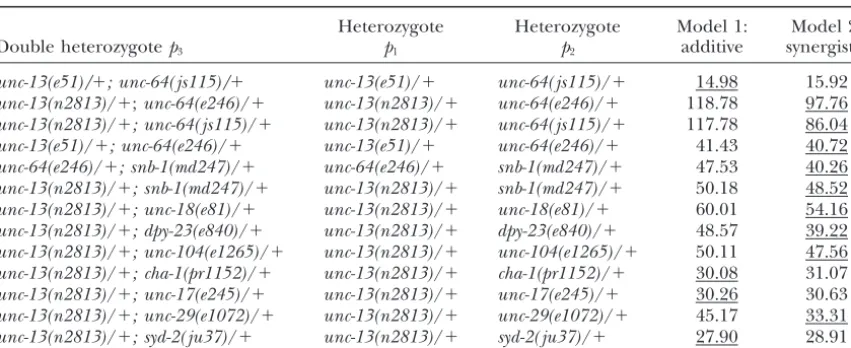
poisonous effect of the weak allele,n2813, but not the to an additive effect of each single heterozygote (Table 1,appendix).
nonsense allele,e51, in our Aldicarb sensitivity
TABLE 1
Adjusted negative log-likelihood scores of the two models for complementation
Heterozygote Heterozygote Model 1: Model 2: Double heterozygotep3 p1 p2 additive synergistic
unc-13(e51)/⫹; unc-64( js115)/⫹ unc-13(e51)/⫹ unc-64( js115)/⫹ 14.98 15.92
unc-13(n2813)/⫹;unc-64(e246)/⫹ unc-13(n2813)/⫹ unc-64(e246)/⫹ 118.78 97.76
unc-13(n2813)/⫹; unc-64( js115)/⫹ unc-13(n2813)/⫹ unc-64( js115)/⫹ 117.78 86.04
unc-13(e51)/⫹; unc-64(e246)/⫹ unc-13(e51)/⫹ unc-64(e246)/⫹ 41.43 40.72
unc-64(e246)/⫹; snb-1(md247)/⫹ unc-64(e246)/⫹ snb-1(md247)/⫹ 47.53 40.26
unc-13(n2813)/⫹; snb-1(md247)/⫹ unc-13(n2813)/⫹ snb-1(md247)/⫹ 50.18 48.52
unc-13(n2813)/⫹; unc-18(e81)/⫹ unc-13(n2813)/⫹ unc-18(e81)/⫹ 60.01 54.16
unc-13(n2813)/⫹; dpy-23(e840)/⫹ unc-13(n2813)/⫹ dpy-23(e840)/⫹ 48.57 39.22
unc-13(n2813)/⫹; unc-104(e1265)/⫹ unc-13(n2813)/⫹ unc-104(e1265)/⫹ 50.11 47.56
unc-13(n2813)/⫹; cha-1(pr1152)/⫹ unc-13(n2813)/⫹ cha-1(pr1152)/⫹ 30.08 31.07
unc-13(n2813)/⫹; unc-17(e245)/⫹ unc-13(n2813)/⫹ unc-17(e245)/⫹ 30.26 30.63
unc-13(n2813)/⫹; unc-29(e1072)/⫹ unc-13(n2813)/⫹ unc-29(e1072)/⫹ 45.17 33.31
unc-13(n2813)/⫹; syd-2( ju37)/⫹ unc-13(n2813)/⫹ syd-2( ju37)/⫹ 27.90 28.91
The additive model plays the role of a null model, as it has only two parameters, while the synergistic model has three. We compare the likelihood scores of the two models, adjusted for the number of parameters by the Akaike information criterion (AIC). This penalizes the higher parameter model, because an increase in parameters will always bring a better fit. When the synergistic model has a better AIC than the additive model, we reject additivity. The underlined score represents the accepted model.
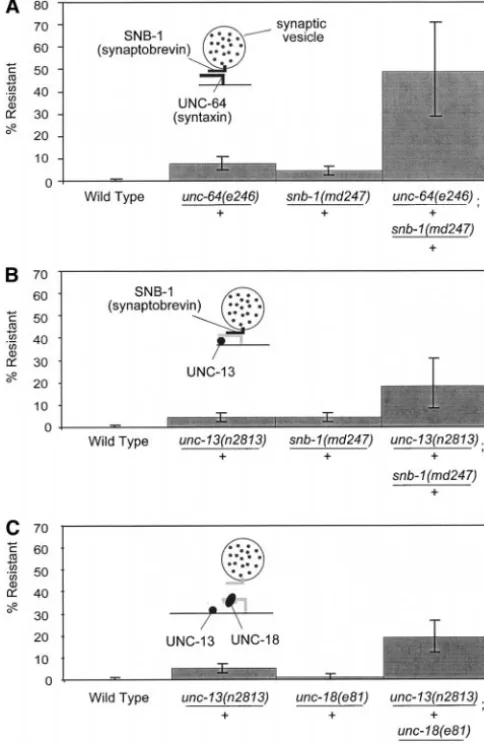
sensitize the strain to further mutations, we constructed tested noncomplementation of unc-64 using the snb-1 hypomorphic allele, md247 (Nonet et al. 1998). We worms heterozygous for a poison allele at one locus and
a null allele at the other locus. In these cases, we still observed that the double heterozygote exhibited a marked increase in Aldicarb resistance, [48% (29–71%) observed nonallelic noncomplementation (Figure 3, C
and D). In addition, noncomplementation occurred re- for unc-64(e246)/⫹; snb-1(md247)/⫹; Figure 4A] com-pared to the resistance of either heterozygote alone [8% gardless of which locus encoded the poison allele or
the null allele. The level of Aldicarb resistance exhibited (5–11%) for unc-64(e246)/⫹ and 4% (2–7%) for snb-1 (md247)/⫹]. This result suggests that nonallelic noncom-by worms heterozygous for the unc-13(n2813) poison
allele and theunc-64( js115) null allele [genotype unc- plementation is a more general phenomenon among synaptic genes and is not specific to theunc-13(n2813) 13(n2813)/⫹;unc-64( js115)/⫹] was 56% (43–69%;
Fig-ure 3C). Conversely, the level of Aldicarb resistance mutation.
Noncomplementation among proteins of the same
exhibited by worms heterozygous for the unc-13(e51)
nonsense allele and theunc-64(e246)poison allele was complex:Nonallelic noncomplementation is often in-terpreted to signify a direct physical interaction between 17% [10–24%; genotypeunc-13(e51)/⫹; unc-64(e246)/⫹].
This is significantly different than the level of resistance the products of the loci involved. To test whether nonal-lelic noncomplementation requires a direct physical exhibited by the single heterozygotes alone and is not
simply an additive effect of the single heterozygotes association between the noncomplementing gene prod-ucts, we constructed double heterozygotes between unc-(Table 1,appendix). These data imply that the presence
of one altered synaptic component is sufficient to sensi- 13(n2813)and mutations in proteins that are not known to bind to UNC-13. Since SNB-1/synaptobrevin associates tize synaptic transmission to the levels of interacting
gene products. only indirectly with UNC-13 as part of a complex with
UNC-64/syntaxin (Betz et al.1997), we tested whether
Noncomplementation among interacting loci:
Bio-chemical studies have demonstrated that syntaxin binds unc-13(n2813)would complementsnb-1.Double hetero-zygotes between unc-13(n2813) and the snb-1(md247) to the integral synaptic vesicle membrane protein
synap-tobrevin and plasma membrane protein SNAP-25 to weak allele exhibited a level of drug resistance that is significantly different from either heterozygote alone form a SNARE complex (Sollner et al. 1993). The
crystal structure of the SNARE complex suggests that [19% (11–28%) forunc-13(n2813)/⫹; snb-1(md247)/⫹, 4% (2–7%) forunc-13(n2813)/⫹, and 4% (2–7%) for these three proteins are intertwined when the synaptic
vesicle is positioned at the active zone (Sutton et al. snb-1(md247)/⫹; Figure 4B]. Therefore nonallelic non-complementation at the synapse does not require a di-1998). To determine whether other proteins that
inter-act with syntaxin exhibit nonallelic noncomplementa- rect physical interaction between the gene products. However, as observed betweenunc-13andunc-64, there tion, we tested interactions between theunc-64/syntaxin
Figure 3.—Noncomplemen-tation between UNC-13 and syntaxin requires the presence of a poison allele. Worms singly or doubly heterozygous for unc-13andunc-64were constructed and tested for resistance to 0.7 mmAldicarb after 12 hr of ex-posure and compared to the wild type [first column of each graph,n⫽20(30)]. (A) Synap-tic function is not dosage sensi-tive.unc-13(e51)/⫹,n⫽7(34);
unc-64( js115)/⫹, n ⫽ 12(18); and unc-13(e51)/⫹; unc-64 ( js115)/⫹,n⫽5(27). (B) The two hypomorphic alleles ex-hibit nonallelic noncomple-mentation. unc-13(n2813)/⫹,
n⫽13(32);unc-64(e246),n⫽
9(33); and unc-13(n2813)/⫹; unc-64(e246)/⫹,n⫽9(33). (C) The hypomorphicunc-13allele reveals dosage sensitivity to
unc-64 gene product levels.
unc-13(n2813)/⫹,n⫽12(30);
unc-64( js115)/⫹, n ⫽ 12(18); and unc-13(n2813)/⫹; unc-64( js115)/⫹, n ⫽ 8(29). (D) Theunc-64hypomorphic allele reveals dosage sensitivity to
unc-13 gene product levels.
unc-13(e51)/⫹,n⫽7(34); unc-64(e246), n ⫽ 9(33); and
unc-13(e51)/⫹; unc-64(e246)/⫹,
n⫽7(29).
Specifically, unc-13(e51)fully complements the null al- mutation does not appear to have a poisonous effect. Furthermore, unc-18(e81) is likely to be a null allele lelesnb-1( js124)(data not shown).
Furthermore, we tested whether unc-13 exhibited since it is a nonsense mutation and since there is no immunoreactivity in unc-18(e81) homozygous worms nonallelic noncomplementation with unc-18. UNC-18
also binds to UNC-64/syntaxin (Hataet al.1993), but (Gengyo-Ando et al. 1993). Thus, unc-13(n2813) can sensitize synaptic function to decreases in the dosage does not bind when UNC-13 or synaptobrevin is bound
(Pevsner et al.1994; Sassa et al.1999). We observed of proteins that are not components of the SNARE com-plex.
that the double heterozygote exhibited more resistance
than either heterozygote alone [19% (12–27%) forunc-13 Boundaries of nonallelic noncomplementation:So far our results have demonstrated that a poison allele of (n2813)/⫹; unc-18(e81)/⫹, 4% (2–7%) for unc-13
(n2813)/⫹, and 1% (0–2%) forunc-18(e81)/⫹; Figure unc-13can sensitize synaptic transmission to the dosage of components required for synaptic vesicle exocytosis. 4C]. Since unc-18 heterozygotes (unc-18(e81)/⫹) are
There is no evidence to support a direct interaction between UNC-13 and UNC-104 proteins, nor is it sus-pected that these products participate in the same com-plex. Worms homozygous for the weak allele, unc-104(e1265), are nearly paralyzed, whereas heterozygotes behave like the wild type. In the presence of Aldicarb, unc-104/⫹ single heterozygotes also behave like wild-type animals. However, double heterozygotes exhibited a significantly increased level of Aldicarb resistance com-pared to either heterozygote [19% (11–28%) for unc-13(n2813)/⫹; unc-104(e1265)/⫹, 2% (0–5%) for unc-104(e1265)/⫹; Figure 5A]. This result suggests that a poison allele in the fusion machinery can reveal pertur-bations in trafficking components.
Synaptic gene products are recycled from the plasma membrane via clathrin-mediated endocytosis. Clathrin assembly on the plasma membrane requires the AP-2 adaptor complex. The-subunit of theC. elegansAP-2 complex is encoded bydpy-23(P. BaumandG. Garriga, personal communication). Worms homozygous for the null alleledpy-23(e840)are severely uncoordinated and exhibited an intermediate level of resistance to Aldicarb [55% (46–63%), data not shown]. Althoughdpy-23 het-erozygotes were not drug resistant, double heterozy-gotes were markedly resistant [42% (29–58%) for unc-13(n2813)/⫹; dpy-23(e840)/⫹, 4% (2–7%) for unc-13 (n2813)/⫹, and 0% (0–3%) fordpy-23(e840)/⫹; Figure 5B]. This level of resistance is similar to the level of drug resistance exhibited bydpy-23(e840)homozygotes. Thus, the poison mutation ofunc-13can sensitize synap-tic function to decreased levels of components required for endocytosis.
Mutations in distant pathways: To determine if
unc-Figure 4.—Nonallelic noncomplementation occurs
be-tween genes that encode components of the same complex. 13(n2813) could sensitize neurotransmission to muta-(A) Syntaxin and synaptobrevin mutations exhibit nonalle- tions that do not affect the exocytotic machinery, we lic noncomplementation. unc-64(e246)/⫹, n⫽ 9(46); snb-1
analyzed interactions with mutations affecting the levels (md247)/⫹,n⫽7(27); andunc-64(e246)/⫹; snb-1(md247)/⫹,
of neurotransmitter in synaptic vesicles.cha-1encodes n⫽4(17). (B) UNC-13 and synaptobrevin mutations exhibit
choline acetyltransferase, the biosynthetic enzyme for nonallelic noncomplementation.unc-13(n2813)/⫹,n⫽12(30);
snb-1(md247)/⫹, n ⫽ 7(27); and unc-13(n2813)/⫹; snb-1 acetylcholine (RandandRussell1984). Null mutations (md247)/⫹,n⫽5(27). (C) UNC-13 and UNC-18 mutations in cha-1 are lethal whereas a hypomorphic mutation exhibit nonallelic noncomplementation.unc-13(n2813)/⫹,n⫽
[cha-1(p1152)] is viable and paralyzed as homozygotes. 12(30);unc-18(e81)/⫹,n⫽9(28); andunc-13(n2813)/⫹;
unc-Even though thecha-1heterozygote has decreased levels 18(e81)/⫹, n ⫽ 9(30). Insets depict gene products at the
of choline acetyltransferase activity (RandandRussell synapse. In all graphs, wild-typen⫽ 20(30) and resistance
was measured after 12 hr of exposure to 0.7 mmAldicarb. 1984), heterozygous worms exhibited wild-type levels of Aldicarb resistance [1% (0–4%) forcha-1(p1152)/⫹; Figure 6A]. Furthermore, the double heterozygote was requires transport from two routes: via kinesin-mediated barely distinguishable from the unc-13 heterozygote transport from the cell body and via endocytosis from alone and any increase in the level of resistance of the the terminal itself. Therefore, to explore the ability of a double heterozygote could be attributed to an additive poison allele to reveal dosage sensitivity in the transport effect of both mutations [5% (0–14%) for unc-13 machinery, we tested genetic interactions between (n2813)/⫹; cha-1(p1152)/⫹and 4% (2–7%) forunc-13 UNC-13 and synaptic vesicle kinesin and between UNC- (n2813)/⫹; Figure 6A,appendix]. Therefore, a poison 13 and the clathrin adaptor complex, proteins that con- UNC-13 protein does not sensitize synaptic function to trol vesicle trafficking at the synapse. deficits in neurotransmitter supply.
Figure 5.—Nonallelic noncomplementation oc-curs betweenunc-13(n2813)
and genes involved in syn-aptic vesicle trafficking. (A) UNC-13 and synaptic vesicle kinesin mutations exhibit nonallelic noncomplemen-tation. unc-13 (n2813)/⫹,
n⫽6(39);unc-104(e1265)/⫹,
n ⫽ 6(38); and unc-13 (n2813)/⫹; unc-104(e1265)/ ⫹,n⫽6(38). (B) UNC-13 and clathrin adaptor com-plex mutations exhibit non-allelic noncomplementa-tion.unc-13 (n2813)/⫹,n⫽
6(39);dpy-23(e840)/⫹,n⫽
2(31); and unc-13(n2813)/ ⫹; dpy-23(e840),n⫽6(22). In all graphs, wild-type,n⫽
10(32) and resistance was measured after 12 hr of ex-posure to 0.7 mmAldicarb.
quired for loading synaptic vesicles with acetylcholine enhance defects in the loading of acetylcholine into synaptic vesicles.
(Alfonsoet al.1993). Worms homozygous for the null
allele,ox51, are lethal, whereas worms homozygous for Neurotransmitter from the synaptic vesicle is released into the synaptic cleft and diffuses to receptors on the the weak allele, e245, are severely uncoordinated and
coiled. unc-17(e245) heterozygotes exhibited a small postsynaptic cell. We observed that unc-13(n2813)/⫹ does not complement a mutation in the acetycholine amount of resistance. However, the double
heterozy-gote did not exhibit a level of Aldicarb resistance that receptor subunit encoded by theunc-29gene [26% (19– 34%) for unc-13(n2813)/⫹; unc-29(e1072)/⫹; 1% (0– was significantly different from the single heterozygotes
[3% (0–6%) forunc-13(n2813)/⫹; unc-17(e245)/⫹, 4% 5%) for unc-29(e1072)/⫹, and 4% (2–7%) for unc-13(n2813)/⫹; Figure 7]. Therefore, perturbations in (2–7%) forunc-13(n2813)/⫹, and 1% (0–5%) for
unc-17(e245)/⫹; Figure 6B]. Similar results were obtained unc-13enhance reductions in the postsynaptic receptors that bind acetylcholine but not reductions in the ma-for the lethal allele, ox51, of unc-17 (data not shown).
Thus, a poison UNC-13 protein does not significantly chinery that loads the vesicle with acetylcholine. These
Figure 6.—Nonallelic noncomplementation does not occur between distant members of the synaptic ves-icle pathway. (A) unc-13
complements a mutation of the biosynthetic enzyme for acetylcholine. unc-13(n28-13)/⫹, n ⫽ 6(39); cha-1(pr1152)/⫹, n ⫽ 4(29);
unc-13(n2813)/⫹; cha-1(pr-1152)/⫹, n ⫽ 5(25). (B)
unc-13 complements a mu-tation of the acetylcholine vesicular transporter. unc-13(n2813)/⫹, n ⫽ 6(39);
unc-17(e245)/⫹,n⫽4(22); and unc-13(n2813)/⫹; unc-17(e245)/⫹,n⫽8(31). For both graphs, wild-type,n⫽
Figure 7.—Nonallelic noncomplementation occurs be- Figure 8.—Nonallelic noncomplementation does not oc-cur betweenunc-13and genes required for development.
unc-tween genes that function across the synapse.unc-13does not
complement a mutation inunc-29, which encodes an acetyl- 13(n2813)complements a mutation insyd-2, which is required for active zone formation. Wild type, n ⫽ 10(32);
unc-choline receptor subunit. Wild type, n ⫽ 10(32); unc-13
(n2813)/⫹,n⫽6(39);unc-29(e1072)/⫹,n⫽2(48); andunc- 13(n2813)/⫹,n⫽6(39);syd-2( ju37)/⫹,n⫽3(26); and unc-13(n2813)/⫹; syd-2( ju37)/⫹,n⫽6(23). Resistance was
mea-13(n2813)/⫹; unc-29(e1072)/⫹, n ⫽ 6(22). Resistance was
measured after 12 hr of exposure to 0.7 mmAldicarb. sured after 12 hr of exposure to 0.7 mmAldicarb.
data suggest that vesicle loading is not a rate-limiting are recessive in behavioral assays, can act as weak poisons step in synaptic transmission. as heterozygotes in quantitative drug sensitivity assays. Finally, a mutation that affects synaptic development These poisons sensitize the process of neurotransmis-does not display nonallelic noncomplementation with sion to perturbations at other synaptic loci, resulting in unc-13(n2813). syd-2encodes a liprin protein, which is nonallelic noncomplementation. In addition, it is the a family of proteins that interact with receptor tyrosine presence of these poisons rather than a simple decrease phosphatases.syd-2is required for the development of in the dosage of the gene product that is essential for synaptic termini (ZhenandJin1999). Specifically, ho- nonallelic noncomplementation interactions at the syn-mozygoussyd-2mutants exhibit a mislocalization of pre- apse. Furthermore, in the cases where we observed non-synaptic proteins and have deformed active zones.syd-2 allelic noncomplementation we have demonstrated that mutant animals are moderately resistant to Aldicarb. the increase in drug resistance of the double heterozy-However,unc-13(n2813)fully complements syd-2( ju37) gote is a synergistic effect and not simply an additive [7% (0–16%) forunc-13(n2813)/⫹; syd-2( ju37)/⫹, 4% effect of the noncomplementing mutations.
(1–10%) for syd-2( ju37)/⫹, and 4% (2–7%) for unc- The dosage model and the poison model have been 13(n2813)/⫹; Figure 8]. These results indicate that the proposed to explain how nonallelic mutations could compromises in synaptic machinery caused by unc- exhibit noncomplementation. In the dosage model a 13(n2813)do not synergistically interact with mutations decrease in expression at two loci cripples the process. in the developmental genesyd-2. In the poison model an altered gene product poisons the protein complex with which it is associated; thus there are not enough functional complexes. In the poi-DISCUSSION
son model the number of functional protein complexes is the limiting factor, not the amount of a single protein. Nonallelic noncomplementation occurs between
syn-aptic function genes inC. elegans.Our analysis of this Examples of both dosage-based (Rancourtet al.1995; JacksonandBerg1999;Kiddet al.1999) and poison-genetic interaction demonstrated that hypomorphic
Welch et al. 1993) nonallelic noncomplementation well as for genes acting at more distant steps in synaptic transmission.
have been reported. In the instances of dosage-based
nonallelic noncomplementation the gene products are We are very grateful to Becky Eustance Kohn, Jim Rand, Paul Baum, required to coordinate developmental programs. For and Gian Garriga for kindly sharing unpublished data. We thank the members of the Jorgensen Lab and the participants of Theory Lunch example, neuronal outgrowth across the CNS midline
for providing invaluable discussions and support. In particular, we in Drosophila is compromised by a decrease in dosage
thank Mark Hammarlund, Todd W. Harris, and Wayne Davis for very of bothslit androbo, the ligand and receptor, respec- helpful comments on the manuscript. We thank theCaenorhabditis tively, of this guidance pathway (Broseet al.1999;Kidd Genetics Centerand Mike Nonet for providing strains. This work was supported by a National Institutes of Health (NIH) genetics training
et al.1999). Thus a limiting factor in neuronal outgrowth
grant to K.J.Y. and NIH grant RO1 NS34307 to E.M.J. is the concentration of its signals and receptors. This
sensitivity to protein concentrations is a common fea-ture of developmental pathways that must respond to
LITERATURE CITED protein gradients.
By contrast, we have demonstrated that synaptic func- Ahmed, S., I. N. Maruyama, R. Kozma, J. Lee, S. Brenneret al., 1992 TheCaenorhabditis elegans unc-13gene product is a phospholipid-tion is not sensitive to gene dosage; however, synaptic
dependent high-affinity phorbol ester receptor. Biochem. J.287:
function is sensitive to altered gene products. These 995–999.
Alfonso, A., K. Grundahl, J. S. Duerr, H. P. HanandJ. B. Rand,
observations suggest that neurotransmission is not as
sen-1993 TheCaenorhabditis elegans unc-17gene: a putative vesicular sitive a process as developmental pathways to changes
acetylcholine transporter. Science261:617–619.
in protein concentrations. However, neurotransmission Aravamudan, B., T. Fergestad, W. S. Davis, C. K. Rodeschand
K. Broadie,1999 Drosophila UNC-13 is essential for synaptic
depends on the formation of a limited number of
pro-transmission. Nat. Neurosci.2:965–971. tein complexes. In processes requiring the correct
as-Augustin, I., A. Betz, C. Herrmann, T. JoandN. Brose,1999
Dif-sembly of protein complexes, a single faulty subunit can ferential expression of two novel Munc13 proteins in rat brain. Biochem. J.337:363–371.
render a large number of gene products inactive by
Benzer, S.,1955 Fine structure of a genetic region in bacteriophage.
participating in and poisoning protein complexes. Proc. Natl. Acad. Sci. USA41:344–354.
How could poison alleles such as unc-13(n2813) or Betz, A., M. Okamoto, F. BenselerandN. Brose, 1997 Direct interaction of the ratunc-13homologue Munc13-1 with the N
unc-64(e246) affect synaptic transmission? Synaptic
trans-terminus of syntaxin. J. Biol. Chem.272:2520–2526.
mission requires the action of a docking complex and Betz, A., U. Ashery, M. Rickmann, I. Augustin, E. Neheret al., 1998 then a fusion complex. We imagine that if a component Munc13-1 is a presynaptic phorbol ester receptor that enhances
neurotransmitter release. Neuron21:123–136. of a complex is a poison protein, then the complex as
Brenner, S.,1974 The genetics ofCaenorhabditis elegans.Genetics
a whole would not function or would function ineffi- 77:71–94.
Brose, N., K. Hofmann, Y. HataandT. C. Sudhof,1995
Mamma-ciently. Therefore, poisons of the docking or fusion
lian homologues ofCaenorhabditis elegans unc-13gene define novel complexes could hinder vesicles from associating with
family of C2-domain proteins. J. Biol. Chem.270:25273–25280. the plasma membrane. Brose, K., K. S. Bland, K. H. Wang, D. Arnott, W. Henzelet al., 1999 Slit proteins bind Robo receptors and have an evolution-Not surprisingly, nonallelic noncomplementation was
arily conserved role in repulsive axon guidance. Cell96:795–806. not observed between genes involved in processes
re-Edwards, A. W. F.,1992 Likelihood.Johns Hopkins University Press,
moved from the exocytotic machinery. For example, Baltimore.
Fuller, M. T., C. L. Regan, L. L. Green, B. Robertson, R. Deuring
unc-13(n2813)fully complemented mutations in genes
et al., 1989 Interacting genes identify interacting proteins in-responsible for acetylcholine synthesis or loading of neuro- volved in microtubule function in Drosophila. Cell. Motil. Cy-transmitter into vesicles. In additionunc-13(n2813)fully toskeleton14:128–135.
Gengyo-Ando, K., Y. Kamiya, A. Yamakawa, K. Kodaira, K.
Nishi-complemented a mutation in syd-2, which is required
wakiet al., 1993 TheC. elegans unc-18gene encodes a protein for development of neuromuscular junctions. Thus, expressed in motor neurons. Neuron11:703–711.
nonallelic noncomplementation withunc-13is observed Hall, D. H.,andE. M. Hedgecock,1991 Kinesin-related gene unc-104is required for axonal transport of synaptic vesicles inC. with other proteins in the UNC-13 pathway but no
inter-elegans.Cell65:837–847.
actions were observed with genes involved in distant Halsell, S. R.,andD. P. Kiehart,1998 Second-site noncomple-pathways such as neurotransmitter synthesis or synaptic mentation identifies genomic regions required for Drosophila nonmuscle myosin function during morphogenesis. Genetics development. Nonetheless, it is surprising that
unc-148:1845–1863.
13(n2813) can sensitize synaptic transmission to UNC- Hata, Y., C. A. SlaughterandT. C. Sudhof,1993 Synaptic vesicle fusion complex containsunc-18homologue bound to syntaxin. 104 and DPY-23, proteins that are not involved in the
Nature366:347–351. formation of the SNARE complex. Heterozygotes of
Hayashi, T., H. McMahon, S. Yamasaki, T. Binz, Y. Hataet al., 1994
these genes must affect the complex indirectly by stress- Synaptic vesicle membrane fusion complex: action of clostridial neurotoxins on assembly. EMBO J.13:5051–5061.
ing the vesicular transport machinery. Thus, nonallelic
Hays, T. S., R. Deuring, B. Robertson, M. ProutandM. T. Fuller,
noncomplementation withunc-13extends to processes 1989 Interacting proteins identified by genetic interactions: a involved in synaptic vesicle trafficking. Taken together, missense mutation in alpha-tubulin fails to complement alleles of the testis-specific beta-tubulin gene ofDrosophila melanogaster. our results suggest that nonallelic noncomplementation
Mol. Cell. Biol.9:875–884.
kinase and failed axon connections (fax), a novel protein in axon vitro that may correspond to sequential steps of synaptic vesicle docking, activation, and fusion. Cell75:409–418.
bundles. Genetics141:595–606.
Stearns, T.,andD. Botstein,1988 Unlinked
noncomplementa-Hosono, R., T. SassaandS. Kuno,1989 Spontaneous mutations
tion: isolation of new conditional-lethal mutations in each of the of trichlofon resistance in the nematodeCaenorhabditis elegans.
tubulin genes ofSaccharomyces cerevisiae.Genetics119:249–260. Zool. Sci.6:697–708.
Sutton, R. B., D. Fasshauer, R. JahnandA. T. Brunger,1998
Crys-Jackson, S. M.,andC. A. Berg,1999 Soma-to-germline interactions
tal structure of a SNARE complex involved in synaptic exocytosis during Drosophila oogenesis are influenced by dose-sensitive
in-at 2.4 A resolution. Nin-ature395:347–353. teractions between cutand the genescappuccino,ovarian tumor
Vinh, D. B., M. D. Welch, A. K. Corsi, K. F. WertmanandD. G.
andagnostic.Genetics153:289–303.
Drubin,1993 Genetic evidence for functional interactions
be-Jorgensen, E. M., E. Hartwieg, K. Schuske, M. L. Nonet, Y. Jinet al.,
tween actin noncomplementing (Anc) gene products and actin 1995 Defective recycling of synaptic vesicles in synaptotagmin
cytoskeletal proteins inSaccharomyces cerevisiae.Genetics135:275– mutants ofCaenorhabditis elegans.Nature378:196–199.
286.
Kidd, T., K. S. BlandandC. S. Goodman,1999 Slitis the midline
Wang, T.,andA. Bretscher,1997 Mutations synthetically lethal
repellent for the robo receptor inDrosophila.Cell96:785–794.
withtpm1deltalie in genes involved in morphogenesis. Genetics
Kohn, R. E., J. S. Duerr, J. R. McManus, A. Duke, T. Rakowet al.,
147:1595–1607. 2000 Expression of multiple UNC-13 proteins in theC. elegans
Welch, M. D., D. B. Vinh, H. H. OkamuraandD. G. Drubin,1993
nervous system. Mol. Biol. Cell11:3441–3452.
Screens for extragenic mutations that fail to complement act1
Kusch, M.,andR. S. Edgar,1986 Genetic studies of unusual loci
alleles identify genes that are important for actin function in that affect body shape of the nematodeCaenorhabditis elegansand
Saccharomyces cerevisiae.Genetics135:265–274. may code for cuticle structural proteins. Genetics113:621–639.
Zhen, M.,andY. Jin,1999 The liprin protein SYD-2 regulates the
Maruyama, I. N.,andS. Brenner,1991 A phorbol
ester/diacylglyc-differentiation of presynaptic termini inC. elegans.Nature401:
erol-binding protein encoded by theunc-13gene ofCaenorhabditis
371–375. elegans.Proc. Natl. Acad. Sci. USA88:5729–5733.
Miller, K. G., A. Alfonso, M. Nguyen, J. A. Crowell, C. D. Johnson
Communicating editor:P. Anderson
et al., 1996 A genetic selection forCaenorhabditis eleganssynaptic transmission mutants. Proc. Natl. Acad. Sci. USA 93:12593– 12598.
Mounkes, L. C.,andM. T. Fuller,1999 Molecular characterization APPENDIX: MAXIMUM-LIKELIHOOD MODELS
of mutant alleles of the DNA repair/basal transcription factor OF GENETIC EFFECTS haywire/ERCC3in Drosophila. Genetics152:291–297.
Nonet, M. L., O. Saifee, H. Zhao, J. B. RandandL. Wei,1998 Syn- The analysis of data in this article required statistical
aptic transmission deficits inCaenorhabditis eleganssynaptobrevin
calculations to estimate the effects of particular muta-mutants. J. Neurosci.18:70–80.
Nurrish, S., L. SegalatandJ. M. Kaplan,1999 Serotonin inhibi- tions to test genetic hypotheses. We adopted a
maxi-tion of synaptic transmission: Galpha(0) decreases the abundance mum-likelihood approach, which allows both parameter of UNC-13 at release sites. Neuron24:231–242.
estimation and hypothesis testing using the same
tech-Ogawa, H., S. Harada, T. Sassa, H. YamamotoandR. Hosono,
1998 Functional properties of the unc-64 gene encoding a nique. Parameter estimations can determine the contri-Caenorhabditis eleganssyntaxin. J. Biol. Chem.273:2192–2198. butions to resistance by both the experimental
geno-Otsuka, A. J., A. Jeyaprakash, J. Garcia-Anoveros, L. Z. Tang, G.
types and the balancer genotypes, which will appear in
Fisket al., 1991 TheC. elegans unc-104gene encodes a putative
our experiments but are not informative. There are two kinesin heavy chain-like protein. Neuron6:113–122.
Pevsner, J., S. C. Hsu, J. E. Braun, N. Calakos, A. E. Tinget al., hypotheses for the resistance of the double
heterozy-1994 Specificity and regulation of a synaptic vesicle docking
gote: It is either due to the independent resistance from complex. Neuron13:353–361.
each locus—that is it is additive—or they interact
syner-Rancourt, D. E., T. TsuzukiandM. R. Capecchi,1995 Genetic
interaction betweenhoxb-5andhoxb-6is revealed by nonallelic gistically. Note that nonallelic noncomplementation noncomplementation. Genes Dev.9:108–122.
could also be caused by the independent additivity of
Rand, J. B.,andR. L. Russell,1984 Choline
acetyltransferase-defi-resistance of the genotypes; that is, the double heterozy-cient mutants of the nematodeCaenorhabditis elegans.Genetics
106:227–248. gote will have greater resistance than either of the single
Rand, J. B.,andR. L. Russell,1985 Pharmacogenetics: a preclinical
heterozygotes. However, this is not true for the interac-and clinical perspective. Psychopharmacol. Bull.21:623–630.
tions observed.
Richmond, J. E., W. S. DavisandE. M. Jorgensen,1999 UNC-13
is required for synaptic vesicle fusion inC. elegans.Nat. Neurosci. Estimating gene effects:The unc-64null allele is
ho-2:959–964.
mozygous lethal; thus it can be maintained only as a
Rine, J.,and I. Herskowitz,1987 Four genes responsible for a
heterozygous strain balanced by another mutation [ge-position effect on expression from HML and HMR in
Saccharo-myces cerevisiae.Genetics116:9–22. notype unc-64( js115)⫹/⫹ bli-5(e518)]. Therefore, the
Saifee, O., L. WeiandM. L. Nonet,1998 TheCaenorhabditis elegans
effect of theunc-64( js115)null allele could not be mea-unc-64 locus encodes a syntaxin that interacts genetically with
sured directly; populations ofunc-64(js115)/⫹ heterozy-synaptobrevin. Mol. Biol. Cell9:1235–1252.
Sakamoto, Y., M. IshiguroandG. Kitagawa,1986 Akaike Informa- gotes are always accompanied bybli-5(e518)/⫹ worms.
tion Criterion Statistics.Kluwer Academic, Boston.
This problem is compounded in the generation of
dou-Sassa, T., S. Harada, H. Ogawa, J. B. Rand, I. N. Maruyamaet al.,
ble heterozygotes; populations of double heterozygotes 1999 Regulation of the UNC-18-Caenorhabditis eleganssyntaxin
complex by UNC-13. J. Neurosci.19:4772–4777. containing the lethalunc-64allele are accompanied by
Schulze, K. L., K. Broadie, M. S. PerinandH. J. Bellen,1995 Ge- double heterozygotes containing the balancing allele.
netic and electrophysiological studies of Drosophilasyntaxin-1A
Since the lethal and balancing mutations segregate in demonstrate its role in nonneuronal secretion and
neurotrans-mission. Cell80:311–320. a Mendelian fashion, the total probability that a worm
Sokal, R. F.,andF. J. Rohlf,1987 Introduction to Biostatistics.W. H. carries the lethal mutation is easily calculated. Since
Freeman, New York.
the worms are isogenic, each worm is treated as an
Sollner, T., M. K. Bennett, S. W. Whiteheart, R. H. Schellerand
a binomial model of drug resistance. This model has p*1 ⫽n2⫹i1⫹2(n1⫹i2)⫺√(n2⫹i1⫹2(n1⫹i2))2⫺8(i1⫹i2)(n1⫹n2)
2(n1⫹n2)
no error terms, even though experimental error is
intro-(A4) duced by variations in drug batches, humidity, agar,
etc. These factors are unlikely to affect our statistical
p*2 ⫽0. (A5)
interpretations because wild-type worms were treated and measured in parallel with each of the drug trials.
Likewise, if Equation A3 yields ap*2 ⬎1, then the
solu-Data were included in the analysis only on days when
tion is wild-type worms, used as our control, behaved
consis-tently with previously measured data.
p*1 ⫽
i1⫹2i2⫺n1⫺n2⫹√(n1⫹n2⫺i1⫺2i2)2⫹4i1(n1⫹n2)
2(n1⫹n2)
Maximum-likelihood statistics involve the probability
of observing the data given a model and model parame- (A6)
ters. With the model described above, the probability
p*2 ⫽1. (A7)
of observing a given data set is
The confidence intervals were calculated by finding
Pr[data|p1,p2]⫽
兿
j冢冢
n1,j
i1,j
冣
pi1,j 1(1⫺p1)
n1,j⫺i1,j
冣
the range of parameters for which the likelihood func-tion was within 2 of the maximum value. The range of ⫻
兿
j
冢冢
n2,j
i2,j
冣冢
p1⫹p2
2
冣
i2,j
冢
1⫺p1⫹p22
冣
n2,j⫺i2,j
冣
, (A1) parameters was determined by numerically finding the value ofp1that produced a likelihood score 2 units lesswhere p1 is the probability that an individual with the than the maximum, while the likelihood function was
balancing allele is resistant;p2is the probability that an maximized inp2. The bounds forp2were calculated in
individual with the lethal allele is resistant; n1,j and i1,j a symmetric way.
are the starting number, that is, the initial number of Testing genetic hypotheses: Since single heterozy-worms on each plate, and ending number, that is, the gotes can exhibit a low level of drug resistance on their number of resistant worms on each plate, from thejth own, it was important to determine if the resistance of trial for the balancing allele; and n2,j and i2,j are the the double heterozygote could be explained simply by
starting and ending numbers of worms for thejth trial the two loci acting independently or if the resistance for the lethal allele. The likelihood function is the nega- of the double heterozygote is caused by a synergistic tive of the natural logarithm of the probability. The interaction of the two loci. To this end we compared maximum-likelihood estimator (MLE) is the parameter two hypotheses for the resistance of the double heterozy-value that maximizes the likelihood function. This can gote. We call the first hypothesis the additive hypothesis, be found by solving for the derivative of the likelihood that is, that the resistance of the double heterozygote function, with respect to the parameters, equal to 0. For is given by p3 ⫽ 1 ⫺ (1 ⫺ p1)*(1 ⫺ p2). The other the two-parameter model described by Equation A1, hypothesis, which we call the synergistic hypothesis, is that is the simultaneous solution of that all three genotypes have independent resistances. The additive hypothesis could be rejected in favor of Log(Pr[data|p1,p2])
p1
⫽0 the synergistic hypothesis for two potential reasons: The resistance of the double heterozygote was either lower or higher than expected under additivity. If it is higher and
than expected under additivity then we can say that there is a synergistic effect. This is similar to a two-Log(Pr[data|p1,p2])
p2
⫽0,
tailed test. There were no cases of synergism where the resistance was less than expected under the additive which yields
hypothesis.
The likelihood of a given model is analogous to Equa-p*1 ⫽
i1
n1
(A2)
tion A1 for each genotype, and the total likelihood of a model is the sum of the likelihoods for each genotype p*2 ⫽
2i2
n2 ⫺ i1
n1
, (A3) (Edwards1992). We used likelihood-ratio tests [analo-gous to theG-test (Edwards1992)] to determine which hypothesis best represents the data. Since the different where ik⫽
兺
jik,j,nk⫽兺
jnk,j, and p*i is themaximum-models have different numbers of parameters, we apply likelihood estimator for genotypei.
the Akaike information criterion (AIC; Sakamoto et While the solutions in Equations A2 and A3 represent
al.1986) and deduct one log-likelihood point per free the only critical point for the likelihood function, they
parameter. The results from the hypotheses testing for sometimes yield solutions outside of the range of
possi-the genotypes compared in this article are displayed ble susceptibilities [0, 1]. In that case there is no critical
in Table 1 (underlined values represent the accepted point and the MLE is on the boundary. If Equation A3