ISSN(Online): 2319-8753 ISSN (Print): 2347-6710
International Journal of Innovative Research in Science,
Engineering and Technology
(An ISO 3297: 2007 Certified Organization)
Website: www.ijirset.com
Vol. 6, Issue 6, June 2017
Electrical Conductivity and Dielectric
Behavior of Pure and Fe
3+
doped
poly (vinyl
chloride)
Solid Polymer Electrolyte Films
K. Bhagyasree, Y. Madhava Kumar, N.O. Gopal, Ch.Ramu*
Research Scholar, Department of Physics, Vikrama Simhapuri University PG centre, Kavali, India
Research Scholar, Department of Physics, Vikrama Simhapuri University PG centre, Kavali, India
Assistant Professor, Department of Physics, Vikrama Simhapuri University PG centre, Kavali, India
Associate Professor, Department of Physics, Vikrama Simhapuri University PG centre, Kavali, India.
ABSTRACT: Solid polymer electrolytes (SPEs) consisting of poly (vinyl chloride) complexed with FeSO4 have been synthesized by solution casting method. The ionic conductivity, dielectric response of the SPE system is studied within the frequency range 100 Hz – 2 MHz. The electrical conductivity was evaluated from ac impedance spectroscopy studies in the temperature range 303-363 K and the conductivity was found to increase with increasing temperature.
The maximum ionic conductivity value 4.78 x 10⁻⁴ S/cm has been observed for 5 mol% at 363 K using impedance
spectroscopy technique. Dielectric relaxation studies of the polymer electrolyte have been undertaken and the results are discussed. It is observed that magnitude of dielectric permittivity is high in the lower frequency region due to electrode polarization (EP) effect.
KEYWORDS: PVC, Dielectric properties, Impedance Analysis
I. INTRODUCTION
Solid polymer electrolytes (SPEs) are playing a vital role in the fabrication of rechargeable batteries, electrochemical cells, supercapacitors, solar cells, and specific ion sensors [1-5]. Solid polymers have better mechanical strength than those of liquid and gel polymer electrolytes. SPE are synthesized using solution casting which facilitates fabrication in desired geometry. SPE also offers good contact between electrolyte and electrode [6-10]. The ion conducting polymer electrolytes are formed by the dissolution of alkali metal salts into the various polymer hosts. Dielectric or electrical insulating materials are understood as the materials in which electrostatic fields can persist for a long time. These materials offer a very high resistance to the passage of electric current under the action of the applied direct-current voltage and therefore sharply differ in their basic electrical properties of conductive materials. Layers of
such substances are commonly inserted into capacitors to improve their performance, and the term dielectric refers
specifically to this application.
ISSN(Online): 2319-8753 ISSN (Print): 2347-6710
International Journal of Innovative Research in Science,
Engineering and Technology
(An ISO 3297: 2007 Certified Organization)
Website: www.ijirset.com
Vol. 6, Issue 6, June 2017
properties like low price, good process ability, chemical resistance, good mechanical strength, thermal stability and low flammability [11]. Currently, PVC is one of the world’s leading synthetic polymers with global consumption of above 40 million tonnes per annum [12]. The major aim of this study is to investigate a wide range of the electrical properties
of PVC films by doping with different concentrations of Fe3+ and at different temperatures.
II. EXPERIMENTAL PART
Poly(vinyl chloride) (PVC) has a mean relative molecular mass of about 5,34,000 g/mol. PVC polymer films doped with FeSO4 in various concentrations were prepared at room temperature by solution cast method. The desired
concentration of FeSO4 solutions (1, 2, 3, 4 and 5 mol%) were prepared by using distilled water. 1g/mol of PVC
polymer is dissolved in tetrahydrofuran (THF) separately. Different amounts of FeSo4 solution (1, 2, 3, 4 and 5 mol%) was added into the polymer solution. The mixture solution was magnetically stirred for 10-12 hours to get the homogeneous mixture and then cast onto poly propylene dishes. The film was slowly evaporated at room temperature to obtain free standing polymer film at the bottom of the dishes.
In order to investigate the nature of the polymer films, the electrical conductivity of polymer complexes was performed by using Hioki 3532-50 LCR Hi-Tester interfaced to a computer in the frequency range 100 Hz -2 MHz and temperature range 303-363.
III. DIELECTRIC STUDIES
The dielectric analysis is an important characteristic that can be used to fetch knowledge based on the electrical properties of a material medium as a function of temperature and frequency. Based on this analysis, the capability of storing electric charges by the material and capability of transferring the electric charge can be assessed. Dielectric properties are correlated with electro optic property of the crystals, particularly when they are non conducting materials.
Fig 1. Variation of real part of dielectric constant with frequency of Fe3+ doped PVC electrolytes at 303K
From Fig 1, it is observed that with the increase in frequency, the value of dielectric constant decreases up to100 kHz, thereafter it becomes almost constant for all the samples. The presence of all types of polarizations (dipolar, ionic, atomic and interface) may be primarily responsible for this type of trend at very low frequency for the samples. The
ISSN(Online): 2319-8753 ISSN (Print): 2347-6710
International Journal of Innovative Research in Science,
Engineering and Technology
(An ISO 3297: 2007 Certified Organization)
Website: www.ijirset.com
Vol. 6, Issue 6, June 2017
defects [13]. But on increasing frequency, some of the polarizations slowly vanish except ionic and electronic polarization, which results in rapid decrease in dielectric constant. The value of dielectric constant also relies on some other features such as void, grain boundaries and dipolar interaction [14]. The frequency of hopping between ions could not follow the frequency of applied field and hence it lags behind, therefore the values of dielectric constant become reduced at higher frequency [15].
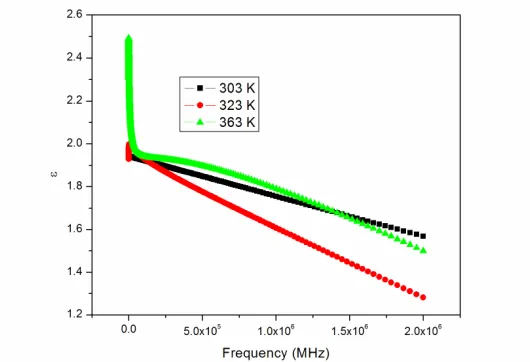
Fig 2. Dielectric constant vs. frequency plots of 5 mol% Fe3+ doped PVC electrolytes at different temperatures
Fig 2, show the variation of dielectric constant and dielectric loss with respect to frequency for temperatures (30˚C,
50˚C, and 90˚C) for both pure and boron doped PVC films. It was found that the values of dielectric constant and dielectric loss increase with an increase in temperature and decrease with the increasing frequency. At low frequencies the dipoles can easily switch alignment with the changing field [16]. As the frequency increases the dipoles can rotate less and maintain phase with the field; thus they reduce their contribution to the polarization field, and hence the observed reduction in dielectric constant and dielectric loss. According to Miller rule, the lower value of dielectric constant at higher frequencies is a suitable parameter for the enhancement of SHG coefficient [17, 18].
IV. IMPEDANCE ANALYSIS
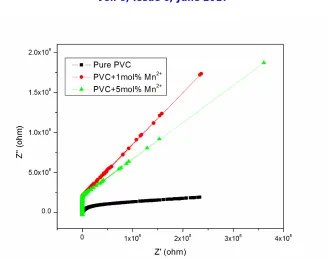
Impedance spectroscopy is employed to establish the conduction mechanism, observing the participation of the polymer chain, mobility and carrier generation processes. The conductivities of the polymer complexes were calculated from the bulk resistance obtained by the intercepts of the typical impedance curvers for various
temperatures. The impedance curves of Fe3+ doped PVC films are shown in Fig 3 and 4, for the temperature range 302
– 363 K. The disappearance of the semicircular portion in the impedance curve leads to a conclusion that the current carriers are ions and this leads one to further conclude that the total conductivity is mainly the result of ion conduction [19]. The ionic conductivity were calculated using the relation
A
R
l
b
………….(1)Where l is the thickness, Rb is bulk resistance and A is the known area of the electrolyte film.
ISSN(Online): 2319-8753 ISSN (Print): 2347-6710
International Journal of Innovative Research in Science,
Engineering and Technology
(An ISO 3297: 2007 Certified Organization)
Website: www.ijirset.com
Vol. 6, Issue 6, June 2017
Fig 3. Nyquist plots of Fe3+ doped PVC polymer electrolyte at different compositions at 303 K
Table 1 shows the conductivity values of the temperature increases, the conductivity also increases for all complexes and this behavior is in agreement with the theory established by Armand et al. [20]. This can be rationalized by recognizing the free volume model [21].
Table 1: Ionic conductivity values of PVC complexed with FeSO4
Composition Ionic conductivity values of PVC doped Fe3+ (*10-4
S/cm)
303 323 363
Pure 1 mol 5 mol
1.65 2.00 2.70
1.66 2.06 3.51
ISSN(Online): 2319-8753 ISSN (Print): 2347-6710
International Journal of Innovative Research in Science,
Engineering and Technology
(An ISO 3297: 2007 Certified Organization)
Website: www.ijirset.com
Vol. 6, Issue 6, June 2017
Fig 4. Nyquist plots of Fe3+ doped PVC polymer electrolyte at different compositions at 363 K
When temperature is increased, the vibrational energy of a segment is sufficient to push against the hydrostatic pressure imposed by its neighbouring atoms and create a small amount of space surrounding its own volume in which vibrational motion can occur [22].
ISSN(Online): 2319-8753 ISSN (Print): 2347-6710
International Journal of Innovative Research in Science,
Engineering and Technology
(An ISO 3297: 2007 Certified Organization)
Website: www.ijirset.com
Vol. 6, Issue 6, June 2017
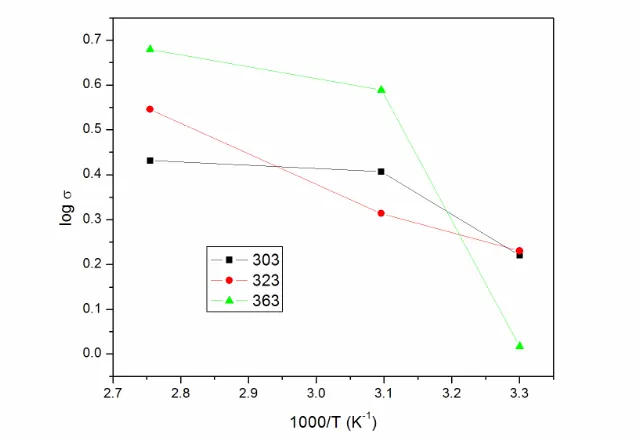
Fig 5, Shows that the ionic conduction in all polymer electrolyte system obeys the VTF (Vogel – Tammam – Fulcher) relation, Which describes the transport properties in a viscous matrix [23]. It supports the idea that the move through the plasticizer rich phase, which is the conductivity medium and involves.
V. CONCLUSIONS
PVC based polymer electrolytes were prepared by solvent cast technique. All electrolytes show appreciable
conductivity even at room temperature. Maximum conductivity (4.78 x 10⁻⁴ S/cm) at 363 K temperature with good
mechanical stability has been observed for PVC doped 5mol% Fe3+. The maximum conductivity (2.70 x 10⁻⁴ S/cm) at
room temperature with good mechanical stability has been observed for 5mol%, Fe3+ system among the various
compositions studied. The dielectric relaxation of the samples was also discussed. Large magnitudes of values are observed in the low frequency region is due to EP effect. A substantial increase in the thermal stability (323 K) is
observed for Fe3+ complex as compared to pure PVC.
REFERENCES
1. M. A. Ratner, D. F. Shriver, ‘’Ion transport in solvent-free polymer’’, Chemicals Reviews, 88(1), 109-124,1988.
2. E. Ruiz-Hitzky, P. Aranda,“Polymer-salt intercalation complexes in layer silicates”, Advanced Materials, 11, 545-547, 1990.
3. F. Croce, G. B. Appetcchi, L. Parsi, B. Scorosati, “Nonocomposite polymer electrolytes for lithium batteries”, Letters to Natures, 394, 456-458. 1998.
4. K. Murata. “An overview of research and development of solid polymer electrolyte batteries”, Electrochemica Acta, 40, 2177-2184.
5. M. Jaipal Reddy, P. P. Chu, T. Sreekanth, U. V. Subba Rao, “PEO: KIO3 polymer electrolyte system – Its applications to solid state electrochemical cell”, Journal of Materials Science: Materials in Electronics, 12, 153-156,2001.
6. Y. L. Lee, B. Crist, “Phase behaviour and conductivityin poly (ethylene oxide)-sodium thiocyanate system”, Journal of Applied Physics, 60,
2683-26891986.
7. S. Sreepathi Rao, M. Jaipal Reddy, E. Laxmi Narsaiah, U.V. Subb A Rao, “Development of electrochemical cells based on (PEO+ NaYF4) and (PEO+KYF4) polymer electrolytes”, Materials Science and Engineering B, 33, 173-177,1995.
8. T. Sreekanth, M. Jaipal Reddy, S. Ramalingaiah, U. V. Subba Rao, “Ion-conducting polymer electrolyte based on poly (ethylene oxide) complexed with NaNO3 salt-application as an electrochemical cell”, Journal of Power Sources,79, 105-110,1999.
9. Bac, M. Ciosek, M. Bukat, M. Marczewski, H. Marczewska, W. Wieczorek, “The effect of type of the inorganic filler and dopant salt concentration on the PEO–LiClO4 based composite electrolyte–lithium electrode interfacial resistivity”, Journal of Power Sources, 159, 405-411, 2006.
10. J. Siva Kumar, A. R. Subrahmanyam, M. Jaipal Reddy, U. V. Subba Rao, “Preparation and study of properties of polymer electrolyte system (PEO+NaClO3)”, Materials Letters, 60, 3346-3349, 2006.
11. Mediha KOK,Demirelli K, Aydogdu Y, “Thermo physical Properties of Blend of Poly (Vinyl Chloride) with Poly (Isobornyl Acrylate)”, International Journal of Science &Technology, 3(1), 37-42, 2008.
12. Warren H, “Global vinyls outlook:Building on change”, In Proceedings of 30Annual World Petrochemical Conference; Houston, Texas, USA. p. 479-5032015 Mar 24-27.
13. S. Pattanayak, R.N.P. Choudhary, P. R. Das, J. Mater. Sci.: Mater. Electron., 24, 2767,2013. 14. B.K. Barick, K.K. Mishra, A.K. Arora, R.N.P. Choudhary, Dillip K. Pradhan, J. Phys. D: Appl. Phys., 44 (2011) 355402.
15. G.B. Kumar, S. Buddhudu, “Optical, thermal and dielectric properties of Bi4(TiO4) ceramic powders” Ceram. Int. 36, pp. 1857-1861, 2010. 16. S. Suresh, A. Ramanand, D. Jayaraman and P. Mani, “Growth, Photoconductivity and Dielectric Properties of Triglycine Sulfate (TGS) Single Crystals,” Optoelectron- ics and Advanced Materials, Vol. 4, No. 11, pp. 1763-1765, 2010.
17. C. Balarew and R. Duhlew, “Application of the Hard and Soft Acids and Bases Concept to Explain to Ligand Co- ordination in Double Salt Structures,” Journal of Solid State Chemistry, Vol. 55, No. 1, pp. 1-6. doi:10.1016/0022-4596(84)90240-8, 1984.
18. M. Meena and C.K. Mahadevan, “Growth and Electrical Characterization of L-Arginine Added KDP and ADP Single Crystals,” Crystal Research and Technology, Vol. 43, No. 2, pp. 166-172, 2008.
19. M.M.E. Jacob, S.R.S. Prabaharan, S. Radhakrishns, Solid State Ionics 104, 267, 1997.
20. M.B. Armand, J.M. Chabagno, M.J. Duclot, P. Vashishta, L.N. Mundy, G. Shenoy, Fast-Ion Tranport in Solids, North-Hol-Land, Amsterdam, 131, 1979.
21. T. Miyaamoto, K. Shabayama, J.Appl. Phys. 44, 537, 1973.