ISSN(Online): 2319-8753 ISSN (Print): 2347-6710
I
nternational
J
ournal of
I
nnovative
R
esearch in
S
cience,
E
ngineering and
T
echnology
(An ISO 3297: 2007 Certified Organization)
Website: www.ijirset.com
Vol. 6, Issue 6, June 2017
Fair Arbitration based Dynamic and
Public Integrity Auditing for Cloud Data
using Hybrid Encryption
Komal H Mulik, Sonali Patil
P.G. Student, Dept. of Computer Engg., JSPM’s Bhivarabai Sawant Institute of Tech. & Rese. Pune, India
Asst. Professor, Dept. of Computer Engg., JSPM’s Bhivarabai Sawant Institute of Tech. & Rese. Pune, India
ÀBSTRACT: Cloud computing is mainly used for storing client information in the server as the cloud storage without overhead of storage and maintenance, which is very helpful for clients because it is pay per use process. Here security is main problem for both client and server. Cloud users no longer physically possess their data and consequently lose direct control over the data, direct employment of traditional cryptographic primitives like hash or encryption to ensure remote data’s integrity may lead to many security loopholes. To tackle this problem, in existing, a public auditing scheme with data dynamics support and fairness arbitration of potential disputes proposed. It is used public key encryption. For more security, we proposed Fair Arbitration based Dynamic and Public Integrity Auditing for Cloud Data using Hybrid Encryption. In particular, we design an index switcher to eliminate the limitation of index usage in tag computation in current schemes and achieve efficient handling of data dynamics. To address the fairness problem so that no party can misbehave without being detected, we further extend existing threat models and adopt signature exchange idea to design fair arbitration protocols, so that any possible dispute can be fairly settled.
KEYWORDS: Hybrid Encryption algorithm; Dynamic Auditing; Data integrity; Fairness Protocol
I. INTRODUCTION
Cloud computing is the one of the critical idea of Information Technology. The distributed computing gives part of advantages to IT as they are pay per utilize, decrease the framework innovation, stream line prepare, enhance openness and enhance adaptability. The fundamental part of distributed computing is the information has concentrated or outsourced to the cloud. From the client's perspective including both people and IT environment, they can store the remote information on cloud that has the favourable position like without overhead of capacity upkeep, worldwide information access with not needy of topographical areas.
ISSN(Online): 2319-8753 ISSN (Print): 2347-6710
I
nternational
J
ournal of
I
nnovative
R
esearch in
S
cience,
E
ngineering and
T
echnology
(An ISO 3297: 2007 Certified Organization)
Website: www.ijirset.com
Vol. 6, Issue 6, June 2017
Information outsourcing is a key use of distributed computing, which mitigates cloud clients of the substantial weight of information administration and framework upkeep, and gives quick information get to free of physical areas. Be that as it may, outsourcing information to the cloud achieves numerous new security dangers. Firstly, in spite of the effective machines and solid security instruments gave by cloud specialist co-ops (CSP), remote information still face organize assaults, equipment disappointments and authoritative mistakes. Besides, CSP may recover capacity of once in a while or never got to information, or even conceal information misfortune mishaps for notoriety reasons. As clients no more drawn out physically have their information and subsequently lose coordinate control over the information, coordinate work of conventional cryptographic primitives like hash or encryption to guarantee remote information's trustworthiness may prompt to numerous security provisos.
Specifically, downloading every one of the information to check its trustworthiness is not reasonable because of the costly correspondence overhead, particularly for huge size information documents. In this sense, message verification code (MAC) or mark based instruments, while broadly utilized as a part of secure stockpiling frameworks, are not appropriate for respectability check of outsourced information, since they can just confirm the trustworthiness of recovered information and don't work for once in a while got to information (e.g., document information). So how to guarantee the accuracy of outsourced information without having the first information turns into a testing errand in distributed computing, which, if not viably took care of, will block the wide organization of cloud administrations. Information evaluating plans can empower cloud clients to check the uprightness of their remotely put away information without downloading them locally, which is named as block less confirmation. With inspecting plans, clients can occasionally connect with the CSP through reviewing conventions to check the accuracy of their outsourced information by confirming the trustworthiness confirmation processed by the CSP, which offers more grounded trust in information security since client's own decision that information is in place is significantly more persuading than that from specialist co-ops. By and large talking, there are a few patterns in the advancement of evaluating plans. Above all else, prior evaluating plans for the most part require the CSP to create a deterministic confirmation by getting to the entire information document to perform honesty check, e.g., plans utilize the whole record to perform secluded exponentiations. Such plain arrangements bring about costly calculation overhead at the server side, subsequently they need effectiveness and common sense when managing extensive size information. Spoken to by the "examining" strategy in "Evidences of Retrievability" (PoR) show and "Provable Data Possession" (PDP) demonstrate, later plans have a tendency to give a probabilistic confirmation by getting to part of the document, which clearly upgrades the inspecting effectiveness over prior plans. Furthermore, some reviewing plans give private evidence that require just the information proprietor who has the private key to play out the examining undertaking, which may possibly overburden the proprietor because of its constrained calculation ability. Ateniese el al. were the first to propose to empower open obviousness in reviewing plans. Conversely, open examining plans permit any individual who has the general population key to play out the evaluating, which makes it feasible for the inspecting errand to be assigned to an outer outsider inspector (TPA).
ISSN(Online): 2319-8753 ISSN (Print): 2347-6710
I
nternational
J
ournal of
I
nnovative
R
esearch in
S
cience,
E
ngineering and
T
echnology
(An ISO 3297: 2007 Certified Organization)
Website: www.ijirset.com
Vol. 6, Issue 6, June 2017
label lists authorizes piece validation and stays away from label re-calculation of pieces after the operation position all the while. Subsequently, the productivity of taking care of information flow is extraordinarily improved. Besides and critical, in an open reviewing situation, an information proprietor dependably appoints his inspecting undertakings to a TPA who is trusted by the proprietor however not really by the cloud. Momentum look into as a rule accept a legitimate information proprietor in their security models, which has an inherent slant toward cloud clients. Notwithstanding, the truth of the matter is, the cloud, as well as cloud clients, have the intention to take part in beguiling practices.
For instance, a malignant information proprietor may purposefully guarantee information debasement against a legit cloud for a cash pay, and an untrustworthy CSP may erase seldom got to information to spare stockpiling. In this way, it is of basic significance for an examining plan to give reasonableness assurance to settle potential debate between the two gatherings. Zheng et al. proposed a reasonable PoR plan to keep a deceptive customer from denouncing a genuine CSP, however their plan just acknowledges private examining. Kupccu proposed general discretion conventions with robotized installments utilizing reasonable mark trade conventions. Our work additionally receives the possibility of mark trade to guarantee the metadata rightness and convention reasonableness, and we focus on consolidating productive information elements support and reasonable debate discretion into a solitary examining plan. To address the reasonableness issue in evaluating, we present an outsider arbitrator(TPAR) into our risk demonstrate, which is an expert foundation for clashes intervention and is trusted and payed by both information proprietors and the CSP.
Since a TPA can be seen as a delegator of the information proprietor and is not really trusted by the CSP, we separate between the parts of examiner and judge. In addition, we receive the possibility of mark trade to guarantee metadata rightness and give question discretion, where any contention about inspecting or information upgrade can be decently mediated. For the most part, this proposition proposes another examining plan to address the issues of information progression bolster, open unquestionable status and question discretion at the same time.
II. RELATED WORK
Remote Integrity Checking [1]
This paper dissects the issue of checking the uprightness of records put away on remote servers. Since servers are inclined to fruitful assaults by pernicious programmers, the consequence of straightforward uprightness checks keep running on the servers can't be trusted. On the other hand, downloading the records from the server to the confirming host is unfeasible. Two arrangements are proposed, in view of test reaction conventions.
Pros: proofs of retrievability for large files [2]
In this paper, we characterize and investigate verifications of retrievability (PORs). A POR plot empowers a chronicle or go down administration (prover) to create a succinct evidence that a client (verifier) can recover an objective document F that will be, that the file holds and dependably transmits record information adequate for the client to recuperate F completely. A POR might be seen as a sort of cryptographic confirmation of information (POK), however one exceptionally intended to handle a huge document (or bitstring) F. We investigate POR conventions here in which the correspondence costs, number of memory gets to for the prover, and capacity necessities of the client (verifier) are little parameters basically autonomous of the length of F. Notwithstanding proposing new, pragmatic POR developments, we investigate usage contemplations and advancements that bear on beforehand investigated, related plans. In a POR, dissimilar to a POK, neither the prover nor the verifier require really know about F. PORs offer ascent to another and uncommon security definition whose plan is another commitment of our work. We see PORs as a critical apparatus for semi-trusted online files. Existing cryptographic methods help clients guarantee the protection and honesty of records they recover. It is likewise normal, in any case, for clients to need to check that documents don't erase or adjust records preceding recovery. The objective of a POR is to finish these checks without clients downloading the documents themselves. A POR can likewise give nature of-administration certifications, i.e., demonstrate that a document is retrievable inside a specific time bound.
Provable data possession at untrusted stores [3]
ISSN(Online): 2319-8753 ISSN (Print): 2347-6710
I
nternational
J
ournal of
I
nnovative
R
esearch in
S
cience,
E
ngineering and
T
echnology
(An ISO 3297: 2007 Certified Organization)
Website: www.ijirset.com
Vol. 6, Issue 6, June 2017
which radically lessens I/O costs. The customer keeps up a steady measure of metadata to check the evidence. The test/reaction convention transmits a little, consistent measure of information, which minimizes arrange correspondence. Hence, the PDP display for remote information checking bolsters substantial information sets in generally disseminated capacity framework. We display two provably-secure PDP plans that are more proficient than past arrangements, notwithstanding when contrasted and plots that accomplish weaker certifications. Specifically, the overhead at the server is low (or even steady), rather than straight in the extent of the information. Tests utilizing our usage check the reasonableness of PDP and uncover that the execution of PDP is limited by plate I/O and not by cryptographic calculation.
Smaller Proofs of Retrievability [4]
In a proof-of-retrievability framework, an information stockpiling focus persuades a verifier that he is really putting away the greater part of a customer's information. The focal test is to assemble frameworks that are both proficient and <em>provably</em> secure- - that is, it ought to be conceivable to remove the customer's information from any prover that passes a confirmation check. In this paper, we give the main evidence of-retrievability plans with full verifications of security against <em>arbitrary</em> enemies in the most grounded model, that of Juels and Kaliski. Our first plan, worked from BLS marks and secure in the arbitrary prophet demonstrate, has the <em>shortest inquiry and response</em> of any evidence of-retrievability with open unquestionable status. Our second plan, which constructs richly on pseudorandom capacities (PRFs) and is secure in the standard model, has the <em>shortest response</em> of any evidence of-retrievability plan with private undeniable nature (yet a more drawn out_question). Both plans depend on homomorphic properties to total a proof into one little authenticator esteem.
III. PROPOSED ALGORITHM
This section describes structure and steps involved in implementation of algorithm used in the venture. These are listed and briefed below. Our dynamic auditing scheme with public verifiability and dispute arbitration consists of the following algorithms.
Hybrid KeyGen(1k):
This algorithm is controlled by the customer, which takes as info security parameter 1k and creates an open private key match (pk, sk) for Asymmetric Encryption with Secret Key for Symmetric Encryption.
TagGen(sk, F, Ω):
This algorithm is controlled by the customer, which takes as information a mystery key sk and client's document F ∈{0, 1}k as a gathering of information squares {mi}1≤i≤n, yields a label set Φ = {σi}1≤i≤n, where σi is the tag for piece mi.
Also, a mark on the metadata Ω marked with proprietor's private key is delivered.
Commitment(pk, F, Φ, Ω):
This algorithm is controlled by the cloud, which takes as info the entire square set F and the label set Φ, produces a
honesty evidence and confirms its legitimacy with pk. This procedure guarantees that the label set Φ got by the CSP is accurately registered from the square set F. In the event that succeeds, a mark on the metadata Ω marked with CSP's
private key is delivered.
ProofGen(chal, F, Φ):
This algorithm is controlled by the cloud, which takes as info a test ask for chal, the information record F and the label
set Φ, yields a respectability confirmation π.
ProofVerify(pk, chal, π):
This algorithm is controlled by the inspector, which takes as info general society key pk, the test chal and the honesty
evidence π, yields TRUE if the confirmation is checked as legitimate, which implies that the document is put away in
ISSN(Online): 2319-8753 ISSN (Print): 2347-6710
I
nternational
J
ournal of
I
nnovative
R
esearch in
S
cience,
E
ngineering and
T
echnology
(An ISO 3297: 2007 Certified Organization)
Website: www.ijirset.com
Vol. 6, Issue 6, June 2017
Update(F, Φ, up req):
This calculation is controlled by the cloud, which takes as algorithm the information document F, the label set Φ and an
overhaul record up req from the customer. It yields the redesigned document F′ and label set Φ', and the upgrade
evidence P of the dynamic operation.
UpdateVerify(pk, up req, P):
This algorithm is controlled by the examiner, which takes as information people in general key pk, the overhaul ask for up req and the redesign confirmation P from the cloud. In the event that succeeds, it yields TRUE, or FALSE generally.
Data Owner/ Cloud User Module:
In this module, the data owner/cloud user, who has a large amount of data to be stored in the cloud, and will dynamically update his data (e.g., insert, delete or modify a data block) in the future.
Cloud Service Provider Module:
In this module, the cloud service provider (CSP), who has massive storage space and computing power that users do not possess, stores and manages user’s data and related metadata (i.e., the tag set and the index switcher)
Third Party Auditor (TPAU) Module:
In this module, the third party auditor (TPAU) is similar to the role of TPA in existing schemes, who is a public verifier with expertise and capabilities for auditing, and is trusted and payed by the data owner (but not necessarily trusted by the cloud) to assess the integrity of the owner’s remotely stored data.
Third Party Arbitrator (TPAR) Module:
In this module, the third party arbitrator (TPAR), who is a professional institute for conflict arbitration and trusted by both the owner and the CSP, which is different to the role of TPAU.
IV. PSEUDOCODE
TPA Proof generation:
Data owner Do at any point of time t can perform verification process called proof generation with third party auditor.
Data owner Do sends a series of random Challenge Chal = {Bi,Hi}
Where Bi = Block index
Hi= Sig / hash digest of block with index i
With following Formula we check the integrity of data Block Bi
Φ is set of tags of blocks sent in challenge to csp
Φcsp represents set of tags representing tag of blocks stored on cloud
= Output of Proof generation sent back to Client
Where Chal represents set of blocks Bi along with Hash Hi sent to TPA who compares Hi and Hcsp where Hcsp represents block tag on cloud.
ISSN(Online): 2319-8753 ISSN (Print): 2347-6710
I
nternational
J
ournal of
I
nnovative
R
esearch in
S
cience,
E
ngineering and
T
echnology
(An ISO 3297: 2007 Certified Organization)
Website: www.ijirset.com
Vol. 6, Issue 6, June 2017
V. SIMULATION RESULT
Our proposed system solves the problem of security of documents while uploading implementing a secure and efficient encryption technique called hybrid encryption across cloud platform with N users.
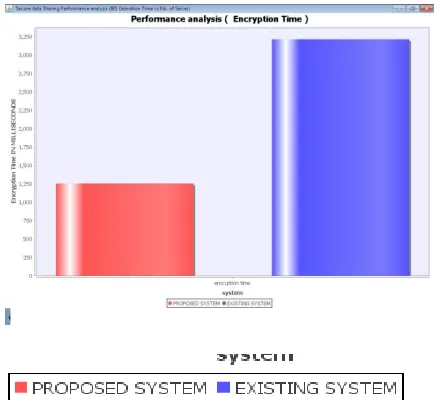
For performance measure we compare the computational overhead that is incorporated in implementing secure hybrid encryption. Computational overhead is involved in process of hybrid encryption which is measured in terms of time cost required to generate encrypted data for document D uploaded by N users.
As input length document data increases the time required for encrypted data for document D also increases thus increasing time required for uploading and downloading process.
For existing system it is recorded that the time required to generate encrypted data for document D will depend on size of document D and RSA key size increases time cost increases exponentially as for large document we will use large key size.
It is expected that for proposed system time cost required to generate encrypted data for document D would not increases exponentially but will scale accordingly keeping the time almost constant as second input is HYBRID key in place of RSA key which is always of constant length.
Figure 1: Performance analysis
VI. CONCLUSION AND FUTURE WORK
ISSN(Online): 2319-8753 ISSN (Print): 2347-6710
I
nternational
J
ournal of
I
nnovative
R
esearch in
S
cience,
E
ngineering and
T
echnology
(An ISO 3297: 2007 Certified Organization)
Website: www.ijirset.com
Vol. 6, Issue 6, June 2017
REFERENCES
[1] Y. Deswarte, J.-J. Quisquater, and A. Sa¨ ıdane, “Remote integrity checking,” in Proc. 5th Working Conf. Integrity and Intl Control in Information Systems, 2004, pp. 1–11.
[2] A. Juels and B. S. Kaliski Jr, “Pors: Proofs of retrievability for large files,” in Proc. 14th ACM Conf. Computer and Comm. Security (CCS07), 2007, pp. 584–597
[3] G. Ateniese, R. Burns, R. Curtmola, J. Herring, L. Kissner, Z. Peterson, and D. Song, “Provable data possession at untrusted stores,” in Proc. 14th ACM Conf. Computer and Comm. Security (CCS07), 2007, pp. 598–609.
[4] H. Shacham and B. Waters, “Compact proofs of retrievability,” in Proc. 14th Intl Conf. Theory and Application of Cryptology and Information Security: Advances in Cryptology (ASIACRYPT 08), 2008, pp. 90–107
[5] Q. Wang, C. Wang, J. Li, K. Ren, and W. Lou, “Enabling public verifiability and data dynamics for storage security in cloud computing,” in Proc. 14th European Conf. Research in Computer Security (ESORICS 08), 2009, pp. 355–370.
[6] M. A. Shah, R. Swaminathan, and M. Baker, “Privacy-preserving audit and extraction of digital contents.” IACR Cryptology ePrint Archive, Report 2008/186, 2008.
[7] C. Wang, K. Ren, W. Lou, and J. Li, “Toward publicly auditable secure cloud data storage services,” Network, IEEE, vol. 24, no. 4, pp. 19–24, 2010.
[8] Y. Zhu, H. Wang, Z. Hu, G.-J. Ahn, H. Hu, and S. S. Yau, “Dynamic audit services for integrity verification of outsourced storages in clouds,” in Proc. ACM Symp. Applied Computing (SAC 11), 2011, pp. 1550–1557.
[9] Q. Zheng and S. Xu, “Fair and dynamic proofs of retrievability,” in Proc. 1st ACM Conf. Data and Application Security and Privacy (CODASPY 11), 2011, pp. 237–248.