Failure Analysis of Roller Bearing and
Avoiding Failure by FRP Composite Material
Bhakti Sanjay Kate1, B. S. Allurkar2, S. M. Nagure3
P.G. Student, Department of Mechanical Engineering, M.B.E. Society’s College of Engineering, Ambajogai,
Maharashtra, India1
Associate Professor, Department of Mechanical Engineering, M.B.E. Society’s College of Engineering, Ambajogai,
Maharashtra, India2
Associate Professor, Department of Mechanical Engineering, M.B.E. Society’s College of Engineering, Ambajogai,
Maharashtra, India3
ABSTRACT: mostly the failure occurs in the roller bearing due to the overheating and maximum load affects the rollers in bearing resulting, the failure of roller bearing. This paper is focussed about how the FRP composite material lamination is important to the roller bearing than the normal roller bearing without FRP material lamination. This paper can prove the importance of FRP material to increase the strength of roller bearing. We are taking the help of some references and our analysis work. We are using the ANSYS software to analyse the work and pro-E software to design of a roller bearing.
KEYWORDS: ANSYS, roller bearing, pro-E.
I. INTRODUCTION
The Bearings are one of the important machine elements used in many applications, which include rotating and vibrating component. This supports another moving machine element permitting the relative motion between the rolling-element. Bearings consist of balls or rollers positioned between raceways. This paper consists of importance of FRP material in roller bearings or ball bearing applications for the high stress or heavy load applications.
Precision ball bearings are designed to have a long and useful Life. Assuming the application is correct to begin with, maximizing longevity means bearings must be properly installed, lubricated and maintained. Poor operating environments, particularly moist or contaminated areas, Improper handling practices invite premature bearing failure. - When a bearing does fail, it is important to determine the exact cause so appreciate adjustments can be made. Examination of th6 failure mode reveals the true cause of failure. ?his procedure is complicated by the fact that one failure mode may initiate another. For example, corrosion in a ball race leaves rust-an abrasive-which can cause wear, resulting in loss of preload or an increase in radial clearance. The wear debris can, in a grease-lubricated bearing, impede lubrication, resulting in lubrication failure and subsequent overheating.
II. LITERATURE REVIEW
Eschmann et al (1958) stated that one of the reason fatigue failure begins with smaller scissor between raceway and rolling elements and it’s propagate gradually with continues operation .it’s also generate vibration and increasing noise levels.
Riddle (1995) stated that bearing failure is occurred due to contamination, improper lubrication and dirt particles. Improperly installed bearing are also reason of failure due to forcing bearing on shaft and housing and its cause’s physical damage to bearing.
R.K Upadhyay stated that due to cyclic stress rolling contact fatigue occurs. to reduce this kind of problem we have to increase angle of oscillation to secure roller overlap to drag fresh lubricant in to area so surface of raceway and balls are separate d by lubricant and reduce friction. JafarTakabi et al (2015) stated that first type is thermal failure of rolling bearings that can occur at high rotational speeds and large radial loads, and the second type deals with spindle bearings of high–speed machine tools. The results of dynamic simulations for the first type of thermal failure show that the unstable motion of the cage can lead to an ultimate bearing seizure because o f the cage failure due to the large rollers/cage contact forces and high wear rate of the cage. Second type of thermal failure of rolling element bearings, the simulation results reveal that the minimum film thickness at the raceways. Severe surface damage and wear occur at the raceways contact surfaces and eventually the bearing fails. The cause of this failure is the thermal seizure of the spindle bearing due to the rapid rise of the thermally–induced preload inside the bearing assembly with no sign of cage instability.
III.FAILURE ANALYSIS OF BEARING
a. Overheating
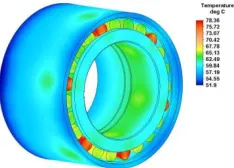
Symptoms are discoloration of the rings, balls, and cages from gold to blue. Temperatures in excess of 400°F can anneal the ring and ball materials. The resulting loss in hardness reduces the bearing capacity causing early failure. In extreme cases, balls and rings will deform. The temperature rise can also degrade or destroy lubricant Common culprits are heavy electrical heat loads, inadequate heat maths and insufficient cooling or lubrication when loads and speeds are excessive. Thermal or overload controls, adequate heat paths, and supplemental cooling are effective cures.
Fig. 1 Roller in Bearing
Damage due to overheating
Symptoms:
Bearing parts badly discoloured.
Causes:
Usually no longer detectable from damage pattern resulting from overheated bearings.
Possible causes: Bearing clearance in operating condition too low, particularly with high speed bearings
Inadequate lubrication
Radial preload due to external heating
Lack of lubrication
Impeded running due to cage fracture
Remedial measures:
Increase bearing clearance
In the case of external heating ensure sufficiently slow heating up and cool
Ring down, that is, uniform heating of complete bearing
Avoid lubricant pile-up
Improve lubrication
b. OVERLOADING
Overloading is one of the leading causes of bearing failure. Over loading that means over stress symptoms are denting of the bearing raceways and balls or rollers resulting in high vibration and wear. Contaminants include airborne dust, dirt or any abrasive substance that finds its way into the bearing. Principal sources are dirty tools, contaminated work areas, foreign matter in lubricants or cleaning solutions. Clean work areas, tools, fixtures and hands help reduce contamination failures. Keep grinding operations away from bearing assembly areas and keep bearings in their original packaging until you are ready to install them. Seals are critical-damaged or inoperative seals cannot rot bearings.
Fig. 2 Ring of bearing damage due to overloading.
c. LUBRICANT FAILURE
Causes Failure rate in %
Dirt 24
Misassemble 18.2
Misalignment 11.5
Insufficient Lubrication 36.5
Overloading 13.4
Corrosion 3.8
Other 5
Table 1. Bearing damage survey results
IV.IMPORTANCE OF FRP MATERIAL OVER FAILURE ANALYSIS OF BEARING
Fiber reinforced polymer (FRP) composites are an important class of tri-biological materials. They possess unique self lubrication capabilities and low noise which make them suitable for applications like seals, bearings, gears and artificial prosthetic joints. The FRP composite bearings are ideal for high load low speed applications or where normal lubrication is difficult or costly. The friction and wear behavior of FRP composites varies with fiber orientation and sliding direction. For the purpose of fully utilizing the beneficial contact characteristics of FRP composite, it is necessary to obtain an in-depth knowledge of their contact behavior.
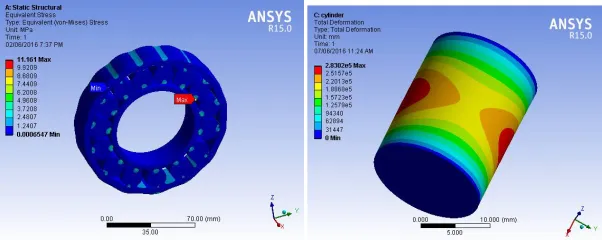
In this work, the compliance behaviour of FRP composite bearings is studied. The frictional sliding contact between a FRP composite and a rigid parabolic cylinder is analysed. The influence of sliding direction, fibber and matrix material combinations, volume fraction of the fibber, and frictional coefficient and fibber ply orientation on the contact pressure distribution and the contact area for unidirectional FRP composite bearings are evaluated. A finite element model is developed using ANSYS and the results obtained from the analysis are compared with the analytical results. The influence of sliding direction on the contact pressure distribution for cross FRP composite bearings is studied and compared with unidirectional FRP composite bearing.
Fig. 3. FRP laminated roller and roller bearing analysis.
of the roller bearing which holds good for a durable operation even in criticalities when operated with whole steel outer race. This usage of FRP also reduces the weight of the bearing which positively affects the power usage of the engine.
REFERENCES
[1] Buchanan, G.R., Mechanics of Materials, HRW Inc., New York, 1988.
[2] Ugural, A.C. and Fenster, S.K., Advanced Strength and Applied Elasticity, 3rd ed. Prentice Hall, Englewood Cliffs, NJ, 1995. [3] Swanson, S.R., Introduction to Design and Analysis with Advanced Composite Materials, Prentice Hall, Englewood Cliffs, NJ, 1997. [4] Rolling Bearing Damage Recognition of damage and bearing inspection.
[5] Review of Different Types of Bearing Failure JigarModh*a ,SankalpBhatiyab , Harsh Joshic, Vol-2 Issue-3 2016 IJARIIE-ISSN(O)-2395-4396. Xiaoqing Liu and JagathSamarabandu, “Multiscale Edge-Based Text Extraction From Complex Images”, IEEE Trans., 1424403677, 2006.
[6] Bearing Failure: Causes And Cures, Barden Precision Bearings Jyoti K. Sinha,
[7] Frequent And Premature Failure Of Anti-Friction Bearings: Diagnosis Approach? 20-24 July 2009